

You might be reading this because something feels different lately. Maybe your mind used to quiet down after a stressful meeting, a hard conversation, or a bad night of sleep. Now it stays loud. You get through the day, but it takes more effort. You cancel plans. You scroll instead of resting. You keep telling yourself, “I'm fine, just stressed,” while another part of you wonders if your anxiety is getting harder to manage.
That question matters. Not because it means something is wrong with you, but because noticing a pattern is often the moment healing begins. Anxiety usually doesn't become overwhelming all at once. It often grows through small shifts in your body, your thoughts, and your daily habits. The good news is that these shifts can be recognized. When you can see them clearly, you can respond earlier and more effectively.
You also aren't alone in this. The CDC found that anxiety symptom prevalence in U.S. adults increased from 15.6% in 2019 to 18.2% in 2022 in its National Health Statistics Report. That doesn't make your experience smaller. It makes it more understandable. Many people are asking the same question you are, and many do get better with the right support and tools.
Table of Contents
- Is My Anxiety Getting Worse or Am I Just Stressed
- Understanding the Tipping Point From Worry to Worsening
- Common and Hidden Signs Your Anxiety Is Escalating
- How to Become an Expert on Your Own Anxiety
- Your First Aid Kit for Overwhelming Moments
- Your Path to Healing A Practical Guide
- Frequently Asked Questions About Worsening Anxiety
Is My Anxiety Getting Worse or Am I Just Stressed
Stress usually has a recognizable cause. A deadline, conflict, money pressure, travel, illness, parenting, uncertainty. Anxiety can start there too, but worsening anxiety tends to outlast the event that triggered it. The original problem passes, yet your body stays on alert and your mind keeps scanning for danger.
That's where many people get confused. They assume that if they can still go to work, answer texts, and smile through a conversation, it must not be serious. But the better question isn't “Do I look functional?” It's “How much effort is this taking, and what parts of my life am I starting to avoid?”
A useful way to sort this out is by distinguishing anxiety from stress. Stress often feels connected to a situation. Worsening anxiety starts to feel like your nervous system no longer trusts calm.
Recognition is not overreacting. It's information.
Another clue is whether your daily functioning is shrinking. You may still be getting things done, but maybe you're doing them with more dread, more checking, more reassurance-seeking, and less freedom. That change matters. It often shows up before a person fully realizes how much anxiety has taken over.
If you want a more structured snapshot of where you are right now, you can take the anxiety severity test. A screening tool can't diagnose you, but it can help you put words to what you've been carrying.
The hopeful part is this. If anxiety has been getting louder, that doesn't mean you're losing control forever. It means your mind and body are asking for a different kind of support. Once you can name the pattern, you can start changing it.
Understanding the Tipping Point From Worry to Worsening
Most anxiety begins as a normal alarm system. It helps you prepare, focus, and respond. Before a presentation, test, interview, or medical appointment, some anxiety makes sense. The problem starts when the alarm keeps ringing after the situation is over.
It's like a check engine light. A brief flicker gets your attention. A warning light that stays on tells you something isn't resetting the way it should.
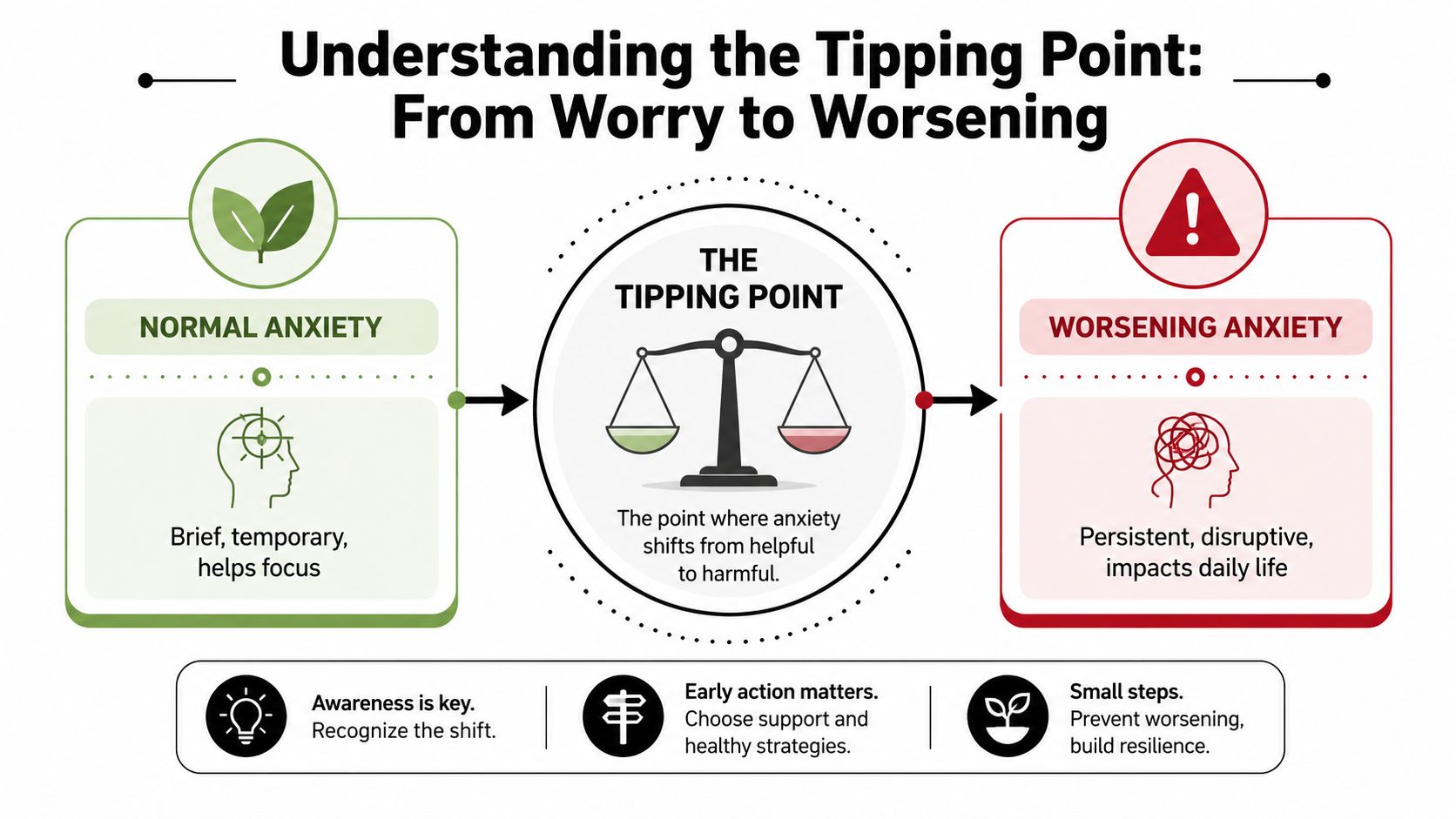
Intensity frequency and duration
Clinicians often think about worsening anxiety through three lenses: intensity, frequency, and duration.
- Intensity means the anxiety no longer feels like nerves or butterflies. It feels disruptive. Your chest tightens, your thoughts race, or you feel a strong urge to escape.
- Frequency means it's happening more often. What used to show up only during major stress begins appearing in ordinary moments.
- Duration means it lingers. Instead of passing when the event is over, it stays with you for hours or keeps reactivating.
A key sign is when anxiety persists well beyond the immediate stressor, such as lingering for a full day or more. That extended duration can suggest your nervous system is struggling to return to baseline.
What the tipping point looks like in real life
You have a difficult conversation at work in the morning. Normal stress might leave you unsettled for a while, then gradually ease. Worsening anxiety often behaves differently. You replay the conversation all day, your body stays tense into the evening, and the next morning you're still bracing for more.
Or maybe you had one panic-like experience while driving. A temporary reaction is possible. But when anxiety worsens, the fear spreads. Soon you're not just nervous on highways. You're avoiding bridges, traffic, unfamiliar routes, or driving altogether.
Practical rule: Watch for anxiety that stops being event-specific and starts shaping your whole day.
This is one reason functional decline matters so much. Anxiety isn't measured only by how bad it feels. It's also measured by how much room it takes up in your life. When it starts deciding where you go, what you avoid, and how much energy everyday tasks require, that's a meaningful shift.
Common and Hidden Signs Your Anxiety Is Escalating
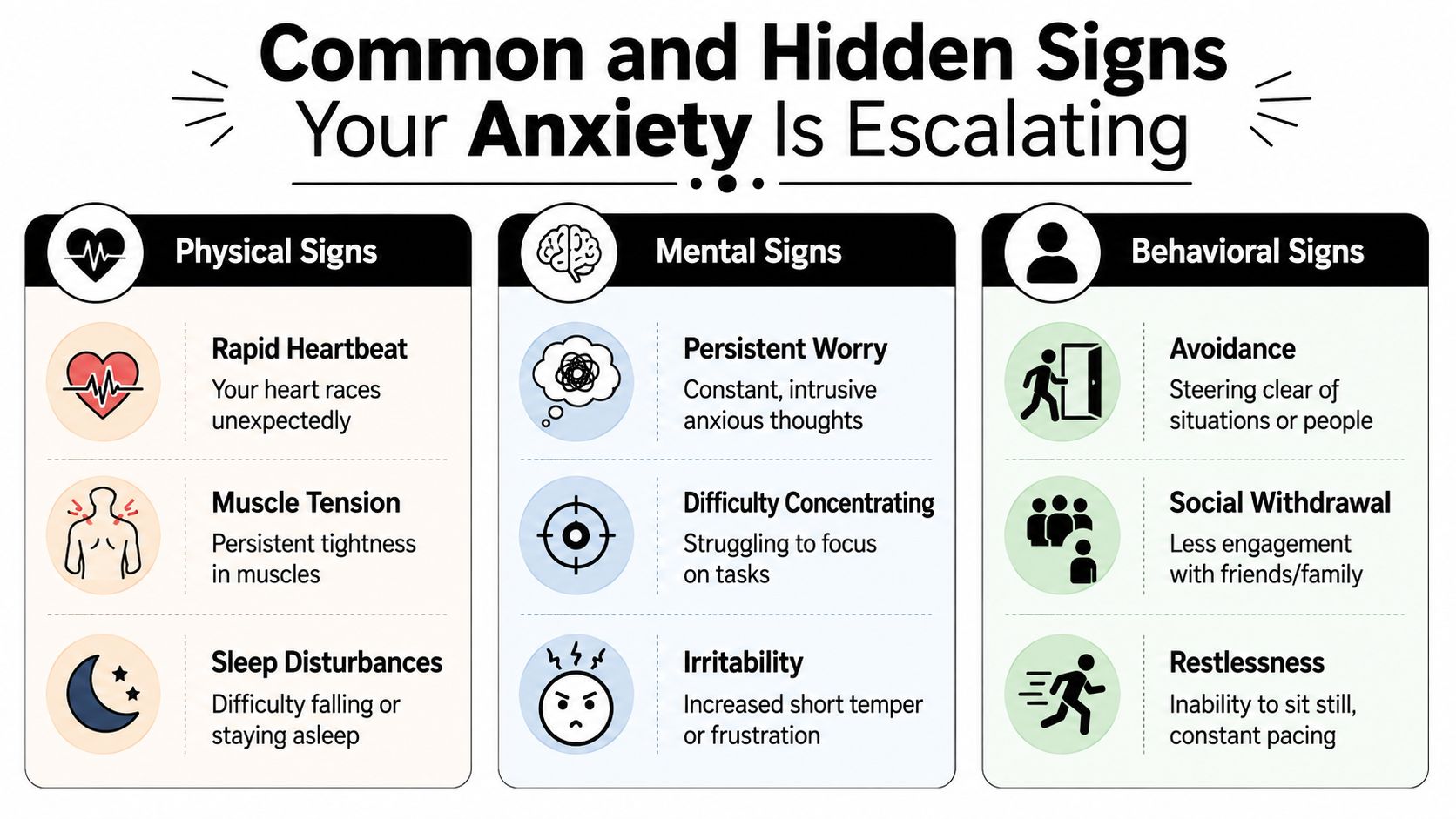
Some signs anxiety is getting worse are obvious. Others hide in habits that look ordinary from the outside. The pattern to watch isn't just “Do I feel anxious?” It's “What has changed lately in my body, my thinking, and my behavior?”
What changes in the body
Physical symptoms often intensify before people realize what's happening emotionally. You might notice:
- A racing heart that shows up in situations that used to feel manageable
- Muscle tension in your jaw, shoulders, neck, or stomach that doesn't fully let go
- Sleep disruption where you feel tired but too activated to settle
- A shaky, keyed-up feeling that appears even when you're trying to relax
The important clue is the change. Maybe you've always been an anxious person, but now your body reacts faster, more often, or takes longer to calm down.
What changes in the mind
Mental signs can be subtle because they often sound like planning, problem-solving, or being responsible. But worsening anxiety tends to feel less flexible.
You may notice that worry becomes harder to interrupt. Your mind circles the same questions. You keep searching for certainty and don't feel relieved when you find an answer. Concentration gets harder because part of your attention is always scanning for what might go wrong.
A person with escalating anxiety may also become more irritable. Not because they're difficult, but because a chronically activated nervous system has less room for frustration, noise, delays, or surprises.
What changes in behavior
Behavioral signs are often the clearest. They're also the most overlooked.
A key sign of worsening anxiety is the growth of avoidance behaviors, including modern digital habits, as described in this overview of high-functioning anxiety signs. You might cancel plans more often, avoid unfamiliar places, or use digital distraction to sidestep uncertainty. That can include endless scrolling, repeatedly checking your phone, rereading messages, or seeking reassurance in ways that calm you for a moment but keep the cycle alive.
These behaviors aren't laziness or weakness. They are attempts to feel safe. The problem is that they teach your brain that avoidance is the solution, so your world starts getting smaller.
If you've noticed anxiety tangling with other coping patterns, this guide on signs of anxiety and addiction can help you think more clearly about overlap without reducing everything to one issue.
You may also relate to the pattern described in https://anxietychecklist.com/overthinking-and-anxiety, where thinking itself becomes a form of self-protection. It feels productive, but it rarely creates peace.
| Indicator | Everyday Worry / Stress | Sign of Worsening Anxiety |
|---|---|---|
| After a stressful event | You feel unsettled, then recover | Your mind and body stay activated long after it ends |
| Plans and routines | You push through with some discomfort | You start canceling, delaying, or needing escape routes |
| Phone use | You distract yourself briefly | You repeatedly check, scroll, or seek reassurance to reduce fear |
| Work and concentration | Focus dips during pressure | Your attention keeps getting pulled back into anxious thoughts |
| Daily freedom | Life feels temporarily harder | Life starts feeling narrower and more controlled by fear |
If your life still looks normal from the outside but feels more restricted on the inside, pay attention. That's often where worsening anxiety first shows itself.
How to Become an Expert on Your Own Anxiety
When anxiety feels slippery, people often say, “I don't even know what's happening anymore.” That makes sense. Anxiety can blur together into one constant feeling. A better approach is to observe it like a pattern instead of fighting it like a mystery.
Track impact, not just feelings
You don't need a perfect journal. You need useful clues. Each evening, write down a few simple notes:
What triggered it
A conversation, silence, uncertainty, a physical sensation, social plans, work pressure.How long it lasted
Did it pass quickly, come in waves, or stay in your system for hours?What you did next
Did you avoid, check, scroll, ask for reassurance, leave early, or push through?What changed in functioning
Did you skip a task, delay something important, withdraw, or need much more effort than usual?
That last question is often the most revealing. Anxiety becomes easier to understand when you measure its effect on your choices, not just its intensity.
Look for patterns, not perfection
You might discover that your anxiety spikes most when plans are uncertain. Or that your hardest moments come after poor sleep. Or that doomscrolling isn't random. It starts when your mind wants reassurance but can't tolerate not knowing.
Small observations can create big relief because they turn “something is wrong with me” into “I can see the cycle.”
If you want guidance while you do this, evidence-based anxiety resources can help you learn how triggers, thought patterns, and avoidance loops work. Knowledge doesn't cure anxiety by itself, but it lowers confusion. That matters.
Try to gather information with a calm attitude. You're not building a case against yourself. You're learning the language your anxiety speaks so you can respond more skillfully.
Your First Aid Kit for Overwhelming Moments
When anxiety surges, insight alone usually isn't enough. Your thinking brain may know you're safe, but your body may still feel under threat. In those moments, the first job is not to solve your whole life. It's to help your nervous system come down a notch.
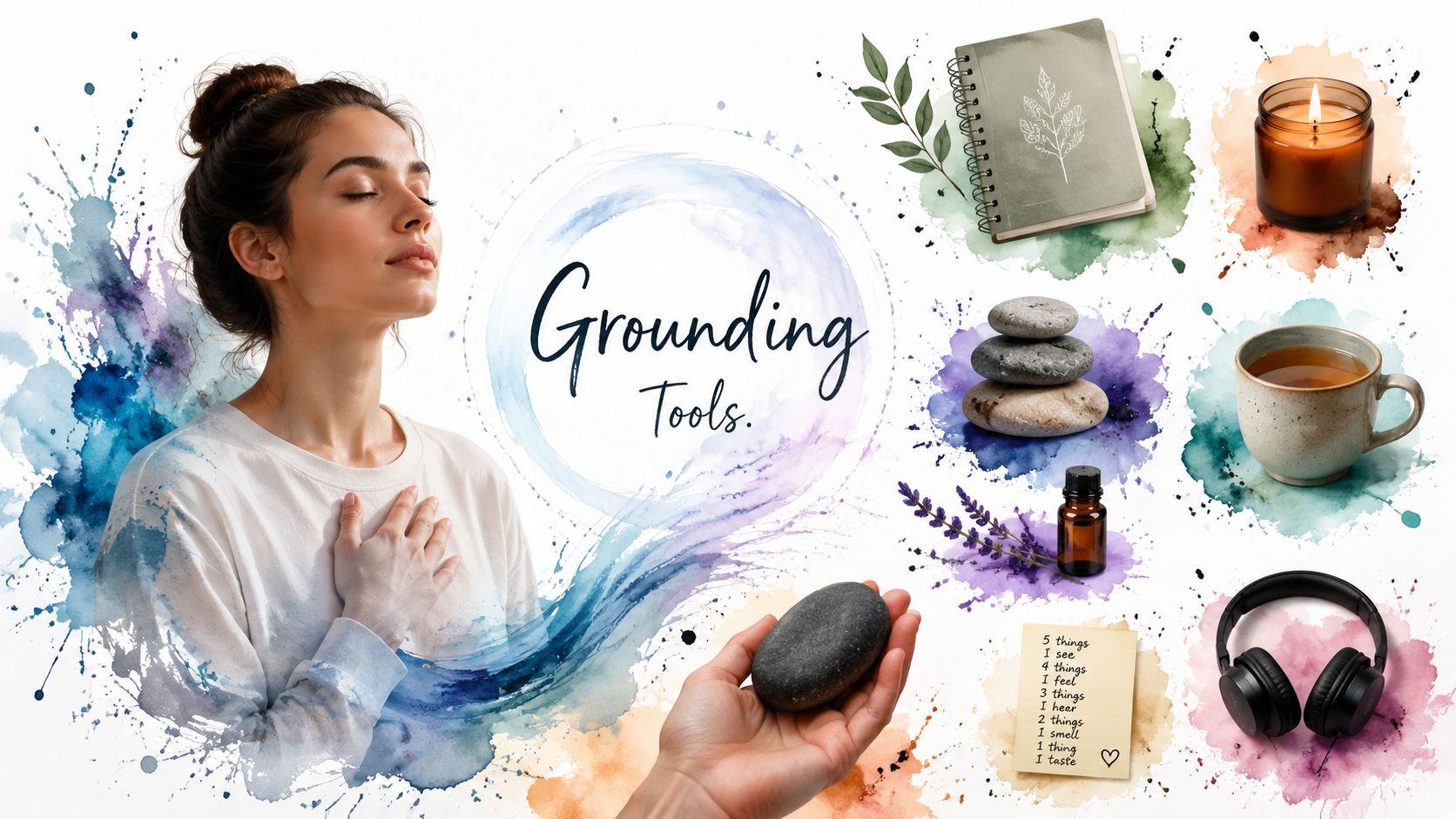
Reset your body first
Start with box breathing. Breathe in for four seconds, hold for four, breathe out for four, hold for four. Repeat gently. The structure matters because it gives your body a simple rhythm to follow when your thoughts are chaotic.
You can also try progressive muscle release. Tighten your hands for a few seconds, then let go. Lift your shoulders, then drop them. Press your feet into the floor. These small actions help interrupt the body's threat response.
Another option is temperature and sensation. Hold something cold. Splash cool water on your face. Wrap up in a blanket. Physical cues can remind your nervous system that you are here, now, and not in immediate danger.
Bring your attention back to the present
Grounding works best when it's concrete.
Name what you see
Pick five objects around you and describe them in detail.Use a simple phrase
Say, “This is anxiety. It feels intense, but it will pass.”Shrink the timeline
Ask, “What is the next safe thing I need to do in the next ten minutes?”
If you want more guided options, these effective anxiety grounding techniques offer practical ways to interrupt spirals when your mind goes blank.
Some people also want to build a broader calming routine outside crisis moments. If that's you, this overview of effective natural anxiety remedies may give you ideas for supportive habits to discuss with a professional.
Don't judge a grounding skill by whether it erases anxiety instantly. Judge it by whether it helps you stay present instead of escalating the spiral.
If one technique doesn't help, that doesn't mean you're failing. It means you may need repetition, a different tool, or more support. Relief often comes from practice, not perfection.
Your Path to Healing A Practical Guide
Healing usually begins with one honest shift. You stop asking, “How do I make this disappear right now?” and start asking, “What kind of support will help me live with more freedom again?” That question opens doors.
The World Health Organization reports that 359 million people were living with an anxiety disorder in 2021, and about 27.6% received any treatment, according to its anxiety disorders fact sheet. That treatment gap helps explain why so many people stay stuck longer than they need to. Clear guidance and accessible tools matter.
When it is time to get more support
Consider reaching out for professional help when anxiety is repeatedly interfering with work, relationships, sleep, routine tasks, or your willingness to leave your comfort zone. Another important sign is when you spend more and more energy managing fear through avoidance, reassurance, or rituals.
Support can also be important if you feel frightened by your symptoms, if panic is becoming a pattern, or if your life is starting to revolve around preventing anxiety instead of living.
A therapist can help you sort out what's happening and what kind of care fits best. For many people, it helps to learn about cognitive behavioral therapy, because CBT focuses on the loops that keep anxiety active. It teaches practical skills for responding to thoughts, sensations, and avoidance in new ways.
What recovery can look like
Recovery doesn't always mean you never feel anxious again. It often means anxiety stops running your decisions. You can feel discomfort without instantly obeying it. You can notice fear without shrinking your life around it.
For some people, that process starts with therapy. For others, it starts with consistent self-help tools, support from a doctor, or a structured app that makes coping skills easier to use in real time.
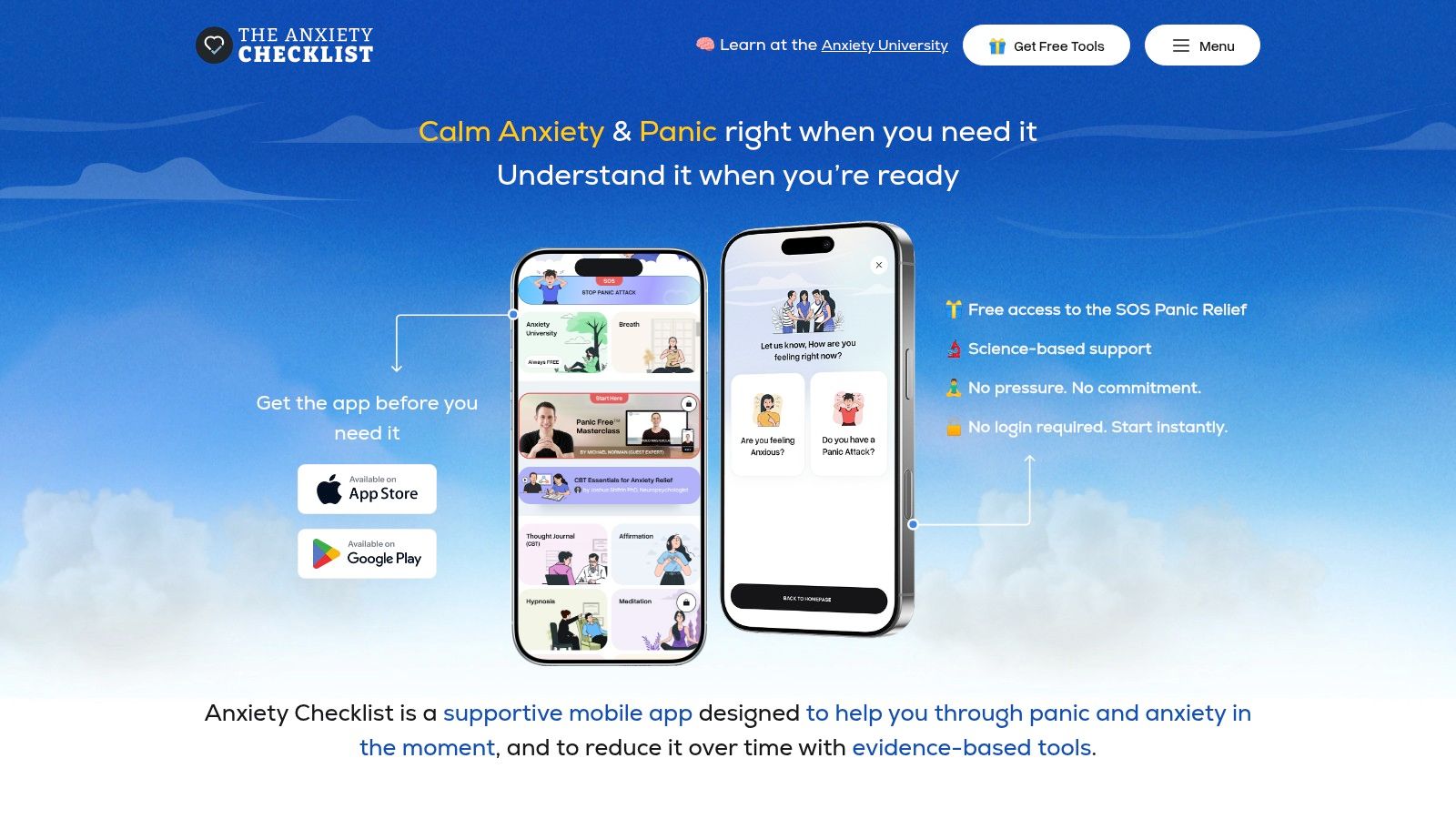
One option is The Anxiety Checklist, which includes an always-free SOS mode for grounding in high-stress moments, along with journaling, exposure tools, and CBT-based exercises for longer-term practice. Tools like that can be useful as a first step, a bridge while you look for therapy, or a companion to treatment.
The most hopeful truth I can offer is simple. Anxiety can worsen, but it can also heal. Brains learn fear, and brains can learn safety. Nervous systems get stuck, and they can also become flexible again. The signs aren't a verdict. They're directions.
Frequently Asked Questions About Worsening Anxiety
Can worsening anxiety be temporary
Yes. Anxiety can intensify during hard seasons, major changes, illness, lack of sleep, or prolonged uncertainty. Temporary worsening still deserves attention. Early support can keep a rough patch from becoming an entrenched pattern.
Can anxiety get worse suddenly
Sometimes yes. A panic episode, health scare, conflict, or buildup of stress can make anxiety feel as if it spiked overnight. Even then, there are usually patterns underneath it, such as rising avoidance, chronic tension, or an overworked nervous system.
How do I know if it is anxiety and not depression or burnout
Look closely at the pattern of fear and control. Worsening anxiety often centers on threat, uncertainty, anticipation, and attempts to prevent bad outcomes. Depression more often brings heaviness, low motivation, hopelessness, or loss of interest. Burnout usually has a stronger connection to prolonged overload and emotional exhaustion. These can overlap, which is one reason professional support can help.
What changes in functioning should make me seek help
Pay attention if you're avoiding more, canceling more, taking much longer to do ordinary tasks, needing constant reassurance, or organizing your day around feeling safe rather than living normally. Functional decline is often the clearest signal.
What if I am high functioning on the outside
That still counts. Many people keep performing while suffering privately. If your life looks intact but feels increasingly narrow, effortful, or fear-driven, your anxiety still deserves care.
If you want a gentle, practical place to start, The Anxiety Checklist can help you assess symptoms, calm panic in the moment, and build longer-term coping skills at your own pace.