



Your mind may feel like it’s always scanning for danger. You replay conversations, brace for the next panic wave, and try to stay one step ahead of embarrassment, loss of control, or some unnamed disaster. After a while, anxiety can start to feel less like something you experience and more like who you are.
It isn’t.
Adlerian therapy offers a different way to understand anxiety. Instead of treating you as broken, it asks a gentler question: what if your anxious habits are misguided attempts to protect you, help you belong, or keep you from failing? That shift matters. If anxiety is a strategy, even a painful one, then strategies can be changed.
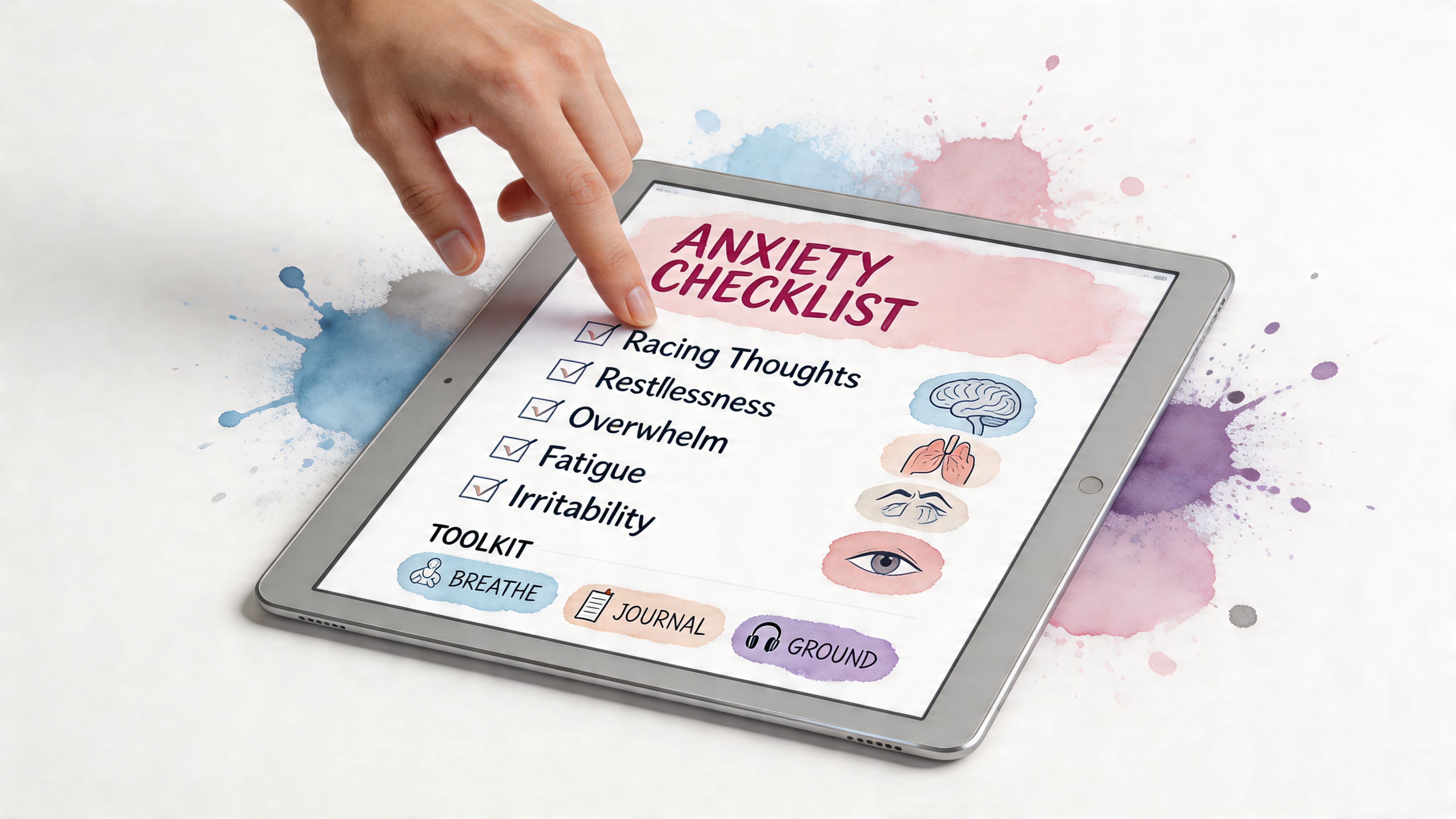
That’s why this guide is focused on self-application. Most Adlerian writing is aimed at therapists, even though many people are looking for practical ways to use these ideas on their own. That self-help gap is one reason this approach can feel harder to access than it should, as noted in this discussion of Adlerian self-application from Blueprint. If you want a grounded place to start noticing patterns, an anxiety checklist can help you sort what you’re feeling before you try to change it.
You Are More Than Your Anxiety
Anxiety often shrinks your world in quiet ways. You may still go to work, answer texts, show up for family, and look fine from the outside. But inside, you’re negotiating with fear all day long.
You might avoid one store because it feels too exposed. You might rehearse a simple phone call ten times. You might leave early, cancel late, overprepare, overexplain, or stay busy so you never have to feel still. These habits can look random, but Adlerian therapy sees them as purposeful.
Anxiety as a mistaken solution
A central Adlerian idea is that many painful patterns begin as attempts to solve a problem. Anxiety can become a private rule like, “If I stay alert, nothing bad will happen,” or “If I’m perfect, nobody can reject me.” Those rules aren’t silly. They usually formed for a reason. But they can trap you.
That’s the hopeful part of adlerian therapy techniques. They don’t ask you to hate your anxiety into submission. They help you understand what anxiety has been trying to do for you, then build a better plan.
You don’t need to prove that you’re fearless before you start healing. You need a better map.
A more human view of change
Adlerian thinking also says people heal through courage, usefulness, and connection. Anxiety tells you to withdraw and monitor yourself. Adlerian work nudges you outward. It asks how you can live with more contribution, more belonging, and less obsession with getting everything right.
That doesn’t mean forcing yourself into fake positivity. It means learning to see your life as larger than your symptoms.
A practical way to think about it is this:
- Anxiety says danger is everywhere. Adlerian work asks whether your mind learned to overpredict danger.
- Anxiety says you must control every outcome. Adlerian work asks what goal that control is serving.
- Anxiety says stay small and safe. Adlerian work asks what courage would look like in one tiny moment today.
Why this matters for self-help
If you’ve ever thought, “I know I’m overreacting, so why can’t I stop?” you’re not missing willpower. You’re likely following an old inner blueprint. Once you can see it, you can start editing it.
That’s where these techniques come in. Some help you notice your personal rules. Others help you interrupt them in real time. Others help you practice a new identity before you fully believe it.
Understanding Your Inner Blueprint
Adlerian psychology is easier to understand when you stop treating it like jargon and start treating it like a map of how people adapt.
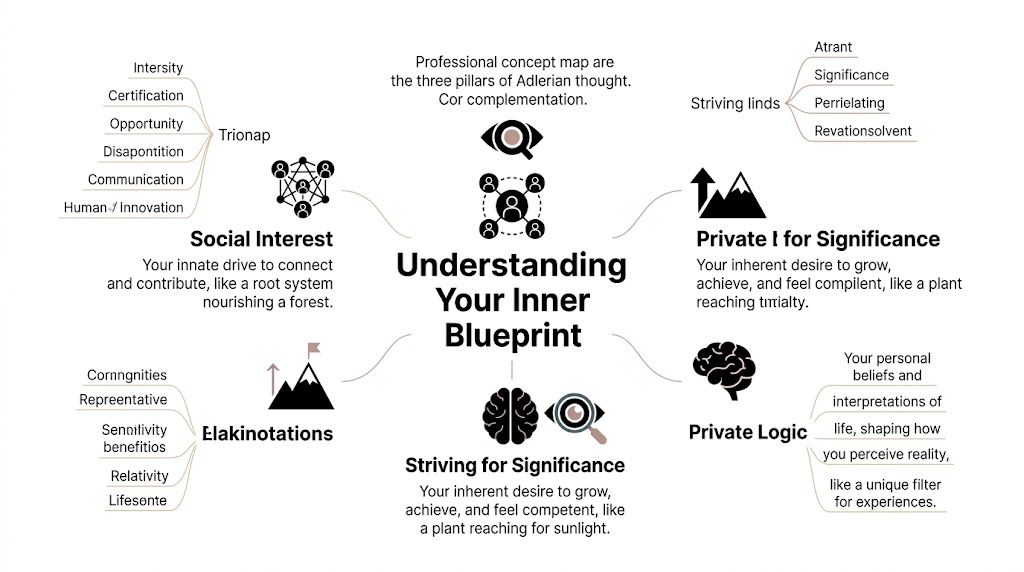
Think of you as a plant growing toward light. You naturally reach toward safety, competence, worth, and meaning. If the light feels blocked, you don’t stop growing. You twist, lean, stretch, or grow around obstacles. Some of those adaptations help. Some become anxiety.
Striving for significance
Adler believed people are always moving from a felt “less than” position toward growth, mastery, and contribution. That doesn’t mean arrogance. It means human beings want to matter.
Anxiety often hijacks that normal striving. Instead of “I want to grow,” the mind shifts into “I must never look foolish,” “I must never fail,” or “I must always stay in control.” The drive to improve gets squeezed into a drive to prevent humiliation or danger.
If this sounds familiar, you’re not uniquely defective. You’re doing what many anxious people do. You’re trying to protect your worth by controlling risk.
Social interest
Another major Adlerian idea is social interest. This means a sense of connection, contribution, and belonging with other people. When anxiety takes over, your attention narrows to self-protection. You monitor your heartbeat, your words, your face, your future, your mistakes.
Social interest softens that self-preoccupation. It doesn’t erase anxiety by force. It changes the direction of your attention.
A few examples make this clearer:
- At work: Instead of “I can’t speak unless I’m flawless,” the question becomes, “What would be useful to contribute here?”
- In relationships: Instead of “Do they secretly dislike me?” the question becomes, “How can I show up with curiosity?”
- In daily life: Instead of “How do I avoid discomfort?” the question becomes, “What small act would connect me to life today?”
That shift can feel subtle, but it changes your nervous system’s job. You stop treating every moment like a test of your worth.
Private logic and lifestyle
Adlerian therapists often explore a person’s lifestyle, meaning the pattern of beliefs and strategies they developed early in life. A core part of this assessment looks at early memories, family dynamics, and the life tasks of work, social relationships, and intimacy, with satisfaction in those areas often rated on a 1 to 10 scale, as described in this Adlerian overview from SupaNote.
Your lifestyle is not your clothes or hobbies. It’s your inner operating system.
It includes beliefs like:
- “If I relax, something bad will happen.”
- “If people see my authentic self, they’ll pull away.”
- “I only count when I perform well.”
Adlerians call this kind of inner reasoning private logic. It’s the personal lens that makes your habits seem necessary, even when they’re exhausting.
Practical rule: Don’t ask only, “What am I afraid of?” Ask, “What rule am I obeying?”
If you want a simple place to learn core anxiety concepts alongside approaches like this, Anxiety University can help you build vocabulary for what you’re experiencing.
A quick self-check
Write down your first instinctive answers to these prompts:
- When I’m anxious, I’m usually trying to prevent…
- If I let my guard down, then…
- To feel safe or valued, I believe I must…
You don’t need perfect answers. You’re looking for patterns. Your anxiety usually follows a blueprint. Once you know the blueprint, adlerian therapy techniques become much easier to use.
Practical Tools to Reframe Your Anxiety
Insight helps, but anxiety changes when you practice. Adlerian techniques work best when you turn them into small repeated actions, not just ideas you admire.
One helpful attitude is to stop asking, “How do I get rid of anxiety forever?” and start asking, “How do I relate to this pattern differently today?”

Lifestyle assessment you can do at home
A therapist might guide a full lifestyle assessment. On your own, you can still do a simplified version in a notebook.
Start by rating these three life tasks from 1 to 10:
- Work or purpose
- Friendship and social connection
- Love or emotional closeness
Then ask:
- Where do I feel most discouraged?
- Where do I overcompensate by being hypervigilant, controlling, or perfectionistic?
- Where do I feel most alone?
This exercise helps you see where anxiety is clustering. Some people don’t feel anxious everywhere. They feel it most around visibility, closeness, or competence.
Early recollections
Early recollections are one of the most interesting adlerian therapy techniques because they can reveal the story your mind has been living by.
Write down three early memories from childhood. Keep them specific. A single scene is better than a general summary. Then look for themes.
You’re not trying to prove what literally happened. You’re noticing what your mind has chosen to keep.
For each memory, ask:
- What role was I in? Left out, pressured, responsible, invisible, in trouble?
- What were other people like? Supportive, unpredictable, busy, critical?
- What did I seem to learn about life?
A person who repeatedly remembers being watched or corrected may carry a rule like “I’m always being evaluated.” A person who remembers handling things alone may live by “I can’t rely on people.”
Acting as if
“Acting as if” means trying a behavior as though you already had the quality you want. Not forever. Just as an experiment.
If anxiety says, “You can’t go unless you feel calm,” acting as if says, “What would I do for five minutes if I trusted myself a little more?”
Try one of these:
- At the grocery store: Walk one aisle without checking your body sensations.
- Before a text: Send a kind, simple reply without editing it repeatedly.
- In a meeting: Share one point without trying to make it perfect.
The goal isn’t performance. The goal is rehearsal. You teach your mind through action.
If anxiety often rides alongside distorted thinking patterns, learning more about cognitive distortions can help you spot the thoughts that make these moments harder.
Catching yourself
This technique is simple and powerful. You notice the anxious habit while it’s happening.
That might sound obvious, but most anxious patterns run fast. You don’t notice the sequence. You just end up trapped in it.
Create a three-part note on your phone:
- Trigger
- Old move
- New move
Example:
- Trigger: Friend doesn’t reply for hours
- Old move: Check messages, assume rejection, rehearse what I did wrong
- New move: Name the fear, put phone down, do one meaningful task
The point is not to become a flawless observer. The point is to interrupt automaticity.
When you catch the pattern early, you don’t have to fight as hard later.
Here’s a quick reference table you can copy into your journal.
| Technique | Goal for Anxiety | Simple Self-Help Exercise |
|---|---|---|
| Lifestyle assessment | Identify where anxiety is most tied to discouragement | Rate work, social connection, and intimacy from 1 to 10 and journal about the lowest area |
| Early recollections | Uncover old beliefs shaping current fear | Write three early memories and note repeating themes |
| Acting as if | Practice courage before confidence arrives | Choose one small behavior you’d do if you trusted yourself slightly more |
| Catching oneself | Interrupt anxious autopilot | Track trigger, old move, and new move in real time |
| Spitting in the soup | Make self-defeating patterns less appealing | List the hidden costs of one anxious habit |
| Paradoxical intention | Reduce fear of symptoms by approaching them differently | In a safe setting, briefly invite the sensation you usually resist |
Spitting in the soup
This odd phrase means making a pattern less attractive by exposing what it really does.
Anxiety often has hidden rewards. Avoidance can bring short-term relief. Perfectionism can create a temporary feeling of control. Reassurance seeking can offer a brief drop in uncertainty.
But the bigger cost is usually freedom.
Take one anxious habit and finish this sentence several times: “This protects me for a moment, but it also…”
For example:
- “Checking my pulse protects me for a moment, but it also teaches my brain that sensations are dangerous.”
- “Canceling plans protects me for a moment, but it also shrinks my confidence.”
- “Overpreparing protects me for a moment, but it also tells me I’m not capable without a ritual.”
Once you really see the tradeoff, the habit starts to lose its shine.
A short explainer may help if you want to hear these ideas described aloud:
Paradoxical intention
One of the best known adlerian therapy techniques for anxiety is paradoxical intention. In this method, a person intentionally tries to amplify the symptom they fear. Rather than resisting panic sensations, they briefly invite them. This can disrupt the fear-avoidance cycle and reduce the symptom’s power, as explained in this overview of Adlerian anxiety treatment from Simply Psychology.
This technique needs care. Don’t use it in dangerous situations like driving. Start small and safe.
Examples:
- If you fear blushing, you might say, “Let’s see if I can blush more.”
- If you fear your heart racing, you might sit down and say, “Okay body, show me the sensation.”
- If you fear panic itself, you might experiment with dropping the struggle for a brief moment instead of trying to suppress every sign.
That shift changes the relationship. You stop acting like a victim cornered by symptoms and start acting like a person who can observe, allow, and respond.
Your Adlerian Action Plan for Panic and Worry
A story can make these ideas easier to trust. Consider Sarah, a fictional example based on common anxiety patterns.
Sarah dreads work meetings. Before each one, she rehearses what to say, worries she’ll sound foolish, and scans her body for signs of panic. If her chest tightens, she tells herself it means she’s losing control. Then she either stays silent or speaks so carefully that she feels robotic.

Step one sees the rule underneath the panic
Sarah starts by writing down what panic seems to mean to her. Under the surface, she finds a rule: “If I’m not composed and impressive, people will reject me.”
That’s private logic. It feels like truth because she’s obeyed it for years.
She notices that her anxiety isn’t random. It flares most when she could be evaluated. Her problem isn’t only bodily fear. It’s the belief that imperfection is dangerous.
Step two catches the sequence earlier
Next, Sarah uses “catching oneself.” Before meetings, she notices the order of events:
- A meeting appears on the calendar
- She imagines embarrassment
- She starts rehearsing
- Her body tenses
- She interprets the tension as proof she can’t cope
Once she sees the chain, she has a point of choice.
Instead of waiting until she’s flooded, she interrupts at the rehearsal stage. She writes one simple sentence she wants to contribute and stops there. No polishing marathon. No mental courtroom.
Try this lens: Panic often grows in the space between a trigger and the meaning you assign to it.
Step three practices acting as if
Sarah doesn’t try to become a different person overnight. She chooses one small behavior: speak once in each meeting, even if her voice shakes a little.
That’s her “acting as if” experiment. She acts as if being useful matters more than sounding perfect.
The first few times feel awkward. But awkward is not failure. It’s practice.
Step four widens her life beyond self-monitoring
Sarah also notices how isolated she’s become. Anxiety has trained her to spend most of her energy on prevention. So she chooses one act of social interest each week that isn’t about performance. She checks in on a friend, helps a coworker, and joins a casual group activity without trying to impress anyone.
Anxiety shrinks attention inward. Connection, however, broadens it again.
If panic is part of your experience, learning the basics of what’s happening in your body during a panic attack can make these steps feel less mysterious.
Step five uses support when a wave hits
Sarah also tells one trusted person what happens during her panic spikes. That way she doesn’t have to hide and improvise every time. If you’re supporting someone else, this practical guide on how to calm down someone having a panic attack offers grounded ways to help without adding pressure.
The key is not rescue. It’s steady presence.
Why this path is worth trusting
A documented Adlerian case gives real reason for hope. In a case involving a client named Lisa, 14 sessions of Adlerian therapy that included early recollections, life task ratings, encouragement, and social interest work led to a 60% reduction in anxiety symptoms, and she began socializing more freely, according to the clinical review at the NCBI Bookshelf.
Your path won’t look exactly like Lisa’s. Sarah’s path won’t either. But the message is encouraging. Anxiety patterns can change when you understand the goal beneath them and practice a different way of living.
Downloadable Tools for Your Fearless Living Toolkit
You don’t need fancy worksheets to use adlerian therapy techniques well. A notebook, notes app, or simple document is enough. What matters is that the tool is easy to use when you’re anxious, not beautiful when you’re calm.
The Acting As If planner
Create a page with four lines:
- Situation
- What anxiety tells me to do
- What the more courageous version of me would do
- One tiny action I’ll take
Example:
- Situation: Calling the doctor
- What anxiety tells me to do: Put it off and rehearse
- Courageous version: Call even if my voice sounds shaky
- Tiny action: Dial before lunch
Keep the action small enough that you can do it. This tool works because it turns vague courage into a visible step.
The encouragement log
Anxious people often notice only what went wrong. Adlerian work leans hard in the other direction. Encouragement means learning to see effort, movement, and willingness.
Finally, write three short entries:
- Something I faced
- Something I did imperfectly but still did
- One strength I showed
This can feel cheesy at first. Keep going anyway. You’re retraining attention.
Keep this short: If your log takes more than a few minutes, it becomes another pressure ritual.
The private logic rewrite sheet
Draw a line down the page. On the left, write the old rule. On the right, write a more flexible replacement.
Examples:
| Old rule | More useful replacement |
|---|---|
| I must not feel anxious in public | I can feel anxious and still function |
| If I don’t prepare endlessly, I’ll fail | Preparation helps, but overpreparing feeds fear |
| People will reject the real me | Some people may not connect with me, and I can still belong |
The point is not to force yourself into affirmations you don’t believe. The point is to weaken rigid rules and create alternatives you can test.
If you like structured prompts and digital tracking, a CBT journaling app can pair well with these worksheets by helping you capture thoughts, patterns, and experiments consistently.
The social interest micro-list
On one page, list ten tiny ways to connect or contribute that don’t require perfection.
Examples might include:
- Send a kind message
- Hold a door
- Ask one sincere question
- Thank someone directly
- Join one low-pressure activity
- Offer help with one simple task
When anxiety starts looping, pick one item. This doesn’t deny distress. It gives your attention somewhere healthier to go.
Knowing Your Options and Limitations
Self-help can be powerful, but it isn’t the answer for every situation. If anxiety comes with severe depression, active self-harm risk, psychosis, substance instability, or a level of panic that leaves you unable to function safely, professional care matters. A trained clinician can assess what’s happening and help you choose an approach that fits your needs.
Adlerian work also isn’t a contest against other therapies. CBT is highly effective for specific symptom reduction, while Adlerian therapy may support longer-term resilience by focusing on social interest and reducing feelings of inferiority, especially in family and group settings, as discussed in this Adlerian comparison at Positive Psychology. In plain language, CBT often targets the thought pattern directly. Adlerian therapy often asks what life goal, belonging need, or self-protective rule is driving the pattern.
Both can help. Some people even benefit from using both lenses.
A few signs it may be time to look for professional support:
- Your world is shrinking fast. You’re avoiding more places, people, or responsibilities each week.
- Self-help turns into self-pressure. Every technique becomes another test you feel you’re failing.
- You need diagnosis or coordination. Medication questions, trauma history, or overlapping conditions call for guidance.
If you’re trying to find local support and want a concrete example of what counseling options can look like in one area, this Penticton counselling guide shows the kind of information that can help when comparing therapists and services.
Getting help doesn’t mean you’ve failed at self-help. It means you’re using all the tools available.
Building a Life of Courage and Connection
Healing from anxiety isn’t only about having fewer symptoms. It’s about becoming less ruled by fear and more guided by purpose, courage, and connection.
That’s what makes adlerian therapy techniques so refreshing. They don’t reduce you to a diagnosis. They ask who you’ve had to become to feel safe, then help you become someone freer. They treat anxiety not as your identity, but as a pattern that can be understood and changed.
The biggest shift is simple to say and hard to practice. Stop asking your anxious mind for permission to live. Start choosing small acts that teach your mind you can live with uncertainty, imperfection, and still belong.
A few truths are worth keeping close:
- You can feel fear and still move.
- You can be imperfect and still be worthy.
- You can stop organizing your life around panic.
- You can build confidence through action before you feel fully ready.
That’s how many people recover. Not in one dramatic breakthrough, but in repeated moments of courage. One phone call. One outing. One honest conversation. One less ritual. One more act of connection.
Choose one technique from this guide today. Not five. One. Rate your life tasks. Write one early memory. Catch one anxious sequence. Act as if for five minutes. Do one small thing that contributes to someone else’s day.
A freer life is built that way. Subtly. Repeatedly. On purpose.
If you want a practical system to put these ideas into daily action, The Anxiety Checklist offers a structured self-help approach for chronic anxiety and panic, with tools for tracking symptoms, challenging thought patterns, and building a personalized plan for calmer, more confident living.