



You may be sitting next to someone you love and still feel miles away from them.
Maybe your partner asks for reassurance over and over. Maybe they cancel plans at the last minute, shut down after a simple conversation, or wake in the night with a racing heart and a look of pure fear. You try to help, but what comes out is, “It’s okay,” “Try to relax,” or “Don’t think about it so much,” and somehow that only makes things worse.
That leaves many people feeling guilty, confused, and worn thin. They love their partner. They want to help. They just don’t know how to support without becoming consumed by the anxiety too.
From Helpless to Hopeful Your Journey Starts Here
Watching a partner struggle with anxiety can make everyday life feel unstable. A dinner out turns into a last-minute exit. A small delay becomes a spiral. A normal disagreement suddenly carries far more weight than it should. Many supporters start wondering whether they’re helping, enabling, or failing.

The strain is real. A 2016 study on couples and anxiety found that higher daily anxiety in one partner correlated with lower relationship satisfaction for both. The same study also found that anxiety-specific support from a partner could improve perceptions of relationship quality by up to 25% on supported days.
That matters because it tells you something hopeful. Your presence alone isn't enough. But your kind of presence matters.
What hope looks like in real life
Hope doesn't mean never seeing anxiety again. It means knowing what to do when it shows up. It means the two of you stop treating anxiety as proof that the relationship is broken. Instead, you start treating it as something that can be understood, responded to, and gradually reduced.
Practical rule: Your job isn't to eliminate every anxious moment. Your job is to become a steady person inside an unsteady moment.
I've seen the shift happen when supporters stop trying to rescue and start learning how to respond. The relationship often gets less reactive. Conversations get clearer. Both people feel less alone.
Your role can become a powerful one
If you're supporting a partner with anxiety, you can become an informed ally rather than a desperate firefighter. That starts with understanding what anxiety is, what it isn't, and how supportive behavior differs from accommodation.
A good place to build that foundation is Anxiety University, especially if you need language for what your partner is experiencing and want something more practical than vague encouragement.
A panic-free life may feel far away right now. But anxiety is treatable, and many couples build calmer, stronger relationships when they stop improvising and start using the right tools.
Understanding the Landscape of Their Anxiety
Not every tense moment is an anxiety disorder. People get stressed before a deadline, overwhelmed after bad news, or uneasy during conflict. That's part of being human. Anxiety becomes more concerning when fear starts running the schedule, the relationship, or the person's choices.
Think of it this way. Stress is pressure from something happening. Normal anxiety is the body's alarm system switching on to protect you. An anxiety disorder is when that alarm keeps firing too often, too intensely, or in situations that don't call for that level of danger response.
What you may actually be seeing
Some partners expect anxiety to look dramatic. Sometimes it does. Panic, shaking, tears, chest tightness, and urgent reassurance-seeking are obvious signs. But many people show anxiety in quieter ways.
You might notice:
- Avoidance: They delay calls, skip events, or back out of plans that feel risky.
- Control behaviors: They over-plan, double-check, or need every detail settled in advance.
- Irritability: Anxiety often comes out sideways. A tense nervous system can sound snappy.
- Reassurance loops: They ask the same question repeatedly because relief fades fast.
- Withdrawal: They go quiet, shut the bedroom door, or become emotionally hard to reach.
If you're not sure what category your partner fits into, this overview of anxiety disorders can help you sort symptoms more clearly.
Your role isn't fixer. It's ally.
Trying to fix anxiety usually backfires. It puts pressure on your partner to calm down for your comfort, and it pushes you into a role no partner can sustain. An ally does something different. An ally pays attention, stays respectful, and learns patterns without turning every hard moment into a project.
That means noticing questions like these:
- When does anxiety spike most often? Morning, night, before social events, during conflict?
- What helps a little? Quiet, touch, space, a walk, fewer questions?
- What makes it worse? Logic battles, urgency, too much reassurance, criticism?
Learn the pattern before you try to change the pattern.
Don't overlook body-based strain
Anxiety isn't only mental. Poor sleep, overstimulation, and physical exhaustion often make symptoms harder to manage. If sleep has become part of the problem, practical guidance on alleviating sleep disorders can help you think about how the home environment, nighttime habits, and rest quality affect the whole picture.
One of the most useful shifts for supporters is this: stop asking, “Why are they like this?” Start asking, “What is their nervous system trying to do right now?” That question creates empathy without excusing hurtful behavior. It also gives you a better starting point for helping.
Your In-the-Moment Toolkit for High Anxiety and Panic
When anxiety spikes, your calm matters more than your explanation. In that moment, your partner doesn't need a lecture on cognitive distortions. They need help getting back into the present.
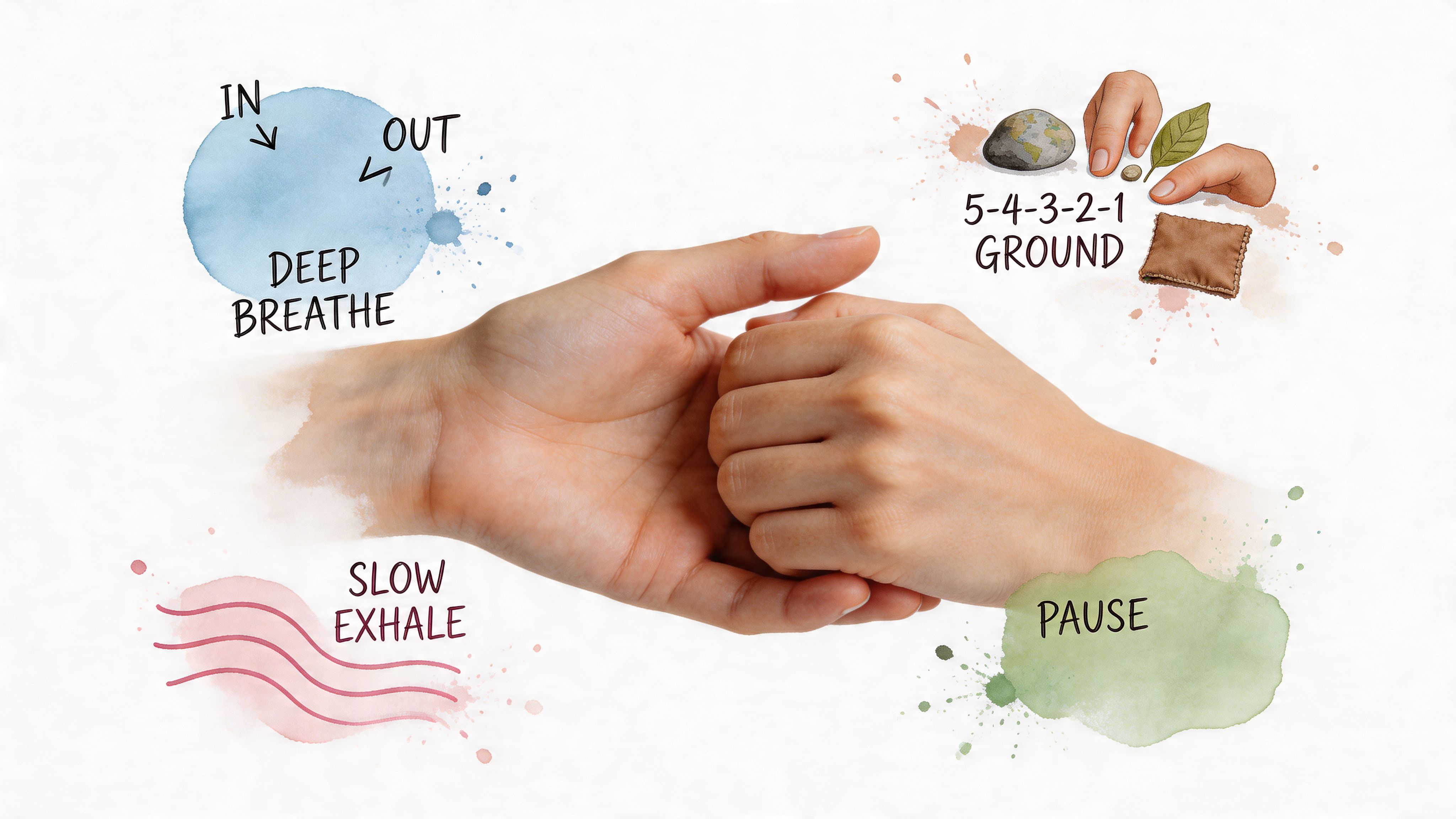
A useful response is simple, slow, and concrete. Don't argue with the fear. Don't flood them with questions. Give their nervous system something steady to follow.
What to say in the moment
Short phrases work better than long explanations. Try lines like these:
- “I'm here with you.”
- “You're safe with me right now.”
- “Let's take this one step at a time.”
- “You don't have to force it to stop this second.”
- “Can I help you ground right now?”
Avoid phrases that sound dismissive, even if you mean well.
- Don't say: “Calm down.”
- Don't say: “You're overreacting.”
- Don't say: “There's nothing to worry about.”
- Don't say: “Just breathe.”
- Don't say: “This again?”
Those responses often increase shame. Shame tends to intensify panic, not reduce it.
A simple crisis sequence
When you're supporting a partner with anxiety during a surge, use a repeatable order.
Lower the stimulation
Reduce noise. Step away from crowds if possible. Put phones down. Sit rather than pace.Orient them to the present
Ask for concrete details. “Can you name five things you see?” is often more effective than “Tell me what's wrong.”Match your speed to calm, not to panic
Slow voice. Short sentences. Relax your shoulders. People in panic borrow cues from the nervous system beside them.Offer one choice
“Would you like me to sit quietly or guide you through grounding?” Too many choices can overwhelm.
A deeper guide to grounding techniques for anxiety can help you practice these before you need them.
Two techniques that travel well
The first is 5-4-3-2-1 grounding. Ask them to name:
- 5 things they can see
- 4 things they can feel
- 3 things they can hear
- 2 things they can smell
- 1 thing they can taste
The second is paced breathing. Keep it uncomplicated. You might say, “Let's exhale slowly together.” For many people, extending the exhale feels more manageable than trying to take a deep breath while panicking.
This video can help if you'd rather follow a visual guide together once the first wave settles.
Stay with what works. Don't switch methods every thirty seconds.
What helps after the wave passes
The end of a panic spike is not the time for a postmortem. First, help them recover physically. Water. A blanket. A quieter room. Maybe a short walk. Maybe just sitting without talking.
Then, later, ask one useful question: “Next time this happens, what would feel most supportive from me?” That turns the episode into information, not failure.
If you're the supporter, remember this too. You don't need to perform perfect calm. You need to be predictable, respectful, and grounded enough that your partner doesn't feel abandoned inside the fear.
Building a Partnership for Long-Term Healing
Short-term relief matters. Long-term healing depends on what the two of you build between episodes.
Many couples get trapped in a cycle of reaction. Anxiety appears, one partner scrambles, the other withdraws or clings, and both end the day exhausted. A better path is to create shared systems that reduce confusion before the next hard moment arrives.
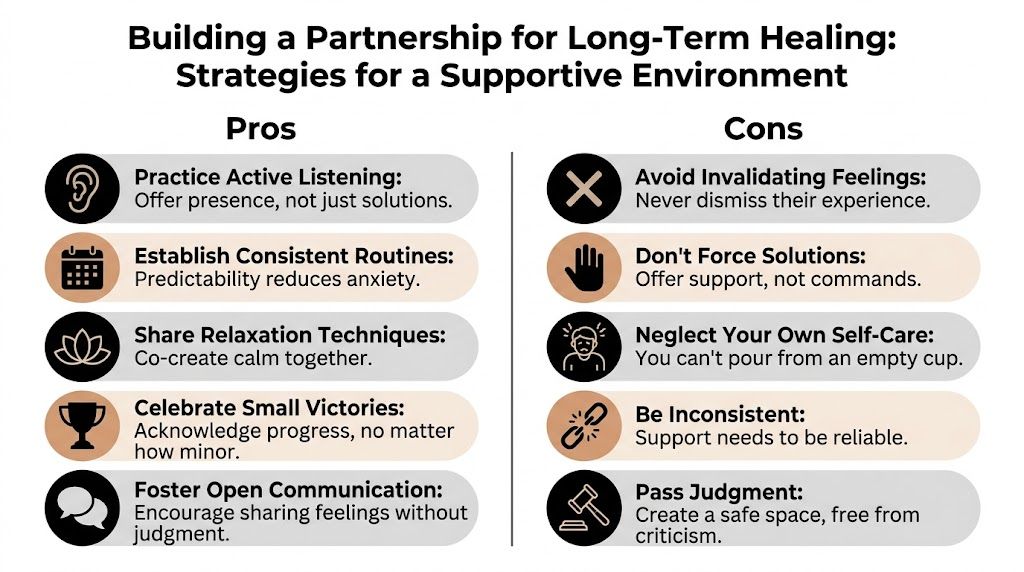
A difficult truth belongs here. Some couples want to help each other but have conflicting support preferences. One partner may want frequent reassurance, while the other feels depleted by constant reassurance. One may want encouragement to face fears, while the other experiences that as pressure. A discussion of this gap in anxiety support advice points out that many resources don't offer frameworks for negotiating these mismatches.
Start with a support conversation outside the crisis
Don't negotiate support in the middle of panic. Have the conversation when both of you are relatively calm. Keep it practical.
Ask:
- “When anxiety rises, what helps you feel supported?”
- “What feels supportive at first but usually makes things worse later?”
- “What can I give consistently, and what is too much for me to sustain?”
- “How should we handle reassurance when it turns into a loop?”
That last question matters. Reassurance can soothe briefly while feeding dependence over time. You don't have to choose between total reassurance and cold refusal. You can agree on limits.
“I can remind you once that we're okay, and then I'll help you use the tools we've agreed on.”
Build routines that make the home feel steadier
Healing usually happens better in a predictable environment. That doesn't mean rigid control. It means fewer unnecessary surprises, clearer expectations, and habits that lower strain.
Useful routines often include:
- A daily check-in: Ten calm minutes to ask how each person is doing.
- A weekly planning rhythm: Looking ahead can reduce anticipatory anxiety.
- Shared decompression habits: Walks, journaling, gentle movement, or quiet phone-free time.
- Post-trigger repair: If anxiety affected a conversation, return to it later instead of pretending nothing happened.
Supportive communication do's and don'ts
| Do Say This… | Don't Say This… |
|---|---|
| “Do you want comfort, problem-solving, or space?” | “Tell me exactly what's wrong right now.” |
| “I can stay with you for a few minutes.” | “You need to stop this.” |
| “Let's use the plan we agreed on.” | “Why are you doing this again?” |
| “I care about you, and I also need a short break.” | “I can't deal with you when you're like this.” |
Recovery works better when both people have a plan
Long-term support gets stronger when the couple has named triggers, early warning signs, and agreed responses. Some couples do this in a notebook. Others use worksheets or symptom tracking. The format matters less than the consistency.
If you want a practical structure for thinking through the stages of improvement, these anxiety recovery steps can help frame the process. The point is not perfection. The point is reducing chaos and replacing guesswork with a repeatable way of working together.
Small steady changes often do more for recovery than dramatic promises. A calmer home, better conversations, and clearer limits can make anxiety feel less like the third person in the relationship.
Encouraging Professional Help as a United Front
Love helps. Expertise helps differently.
Many supporters hesitate to bring up therapy because they don't want to sound critical. So they wait until they're burned out or until anxiety has taken over routines, intimacy, and decision-making. By then, the suggestion can land like an accusation.
A better approach is to frame professional care as support for both of you. Not “you need fixing.” More like, “we deserve better tools than the ones we're trying to invent under stress.”

A strong case exists for partner involvement. A review discussed by Inspire Recovery on professional counseling for anxiety notes that enlisting a partner as a co-therapist in evidence-based treatments like CBT can achieve response rates of up to 60%, with relapse rates as low as 4.9%. Professionally guided partner support outperforms self-help alone.
How to bring it up without triggering shame
Tone matters more than the exact script, but these openings are usually gentler than “You need help.”
Try:
- “I've noticed how hard this has been on you, and I don't want you carrying it alone.”
- “Would you be open to talking with someone who treats anxiety regularly?”
- “I want us to have more support than just the two of us guessing.”
- “If you want, I'll help you research options and sit with you while you make the call.”
Avoid making therapy sound like punishment, a threat, or a condition for love.
What partner involvement can look like
Being a supportive partner in treatment doesn't mean acting like a clinician. It means reinforcing the work in everyday life. If the therapist assigns homework, you help create room for it. If exposure practice is part of treatment, you support without taking over. If your partner learns a new coping method, you encourage consistency.
For people unfamiliar with Cognitive Behavioural Therapy (CBT), it can help to read a plain-language overview before the first appointment. Knowing the basics often makes therapy feel less intimidating.
Professional help isn't a sign that love failed. It's a sign that love is getting backup.
Be collaborative, not managerial
Offer help with logistics if your partner wants it. That might mean helping find a therapist, comparing appointment times, or driving them to a session. But keep ownership where it belongs. Their therapy is theirs.
If you want a broader picture of treatment options, this guide to psychotherapy for anxiety gives a useful starting point for understanding what care can involve.
The best supporters don't drag a partner into treatment. They lower friction, reduce shame, and stand beside them as they step in.
The Supporter's Guide to Self-Care and Boundaries
Many supporters think love means endless availability. It doesn't. Endless availability often turns into resentment, exhaustion, and accidental enabling.
This matters even more in relationships affected by social anxiety. A PubMed summary of research on social anxiety in romantic relationships notes that individuals with social anxiety often receive less partner support and show higher withdrawal, which can increase breakup risk. That pattern can also drive supporter burnout, especially when care isn't consistently reciprocated.
Boundaries are part of good support
A boundary is not rejection. It's a clear statement of what you can do, what you can't do, and how you'll still remain caring.
Examples:
- “I can talk about this for fifteen minutes, and then I need to rest.”
- “I want to help, but I can't do repeated reassurance for the rest of the night.”
- “I'm happy to support your therapy work. I can't be the only thing keeping you regulated.”
- “If voices rise, I'm going to pause and come back when we're both calmer.”
These statements protect the relationship from the damage that silent resentment causes.
Watch for your own warning signs
Supporters often notice their partner's symptoms before their own. Pay attention if you start feeling:
- Constant vigilance: You're always scanning for the next episode.
- Guilt when you rest: Time for yourself starts to feel selfish.
- Emotional numbness: You care, but you're too drained to feel present.
- Loss of your own routines: Friendships, hobbies, sleep, and exercise disappear.
- Irritation that leaks out sideways: You become shorter, colder, or avoidant.
If that sounds familiar, scale back before the relationship becomes organized around anxiety alone.
Care that destroys the caregiver isn't sustainable care.
What sustainable support looks like
Keep your own appointments. Maintain your friendships. Protect some ordinary joy. Take the walk, go to the gym, read the book, see the family member, have the quiet coffee without apologizing for it.
When needed, say, “I love you, and I'm at my limit tonight. I can talk tomorrow.” That isn't abandonment. It's honesty. Honest limits are kinder than overpromising and then snapping.
Supporting a partner with anxiety works best when two truths stay in the room at once. Your partner's suffering is real. Your limits are real too.
If you want a structured way to understand symptoms, spot patterns, and build a calmer plan together, The Anxiety Checklist offers practical tools for anxiety, panic, habit tracking, and day-to-day recovery support. It's especially useful for people who want something concrete they can use at home, not just more advice to remember when they're already overwhelmed.