



You may know this feeling well. You're not only afraid of an anxiety attack itself. You're afraid of the next one, and the one after that. You scan your body in the grocery store, in a meeting, while driving, while trying to fall asleep. A fast heartbeat becomes a warning. Dizziness becomes a threat. Normal stress starts to feel dangerous because you're bracing for panic.
That fear can shrink a life quickly. People stop trusting their body, then their routines, then their world. They start organizing each day around avoidance, recovery, or damage control.
There is another way to live. Anxiety attack prevention isn't about staying on guard every minute. It's about creating enough safety, skill, and repetition that your nervous system stops sounding the alarm so often. Healing usually happens in layers. You need something for the moments when panic surges, something for ordinary days when stress accumulates, and something deeper that changes the beliefs and habits keeping the cycle alive.
Table of Contents
- You Can Live a Life Without Fear of Panic
- The Three Layers of Anxiety Attack Prevention
- Your SOS Plan to Stop Panic in Its Tracks
- Building Your Daily Buffer Against Anxiety
- Rewiring Your Brain for Lasting Change with CBT
- Living Panic-Free Your Long-Term Support Plan
You Can Live a Life Without Fear of Panic
Panic creates a very convincing story: this will keep happening, and I won't be able to handle it. That story feels true because anxiety trains attention to look for danger and ignore evidence of safety. Once that pattern takes hold, people often treat prevention as impossible and settle for surviving episodes as best they can.
That isn't the whole picture. Many people reduce panic dramatically when they stop relying on one-off coping tricks and start using a consistent prevention plan. Such a plan is vital, as anxiety is common, and many people aren't getting enough support. Generalized Anxiety Disorder affects 6.8 million adults in the U.S., but only 43.2% receive treatment, and in England 6 out of 100 people experience GAD each week, according to the ADAA facts and statistics overview.
Clinical reality: Fear of panic often becomes more limiting than panic itself. When treatment works, people don't just feel calmer. They start getting their life back.
The practical takeaway is simple. If access to therapy is limited, delayed, or inconsistent, prevention still matters. Self-guided structure can help people build momentum between sessions, before sessions, or while deciding what level of care they need. That's one reason tools like the Anxiety Checklist app can matter to people who need support in the moment and a plan between difficult moments.
What healing usually looks like
Recovery is rarely a single breakthrough. It tends to involve three kinds of work:
- Immediate interruption: You need something that helps when panic is already rising.
- Baseline reduction: You need habits that lower the general stress load on your body.
- Long-term change: You need a method that weakens catastrophic thinking and avoidance.
People often skip the third part because it's slower. But lasting progress usually depends on it.
What doesn't work well on its own
A few common strategies tend to backfire when used as the whole plan:
| Approach | Why it falls short |
|---|---|
| Waiting until panic hits | It keeps you reactive and exhausted |
| Constant reassurance-seeking | It can make your brain depend on external safety signals |
| Avoiding every trigger | It shrinks life and strengthens fear |
| Trying to "think positive" fast | It often feels fake when your body is already alarmed |
Hope becomes believable when you stop asking one tool to do every job.
The Three Layers of Anxiety Attack Prevention
A strong prevention plan has structure. I think of it as three layers that support each other. The top layer is what you use in a surge. The middle layer steadies your nervous system day to day. The base layer changes the pattern that keeps panic recurring.
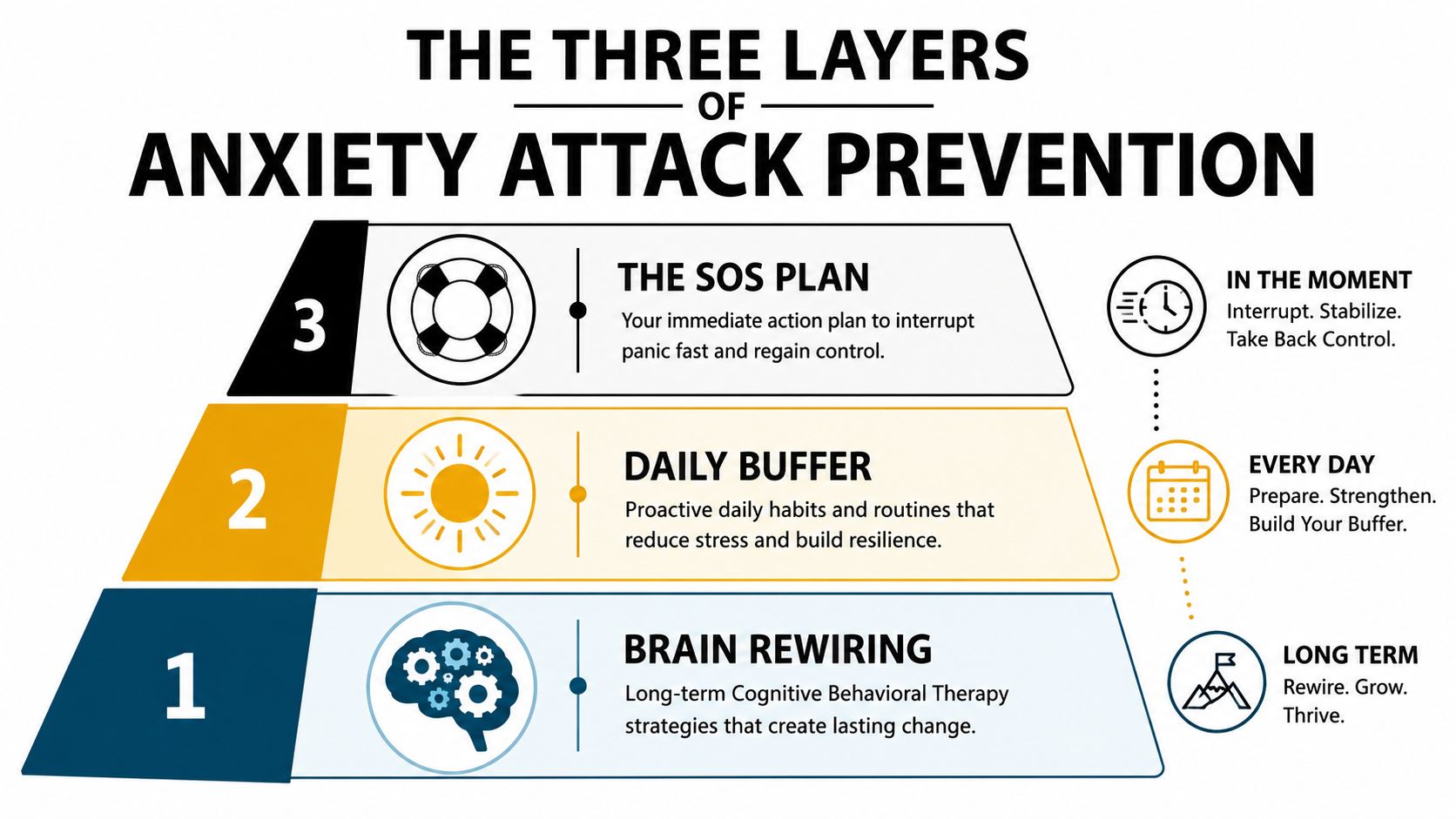
Layer one is the SOS plan
This is your in-the-moment response. Its job isn't to erase every sensation instantly. Its job is to stop the spiral from accelerating. Grounding, breathing, and a simple script can give your brain something concrete to do when it starts shouting danger.
This layer matters because many people lose access to their best thinking when panic starts. A plan has to be short enough to use under stress.
Layer two is the daily buffer
Prevention becomes practical rather than dramatic. Daily guided meditation, movement, affirmations, sleep support, and short check-ins don't look impressive on paper. But they reduce the pileup that makes your system easier to trigger.
That kind of accessible support matters. In 2026, 43% of U.S. adults reported feeling more anxious than the previous year, yet only 24% sought professional help, according to this anxiety statistics roundup. When more people feel overwhelmed than supported, structured self-help becomes more than a convenience. It becomes part of the care pathway.
People usually don't need more alarm about their anxiety. They need a repeatable system that works on ordinary Tuesdays.
Layer three is brain rewiring
This is the deepest layer. It includes the CBT skills that help you question catastrophic predictions, track patterns, and gradually face what you've been avoiding. Without this layer, a person may get good at calming down but never fully stop fearing their own symptoms.
A useful way to think about the full system is this:
- SOS tools reduce escalation
- Daily habits reduce vulnerability
- CBT work reduces recurrence
People who only use one layer often feel stuck. They may know how to survive an episode but still live in dread of the next one. People who build all three layers often report a different shift. Their life stops revolving around breaking the overthinking cycle and starts expanding again.
The trade-off most people miss
The top layer brings the fastest relief. The bottom layer creates the deepest change. The middle layer is what makes both sustainable.
If you skip the daily buffer, you may never have enough steadiness to practice the deeper work. If you skip CBT, your routines can become another form of self-management without recovery. Good anxiety attack prevention respects all three.
Your SOS Plan to Stop Panic in Its Tracks
When panic starts, simplicity wins. You won't use a ten-step routine when your chest is tight and your thoughts are racing. You need a short sequence that tells your body, "I know what to do now."

What to do first when your mind goes blank
Start with orientation, not analysis. In the first moments, don't argue with every anxious thought. Anchor yourself in the present.
Use this sequence:
- Name the wave
Say, "This is anxiety. My body is activated. This will pass."
That statement matters because panic often becomes stronger when you mistake activation for catastrophe.
Plant your feet
Press both feet into the floor. Notice the pressure in your heels and toes. If you're standing, slightly bend your knees instead of locking them. This helps shift attention from inner alarm to physical contact with the environment.
Use box breathing
Inhale gently through your nose. Pause. Exhale slowly. Pause again. Keep the pace even and unforced. The point isn't to breathe perfectly. It's to slow the frantic rhythm that tells your brain something terrible is happening.
Do a 5-4-3-2-1 grounding round
Identify:
- Five things you can see
- Four things you can feel
- Three things you can hear
- Two things you can smell
- One thing you can taste
This works because it interrupts the tunnel vision of panic. Your attention moves from imagined disaster to direct sensory data.
Practical rule: If a technique makes you strain, simplify it. During panic, "good enough" is more effective than "perfect."
What usually doesn't help in the moment
People often try to force calm. That tends to create a second layer of fear. "I need this to stop right now" becomes its own threat signal.
A better goal is steadiness. You're not trying to prove you're never anxious. You're showing your nervous system that activation can happen without a full collapse.
Common traps include:
- Checking symptoms repeatedly: This keeps your attention locked on danger.
- Leaving immediately every time: Sometimes leaving is appropriate, but automatic escape can teach your brain the place was unsafe.
- Seeking nonstop reassurance: It may soothe you briefly but can keep confidence from growing.
For many people, it helps to keep a short list of practical anxiety management resources saved on their phone so they don't have to remember techniques under pressure.
A simple script for a real-world moment
Take a crowded grocery store. Your heart jumps. The line feels too long. You notice lightheadedness, then the thought arrives: I'm trapped.
At that point, don't debate whether you're trapped. Use the script.
- Step one: Put one hand on the cart handle and feel its temperature and texture.
- Step two: Soften your exhale.
- Step three: Look for five neutral objects. A cereal box. A red sign. A child's shoe. A freezer door. A shopping basket.
- Step four: Tell yourself, "My body is alarmed. I can stay with this for one minute."
That last line matters. One minute is believable. Panic responds better to believable statements than grand promises.
A guided practice can help when you want spoken support instead of trying to remember the sequence yourself:
Build your SOS plan before you need it
Write your plan on one note in your phone or on a small card. Keep it brief.
- My first sentence: "This is anxiety, not danger."
- My body cue: Feet on floor
- My breath cue: Slow and even
- My grounding cue: 5-4-3-2-1
- My time cue: Stay for one minute, then reassess
The best SOS plan is not the most complex one. It's the one you'll use.
Building Your Daily Buffer Against Anxiety
Panic rarely appears in a vacuum. It often grows in a body that's already overloaded, underslept, overstimulated, or mentally pinned in a constant threat scan. That's why prevention can't rely only on emergency skills. You need a daily buffer that lowers the background noise.
Small habits beat dramatic resets
People often try to recover by making huge changes all at once. They promise a strict routine, long workouts, perfect sleep, and total calm. That usually fails because an anxious system doesn't respond well to pressure disguised as self-care.
Small habits work better because they create repetition without overwhelm. In this regard, self-guided support can be useful. A 2025 meta-analysis found mobile CBT interventions led to a 68% reduction in panic attack frequency at 6 months, sustained in 55% of users at 12 months, as summarized in this Harvard Health-linked overview of panic attacks and prevention.
That doesn't mean an app replaces skilled therapy for everyone. It means structured practice matters, and accessibility matters.

What daily support should actually include
A useful daily buffer usually includes three ingredients.
Something that settles the body
This might be a guided meditation, a slow walk, gentle stretching, or a brief hypnosis audio. The point is regular nervous system downshifting, not performance.
Something that closes the day
People with panic often arrive at bedtime physiologically revved up. A wind-down routine helps your brain stop treating the night as one more alert period. Low light, reduced stimulation, and sleep audio or calming narration can help.
Something that organizes the mind
Anxiety grows in unstructured mental loops. A short journal prompt, a check-in, or a simple plan for tomorrow can reduce the unfinished, spinning quality that fuels nighttime dread.
A prevention habit should be easy enough to repeat on your worst week, not just your best one.
A realistic daily buffer
Here is a simple version I often recommend:
| Time of day | Supportive action | Purpose |
|---|---|---|
| Morning | Two quiet minutes before checking messages | Reduces immediate threat scanning |
| Midday | Short walk or guided movement | Releases tension and resets arousal |
| Evening | Brief reflection or written check-in | Lowers mental clutter |
| Before bed | Predictable wind-down audio or meditation | Signals safety and rest |
None of these steps are dramatic. That's why they help.
Prevention also needs room for your real life
Parents, caregivers, students, and people working long hours often feel they don't have time for anxiety care unless they're already in crisis. That belief creates a hard cycle. Care goes to the bottom of the list until panic forces it to the top.
If you're supporting someone else while trying to manage your own stress, it's worth looking at this resource on support for caregiving challenges. Caregivers often need shorter, more flexible routines, not more guilt.
Daily buffering doesn't need to be impressive. It needs to be steady. A calm nervous system is usually built, not found.
Rewiring Your Brain for Lasting Change with CBT
If grounding helps you survive panic, CBT helps you change the pattern that keeps feeding it. With this, anxiety attack prevention becomes more than symptom management. It becomes retraining.
CBT works because panic is not only a body problem. It's also a meaning problem. A racing heart gets interpreted as danger. Dizziness gets interpreted as collapse. Uncertainty gets interpreted as "I can't cope." The sensations are real, but the interpretation drives the spiral.
CBT, especially when it includes exposure, is considered the gold standard for long-term panic attack prevention, with studies showing a 50 to 70% success rate in reducing attacks. A key metric is a 60% reduction in conviction of catastrophic thoughts, achieved through graded exposure and cognitive restructuring over 8 to 20 sessions, according to this CBT panic prevention toolkit overview.
Thought journaling that changes the pattern
A thought journal is not just "write your feelings down." It is a structured way to catch anxious predictions and test them.
Start with four columns:
Situation
Where were you? What happened?Automatic thought
What flashed through your mind?Emotion and body response
What did you feel physically and emotionally?Balanced response
What would be a more accurate, less catastrophic interpretation?
Here is a simple example:
| Situation | Automatic thought | Emotion and body response | Balanced response |
|---|---|---|---|
| Standing in line at a pharmacy | "I'm going to pass out and embarrass myself" | Fear, dizziness, tight chest | "I'm anxious and uncomfortable. I've felt this before and stayed upright." |
This doesn't work because you're forcing positivity. It works because you're replacing a distorted conclusion with a usable one.
The goal isn't to talk yourself into feeling wonderful. The goal is to stop treating every sensation like proof of disaster.
How to make the journal useful
A few practical rules help:
- Write close to the event: Memory gets tidier and less honest with time.
- Use the exact thought: Don't sanitize it. "I'm going crazy" tells you more than "I felt stressed."
- Look for repeated themes: Common themes include fear of losing control, fear of embarrassment, fear of bodily harm, and fear of being trapped.
If you want a more structured version of this process, learning how to conduct a belief experiment can help you move from abstract insight to real-world testing.
Why exposure works when reassurance does not
Many people understandably try to prevent panic by avoiding triggers. They avoid crowded stores, exercise, travel, meetings, elevators, caffeine, silence, being alone, being far from home, and any sensation that resembles the start of panic.
Avoidance brings short-term relief. It also teaches the brain a costly lesson: you escaped because the situation was dangerous. That keeps fear alive.
Exposure teaches the opposite lesson. You approach feared sensations or situations gradually, in steps your system can tolerate, and you stay long enough to learn something new.
A gentle exposure ladder might look like this:
- First step: Stand near the store entrance for a short period
- Next step: Walk one aisle and leave
- Later step: Wait in a short checkout line
- Higher step: Complete a full shopping trip during a busier time
The same logic can apply to body sensations. If a fast heartbeat scares you, light movement in a safe setting can help you learn that increased heart rate is uncomfortable, not catastrophic.
The trade-off in deep work
CBT asks more of you than quick relief tools do. It requires repetition, honesty, and some willingness to feel discomfort on purpose. That is the trade-off. In return, it gives you something panic desperately tries to take away: confidence.
That confidence doesn't come from never feeling anxious again. It comes from learning, through practice, that anxiety can rise without controlling your choices.

Living Panic-Free Your Long-Term Support Plan
A panic-free life usually doesn't mean you never feel anxiety again. It means anxiety stops running the show. You know what early signs look like. You know which tools help. You don't interpret every hard day as proof that you've lost progress.
How to respond to setbacks without spiraling
Individuals recovering from panic eventually have a rough patch. Stress increases. Sleep slips. A trigger catches them off guard. The mistake is turning that moment into a verdict.
Instead, treat setbacks as information.
Ask:
- What changed recently: sleep, workload, conflict, health, overstimulation?
- Which layer needs attention: SOS, daily buffer, or CBT work?
- What did I do that helped even a little?
This keeps you in problem-solving mode instead of shame mode.
Recovery becomes sturdier when you measure it by how you respond to activation, not by whether activation ever appears.
A strong long-term plan also includes early warning signs. Those signs might be more body checking, rising avoidance, poor sleep, mental rehearsal before leaving home, or a sudden increase in reassurance-seeking. The earlier you notice the pattern, the easier it is to interrupt.
Teaching other people how to help
Support matters, but unstructured support can accidentally keep panic going. A 2025 survey found 62% of family members feel helpless when a loved one has an anxiety attack, and 45% unintentionally worsen it through reassurance. A "validate then redirect" approach can reduce helper burnout by 37%, according to this family support and self-care resource.
That approach is simple:
- Validate: "I can see this is hard right now."
- Redirect: "Let's use the steps you already know."
- Avoid rescuing immediately: Help the person use their tools rather than taking over the whole situation.
This is especially important for partners, parents, and close friends. Reassurance feels caring in the moment, but repeated reassurance can become a hidden safety behavior. Supporting independence is usually more useful than rescue.
Your personal maintenance plan
A long-term support plan can be brief and still work. Include:
| Part of the plan | What to write down |
|---|---|
| Early warning signs | Your most common first signals |
| Fast response | Your SOS sequence |
| Daily support | The two or three habits you can maintain consistently |
| Deeper reset | The CBT practice you return to when fear grows again |
| Support script | What loved ones should say and avoid saying |
Many people also benefit from keeping a trusted library of anxiety coping guides and tools so they can refresh skills before things escalate.
The central question is not, "What if I have another attack?" A better question is, "If anxiety rises again, do I know how to respond?" When the answer becomes yes, fear starts losing ground.
If you want support that covers all three layers of anxiety attack prevention, The Anxiety Checklist is designed for exactly that. It offers an always-free SOS mode for immediate help, daily tools like guided meditations, sleep audios, affirmations, and walking sessions, plus deeper CBT resources for thought journaling, belief work, and exposure practice. If you're ready to build a practical path toward living panic-free, it's a steady place to start.