


You open your laptop with a clear plan. Then the spiral starts. One email makes your chest tighten. A Slack message interrupts your thought. You switch tabs to calm yourself, forget what you were doing, and by noon you feel behind, ashamed, and even more scattered.
If that sounds familiar, you're not lazy and you're not broken. Focus problems at work often have less to do with discipline than people think. For many adults, concentration falls apart because anxiety keeps the brain scanning for threat instead of settling into one task. That's why ordinary advice like “just try harder” can feel almost insulting.
There is good news here. Focus can improve when you help your nervous system feel safe enough to stay with one thing at a time. That means learning how to calm overwhelm in the moment, structure your day with less friction, and work with anxious thoughts instead of fighting them. If you want to learn how to focus better at work, start there.
Table of Contents
- Why Your Brain Feels Scattered and How to Find Calm
- Immediate Relief When You Feel Overwhelmed
- Design a Workflow That Calms Your Brain
- Manage the Intrusive Thoughts That Steal Your Focus
- Build Sustainable Focus with Long-Term Habits
- Your Path Forward to Calm and Focused Work
Why Your Brain Feels Scattered and How to Find Calm
Many people think focus is a character trait. It isn't. Focus is often the result of a brain that feels safe enough to stay present.
That matters because common advice misses a major part of the problem. Existing focus advice often misses that 40% of workers report anxiety as a primary focus barrier, and anxious individuals experience 2.5x more task-switching due to intrusive thoughts, which is why generic productivity tips often fall flat for anxious professionals, as noted in Indeed's guide to improving focus at work.
Anxiety doesn't just distract you
When anxiety shows up at work, it rarely announces itself clearly. Sometimes it looks like procrastination. Sometimes it looks like rereading the same sentence five times. Sometimes it looks like opening a new tab because your brain wants relief more than progress.
Your mind may start asking fast, loaded questions:
- Did I miss something important
- What if I do this wrong
- What if they think I'm not good enough
- How am I supposed to finish all of this
Those thoughts pull attention away from the task in front of you. The result is a constant mental tug-of-war. You try to work, but part of your brain is busy protecting you from imagined danger.
Focus usually returns faster when you stop treating yourself like a machine and start treating yourself like a nervous system.
Calm first, then concentration
If your brain is running on stress, forcing harder rarely works. It usually adds pressure, and pressure makes anxious thinking louder. A calmer approach works better. You lower the threat level first, then attention has a chance to settle.
For some people, that starts with changing the sensory tone of the morning. A quieter workspace, a slower start, or a steady ritual can help signal safety. If you like warm drinks as part of that ritual, this Uji matcha powder guide offers a thoughtful look at a calming option many people use to create a more intentional workday.
If overthinking is part of what keeps breaking your concentration, it helps to learn practical ways of breaking the overthinking cycle. The key shift is simple. You don't need to become fearless before you can focus. You need enough steadiness to stay with the next small step.
Immediate Relief When You Feel Overwhelmed
Sometimes you don't need a better system. You need relief in the next two minutes.
When anxiety spikes at work, your thinking brain can go fuzzy. That's why simple grounding tools help. They give your body something concrete to do, which can interrupt the stress response long enough for your attention to come back online.

Use your senses to stop the spiral
The 5-4-3-2-1 method works well when your mind feels fast and slippery.
- Name 5 things you can see. Look for ordinary details like a pen, a shadow, a folder, the edge of your desk.
- Name 4 things you can feel. Your feet in shoes, your back on the chair, your hands on the table.
- Name 3 things you can hear. An air conditioner, keyboard clicks, traffic outside.
- Name 2 things you can smell. Coffee, hand lotion, clean fabric.
- Name 1 thing you can taste. Water, gum, toothpaste, or just the inside of your mouth.
This works because it pulls you out of prediction and back into the present.
Slow your breathing on purpose
If your chest is tight or your thoughts are racing, try box breathing for two minutes.
- Inhale for 4
- Hold for 4
- Exhale for 4
- Hold for 4
Repeat several rounds. Keep your shoulders loose. Don't worry about doing it perfectly. The point is rhythm, not performance.
Practical rule: If you can't focus, don't argue with your mind first. Regulate your body first.
Reset the body to help the mind
A physical reset can help when you feel trapped in adrenaline. Try this discreet version at your desk:
- Press both feet into the floor for a few seconds.
- Clench your fists under the desk.
- Tighten your shoulders gently.
- Release everything slowly and exhale.
This tension-and-release pattern can help discharge some of the stress your body is holding.
Give your mind one next instruction
When panic rises, large tasks feel impossible. Shrink the goal. Say to yourself:
- Open the document
- Write one sentence
- Reply to one message
- Read one paragraph
That small instruction matters. It turns “I can't handle today” into “I can do the next action.”
If you want extra support during those moments, a tool like the Anxiety Checklist app can be useful because it's built for real-time grounding when your mind goes blank. The main skill, though, is remembering that overwhelm is a state. It passes faster when you meet it with a concrete action instead of self-criticism.
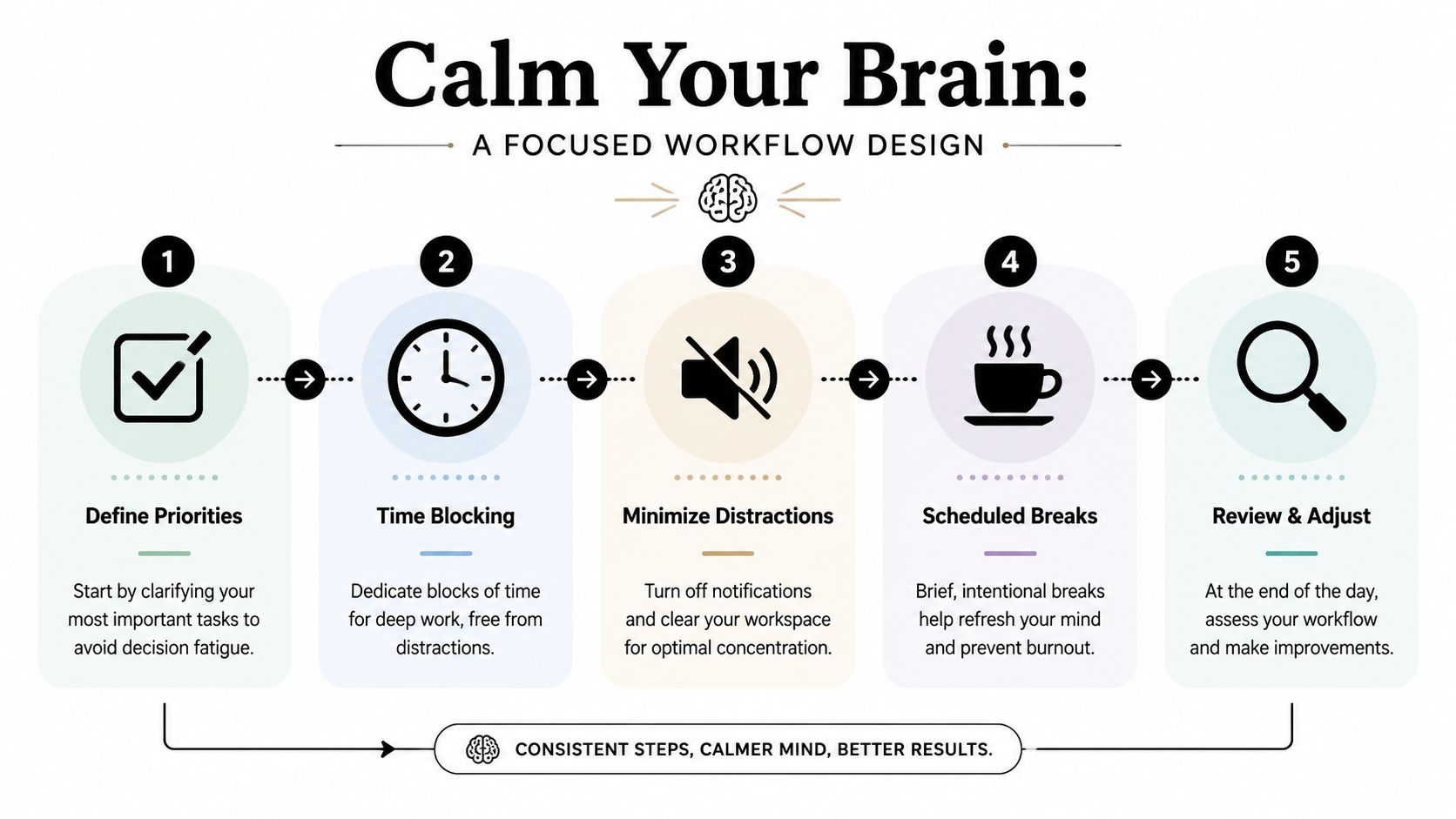
Design a Workflow That Calms Your Brain
A calm workday rarely happens by accident. It usually comes from a structure that reduces surprise, cuts decision fatigue, and gives your mind clear edges.
For anxious people, that's more than a productivity preference. Predictability lowers mental strain. When your day has shape, your brain spends less energy figuring out what to do next.
Work in blocks your brain can actually sustain
One of the most helpful findings here is that the brain operates optimally in focused work blocks of 60 to 90 minutes, and using this rhythm with short breaks improves focus scores and activates parasympathetic nervous system recovery, according to Memtime's deep work overview. In plain language, your brain does better when you focus for a while, then recover before pushing again.
A simple pattern looks like this:
| Work phase | What to do |
|---|---|
| Start | Choose one clearly defined task |
| Focus block | Work for 60 to 90 minutes in single-task mode |
| Short break | Step away for 5 to 10 minutes |
| Return | Begin the next block only after deciding the one task |
This structure helps because it answers two questions anxious brains ask all day. What am I doing right now? and When do I get to rest?
Build a calmer daily rhythm
A workflow doesn't need to be fancy. It needs to be clear enough that you can follow it even on a stressed day.
Try this sequence:
- Begin with a short planning window. Write down your tasks before opening reactive channels.
- Group similar work together. Batch emails, admin, meetings, and creative work instead of bouncing between them.
- Protect one high-focus block early. Put your mentally demanding work before your brain gets scattered.
- Take breaks on purpose. Don't wait until you're fried.
A good schedule doesn't squeeze more out of you. It gives your attention fewer places to leak.
Reduce friction in your environment
Your setup matters too. If your workspace is chaotic, your mind often feels the same way. Clear the desk. Silence nonessential notifications. Keep only the tab or tool you need for the task in front of you.
Small rituals can also help. A notebook opened to today's priorities. Headphones that signal focus. A short breathing pause before beginning a work block. These cues tell your brain, “We know what we're doing now.”
If you need more guided support for calming routines and coping skills outside the work task itself, these anxiety coping guides and tools can help you build a system that feels manageable. The most effective workflow is the one that lowers chaos enough for your mind to stay put.
Manage the Intrusive Thoughts That Steal Your Focus
Sometimes the biggest distraction isn't your phone or inbox. It's the running commentary in your head.
Anxious thoughts don't just sit in the background. They interrupt, warn, predict, and rehearse. You may be trying to finish a spreadsheet while your mind insists on replaying a tense meeting or forecasting every possible mistake.

Name the thought pattern before you obey it
A useful CBT skill is learning to spot a thought without instantly treating it like a fact.
Here are a few common patterns that wreck focus:
Catastrophizing
“If I make one mistake on this report, everyone will lose trust in me.”Mind reading
“My manager sounded brief. They must be disappointed in me.”All-or-nothing thinking
“If I can't do this perfectly, there's no point starting.”
Once you name the pattern, the thought often loses some force. You don't have to win an argument with it. You just need enough distance to return to the task.
Put worries somewhere other than your head
Try a thought journal or a quick “thought parking” note. Write down the worry in one sentence. Then add two lines:
- What is the thought saying
- What do I need to do right now
Example:
| Prompt | Example response |
|---|---|
| Thought | “I'm going to miss something and get blamed.” |
| Right now | “Review the email draft once, then send it.” |
This keeps the thought from floating around uncontained. You've acknowledged it, but you haven't handed it control.
Another option is scheduled worry time. If worries keep intruding, tell yourself, “I'll come back to this at 4 p.m. for ten minutes.” That sounds simple, but it teaches your brain that not every fear needs immediate attention.
Here's a short video that can support this shift toward calmer attention:
Choose one anchor task
One of the most practical ways to reduce mental chaos is the anchor task. This means choosing one essential priority for the day. According to James Clear's focus article, this approach can reduce decision overhead by 40 to 60%, which matters for anxiety because constant task-switching increases cortisol and anxiety symptoms as the prefrontal cortex repeatedly reloads task parameters.
That doesn't mean you only do one thing all day. It means one task becomes your home base. When your mind starts spinning, you return there.
When your brain is noisy, one clear priority is often kinder than a long ambitious list.
A good anchor task is specific. Not “work on presentation.” Try “write the opening three slides” or “edit the budget section.” Specificity lowers resistance.
If your anxiety includes fear of your own fear response, this can overlap with https://anxietychecklist.com/phobophobia-fear-of-fear. In that case, focusing may feel hard because part of your mind is also monitoring your body for signs of panic. That pattern can soften with practice, especially when you stop demanding perfect calm before you begin.
Build Sustainable Focus with Long-Term Habits
Short-term tools matter. Long-term habits matter just as much.
If your brain is overstimulated, under-rested, and interrupted all day, focus becomes fragile. You may still get things done, but it costs more energy than it should. Building steadier concentration means caring for the conditions that attention depends on.

Protect your attention like it matters
It does matter. After an interruption, it takes an average of 23 minutes and 15 seconds to get back on task, and knowledge workers switch apps and windows every 40 seconds, according to these workplace focus findings. If your day feels mentally chopped into pieces, that helps explain why.
That's why habits around attention protection aren't extra. They're basic care.
Consider these examples:
- Create phone boundaries. Put the phone out of reach during focus periods if possible.
- Close what you're not using. Fewer open windows means fewer invitations to escape.
- Use set check-in times. Read email and chat at planned moments instead of all day.
Strengthen the roots of focus
Focus improves when your body gets regular signals of safety and recovery. Three habits often help most.
Sleep
Sleep is where your brain restores a lot of what attention needs. If sleep has been rough, don't shame yourself. Start with a gentler wind-down, a more consistent bedtime, or less stimulating screen use before bed.
Movement
Movement helps stress move through the body instead of getting stuck there. This doesn't have to mean intense workouts. A walk after work, stretching between tasks, or standing up during breaks can all help.
Digital recovery
Many people never give their mind a true pause. There's always one more notification, one more tab, one more quick check. Small digital boundaries help your brain recover from constant novelty.
A simple weekly reset might look like this:
- One screen-free meal
- One short walk without podcasts
- One evening with apps silenced
- One planned review of what helped focus that week
A grounding reminder: Sustainable focus is less about pushing harder and more about recovering well enough to return.
If you want to turn these habits into something realistic instead of idealistic, The Anxiety Checklist's SMART goals resource can help you set goals that are clear and small enough to keep. Lasting progress usually starts that way. Not with a dramatic overhaul, but with repeatable actions your nervous system can trust.
Your Path Forward to Calm and Focused Work
The path to better focus at work is rarely one trick. It's a layered approach.
Some days you'll need immediate grounding because anxiety is loud and your body feels flooded. Other days, a key solution is a calmer workflow, a protected focus block, or one anchor task that stops your mind from scattering in ten directions. Over time, stronger habits around sleep, movement, and digital boundaries make focus feel less like a daily battle.
That's the hopeful part. You can learn this. You can heal your relationship with work. You can become more focused without becoming harder on yourself.
If your concentration problems come with frequent panic, intense dread, sleep loss, or a level of distress that affects daily life, it's wise to talk with a therapist, doctor, or another qualified mental health professional. Support matters, especially when anxiety has been running the show for a long time.
Try to think in terms of practice, not perfection. Calm attention is built. It grows each time you pause before spiraling, each time you return to one task, and each time you respond to your anxiety with skill instead of shame. That's how you move from overwhelm toward control. And for many people, it's also part of the deeper work of living more freely and feeling less afraid.
If you want extra support putting these ideas into practice, The Anxiety Checklist is a helpful companion. It offers real-time SOS support for overwhelming moments, plus guided tools for grounding, journaling, sleep, and long-term anxiety recovery. If your goal is to feel calmer, work with more focus, and move toward a more panic-free life, it gives you a practical place to start.