



If you're reading this right after a panic attack, you might still feel shaky, embarrassed, or afraid of the next one. Maybe part of you knows it was panic, but another part is still asking, “What if something is seriously wrong with me?” That aftermath can feel lonely in a way that's hard to explain to people who haven't lived it.
Panic disorder often shrinks a person's world. You start tracking exits, scanning your body, avoiding places, and wondering whether anyone else understands how exhausting it is to fear your own nervous system. The good news is that many people do understand. Panic disorder support groups exist for exactly this reason. They offer a place where you don't have to translate your experience before being believed.
Table of Contents
- You Are Not Alone on the Path to Healing
- What Are Panic Disorder Support Groups Really Like
- The Healing Power of Shared Experience
- Choosing the Right Support Group for You
- How to Find and Safely Join a Group
- Your First Meeting and Getting the Most Out of It
- Beyond Groups Building Your Full Support System
You Are Not Alone on the Path to Healing
A lot of people reach support groups after months or years of trying to manage panic in private. They leave social events early. They sit in parking lots trying to calm down. They tell friends they're “just tired” when the truth is that they're scared of having another episode in public. From the outside, it can look like withdrawal. On the inside, it often feels like survival.
That isolation is one of the cruelest parts of panic disorder. The symptoms are intense, physical, and frightening. Then comes the self-doubt. You may wonder whether anyone would understand why a grocery store, a highway, or a meeting suddenly feels impossible.

Panic disorder support groups can interrupt that cycle. They aren't about forcing you to “be positive” or retell painful moments for drama. They're about being with people who recognize the fear, the body sensations, the avoidance, and the courage it takes to keep trying. For many people, hearing “me too” lowers shame.
You don't have to be fully confident to show up. You only have to be willing to be around people who get it.
Connection doesn't cure panic by itself, but it can make healing feel possible again. If you've been searching for tools, education, and a calmer place to start, anxietychecklist.com can also point you toward practical next steps. The main message is simple. You are not broken, and you are not the only person walking this road.
What Are Panic Disorder Support Groups Really Like
Think of a support group as a room full of travelers comparing maps after getting lost in the same difficult terrain. Nobody claims the road is easy. But people share what helped them through the steep parts, what made things worse, and what gave them enough confidence to keep moving.
That's the heart of panic disorder support groups. They create shared understanding, practical encouragement, and a place to speak openly without worrying that you'll be judged for symptoms other people can't see.
What usually happens in a support group
Most groups have a simple rhythm. People check in, talk about recent struggles or wins, and share coping ideas that have helped them handle panic, avoidance, or anticipatory anxiety. Some groups focus on open discussion. Others use a theme such as leaving the house, riding out body sensations, or rebuilding daily routines.
You might hear someone describe the fear that starts before a commute. Another person may talk about how they stayed in a store a little longer than usual. These moments matter because they turn recovery into something concrete, not abstract.
A helpful outside resource for understanding panic in plain language is Therapy with Ben's anxiety and panic guide. It can give you a steady overview if you're still trying to put words to what you've been experiencing.
Support group versus group therapy
This part confuses many people, so it's worth making it clear.
Support groups are usually centered on peer connection. People learn from one another's experiences, offer encouragement, and reduce the sense of being alone. Some are peer-led. Some have a facilitator who keeps the conversation safe and focused.
Group therapy is a clinical treatment. It's typically led by a licensed mental health professional and follows a more structured treatment plan. The group may work on specific therapeutic skills, patterns, or exercises over time.
Here is a simple way to understand it:
- Support group: “I'm not alone, and I can learn from others who live this.”
- Group therapy: “I'm receiving structured treatment in a group setting.”
Both can help. Some people use both at different times in recovery.
Practical rule: If you want community, validation, and shared coping ideas, a support group may fit. If you need diagnosis, treatment planning, or clinician-guided interventions, group therapy or individual therapy may be the better starting point.
If panic has become frequent, intense, or confusing, it can also help to learn more about managing a chronic panic attack. Understanding your symptoms often lowers the fear attached to them.
The Healing Power of Shared Experience
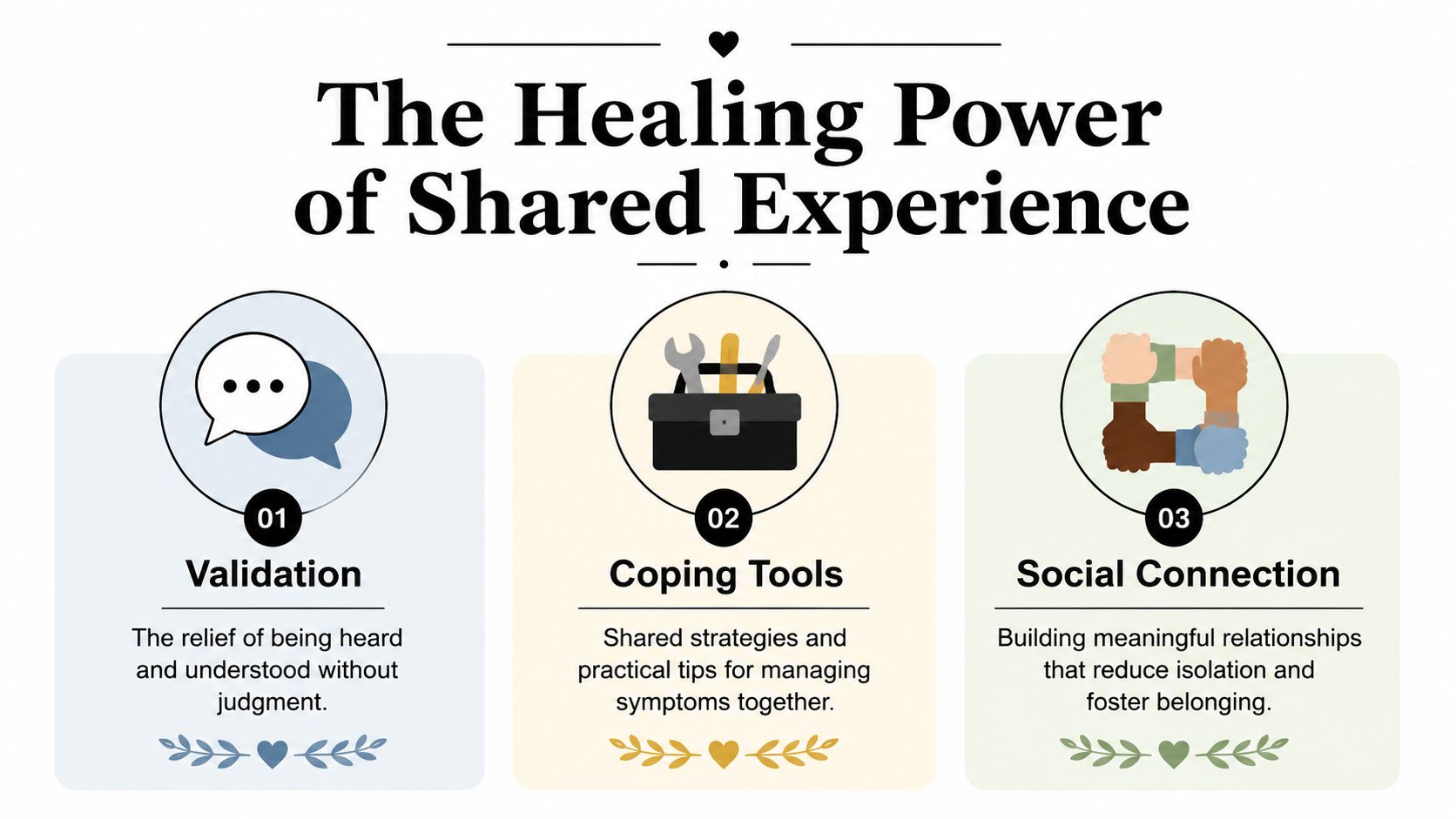
When people talk about support groups helping, they sometimes make it sound vague. It isn't vague. Several healing processes happen when you sit with people who understand panic from the inside.
First, shame starts to loosen. Many people with panic disorder assume they're weak, dramatic, or failing at basic life tasks. Then they hear someone else describe the same body sensations, the same avoidance, the same fear of fear. That recognition matters.
Second, people learn by watching. In psychology, this is often called vicarious learning. When you see another person stay with discomfort and come out the other side, your brain gets a new reference point. Panic stops looking like an unbeatable force and starts looking like something human beings can face.
Why groups can reduce anxiety
A 2022 randomized controlled trial examined a web-based group self-management support program added to usual treatment for anxiety disorders. It was designed to achieve a 7-point reduction in anxiety symptoms on the Beck Anxiety Inventory, compared with a 3-point reduction for treatment-as-usual alone, which supports the added value of structured group support (trial details).
That doesn't mean every group will feel life-changing right away. It does mean group-based support isn't “just talking.” Structured connection can support measurable symptom change.
What people often gain from other members
The benefits are often practical as well as emotional:
- Validation that calms the nervous system: Hearing “that happens to me too” can reduce the alarm that comes from feeling strange or alone.
- Borrowed coping tools: Members often share what helps them stay grounded before, during, and after panic.
- Hope with evidence: You watch people improve in real time. That kind of hope feels more believable than generic reassurance.
- Gentle accountability: Returning each week can help you keep practicing instead of retreating.
For people who struggle with coping with fear of anxiety itself, this kind of shared learning can be especially powerful. The group doesn't erase fear. It helps make fear less mysterious, less shameful, and less in charge.
People often heal faster when panic is no longer a private battle.
Choosing the Right Support Group for You
Not all panic disorder support groups feel the same. Some are informal and peer-led. Others are more structured and clinician-led. Some meet in church basements or community centers. Others happen on video calls from your bedroom, your parked car, or your office between appointments.
The best choice is the one you will use. A perfect-sounding group that doesn't fit your schedule, budget, or comfort level won't help much.
Four common formats
Here are the main options people tend to find.
| Group Type | Best For | Potential Cost | Structure |
|---|---|---|---|
| Peer-led in-person | People who want local connection and face-to-face support | Often free or low-cost | Usually conversational and community-based |
| Clinician-led in-person | People who want more structure and professional guidance | Often higher cost | More organized, with therapeutic direction |
| Peer-led online | People who need flexibility, privacy, or access from home | Often free or low-cost | Varies widely, from casual check-ins to themed discussion |
| Clinician-led online | People who want structure without travel | Often moderate to higher cost | Structured sessions led by a licensed professional |
How to decide
A few questions can make the decision easier.
If being around people in person feels grounding, an in-person group may help you feel more connected. If travel, agoraphobia, or privacy are bigger barriers, an online group may be much easier to attend consistently.
If you want discussion and mutual support, peer-led may be enough. If you know you need a firm container, a clinician-led option may feel safer and more useful.
You can also consider whether social fears are part of the picture. If they are, a smaller online setting may feel like a gentler starting point while you're coping with social anxiety in daily life.
Is group treatment “less effective” than individual care
Many people worry that choosing a group means settling for a weaker option. The evidence doesn't support that assumption. A major meta-analysis of 15 randomized controlled trials involving 864 adult patients found that group psychotherapy for panic disorder produced large, significant reductions in panic symptoms. When compared directly with individual CBT or pharmacotherapy, there were no significant differences in effectiveness, which suggests group treatment can be an equally strong option (meta-analysis summary).
That finding gives people permission to choose based on fit, not stigma. Some people thrive with one-on-one attention. Others do better when recovery happens in the company of peers. Neither choice is inferior.
Good fit beats idealized fit. The right group is the one that feels safe enough to return to and useful enough to keep practicing what you learn.
How to Find and Safely Join a Group
Finding a group can feel harder than it should. You finally decide to reach out, and then you're met with outdated directories, vague descriptions, or meeting times that don't work with real life. That frustration is common.
A steady approach helps. Instead of joining the first listing you see, look for signs that the group is active, clear about expectations, and appropriate for your needs.
Where to look first
These sources are commonly used starting points for support group searches:
- NAMI directories: Good for community-based mental health support and local chapters.
- ADAA listings: Often useful for anxiety-focused resources and referrals.
- Psychology Today profiles: Helpful when you're looking for clinician-led groups in your area or online.
If you want to build your understanding alongside your search, a free anxiety education hub can help you sort through symptoms, terminology, and coping concepts while you're deciding what kind of support fits best.
Safety signs to check before joining
Before your first meeting, scan for a few basics.
- Clear confidentiality expectations: Members should know what stays inside the group.
- Defined group guidelines: Good groups set rules for respectful sharing, time boundaries, and crisis situations.
- Facilitator transparency: If the group is clinician-led, the facilitator should state their credentials and role clearly.
- Realistic scope: A support group should not present itself as emergency care or a substitute for urgent medical or psychiatric help.
If the information is vague, it's okay to email or call first. You can ask whether new members are welcome, whether cameras are required in online meetings, and whether you can attend once just to observe.
The support group timing problem
A major barrier is simple scheduling. Fixed meeting times can shut people out. One noted challenge with traditional groups is the “support group timing problem,” where rigid schedules such as “every other Monday at 7 p.m.” make attendance difficult for working professionals, caregivers, and people across time zones (accessibility discussion).
That's not a small issue. If support is only available when you're unavailable, it stops being support in any practical sense.
This short video can help if you're weighing whether online formats feel more manageable than traditional meetings.
If schedules keep blocking you
When live groups don't fit, people often do better with a layered approach:
- Join a live group when you can, even if attendance isn't perfect.
- Use on-demand tools between meetings so support isn't limited to one evening slot.
- Keep a short list of coping practices for moments when panic hits outside group hours.
- Reassess every few weeks to see whether the format is helping or whether you need a different one.
A support plan doesn't have to be elegant. It has to be usable on ordinary days and hard days.
Your First Meeting and Getting the Most Out of It
Your first meeting may feel awkward before it feels helpful. That's normal. Many people log in or walk in with the same thought: “What if I freeze, cry, or say the wrong thing?” Most groups are used to newcomers arriving guarded.
A typical meeting often begins with brief introductions and a few ground rules. You may hear reminders about confidentiality, respectful listening, and the fact that nobody has to share more than they want to. Then the group moves into check-ins or a discussion topic.
What to expect in the room
Some people speak right away. Others listen for several meetings before saying much at all. Both are acceptable.
You might hear stories that sound surprisingly familiar. A foundational study of anxiety support groups found that participants often came with complex clinical pictures. In that study of 151 subjects, 88 subjects (94%) at the Dallas site and 57 subjects (61%) at the Durham site met criteria for at least one current anxiety or affective disorder, and more than half of those with current panic disorder with agoraphobia also met criteria for at least one other anxiety disorder or major depression (study abstract). If you also struggle with low mood, avoidance, or another anxiety problem, you won't be the odd one out.
How to make the first few meetings easier
A few simple habits can lower pressure and help you stay long enough to benefit:
- Arrive with one sentence ready: Something as simple as “I'm new and mostly here to listen” is enough.
- Notice your body without making it a verdict: Fast heartbeat, sweating, or dizziness don't mean you've failed. They often mean you're doing something brave.
- Write down one useful takeaway: It could be a phrase, a coping idea, or just the relief of seeing people be honest.
- Give it more than one try: A single meeting may tell you whether a group feels safe, but it may not show you its full value.
“You can let the first meeting count as practice, not a performance.”
What helps over time
The people who get the most out of panic disorder support groups usually aren't the most polished or outgoing. They're the ones who keep showing up, stay open to learning, and let trust build gradually.
If a group leaves you feeling consistently dismissed, overwhelmed, or unsafe, that's useful information. It doesn't mean support groups aren't for you. It may mean that particular group isn't the right match.
Beyond Groups Building Your Full Support System
Support groups can be powerful, but they work best as part of a broader recovery system. Some people need a formal diagnosis. Some need medication support, individual therapy, or exposure-based treatment. Some need practical tools for the middle of a workday when panic starts rising and there isn't a meeting to attend.
Healing usually gets stronger when support comes from more than one direction. A group can give you belonging. A therapist can help you build a treatment plan. Daily self-help tools can help you practice between sessions. Education helps you understand what your body is doing so panic feels less chaotic.
Family members matter here too. There's a real gap in resources for loved ones. Many organizations offer groups for individuals, but there is little structured guidance for family members and friends who want to support someone with panic disorder while managing their own stress, which highlights the need for more family-inclusive resources (NAMI support group information). If you're supporting someone you love, you may need your own education, boundaries, and emotional support, not just instructions on what to say during a panic episode.
The larger truth is hopeful. Recovery doesn't depend on one perfect solution. It grows through repeated experiences of safety, understanding, skill-building, and connection. Panic may have taught you to expect danger from your own body. Support can teach you something new. You can heal, and life can become bigger again.
If you want support that meets you both in the moment and over time, The Anxiety Checklist is a practical next step. It offers an always-free SOS mode for immediate panic relief, along with guided tools, CBT-based self-therapy features, and educational resources that can support both individuals and loved ones who are learning how to manage anxiety with more confidence.