


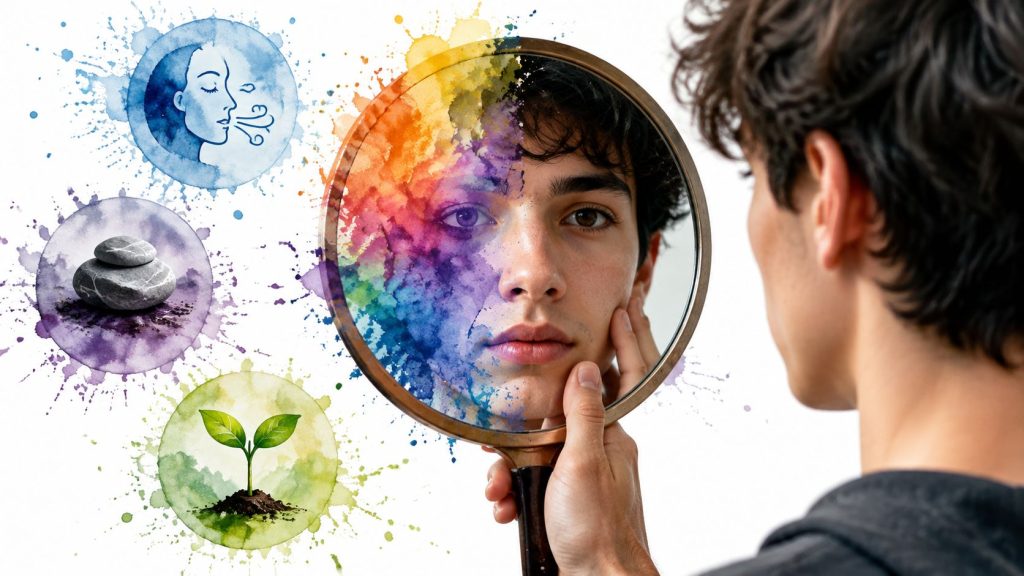
You're getting ready for something ordinary, maybe a meeting, a date, a photo, a class, or just a day when you want to feel like yourself. Then the mirror catches you at the wrong angle, and suddenly your face, skin, hair, posture, or clothes feel like they're on trial. The same reflection that was neutral a minute ago starts handing down judgments you didn't ask for.
That spiral can feel embarrassing, but it isn't a character flaw. Appearance anxiety is a learned loop, and learned loops can be unlearned. That's the hopeful part most advice skips. You don't need a pep talk that says “just be confident.” You need a clear path that helps you calm the body in the moment, change the story underneath the panic, and reshape the environments that keep pulling the loop back online.
If you've ever tried to “think positive” and still ended up checking the mirror again, you're not alone. A better starting point is to see what's happening with more precision, then choose the right response. Some people need anxiety grounding exercises first, some need help with self-talk, and some need a bigger change in how they relate to identity, comparison, and the digital spaces they spend time in.
Table of Contents
- The Moment Your Reflection Starts Talking Back
- What Appearance Anxiety Is
- How Common It Is and What Drives It
- In-the-Moment Tools That Help
- The Longer-Term Plan for Real Change
- How Supporters and Therapists Can Help
- When to Get More Help and What to Ask For
- A First Week Toward Feeling Like Yourself
The Moment Your Reflection Starts Talking Back
You've probably had this happen in a bathroom mirror, a car window, a phone camera, or a dressing room under unforgiving light. You were fine until you noticed one feature, then another, then the imagined reaction of everyone who might see you. The room didn't change, but your attention did, and once that shift happens, every glance can feel loaded.
That's the beginning of the loop. A person sees a feature, feels alarm, and starts treating that alarm as evidence that something must be wrong. If you need a practical place to start, a short set of anxiety grounding exercises can help interrupt the spike before it turns into a full day of checking and hiding.
A small outside perspective can also help when you're stuck on one detail, especially with glasses, frames, or other style choices that can make the face feel “wrong” only because you're exhausted and hyper-focused. A useful example is this Style Site Optical frame guide, which shows how styling decisions can be approached calmly rather than as a judgment on your appearance.
Practical rule: the moment you notice yourself scanning for flaws, treat that as a signal to slow the body down first, not to solve your appearance in the mirror.
What matters most is this. Appearance anxiety is a loop, not a verdict. The feeling is real, but the conclusion it pushes you toward isn't automatically true. The rest of this guide builds from that point, first by defining the loop, then by showing how to calm it, and finally by changing the deeper patterns that keep it alive.
What Appearance Anxiety Is
A person notices a feature in the mirror, then feels their mind lock onto it. The face is the same face, but it starts to feel like a problem that has to be solved before the day can continue. That experience is one common form of appearance anxiety. It is a fear about how you look and how other people may judge that appearance, and it can keep pulling attention back to the face, body, clothes, hair, skin, or movement.
The feeling is more than ordinary self-consciousness. Ordinary self-consciousness may pass once you leave the room or get busy with something else. Appearance anxiety keeps returning, like a song stuck on repeat, and it often pushes a person toward checking, hiding, or avoiding. A change in expression, a photo, a bright light, or even a passing glance can start the loop again.
The loop that keeps it alive
The pattern usually shows up in three clusters, threat monitoring, camouflaging, and avoidance. Threat monitoring means scanning mirrors, photos, angles, or other people's faces for signs of danger. Camouflaging means trying to cover, fix, or control the feature that feels exposed. Avoidance means skipping events, cameras, bright lighting, eye contact, or anything else that might trigger shame.
A short scenario makes this easier to see. Someone checks a reflection, feels alarm, adjusts their hair, avoids a photo, and then feels brief relief. The relief teaches the brain a false lesson. It says, “The danger was real, and escaping kept me safe.” Over time, the alarm system becomes more sensitive, the way a smoke detector starts going off from the smell of toast.
A useful analogy is a smoke detector that lost its calibration. It still responds to real danger, social judgment does exist, but it starts sounding the alarm far too easily.
Where it ends and where it doesn't
Appearance anxiety overlaps with body image dissatisfaction and social anxiety, but it occupies a distinct space between the two. Body image dissatisfaction is broader discomfort with shape or size. Social anxiety is a wider fear of judgment in social situations. Appearance anxiety sits where those concerns meet and stays focused on how the body might be evaluated by others.
A more complete picture of social anxiety and fear of judgment helps here, because a lot of appearance fear is really about anticipated rejection. That is why a face, a haircut, or something like lip enhancement can feel loaded with meaning far beyond the physical change itself.
It can also overlap with body dysmorphic disorder when distress becomes clinically significant and starts interfering with life. In BDD, the person's preoccupation causes real impairment, and repetitive checking, fixing, hiding, or reassurance-seeking can take over daily functioning. That boundary matters because it shows when self-help may be enough and when screening or treatment should enter the picture.
Once the loop is clear, the next question becomes simpler. You can start choosing where to intervene, on the body in the moment, on the thoughts underneath it, or on the environment that keeps feeding it.
How Common It Is and What Drives It
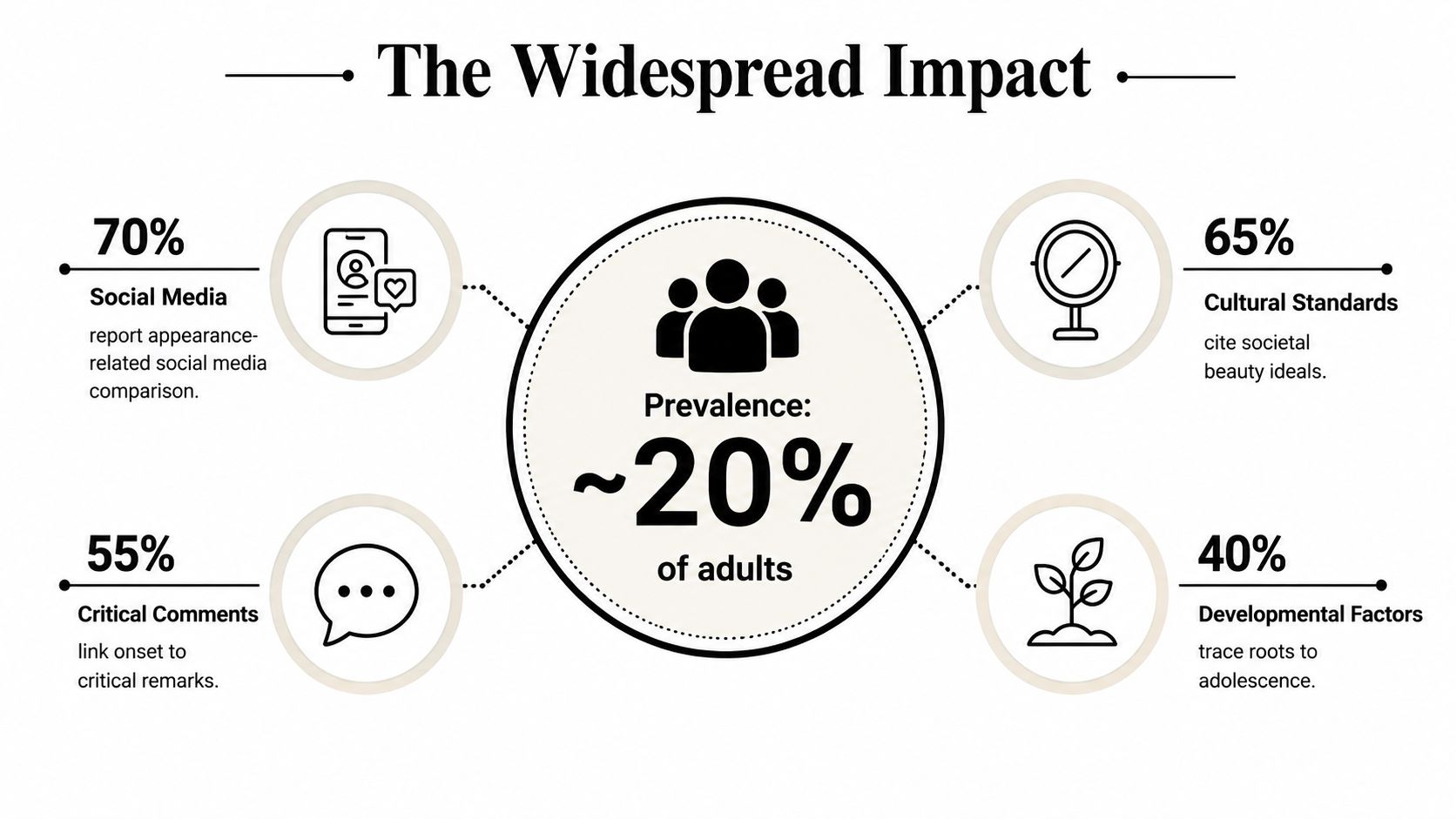
Appearance anxiety can feel private, yet it shows up at population scale. Harvard T.H. Chan School of Public Health estimated in 2019 that 45 million people in the U.S. aged 10 and older, about 16% of that population, were severely affected by body dissatisfaction, and 66 million, about 18%, experienced appearance-based discrimination. The burden also varies by age and sex, which tells us this is not confined to one narrow group. For example, prevalence was 19.2% for females ages 10 to 24 versus 12.2% for males in the same age band, and it rose to 24.8% for females ages 45 to 54 (Harvard T.H. Chan School of Public Health report).
Why it feels bigger than “being insecure”
A classroom is a good place to see the pattern. One student starts comparing skin, another checks the camera angle before speaking, and soon the room feels like a quiet contest. In a 2021 survey of 2,063 Chinese college students, 59.03% had some level of appearance anxiety, and total prevalence across severity levels reached about 62%. In that dataset, 9.09% of male students had severe appearance anxiety, a reminder that this concern is not limited to women (Chinese college student survey).
That scale changes how you should think about the issue. If many people are dealing with it, the question is not, “Why am I weak?” The better question is, “What keeps normal self-awareness turning into distress?” Research points to self-esteem, body shame, social comparison, and even self-identity confusion as drivers, not appearance alone. A conceptual paper on identity and appearance anxiety describes this as a loop in which how someone sees their body becomes tied to how they read their worth and place with other people (conceptual paper on identity and appearance anxiety).
The relational and digital layer
The online environment matters because appearance anxiety is social before it feels private. Social-media-heavy spaces can intensify comparison loops, and body talk in networking environments can make appearance feel like a public scorecard rather than a personal experience. A useful frame is to ask whether some feeds, group chats, or relationships are repeatedly teaching your brain to look for flaws.
That is also why changing the environment can matter as much as changing the thought. If your phone keeps serving idealized beauty content, even a well-meaning conversation about a lip enhancement trend can become another comparison trigger instead of a neutral topic. The helpful move is often to notice what reliably inflames the loop and edit the environment accordingly.
For a broader map of the patterns behind anxiety, the page on underlying anxiety triggers can help you sort appearance fear from other stressors that may be amplifying it.
In-the-Moment Tools That Help
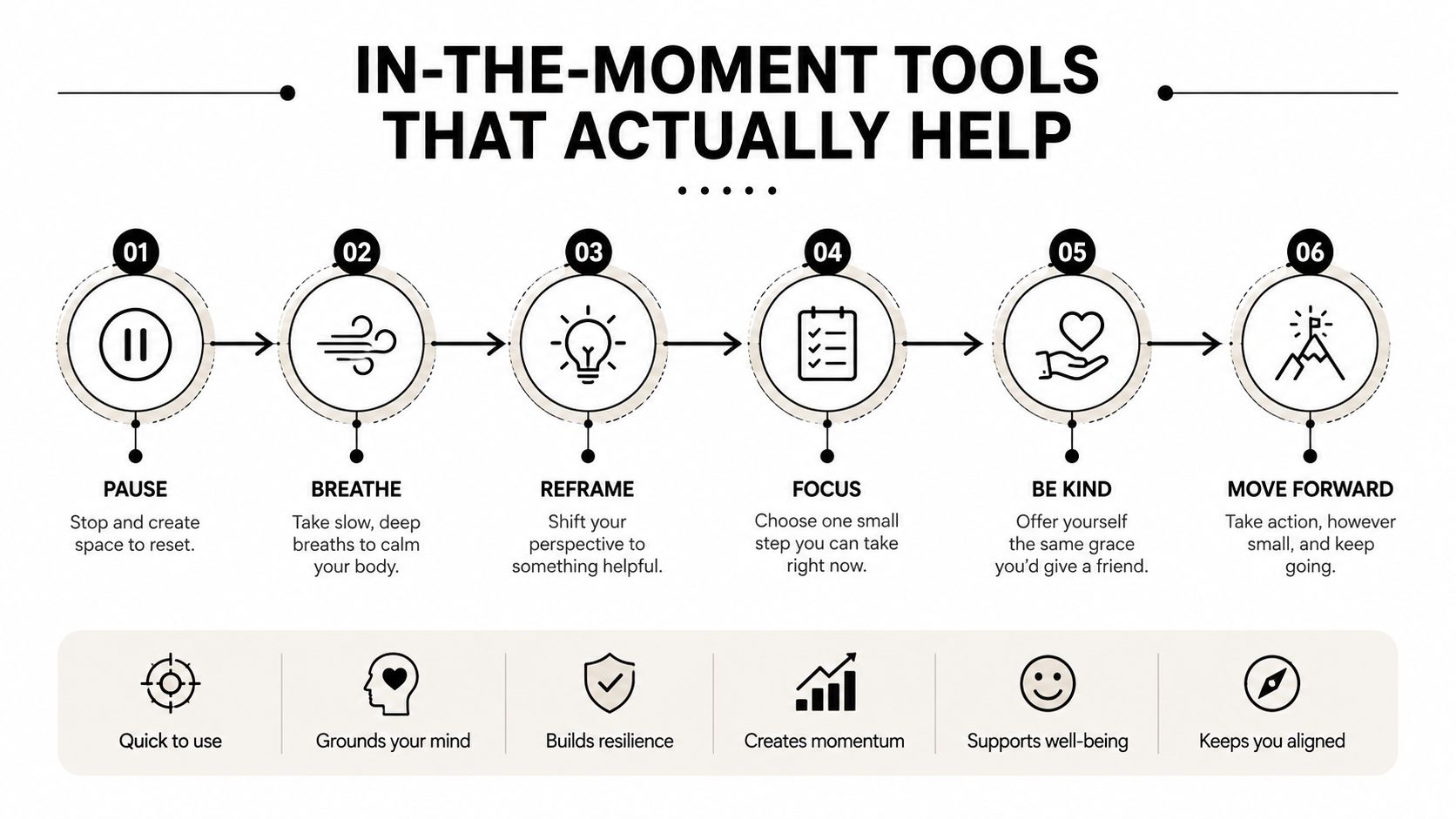
A mirror moment can feel like a trap. Your mind starts zooming in on one feature, then another, until the rest of the room fades away. The goal in that moment is not to feel beautiful. It is to keep the spiral from taking over the next ten minutes, so your body has a chance to settle and your thinking can come back online.
A short SOS sequence
Start with the room around you. Name five things you can see, four you can touch, three you can hear, two you can smell, and one you can taste. That 5-4-3-2-1 sequence gives your attention a concrete task, which helps pull it away from the threat scan. Say to yourself, “I'm here, not in the mirror. I'm in this room, and I'm safe enough right now.”
Then slow your breathing by lengthening the exhale. Try inhaling for four counts and exhaling for six. The point is not perfect rhythm, it is to signal to your nervous system that the emergency is easing. If you want a guided version, you can try The Anxiety Checklist method and let a structure carry the counting for you.
Next, separate the thought from the fact. Say, “I'm having the thought that people are judging me. That is a thought, not proof.” Appearance anxiety often turns prediction into certainty, the way a smoke alarm can make a small cooking mistake feel like a house fire.
A simple script can help when your mind keeps demanding answers. “My mind is scanning for danger. I do not have to obey every alarm it makes.”
Why self-compassion belongs here
A 2023 Frontiers in Public Health study on appearance anxiety and social anxiety found that self-compassion partially mediated the relationship between the two, which means kinder self-talk can soften the fear that spills into social situations. That is why the next sentence should be short and plain. “This is hard, and I am allowed to be human right now.”
These tools interrupt the loop and steady the moment, while longer change still asks for repeated practice that reshapes what you believe, what you avoid, and what you keep exposing yourself to. They can also sit alongside the wider identity and environment work that helps appearance anxiety loosen its grip over time. If you want a fuller picture of how appearance-related change can be approached from a body-confidence angle, the ProMD Health Bel Air thread lift page shows how some people think about changes in a very different, highly targeted way.
The Longer-Term Plan for Real Change
Short-term calming helps, but lasting change comes from changing the pattern that taught your brain to fear the mirror. That usually means working on thoughts, behaviors, and identity at the same time.
Rewriting the belief, not just the mood
A cognitive behavioral therapy overview is useful here because CBT does not stop at “think positive.” It asks what you predict, what you do next, and what evidence you collect when you test those predictions. A thought journal might start with, “If I go out looking like this, people will notice and reject me,” then compare that prediction with what happened.
Belief experiments work the same way. If you normally wear heavy makeup, take repeated selfies, or avoid certain clothes, you can test one small change at a time and see whether the feared outcome shows up. That is how the brain learns through experience, not just insight.
Exposure with a ladder, not a leap
Exposure works best when it is voluntary and gradual. Start with the easiest avoided situation, then move up one step only after that step becomes less activating. A simple ladder might begin with taking one unfiltered photo, then leaving the room without checking it, then going to a casual event, then sitting under brighter lighting, then showing up on a day when you feel imperfect.
Practical rule: if the step feels impossible, it is too big. If it feels annoying but doable, you are probably in the right range.
Identity work matters. Some people are not only afraid of looking flawed, they are afraid of what that means about who they are. That is why the most effective shift is often, “My appearance is one part of me, not the definition of me.” A conceptual paper on self-identity confusion in emerging adulthood argues that this deeper question is often what people are really asking, not just how to manage looks-related distress.
That is also why appearance change and identity change can move in different directions. A ProMD Health Bel Air thread lift may fit one person's goals, while another person may need to pause appearance-focused decisions until the fear loop is quieter and more settled.
What six to twelve weeks can look like
Real progress often looks ordinary. You check less, avoid less, and recover faster when you do get triggered. You may still have hard days, but they do not hijack the whole week. In a structured plan, tools like SOS mode, CBT self-therapy exercises, sleep support, or a course such as the PanicFree Masterclass can sit around the work as reinforcement, not replacement.
The other change is environmental. Muting accounts that trigger comparison, trimming appearance-heavy feeds, and stepping back from conversations that center on flaw-finding can be just as important as the thought work. For some people, even a cosmetic discussion about a thread lift is too much during active recovery, not because procedures are bad, but because the brain is still learning not to turn every body-related topic into a verdict.
The best sign of progress is not perfection. It is that the mirror stops being the boss of the room.
How Supporters and Therapists Can Help
A friend usually knows something is wrong when the person starts changing clothes three times, asking for the same reassurance again, or canceling plans because of a “bad face day.” The first instinct is often to say, “You look fine.” That sentence is kind, but if it becomes the only response, it can accidentally teach the brain to keep asking.
What helps more than reassurance
Try validation first. “I can see this is really distressing for you.” Then move to curiosity. “What part of this feels strongest right now, the checking, the fear of being seen, or the urge to hide?” That kind of response keeps the person from feeling dismissed while also avoiding endless appearance reassurance.
Therapists can use the same principle between sessions. Structured CBT tools, thought journaling, exposure planning, and brief psychoeducation can keep the work active after the appointment ends. A toolset like that helps the person practice when the room is quiet and the shame feels louder.
For supporters, one good rule is to avoid becoming part of the ritual. If someone asks, “Do I look bad?” pause before answering. You can say, “I'm not going to rank your looks, but I will sit with you while the feeling passes.” That protects the relationship and the recovery.
A team approach that doesn't overwhelm
Busy clinicians often need between-session structure because insight alone doesn't interrupt a ritual. Digital tools can help with that continuity when they're used as support rather than a substitute for care. The right setup gives the person a place to log thoughts, plan exposure steps, and review what happened after the panic dropped.
Loved ones can help by tracking behavior, not debating appearance. If the person skipped a gathering, spent an hour in the mirror, or put on a different outfit ten times, those are the patterns worth noticing. The goal is gentleness with accountability, not scrutiny.
When to Get More Help and What to Ask For
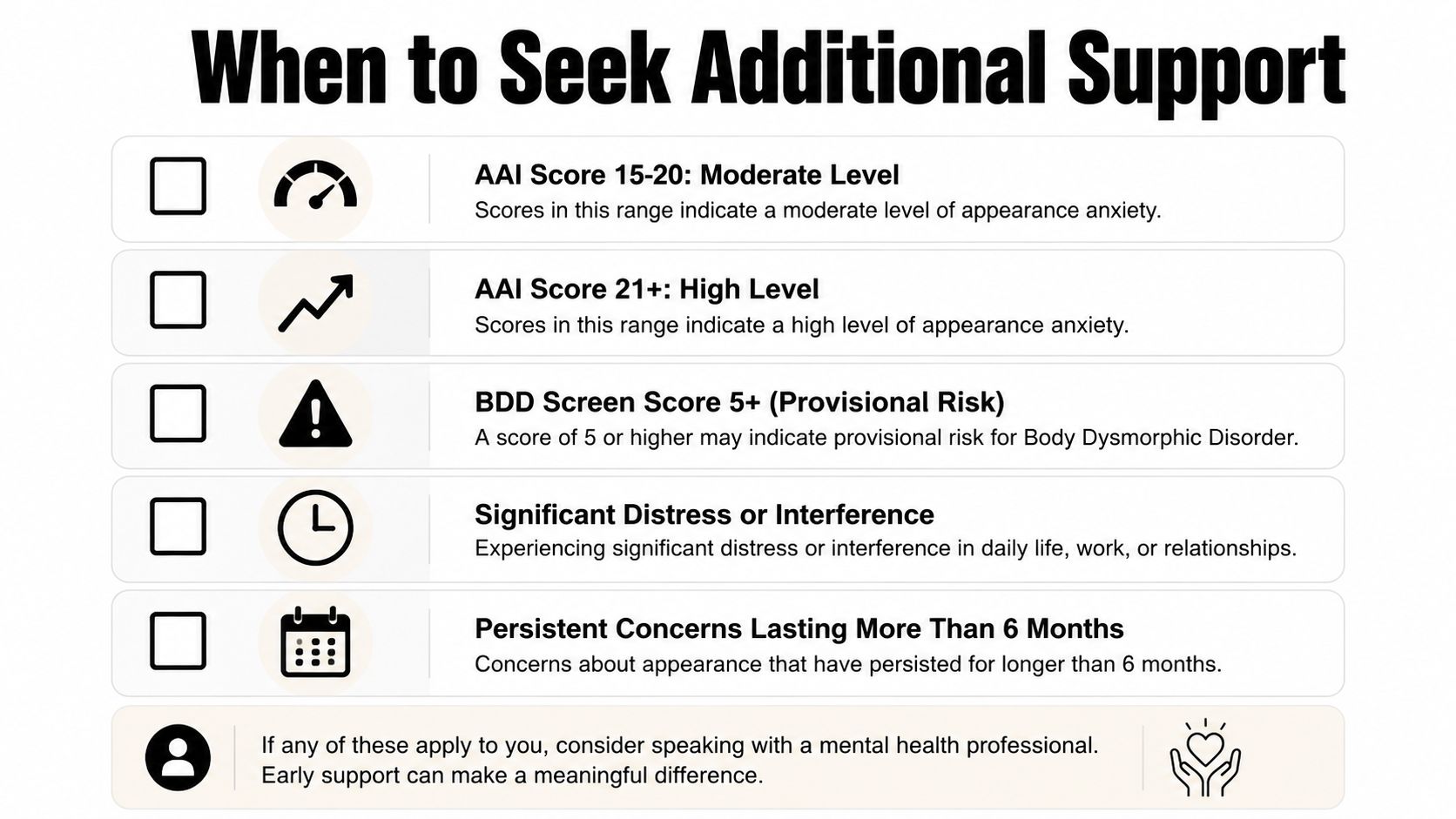
A lot of readers wonder whether this is serious enough to bring up with a professional. A good rule is to look at distress, impairment, and the amount of time the rituals take. If appearance concerns are taking over your relationships, work, or daily functioning, that's already a strong reason to ask for help.
Signs that screening makes sense
The Appearance Anxiety Inventory can give a practical benchmark. Published scoring guidance places 15+ in a moderate BDD-risk range and 20+ in a provisional BDD range, and validation work showed good one-week test-retest reliability with an intra-class correlation of 0.87 (AAI scoring guidance) (AAI overview). A validated Social Appearance Anxiety Scale was also designed specifically to measure fear of negative evaluation because of appearance, which helps clinicians distinguish broad worry from a more focused appearance-based fear (SAAS validation paper).
What a useful first appointment sounds like
Bring specific questions. Ask whether the clinician works with body dysmorphic disorder, appearance-related exposure, and rituals like mirror checking or reassurance-seeking. Ask how they decide whether the problem fits appearance anxiety, broader social anxiety, or BDD. If digital environments are clearly fueling the loop, say that plainly too.
The other challenge is the common belief that the answer is always more self-acceptance. Sometimes the stronger move is less exposure to appearance-saturated spaces, fewer comparison-heavy conversations, or firmer boundaries with people who keep the loop alive. Recovery isn't always about being more tolerant of everything. Sometimes it's about protecting your attention.
If the fear feels relentless, or the rituals feel bigger than your life, that's not a failure. It's a sign to bring in more support. Help works better when it's matched to the specific shape of the problem.
A First Week Toward Feeling Like Yourself
Keep the first week small. Practice one in-the-moment tool every day, even when you're not especially anxious, so your body learns the sequence before panic hits. Pick one short journaling prompt, one exposure step, and one digital change that reduces comparison pressure.
A simple starter plan can look like this. On day one, write down the main thought that shows up in the mirror. On day two, do one brief 5-4-3-2-1 grounding round. On day three, test one small avoided situation, then don't go back and “check” whether it went perfectly. On day four, mute one appearance-heavy account or reduce time in one comparison-heavy space.
By day five or six, ask a more honest question. “Is this manageable with self-help, or am I still stuck in the same loop?” If the answer is still stuck, that doesn't mean you failed. It means you may need a more structured plan, which is exactly what good help is for.
For readers who want a low-pressure place to start, resources like Anxiety University, the PanicFree Masterclass, and a free SOS mode can be helpful supports while you build the habit of responding differently. The point is not to perfect your face, your feed, or your confidence. The point is to train your nervous system to stop treating every reflection as an emergency.
You can heal from this. The loop was learned, and the same way it was learned is the way it can be unlearned, one breath, one sentence, one small step at a time, until the mirror becomes a mirror again.
If you want a calm place to keep going, start with The Anxiety Checklist. It offers practical support for panic and anxiety in the moment, plus tools that help with the deeper work behind appearance anxiety. Visit it today and choose one small step you can practice before the week is over.