



You're holding a child, a phone, a half-finished chore, and a mind that won't stop spinning. The sink is full, someone is crying, and your patience feels gone before the day is halfway over. That kind of overload doesn't mean you're failing, it means your system is maxed out, and parenting stress management is about helping that system recover, one workable step at a time.
There's real hope in that. Stress can shrink, panic can settle, and calm can become more familiar again, not because parenting gets perfect, but because your body and home life can learn safer patterns.
Table of Contents
- You Are Not Alone in Parenting Overwhelm
- Calming the Storm Immediate Relief Techniques
- Building Your Foundation with Daily Resilience Routines
- Rewriting the Script Through Communication and Boundaries
- Creating Your Personal Self-Care Blueprint
- When to Seek More Support and How to Find It
You Are Not Alone in Parenting Overwhelm
Some days, the stress hits all at once. The toddler melts down in the grocery store, the older child won't start homework, and you can feel your voice getting sharp before you've had a chance to slow down. In moments like that, it's easy to think you're the only parent barely holding it together, but the data says otherwise.
The American Psychological Association's 2023 analysis found that 33% of parents reported high stress in the past month, compared with 20% of other adults, and 48% of parents said their stress was completely overwhelming. That tells me two things. First, this is common. Second, it's serious enough that it deserves a real plan, not just a quick “try to relax” line that doesn't fit real family life. You can read more about support for postpartum and early parenting anxiety through this helpful postpartum anxiety relief resource, and if you want a broader starting point, a free anxiety education hub can help you understand what's happening in your body and mind.
Practical rule: if your stress feels overwhelming most days, the goal isn't to power through. The goal is to reduce load, restore safety, and give your nervous system a chance to settle.
Why that matters
Parenting stress doesn't stay neatly in your head. It changes how you speak, how fast you react, how much patience you have, and how safe the home feels. A parent who is chronically flooded can't easily access the calm tone, clear thinking, or flexible problem-solving that kids need.
That's why hopeful change starts with naming the problem accurately. You're not weak, lazy, or bad at this. You're dealing with a strain that many parents share, and strain can be managed.
Calming the Storm Immediate Relief Techniques
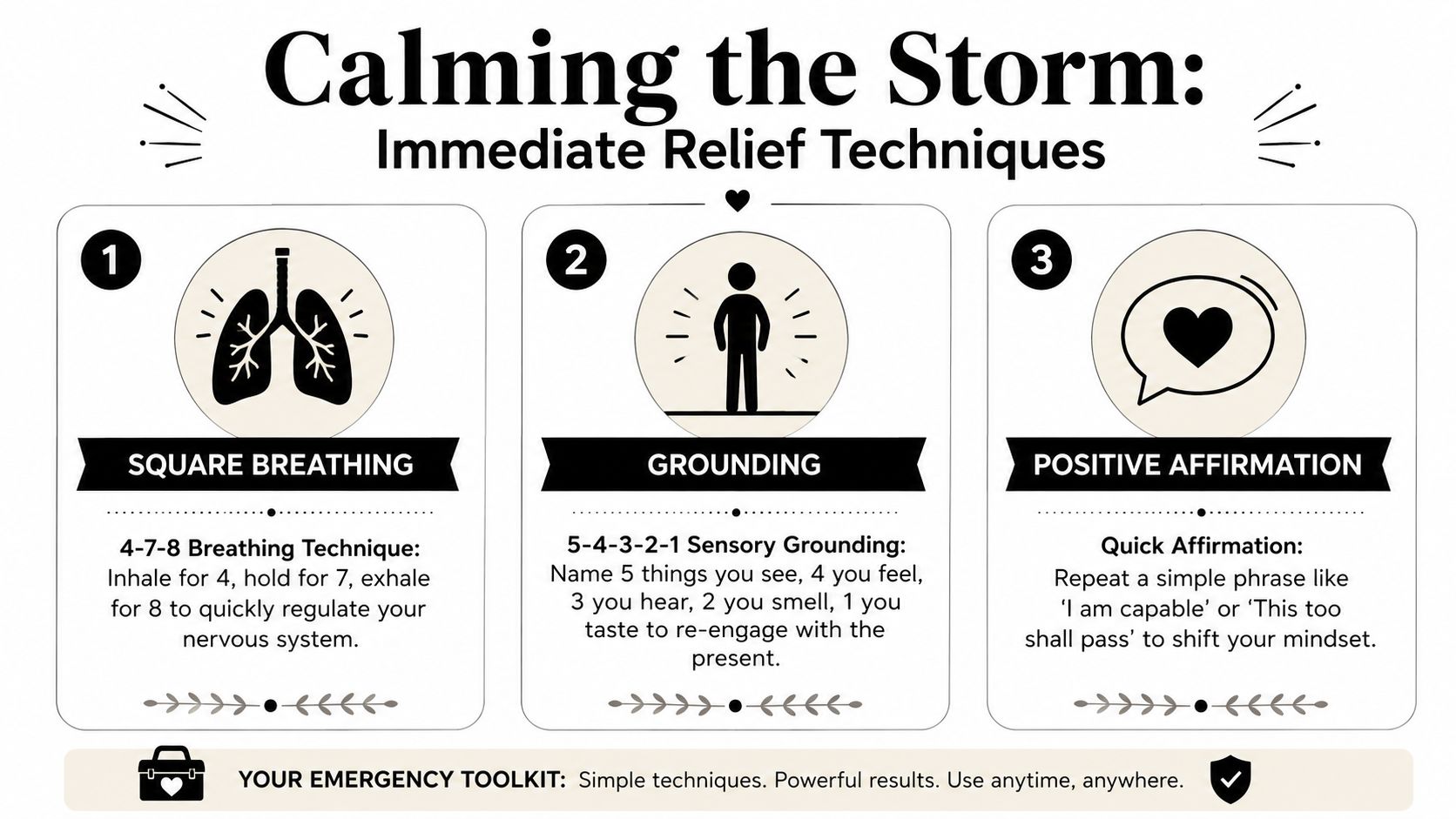
When stress spikes, the first job is not solving the whole family system. The first job is getting your body out of alarm mode enough to think clearly. These tools are simple on purpose, because simplicity is what works when your child is screaming and you've got ten seconds before you react.
Box breathing in a real-life moment
Sit if you can, or stand with both feet on the floor. Inhale through your nose for four counts, hold for four, exhale for four, and hold again for four. Repeat the cycle a few times.
If your child is having a tantrum in public, box breathing gives your body a rhythm that can interrupt the rush to yell or flee. It doesn't erase the situation, but it can lower the heat enough for you to respond instead of explode.
5-4-3-2-1 grounding when your mind is racing
Look around and name five things you see, four things you can feel, three things you hear, two things you smell, and one thing you taste. Do it without speaking aloud if you need privacy, or whisper it if that helps you stay focused.
This works well when your thoughts are spiraling, especially after a hard interaction with a child or partner. It pulls attention out of catastrophic thinking and back to the physical space you occupy. If you want more ways to calm an overactive mind, this is one of the most reliable places to start.
The tactical pause before you answer
Before you respond to the yelling, the backtalk, or the spilled juice on your last clean shirt, pause. Unclench your jaw, drop your shoulders, and count to five. Then speak.
A short pause is not avoidance. It's the space that keeps a hard moment from becoming a bigger one.
A systematic review of parenting programs found that active skills practice and emotion-focused support are linked with stronger reductions in parental stress than generic education alone, which is why these in-the-moment exercises matter so much source. The body learns calm by repeating calm, not by reading about calm once and hoping for the best.
Building Your Foundation with Daily Resilience Routines
Big recovery usually starts with small repetition. A parent doesn't need a perfect morning routine, an hour-long workout, or a silent house to build resilience. What helps most is a pattern of tiny, repeatable resets that teach the nervous system that calm can return during ordinary life.

Evidence-based cognitive behavioral stress management protocols for parents often use a multisession, competency-based model where skills are reviewed and practiced weekly, which reinforces the idea that resilience grows through repeated structure over time source. That logic fits home life too. A two-minute breathing break repeated most days will usually do more than one ambitious self-care afternoon that never happens again.
Build micro-breaks into what already happens
Think of micro-breaks as stress-reducing pauses that attach to existing routines. A few slow breaths while coffee brews, a shoulder roll after buckling a child into the car seat, or a minute of stillness before opening the front door after work can all count.
The point isn't duration, it's consistency. These moments are short enough to survive real parenting, which makes them far more realistic than all-or-nothing wellness plans. If you need a starting point with more mental health tools for anxiety, use that as a menu, not a mandate.
Use habit stacking instead of willpower
Habit stacking means linking one helpful action to something you already do. After brushing your teeth, take three slow breaths. After the school drop-off, stretch your neck before driving away. After putting your phone on the charger, sit down without scrolling for one minute.
That small link matters because tired parents don't usually need more pressure. They need less decision-making. When a calming action becomes part of a familiar chain, it stops feeling like one more task on an impossible list.
Choose routines that fit your actual day
A routine that only works on weekends won't stabilize a weekday nervous system. Better to choose something smaller and repeat it often. A brief walk, a stretch, or a quiet cup of tea in the car before going inside can all become anchors.
Best use of effort: make the routine so small that missing it feels odd, but doing it feels possible.
Rewriting the Script Through Communication and Boundaries
A parent can be doing everything on paper and still feel overloaded if no one knows what they need. The hidden strain usually comes from carrying workload, unspoken frustration, guilt, and the pressure to keep the house emotionally smooth. Clear communication and firm boundaries reduce that load before it turns into constant stress.
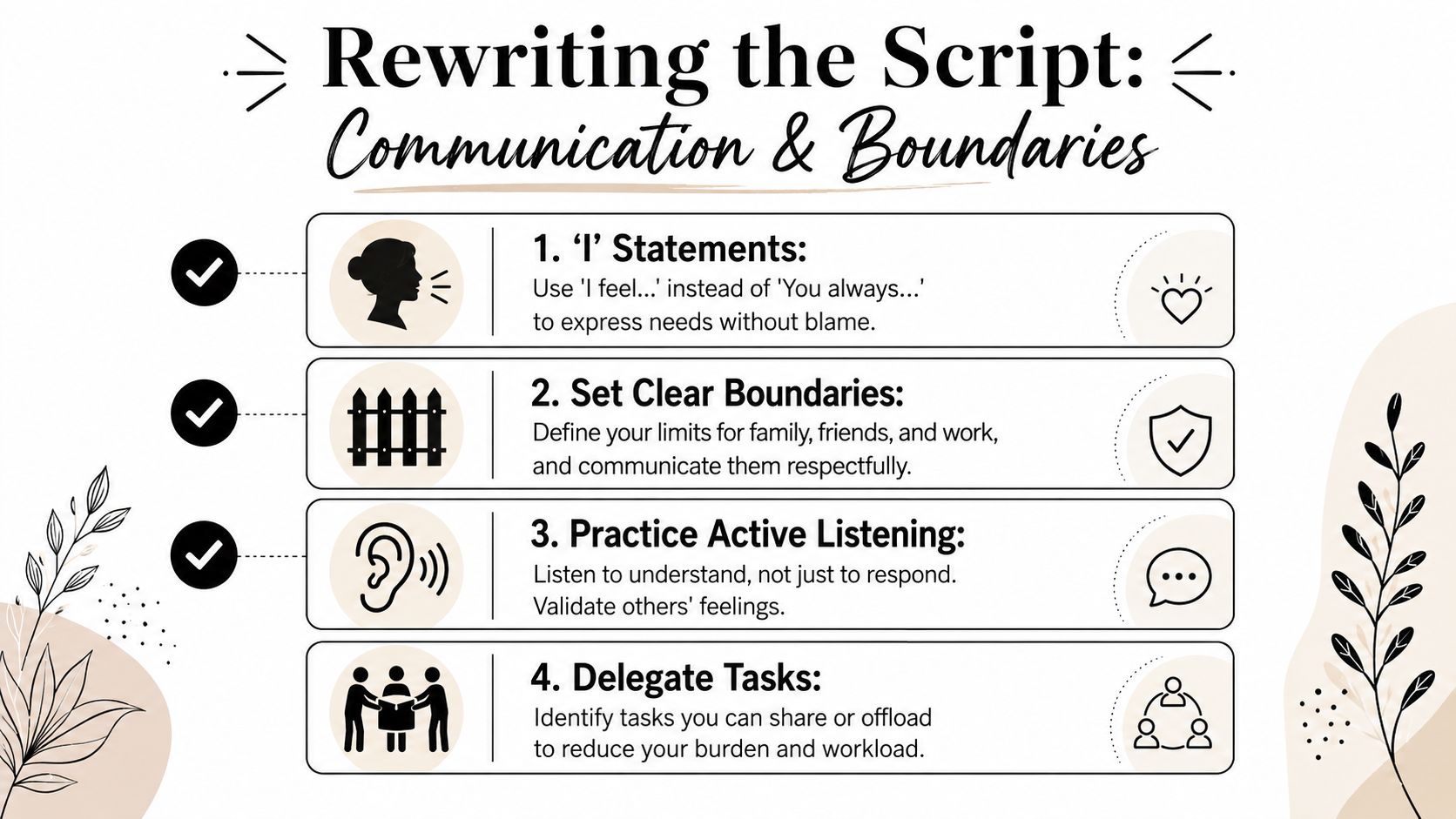
A family-level stress-management model outlines a 6-step workflow that begins by identifying the stressor and reducing it before focusing on coping source. That order matters in real homes. If the schedule is impossible, the chores are uneven, or expectations are out of reach, no amount of deep breathing will fully solve the overload. Parents who deal with social anxiety and fear of judgment may find these conversations especially hard, because speaking up can feel risky, but setting limits still protects well-being.
Use scripts that lower blame
When you are already worn down, improvising usually makes things worse. Simple, direct phrases work better because they reduce room for misunderstanding.
- With a partner: “I'm at capacity. I need you to take over bedtime tonight.”
- With a child: “I can hear you're upset. I'm going to answer after I take one minute to calm down.”
- With family or friends: “We can't take on another commitment this week.”
- With yourself: “I don't need to do this perfectly. I need to do it sustainably.”
These are not soft words. They are containment words. They stop the spiral before it turns into snapping, shutting down, or agreeing to more than you can carry.
Set boundaries around time, energy, and expectations
A boundary is not a lecture. It is a limit you can keep. That can mean declining an extra favor, reducing a social commitment, or deciding that certain chores can wait until tomorrow.
It also means noticing perfectionism. Some parents treat every delay, mess, or emotional outburst as proof they should push harder. That usually creates more pressure, not better parenting. Healthy boundaries say, “This is enough for today.”
Practice active listening without absorbing everything
Listening does not mean agreeing to every request. It means showing the other person they have been heard. A brief reflection like “You're frustrated because the routine changed” can lower tension quickly.
That is especially useful when a child is upset and your own stress is rising. You do not have to fix the feeling instantly. You do have to avoid adding shame to it.
Creating Your Personal Self-Care Blueprint
Self-care works best when it's treated like a support system, not a reward. Parents often postpone care until they've earned it, but stress recovery usually requires the opposite approach. You protect the fuel source first, then the rest of life becomes easier to carry.
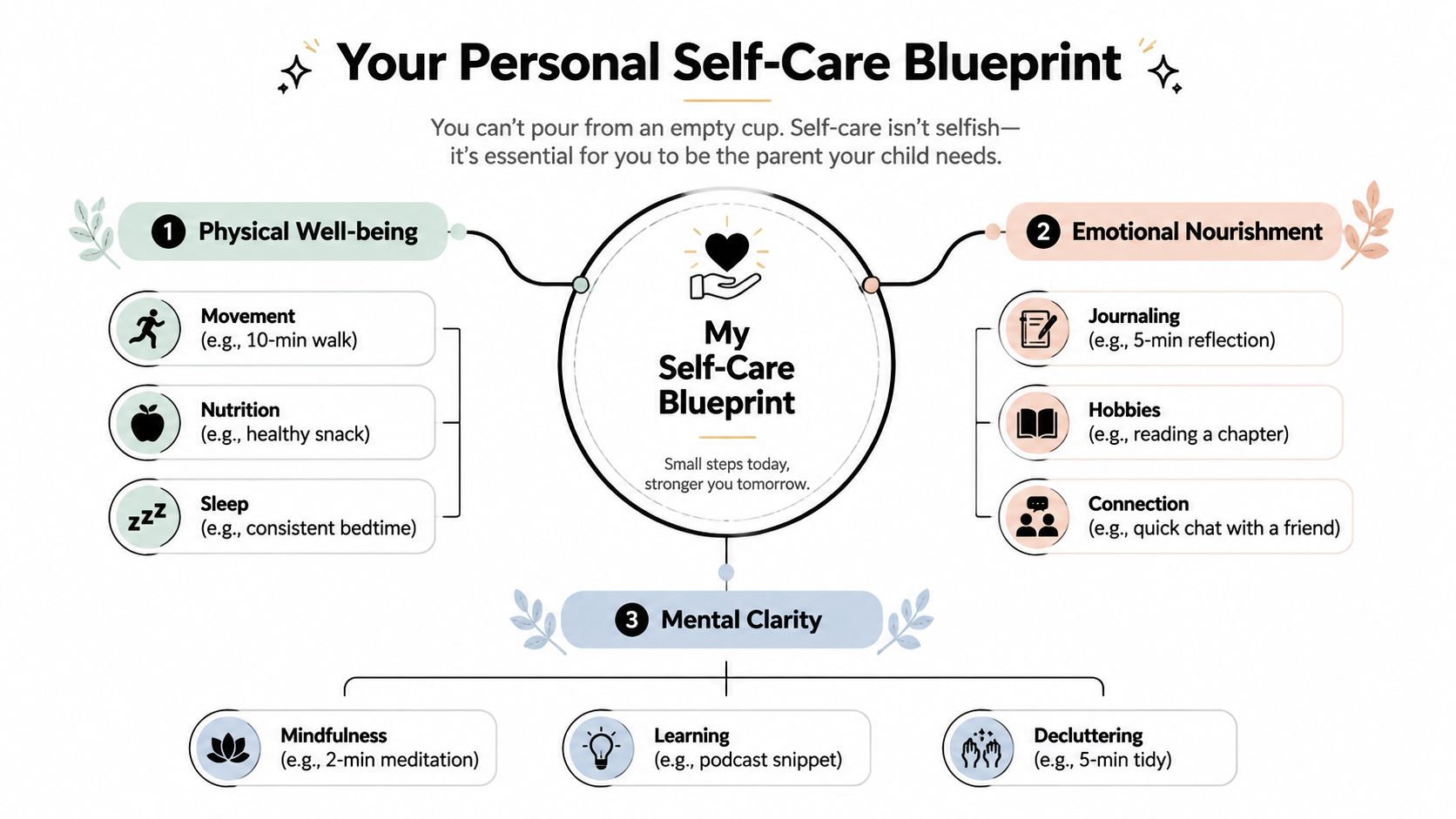
A good blueprint is flexible. It gives you options across physical, emotional, mental, and social needs, so you can choose what fits the day instead of forcing a single ideal routine. If you like reflective work, shadow work prompts for anxiety can help you notice which needs you've been ignoring.
Start with four simple categories
Write one or two realistic actions under each category.
- Physical: a short walk, a healthy snack, or a consistent bedtime.
- Emotional: journaling one sentence, a chapter of a book, or a quick chat with a friend.
- Mental: a podcast snippet, two minutes of mindfulness, or a five-minute tidy.
- Social: a text to someone who gets it, or a brief conversation with another adult.
You do not need to do all of them every day. You need a menu that helps you notice what kind of depletion you're feeling.
Match the tool to the need
If you're exhausted, physical care matters most. If you feel numb or snappish, emotional care may help you reconnect. If your head feels crowded, mental clarity tools usually work better than forcing yourself to “think positive.”
That match is what makes self-care effective. The right support at the right time is more useful than random habits copied from someone else's routine.
Keep the plan kind and realistic
A self-care blueprint fails when it becomes another performance standard. Make it so practical that you'd use it on a messy weekday. If the only thing you can manage is a calm cup of tea after school pickup, that still counts.
Self-care isn't a luxury add-on. It's part of how you stay regulated enough to parent with more steadiness.
When to Seek More Support and How to Find It
Sometimes the stress is bigger than self-help can handle alone. If you're stuck in constant panic, sleeping poorly for a long stretch, feeling persistently hopeless, or noticing that everyday coping tools aren't touching the intensity, it's time to get more support. That's not a failure of effort, it's a sign the load needs more than one person can carry.
The U.S. Surgeon General emphasizes that parental mental health is treatable and recommends building support networks, protecting sleep, and getting professional help when stress becomes persistent source. That message matters because it replaces shame with direction. Recovery is not reserved for other families.
What to look for
A good next step may be a therapist who understands parenting, postpartum anxiety, trauma, or family stress. A primary care doctor can also help screen for anxiety or depression and guide referrals. If your stress is tied to a child's needs, school support, or caregiving overload, you may need a combination of clinical care and practical family support.
Make the first step easier
Start with one action, not ten. Send one email. Make one appointment. Ask one trusted person to sit with the kids while you talk to a professional. If a digital tool helps you get through the gap before therapy starts, use it without guilt.
The point is not to wait until you're at your breaking point. The point is to notice that your body deserves relief before panic becomes your daily baseline.
If you're ready to start feeling steadier, The Anxiety Checklist offers practical tools for calming panic, reducing anxious spirals, and building daily resilience that fits real family life. Use it as a support between hard moments, especially when parenting stress starts to feel bigger than your usual coping skills. You don't have to do this alone, and you don't have to stay stuck in survival mode.