

Your chest is tight, your thoughts are racing, and your body is acting like something dangerous is happening right now. Maybe you've already tried to “just breathe,” and it only made you more aware of how stuck you feel. If that's where you are, you're not broken. You need a guided meditation peace practice that can meet panic at its worst point, plus a second practice that slowly teaches your nervous system how to stay calmer between spikes.
That's the promise here. Not perfect serenity, not forced positivity, and not a script that only works when you're already relaxed. The practical goal is to give you two tools, one for the moment your mind won't stop, and one for the days when you want peace to become more familiar than fear. If you're also noticing how panic can feed on itself, the phobophobia and panic attack cycle is part of what makes this feel so relentless.
For people who want a broader clinical lens on anxiety and calming strategies, functional medicine for anxiety relief can be a useful resource to compare alongside meditation-based support.
Table of Contents
- When Your Chest Is Tight and Your Mind Will Not Stop
- What Guided Meditation for Peace Does in the Body
- Setting Up the Space, the Breath, and the Voice You Will Use
- The 90 Second SOS Script for Panic Spikes
- A 12 Minute Guided Meditation for Inner Peace You Can Follow
- Adapting the Practice for Panic Versus Chronic Anxiety
- When Meditation Backfires and What to Do Next
When Your Chest Is Tight and Your Mind Will Not Stop
You're in bed or on the couch, and suddenly your pulse feels too loud. Your mind grabs one thought, then another, and within seconds you're scanning your body for danger that isn't obvious yet but feels very real. That moment is exactly why a guided meditation peace practice matters, because it doesn't ask you to climb out of panic with willpower alone.
There's a reason so many anxious people keep searching for something that works in real time. Meditation use has moved far beyond a niche wellness habit, with U.S. adult meditation practice rising from 7.5% in 2002 to 17.3% in 2022 in NCCIH reporting, and a 2024 analysis estimating 18.3% in 2022, or about 60.53 million U.S. adults, while guided imagery and progressive relaxation were used by 6.7% of adults that year (NCCIH). That doesn't prove every meditation works for every person, but it does show guided calming practices have become a mainstream self-regulation tool, not a fringe idea.
Why this moment feels so hard
When panic is loud, the brain tends to treat sensation as evidence of danger. Breath gets shallow, attention narrows, and the urge to escape can make sitting still feel impossible. That's why this guide splits the work into two parts, a short SOS script for the spike itself, and a daily peace practice that helps the nervous system relearn safety over time.
A helpful companion if you want a structured support tool is peace of mind therapy guide, especially if you're pairing meditation with counseling or other care.
Practical rule: when panic is peaking, the goal is not deep insight. The goal is enough steadiness to ride the wave without feeding it.
If you've spent years trying to outthink anxiety, this approach may feel simpler than you expected. That simplicity is part of the point.
What Guided Meditation for Peace Does in the Body
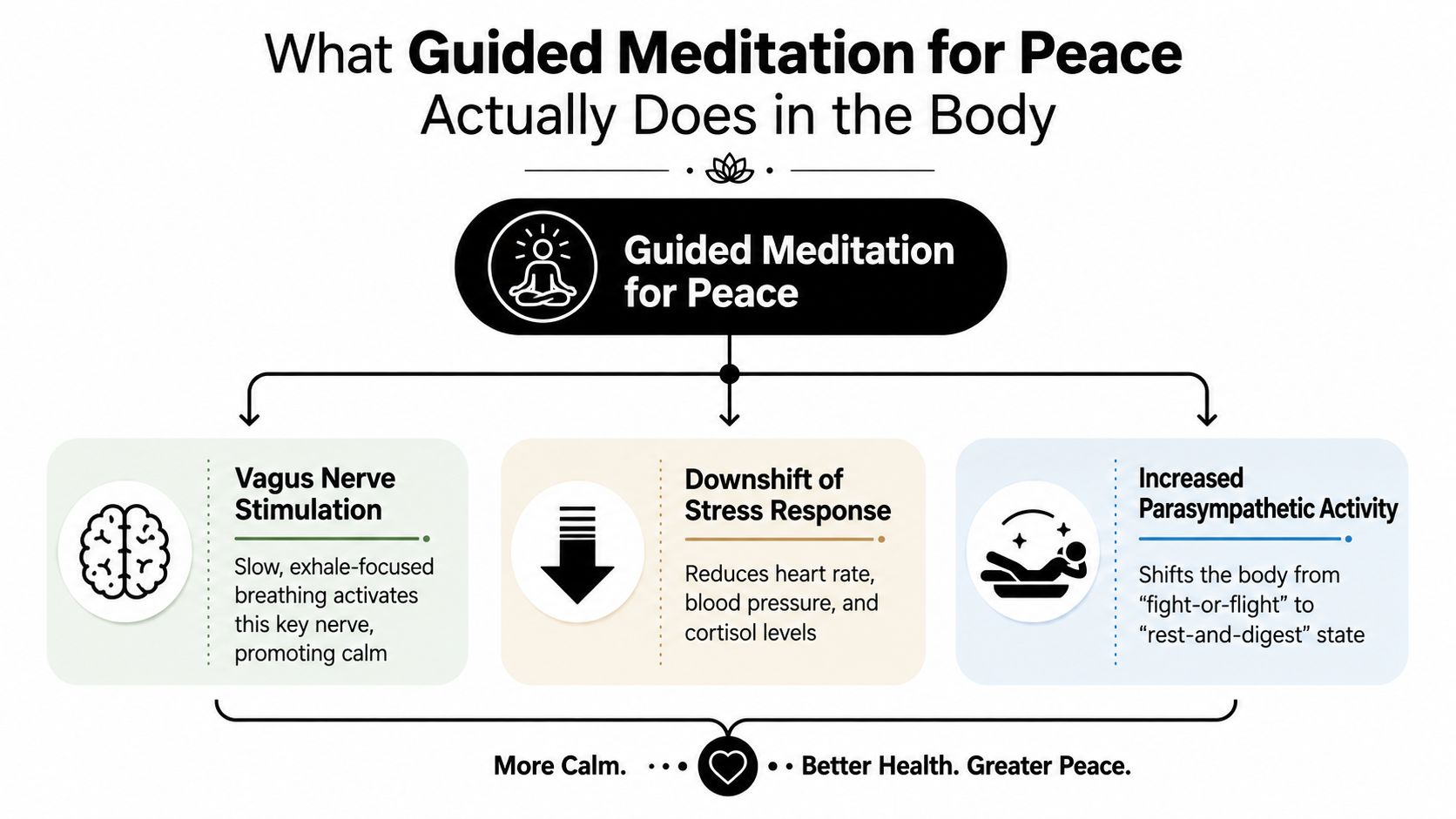
Guided meditation works partly because it gives the mind something external to hold onto. A voice can pace your attention, lower the amount of inner narration you have to manage, and make the practice feel safer than sitting alone with a storm of thoughts. In plain terms, it reduces the amount of internal scrambling you have to do while your body is already activated.
The nervous system side of the practice
Slow, exhale-led breathing is one of the clearest levers you have when anxiety rises. It nudges the body toward a more settled state, and that is why guided practice often starts with breath rather than abstract reassurance. Meditation is not magic. It is a trainable skill that uses repetition, pacing, and attention to help the body downshift. If you need a quick primer on the physiology behind that shift, the how to calm fight or flight mode guide is a useful companion.
The research supports that practical framing. A systematic review and meta-analysis of 36 randomized controlled trials with 2,466 observations found meditative therapies significantly reduced anxiety symptoms, with pooled effects of SMD = −0.52 versus waiting-list control across 25 RCTs, SMD = −0.59 versus attention control across 7 RCTs, and SMD = −0.27 versus alternative treatments across 10 RCTs (PMC review). The same review also reported that 5 to 12 minutes daily was associated with decreased stress and anxiety, and larger change showed up as practice minutes increased.
Why short daily doses matter more than rare long sits
The mistake many people make is waiting for the “right” moment to meditate. Anxiety rarely cooperates with long, occasional sessions, because the nervous system learns through repetition, not heroics. A brief daily practice is easier to keep, easier to recover from if it feels awkward, and more likely to teach your body a predictable pattern of settling.
That is why consistency beats intensity here. A calm voice, a short duration, and a repeatable routine help the practice become familiar enough that your body starts recognizing the cues. If you want a broader explanation of body-based calming, the peace of mind therapy guide can help if you are pairing meditation with counseling or other care.
Clinical shorthand: if the practice is so long that you avoid it, it is too long.
A useful outside reference for people comparing meditation styles with broader stress support is MedEq Fitness recovery guide, especially if you are looking at anxiety recovery as part of a wider routine.
Setting Up the Space, the Breath, and the Voice You Will Use
Start by making the practice easier than your anxiety. Sit on a chair, cushion, or bed, with your feet grounded or your body fully supported. Let your shoulders drop on purpose, unclench your jaw, and soften your hands, because tension in those places often keeps the alarm system humming.
The first three breaths matter more than the rest of the session, not because they're special, but because they signal a transition. Take them slowly enough that you can feel the exhale lengthen without straining. If you like numbers, think of a calm rhythm rather than a performance.
Make the setup work for your nervous system
Eyes open can be better if closing them feels unsafe. Earphones can help when you need privacy or want the voice to feel closer and steadier. A low, even tone works better than a peppy one, because anxious bodies usually don't need coaching energy, they need steadiness.
A short pre-flight ritual can help too. Put the phone on do-not-disturb, sit or lie down, and decide ahead of time whether you're doing a short SOS practice or the longer peace practice. If you want prompts and timing handled for you, The Anxiety Checklist breathing guide can be a useful companion.
Practical rule: if your body is already braced, don't force a perfect meditation posture. Comfort first, form second.
The voice you use matters as much as the words. Read the practice like you're helping someone half-asleep and frightened, not like you're trying to impress them. That tone lowers the sense of threat before the script even begins.
The 90 Second SOS Script for Panic Spikes
If the wave is already rising, keep your eyes open and let your attention land on the room first. Say, in your head or out loud, “I am here, and I'm orienting.” Then begin the sensory ladder. The point is to stop the mind from free-falling into prediction mode and bring it back to what's already present.
Read this slowly
Take one breath in for 4.
Take one breath out for 6.
Name five things you can see.
Name four things you can hear.
Name three things you can touch.
Name two things you can smell.
Name one thing you can taste.
If your mind goes blank, stop trying to do it perfectly. Pick up at the next number you remember, or start again at five. The script still works because the repetition gives the brain a task that is concrete, present, and non-threatening.
On each exhale, repeat one phrase of self-kindness. “This is hard, and I'm safe enough in this moment.” If that feels too long, use only, “I'm here now.” Short phrases are easier to hold when adrenaline is high.
The sensory ladder is not about convincing yourself nothing is wrong. It is about reducing the brain's tunnel vision so it can stop treating every sensation as an emergency. If you want a compact visual prompt for that kind of moment, coping cards from The Anxiety Checklist can sit beside the script as a simple backup.
If attention fractures mid-sentence
That will happen. Don't restart by criticizing yourself. Touch the chair, the wall, or your own forearm, then go back to the exhale and the next item you can name.
When panic is active, successful practice often looks messy.
Use the same script until your breathing starts to feel less ragged, or until the room feels more distinct again. You're not trying to feel peaceful in the middle of the spike. You're trying to create just enough space for the spike to pass.
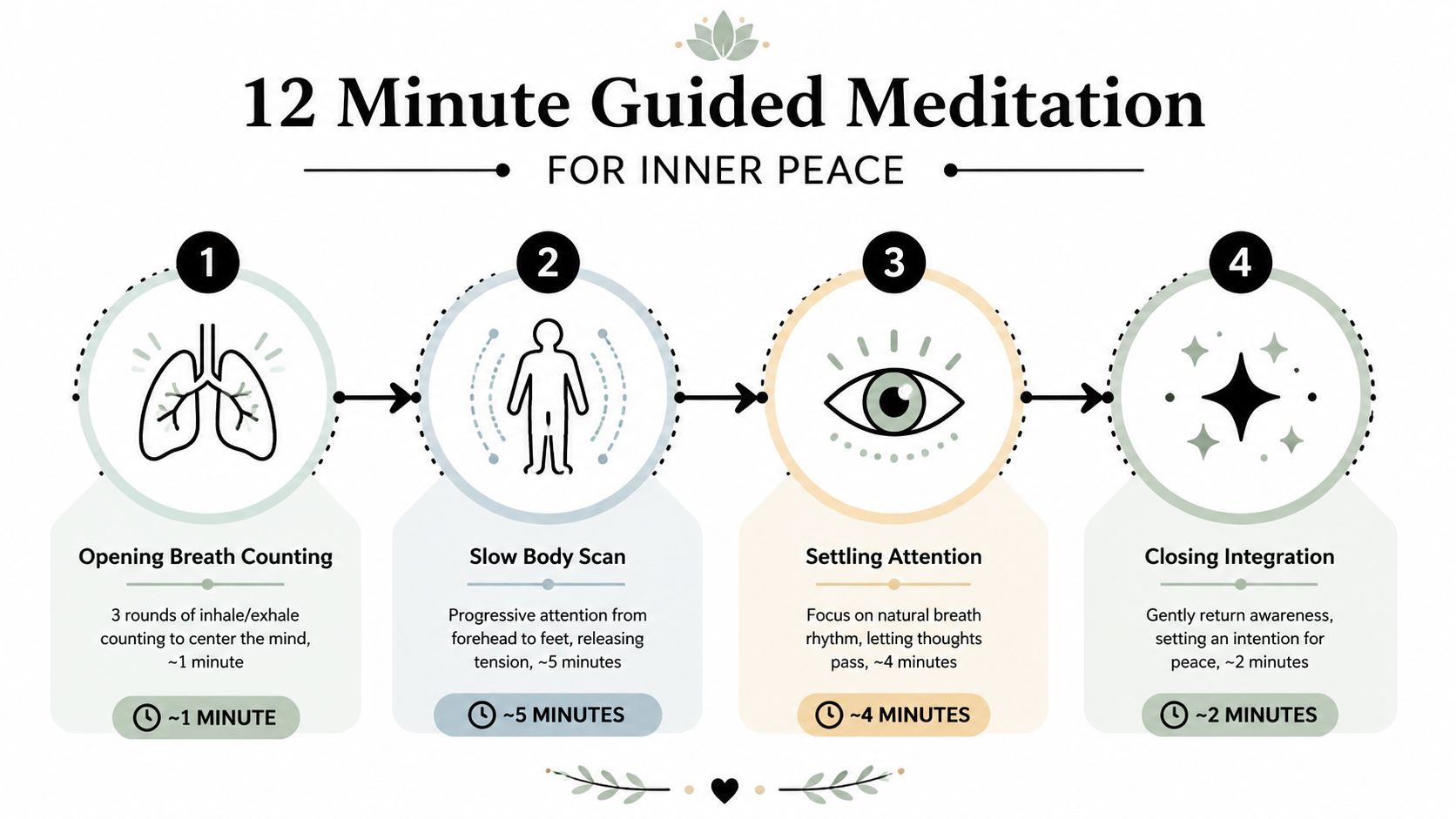
A 12 Minute Guided Meditation for Inner Peace You Can Follow
This version is slower, quieter, and better for the time when you're not in a full panic spike. Read it aloud, listen to a recording of it, or follow it at your own pace. If a pause feels helpful, let it stay there.
Guided script
Settle where you are.
Let your eyes close if that feels okay.
If not, keep them softly open.
Take a slow breath in.
Take a longer breath out.
Again, in.
Again, out.
One more time, in.
One more time, out.
Now count your breath for three rounds.
In for one. Out for one.
In for two. Out for two.
In for three. Out for three.
Bring your attention to your forehead.
Let the muscles there soften.
Move to the jaw. Unclench it.
Move to the neck and shoulders. Let them be heavy.
Move down through the chest.
Let the belly be loose, not held in.
Notice the hands.
Notice the arms.
Notice the hips, legs, and feet.
If you find tension, don't fight it.
Just notice it, and let the next exhale be a little longer.
Let the body know it doesn't have to hold the whole day anymore.
Bring attention to the area around the heart.
You don't need to force warmth or calm.
Just rest your attention there.
Feel one natural breath come and go.
If thoughts wander, return to the next breath.
If emotions rise, let them pass through without grabbing them.
You're not trying to empty the mind.
You're practicing steady return.
On the next exhale, say, “May I be steady.”
On the next exhale, say, “May I be kind to myself right now.”
On the next exhale, rest.
Take one final slow breath in.
Take one final long breath out.
Open your eyes when you're ready.
A daily reset works best when it's repeatable, not dramatic. If you can run this once a day for two weeks, you'll give your nervous system enough consistent contact to start recognizing the pattern. For a guided, app-based option, the Anxiety Checklist includes meditation alongside other daily relief tools, so you can keep the same practice available on the days your motivation drops.
A simple timing note
The practice doesn't need to be perfect to be useful. What matters is the sequence, breath, body scan, attention, and self-kindness. If you want a warmer framing of inner steadiness, Calm's discussion of inner peace describes it as a learnable state of equanimity rather than a brief escape from stress (Calm).
Adapting the Practice for Panic Versus Chronic Anxiety
The same meditation can feel almost opposite depending on your state. During a panic spike, you need fewer inward cues and more external grounding. On a quieter day with chronic anxiety, you can tolerate longer attention inside the body and let the practice deepen.
| Adapting Your Guided Meditation for Peace | During a panic spike | Daily chronic anxiety practice |
|---|---|---|
| Eyes | Keep them open, look around the room | Close them if that feels safe |
| Breath | Short exhale focus, keep it simple | Slow the rhythm and stay with it longer |
| Attention | Use the room, touch, and sound first | Move gradually through body awareness |
| Language | Use the SOS script only | Use the full peace practice |
| Support | Cold hand on face or grounding object | Quiet space, timer, and follow-through |
If you're stuck in repetitive worry, why overthinking causes anxiety is a useful reminder that the problem isn't laziness or weak discipline, it's a nervous system that keeps trying to solve uncertainty by thinking harder.
When to shift gears
If your body feels unreal, detached, or flooded, don't push through a long sit. Use the shorter grounding version, or stop and reorient with sound, touch, and movement. Meditation should feel like contact with reality, not a deep dive away from it.
There are also moments when the body needs a different kind of support first. If you're actively processing trauma, dissociating, or using substances that blunt awareness, pause the meditation and choose grounding, connection, or professional support instead.
Clinical shorthand: the right practice is the one your nervous system can actually receive.
The highest-yield pattern is usually simple. Panic gets the short script. Chronic anxiety gets the longer daily session. Both benefit from repetition.
When Meditation Backfires and What to Do Next
Some people feel worse before they feel better, and that reaction can be real rather than a sign that they are doing it wrong. Turning attention inward can make fear louder. Unresolved trauma can make stillness feel exposing. Sometimes the practice is too long for the state you are in.
A recent 2024 systematic review of meditation adverse effects reported that some participants experienced increased anxiety, emotional pain, dissociation, or panic-like symptoms, while benefits tended to be small to moderate and depended on fit, dose, and supervision. That does not mean meditation is unsafe for everyone. It does mean a trauma-sensitive approach is honest enough to stop pretending every quiet practice feels safe from the start.
What to do if a session turns rough
If the body starts to spiral, stop the sit gently. Open your eyes, name the room, and return to external anchors like sound or touch. If you can, use the SOS version instead of the longer meditation. The goal is not to push through distress for points.
The most common mistake is reading wandering attention as failure. It is not. Beginners are supposed to notice drift and return. That return is the repetition that builds the skill, and it is the same reason short guided practice can be more effective than an ambitious sit that leaves you overwhelmed.
For people who want a broader set of recovery tools beyond meditation alone, the MedEq Fitness recovery guide can sit alongside a calmer routine and other mental health supports.
A realistic first 14 days
- Days 1 to 3: Use the 90-second SOS script once a day, even if you feel fine. The habit matters more than the intensity.
- Days 4 to 7: Add one 12-minute session on a quiet day. Keep the voice slow and secular.
- Days 8 to 10: Repeat the longer practice on most days, and use the SOS script for spikes.
- Days 11 to 14: Log what changed after each sit, especially whether recovery feels faster, sleep onset feels easier, or intrusive thoughts lose some grip.
If a session surfaces a difficult belief, write it down in the CBT thought-journal inside The Anxiety Checklist and test it later when you are calm. That is often where meditation becomes more than relaxation, it becomes a way to notice what your mind keeps insisting is true.
The hopeful part is simple. Panic-free living is not a personality trait. It is a trainable nervous-system skill, and brief, repeated, trauma-informed guided meditation peace practice is one of the most reliable ways to build it.
If you want a place to keep these tools together, visit The Anxiety Checklist for SOS grounding, guided meditations, and CBT support you can use when panic is loud and when you are rebuilding calm between episodes. It is a practical next step if you want one app to hold the short script, the daily practice, and the follow-through in one place.