



Your name gets called. Or your phone lights up with a message you’ve been waiting for. Or you’re sitting in the car outside a job interview, trying to breathe normally while your stomach seems to flutter, dip, and twist all at once.
That feeling is so common that most of us have a name for it. Butterflies in your stomach.
Sometimes it shows up with excitement. Sometimes with dread. Sometimes it’s hard to tell the difference. If you live with anxiety, that confusion can make the sensation feel even worse. You might wonder, “Is this normal?” or “Is something wrong with me?” or “Am I about to panic?”
You’re not broken. Your body is responding to pressure in a very human way.
That Familiar Flutter An Introduction to Your Butterflies
A lot of people first notice this sensation in ordinary moments. Before a presentation. Before sending an important email. Before a first date. Before a difficult conversation. Your mind starts scanning for danger, and your stomach seems to answer before you’ve even formed a full thought.

For some readers, the feeling is mild and brief. For others, it’s tied to chronic anxiety and can feel like the opening note of a much larger spiral. Both experiences deserve compassion.
From old myths to a real body signal
People once took this feeling to be a true physical manifestation. Historical medical records from the 16th to 19th centuries documented alleged human infestations by butterfly larvae, with the first recorded instance noted in 1610 Italy, though modern analysis classifies these reports as pseudoparasitoses in the medical review of historical butterfly infestation cases. In other words, the strange sensation sparked strange explanations.
Today, we understand something far more useful. The flutter isn’t a mystery and it isn’t a curse. It’s a body signal.
Grounding truth: A fluttery stomach can feel alarming, but it usually means your nervous system has shifted into protection mode, not that you’re losing control.
That’s good news, because what we can understand, we can work with.
Why hope matters here
If anxiety has trained you to fear every internal sensation, butterflies in your stomach can start to feel like an enemy. But they don’t have to stay that way. Many people learn to treat the sensation as an early cue. A prompt to slow down, regulate, and respond differently.
That shift matters. It’s the difference between “Oh no, here it comes” and “My body is activated, and I know what to do next.”
If you want a broader foundation for understanding anxiety patterns, Anxiety University is a helpful place to build that bigger picture.
The Science Behind the Sensation Your Gut-Brain Connection
The clearest way to understand butterflies in your stomach is to picture a two-way superhighway between your brain and your digestive system. Your thoughts, emotions, stress chemistry, and gut activity are constantly sending messages back and forth.
That network is often called the gut-brain axis.
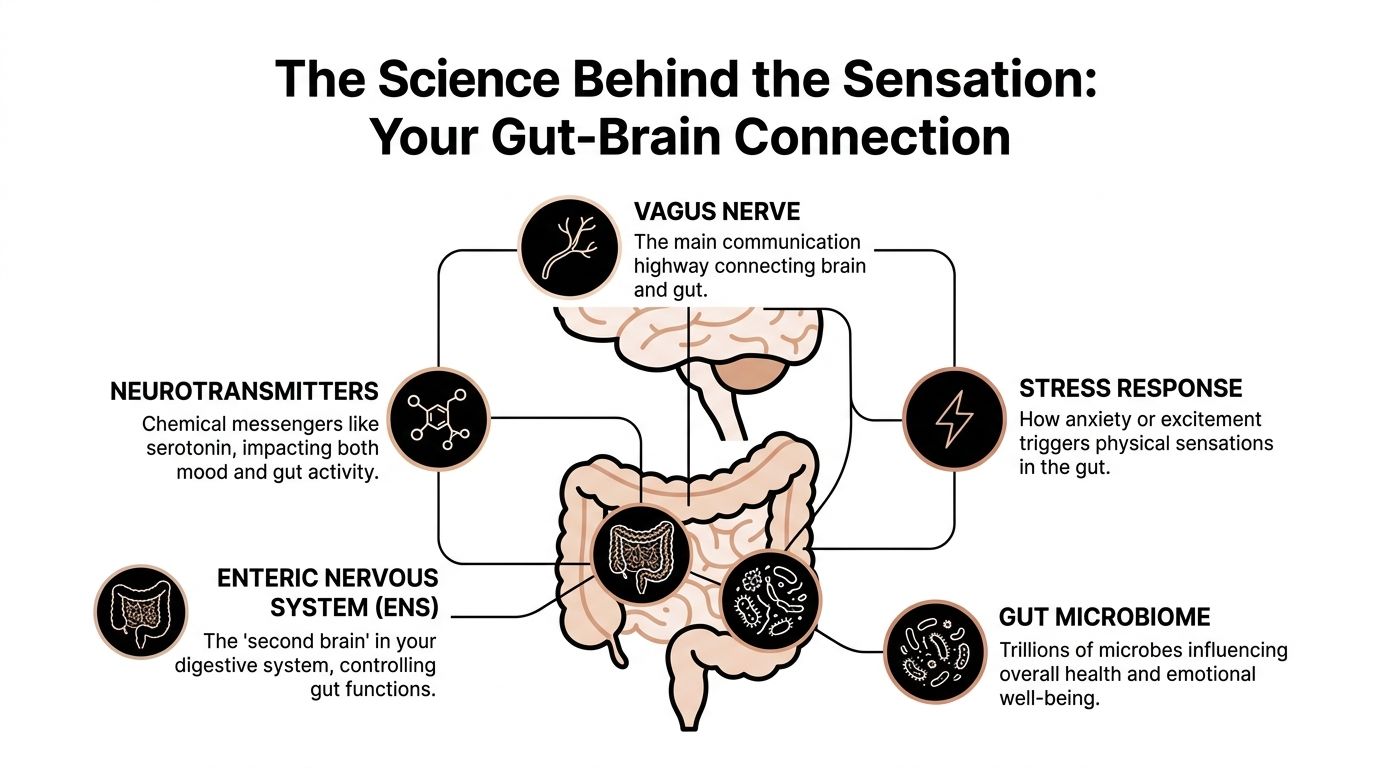
Your gut has its own nervous system
The phrase “butterflies in the stomach” first appeared in print in a 1908 novel, and modern science links the sensation to the enteric nervous system, a “second brain” with over 100 million nerve cells lining the gastrointestinal tract, as described in this gut-brain axis review.
That means your stomach isn’t just a food container. It’s wired into your emotional life.
When people say, “I felt it in my gut,” they’re not just being poetic. They’re describing a real communication loop between body and mind.
What happens when stress hits
When you feel pressure, your brain doesn’t always wait for proof that something is dangerous. It reacts to the possibility. That reaction activates stress systems that prepare you to act fast.
Here’s the simple version:
Your brain detects a threat or high-stakes moment.
This might be a real danger, or it might be social stress, anticipation, or a feared situation.Stress signals travel through the gut-brain network.
One important route in this system is the vagus nerve. If you want a deeper overview, this guide to the fight or flight response explains how that body alarm works.Your digestion changes.
Your body shifts resources away from calm digestion and toward readiness. Blood flow changes. Stomach activity changes. Muscles in the digestive tract can contract irregularly.You feel the flutter.
That odd, swooping, churning, fluttery sensation is the physical result.
Why understanding helps
Confusion fuels fear. Clarity reduces it.
If you think butterflies in your stomach mean something terrible is happening, the sensation often gets louder. If you understand that your nervous system is reacting in a predictable way, the experience becomes less mysterious and often less frightening.
Your body is not betraying you. It’s trying to prepare you.
That doesn’t make the feeling pleasant. But it does make it workable. And that distinction is where healing often begins.
Normal Nerves vs Anxiety When Butterflies Become a Storm
A hard part of anxiety recovery is learning that not every uncomfortable sensation means danger. Plenty of healthy people feel butterflies before important moments. The challenge is knowing when normal nerves have crossed into something more disruptive.
That confusion has grown. A key gap in public understanding is the difference between ordinary stress and pathological anxiety, and post-pandemic surveys from 2023 to 2025 reported a 25% rise in self-reported gut anxiety misattribution in major markets, as summarized in the overview of butterflies in the stomach.
A side-by-side way to check in
| Characteristic | Normal Nervousness ('Butterflies') | Potential Anxiety Disorder ('Storm') |
|---|---|---|
| Trigger | A specific event such as a speech, date, test, or interview | May appear with small triggers or no clear trigger at all |
| Duration | Usually fades when the moment passes | Can linger before, during, and long after the event |
| Intensity | Uncomfortable but manageable | Feels overwhelming, consuming, or hard to interrupt |
| Meaning you assign to it | “I’m nervous because this matters” | “Something is wrong with me” or “I can’t handle this” |
| Impact on behavior | You still do the thing, even if shakily | You avoid, cancel, delay, or structure life around fear |
| Impact on daily life | Brief disruption | Ongoing strain on work, relationships, sleep, or routine |
Two examples that often clarify it
Take a common situation like public speaking.
A person with normal nerves might feel a flutter, sweaty palms, and a racing heart right before speaking. They may dislike it, but they can still walk to the front of the room and begin.
A person in an anxiety storm may start feeling dread days in advance. They might replay disaster scenarios, lose sleep, feel sick thinking about the event, and consider calling in sick to avoid it.
Now think about leaving the house.
Feeling a little activated before a difficult appointment can be normal. Feeling repeated stomach panic every time you think about errands, driving, crowds, or ordinary responsibilities suggests a different pattern.
A useful question: Is the sensation helping me rise to a moment, or is it shrinking my life?
Signs it may be more than ordinary nerves
Watch for patterns like these:
- Frequent episodes: The flutter shows up again and again, not just around obvious stress.
- Strong avoidance: You start changing plans, relationships, or goals to escape the feeling.
- Long recovery time: Your body stays activated well after the trigger ends.
- Fear of the sensation itself: You become anxious about getting anxious.
If you want a practical way to identify patterns, reviewing common triggers can help. This list of common anxiety triggers can make your own reactions easier to sort out.
For readers wondering whether their experience fits a broader clinical picture, this overview of anxiety disorders offers useful context in plain language.
Be careful with self-judgment
Many people with anxiety shame themselves for “overreacting.” That shame often makes symptoms worse.
A better approach is curiosity. Notice frequency. Notice impact. Notice what happens before the flutter and what happens after. You don’t need to label yourself harshly in order to take yourself seriously.
How to Calm the Flutter In-the-Moment Strategies
When butterflies in your stomach show up, your first goal isn’t to force them away. It’s to give your body a clear signal that you’re safe enough to settle.
That works better than arguing with yourself.

Start with your breath
Slow, steady breathing can help interrupt the spiral between fearful thoughts and body activation. The key is to breathe low and gently, so your belly expands more than your upper chest.
Try this:
- Inhale softly through your nose
- Let your belly rise
- Exhale slowly and longer than the inhale
- Repeat for several rounds
If you want guided practice, these breathing exercises for anxiety can help you build the skill before you need it in a stressful moment.
Don’t worry about doing it perfectly. The point is rhythm, not performance.
Use the ground to steady your attention
An anxious brain pulls attention inward. You start monitoring your stomach, heart, breathing, thoughts, and “what if” scenarios all at once.
Grounding shifts attention outward.
A simple version is the 5-4-3-2-1 method:
- 5 things you can see
- 4 things you can feel
- 3 things you can hear
- 2 things you can smell
- 1 thing you can taste
This isn’t magic. It’s orientation. You’re helping your nervous system reconnect with the actual room you’re in, instead of the danger movie your mind is projecting.
If your body feels loud, widen your focus. The room is usually calmer than the thought loop.
Add gentle physical reassurance
Butterflies often come with muscle bracing. Your stomach tightens. Your shoulders lift. Your jaw sets. Your breath gets shallow.
Try one physical cue:
- Put a warm hand over your belly.
- Drop your shoulders on purpose.
- Unclench your jaw.
- Let your knees soften if you’re standing.
This kind of body-based cue can feel surprisingly powerful because it speaks the language your nervous system already understands.
A short guided reset can also help when you’re too activated to remember steps on your own:
One sentence that helps many people
When the sensation starts, say to yourself:
“This is activation, not danger.”
That sentence won’t erase every symptom. But it can stop you from adding a second wave of fear on top of the first one.
Building Long-Term Resilience to Tame Anxiety
Quick tools matter. Long-term healing matters more.
If butterflies in your stomach appear often, the deeper task is to lower your baseline stress load so your body doesn’t stay on hair-trigger alert. Daily habits prove powerful. Not because they make you perfectly calm, but because they make recovery easier and stress less sticky.
Support your gut as part of your recovery
Gut microbiota can shape how intensely you feel this flutter. Stress alters microbial composition, reducing Lactobacillus and Bifidobacterium, and prebiotic approaches such as 5 to 10g of inulin daily lowered cortisol by 15 to 20% in human trials while stabilizing gut signals, according to this article on the gut and brain connection.
You don’t need to obsess over your microbiome to use that insight well. You can make a simple start.
- Feed beneficial bacteria: Foods that contain prebiotic fibers may support a steadier gut environment.
- Notice food-stress patterns: Some people find their stomach is more reactive when they’re under pressure, sleeping poorly, or eating irregularly.
- Think consistency over perfection: A calm digestive system usually responds better to regular care than to extreme overhauls.
Calm your body before it has to shout
Anxiety often builds without immediate notice. You may not notice the load until your stomach, chest, or sleep starts protesting.
That’s why daily downshifting matters. Useful habits include:
- Regular movement: Walking, stretching, or strength work can help discharge nervous system tension.
- Steadier sleep routines: A more predictable schedule gives your body more opportunities to reset.
- Mindfulness practice: Even brief check-ins can help you catch activation earlier.
- Reduced overload: Too many commitments can keep your body in constant anticipation mode.
If chronic stress and depletion are part of your pattern, this guide on how to avoid burnout with practical, actionable steps is worth reading. Burnout and anxiety often travel together.
Work with your thoughts, not just your symptoms
Some people try to heal anxiety only through physical calming. Others stay only in their thoughts. Lasting change usually needs both.
If your mind keeps interpreting every flutter as danger, your body learns to stay vigilant. That’s why approaches like CBT can be helpful. They teach you to notice the thought, test it, and respond differently. This introduction to understanding CBT for anxiety offers a practical overview.
Build a pattern you can return to
You don’t need a heroic routine. You need a repeatable one.
A sustainable resilience plan might look like this:
- a consistent wake time
- a few minutes of calm breathing
- regular meals
- some daily movement
- less doom-scrolling when already activated
- a brief evening check-in instead of endless mental review
Recovery often looks ordinary from the outside. Small repeated actions teach the nervous system that life is becoming safer.
That’s how butterflies lose some of their power. Not overnight. But steadily.
When to Ask for Help and Use Structured Tools
Sometimes self-help is enough to take the edge off. Sometimes it isn’t. Needing more support doesn’t mean you failed. It means your system may need more structure, more guidance, or more care than solo coping can provide.
That’s a wise thing to notice.
Signs it’s time to reach out
Consider getting professional help if:
- Your daily life is shrinking: You’re avoiding work, school, driving, social contact, or basic tasks.
- The fear feels relentless: You keep waiting for the next wave of symptoms.
- Your body stays keyed up: Sleep, digestion, concentration, or relationships are taking a hit.
- You feel trapped by the cycle: You know the tools, but can’t seem to use them consistently when it counts.
The body side of this is real. The butterflies sensation is linked to the HPA axis, and stress signals move through the vagus nerve. Research summarized in this Live Science explanation of a nervous stomach notes that 70 to 80% of gut-brain stress signals travel through this pathway, which can become overactive in chronic anxiety.
Why structured support helps
When anxiety gets repetitive, vague advice often isn’t enough. People do better with patterns they can track.
That might include:
- Symptom tracking: noting when butterflies happen, what triggered them, and how long they lasted
- Therapy: especially if fear, trauma, or panic keeps hijacking daily life
- Medical guidance: when symptoms are intense, confusing, or mixed with digestive concerns
- A clear practice plan: so you know what to do before, during, and after activation
Asking for help is not a last resort. It’s a skillful response to a nervous system that needs more support than guesswork can offer.
The right support can help you stop treating each episode like an isolated emergency. Instead, you begin to see the pattern. And once you can see the pattern, you can change it.
Your Path to a Calmer More Fearless Life
Butterflies in your stomach are uncomfortable, but they aren’t meaningless and they aren’t permanent. They’re a signal. Your body gets activated, your gut responds, and your mind tries to make sense of it.
When you understand that loop, the sensation becomes less mysterious.
When you learn how to calm it in the moment, it becomes less overwhelming.
When you build daily habits that support your nervous system, it becomes less frequent and less powerful.
That’s the hopeful truth underneath all of this. Anxiety can be healed from. Panic doesn’t have to run your life. You can learn to meet the flutter with skill instead of fear.
Some days that will look like one slower breath. Some days it will mean grounding, therapy, better rest, or more structure. All of it counts.
You are not weak because your body reacts strongly. You are learning a new relationship with that reaction. And with practice, butterflies in your stomach can become less like a warning siren and more like an early cue to care for yourself, steady yourself, and keep moving toward the life you want.
If you want a practical way to track patterns, spot triggers, and build your own step-by-step anxiety plan, The Anxiety Checklist offers a structured system to help you turn insight into action.