


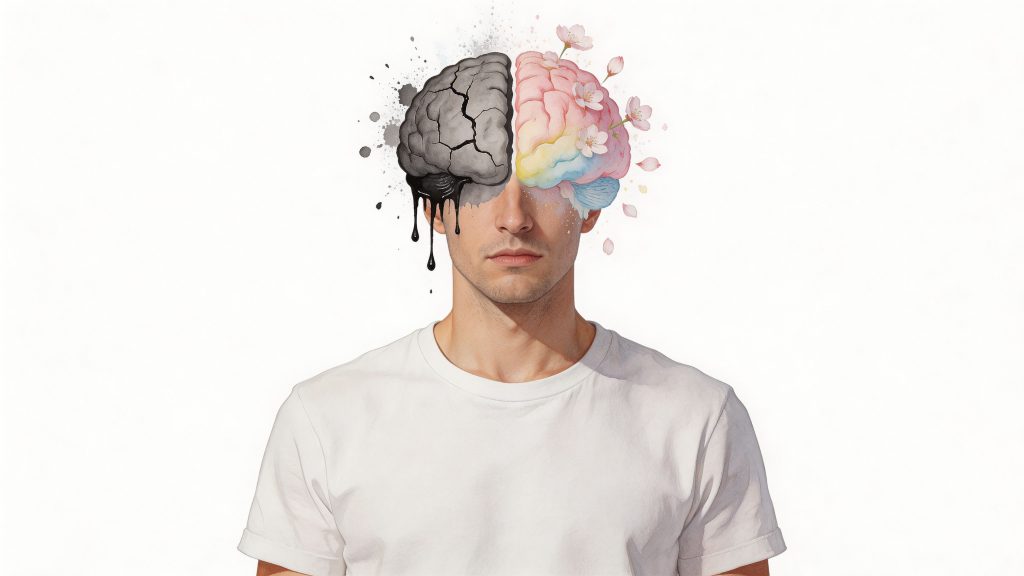
You might be reading this after another night of shallow sleep, another morning with a tight chest, or another day of telling yourself, “I’m functioning, so maybe it’s not that serious.” I know that place. Anxiety can become so familiar that it starts to feel like your personality instead of a condition.
That’s part of what makes untreated anxiety so tricky. It rarely announces itself as a crisis at first. It often shows up as overthinking, people-pleasing, cancelled plans, stomach tension, a racing heart, and a life that gets a little smaller each month.
Still, this isn’t a doom story. The long term effects of untreated anxiety are real, but they are not a fixed destiny. Your brain can heal. Your body can calm down. Your habits can change. Panic doesn’t have to run your future.
Beyond the Daily Worry The Real Cost of Untreated Anxiety
It often starts in ordinary moments. You are standing in the grocery store trying to pick a brand of pasta, and your mind treats that tiny choice like a high-stakes test. Later, you replay a short text you sent, wonder if it sounded wrong, and carry that tension into bedtime. From the outside, nothing looks dramatic. Inside, your system has been running a marathon all day.
That is why untreated anxiety gets underestimated so often. It does not always look loud. It can look like responsibility, perfectionism, being “careful,” or always staying one step ahead. But living with a mind and body that rarely feel safe has a cost. It drains attention. It steals rest. It trains you to spend more of life reacting than living.
Anxiety is not just extra worry. It works more like a smoke alarm that becomes too sensitive. After a while, it can start ringing for burnt toast, steam from the shower, or even no clear reason at all. You may still go to work, answer messages, and keep up with family life. But you are doing it with a nervous system that is burning through energy in the background.
That constant strain can shape your choices in quiet ways. You put off appointments. You avoid hard conversations. You say no to things you might enjoy because the uncertainty feels too expensive. Month by month, anxiety can begin organizing your life around relief instead of meaning.
If you have been telling yourself, “I’m still functioning, so maybe this doesn’t count,” please pause there. Functioning is not the same as thriving. Plenty of people with anxiety keep meeting their responsibilities while feeling exhausted, isolated, and stuck in survival mode.
The hopeful part matters just as much as the warning. These effects are serious, but they are not a fixed destiny. Patterns learned through anxiety can be unlearned with support, practice, and treatment that fits your life. If you want a broader picture of how common and disruptive it can be, this overview of anxiety statistics can help put your experience in context.
You do not need to wait until anxiety takes up more space in your life before you treat it like it matters.
How Anxiety Rewires Your Brain Over Time
An anxious brain is not a broken brain. But it is a brain that can get stuck practicing fear.
Imagine a path through grass. Walk it once, and nothing changes. Walk it every day, and a groove forms. Chronic anxiety works in a similar way. Repeated fear, vigilance, and body tension teach the brain which pathways to strengthen.
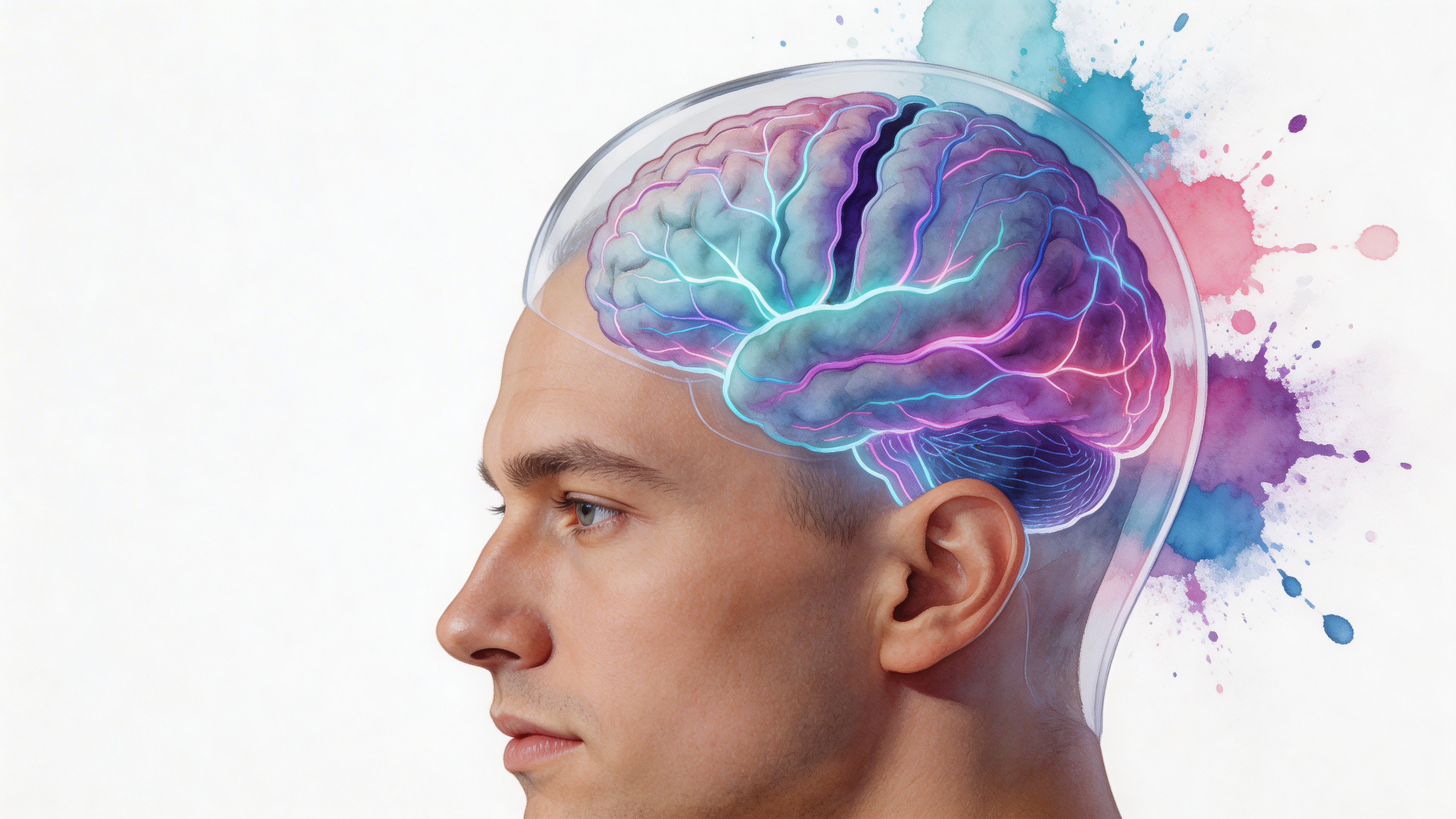
The stress system that stops turning off
Your body has a built-in alarm system. In a true emergency, it helps you react fast. But anxiety can keep that alarm active long after the danger is gone. If you want a simple breakdown of that body process, this guide to the fight-or-flight response is useful.
When anxiety stays untreated for a long time, cortisol and other stress hormones remain at higher levels more often than they should. Over time, that can affect brain structures involved in memory, emotional regulation, and threat detection.
According to HealthCentral’s summary of the research, prolonged untreated anxiety is linked to atrophy of the hippocampus and enlargement of the amygdala. The same source notes that untreated anxiety patients show 2 to 3 times higher incidence of comorbid depression and a 1.5 to 2-fold increased dementia risk over 10+ years, while early intervention with CBT can help prevent that trajectory (HealthCentral).
What that can feel like in real life
Few people notice these changes as “my hippocampus is struggling.” They notice them as:
- Memory slips that make you doubt yourself
- Poor concentration during work, reading, or conversations
- Emotional exhaustion after small tasks
- A negative bias where your mind spots threat before anything else
- A short fuse for stress even when you want to stay calm
You may also start feeling detached from your own judgment. You know a situation is probably safe, but your body disagrees. That mismatch is one of the most frustrating parts of long term anxiety.
Why the brain can still recover
Here’s the hopeful part. The brain changes in response to what it repeatedly does. That principle can work in your favor.
When you start treatment, practice calmer responses, challenge anxious thinking, improve sleep, and reduce avoidance, you begin cutting a new path. At first it feels awkward. Then it feels possible. Eventually it can feel natural.
A lot of recovery is repetitive and unglamorous. You breathe through a wave instead of escaping it. You go to the store even though your chest is tight. You stop treating every thought like a prophecy. Those moments teach the brain something new.
Practical rule: Repetition built the fear groove. Repetition also helps build the recovery groove.
If your mind feels foggy, reactive, or worn down, that doesn't mean you've missed your chance. It means your nervous system has been overtrained in danger. With the right support, it can learn safety again.
The Silent Toll on Your Physical Health
You might look fine from the outside. You get through work, answer texts, buy groceries, keep the car running. Meanwhile, your body is paying for the constant alarm in ways that are easy to dismiss as “just stress.”
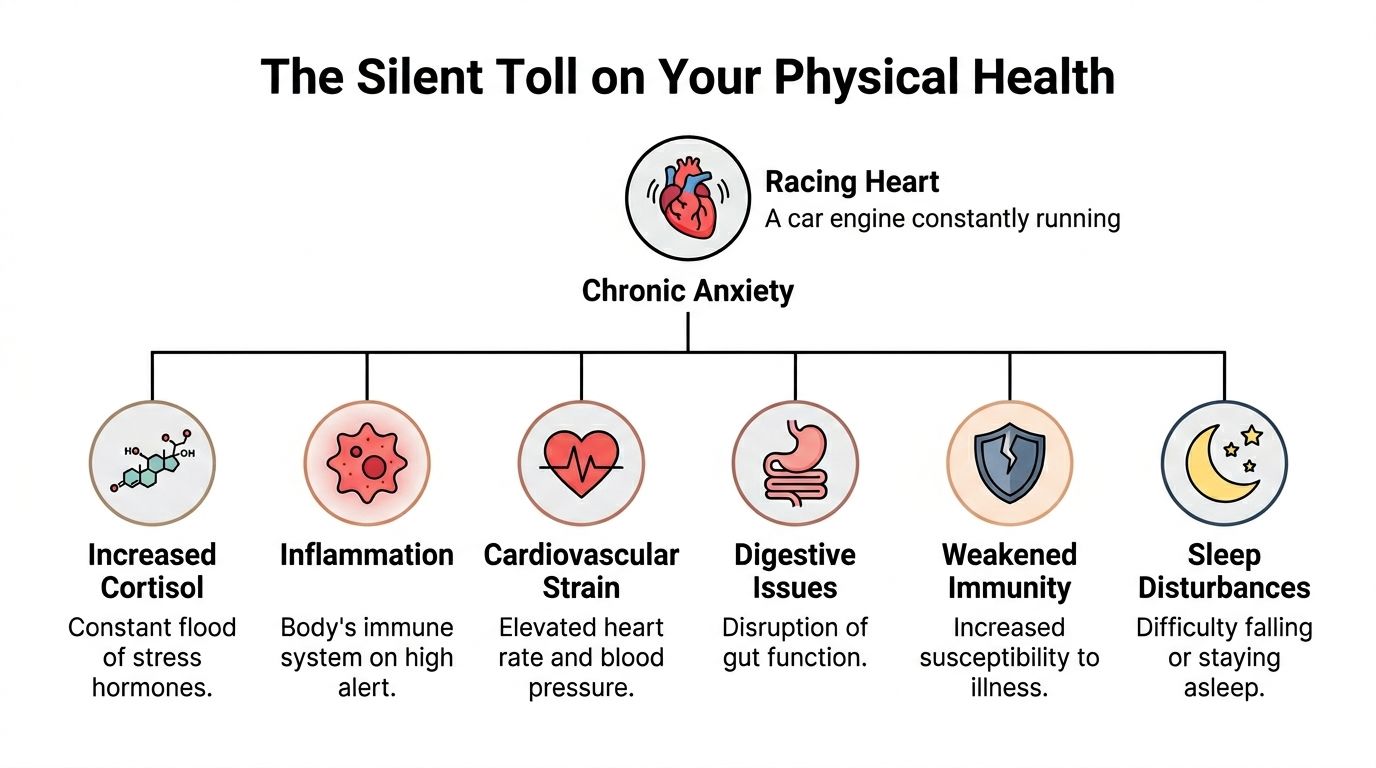
Anxiety starts in the nervous system, but over time it can spread through the body like a house alarm that never fully shuts off. The sound may fade into the background, yet every room is still affected. Muscles stay braced. Breathing stays shallow. Recovery never quite feels complete.
Your heart and circulation feel the pressure
A body that keeps preparing for danger does extra work all day long. Heart rate rises faster. Blood pressure can stay higher. Muscles stay half-contracted, as if something bad might happen at any moment.
As noted earlier, this chronic state of alert has been linked to serious long-term health risks, including a higher risk of death from natural causes over time. That is not a reason to panic. It is a reason to treat anxiety as a real health issue, not a personality flaw or a lack of toughness.
I think this shift matters. Many people blame themselves for symptoms that are signs of strain. A racing heart, chest tightness, and feeling physically “keyed up” can be your body asking for care.
Sleep, pain, digestion, and immunity often get pulled in too
The body works as a team. When one system stays stuck in alarm mode, others start adjusting around it.
That is why long-term anxiety can show up far away from your thoughts.
| Body area | What people often notice |
|---|---|
| Sleep | Trouble falling asleep, waking often, feeling unrefreshed |
| Pain | Jaw clenching, headaches, neck tension, back tightness |
| Digestion | Nausea, stomach knots, appetite changes, bathroom issues |
| Immune function | Feeling run down more often, slower recovery when sick |
These symptoms can feel random when you are living inside them. One week it is stomach trouble. The next it is tension headaches. Then you catch yourself wondering whether something is seriously wrong because your body never feels settled.
Sometimes anxiety is the thread connecting all of it.
That does not mean every physical symptom is “just anxiety,” and it does not mean you should ignore medical care. It means anxiety can amplify physical distress in a very real way, and relief often begins when both body and mind are taken seriously.
Movement can retrain the body’s alarm system
Exercise is not a punishment, and recovery does not require a boot-camp mindset. For an anxious body, the goal is often simpler. Teach your system that physical activation is not always danger.
A brisk walk, light cycling, resistance training, yoga, or stretching can all help. The repeated lesson is what matters. Your heart speeds up, you breathe harder, and then your body comes back down safely. That is powerful practice for a nervous system that has started treating every sensation like a warning.
If structure helps you follow through, a personalized strength training app can make movement feel more clear and less mentally draining. And if you want practical support beyond exercise, this guide to lifestyle diet changes anxiety management offers realistic ideas for sleep, food, movement, and daily habits.
Your body can recover its rhythm
A healthy nervous system still reacts to stress. It just does not stay stuck there.
That is the hopeful part of this whole conversation. The physical effects of untreated anxiety are serious, but they are often reversible challenges, not a fixed destiny. With treatment, medical support when needed, better sleep, steadier routines, and repeated moments of safety, the body can become less reactive and more resilient.
Healing often begins subtly. Your shoulders drop. You wake up less exhausted. Your stomach settles more often. You notice a stressful moment, then feel it pass instead of owning the whole day.
That is not small progress. That is your system learning safety again.
When Your World Starts to Shrink
Untreated anxiety often steals life by inches.
It may start with one skipped event. You tell yourself you're tired. Then you avoid another because your stomach is in knots. Then a work meeting feels unbearable, so you stay quiet on camera. Months later, people think you've become less interested, less ambitious, less social.
Inside, that's not what happened at all. You're still you. Anxiety just started making too many decisions.
How avoidance grows quietly
A familiar story goes like this.
Someone turns down a friend's birthday dinner because they feel “off” and don't want to fake being okay. The relief is immediate. No awkward conversation. No pounding heart. No worrying about saying the wrong thing.
The brain learns from that relief.
Next time, avoiding feels even smarter. Then they stop speaking up in meetings. Then they delay replying to texts because any interaction feels loaded. Then they pass on a promotion because more visibility sounds terrifying.
What looks like laziness from the outside is often a person building their life around fear.
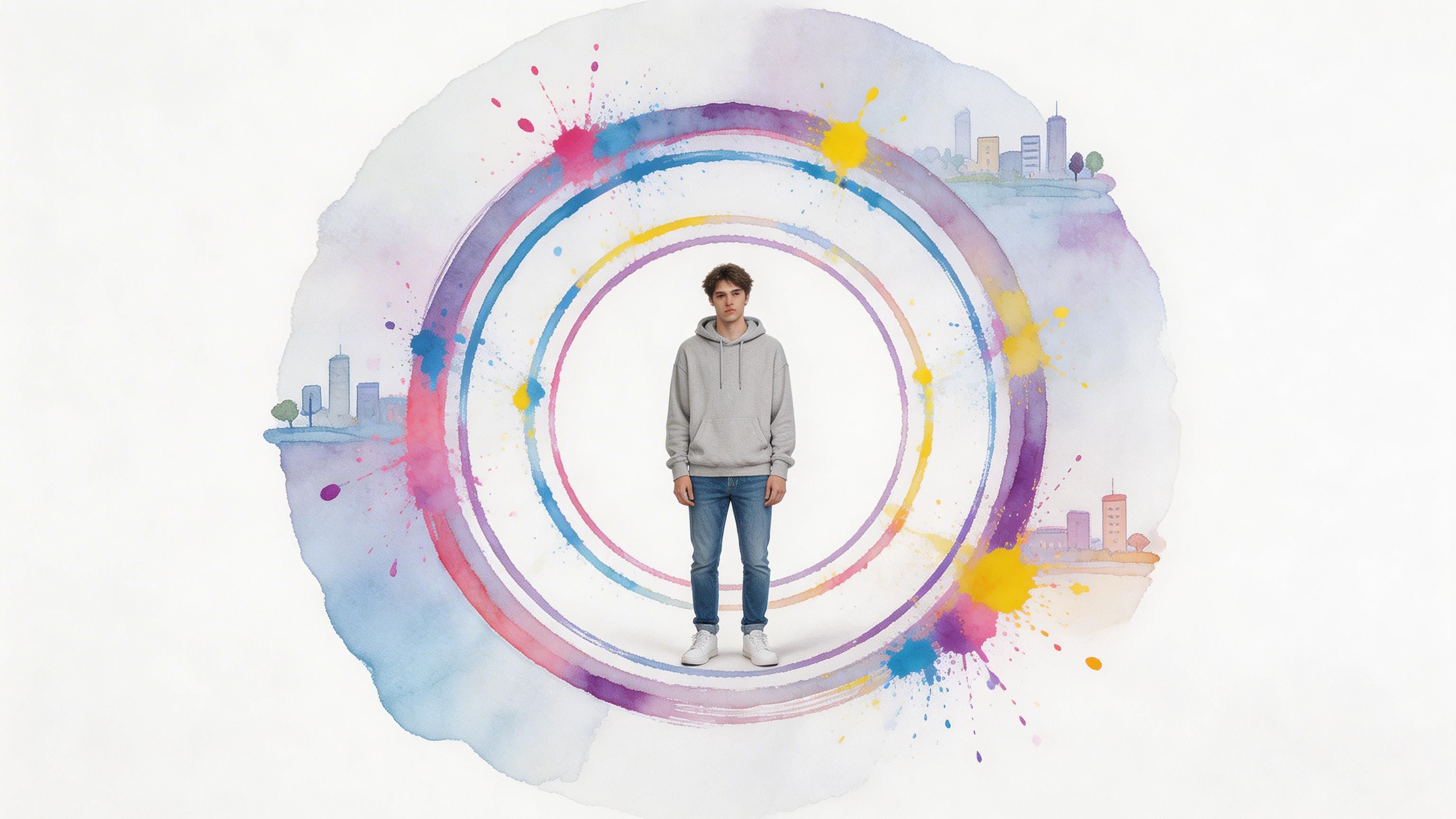
Relationships can become narrower
Anxiety makes connection hard in subtle ways:
- You cancel often, so people stop asking
- You need constant reassurance, so conversations revolve around fear
- You stay guarded, which makes closeness harder
- You overanalyze small moments, then pull away before anyone can reject you
Sometimes the fear becomes tied to places too. Crowded stores, highways, public transport, open spaces, or any setting where escape feels difficult can start to feel dangerous. For some people, that pattern moves toward agoraphobia, which can make daily life feel tightly boxed in.
Career and purpose take hits too
Anxiety doesn't just affect comfort. It affects trajectory.
You may avoid applying, presenting, leading, networking, traveling, negotiating, or asking for help. Over time, that can create a painful gap between what you're capable of and what you're currently living.
That gap often feeds shame. Then shame feeds more avoidance.
If this sounds familiar, try to see it clearly without attacking yourself. You didn't choose fear as a lifestyle. You adapted to distress the best way you knew how. The good news is that what was learned can be unlearned. Your world can expand again, one safe step at a time.
The Domino Effect of Comorbidity Risks
Untreated anxiety rarely stays in one lane.
A useful way to think about this is a cracked foundation. The house may still stand. From the street, it might even look fine. But over time, stress spreads into other parts of the structure. Doors stop closing right. Walls shift. New problems appear that seem separate, but they trace back to the same weakness underneath.
That’s how anxiety can interact with other mental health struggles.
Why depression often follows anxiety
Living with constant fear is exhausting. It drains joy, shrinks routines, and interrupts the kinds of experiences that keep people grounded. If every day feels like effort and every decision carries tension, hopelessness can start to creep in.
Research shows anxiety disorders often follow a chronic, recurrent course. Globally, only about 27.6% of people who need anxiety treatment receive it. Untreated anxiety also commonly progresses to depression, and longitudinal research found that people who remained symptomatic reported severely impaired quality of life, while those who achieved remission through treatment regained normal quality of life (PMC).
That matters because depression can feel like a personality collapse when it's really the nervous system and mind running out of room.
Other problems can become coping tools
Some people don't notice worsening anxiety at first because another behavior steps in to manage it.
That behavior might be:
- Overworking to avoid sitting with fear
- Drinking or using substances to force calm
- Compulsive reassurance seeking from partners or family
- Rigid routines that reduce uncertainty but reduce freedom too
These strategies often make sense in the short term. They offer relief. But they usually deepen dependence on avoidance and make recovery harder later.
Treating the root changes the whole picture
The hopeful part of comorbidity is that improvement can spread too.
When you treat anxiety directly, you often reduce the pressure that feeds low mood, burnout, panic, irritability, and unhealthy coping. The goal isn't to blame anxiety for every struggle. It's to recognize that unresolved fear puts extra load on the entire system.
Healing the foundation doesn't fix everything overnight. It does make every other part of recovery more stable.
If you've developed depression, isolation, or unhealthy coping alongside anxiety, that doesn't mean you've failed. It means your system has been carrying too much for too long. Support can still work. In many cases, treating the root fear changes more than people expect.
How to Know When Anxiety Is Becoming Dangerous
A lot of people ask the wrong question. They ask, “Is my anxiety bad enough?” A better question is, “Is anxiety taking over my functioning, my health, or my hope?”
That shift matters because many people minimize serious symptoms since they are still getting through the day.
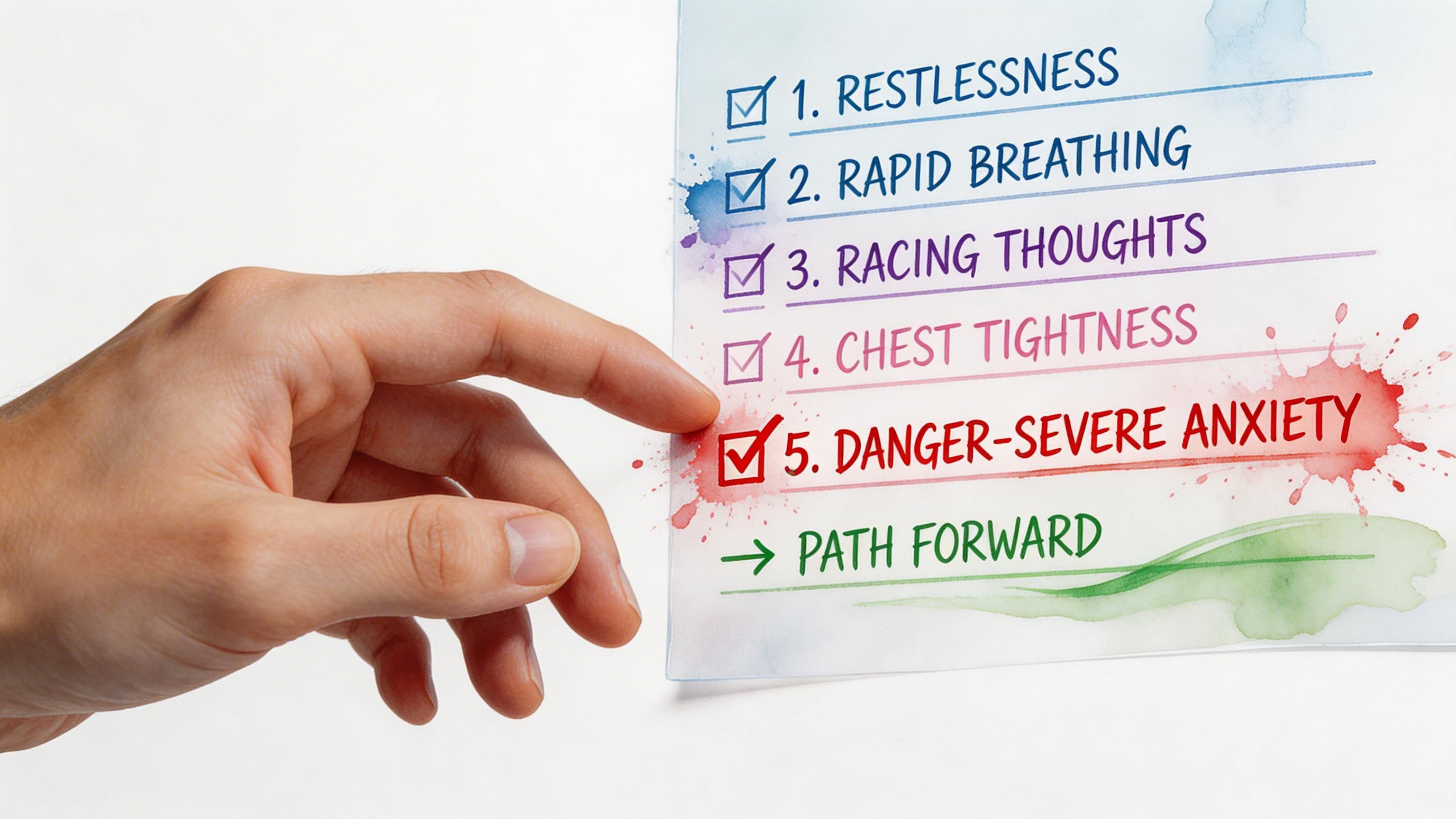
Warning signs that deserve attention
Watch for patterns like these:
- Daily life is getting harder. Work, school, parenting, errands, or basic self-care feel increasingly difficult.
- Avoidance is spreading. One feared situation becomes five. Your “safe zone” gets smaller.
- Your body is paying the price. Chest tightness, dizziness, stomach distress, exhaustion, and sleep disruption keep showing up.
- You feel cut off from people. You're withdrawing, cancelling, or hiding how bad things feel.
- You feel trapped by your own mind. Reassurance helps less, rumination takes longer, and calm feels harder to reach.
- Hopelessness is growing. You start thinking this is just who you are and nothing will change.
None of these signs mean you're doomed. They mean it's time to stop carrying this alone.
Some risks are higher for certain groups
Untreated anxiety isn't equally dangerous for everyone. A source discussing projected disparities reports that 2025 WHO-updated data projects 35% higher cardiovascular mortality among low-income groups in the US/EU with untreated cases, and that women may face double the risk due to underdiagnosis (Thriving Center of Psychology).
The main point isn't to compare suffering. It's to recognize that access barriers, underdiagnosis, and delayed care can make anxiety more dangerous in some communities and families.
If that describes you or someone you love, please don't use “I've managed this long enough” as a reason to wait longer.
Here’s a brief video that may help you reflect on severity and next steps.
When to seek urgent help
Some situations call for prompt professional support, not just self-help:
| Sign | Why it matters |
|---|---|
| You can't function normally for days at a time | Anxiety is disrupting core daily living |
| Panic symptoms keep escalating | Fear of fear can create a self-reinforcing cycle |
| You're using alcohol or other substances to cope | Relief may be masking worsening risk |
| You feel hopeless or unsafe | This needs immediate support from a qualified professional or emergency resource |
If anxiety is making life feel unlivable, that is enough reason to reach out.
Your Path Back to a Fearless Life Starts Now
The long term effects of untreated anxiety are serious. But serious doesn't mean permanent.
I want to be careful with that distinction. Recovery doesn't usually arrive as one dramatic breakthrough. More often, it shows up as a series of quiet wins. A slower heartbeat after a spiral. A grocery trip you finish. A full night's sleep. A thought you don't obey. Those moments count because they teach your system a new story.
A life that feels calm, open, and panic-free might seem far away right now. It isn't imaginary. People get there through a mix of skills, support, and repetition.
Start with what you can do today
If anxiety has been running your life, begin small enough that your nervous system can cooperate.
Try a few anchors:
- Breathing with longer exhales. Don't force giant breaths. Slow the exhale and let your body catch the message that it isn't in immediate danger.
- Thought labeling. When your mind says, “Something bad is about to happen,” answer with, “This is an anxious prediction, not a fact.”
- Reduce reassurance loops. Pause before texting someone for the fourth time or searching symptoms again. Give discomfort a little room.
- Gentle exposure. Approach what you've been avoiding in manageable pieces instead of waiting to feel fearless first.
- Daily basics. Eat regularly, reduce overstimulation where you can, move your body, and protect sleep.
These aren't glamorous. They work because they are repeatable.
Get support before you're at the edge
A lot of anxious people wait for certainty before seeking help. They want proof that therapy is necessary, proof that medication is justified, proof that they aren't overreacting.
You usually won't get that kind of certainty in advance.
If anxiety is persistent, treatment-resistant, physically intense, or tied to panic, avoidance, depression, or hopelessness, professional care is a smart move. A therapist trained in CBT, exposure work, panic treatment, or anxiety disorders can help you interrupt patterns that self-help alone may not fully shift.
If therapy feels overwhelming to approach, write down three things before you search:
- What symptoms are affecting you most.
- What situations you're avoiding.
- What “better” would look like in daily life.
That short list makes first appointments easier and helps you find a clinician who fits the problem you are dealing with.
Some people also benefit from additional structure outside therapy. For example, health and wellness coaching can help with routines, accountability, stress habits, and behavior change, especially when anxiety has tangled itself into sleep, work, movement, and daily follow-through.
Build a system, not a burst of motivation
Motivation is unreliable when you're anxious. Systems are kinder.
That means creating a recovery setup you can use on hard days, not just good days. Your system might include a morning check-in, a short walk, a panic response card in your phone, one person you can text openly, and a weekly exposure goal.
Here are examples of what a simple system can include:
- A symptom log so you can spot patterns instead of assuming everything is random
- A coping menu with options like breathing, grounding, walking, journaling, or stepping outside
- A thought worksheet to challenge catastrophic predictions
- A recovery schedule that protects sleep and lowers overload
- A learning resource that explains anxiety in plain language
If you like structured guidance, Anxiety University is one place to keep learning how anxiety works and what recovery can look like in practice.
Fearless doesn't mean never anxious
Its importance is often overlooked.
A fearless life is not a life with zero adrenaline, zero intrusive thoughts, or zero hard days. It's a life where anxiety stops making your decisions. You still feel uncertainty, but you don't hand it the steering wheel.
That's the shift many people miss. They keep waiting to feel no fear before they act. Recovery usually works in the opposite direction. You act, gently and repeatedly, and fear loses authority.
If you've lived with anxiety for years, you may have started to believe you've become “the anxious person.” I don't think that's the full truth. I think you've been a whole person adapting to a loud nervous system. That's different. And it leaves room for change.
Recovery often begins the moment you stop asking, “How do I get rid of every anxious feeling?” and start asking, “How do I live well while I retrain my brain and body?”
You do not need to solve your entire future today. You need one honest next step.
That might be making an appointment. It might be telling someone the truth. It might be going for a walk instead of spiraling online. It might be deciding that your panic attacks are not a private shame you have to outlast.
Healing is possible. Not because you force yourself into positivity. Because brains adapt, bodies respond to care, and people can learn new ways to live.
If you're ready for a practical next step, The Anxiety Checklist offers a structured self-help system built for people who want clear tools, daily guidance, and a realistic path toward calmer thinking, fewer panic attacks, and a more fearless life.