


Your partner takes longer than usual to reply. Your chest tightens. Your mind starts filling in the blanks before you have facts. Maybe they’re pulling away. Maybe they’re upset. Maybe you missed a tone in their last message. Maybe this relationship is about to become one more place where your nervous system never gets to rest.
That spiral is exhausting. It also makes perfect sense if you live with chronic anxiety.
People with anxiety often strongly desire closeness and fear it at the same time. You may crave reassurance, then doubt the reassurance when it comes. You may notice tiny changes in expression, tone, timing, or routine and treat them like warning sirens. That doesn’t mean you’re broken. It means your brain has learned to scan for danger, and relationships can become one of its favorite hunting grounds.
Most trust advice misses this completely. It tells you to “just communicate” or “choose trust,” as if anxious thinking doesn’t hijack the process halfway through. That gap matters. The challenge isn’t only building trust with another person. It’s learning how to tell the difference between a real relational problem and an anxiety alarm.
Trust Can Heal Your Anxiety and Your Relationships
If you’ve ever asked for reassurance and then felt ashamed for needing it, you already know how painful this can get. Anxiety can make healthy dependence feel risky. It can also make ordinary uncertainty feel unbearable.
That’s why generic relationship advice often falls flat. It doesn’t address the core problem described in this discussion of trust-building and anxiety from Be Bold Psychology and Consulting. Mainstream frameworks often miss the mark for people with anxiety because they don’t help you distinguish anxiety-driven distrust from legitimate relationship concerns. When that difference stays blurry, couples get trapped in a cycle where one person seeks reassurance and the other starts feeling accused or policed.
Anxiety can imitate intuition
Anxious distrust often sounds convincing because it borrows the language of self-protection.
You might think:
- “I’m just being realistic.” But your mind may be catastrophizing.
- “I need certainty before I can relax.” But relationships never offer total certainty.
- “If I ask again, I’ll finally feel better.” But compulsive reassurance usually wears off fast.
For many people, fears around betrayal sit right at the center of this cycle. If that’s the theme your mind keeps returning to, this guide on anxiety about partner cheating can help you separate fear-driven checking from grounded discernment.
Trust is not blind faith
Trust isn’t pretending red flags don’t exist. It isn’t staying silent when something feels off. It’s the ability to stay open, curious, and steady enough to respond to reality instead of reacting to panic.
That’s where healing begins.
Practical rule: If your body is in alarm, delay conclusions. Regulate first, interpret second.
A lot of relationship suffering comes from confusing emotional intensity with evidence. Anxiety makes feelings loud. Loud doesn’t always mean true.
If you’ve been trying to sort out whether what you feel is love, fear, attachment, or panic, the resource on love vs anxiety in a relationship can help put language to experiences that otherwise feel tangled and impossible to name.
Building trust in relationships is one of the most effective ways to lower chronic relational stress. As safety grows, panic loses some of its fuel. You stop bracing for abandonment in every silence. You stop treating every uncomfortable feeling like a forecast. You learn that trust is not a personality trait you either have or don’t have. It’s a skill. Skills can be practiced. Practice changes lives.
Why Your Anxious Brain Is Hardwired for Distrust
An anxious brain doesn’t wait calmly for more information. It moves early.
It scans for threat, fills in missing pieces, and treats uncertainty like danger. In relationships, that can look like overreading texts, replaying conversations, noticing small shifts in affection, or assuming distance means rejection. Many people call this overthinking. Clinically and practically, it’s closer to hypervigilance.
Attachment patterns shape what you expect
Research published in PMC found that anxious and avoidant attachment styles explained 42% of the variance in trust scores in relationships (PMC study on dyadic trust). That matters because it shows trust problems often come from internal patterns, not only from what a current partner is doing.
If you have an anxious attachment style, you may chase closeness while fearing loss. If you have avoidant patterns, you may protect yourself by staying guarded and emotionally distant. Both styles interfere with trust, but in different ways.
The important takeaway is simple. Your distrust may feel personal and permanent, but often it’s patterned. Patterns can be identified. Identified patterns can be interrupted.
Anxiety hates ambiguity
Most relationships include delayed replies, mixed moods, imperfect wording, and occasional misunderstandings. A regulated nervous system can usually tolerate that. An anxious one often can’t.
So the mind does three things fast:
- It predicts the worst-case scenario.
- It searches for confirming evidence.
- It ignores reassuring data because reassurance feels temporary.
That’s why anxious people often say, “I know I’m overreacting, but it still feels real.” They’re telling the truth. The feeling is real. The interpretation may not be.
If you want language for these mental habits, this breakdown of cognitive distortions is useful. It helps people catch patterns like mind reading, catastrophizing, emotional reasoning, and black-and-white thinking before those patterns start running the relationship.
The brain under stress prefers a painful certainty over a peaceful unknown.
Past pain trains the nervous system
If you’ve been betrayed before, grew up around instability, or learned that closeness can disappear without warning, your body may react before your logical mind catches up. That’s not weakness. It’s conditioning.
I’ve seen this in people who kept calling themselves “too much” when they were carrying an overtrained threat system. Once they understood that, shame started to loosen.
For some, outpatient support is enough. For others, anxiety becomes so disruptive that daily functioning and relationships both suffer. In those cases, more structured care can make sense. This overview of residential treatment for anxiety offers a grounded look at when a higher level of support may be worth considering.
The goal isn’t to stop caring. It’s to stop treating every unknown as a warning. Trust grows when your nervous system learns that not every pause means danger, not every fear deserves obedience, and not every thought deserves a reaction.
Mastering Communication That Calms Anxiety and Builds Connection
Words can inflame anxiety fast. They can also settle it. The difference usually isn’t the topic. It’s the level of attunement.
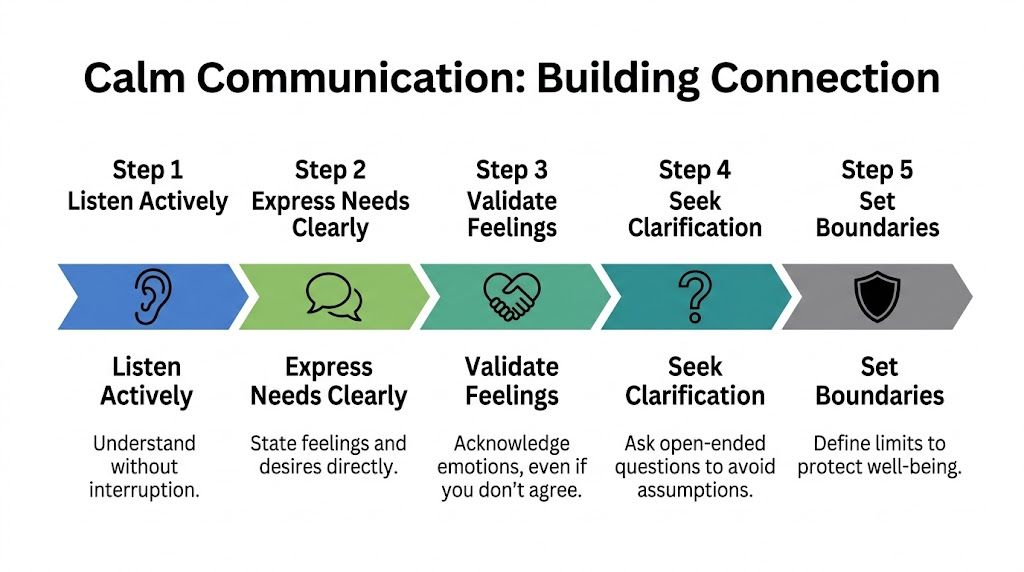
Dr. John Gottman’s work with thousands of couples found that emotional attunement through the ATTUNE framework is a greater predictor of relationship stability than the content of conversations (overview of Gottman’s ATTUNE framework). For an anxious person, that’s good news. You don’t need perfect wording. You need a better emotional process.
A visual reminder can help when your mind goes blank in conflict.
The ATTUNE method in real life
Here’s what each part looks like when anxiety is in the room.
Awareness
Notice what your partner is feeling, and notice what you’re feeling before you speak. If your heart is racing and your mind is writing a breakup story, say that to yourself first. “I’m activated.” That label creates a little space.
Turning toward
When your partner reaches for connection, respond. A bid for connection can be small. A sigh. A text. A “Can we talk later?” Anxiety often misreads bids because it’s busy bracing. Turning toward means choosing engagement over withdrawal, stonewalling, or accusation.
Tolerance
Your partner won’t regulate exactly like you do. They may need time when you need closeness. They may speak more slowly when you want immediate reassurance. Tolerance means accepting these differences without turning them into evidence of rejection.
Understanding
Ask open questions. Then reflect back what you heard. “Can you tell me more about what you meant?” is often more useful than “Why would you say that?” One opens. One corners.
Non-defensive listening
Defensiveness kills repair. If your partner says, “I felt shut out,” don’t rush to explain why you were right. First prove you heard the pain. An anxious nervous system settles faster when it feels understood.
Empathy
Empathy isn’t agreement. It’s emotional contact. “I can see why that landed hard” goes much further than advice delivered too early.
Later in the same spirit, it can help to hear these ideas discussed out loud:
Translate panic into clarity
Most couples don’t fail because they don’t care. They fail because fear gets translated into criticism, testing, withdrawal, or interrogation.
That’s why I like to teach communication scripts. They give anxious people something to reach for before they say the harsher sentence their fear wants to deliver.
| Anxiety-Informed Communication Scripts | |
|---|---|
| The Anxious Thought | The Trust-Building Script |
| They’re mad at me. | My anxiety is telling me I may have upset you. Can we check in about how you’re feeling? |
| If they loved me, they’d know what I need. | I want to tell you directly what would help me feel supported right now. |
| I need to ask again or I won’t calm down. | I’m feeling the urge to seek more reassurance. Can we pause and decide together what would actually help? |
| They seem distant, so something must be wrong. | I’m noticing some distance and my mind is filling in blanks. Is this a good time to talk about how we’re both doing? |
| If I bring this up, I’ll sound needy. | This feels vulnerable to say, but I’d rather be honest than shut down. |
| I have to prove my point. | I want to understand your experience before I explain mine. |
| They should answer immediately. | Delays are hard for my nervous system. Could we agree on a simple check-in if one of us will be unavailable? |
Communication that lowers the temperature
A few practices make building trust in relationships much easier when anxiety is active:
- Name the state, not just the issue. Say “I’m flooded” or “I’m getting activated” before the topic escalates.
- Ask for a container. Try “Can we spend ten minutes on this after dinner?” Predictable timing is calming.
- Use one-issue conversations. Don’t stack old wounds onto a current misunderstanding.
- Reflect before responding. A short summary of what you heard reduces misfires.
- End with a concrete next step. Vague repair leaves anxious minds spinning.
If you want a practical framework for changing these patterns, understanding CBT for anxiety can help. CBT is especially useful here because it teaches you to challenge the thought, regulate the body, and choose a more skillful behavior instead of following the panic script.
Say the vulnerable thing one sentence earlier. It usually lands better than the defensive version.
The Power of Predictability How Consistency Heals the Anxious Brain
Trust doesn’t grow from one intense conversation. It grows from repeated proof.
For an anxious person, predictability is not boring. It’s regulating. Consistency tells the nervous system, “You don’t have to stay on watch all day.” That’s why small rituals often work better than dramatic promises.

What consistency looks like in practice
A couple doesn’t need a grand reinvention. They need a few reliable behaviors they can repeat without resentment.
That may mean:
- A steady check-in rhythm. A short morning text, an evening call, or a quick update when plans change.
- A repair habit after conflict. One partner says, “I need twenty minutes, then I’ll come back.” The other knows the conversation is paused, not abandoned.
- A weekly temperature check. Not a crisis talk. Just a set time to ask what felt good, what felt hard, and what each person needs this week.
These actions sound simple because they are. Their power comes from repetition.
Build a behavioral consistency plan
When I work with anxious relationship patterns, I encourage people to stop asking only, “Do we trust each other?” and start asking, “What behaviors make trust easier to feel?”
Use a simple plan like this:
| Behavioral consistency plan | Example |
|---|---|
| Daily reliability signal | We send a goodnight text if we’re apart |
| Transition moment | We update each other if plans change |
| Conflict agreement | We don’t disappear mid-argument without naming when we’ll reconnect |
| Reassurance boundary | We comfort each other, but we don’t spend hours looping the same fear |
| Connection ritual | We share coffee on Saturday morning without phones |
The point isn’t perfection. The point is creating enough rhythm that the anxious brain no longer has to guess all the time.
Why this works better than big speeches
Anxiety tends to distrust declarations. Someone can say “I’m here for you,” and an activated mind may still think, “For how long?” Consistent action answers that question more effectively than eloquent promises do.
That’s also why vague goals usually fail. “We’ll communicate better” is too abstract. “We’ll do a ten-minute check-in on Sundays” is visible and testable.
If you need help turning relational intentions into concrete habits, the framework behind SMART goals for anxiety can make the process much easier. Specific, realistic behaviors calm the nervous system faster than broad emotional promises.
Reliability is one of the most soothing forms of love.
When consistency improves, anxiety often softens in a very practical way. You spend less time interpreting silence. You stop chasing certainty through constant checking. You start borrowing stability from the structure you and your partner built together.
That’s one of the quiet truths about building trust in relationships. Safety often arrives through ordinary moments done on purpose.
How to Repair Trust When It Shatters
Some relationships aren’t just dealing with anxiety. They’re dealing with an actual rupture.
Maybe there was infidelity. Maybe there was lying, secrecy, emotional betrayal, or a long period of broken promises. In those moments, anxious people often blame themselves twice. First for the pain. Then for how intensely they react to it.
A real breach needs more than calming skills. It needs repair.
Research summarized by Addo Recovery describes a structured process of radical transparency after betrayal. In a survey of 1,000 couples, 86% remained married when they fully committed to that process, including answering questions with complete honesty no matter how difficult (rebuilding trust after betrayal). That doesn’t mean every relationship should stay together. It does mean repair is possible when both people are serious.
Phase one is naming the injury
The hurt partner has to be allowed to say what happened and what it did to them.
Not once. Usually many times.
This part is messy because the betrayed person often needs detail, and the person who caused the harm often wants to move past it quickly. That tension is normal. Fast forgiveness without full acknowledgment usually creates fake peace.
The goal here is not endless punishment. It’s accurate reality.
Phase two is radical transparency
At this point, many couples either begin healing or stall out.
The partner who broke trust must answer questions truthfully. Not selectively. Not with half-truths designed to manage the other person’s reaction. Genuine repair requires directness, accountability, and a willingness to tolerate the discomfort of being seen clearly.
If you’re the one who caused the breach, statements like these matter:
- “You’re not overreacting. I created this injury.”
- “I will answer what you ask, even when it’s uncomfortable.”
- “I understand that trust won’t return on my timeline.”
If you’re the hurt partner, your task is different. You need room to seek clarity, but you also need structure so the pain doesn’t consume every waking hour. That might mean agreeing on when these conversations happen, how long they last, and what helps both people regulate afterward.
Phase three is building a new system
Repair isn’t complete when the truth comes out. Repair becomes real when the relationship starts operating differently.
That often includes:
- New transparency agreements. Not surveillance. Clear expectations.
- Changed routines. Less secrecy, more follow-through.
- Repair rituals. Planned check-ins for discussing triggers and progress.
- Support outside the relationship. Often with a trained therapist.
I’ve seen couples get stuck because they thought insight alone would heal them. It won’t. Insight matters, but trust grows when behavior changes and stays changed.
The question after betrayal isn’t only “Can I forgive?” It’s “Can we build a relationship that no longer requires me to ignore reality?”
Relapse prevention matters
Even when repair is underway, old fear will flare.
A late reply may trigger the whole story again. An anniversary date may hit hard. A change in tone may reopen panic. This doesn’t always mean the repair is failing. It often means the nervous system still remembers.
Plan for those moments in advance:
- Use trigger language. “I’m having a spike. I need grounding before we talk.”
- Return to facts. What do I know, not just fear?
- Differentiate present from past. Is this today’s issue, or yesterday’s injury replaying itself?
- Revisit agreements. What did we say we’d do when fear resurfaces?
If the person who broke trust becomes irritated every time the wound reopens, repair usually slows down. If the hurt partner uses every trigger as proof that healing is impossible, repair slows down too. Both people need steadiness.
Sometimes the bravest outcome is rebuilding together. Sometimes it’s leaving with clarity. Trust repair is not about forcing reconciliation. It’s about ending confusion and choosing what’s true.
Your Personal Toolkit for Lasting Trust and Inner Peace
Trust becomes sustainable when you stop treating it like a feeling you must wait for and start treating it like a practice you can support.
That matters because a 2023 YouGov survey found that 94% of Americans rated trust as “very important” for a successful relationship, making it the top-rated factor above honesty, respect, and open communication (YouGov relationship survey). If trust matters that much, it deserves tools, not wishful thinking.

Tool one is cognitive reframing
When distrust spikes, write down three things:
- The trigger
- The story your anxiety tells
- A more balanced interpretation
Example:
- Trigger: Partner was quiet tonight
- Anxiety story: They’re withdrawing and won’t tell me
- Balanced interpretation: They may be stressed, tired, or distracted. I need a conversation, not a conclusion
This doesn’t erase fear on command. It helps stop fear from becoming your only narrator.
Tool two is healthy boundaries
A lot of anxious people swing between two extremes. Over-pursuing or shutting down. Boundaries create a middle path.
Healthy boundaries might sound like:
- “I want to talk about this, but not while we’re both flooded.”
- “I can offer reassurance, but I can’t answer the same question for an hour.”
- “If plans change, please tell me. That helps my nervous system stay grounded.”
Boundaries don’t block intimacy. They protect it.
Tool three is visible progress tracking
Trust feels abstract when you only measure it by emotion. Measure behavior too.
Try a personal or shared tracker with prompts like:
| Trust practice | What to note |
|---|---|
| Trigger recovery | How quickly did I return to facts? |
| Clear communication | Did I say what I needed directly? |
| Consistency | Did we follow through on our agreements? |
| Repair | Did we reconnect after tension? |
| Self-regulation | What helped my body settle? |
A simple notebook works. A shared journal works. Some people prefer structured worksheets. One option is mental health tools for anxiety, which includes checklists, worksheets, and tracking resources for cognitive patterns, habits, and symptom monitoring. Used well, tools like these can help turn vague goals into repeatable practices.
When to get professional support
Self-help can take you far. It cannot do everything.
Consider therapy when trust problems keep turning into panic, when conflict becomes repetitive and circular, when betrayal has occurred, or when you and your partner can’t separate anxiety stories from relationship realities on your own.
That step is not failure. It’s skill-building with support.
Building trust in relationships while living with anxiety is hard work. It asks you to slow down when fear wants speed, speak clearly when shame wants silence, and stay open when your body wants armor. But this work changes people. It can soften panic. It can create steadier love. It can teach your nervous system that connection does not always end in danger.
And over time, that lesson becomes more than comforting. It becomes freeing.
If you want a structured way to work on these patterns, The Anxiety Checklist offers practical self-help tools for managing chronic anxiety, challenging cognitive distortions, tracking triggers, and building steadier daily habits. If trust issues in your relationship keep getting tangled with panic, overthinking, or reassurance loops, it can help you turn what you read here into a plan you can use.