



You took a brave step. You started Zoloft because anxiety has been running your life, and instead of relief, you feel more keyed up, shaky, restless, or on edge. That can feel cruel. It can also make you wonder if you made a mistake.
If that's where you are right now, the fear makes sense. Many people ask the same question: can Zoloft make anxiety worse? The short answer is yes, it can at first. But for many people, that early spike is a temporary adjustment period, not proof that healing is out of reach.
Starting Zoloft and Feeling More Anxious? You're Not Alone
A common scene goes like this. You pick up your prescription, tell yourself this might finally help, take the first dose, and then spend the next day scanning your body. Your chest feels tight. Your thoughts speed up. Maybe you feel jittery, irritable, or like you're about to panic. Then a new fear appears: “If this medicine is supposed to help anxiety, why do I feel worse?”
That question scares people because it hits at hope. When you've already been exhausted by worry, panic, poor sleep, and the constant effort of holding yourself together, you want treatment to feel soothing right away. Instead, the first days can feel bumpy.
That doesn't mean you're broken. It doesn't automatically mean Zoloft is wrong for you. It often means your nervous system is reacting to change.
Many people also make a second painful mistake during this window. They assume the spike in symptoms means their anxiety is unbeatable, or that all the work they've done to calm themselves somehow isn't working. If you've been learning about anxiety and recovery through resources like Anxiety University, it helps to remember this: a medication side effect and your underlying anxiety aren't the same thing, even if they feel similar in your body.
The first rough stretch can feel like failure. Often, it's adjustment.
That distinction matters. When you understand what's happening, the experience becomes less mysterious and less personal. You can stop reading every sensation as danger and start responding with a plan.
Why Your Brain Feels Revved Up When Starting Zoloft
Zoloft is the brand name for sertraline, a medication in the SSRI family. SSRIs affect serotonin signaling in the brain. Over time, that can help reduce anxiety, panic, and the intensity of intrusive fear. Early on, though, the adjustment can feel activating instead of calming.

The cold engine effect
Consider the behavior of a cold engine. At first, it may rev unevenly before it settles into a smoother rhythm. Your brain is doing something similar when serotonin activity changes. The system hasn't adapted yet, so you may feel more “revved up” before you feel more stable.
This reaction is sometimes called jitteriness/anxiety syndrome or an activation effect. People often describe it as inner restlessness, shakiness, irritability, racing thoughts, or a feeling that's uncomfortably close to panic.
A Thriveworks review of the evidence notes that a 2017 study found approximately one in four people (25%) starting antidepressants like Zoloft for anxiety or depression experienced worsened anxiety within the first six weeks. The same review explains that this early worsening is tied to the brain adjusting to increased serotonin levels.
Why it feels so convincing
The hardest part is that the sensations can mimic anxiety itself. Your body may feel buzzy, your sleep may get thrown off, and your mind may instantly start building a story around those sensations. That's how a side effect can turn into a spiral.
If you already live in a highly sensitized state, your brain may interpret any change in heart rate, tension, or alertness as a threat. That's one reason the first stretch can feel so intense.
A useful way to frame it is this:
- Your body is reacting to change: The medication is altering signaling.
- Your brain is interpreting the sensations: “Something is wrong.”
- Your anxiety adds a danger story: “This means I won't get better.”
That third step is where understanding the fight or flight response becomes so helpful. The sensations are real, but the danger message attached to them is often misleading.
Practical rule: A revved-up feeling after starting an SSRI can be alarming, but alarming doesn't always mean harmful.
Not proof of failure
People often assume early activation means the medication will never help them. That conclusion is too fast. Early side effects tell you how your system is reacting now. They don't automatically predict the long-term outcome.
The more accurate message is simpler: your brain may need time.
How Long Does the Increased Anxiety from Zoloft Last?
Time is the question that preoccupies individuals when they're in the middle of this. Not because they're impatient, but because anxiety without a timeline feels endless.
The good news is that the early increase in anxiety is usually temporary. A PMC clinical analysis found that 15% of patients experienced early worsening of anxiety symptoms within the first two weeks of SSRI treatment like Zoloft, and that these effects are transient for most, often easing within days to a couple of weeks as the brain adapts.
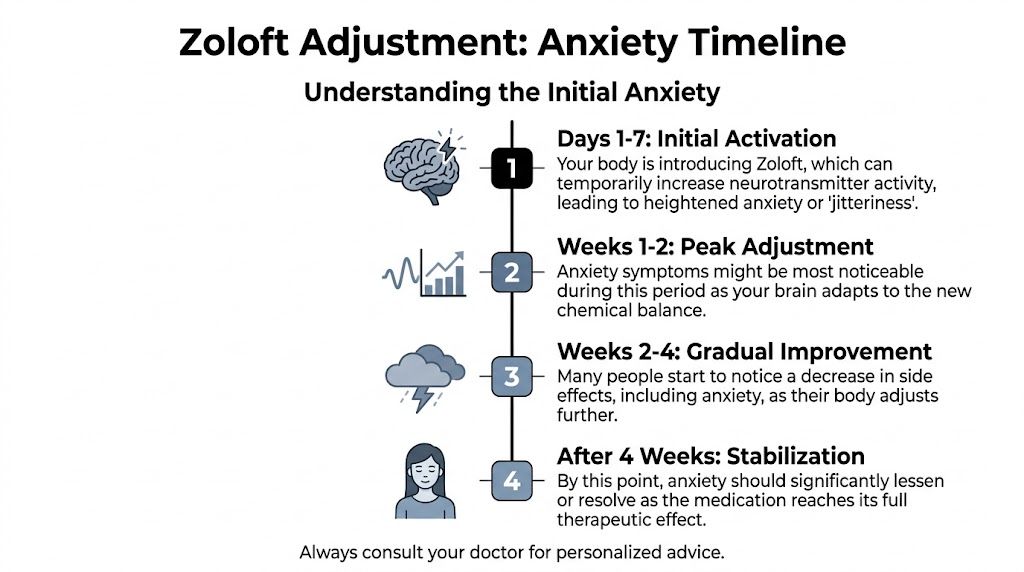
A simple timeline
Here is the pattern many people experience:
| Period | What it can feel like |
|---|---|
| First few days | More body awareness, jitters, restlessness, nausea, poor sleep, or a sense of being “off” |
| Weeks one to two | Symptoms may feel more noticeable as your system adjusts |
| Weeks two to four | Side effects often begin to soften and feel less intrusive |
| Weeks four to eight | The intended calming benefits may become clearer |
This isn't a strict script. Some people feel activated very quickly. Others notice very little. Some improve sooner, while others need more time or a dose adjustment.
What can make the timeline confusing
People often expect anxiety relief to arrive before side effects. With SSRIs, the order can be the opposite. You may feel the adjustment before you feel the benefit.
That mismatch creates doubt. You might think, “If I still feel bad, nothing is happening.” But medication changes aren't always experienced as smooth progress. Sometimes the first sign is disruption, then gradual settling, then clearer relief.
A few practical signs things may be moving in the right direction include:
- You recover faster: A wave of anxiety still comes, but it passes more easily.
- Your body feels less charged: The intensity starts to drop, even if worry hasn't fully lifted.
- You have more moments of normal: Small windows of calm start returning.
Relief often arrives gradually. Many people notice it in hindsight before they notice it in real time.
If symptoms stay intense, keep worsening, or feel impossible to manage, that's not something to just endure. That's a reason to contact your prescriber.
Partnering with Your Prescriber Through the First Few Weeks
You shouldn't have to guess your way through this period. A good prescriber expects questions, wants updates, and can help make the start more tolerable.

The start low, go slow approach
One common strategy is to begin with a low dose and increase gradually. In the verified evidence for this topic, starting at 25 mg and titrating slowly is described as a way to reduce the intensity of the activation phase.
That approach makes sense. If your nervous system is sensitive, a slower start may be easier to tolerate than pushing upward too fast. The goal isn't to delay healing. It's to help you stay on the medication long enough for it to have a fair chance to work.
Questions worth asking
A strong medication follow-up often includes practical questions, not just “Are you okay?” Consider asking:
- Would a slower increase help? If the activation feels rough, your prescriber may adjust the pace.
- Should I change when I take it? Some people do better with morning dosing, while others don't. This guide on the best time of day to take Sertraline can help you think through timing before you ask your clinician what fits your situation.
- Do I need short-term support? In some cases, clinicians use a temporary “bridge” medication while the SSRI settles in.
Bridge support can matter
The verified data notes that clinicians may sometimes use a short-term benzodiazepine if symptoms are severe. Some prescribers may also consider other short-term options depending on the person, the symptoms, and the overall plan.
This is one reason it's helpful to work with a clinician who regularly treats anxiety. If you're still trying to find that kind of support, learning what to look for in a psychiatrist for anxiety can make the process less overwhelming.
Bring specifics to your appointment. Say whether you're feeling shaky, unable to sleep, panicky, nauseated, or afraid to continue. Specific details help your prescriber decide whether the reaction sounds like a typical adjustment, a dosing issue, or something that needs a different plan.
Practical Coping Skills While Your Body Adjusts to Zoloft
Medication can help. Skills still matter.
This is the part many people don't get taught clearly enough. Existing guidance often explains the biology of the side effect but doesn't always show how to use anxiety tools specifically for medication-induced anxiety. A Brightside overview highlights this gap and notes that psychoeducation on applying grounding and cognitive strategies during the adjustment phase can support adherence and outcomes.

First, separate the sensation from the story
When Zoloft temporarily increases anxiety, you may feel a rush of symptoms and assume they mean danger. Try breaking the moment into two parts:
The sensation
Fast heart rate, inner shakiness, tingling, restlessness, nausea.The story
“I'm getting worse.” “This means I'm stuck like this.” “I can't handle this.”
That second layer often drives the suffering. The skill is to name the first part without automatically believing the second.
Try a phrase like: “This feels intense, but it may be my body adjusting. I don't have to solve the whole future from this moment.”
Ground the body before arguing with the mind
When your body is activated, logic alone usually isn't enough. Start with direct nervous system support.
A few options work well here:
- Feet on the floor: Press both feet down and describe five physical things you can feel.
- Cold temperature: Hold a cool drink, splash cool water on your face, or step into fresh air.
- Slow exhale breathing: Breathe in gently, then make the exhale longer than the inhale.
- Object focus: Pick one object in the room and describe it in detail until your attention steadies.
If you want a more structured set of exercises, this guide to grounding techniques for anxiety can help you practice before the next spike hits.
Use coping skills differently during a medication spike
Medication-related anxiety often needs a slightly different approach than your baseline anxiety.
| If the problem is… | Try this |
|---|---|
| Jittery body sensations | Focus on breathing, posture, movement, and grounding |
| Catastrophic thoughts | Use brief reframing, not long mental debates |
| Fear of the medication itself | Remind yourself that side effects can happen during adjustment and need context, not panic |
| Demoralization | Track moments of coping, not just moments of distress |
A small journal can help here. Not a journal for endless symptom checking, but a journal for pattern recognition. If that style appeals to you, this piece on meditation and journaling offers practical ways to combine calm attention with reflection.
Here is a short guided practice that can help when your body feels overstimulated:
What not to do
A few habits can subtly make this phase harder:
- Don't check your body every minute: Frequent scanning makes sensations louder.
- Don't make a permanent conclusion from a temporary reaction: One hard day doesn't tell the whole story.
- Don't abandon every normal routine: Gentle structure helps the nervous system feel safer.
Try saying, “My job today is not to feel perfect. My job is to respond well to what I feel.”
A good daily question
Instead of asking, “Do I feel completely better yet?” ask, “How can I support my nervous system today?”
That question leads to useful action. Eat something simple if nausea is making you shaky. Reduce caffeine if you're feeling overstimulated. Keep your schedule light if possible. Reach out to a trusted person. Use one grounding tool before symptoms escalate.
These are small moves. Small moves are often what carry people through the first stretch.
When to Call Your Doctor or Seek Immediate Care
Some symptoms are uncomfortable but manageable. Others need prompt medical attention. Knowing the difference can lower panic and improve safety.
Call your prescriber soon if
Reach out if the anxiety feels so intense that you can't function, if you're becoming extremely agitated, if you can't sleep in a way that feels unmanageable, or if the symptoms keep escalating instead of settling. Also call if you're thinking about stopping the medication because the side effects feel unbearable.
It also makes sense to check in if the reaction feels very different from your usual anxiety. Trusting your observations is part of good care.
Seek immediate help if
Get urgent help right away if you develop thoughts of self-harm or suicide. The verified data for this topic also notes the black-box warning history related to increased suicidal ideation risk in people under 25. Immediate support matters.
Seek urgent medical care if you have symptoms that could suggest a serious reaction, such as a possible allergic reaction or signs of serotonin syndrome, which can include a dangerous cluster of symptoms that needs emergency evaluation.
Keep this simple
If you're asking yourself, “Is this bad enough to call?” it's usually worth calling. You are not bothering your doctor by reporting a strong reaction to a psychiatric medication.
A brief message with clear details works well:
- when you started
- what you're feeling
- whether it is getting better, worse, or staying the same
- whether you feel safe
That kind of update helps a clinician respond quickly and appropriately.
Looking Beyond the Initial Hurdles to Long-Term Healing
The beginning of Zoloft can be rough. That's real. It can also be survivable, manageable, and temporary.
Early activation doesn't mean you've failed treatment. It doesn't mean you'll always feel this way. It means your system may need time, support, and a steadier frame for what you're experiencing.
There is a hopeful way to look at this period. Not as meaningless suffering, but as a short stretch that many people move through on the way to calmer days. With the right medical guidance, a few grounded coping tools, and a refusal to let fear narrate the whole process, you give yourself the best chance to reach the part you initially sought.
A panic-free life rarely begins with one perfect day. It often begins with understanding, patience, and small acts of courage repeated while healing catches up.
If you need a practical next step, build your own daily support plan and keep it visible. A written plan is often more powerful than a promise you'll “just cope.” That's where a structured anxiety checklist can make the process feel more concrete.
Frequently Asked Questions About Zoloft and Anxiety
| Question | Answer |
|---|---|
| Can Zoloft make anxiety worse at first? | Yes. That early increase is a known reaction for some people, especially during the first days or weeks of treatment. |
| Does early worsening mean Zoloft won't work for me? | No. Early side effects don't automatically predict long-term benefit. They may reflect the adjustment phase rather than the final outcome. |
| Can a low dose still make me feel anxious? | Yes. The verified evidence for this topic describes case reports where activation symptoms appeared even at 25 mg. |
| Should I stop taking it if I feel more anxious? | Don't stop it on your own unless you are having an emergency and have been told to do so. Contact your prescriber and describe what is happening. |
| Can dose increases trigger the same feeling again? | They can for some people. Any dose change may briefly stir up side effects, which is one reason many clinicians increase gradually. |
| Is medication-induced anxiety different from withdrawal anxiety? | Yes. Medication-induced anxiety happens after starting or increasing the medication. Withdrawal-related anxiety can happen when reducing too quickly or stopping suddenly. |
| Will coping skills still work if the medication is causing the anxiety spike? | Yes, but they may need to be used differently. The focus is often on calming the body, labeling the sensations accurately, and not adding a danger story. |
| When should I worry that this is more than a normal adjustment? | Get medical guidance if symptoms are severe, keep getting worse, feel unlike your usual anxiety, or include any safety concerns. |
If you're tired of feeling like anxiety keeps changing the rules on you, The Anxiety Checklist offers a practical, step-by-step way to understand your symptoms, calm panic, and build a plan you can use day to day. It's designed for people who want clear tools, not vague reassurance, so you can move toward a steadier and more fearless life.