



If you're feeling trapped by anxiety, you know how exhausting it is. It's more than just worry; it's a relentless cycle that can make you feel isolated and convinced that this is just how life has to be. But there’s a way out, and it starts with a simple but profound truth: healing is possible.
What if you could do more than just wish for the anxiety to go away? What if you had an active, science-backed strategy to genuinely heal your mind and reclaim your life? This is your first step toward changing your relationship with anxiety for good, and building a future where you are in control.
Your Journey From Anxiety To Peace Starts Now
Living with anxiety can feel like being caught in a storm. Every thought is a wave of worry, every sensation a sign of impending panic. The cycle is isolating, and it's easy to believe there’s no escape. But what if you could learn to navigate those waters instead of fighting them, and finally reach a shore of lasting calm?
This guide is built on a powerful message of hope: you can heal from anxiety and live a life free from panic. The journey begins with understanding the difference between two powerful concepts—care and compassion—and learning to apply them as active tools for your own well-being.
From Concern to Actionable Healing
We often use "care" and "compassion" interchangeably, but they're not the same. Understanding the difference is the first step toward real change.
Care is the feeling of concern or interest. It’s the spark of empathy you feel when you see someone struggling. While it's an important starting point, care on its own is often passive. Compassion, on the other hand, is care put into motion. It’s the desire to alleviate suffering, paired with the active step to actually do something about it.
To help clarify, here’s a simple table that breaks it down.
Understanding Care Versus Compassion
| Attribute | Care | Compassion |
|---|---|---|
| Nature | A passive feeling of concern or sympathy. | An active desire to help, paired with action. |
| Example | Noticing someone is shivering in the cold. | Giving that person your jacket. |
| Role in Healing | Acknowledges the suffering. | Actively works to relieve the suffering. |
| Impact on Anxiety | You feel bad for yourself. | You take steps to soothe and support yourself. |
This shift from passive concern to active support is where healing begins. It’s about learning to offer yourself that same "jacket"—that same warmth and action-oriented kindness—when your own mind feels cold with fear, creating a pathway out of the panic cycle.
This isn't just about "thinking positive." When you practice compassion, you are actively retraining your brain to respond to stress with resilience instead of fear, creating a tangible sense of safety from the inside out. This is the foundation for lasting recovery.
The power of this active approach is gaining recognition everywhere, even in high-stakes environments. We now know that a single compassionate interaction in an emergency room can reduce a patient's long-term psychological trauma. The World Health Organization even considers compassion an essential component of quality healthcare, as explored by experts at wharton.upenn.edu.
This guide will give you the tools to apply these principles directly to your life. With resources drawn from The Anxiety Checklist, you'll learn to turn these ideas into daily habits. You can build a foundation of inner strength and start creating a life where you are in control—not your anxiety.
How Compassion Rewires Your Anxious Brain
When you’re caught in a cycle of anxiety, your brain can feel less like a friend and more like an enemy. It’s constantly sounding an alarm, flooding your system with a sense of dread and tension. But what if you could gently turn down the volume on that alarm and build new pathways to peace? There's a powerful, science-backed way to do just that, and it starts with care and compassion.
This isn't about empty platitudes or a quick fix. It's about physically rewiring your brain's response to stress, one intentional act at a time, paving the way for a panic-free life.
Living with anxiety often means your amygdala, the brain's threat-detection center, is working overtime. Think of it like a smoke detector that goes off every time you make toast—it’s overly sensitive and constantly screaming "danger!" when there's no real fire. This keeps your body locked in a state of high alert.
But when you practice compassion—for yourself and others—something incredible happens. You start activating entirely different neural pathways. These are the circuits in your brain associated with safety, connection, and calm. It’s a gentle but profound way to dial back the internal noise and begin to heal.
The Science Of Soothing Your Nerves
Practicing compassion doesn't just feel good—it creates real, measurable biological shifts that directly counteract anxiety's grip. It’s like giving your nervous system a much-needed break from being constantly on guard, allowing it to remember what it feels like to be safe.
Here are two key changes that happen when you lean into compassion:
- Cortisol Levels Drop: Cortisol is your body's primary stress hormone. Chronic anxiety keeps it elevated, which can lead to exhaustion and a weakened immune system. Studies show that compassionate actions can lower cortisol, helping your body find its way back to balance.
- Heart Rate Variability (HRV) Increases: HRV measures the tiny variations in time between each heartbeat. A higher HRV is a sign of a resilient, adaptable nervous system that can roll with life's punches. Compassion training has been linked to improved HRV, building your body’s natural defense against panic and stress.
This visual map can help you see the path from distress to calm more clearly.
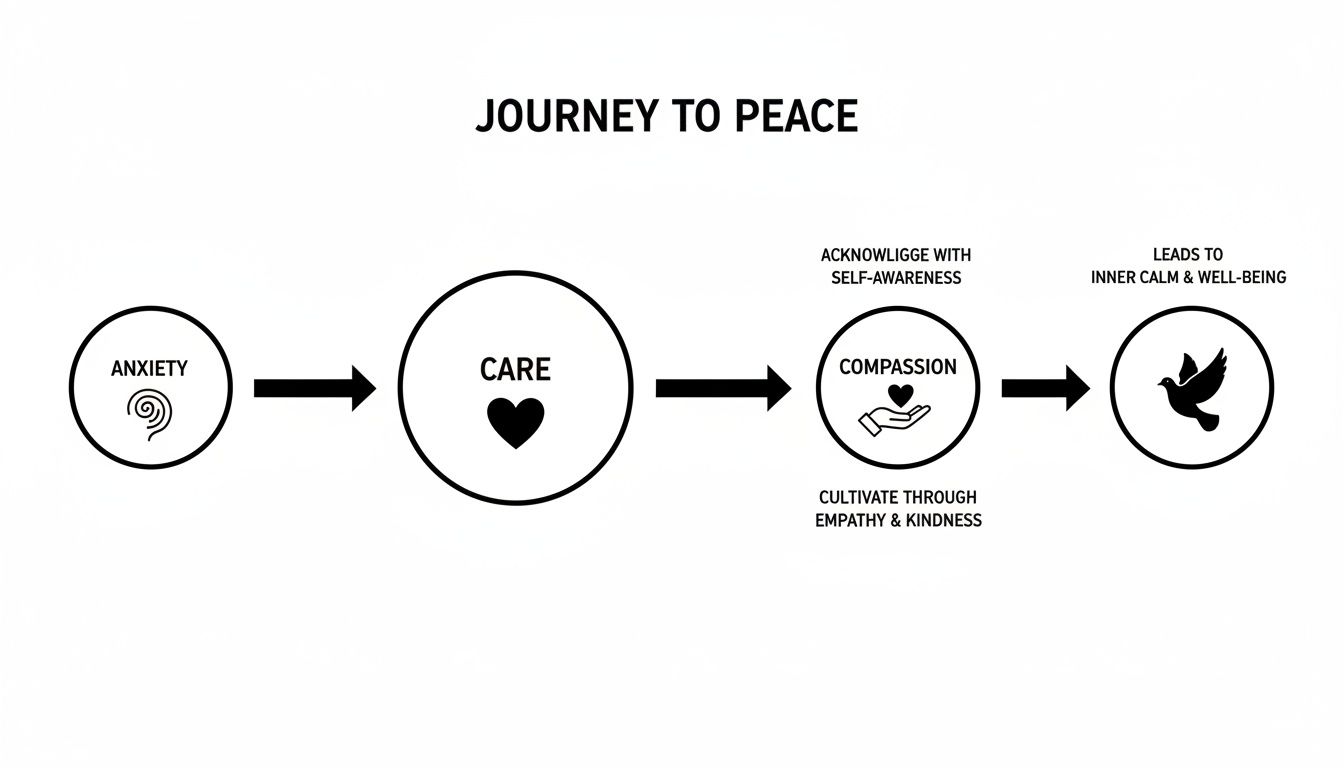
As the chart shows, the journey starts by acknowledging your struggle with care. From there, you can actively apply compassion, creating a clear path toward emotional peace. The shift from a mind in distress to one at ease is built on this intentional process.
From Clinical Term To Core Human Skill
Believe it or not, this focus on compassion is relatively new in many professional fields, including healthcare. Before 2009, the word "compassion" was rarely used in clinical settings. It took a pivotal report on poor patient care in the UK’s Mid Staffordshire NHS Trust—which highlighted a shocking lack of 'attentiveness and compassion'—to bring the term into the spotlight.
Before that, concepts like ‘sympathy’ and ‘tact’ were the go-to words. Today, we understand that compassion isn't just a "soft skill." It's a fundamental part of healing and genuine human connection.
Compassion is the antidote to the brain’s fear response. While anxiety tightens its grip through fear and isolation, compassion loosens it with safety and connection, making true recovery possible.
This process directly counters the physiological storm that anxiety creates. The relentless alert of the fight-or-flight response keeps your heart racing and muscles tense, preparing you for a threat that never actually arrives. It's an incredibly draining way to live.
By activating your brain's soothing system through compassion, you engage the parasympathetic nervous system—the "rest and digest" side of the equation. This is the beautiful reality of neuroplasticity: your brain isn't fixed. It can change.
With consistent practice, you can build new, healthier, and more peaceful neural pathways. You are not broken. You have the capacity to heal and live a life unburdened by constant fear.
Why Compassion Is Your Evolutionary Superpower
When you're wrestling with anxiety, it's so easy to feel fragile or broken. There’s a persistent myth that we have to be tough and competitive to make it in this world, which only makes feelings of anxiety and isolation worse.
But what if our greatest strength isn’t aggression or self-interest? What if it’s our built-in capacity for care and compassion?
This isn’t just a feel-good idea. It’s a deep, biological truth. Compassion wasn’t a luxury we picked up in comfortable times; it's a core part of the evolutionary toolkit that helped our species survive and thrive. Understanding this changes everything. It means the key to your own healing isn't something you need to find—it's something you already have.
It Was Never Just “Survival of the Fittest”
The phrase "survival of the fittest" usually brings to mind images of ruthless, head-to-head competition where only the strongest come out on top. But this is a huge misunderstanding of the human story.
For our ancient ancestors, survival was almost never a solo mission. It hinged on cooperation, social bonds, and the group’s ability to look out for its most vulnerable members.
Think about it: a single human on the prehistoric savanna was an easy target. But a group of humans working together—sharing food, fending off predators, and caring for the sick or injured—was a force to be reckoned with. Our ability to empathize and offer mutual support was our real superpower.
And that’s exactly where the hope for healing your anxiety lies. Your brain isn't just wired for fight-or-flight; it’s also deeply wired for connection and care. When you feel trapped in a panic cycle, remember that you have access to an ancient, powerful system designed for soothing and safety. This is your way out.
The Ancient Proof of Human Kindness
The evidence for this isn't just theory; it’s literally etched into the bones of our ancestors. For a long time, the common view was that early humans were brutish and unsentimental. But archaeological finds tell a completely different story—one of profound, sustained care.
One of the most powerful examples comes from the Shanidar Cave in what is now Iraq. Archaeologists unearthed the remains of a Neanderthal, nicknamed Shanidar 1, who lived with severe, lifelong disabilities. He had a crushed skull that likely left him partially blind, a withered and amputated arm, and serious injuries to his legs. In a world governed purely by "survival of the fittest," he wouldn't have lasted long at all.
And yet, he lived for years with these debilitating conditions. That would have been impossible without constant, dedicated care from his community. They had to protect him, feed him, and help him move. This wasn't a one-off act of kindness; it was a long-term commitment. You can read more about this incredible evidence of early human care in research published in Frontiers in Psychology.
This ancient act of care is a powerful reminder. It proves that compassion isn't a weakness but a core element of human resilience. It’s been our survival strategy for over 100,000 years.
So, what does this ancient history have to do with you and your anxiety today? It means that your capacity for compassion is not some new skill you have to learn from a book. It’s a deep, instinctual part of your human inheritance.
The very same neural circuits that allowed our ancestors to care for one another are waiting inside you, ready to be activated. When you practice self-compassion, you aren't being self-indulgent or weak. You are tapping into one of humanity's oldest and most effective strategies for creating safety and overcoming adversity. You are activating your evolutionary superpower to heal yourself.
Putting Self-Compassion Into Practice To Heal Anxiety

Realizing that compassion is a fundamental human survival skill is a game-changer. Now it’s time to put that knowledge into action and start your journey towards a life free from panic.
For so many of us struggling with anxiety, the harshest voice we ever hear is our own. This inner critic is anxiety’s best friend, keeping us trapped in a brutal cycle of self-doubt, shame, and fear.
But there’s a powerful way out: self-compassion. This isn't about ignoring your pain or just letting yourself off the hook. It's about learning to respond to your own suffering with the same warmth and support you'd instinctively give a friend who's hurting.
This shift in perspective is the secret to building an unshakable sense of inner safety. It’s a quiet promise you make to yourself: no matter how bad the anxiety gets, you won’t abandon yourself. Before we get into the "how," it's worth taking a moment to understand what is self-compassion at its core.
The Three Pillars Of Self-Compassion
Self-compassion is more than just being nice to yourself. It’s a practice built on three core pillars. When you bring them all together, they create a powerful shield against the self-judgment that anxiety thrives on.
Self-Kindness vs. Self-Judgment: This is about choosing warmth over criticism when you’re struggling. Instead of beating yourself up for feeling afraid, you treat yourself with genuine care.
Common Humanity vs. Isolation: This is the simple but profound recognition that suffering is part of being human. Anxiety can make you feel utterly alone, but remembering that you aren't the only one feeling this way breaks down the walls of shame and isolation.
Mindfulness vs. Over-Identification: This means looking at your painful emotions with a balanced perspective. You don't suppress them, but you don't get swept away by them either. You simply observe your thoughts and feelings without letting them define you.
Think of these pillars as the legs of a stool—together, they build a stable foundation of resilience, giving you a real, practical way to change your inner dialogue from one of fear to one of support.
Your Self-Compassion Action Plan
To make this even more concrete, we've broken down these pillars into a simple action plan. These are small, doable exercises from The Anxiety Checklist that you can use right away to start building your self-compassion muscle and create lasting change.
| Component | What It Means | Actionable Exercise (From The Anxiety Checklist) |
|---|---|---|
| Self-Kindness | Treating yourself with warmth when you're in pain, instead of with harsh criticism. | Soothing Touch: Place a hand over your heart or on your arm. Feel the warmth and say, “This is hard, and I’m here for myself.” |
| Common Humanity | Remembering that suffering is a shared experience; you are not alone in your struggles. | Connecting Phrase: When feeling isolated, gently say to yourself, "Others have felt this way. This is part of being human." |
| Mindfulness | Observing your thoughts and feelings without judgment and without getting carried away by them. | Observing Thought: Notice a difficult thought and label it: "There's the thought that I'm not good enough." This creates distance. |
Using this table as a guide, you can start weaving these practices into your daily life. It’s not about perfection; it’s about making a consistent, gentle effort to be on your own side.
Practical Exercises For Acute Anxiety
When panic hits, your first instinct might be to fight it or get angry at yourself for feeling anxious. Self-compassion gives you another way. Here are two exercises, inspired by the tools in The Anxiety Checklist, designed to ground you when stress is high.
1. The Soothing Touch Exercise
Physical touch is one of the quickest ways to tap into your body's own calming system. A simple, gentle touch can trigger the release of oxytocin, a hormone that creates feelings of safety and connection.
- When you feel a wave of anxiety building, gently place one or both hands over your heart.
- Feel the warmth from your hands and the gentle pressure on your chest.
- Take a few slow, deep breaths. You can pair this with a kind phrase, like, "This is a moment of suffering. May I be kind to myself."
This simple act sends a direct signal of safety to your nervous system, acting as a powerful counter to the fight-or-flight response. It's a physical way of reminding yourself that you are there for you.
2. The Compassionate Reframe
Your inner critic loves black-and-white thinking. The Compassionate Reframe is a tool to challenge those harsh, absolute thoughts and introduce a kinder, more realistic perspective.
Start by just noticing the critical thought. Don't judge it, just see it. Then, consciously try to rephrase it through the lens of self-compassion.
Example Reframe:
- Critical Thought: "I can't believe I'm panicking again. What is wrong with me?"
- Compassionate Reframe: "This feeling is intense and scary, and it's okay to struggle. Lots of people feel this way. I will be gentle with myself as I ride this out."
This isn’t about lying to yourself or pretending everything is fine. It’s about acknowledging the pain while choosing support over self-attack. Practicing this reframe over and over can literally rewire your thought patterns, helping you build a more compassionate inner voice.
To get started, you might find it helpful to write these reframes down. If you want to explore this more, you can discover all the benefits of journaling for anxiety on our blog.
Self-compassion isn't a fluffy concept; it's an actionable way to heal. It’s the hopeful truth that you can learn to become your own greatest ally, building a sanctuary within yourself that frees you from the grip of anxiety.
Supporting a Loved One With Compassionate Action

Watching someone you love wrestle with anxiety can leave you feeling powerless. It's a uniquely painful experience. Your first instinct is probably to fix it—to find the magic words that will make the fear disappear.
But common reassurances like "just relax" or "don't worry so much" almost always miss the mark. Instead of helping, they can make your loved one feel even more misunderstood and alone.
Here’s the truth: you can't fix their anxiety. But what you can do is become a source of profound safety and support. This is where you move beyond simple care and into compassionate action, transforming a tense environment into a space where healing can happen.
This isn’t about becoming their therapist. It’s about becoming their ally and showing them they don’t have to face the storm alone.
Words That Heal and Words That Hurt
The right words, offered at the right time, can be a lifeline. But well-intentioned phrases can sometimes do more harm than good, invalidating the person's reality and deepening their sense of shame. Validating words, on the other hand, build a bridge of connection and safety.
Here’s a quick guide to choosing your words with care and compassion.
| Instead of This (Dismissive) | Try This (Validating) | Why It Works |
|---|---|---|
| "You're overreacting." | "That sounds incredibly hard." | It acknowledges their pain without judgment. |
| "Just think positive." | "I'm here for you, no matter what you're feeling." | It offers presence instead of pressure. |
| "It's not a big deal." | "Your feelings are valid. Let's get through this together." | It respects their emotional reality. |
Choosing validation sends a powerful message: "Your struggle is real, I see it, and I am not scared of it." That simple shift can de-escalate fear and create the emotional space they need to find their footing again.
Co-Creating a Panic Attack Safety Plan
One of the most powerful forms of compassionate action is planning ahead. A Panic Attack Safety Plan, a tool from The Anxiety Checklist, is something you create together when your loved one is feeling calm. Think of it as a roadmap for what to do during intense panic, taking the guesswork and fear out of the moment for both of you.
A safety plan transforms the supporter from a helpless bystander into an active, confident ally. It gives the person with anxiety a sense of control even when they feel out of control.
Your plan can include things like:
- Grounding Techniques: Agree on a specific technique that helps them, like the 5-4-3-2-1 method (naming 5 things they see, 4 they feel, etc.).
- Helpful Phrases: Ask them directly: "What is the most helpful thing I can say when you're in the middle of a panic attack?" and write it down.
- Soothing Actions: Does a hug help, or make it worse? What about a weighted blanket or a cold cloth on their neck? Specify what they find comforting.
- Contact Information: List a trusted friend, family member, or therapist to call if things escalate.
When panic hits, you won't be scrambling. You'll have a clear, pre-approved script to follow. This is compassionate action in its most practical form.
The Importance of Loving Boundaries
Supporting someone with anxiety is emotionally demanding. To avoid burnout, it's absolutely vital to protect your own well-being. Setting loving boundaries isn’t selfish; it’s sustainable. It’s what allows you to keep showing up over the long term. For those in more intensive caregiving roles, exploring practical strategies for managing caregiver stress is essential.
Loving boundaries can sound like:
- "I really want to be here for you. I can talk for the next 15 minutes, but then I need to get back to my work."
- "I am here to support you in any way I can, but it's important you know I can't be your only source of support."
Boundaries, when communicated with kindness, actually protect the relationship from resentment. They ensure you can continue to show up with genuine care and compassion. Supporting a partner through anxiety is a unique challenge, and understanding the dynamic between love and anxiety in a relationship can make a huge difference.
Your compassionate action, grounded in both validation and healthy boundaries, creates a foundation of trust where true healing can finally begin.
Your Toolkit For A Compassionate Life
We’ve covered a lot of ground together, exploring how care and compassion can genuinely reshape your brain's response to anxiety. This is where it all comes together—your starting point for a life with less fear and a lot more freedom.
Let's be clear: the goal isn't a magical, overnight cure. It's about the steady, hopeful work of building a new relationship with yourself and your anxiety. A life free from the grip of panic isn't some far-off dream. It's an achievable reality, built one small, compassionate choice at a time. And that journey starts right now, with the tools you have in your hands.
Turning Knowledge Into Action
By now, you've seen that compassion isn't some "soft skill." It's a powerful, ancient survival tool hardwired into our biology. You've learned how practices like the Soothing Touch and Compassionate Reframe can bring your nervous system back from the edge in real-time. This is where the real work—and the real hope—begins.
To help you put these ideas into practice, systems like The Anxiety Checklist are designed to transform these concepts into solid, everyday habits. These aren't just abstract ideas; they are structured tools to guide you forward.
- Habit Trackers: These make it easier to consistently practice your self-compassion exercises, helping you build momentum one day at a time.
- Symptom Monitors: By tracking your anxiety levels, you get to see tangible proof that your hard work is paying off.
Seeing your progress in black and white is powerful. It’s concrete proof that you aren't stuck and that change is already happening.
A life free from chronic fear is built on a foundation of consistent, compassionate action. Each time you choose a kind thought over a critical one, you are laying another stone on your path to healing.
This steady process puts you back in the driver's seat. The road ahead might still have its bumps, but you’re no longer facing them empty-handed. You're now equipped with knowledge, practical strategies, and a growing trust in your own resilience.
For those who want to go even deeper on this path, our Anxiety University offers more in-depth guidance and support.
Your toolkit is ready. The science is on your side. A more peaceful, fearless life is waiting for you. It's time to take that first brave, compassionate step.
Got Questions? We’ve Got Answers.
It’s only natural to have questions when you’re starting something new. Learning to meet your anxiety with care and compassion is a skill, and like any new skill, it’s normal to feel a little hesitant or even doubtful.
Let’s walk through some of the most common concerns. Think of this as a conversation to clear up any doubts and build your confidence for the path ahead.
Is Self-Compassion Just an Excuse to Be Lazy?
Not a chance. This is probably the biggest myth out there—that being kind to yourself is the same as letting yourself off the hook. In reality, the opposite is true.
Think about it: when you’re hard on yourself after a setback, what usually happens? For most of us, that inner critic just fuels a spiral of shame, avoidance, and more anxiety. It’s paralyzing.
Self-compassion is about offering yourself support especially when things are hard. This creates the emotional safety you need to learn from mistakes, get back up, and try again. It’s the foundation of resilience and true accountability, not an escape from it. It's the fuel that makes recovery possible.
How Long Until I Start Feeling Better?
Your healing journey is yours alone, and it will unfold at its own pace. Some people notice a shift almost immediately. A simple soothing touch exercise, for example, can calm a racing heart in just a few moments. Don't underestimate these small wins—they are powerful glimmers of hope.
The deeper, more lasting changes—the kind that literally rewire your brain for calm and lead to a life without panic—come from patient and consistent practice. It’s like building a muscle. The more you intentionally practice compassion, the stronger and more resilient you become to anxiety triggers over time.
What If I Feel Silly or Awkward Doing This?
Feeling awkward at first is not just okay—it’s completely normal. For many of us, self-criticism has been our default setting for years, maybe even decades. Responding to yourself with genuine kindness can feel incredibly foreign, almost like you're learning a new language for your inner world.
Start small. Be patient. Remember, you’re unlearning a lifetime of self-attack and building new, healthier neural pathways. That initial awkwardness is the first sign you're trying something different. It will fade as you start to experience the profound sense of safety and calm that care and compassion bring. The hope for a life without panic is real, and this is how you get there.
At The Anxiety Checklist, we provide the structured tools to turn these hopeful concepts into a practical, daily reality. Take the next step on your journey toward a fearless life by exploring The Anxiety Checklist.