


So, does vaping really help with anxiety and stress?
It’s a question a lot of people are asking, and the honest answer is no—at least, not in any way that actually lasts. That brief sense of calm you might feel is mostly just your brain getting the nicotine it’s started to crave, quieting withdrawal symptoms rather than solving the root of your stress. But there is incredible hope: a life free from both anxiety and nicotine is entirely within your reach.
The Search for Calm When Vaping Feels Like the Answer
When you’re caught in the middle of an anxiety spiral, the need for immediate relief can feel all-consuming. Your heart is pounding, your thoughts are racing, and you feel like you’d do just about anything to make it stop. For many, that "anything" has become reaching for a vape. It feels like a quick fix, a simple way to take the edge off.
This belief is incredibly common, but it’s built on a major misunderstanding of what’s actually happening inside your body and brain. The idea that vaping is a stress-reliever has become a powerful myth, especially among younger people looking for ways to cope. In fact, for many, it’s the main reason they start in the first place.
The Marketing and The Myth
Research has uncovered a pretty troubling trend here. One survey from the Truth Initiative, for example, found that an astounding 81% of young people who vaped said they started to try and reduce their feelings of stress, anxiety, or depression. That number shows just how widespread the myth of vaping as a mental health tool has become, a story often amplified by marketing that frames these products as sleek, modern lifestyle accessories.
This creates a vicious cycle. You feel anxious, so you vape to feel better. For a fleeting moment, it seems to work. But this isn’t a solution—it’s the beginning of a trap.
To put it simply, here’s how the illusion of relief stacks up against the long-term reality.
Vaping for Stress: The Short-Term Feeling vs The Long-Term Reality
The table below breaks down the common perceptions about vaping for anxiety versus what's actually happening behind the scenes, both immediately and over time.
| Aspect | Short-Term Perception | Long-Term Reality |
|---|---|---|
| Immediate Feeling | A sense of calm and relief. | Temporary satisfaction of a nicotine craving; withdrawal symptoms are briefly paused. |
| Stress Response | Feels like it's reducing stress. | Increases heart rate, blood pressure, and cortisol levels—the body's primary stress hormone. |
| Anxiety Levels | Seems to quiet anxious thoughts. | Nicotine withdrawal creates its own anxiety, increasing overall baseline anxiety between vaping sessions. |
| Coping Mechanism | A quick and easy tool for managing difficult emotions. | Prevents the development of genuine coping skills, creating dependence on a substance. |
| Brain Chemistry | Provides a dopamine hit, making you feel good for a moment. | Alters the brain's reward system, making it harder to feel good without nicotine and increasing addiction risk. |
What starts as a perceived solution quickly becomes part of the problem, leaving you more anxious than when you started and now dependent on a substance to feel "normal."
Hope Beyond the Haze
The point of this guide isn’t to judge. It’s to bring some clarity and, more importantly, some hope. If you’ve found yourself using a vape to manage your nerves, you’re not alone. And there is absolutely a path to finding real, sustainable calm that doesn’t involve nicotine.
The journey to a panic-free life isn't about finding a better crutch; it's about realizing you are strong enough to walk without one. Understanding the illusion of vaping as a stress-reliever is the first powerful step on that journey.
We’re going to explore the science behind this cycle and, more importantly, introduce effective, evidence-based strategies for managing anxiety. Imagine a life where you feel in control, where panic doesn't dictate your choices, and where you have the tools to navigate stress without being tethered to a device. This reality is entirely possible.
By using a structured approach, like an anxiety checklist, you can start to identify your triggers and build a personalized toolkit for lasting well-being.
The Nicotine Trap: How Vaping Hijacks Your Brain's Stress Response
To understand why vaping feels like a solution but only digs the hole deeper, picture this: nicotine’s effect on your brain is like taking out a high-interest payday loan for calm. You get a tiny, instant “payout”—a rush of the feel-good chemical dopamine that tricks you into feeling relieved. But the long-term cost is astronomical, paid back with even higher levels of stress and anxiety.
When you vape, nicotine rockets to your brain in seconds. This triggers that quick dopamine hit, creating a fleeting sense of pleasure and relaxation. At the exact same time, however, nicotine acts as a powerful stimulant. It kicks your body’s fight-or-flight response into high gear, flooding you with stress hormones like adrenaline, making your heart race, and jacking up your blood pressure.
Your brain is essentially conned into feeling relaxed while your body is actually getting more stressed out. This internal tug-of-war is the very heart of the nicotine trap.
How Your Brain Gets Rewired for Anxiety
The more you reach for a vape to manage stress, the more your brain adapts. It starts dialing down its own natural dopamine production, becoming dependent on nicotine to regulate your mood. Before you know it, your brain’s reward and stress pathways are completely rewired. You’re no longer vaping to feel good; you’re vaping just to feel “normal.”
This creates a dangerous dependency. That gnawing anxiety you feel when you can't vape? That’s not just your regular anxiety flaring up. It’s your brain in full-blown withdrawal, screaming for the substance it now thinks it needs just to function. This is a critical distinction because it means the vape isn't solving a problem—it’s fueling a problem it created.
This infographic perfectly illustrates this deceptive loop, showing how what starts as a quest for calm spirals into a state of worsened anxiety.
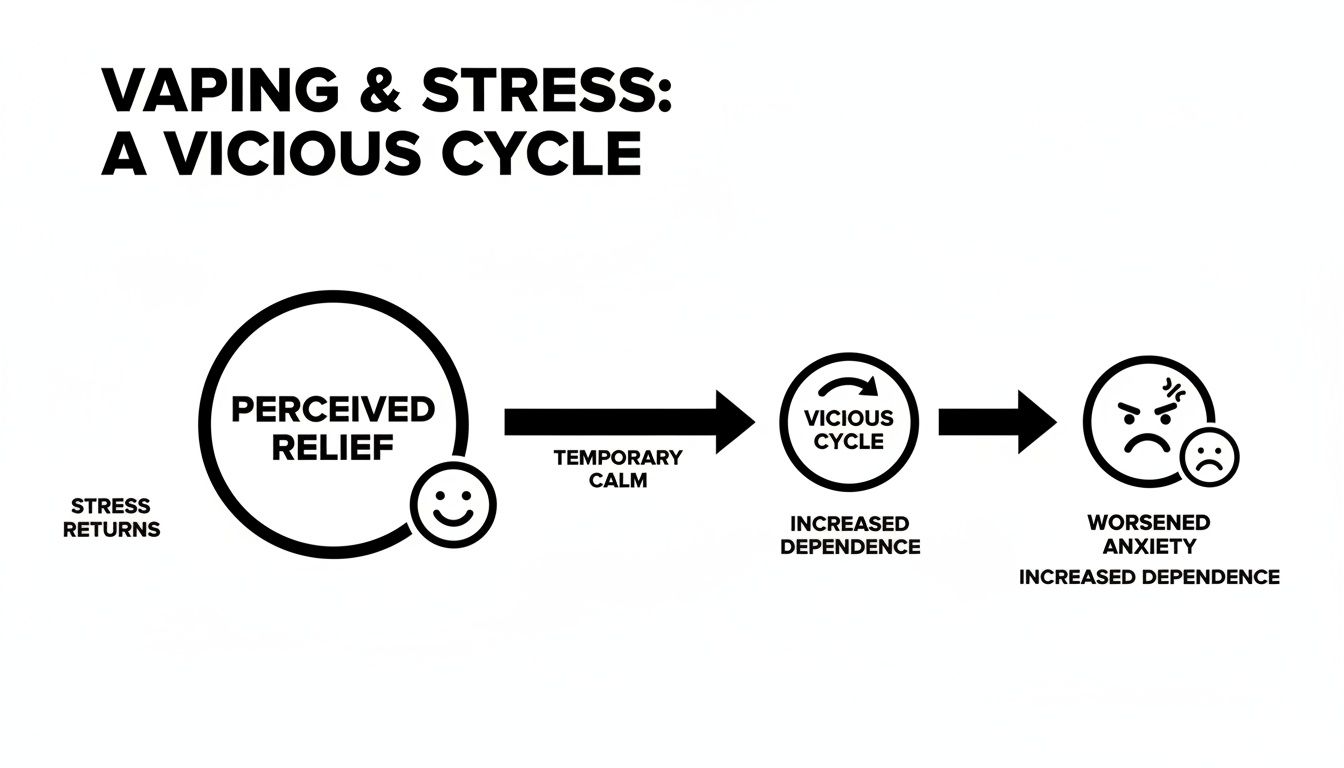
The key takeaway is that the initial feeling of relief is what kicks off this vicious cycle, one that ultimately makes anxiety worse, not better.
The Science Behind the Cycle
This isn't just a theory; it’s a well-documented biological process. To truly grasp why vaping is such a deceptive stress reliever, it helps to understand how addiction affects mental health in general. The cycle of use, withdrawal, and craving hijacks the very systems in your brain that are supposed to manage mood and stress naturally.
This hijacking creates a state of chronic unease, leaving your nervous system perpetually on edge.
The “relief” you feel from vaping is just the temporary silencing of withdrawal symptoms. True calm is the state you find when your brain is no longer screaming for nicotine.
Research consistently backs this up. Study after study shows that nicotine dependence can actually worsen anxiety, disrupt sleep, and shatter concentration. For anyone trying to manage anxiety, these findings are a huge red flag—signaling the need for real coping strategies instead of a substance that just keeps the problem going.
Recognizing this cycle is the first, most powerful step you can take to break free. It shifts your perspective from “I need this to calm down” to “This is what’s keeping me from being truly calm.”
And that shift isn't a reason for despair; it’s a beacon of hope. It means the heightened anxiety you’re feeling isn’t a permanent part of you—it’s a symptom of the nicotine trap. By escaping that trap, you can give your brain the chance to heal and rediscover a level of peace you may have thought was gone for good.
The Vicious Cycle of Withdrawal and the Illusion of Relief
That brief moment of calm after a hit from a vape feels incredibly real. For a second, the tension seems to just melt away. But what if that relief isn't actually solving your anxiety? What if it's just hitting the pause button on a problem the vape created in the first place?
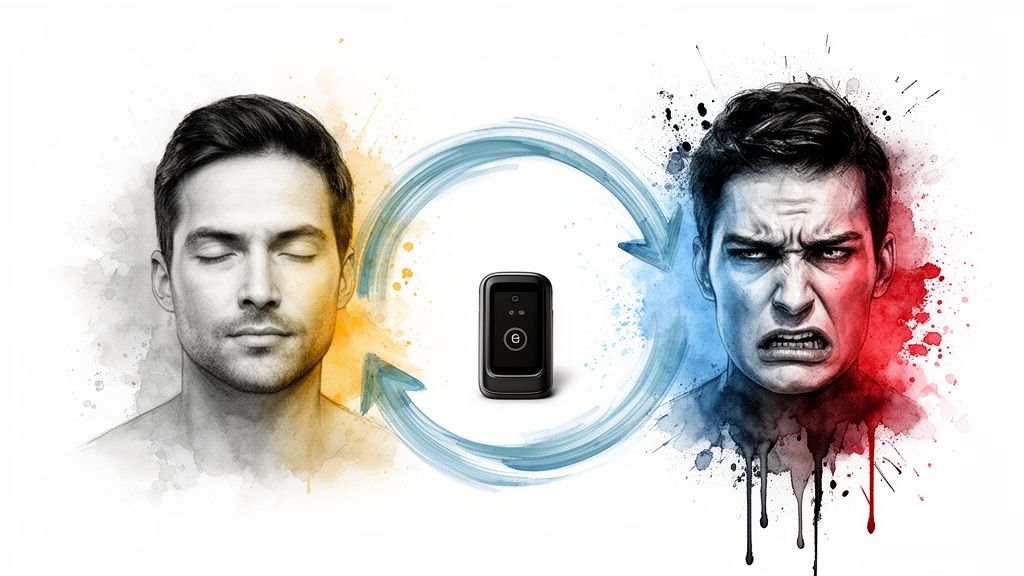
This is the tricky illusion at the heart of nicotine dependency. Many people who vape don't even realize they're caught in this loop. They mistake the nagging symptoms of nicotine withdrawal for their everyday anxiety getting worse—and honestly, it's an easy mistake to make. The two feel remarkably similar.
What Nicotine Withdrawal Actually Feels Like
As nicotine starts leaving your system—which happens surprisingly fast—your body begins to protest. This craving isn't just a fleeting thought; it shows up as real physical and emotional distress. This is nicotine withdrawal.
The symptoms of withdrawal are practically a mirror image of anxiety. They can include:
- Intense Irritability: Suddenly feeling snappy or on edge for no good reason.
- Restlessness: That "antsy" feeling, like you just can't sit still.
- Difficulty Concentrating: Your mind feels foggy, and focusing feels like wading through mud.
- Increased Anxiety: A free-floating sense of dread or stress that wasn't there a few hours ago.
When you feel these sensations, your brain starts screaming for a fix. And the fastest, most familiar solution is to vape again. The moment you do, nicotine floods your system, the withdrawal symptoms disappear, and you get that wave of relief. This creates a powerful, but false, connection in your brain: vaping helps my anxiety.
The "relief" you get from vaping isn't really relief from anxiety. It's just a temporary pause on withdrawal symptoms. In this story, the vape isn't the hero; it's the architect of the very distress it claims to solve.
Identifying the Cycle in Your Own Life
This pattern can be so sneaky it’s easy to miss. Think about your own habits for a second. Does this sound familiar?
You're at work, staring down a deadline, and you feel a tight knot of tension building in your chest. Your thoughts start racing, and you get more and more irritable. You tell yourself, "My anxiety is flaring up; I need a break." You step out, take a few puffs from your vape, and within minutes, you feel calmer, more centered. You think, "See? It works."
But what really happened? It's far more likely that after a few hours without nicotine, your body slipped into a state of micro-withdrawal. The tension, scattered thoughts, and irritability weren't your baseline anxiety acting up—they were the direct result of a brain demanding its next dose. Vaping simply satisfied the craving, creating the illusion of solving an emotional problem when it was really solving a chemical one. Recognizing your own patterns is key, and it can be helpful to learn about common anxiety triggers to better tell them apart.
Why This Realization Is So Empowering
Seeing this vicious cycle for what it is can be a game-changer. It reframes the entire narrative, shifting it from, "I need my vape to cope with my anxiety" to "My vape is causing a huge chunk of the anxiety I'm feeling."
This knowledge gives you back the power. It shows that the constant state of low-grade stress you might be living in isn't your new normal. It's a side effect of a dependency loop. And that means a calmer, more stable state of mind isn't just a fantasy—it’s what's waiting for you on the other side of that dependency.
By untangling yourself from this cycle, you’re not losing a coping tool. You're removing one of the biggest sources of your distress and opening the door to find out what genuine, lasting peace actually feels like. It’s a journey from feeling trapped to realizing you’ve been holding the map to your own freedom all along.
Beyond the Vape: Evidence-Based Strategies for Lasting Calm
Realizing that vaping might be fueling your anxiety, not fixing it, is a huge first step. It’s like you’ve been stuck in a maze and just spotted the exit sign. Now, let’s talk about how to walk through that door.
The journey to a calmer life isn’t about swapping one crutch for another. It’s about building real, sustainable skills to manage stress and anxiety—skills that prove you never needed a vape in the first place. Lasting calm isn't just possible; it’s your brain’s natural state once it’s free from the rollercoaster of nicotine withdrawal.
Retraining Your Brain with Cognitive Behavioral Therapy
One of the most powerful, science-backed tools for anxiety is Cognitive Behavioral Therapy (CBT). Think of it as physical therapy for your thought patterns.
CBT works on a simple but profound idea: your thoughts, feelings, and actions are all connected. By learning to identify and change unhelpful thought patterns, you can directly influence how you feel and how you react to stressful situations.
Where a vape just numbs you out for a few minutes, CBT gives you the tools to dismantle anxiety at its source. It teaches you to catch anxious thoughts, challenge them, and reframe them into something more realistic.
For instance, you might have a thought like, "I'm going to bomb this presentation and everyone will think I'm an idiot." CBT helps you put that thought on trial by asking:
- What's the evidence? Have I prepared? Have I done this successfully before?
- Is there another way to see this? Maybe being nervous just means I care about doing a good job. It’s normal.
- What's the absolute worst that could happen? Even if it’s not perfect, will it really be a catastrophe? Can I handle it?
This isn’t about forcing yourself to "be positive." It's about developing a more rational and less fearful relationship with your own mind.
Mastering the Moment with Mindfulness and Grounding
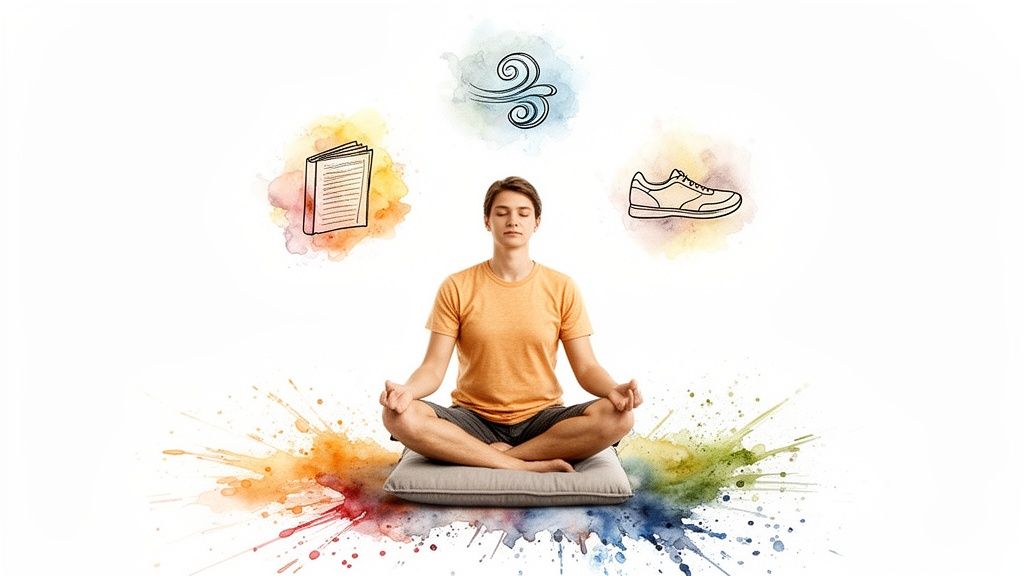
While CBT is fantastic for long-term change, you also need something for when panic hits right now. This is where mindfulness and grounding exercises become your new best friends. They are skills that pull you out of the swirling storm in your head and anchor you firmly in the present moment.
These techniques work by flipping the switch on your body’s “fight or flight” response—the one that both anxiety and nicotine withdrawal love to trigger. Instead, they activate your parasympathetic nervous system, your body’s natural “rest and digest” state.
Mindfulness is the art of paying attention, on purpose, to the present moment without judgment. It’s the direct antidote to a mind lost in anxious "what-ifs" about the future.
Here are a few powerful techniques to try the next time you feel that familiar wave of anxiety rising:
- Box Breathing: This is a simple but incredibly effective way to regulate your nervous system. Inhale for a count of 4, hold for 4, exhale for 4, and hold again for 4. Repeat until you feel yourself settle.
- The 5-4-3-2-1 Grounding Method: This pulls your focus out of your spiraling thoughts and into your senses. Name 5 things you can see, 4 things you can feel, 3 things you can hear, 2 things you can smell, and 1 thing you can taste.
- Body Scan Meditation: Lie down and bring your attention to your toes. Just notice what’s there—warmth, tingling, nothing at all—without judging it. Slowly move your focus up your body, part by part, just observing with gentle curiosity.
These aren't just fancy distractions. They are active skills that prove to you, in real-time, that you have the power to calm your own nervous system without reaching for anything external. For those ready to build a full toolkit of these skills, structured programs like Anxiety University offer in-depth, guided practice.
Building Your Foundation with Lifestyle Changes
No anxiety management plan is complete without looking at the bedrock of your well-being: exercise, nutrition, and sleep. These aren't just "healthy habits"; they are powerful tools that directly regulate your mood and resilience.
- Move Your Body: Just 30 minutes of moderate movement, like a brisk walk, can be as effective at easing anxiety as some medications. It helps burn off stress hormones like cortisol while releasing your brain's own feel-good chemicals, endorphins.
- Nourish Your Brain: What you eat has a direct line to your mental health. A diet heavy in sugar and processed foods can fuel anxiety, while whole foods rich in things like omega-3s, magnesium, and B vitamins help stabilize your mood.
- Prioritize Sleep: Nicotine is notorious for wrecking sleep, and a tired brain is an anxious brain. Aiming for a solid 7-9 hours a night and keeping a consistent sleep schedule helps regulate your body's entire stress-response system.
Ultimately, these strategies help you build a life where calm is your default setting, not a temporary state you have to chase with a vape. They show you that true, lasting relief from anxiety comes from within. You have everything you need to heal and live panic-free.
Your Plan to Quit Vaping and Heal Anxiety
Deciding to quit vaping, especially when it’s become your go-to for managing anxiety, can feel like you're about to climb a mountain. It looks impossible from the bottom, but the path to the top is just a series of single steps. This isn't about white-knuckling your way through it; it’s about having a smart, kind plan to get your well-being back on track.
The real goal here is to take apart the vaping habit, piece by piece, while you build a new, much stronger foundation for dealing with anxiety. By swapping out an unhelpful habit for empowering new ones, you’re creating a bridge to a calmer future. This journey puts you back in the driver's seat, proving you are far more powerful than any craving.
Phase 1: Awareness and Tracking
You can’t fix a problem you don’t fully understand. So, for the first week, your only job is to become a detective in your own life. Just observe your vaping habits without any judgment. We're gathering intel, not trying to quit just yet.
Grab a small notebook or use a notes app on your phone. Every single time you reach for your vape, make a quick entry. This isn’t to shame yourself—it's to pinpoint the patterns that are keeping this habit alive.
For each time you vape, jot down these three things:
- The Trigger: What just happened right before you felt the urge? (e.g., got a stressful work email, felt a wave of boredom, just finished a meal)
- The Emotion: What were you feeling in that moment? (e.g., anxious, restless, tired, or even happy)
- The Time of Day: Do cravings hit harder at certain times? (e.g., first thing in the morning, during that mid-afternoon slump)
After just a few days, a surprisingly clear picture will start to form. You might notice you only vape when you're bored, or that certain social situations are your biggest trigger. This awareness is your personal roadmap. It shows you exactly where you need to build better coping skills.
Phase 2: Building Your Replacements
Now that you know your triggers, it’s time to assemble your toolkit of healthy replacements. This is the most important part of the plan. It's so much easier to quit when you know exactly what you'll do instead of vaping when a craving shows up.
Look back at the strategies we've talked about—like deep breathing, mindfulness, or grounding techniques—and match them to your specific triggers. Create a "go-to" list of actions you can take at a moment's notice.
True freedom from anxiety isn't found in a vape—it's built with small, consistent actions that prove you can soothe your own nervous system. Each time you choose a new coping skill over the old habit, you are rewiring your brain for resilience.
For instance, your replacement plan could look something like this:
- Trigger: Feeling anxious about a looming work deadline.
- Old Habit: Step outside to vape.
- New Habit: Do one minute of Box Breathing right at your desk.
- Trigger: Feeling bored and restless in the afternoon.
- Old Habit: Mindlessly puff on your vape.
- New Habit: Drink a big, cold glass of water and take a quick 5-minute walk.
- Trigger: Hanging out with friends who vape.
- Old Habit: Join in with them.
- New Habit: Hold a non-alcoholic drink, or chew on a toothpick or cinnamon stick to keep your hands and mouth occupied.
Having these replacements ready before a craving hits gives you a concrete action to take, which is key to disrupting that old, automatic pattern.
Phase 3: Gradual Reduction
For many people, quitting cold turkey feels way too jarring, especially with anxiety in the mix. A gradual tapering plan can be a much more sustainable approach, as it gives your body and mind time to adjust slowly.
There are two main ways to taper down:
- Reduce Nicotine Strength: If you can, switch to a vape liquid with a lower nicotine concentration every one to two weeks. This helps wean your body off the chemical dependence while letting you keep the "ritual" a bit longer.
- Delay and Decrease Frequency: Start setting simple rules for yourself. For example, you could start by delaying your first vape of the day by just one hour. The following week, push it to two hours. You can also work on reducing the number of puffs you take each time you use it.
The most important part of this phase is to set a quit date—a final day when you will be completely done. This gives you a clear target to aim for. For a more detailed walkthrough of breaking free from the anxiety cycle, you might find it helpful to explore these anxiety recovery steps in more detail.
Phase 4: Seeking and Sustaining Support
You do not have to do this alone. In fact, your chances of success go way up when you have a solid support system cheering you on.
- Tell Your People: Let a few trusted friends and family members know what you're doing. Explain that you might be more irritable or anxious for a bit and ask for their patience and encouragement.
- Find Your Community: Look for online forums or support groups for people who are also quitting. It can be incredibly validating to share what you're going through with others who actually get it.
- Professional Help: Never hesitate to reach out to a therapist or counselor. They can offer specialized support for both the addiction and the anxiety, giving you tools designed for your specific needs. Resources like 1-800-QUIT-NOW or websites like smokefree.gov also offer free, expert support.
This structured plan turns a huge, scary goal into a series of small, manageable steps. You aren't just quitting a habit; you are actively building a life with less anxiety and a whole lot more freedom.
Frequently Asked Questions About Quitting Vaping & Healing Anxiety
You've made it this far, which means you're serious about finding a way out of the anxiety-vaping cycle. It's totally normal to have some questions still lingering—after all, untangling this is a process.
This section is all about tackling those common questions head-on. Think of it as a final conversation to clear up any doubts and build your confidence. A life with less anxiety and more freedom is not just possible; it's waiting for you.
Why Does Vaping Feel So Relaxing if It Makes Anxiety Worse?
This is the million-dollar question, isn't it? And it gets right to the heart of nicotine’s tricky illusion. The calm you feel from vaping comes from a couple of places, but neither of them is true, lasting stress relief.
First, when you vape, nicotine sets off a rapid-fire release of dopamine, a feel-good chemical in your brain. This creates a quick, artificial burst of pleasure. It feels good in the moment, but it’s a shortcut your brain quickly learns to crave, leaving you wanting more just to feel normal.
But here’s the bigger piece of the puzzle: that "ahhh" feeling of calm is mostly just the temporary relief of ending nicotine withdrawal. Once your brain gets used to nicotine, it starts to panic when levels drop. This withdrawal state feels almost identical to anxiety—restlessness, irritability, a mind that won't shut up. When you vape again, you’re not actually soothing your anxiety; you’re just hitting the snooze button on withdrawal symptoms.
The core illusion is this: you think you're treating your underlying anxiety, but you're really just medicating the withdrawal symptoms that nicotine created in the first place. Over time, this messes with your brain's natural stress-response system, making it much harder to find genuine calm without a vape in your hand.
I’m Afraid My Anxiety Will Get Unbearable if I Quit. What Can I Do?
This is such a real and valid fear. It's one of the biggest reasons people feel trapped. The idea of giving up your main coping tool, even one you know isn't helping in the long run, is genuinely terrifying.
The key is to flip the script from "quitting" to "replacing." You don't have to face your anxiety with an empty toolbox. You just need to build a better one first.
Before you even circle a quit date on the calendar, start practicing new habits.
- When you feel a wave of anxiety, try two minutes of Box Breathing instead of reaching for your vape.
- Feeling restless? Get up and take a quick, brisk walk around the block.
- When your thoughts start to race, practice the 5-4-3-2-1 grounding technique to bring yourself back to the present moment.
The goal is to make these healthy coping skills feel familiar and automatic before you take the vape away. Will your anxiety spike a bit during the initial withdrawal? Yes, it might. But with these tools ready to go, you'll prove to yourself—one moment at a time—that you are more than capable of handling it. You'll learn that the feeling is temporary and that you have the power to soothe your own nervous system.
Are There Any 'Safe' Vapes or Nicotine Products for Anxiety?
Unfortunately, the answer here is a clear and simple no. Any product that delivers nicotine can't be considered a safe or effective long-term solution for anxiety. The problem isn't the delivery system; it's the nicotine itself and the way it hijacks your brain's reward and stress pathways.
Whether it’s a vape, patch, gum, or lozenge, the fundamental cycle of dependency and stress-system disruption is the same. While some products like patches and gum are approved as nicotine replacement therapy (NRT), their purpose is very specific: to help you quit smoking. They are meant to be a temporary bridge, allowing you to carefully wean your body off its chemical dependency—not a permanent crutch for managing anxiety.
The only sustainable path to a calmer mind is to address the roots of your anxiety by building healthy, substance-free coping skills. True healing comes from letting your brain rediscover its natural ability to manage stress, and that process can only begin once nicotine is out of the picture. For those in sobriety from other substances, similar questions come up—you might wonder whether vaping is advisable for men in recovery and find the same principle applies: trading one dependency for another isn't the answer.
How Long Does It Take to Feel Less Anxious After Quitting Vaping?
Everyone's timeline is a little different, but most people move through a few predictable—and hopeful—phases.
The First Week (The Acute Phase)
The first 3 to 7 days are usually the toughest. This is when acute nicotine withdrawal is at its peak. You can expect irritability, brain fog, and yes, a temporary spike in anxiety. This is where your new coping skills become your lifeline. It’s a challenge, but remember: it is temporary.
Weeks 2 to 4 (The Rebalancing Phase)
After that first week, things start looking up. As your brain chemistry begins to find its balance again, most people report a real, noticeable drop in their baseline anxiety. You’ll start having moments of genuine calm and clarity that might feel brand new.
Months 1 to 3 (The New Normal)
After a month, you might be surprised to find you feel much calmer and more emotionally stable than you ever did while vaping. Sleep gets better, your focus returns, and that constant, low-grade hum of anxiety just… fades. You finally get to meet your true, natural baseline and realize you have the tools to manage it.
This journey isn't about punishment; it's about healing. It’s about giving your brain the space to do what it does best: find its own equilibrium. It takes time and patience, but the lasting peace on the other side is worth every bit of the effort.
At The Anxiety Checklist, we believe that everyone deserves to live a life free from the grip of panic and chronic stress. Our system is designed to give you the practical, actionable tools you need to understand your anxiety, challenge your fears, and build a foundation for lasting well-being. Take the first step toward a calmer, more fearless you by exploring the Fearless Living system today.