



Feeling overwhelmed, restless, and unable to focus is a confusing, exhausting place to be. You’re left wondering: Is this constant worry hijacking my thoughts, or is my brain just wired in a way that makes it impossible to stay on task?
That question is more than just a matter of curiosity. Getting to the root of it is the first real step toward finding relief. After all, you can’t solve a problem until you know what the problem actually is.
The core difference comes down to this: anxiety is primarily an emotional response driven by fear and worry, while ADHD is a neurodevelopmental condition driven by brain wiring that impacts attention and impulse control.
Is It Overwhelm or Inattention?
So many people get caught in this diagnostic limbo. Maybe you live with a constant, humming sense of dread that feels exactly like anxiety. Or maybe your biggest struggles are procrastination, forgetfulness, and an inability to get started on anything—all classic signs of ADHD.
The confusion makes perfect sense because, from the outside, the symptoms often look identical. Racing thoughts, trouble concentrating, and a feeling of being constantly on edge can show up in both conditions. This is why untangling them is so important for your healing journey.
Hope Begins with Clarity
The journey to a calmer mind starts with understanding the true source of your struggles. It’s incredibly frustrating to try and manage what you think is anxiety, only to find nothing works because the real issue is an ADHD-related challenge with executive function. The reverse is also true—treating ADHD without addressing a co-occurring anxiety disorder will leave you feeling just as stuck.
But here’s the most powerful thing to realize: it doesn't matter which one it is right now. What matters is that you've started asking the question. This simple act of looking inward is the first step toward taking back control and building a life free from panic.
This flowchart can help you start to visualize that core difference. Is the feeling of being overwhelmed rooted in fear, or is it a byproduct of your brain's unique wiring?
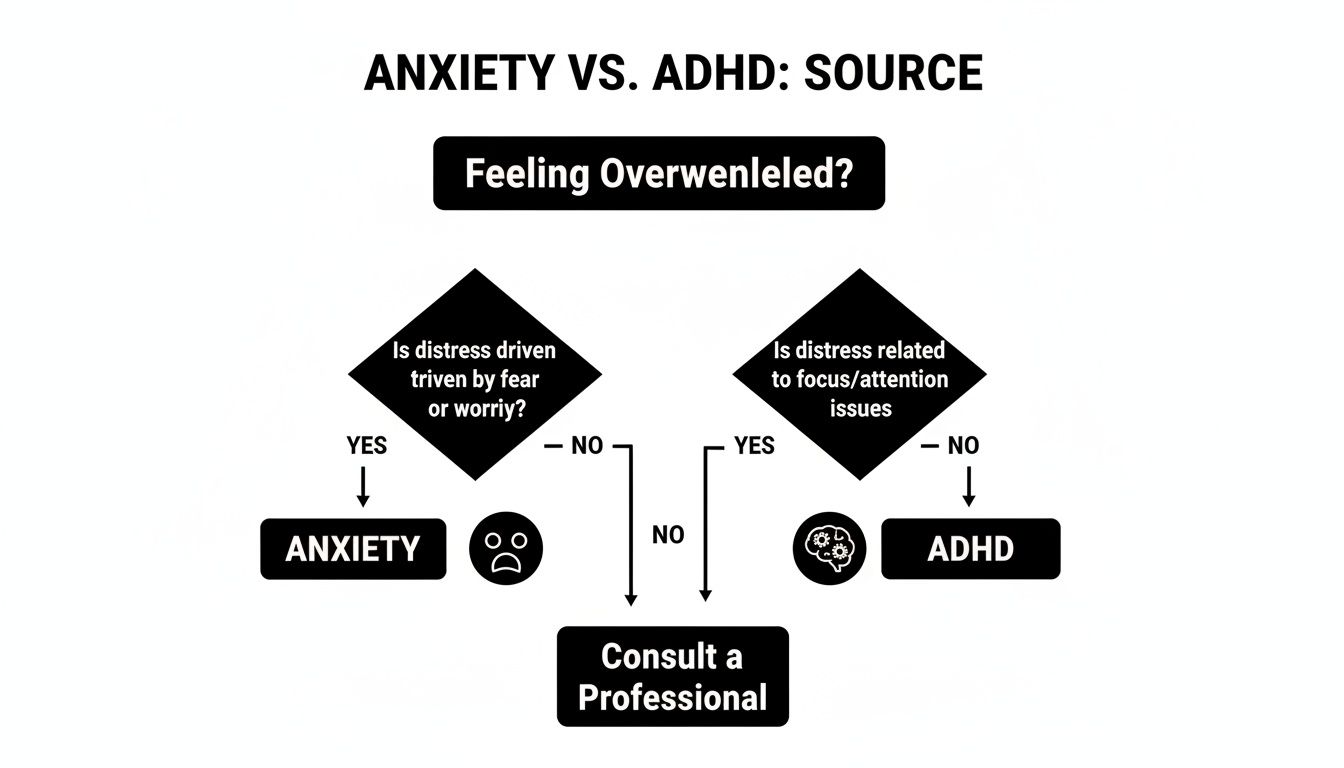
Seeing it laid out like this can be a relief. It helps clarify that your feelings have a source, and every source has a path toward a solution. Healing is not only possible; it's waiting for you.
Quick Guide to Anxiety vs ADHD at a Glance
While we’ll dive much deeper into the nuances, this quick comparison table can help you start mapping your own experiences to the right category. Think of it as a starting point for self-awareness, not a diagnostic tool.
| Symptom Area | Anxiety (Driven by Fear) | ADHD (Driven by Brain Wiring) |
|---|---|---|
| Emotional Experience | Persistent worry, dread, and catastrophic thinking about the future. | Frustration, boredom, and a constant search for stimulation. |
| Primary Challenge | Inability to stop worrying and anticipating threats, even irrational ones. | Difficulty initiating tasks, sustaining focus, and regulating impulses. |
| Thought Patterns | Cyclical "what if" scenarios and replaying past events. | Racing, disconnected thoughts, and trouble organizing ideas sequentially. |
| Physical Sensations | Muscle tension, rapid heartbeat, and stomach issues from stress hormones. | Restlessness, fidgeting, and an internal feeling of needing to move. |
This isn't about diagnosing yourself, but about gathering clues. As you start to see these patterns, you might notice how overthinking and anxiety are tangled up in your own life. Exploring that connection can be an incredibly enlightening next step.
By peeling back the layers of your symptoms, you move from a place of confusion to a position of power—ready to find the strategies that will finally bring you peace.
To really untangle the mess of overlapping symptoms, we have to start with a clear understanding of what we're looking at. Getting a handle on what anxiety and ADHD actually are is more than just sticking a label on your experience. It's like finally getting the right map for a territory you’ve been trying to navigate blind.
This clarity is the first step toward real change. Once you can name what’s happening, you can start to work with it, not against it. This is where hope truly begins to grow.

What Is Generalized Anxiety Disorder?
At its core, Generalized Anxiety Disorder (GAD) is a state of constant, excessive worry that feels completely out of your control. This isn't just feeling nervous before a big meeting. It's a relentless background hum of dread about all sorts of things—your job, your health, your relationships, even just getting through the day. The level of worry is almost always way out of proportion to the actual risk.
This condition essentially hijacks your brain, forcing it into a constant threat-scanning mode. Your body follows suit, staying stuck in a low-grade fight-or-flight response. It’s no wonder you feel tense, on-edge, and utterly exhausted.
But here’s the crucial part: anxiety is a learned pattern of thinking and a physiological habit. It is not who you are. These patterns can be unlearned, and your nervous system can be guided back to a state of safety. A panic-free life is not a dream; it's a skill you can learn. To learn more about the specifics of GAD and other related conditions, you might find it helpful to read about different types of anxiety disorders.
What Is ADHD?
Attention-Deficit/Hyperactivity Disorder (ADHD), on the other hand, is a neurodevelopmental condition. That's a key word. It means ADHD stems from differences in brain structure and function that have been there since childhood. It isn’t caused by worry or fear; it’s rooted in how the brain is wired, which directly impacts executive functions—things like paying attention, managing impulses, and staying organized.
An ADHD brain is often described as having a "race car engine with bicycle brakes." It has incredible processing speed and power but struggles to slow down, shift gears smoothly, or apply the brakes when needed. This isn't a lack of willpower. It's a fundamental difference in cognitive machinery.
The challenges that come with it—the procrastination, the chronic disorganization, the emotional flare-ups—are often a direct symptom of this wiring. Someone with ADHD isn't choosing to be distracted; their brain is wired to seek stimulation and has a much harder time filtering out what’s irrelevant.
Understanding ADHD as a neurotype, rather than a personal failing, is profoundly liberating. It shifts the goal from "fixing" yourself to learning how to work with your brain's unique operating system. This is a path toward self-acceptance and effective management.
Seeing this distinction is empowering. It means that whether your struggles are rooted in fear-based thought patterns (anxiety) or brain-based functional differences (ADHD), there are specific, effective strategies that can help. This knowledge is your first and most powerful tool for healing.
Why Anxiety and ADHD Are So Easily Confused
If you've ever found yourself wondering, "Is this anxiety, or is it ADHD?"—you are not alone. The two conditions share so much territory that telling them apart can feel like an impossible puzzle. This confusion is often the single biggest barrier to finding strategies that actually bring relief.
The reason for the mix-up comes down to a handful of powerful, overlapping symptoms. From the outside, and even from the inside, things like restlessness, a racing mind, and trouble concentrating look nearly identical. But the key to clarity is understanding that these symptoms grow from entirely different roots.
The Great Overlap: Restlessness and Inattention
Let’s break down the most common points of confusion. Imagine two people struggling to sit still during a long work meeting. One person’s heart is pounding with a rising sense of dread, terrified of being called on or judged. The other feels an almost physically painful boredom, their body screaming for movement just to stay engaged.
This simple scenario gets to the heart of the difference.
- Restlessness in Anxiety: This is often an internal, agitated feeling of dread. It’s your body’s fight-or-flight response stuck in the "on" position, creating nervous energy, fidgeting, and a desperate need to escape a perceived threat.
- Restlessness in ADHD: This is usually a physical need for movement to regulate focus and stimulation. The ADHD brain is often under-stimulated, so movement helps "wake it up" and makes it easier to pay attention to something less-than-thrilling.
The same distinction applies to concentration. An inability to focus is a hallmark of both, but the internal experience is worlds apart.
The anxious mind is often hijacked by a relentless loop of "what if" scenarios, making it impossible to focus on the task at hand. The ADHD mind, on the other hand, struggles to filter out distractions and sustain focus on things that aren't inherently interesting, causing it to bounce from one thought to the next.
"Worry with an anxiety disorder is often a maladaptive habit to avoid perceived threats. With ADHD, worry can be a byproduct of a racing mind and the hyperfocus that makes it difficult to switch thoughts away from something troublesome."
Seeing this difference is a huge step toward self-discovery. Recognizing whether your focus is being stolen by fear or is simply wandering in search of stimulation can turn confusion into clarity. It’s the first step toward taking back your mental space and realizing you have the power to change how you feel.
The Comorbidity Complication
To make things even more complex, these two conditions often show up together. The clinical term for this is comorbidity, and the connection is surprisingly strong. In fact, having ADHD significantly increases the chances of developing an anxiety disorder.
For example, research shows a striking difference in how often this happens. While about 30% of children with ADHD also have an anxiety disorder, that number skyrockets to over 50% in adults with ADHD. These rates are far higher than what we see in the general population, showing a clear, undeniable link. You can dive deeper into the data to understand how ADHD is tied to higher rates of anxiety and depression.
This often happens because the daily grind of living with untreated ADHD—the chronic forgetfulness, disorganization, missed deadlines, and social missteps—becomes a constant source of stress. Over time, this relentless pressure can easily build into a full-blown anxiety disorder.
In these cases, the anxiety is a secondary reaction to the primary challenges of ADHD. Untangling this relationship isn't just an academic exercise; it's absolutely essential for finding the right treatment and, ultimately, lasting peace.
Pinpointing the True Source of Your Struggles

After wading through all the confusing symptom overlap, you might feel like you’re still in a fog. But this is where we can start to get some real clarity. Figuring out what’s truly driving your struggles is the most important step you can take because it finally shows you the way forward.
It’s less about finding a magic bullet and more about understanding why you feel the way you do. Once you know the root cause, you can start using strategies that work with your brain instead of constantly fighting against it. This is how you move toward a life that feels less chaotic and more in your control.
Onset and Lifespan of Each Condition
One of the biggest clues a clinician looks for is when and how your symptoms first started. The timeline of your experience says a lot about what might be going on underneath the surface.
ADHD is a lifelong neurodevelopmental condition. That’s a clinical way of saying it’s part of your brain’s wiring, and it’s been there since childhood. To get a diagnosis, symptoms must have been present before the age of 12, even if no one called it "ADHD" back then. It’s incredibly common for adults to get diagnosed and then look back, realizing their childhood struggles with homework, daydreaming, or impulse control were early signs all along.
Anxiety disorders are different. They can pop up at any point in your life. While some people are anxious as kids, it’s very common for anxiety to first appear in the teenage years or adulthood, often kicked off by major life stress, trauma, or big changes. It isn't something you're born with; it's a response pattern your brain learns over time—and the most hopeful part is that what has been learned can be unlearned.
While the symptoms can look similar, statistics show some clear differences. ADHD symptoms are there from the start, with 11.4% of U.S. children having an ADHD diagnosis by 2022. Anxiety, however, often shows up later—social anxiety, for example, typically emerges around age 13. With up to 50% of adults with ADHD also having an anxiety disorder, it’s easy to see how the lines get blurred.
Situational Triggers vs. Constant Challenges
Another huge piece of the puzzle is figuring out what sets your symptoms off. Paying close attention to your triggers can reveal whether you’re dealing with fear-based reactions or challenges with your brain’s internal wiring.
Anxiety is often situational and trigger-based. The intense worry, racing heart, and sense of dread are usually tied to specific fears—a fear of being judged, a fear of failing, or a fear of some future disaster. Your mind gets stuck replaying worst-case scenarios connected to those specific things.
With anxiety, the distress is a response to a perceived threat. The focus is on what might happen. With ADHD, the distress is a response to a demand on your brain's executive functions. The focus is on what is happening right now.
ADHD-related challenges, on the other hand, feel more constant and context-dependent. The struggle isn't about a specific fear but about the brain's difficulty engaging with certain tasks—especially things that are boring, unstructured, or overwhelming. The difficulty is linked to demands on your executive functions, like planning, starting tasks, or managing your time.
Think about it this way:
- Anxiety-driven procrastination: You put off a work project because you're terrified your boss will hate it. The fear of negative feedback is paralyzing.
- ADHD-driven procrastination: You put off the same project because you can't figure out where to start, the task feels incredibly boring, and your brain keeps latching onto anything more interesting.
Noticing this difference is a massive step. If your symptoms flare up around specific "what if" fears, it points toward anxiety. If your struggles are more about the doing of tasks, regardless of fear, that might suggest ADHD.
This clarity helps you target the right problem. To get a better sense of where your symptoms might be coming from, taking a structured anxiety test can be a useful tool for self-reflection before speaking with a professional.
Walking into a clinician's office to finally get answers can feel like a huge, intimidating step. But it’s also one of the most powerful things you can do for your mental health.
Taking the mystery out of the diagnostic process can quiet some of that fear and put you back in the driver's seat of your own health journey. This isn't about getting a "label"—it's about getting a clear, reliable map that can guide you toward a calmer, more focused life.
How Professionals Tell The Difference
A good clinician won’t just hand you a checklist. They use a thoughtful, structured approach to understand what’s happening beneath the surface, trying to pinpoint the differences between anxiety and ADHD as they show up for you.
This usually involves a mix of in-depth conversations, standardized questionnaires, and a careful look at your personal history, all guided by established criteria from the Diagnostic and Statistical Manual of Mental Disorders (DSM-5).
The Power of Diagnostic Questions
A huge part of the assessment comes down to targeted questions. The goal isn’t just to tick boxes based on your behaviors, but to truly understand the why behind your symptoms—your internal experience. Knowing what they're looking for can help you give them the clues they need.
For example, a clinician might ask things like:
- "When your mind races, is it because you're stuck worrying about specific fears, or is it more like you have a dozen different, unrelated thoughts all popping up at once?" This helps untangle the fear-based worry loops of anxiety from the "too-many-tabs-open" feeling of an ADHD brain.
- "When you feel restless, is it a jittery, on-edge feeling in your body? Or is it an intense, almost physical need to move, to burn off a motor that’s running too fast?" This question gets at the difference between the nervous energy of anxiety and the motor-driven hyperactivity common in ADHD.
- "Think back to when you were a kid. Did you have a hard time staying organized, finishing your homework, or paying attention in class, even for subjects you found interesting?" This line of questioning explores the lifelong, neurodevelopmental pattern of ADHD, which typically shows up long before adulthood.
Understanding what a professional is looking for transforms the diagnostic process from a mysterious evaluation into a collaborative effort. You are not just a patient being assessed; you are the expert on your own experience, providing the crucial clues needed for an accurate diagnosis.
Looking at the Bigger Picture
Beyond specific questions, a clinician also looks at broader patterns and data to inform their assessment. For instance, they know how common these conditions are. A comprehensive 2024 review found that adult ADHD affects about 3.1% of people globally. The numbers are even higher in kids, with the CDC estimating that 9.4% of U.S. children have an ADHD diagnosis, which underscores its early onset. If you're interested in the data, you can read the full review of adult ADHD prevalence.
This kind of data, combined with your unique history, helps build the most accurate picture possible. Because the symptoms of anxiety and ADHD are so intertwined—and often show up together—it's crucial to get the right kind of support. When both conditions might be at play, it's wise to work with a therapist for anxiety and depression treatment for comorbid disorders.
Ultimately, a diagnosis isn't the end of the story; it's the beginning. It gives you the clarity to choose the right tools, whether that’s therapy targeting fear-based thinking or strategies to manage executive function challenges.
To learn more about one of the most effective approaches for anxiety, check out our guide to understanding CBT for anxiety. This knowledge is the first step toward finally finding a path to healing and living a life with less panic and more presence.
Your Path Forward to a Panic-Free Life
Figuring out the difference between anxiety and ADHD is more than a mental puzzle—it’s about finding the right set of tools for the job. Once you have that clarity, you can stop fighting a battle with strategies that don't work and start building a life that plays to your strengths. Think of this as your starting point for a more proactive, hopeful future.
Whether you have a diagnosis or you’re just starting to piece things together, a life with less panic is entirely within reach. The secret is knowing that what works for one condition won't necessarily work for the other. Hope begins when you realize that targeted, effective strategies actually exist.
How Your Approach Needs to Change
The journey to managing anxiety is a different road than the one for managing ADHD. Both can lead to a much better quality of life, but the methods are aimed at completely different root causes.
For anxiety, the most proven treatment is often Cognitive Behavioral Therapy (CBT). This therapy zeros in on identifying and changing the fear-based thought patterns that keep the anxiety cycle going. It's all about teaching your brain to stop constantly scanning for threats and learning to face life’s ups and downs from a place of security, not panic.
ADHD management, on the other hand, is all about creating scaffolding for your executive functions. This means building systems, routines, and strategies that help with things like organization, managing time, and keeping emotions in check. It's often supported by ADHD coaching or, in some cases, medication that helps the brain’s planning and focus centers run more smoothly.
The most powerful realization you can have is that you are not broken. You're just running an operating system that needs a different user manual. Whether it's therapy for anxiety or strategic support for ADHD, you can learn to work with your brain, not against it. A life of peace is achievable.
Your First Steps Toward Taking Control
Knowledge is a great starting point, but action is what creates real change. Now that you have a clearer picture of the differences between anxiety and ADHD, you can take real, concrete steps toward a life with less panic. This isn't an overnight fix; it's the start of a sustainable journey toward feeling better.
Here’s a simple, actionable plan to get you started:
Observe with New Eyes: Start paying attention to your symptoms without judging them. When you feel restless or your mind is racing, ask yourself: Is this coming from a specific "what if" fear? Or is my brain just bored and looking for something to latch onto? Use what you’ve learned here to gently observe what’s going on inside.
Share What You're Noticing: The confusion feels a lot less heavy when you don’t carry it alone. Talk to a trusted friend, family member, or doctor about what you've been experiencing. Just saying your observations out loud can bring a surprising amount of relief and clarity.
Explore Skill-Building Resources: You don't have to wait for a diagnosis to start building coping skills. If your struggles seem to point toward anxiety, exploring programs like Anxiety University can give you powerful tools to start managing worry and panic right now. These resources are designed to give you practical strategies you can use immediately.
This process is about taking small, intentional steps. Every time you notice a pattern, have a conversation, or learn a new skill, you're moving away from the chaos of confusion. You're moving toward a future where you are in the driver's seat—a life defined by your courage and resilience, not by panic or distraction.
Frequently Asked Questions

When you're trying to untangle these two conditions, it’s natural for more questions to pop up. Here are some straightforward answers to guide you on your path, reminding you that healing is possible and a calmer life is within your reach.
Can You Have Both Anxiety and ADHD?
Yes, absolutely. It's not just possible—it's incredibly common. Clinicians call this comorbidity, and research shows that up to 50% of adults with ADHD also struggle with an anxiety disorder.
Think about it: when untreated ADHD leads to constant procrastination, disorganization, or social fumbles, it becomes a major source of stress. Over time, that chronic stress and frustration can easily spiral into a full-blown anxiety disorder.
Does Treating ADHD Help With Anxiety?
In many situations, yes. If your anxiety is a direct byproduct of the chaos caused by ADHD, then getting the ADHD symptoms under control can make a world of difference for your anxiety levels.
When you start using strategies that support your executive functions—like planning, focus, and emotional regulation—you cut down on the daily frustrations and "failures" that feed your worry. As your life becomes more manageable and predictable, the anxiety that grew out of that instability often starts to fade. Healing is a real and attainable outcome.
What Is My First Step Forward?
Your journey toward a more peaceful life begins with one powerful action: start tracking your symptoms with compassionate curiosity. Instead of just feeling overwhelmed by the feeling, start asking why. Is this feeling driven by a specific, spiraling fear, or is it a struggle with the task itself?
This simple shift from passively experiencing the struggle to actively observing it is your first step toward taking back control. It gives you the personal data you'll need for a productive conversation with a professional, helping you both find the right path to healing.
Once you have a diagnosis, exploring the available post-diagnostic support for ADHD is a crucial next step in managing your condition effectively. There is always a way forward to a life with less panic and more peace.
At The Anxiety Checklist, we believe in providing you with actionable, step-by-step tools to move from a life of fear to one of fearless living. Our system is designed to give you the clarity and strategies you need to regain control. Start your journey with The Anxiety Checklist today.