


In short
CBT anxiety self-help is a short daily practice: name one anxious prediction, write the evidence for and against it, form a balanced thought, choose one small safe action, and review what actually happened. It can support everyday anxiety, but it does not replace professional assessment, therapy, medication guidance, or emergency care.
Key takeaways
- Work with one specific recent situation; broad labels like “everything is going wrong” are too vague to test.
- Separate facts from possibilities, then write a realistic alternative that allows uncertainty.
- Choose the smallest safe behavior that can produce observable evidence about the prediction.
- Review the outcome once; repeated checking or reassurance can restart the anxiety loop.
- Move beyond self-help when symptoms are severe, worsening, disruptive, or linked to safety concerns.
Table of contents
- What is CBT anxiety self-help, and what can it safely do?
- What is the daily CBT self-help routine?
- How do you catch the thought without arguing with yourself?
- How do you test an anxious thought with evidence?
- How do you choose one small behavior to try?
- How do you review the outcome without chasing reassurance?
- When is CBT self-help not enough?
- What are common questions about CBT anxiety self-help?
- What should you do today?
No single entry has to make anxiety disappear. The purpose is to produce one piece of usable learning, then return to the day.
What is CBT anxiety self-help, and what can it safely do?
CBT anxiety self-help applies CBT's thought-feeling-behavior model to one specific problem outside a therapy session. It is intended as structured practice for everyday worries or between-session homework, not as a way to diagnose a condition or manage a crisis alone.
For adults with diagnosed generalized anxiety disorder in England, as of November 2026, NICE guideline CG113, last updated June 15, 2020, includes CBT-based non-facilitated and guided self-help at step 2 of its care model. Guided self-help includes support and progress review from a trained practitioner.
As of November 2026, the UK NHS self-help CBT guidance also explains that thoughts, feelings, and actions are connected and that many CBT ideas can be practiced alone. Persistent or wide-ranging worry may need the fuller context in this guide to CBT for generalized anxiety disorder.
Safety note: This routine is educational self-help. It cannot diagnose an anxiety disorder, replace therapy or prescribed treatment, or provide emergency support.
CBT self-help is structured practice, not a substitute for diagnosis, treatment, or crisis care.
What is the daily CBT self-help routine?
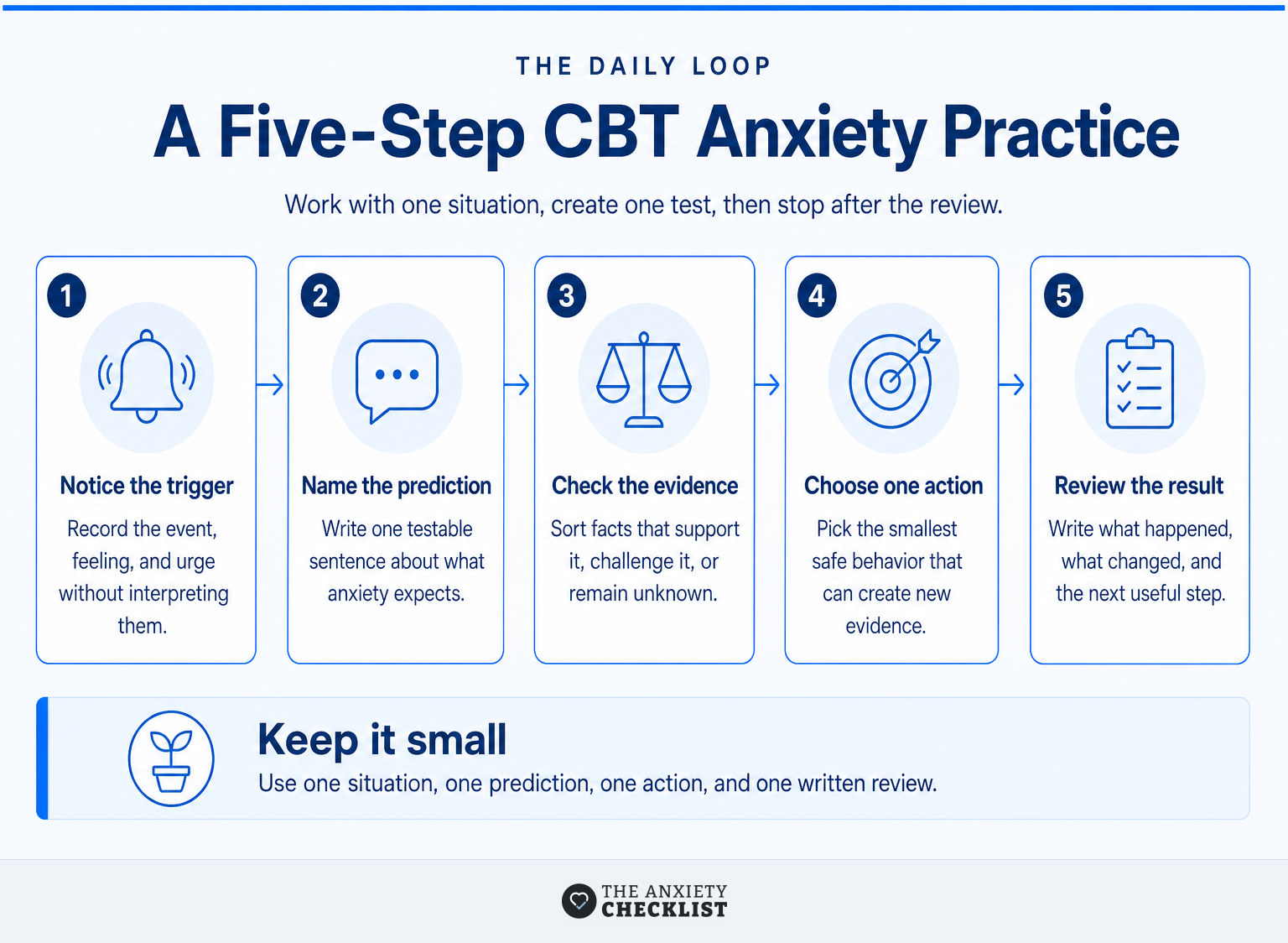
The daily loop is notice, record, examine, act, and review. Keep each pass to one situation and one experiment so the exercise produces learning instead of a long rumination session.
- Notice the trigger. Record what happened, the main feeling, any body sensation, and the urge that followed. Keep observable facts separate from interpretation.
- State one prediction. Write one sentence describing what anxiety expects to happen. A prediction can be tested; a label such as “failure” cannot.
- Check the evidence. List facts supporting the prediction, facts making it less certain, and information that remains unknown.
- Choose a balanced response and one action. Write the most accurate alternative, then choose a small safe behavior that can produce evidence.
- Review the outcome. Record what happened, what did not happen, what was learned, and the next useful step.
The NHS thought record uses seven prompts that move from a situation and feeling through evidence, an alternative thought, and a second emotional check-in. Western Australia's Centre for Clinical Interventions' 2025 anxiety resources add thought diaries and behavioral experiment worksheets.
One situation, one prediction, one action, and one review are enough for a useful daily CBT practice.
How do you catch the thought without arguing with yourself?
Catch the thought by separating the event from anxiety's interpretation of the event. Write a testable prediction, not a broad judgment about the self, the future, or life.
Example
- Situation: At 3:10 p.m., a manager sent a calendar invitation titled “Discussion tomorrow.”
- Prediction: The meeting will end in dismissal.
- Feeling and urge: Fear, followed by rereading the invitation and asking a coworker what it might mean.
Use a recent event with a time, place, or clear trigger. If anxiety is too intense for careful analysis, capture the situation and prediction first, settle the immediate physical distress, and return to the evidence later.
A thought becomes workable when it is written as a specific prediction rather than treated as a fact.
How do you test an anxious thought with evidence?
Test the thought by sorting information into evidence for, evidence against, and unknown. Then write a balanced response that reflects the facts and includes a coping plan.
Ask three questions:
- What observable facts support the prediction?
- What facts make the prediction less certain?
- What information is still missing?
In the meeting example, a recent mistake and a private invitation may support concern. No formal warning, recently accepted work, and the manager's habit of scheduling private conversations may count against dismissal. The meeting topic remains unknown.
A balanced response could be: “The meeting may involve the recent error, but dismissal is not known. Relevant notes can be prepared, and the topic can be addressed directly.” This is realistic, not falsely positive.
A balanced thought aims for accuracy and coping, not certainty or forced optimism.
How do you choose one small behavior to try?

Choose a behavior that is safe, small, and capable of creating new information. The goal is to test the prediction, not to force anxiety to disappear before acting.
Western Australia's CCI behavioral experiments handout recommends defining the prediction, designing a specific test, starting at an appropriate level, recording the outcome, and updating what was learned.
For example, the prediction might be that asking one question in a routine meeting will make colleagues think the questioner is incompetent. The experiment is to prepare one relevant question, ask it, and record visible responses without trying to read minds.
Use the longer guide on testing anxious predictions when a belief needs a more detailed experiment plan.
The best self-help experiment is the smallest safe action that can produce clear evidence.
How do you review the outcome without chasing reassurance?
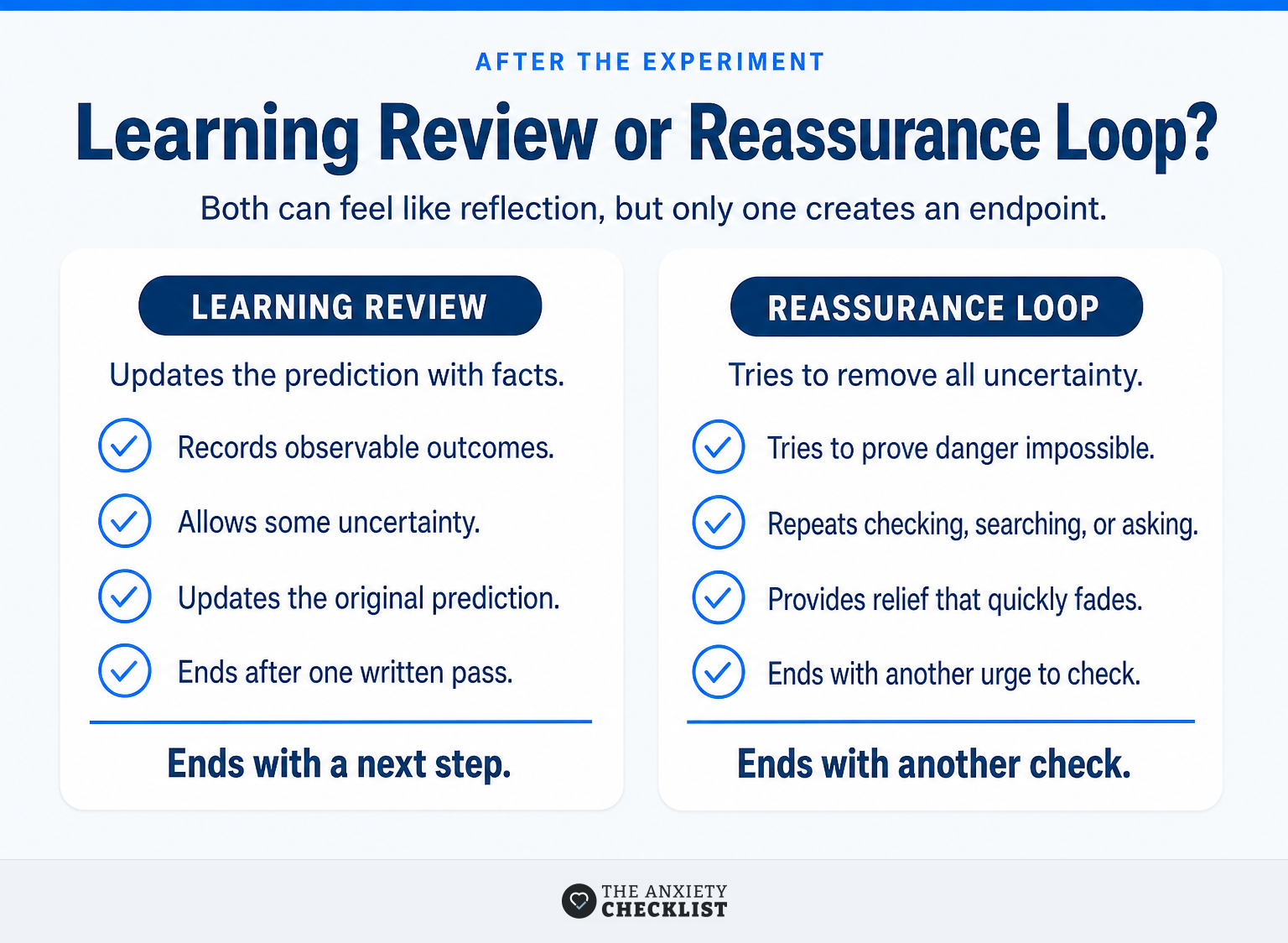
Review the outcome once by comparing the prediction with observable facts. Stop when the learning is written; repeated checking can turn a CBT exercise into reassurance-seeking.
Western Australia's CCI reassurance-seeking handout explains that reassurance can provide short-term relief while the worry and urge to check keep returning.
Use one written review: What happened? Which part of the prediction came true? Which part did not? What does the result suggest for the next attempt? Reopen the entry only when new evidence exists, not because anxiety demands another check.
A review should create learning and an endpoint, not another round of checking.
When is CBT self-help not enough?
CBT self-help is not enough when symptoms are severe or worsening, daily functioning is substantially impaired, or safety is uncertain. Professional care should also take priority when structured practice repeatedly increases distress or does not help.
The NICE stepped-care model moves to high-intensity psychological treatment or medication options when generalized anxiety causes marked functional impairment or has not responded adequately to lower-intensity support.
- Arrange a professional assessment when anxiety substantially disrupts sleep, work, education, relationships, eating, or basic daily care.
- Do not change or stop prescribed treatment because of a self-help entry; discuss treatment changes with the prescribing or treating clinician.
- Seek urgent help when there is immediate danger, an inability to stay safe, or a risk of harming yourself or someone else.
In the United States, the NIMH help page, last reviewed in April 2026, directs people in suicidal crisis or emotional distress to call or text 988 and advises emergency care for life-threatening situations. Outside the United States, contact the local emergency number or crisis service.
If self-guided exercises are not enough but remote support is preferable, learn what to look for in online CBT for anxiety.
Professional or emergency support takes priority when functioning, safety, or symptom severity exceeds self-help.
What are common questions about CBT anxiety self-help?
CBT self-help often raises questions about uncertainty, temporary discomfort, and the limits of self-guided practice. The answers below keep the routine focused and define when to stop.
What if there is no evidence against an anxious thought?
If no evidence argues against the thought, separate fact from uncertainty. A balanced response can say, “This outcome is possible, but the result is not known yet, and a practical response can be planned.” CBT does not require pretending that risk is zero; it asks for the most accurate view available.
Can CBT self-help make anxiety feel worse at first?
Writing down a fear or trying a new behavior can temporarily increase discomfort. That does not automatically mean the exercise is harmful, but intensity and safety matter. Scale the task down, stop if distress becomes overwhelming or safety feels uncertain, and seek professional guidance if distress keeps rising or difficult memories surface.
Can CBT self-help replace therapy?
No. CBT anxiety self-help can support everyday coping and structured practice between sessions, but it cannot diagnose an anxiety disorder, assess risk, tailor treatment to complex conditions, or provide emergency care. Professional help is the better next step when symptoms are severe, worsening, persistent, or substantially disrupting daily life.
A useful routine stays brief, tolerates uncertainty, and hands off to professional care when self-help reaches its limits.
What should you do today?
Choose one recent worry and complete one pass through the routine before the day ends. Stop after the review, even if the feeling has not fully settled.
If a blank page is the barrier, open the CBT Thought Journal. Its four-step flow helps define the worry, identify the thinking trap, balance the thought, and write an alternative; the small behavior and one-pass review can then be added separately.
The useful unit of CBT self-help is one recorded prediction followed by one safe piece of evidence.