

In short
Cognitive behavioral therapy for health anxiety helps by changing the interpretations and safety behaviors that keep illness fears active. Instead of proving that every sensation is harmless, CBT teaches a person to test catastrophic predictions, reduce repeated checking and reassurance seeking, tolerate uncertainty, and follow a sensible medical-care plan for genuinely new or concerning symptoms.
Key takeaways
- A 2026 network meta-analysis of 35 trials involving 3,263 adults supported CBT and several related psychological interventions for health anxiety.
- Checking, symptom searching, and reassurance often reduce distress briefly, but the fading relief can teach the brain to repeat the ritual.
- A balanced CBT thought allows uncertainty and chooses a useful action; it does not replace “Something is seriously wrong” with “Nothing is wrong.”
- Checking reduction should be gradual and should never override prescribed treatment, routine screening, or an agreed medical-care plan.
- New, severe, or rapidly worsening symptoms need appropriate medical assessment rather than automatic labeling as anxiety.
Table of contents
- What cycle is CBT trying to break?
- Does CBT help with health anxiety?
- How do you map your own health-anxiety cycle?
- How do you challenge a catastrophic interpretation without reassuring yourself?
- How do you reduce body checking and symptom searching?
- How do you ask for less reassurance without ignoring medical care?
- How do behavioral experiments change health-anxiety beliefs?
- Which CBT exercise should you use first?
- When is self-help not enough?
- What do people ask about CBT for health anxiety?
- What should you do next?
What cycle is CBT trying to break?
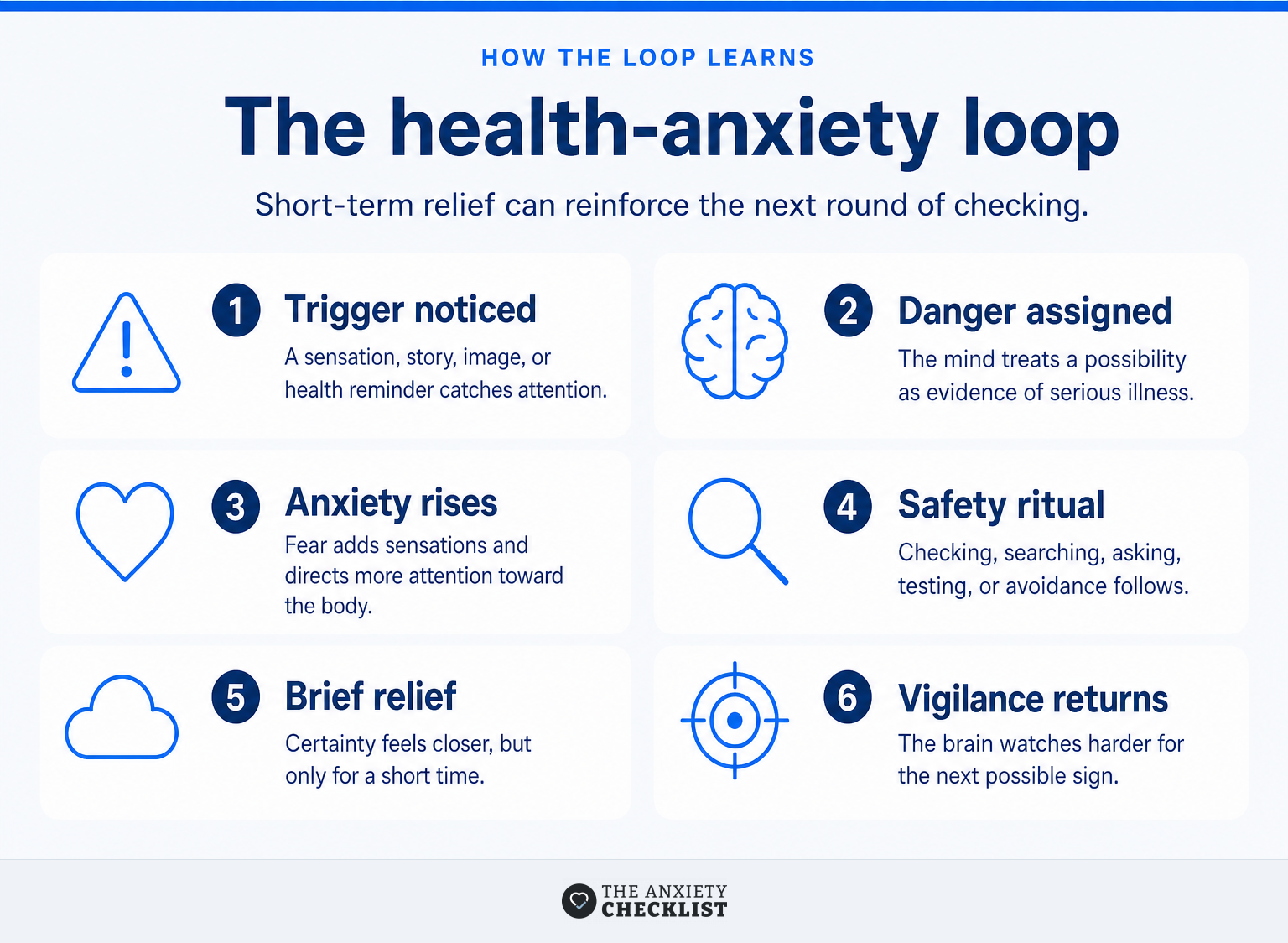
CBT targets the loop that turns a sensation or health reminder into a catastrophic interpretation, anxiety, checking or reassurance, brief relief, and renewed vigilance. The aim is not to prove that the body is safe forever; it is to stop teaching the brain that uncertainty always requires an urgent ritual.
A trigger may be a sensation, a medical story, a routine appointment, or hearing about another person's illness. The mind assigns a threatening meaning, anxiety creates more sensations and focused attention, and the person tries to settle the question through body scanning, online research, repeated appointments, avoidance, or reassurance.
The Association for Behavioral and Cognitive Therapies health-anxiety fact sheet describes the same pattern and emphasizes that health anxiety can coexist with real medical conditions. Persistent fears may also overlap with illness anxiety, panic, OCD, or other concerns that require individual assessment.
Because relief follows the ritual, checking becomes more likely the next time uncertainty appears. The relief fades, but the habit remains.
Health anxiety persists when certainty-seeking behaviors teach the brain to keep treating uncertainty as danger.
Does CBT help with health anxiety?
Yes, CBT is one of the best-supported psychological treatments for health anxiety, although no treatment works for everyone. Effective CBT usually combines changes in interpretation with behavioral practice, particularly exposure, response prevention, and reduced safety behaviors.
A 2017 systematic review and meta-analysis included 14 randomized controlled trials and found a large post-treatment effect for CBT compared with control conditions. Benefits were also present at six- and 12-month follow-up.
The evidence base has since grown. A 2026 network meta-analysis of 35 randomized trials involving 3,263 adults found significant benefits for CBT and several related approaches compared with waiting-list controls. Its component analysis linked exposure and response prevention, cognitive restructuring, and mindfulness with better outcomes.
These results support structured treatment, not a promise that a worksheet will remove every fear. Research protocols may involve clinician guidance, repeated practice, individual formulation, and adjustments for other diagnoses or medical conditions. Self-help exercises can teach the method, but they are not equivalent to diagnosis or individualized treatment.
CBT has substantial trial support, but benefit comes from practicing behavioral change rather than collecting more reassurance.
How do you map your own health-anxiety cycle?
Start by recording one complete episode without trying to correct it. A useful map shows the trigger, feared meaning, anxiety response, safety behavior, brief consequence, and longer-term cost.
Exercise 1: Write a six-part cycle map
For one recurring episode, write down:
- Trigger: What sensation, image, story, appointment, or thought caught attention?
- Feared meaning: What illness or outcome did the mind predict?
- Anxiety response: What emotions, sensations, images, and urges followed?
- Safety behavior: What checking, searching, asking, avoiding, or monitoring occurred?
- Immediate result: How much relief followed, and how long did it last?
- Longer-term result: Did vigilance, doubt, or the urge to check increase later?
A hypothetical entry might begin with a familiar heart flutter that has already been medically assessed. The feared meaning is that a heart condition was missed. Pulse checking and online searching provide ten minutes of relief, but attention remains fixed on every heartbeat for the rest of the evening.
The final column is the most important. A behavior can feel helpful in the moment while carrying a high cost over the next hour, day, or week.
A useful cycle map shows what happened before the fear, what the mind predicted, what you did, and how long relief lasted.
How do you challenge a catastrophic interpretation without reassuring yourself?

CBT does not require replacing a frightening thought with a guarantee of safety. The goal is to separate observation from interpretation, consider more than one explanation, and choose an action based on evidence and an agreed care plan.
Exercise 2: Use a five-column thought record
Create five columns and complete them in order:
- Observable fact: Describe only what could be recorded by a camera or timer.
- Automatic interpretation: Write the feared meaning without softening it.
- Evidence review: What supports the prediction, and what does not?
- Alternative possibilities: List plausible explanations without declaring one correct.
- Useful action: Follow the medical-care rule or return to the planned activity.
Watch for common cognitive distortions, such as treating possibility as probability, focusing only on threat, or assuming that anxiety itself proves danger.
Avoid the reassurance version of a balanced thought: “This is definitely nothing.” A more useful response is: “This sensation is uncomfortable, and several explanations are possible. Scanning cannot diagnose it. The next action will follow the established care plan rather than the urge for complete certainty.”
A balanced CBT response leaves room for uncertainty and chooses an action instead of replacing one certainty claim with another.
How do you reduce body checking and symptom searching?
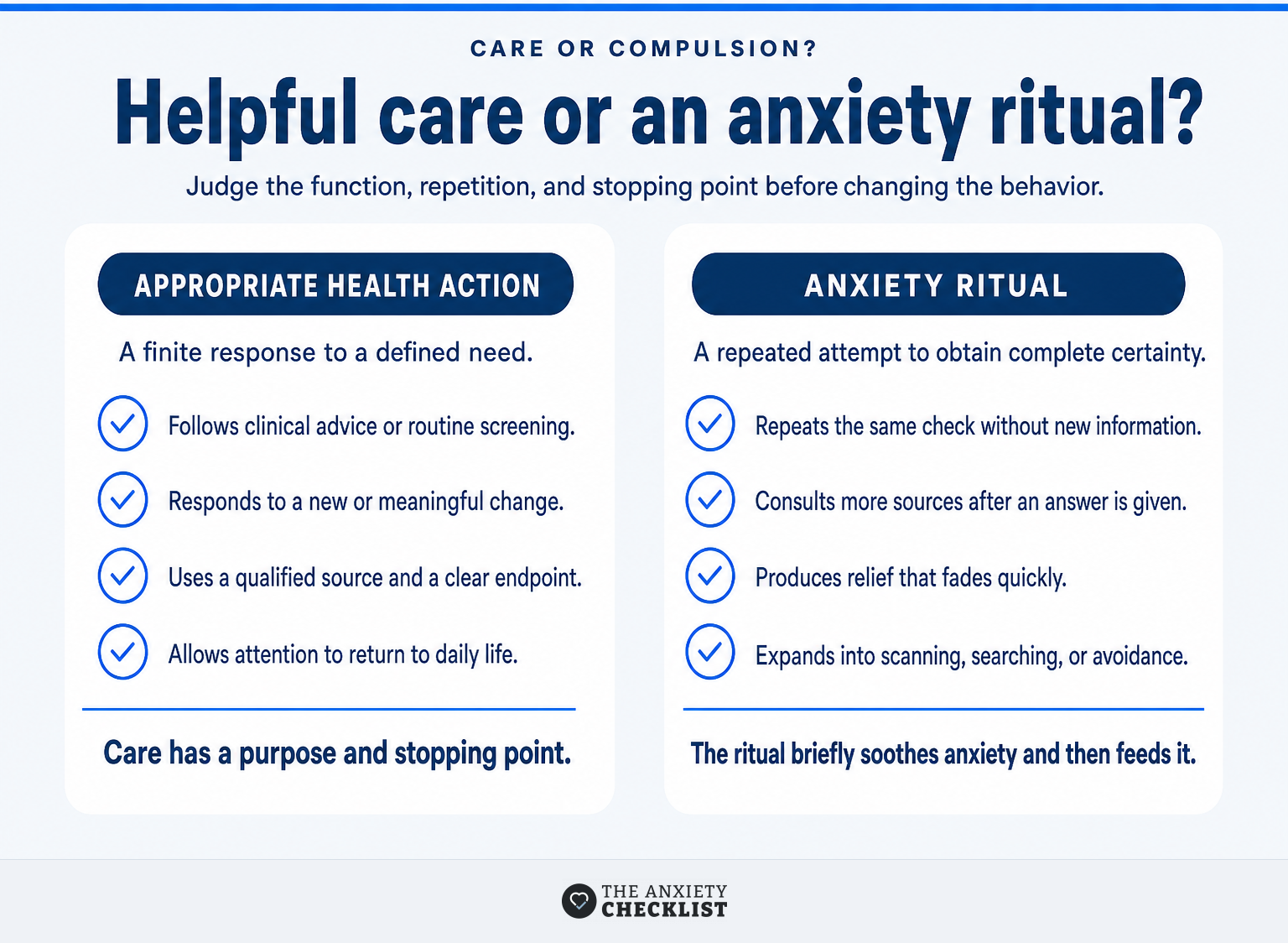
Reduce one low-risk ritual at a time instead of demanding an immediate stop to every safety behavior. The exercise works best when prescribed monitoring and genuinely new symptoms have already been separated from repetitive anxiety-driven checks.
The Centre for Clinical Interventions checking and reassurance worksheet recommends evaluating what a behavior achieves, setting a new behavioral goal, and breaking the change into manageable steps.
Exercise 3: Delay, reduce, or remove one ritual
- List repeated behaviors such as pulse checking, mirror inspection, symptom searches, asking several people, or comparing photographs.
- Mark anything required by a clinician, treatment plan, or routine screening schedule. Do not change those actions independently.
- Choose one remaining ritual and decide whether to delay it, reduce its frequency, shorten it, or remove it.
- Record the urge before the change, at the planned stopping point, and after returning to an ordinary activity.
- Check for ritual substitution, such as stopping online searches but beginning repeated body scans.
Choose a step that is challenging but repeatable. If an hour feels impossible, begin with a shorter delay and extend it after several successful attempts. Measure whether the urge changes without the ritual rather than judging success by whether anxiety disappears immediately.
A gradual demonstration is included below. The video is educational and does not replace personal medical or psychological care.
Video: Reduce HEALTH ANXIETY Checking with These 3 Steps by Dr. Rami Nader.
Reduce one low-risk ritual gradually and measure what happens to the urge rather than waiting to feel completely safe.
How do you ask for less reassurance without ignoring medical care?
Reassurance reduction should target repeated certainty-seeking, not appropriate clinical assessment. The safest plan separates a medical decision rule from an anxiety ritual so that neither fear nor avoidance controls care.
Exercise 4: Replace a reassurance answer with a support response
Ask a trusted person to stop repeatedly judging whether a symptom is dangerous. The person can validate distress, point back to the agreed plan, and help attention return to the present activity.
Possible responses include:
- “The fear is strong, and the agreed plan does not call for another check right now.”
- “Support is available while the urge passes, but the same medical question will not be answered again.”
- “Would practical company help while returning to the planned activity?”
This approach should not turn a friend or family member into a medical gatekeeper. A clinician can help define which recurring sensations have already been assessed, what meaningful changes require reassessment, and which routine follow-ups remain necessary.
Keep medical care outside the experiment. Do not use reassurance reduction to delay prescribed treatment, stop medication, cancel routine screening, or dismiss a new, severe, or rapidly worsening symptom. Follow emergency warning signs and escalation instructions supplied by a qualified health service in the relevant jurisdiction.
Support should help a person follow a plan and return to life, not repeatedly settle the same medical question.
How do behavioral experiments change health-anxiety beliefs?
A behavioral experiment tests a specific prediction by changing one safety behavior and observing what follows. It is not a test of whether illness is impossible, and it must not involve withholding necessary care or deliberately causing harm.
Exercise 5: Test one prediction
Write the experiment before beginning:
- Belief: State the feared rule precisely.
- Prediction: Describe what is expected to happen, when, and how it will be measured.
- Experiment: Change one low-risk safety behavior within the established care plan.
- Observation: Record anxiety, urges, actions, and the outcome without editing the result.
- Learning: Update the original belief according to the observation.
For example, the prediction might be: “If pulse checking is delayed for 20 minutes, anxiety will keep rising until it becomes unbearable.” For a familiar sensation that has already been assessed, the experiment could involve delaying the check while continuing an ordinary task and recording the urge at the beginning, midpoint, and end.
The result may show that anxiety rose and then changed, remained uncomfortable but manageable, or led to an unexpected ritual. Every result provides information. The point is to gather data about the predicted process, not manufacture a calm outcome.
More examples of structuring predictions and observations appear in this guide to CBT belief experiments.
A behavioral experiment tests a prediction safely; it never asks a person to ignore treatment or a genuinely changed symptom.
Which CBT exercise should you use first?
Start with the behavior that consumes the most time or most directly triggers the next turn of the cycle. If medical decisions are unclear, establish a care plan with a qualified clinician before experimenting with checking or reassurance.
| Dominant pattern | Start with | What to track |
|---|---|---|
| Catastrophic interpretation | Five-column thought record | Prediction, evidence, and chosen action |
| Constant body scanning | Attention and activity reset | Time spent scanning and return to task |
| Repeated checking or searches | Delay, reduce, or remove | Frequency, urge, and length of relief |
| Repeated reassurance questions | Support-response script | Number of repeated questions and recovery time |
| Avoidance of normal activities | Gradual return to activity | Time engaged without extra safety behavior |
| A rigid health belief | Behavioral experiment | Predicted outcome compared with observed outcome |
Exercise 6: Practice flexible attention
Choose a brief, ordinary activity that health anxiety has interrupted. Notice the sensation or thought without inspecting it, identify a few details in the external task, and return attention each time scanning begins.
This is not an attempt to distract yourself until danger disappears. It is practice in deciding where attention goes while uncertainty is present. NHS health-anxiety guidance also recommends recording checking behavior, reducing it gradually, challenging thoughts, and returning to avoided activities.
Start with the behavior that consumes the most time or most directly feeds the next turn of the cycle.
When is self-help not enough?
Professional help is appropriate when health anxiety controls daily life, makes medical decisions difficult, or does not improve with careful self-help. A clinician can also assess whether the pattern is better explained by illness anxiety disorder, OCD, panic, depression, trauma, a medical condition, or more than one concern.
Consider professional assessment when:
- Worry, checking, searching, appointments, or avoidance occupy substantial time.
- Work, sleep, relationships, finances, or routine activities are being affected.
- Reassurance reduction repeatedly becomes overwhelming or leads to another ritual.
- Medical visits are being avoided because of fear.
- It is difficult to distinguish an anxiety ritual from appropriate follow-up.
- Intrusive thoughts or compulsions extend beyond health concerns.
- Anxiety is severe, worsening, or accompanied by depression or thoughts of self-harm.
A licensed CBT therapist can build an individual formulation and coordinate the psychological plan with appropriate medical care. If there is immediate danger or a risk of self-harm, contact local emergency services or a crisis service rather than relying on a self-help exercise or wellness app.
Professional help is appropriate when health anxiety controls daily life, overlaps with other symptoms, or makes medical decisions hard to judge.
What do people ask about CBT for health anxiety?
The most common questions concern effectiveness, recovery, overlap with OCD, and which therapy to choose. The answers below describe general evidence and cannot diagnose an individual pattern.
Does CBT help with health anxiety?
Yes. Randomized trials and meta-analyses show that CBT can reduce health-anxiety symptoms, especially when treatment includes cognitive restructuring, exposure, and response prevention. CBT does not promise certainty that illness is impossible. It teaches a person to respond differently to sensations, uncertainty, checking urges, and reassurance seeking.
How did you overcome health anxiety?
Health anxiety is usually improved through repeated practice rather than one reassuring explanation. Common steps include mapping triggers, questioning catastrophic interpretations, reducing checking and symptom searches, limiting repeated reassurance, returning to avoided activities, and seeking professional CBT when self-help is not enough. Appropriate medical assessment still remains part of the plan.
What is the main difference between health anxiety and OCD?
Health anxiety centers on fears of having or developing illness, while OCD can involve many obsession themes and compulsions beyond health. The conditions can overlap, particularly when health fears produce repetitive checking or reassurance rituals. A clinician distinguishes them by the pattern, function, breadth, and impact of the symptoms.
What is the best therapy for health anxiety?
CBT is one of the best-supported psychological treatments for health anxiety. A 2026 network meta-analysis also found benefits for exposure therapy, acceptance and commitment therapy, metacognitive therapy, and mindfulness-based cognitive therapy. The best choice depends on diagnosis, medical context, preferences, access, and the clinician's assessment.
Health anxiety and OCD can overlap, so treatment should target the function of checking and reassurance, not just the topic.
What should you do next?
Choose one low-risk maintaining behavior, record it for several days, and run one gradual experiment rather than trying to fix the entire cycle at once. For structured self-help education, start with Anxiety Checklist's guide to how CBT for anxiety works and consider the CBT Essentials Masterclass if guided lessons suit your goals.
Change one maintaining behavior at a time, and keep appropriate medical care outside the experiment.