

In short
Anxiety can make the heart race because the fight-or-flight response releases stress hormones that raise heart rate and contraction strength. Sit or lie safely, loosen tight clothing, and breathe gently rather than deeply. A new racing heartbeat, or one with chest pain, fainting, severe shortness of breath, or other alarming symptoms, needs urgent medical assessment.
Key takeaways
- Anxiety can produce a fast, pounding, or highly noticeable heartbeat, but palpitations are a symptom rather than a diagnosis.
- A familiar episode that eases as the body settles may be anxiety-related, but that pattern cannot rule out an arrhythmia.
- Gentle, regular breathing is preferable to repeated huge breaths, which can worsen hyperventilation symptoms.
- A new, different, recurrent, or persistent racing heartbeat should be discussed with a healthcare professional.
- Chest pain or pressure, severe breathing difficulty, fainting, neurological symptoms, or a suddenly extreme heart rate require emergency help.
Table of contents
- Why can anxiety make your heart race?
- What should you do when your heart starts racing from anxiety?
- How can you tell anxiety from a heart rhythm problem?
- When should a racing heart get urgent medical help?
- What should you do if a racing heart keeps happening?
- What else do people ask about anxiety and a racing heart?
- What is the next step?
If symptoms are happening now and include chest pain or pressure, severe breathing difficulty, fainting, new confusion, or sudden weakness or speech trouble, call local emergency services. Do not continue reading to decide whether the symptoms are anxiety-related.
A racing heart can be a genuine physical effect of anxiety. It can also come from exercise, fever, stimulants, medication, thyroid problems, anemia, an electrolyte imbalance, or an abnormal heart rhythm. The safest approach is to settle the body without assuming the cause.
Why can anxiety make your heart race?
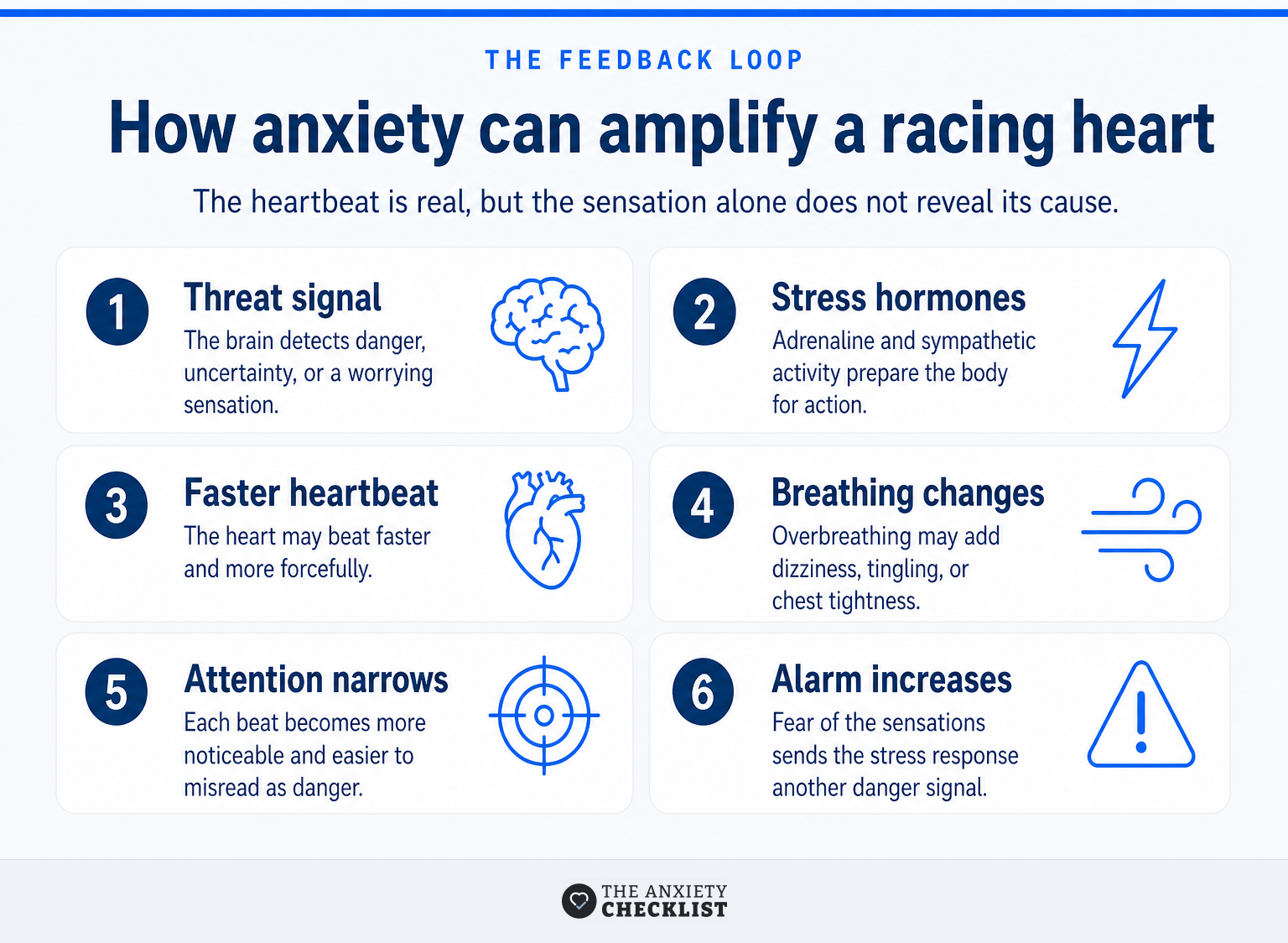
Anxiety can accelerate and intensify the heartbeat by activating the sympathetic nervous system and releasing adrenaline and noradrenaline. Those changes prepare the body for action even when the threat is a thought, body sensation, or false alarm rather than physical danger.
The fight-or-flight response raises heart rate and the force of heart contractions so that blood can reach the muscles quickly. An NCBI Bookshelf review of the stress response describes increased heart rate, stronger contractions, adrenaline release, and faster breathing as normal parts of acute stress physiology.
Palpitations describe an increased awareness of the heartbeat. The sensation may feel fast, pounding, fluttering, forceful, or as if beats have been skipped. It can be noticed in the chest, throat, or neck. The National Institute of Mental Health includes a pounding or racing heart among the physical symptoms that can occur during panic.
Breathing can intensify the experience. Anxiety may make breathing faster or deeper than the body needs. This overbreathing lowers carbon dioxide and can add dizziness, tingling, chest tightness, breathlessness, and a fast or pounding heartbeat, according to MedlinePlus guidance on hyperventilation.
Those sensations can form a feedback loop. The heart speeds up, attention locks onto the heartbeat, the sensation is interpreted as danger, and the alarm response becomes stronger. The symptoms are real even when anxiety is involved.
An episode can also seem to happen for no reason. A thought, memory, caffeine, poor sleep, a body sensation, or fear of another episode may trigger the stress response before the person consciously recognizes the trigger. An unclear trigger does not prove either anxiety or heart disease.
Anxiety can drive a real racing heartbeat, but the sensation still does not identify the cause.
What should you do when your heart starts racing from anxiety?
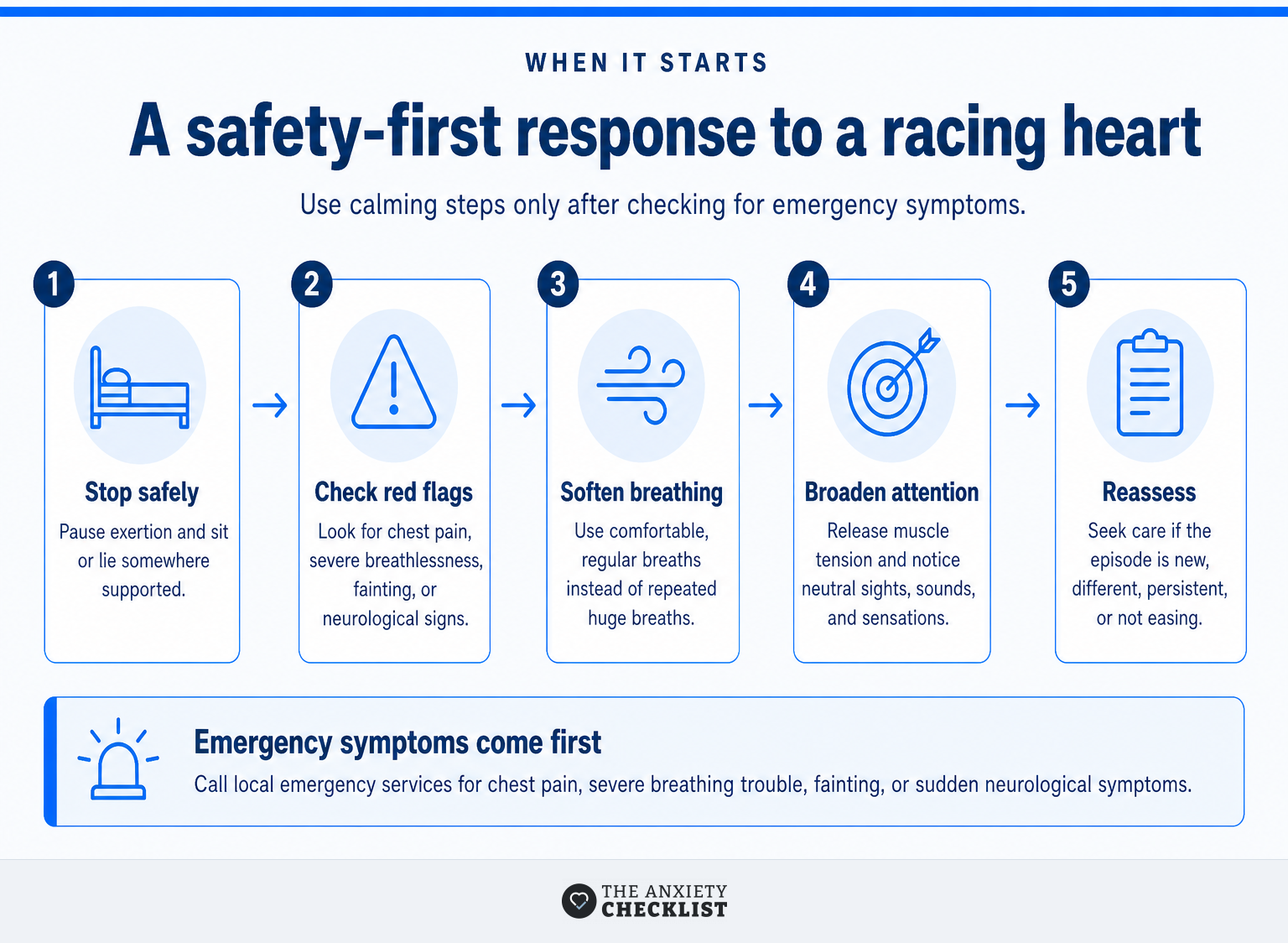
Stop exertion, get into a safe position, and check for emergency symptoms before trying to calm the heartbeat. If no red flag is present and this resembles a familiar anxiety episode, use gentle breathing and grounding while monitoring whether the symptoms ease.
- Stop and get physically safe. Sit in a supported chair or lie down if you feel unsteady. If you are driving, pull over safely. Loosen restrictive clothing and let your shoulders drop.
- Check for red flags first. Chest pain or pressure, severe breathlessness, fainting, new confusion, sudden neurological symptoms, or a heart rate that is suddenly extreme for you requires emergency help. Do not try to breathe through those warning signs.
- Make the breath gentle, not huge. Let air enter through the nose and leave slowly through the mouth. Keep each breath comfortable rather than repeatedly filling the lungs as deeply as possible. Count evenly if that helps, but stop counting if it makes the breathing feel forced. The NHS calming breathing guidance similarly recommends gentle, regular breathing without forcing it.
- Release effort elsewhere in the body. Unclench the jaw, lower the shoulders, rest the hands, and feel both feet or the supported parts of the body. Name a few neutral things you can see, hear, and feel. The aim is to broaden attention rather than repeatedly checking every heartbeat.
- Reassess the whole pattern. Notice whether the breathing, dizziness, chest sensation, and level of fear are changing. If the episode is not easing, feels different from previous episodes, or keeps returning, seek medical advice rather than repeating calming exercises indefinitely.
A longer breathing practice may help after immediate safety has been established. The guide to breathing exercises for anxiety explains several options, but a simple comfortable rhythm is usually easier to follow during acute fear.
Do not breathe into a paper bag. A current NCBI Bookshelf review of hypocarbia states that paper-bag rebreathing is no longer recommended because rapid breathing can also come from serious heart, lung, metabolic, or neurological conditions. Do not take extra heart or anxiety medication unless a clinician has already given you a personal plan for doing so.
If a clinician has previously linked the episodes to panic and no emergency sign is present, open the free SOS Panic Relief for a simple guided sequence. The app is educational self-help, not a diagnostic tool or emergency service.
Check for danger first, then use gentle breathing and grounding rather than trying to force the heart to slow.
How can you tell anxiety from a heart rhythm problem?
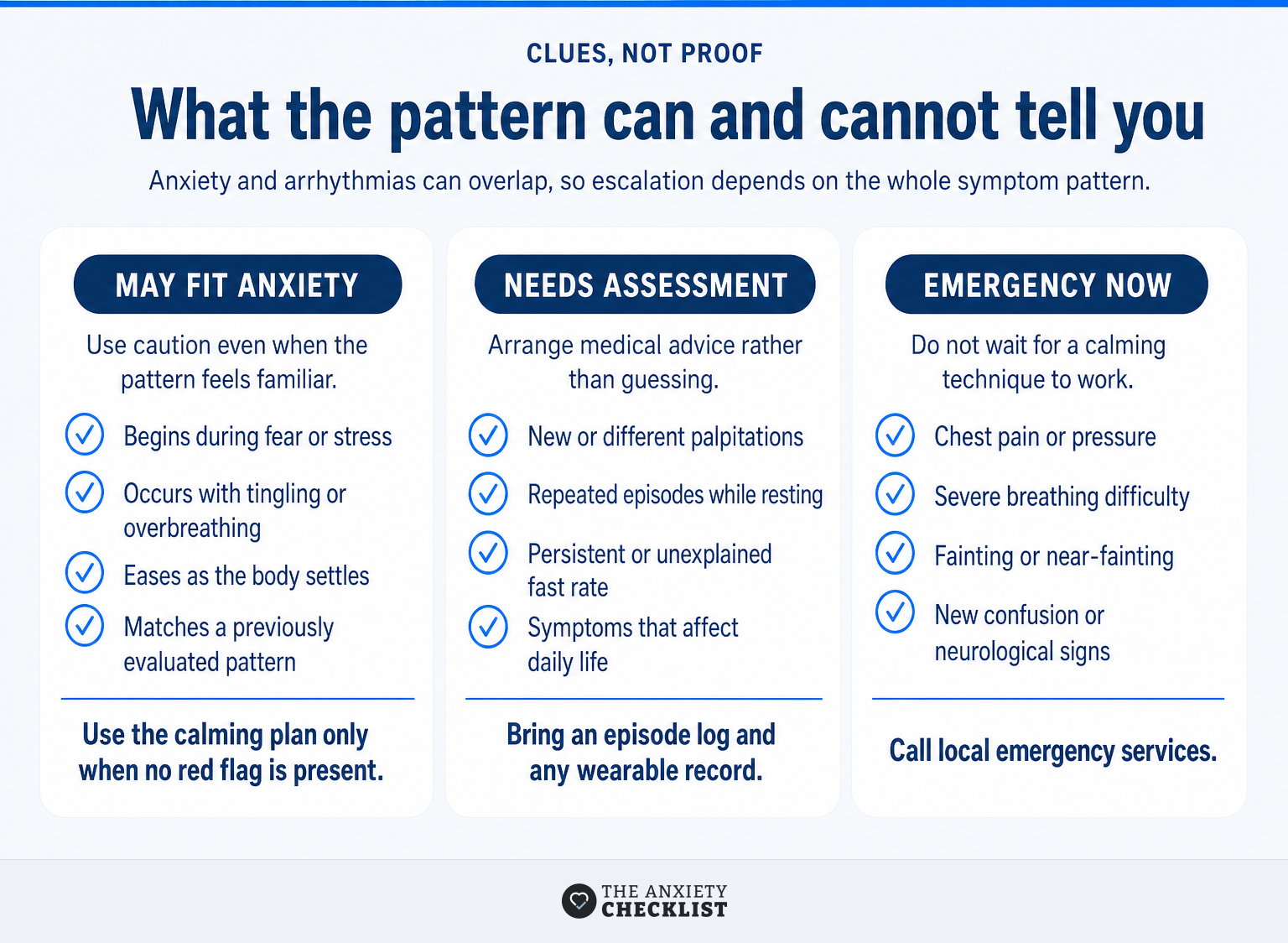
Anxiety and abnormal heart rhythms can produce overlapping sensations, so the cause cannot be confirmed from symptoms, a pulse reading, or a smartwatch alone. Context may provide clues, but an ECG or longer heart-rhythm recording may be needed to identify what the heart is doing during an episode.
Several commonly repeated rules are less reliable than they sound:
- It began during worry. Anxiety may be the cause, but an unexpected palpitation can also trigger fear.
- It stopped when you relaxed. Improvement as the body settles supports an anxiety explanation, but it is not proof because some rhythm disturbances stop on their own.
- The pulse felt regular. Anxiety commonly produces a fast, regular pulse, but some arrhythmias can also be regular.
- It felt irregular or skipped. Premature beats and arrhythmias can cause that sensation, but people can also have palpitations while the recorded rhythm is normal.
- A wearable showed a normal result. Consumer devices can preserve useful timing information, but they cannot rule out every rhythm disorder or other medical cause.
A heart rate of 120 bpm does not prove that anxiety is responsible. The American Heart Association's heart-rate guidance, last reviewed in 2024, describes a calm adult resting rate above 100 bpm as tachycardia while emphasizing that a high rate can be temporary and has multiple possible causes.
If a resting reading near 120 bpm is new, persistent, unexplained, or accompanied by weakness, dizziness, chest discomfort, breathlessness, or faintness, obtain medical advice. Call emergency services if the rate is suddenly very high for you and comes with serious symptoms.
If the racing heart occurs with a sudden wave of fear, trembling, sweating, tingling, dizziness, breathlessness, or fear of losing control, the wider pattern may resemble panic attacks. That resemblance still does not justify treating a first or medically unexplained episode as panic without assessment.
Context can suggest anxiety, but only medical assessment can rule out a rhythm or other physical cause.
When should a racing heart get urgent medical help?
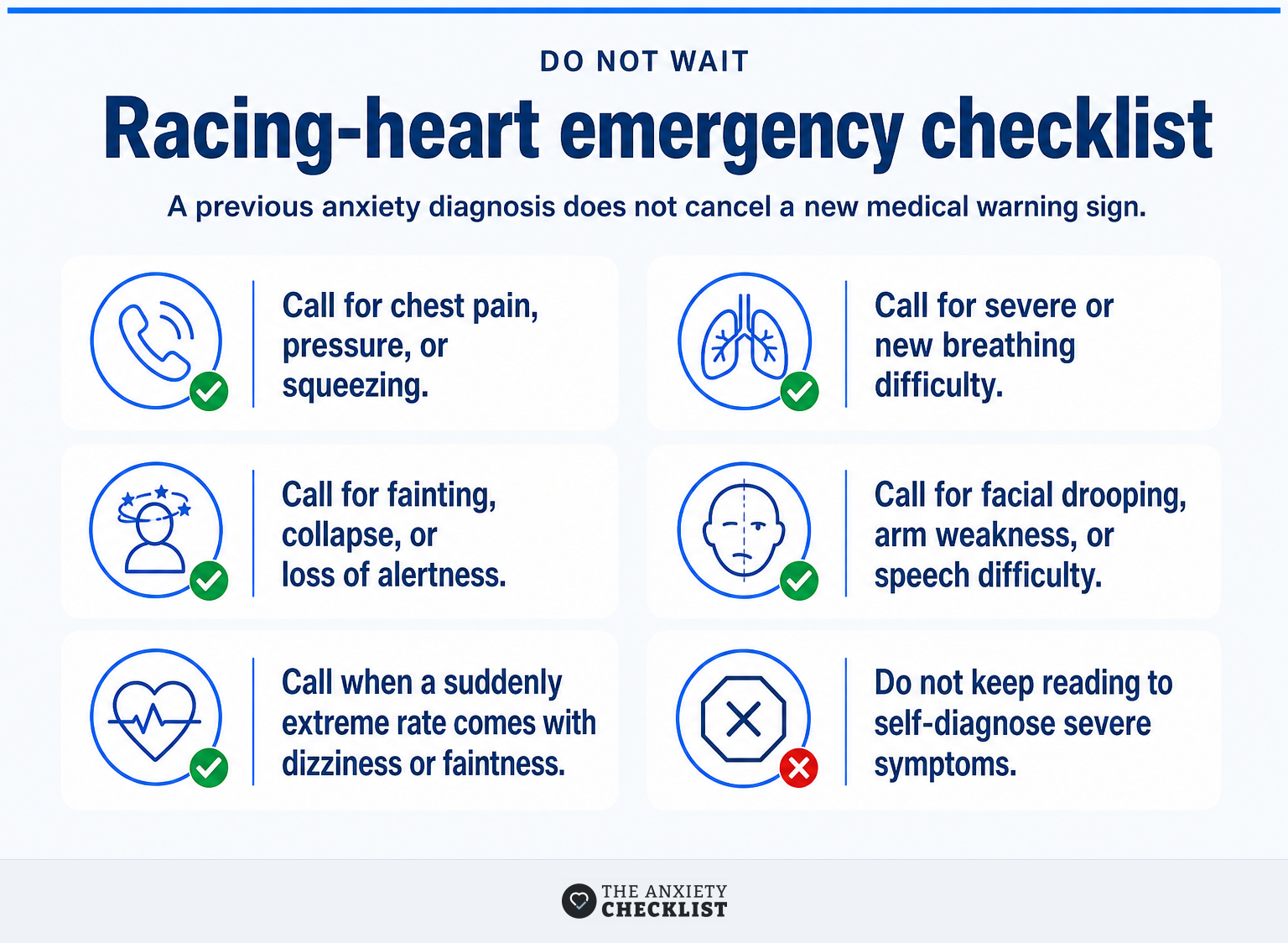
Call local emergency services when a racing or pounding heart occurs with symptoms that could indicate a heart attack, dangerous rhythm, stroke, or another acute medical problem. A previous history of anxiety should not be used to dismiss a new or severe combination of symptoms.
Seek emergency help for:
- Chest pain, pressure, squeezing, or significant upper-body discomfort
- Severe or new difficulty breathing
- Fainting, collapse, near-fainting, or loss of alertness
- New confusion, severe weakness, or inability to stand safely
- Sudden facial drooping, arm weakness, speech difficulty, or other stroke signs
- A suddenly very high or very low heart rate with chest pain, breathlessness, dizziness, or fainting
The American Heart Association's 2026 overview of palpitations advises prompt medical attention when palpitations bring chest pain, shortness of breath, dizziness, lightheadedness, or fainting. The National Heart, Lung, and Blood Institute also identifies chest pain, difficulty breathing, dizziness, and fainting as possible arrhythmia symptoms.
Arrange a medical appointment for palpitations that are new, different, recurrent, prolonged, or affecting daily life, even without emergency signs. MedlinePlus guidance on heart palpitations specifically recommends contacting a healthcare professional for new or changed palpitations and for relevant risk factors or accompanying symptoms.
If emergency care may be needed, use local emergency services rather than driving yourself. Emergency responders can begin assessment and treatment during transport.
Chest pain, severe breathlessness, fainting, neurological symptoms, or a suddenly extreme rate require emergency help.
What should you do if a racing heart keeps happening?
Recurrent episodes deserve a healthcare assessment because palpitations are a symptom with several possible causes. A brief record of each episode can help a clinician decide whether an ECG, blood tests, or longer rhythm monitoring is appropriate.
| Record | Useful detail |
|---|---|
| Time and activity | Note whether you were resting, sleeping, exercising, eating, or under stress. |
| Start and finish | Record whether the change was sudden or gradual and how long it lasted. |
| Pulse information | Note the rate and whether it seemed steady or irregular, without checking continuously. |
| Other symptoms | Include chest discomfort, breathlessness, dizziness, faintness, sweating, nausea, or tingling. |
| Possible triggers | Record caffeine, nicotine, alcohol, poor sleep, fever, stress, exercise, or a new medication. |
| What happened next | Note whether rest, time, gentle breathing, or medical treatment changed the episode. |
The National Heart, Lung, and Blood Institute's diagnostic guidance identifies an ECG as the most common arrhythmia test. Depending on the pattern, clinicians may also use blood tests for electrolytes or thyroid hormone, a Holter monitor, another ambulatory monitor, or an implantable loop recorder for infrequent symptoms.
Treatment depends on the cause. A clinician may address a rhythm disorder, thyroid problem, anemia, medication effect, stimulant use, or another physical trigger. If assessment supports an anxiety disorder, treatment may include psychotherapy, cognitive behavioral therapy, prescribed medication, or a combination.
The National Institute of Mental Health's 2025 anxiety treatment guidance describes psychotherapy, including CBT, and medication as established treatment options. It also notes that reducing caffeine and getting adequate sleep can support treatment, although healthy habits do not replace professional care.
There is no single best anxiety medication for heart palpitations. The appropriate choice depends on the diagnosis, health history, other medication, side-effect risks, and whether the fast heartbeat is actually being caused by anxiety. Never start, stop, or change a prescribed medicine because of an online symptom guide.
A short episode record gives a clinician more useful evidence than trying to diagnose the rhythm from memory.
What else do people ask about anxiety and a racing heart?
These common questions share the same safety rule: use a home calming technique only after checking for emergency symptoms. A racing heart that is new, changing, persistent, or alarming deserves medical advice.
How to lower heart rate anxiety?
To lower a heart rate that may be anxiety-related, stop exertion, sit safely, check for emergency symptoms, and let the breath become gentle and regular rather than taking repeated huge breaths. If the rate is new, very high for you, persistent, or accompanied by chest pain, fainting, or severe breathlessness, seek medical care.
How to stop a racing heart?
You cannot safely stop every racing heartbeat with a home technique because the cause may be anxiety, fever, medication, a stimulant, or an arrhythmia. Rest, breathe gently, and avoid more caffeine or nicotine. Call local emergency services for chest pain, severe breathing difficulty, fainting, or a sudden rate that feels dangerously abnormal.
Can anxiety cause loud heartbeats?
Yes. Anxiety can make the heart beat faster and more forcefully, and heightened attention can make each beat seem unusually loud in the chest, throat, or ears. Loud or pounding beats are still palpitations, not a diagnosis. New, changing, recurrent, or symptomatic episodes should be discussed with a healthcare professional.
What are the treatment options for anxiety-induced tachycardia?
Treatment starts by confirming the cause rather than assuming anxiety. A clinician may check the heart rhythm and look for medical triggers. If anxiety is driving the episodes, options can include cognitive behavioral therapy, other psychotherapy, prescribed medication, breathing retraining, and reducing personal triggers such as excess caffeine or nicotine.
A home calming method is not a substitute for evaluating a new, persistent, or concerning racing heartbeat.
What is the next step?
If this racing heartbeat is new, different, recurrent, or medically unexplained, arrange an appointment and bring a short episode record. If a clinician has already assessed the pattern as anxiety-related, keep the safety check and gentle calming sequence somewhere easy to reach before the next episode begins.
This article provides education rather than diagnosis or treatment. A heartbeat that feels alarming deserves medical attention even when anxiety has caused similar symptoms before.
Calm the body, but never let an anxiety label overrule a new or alarming heart symptom.