


You're lying awake with your phone face down, the room quiet, and your mind still loud. You've replayed the same worry so many times that it doesn't even sound like a thought anymore, it just feels like pressure in your chest, tight shoulders, and the sense that sleep won't come unless you somehow solve your whole life tonight. A cbt self help course gives that moment a structure, which matters because anxiety usually feels chaotic until you give it something concrete to work with.
A lot of people assume healing starts only when they find the perfect therapist appointment. Sometimes it starts earlier, with a workbook, a short exercise, and the decision to stop arguing with your fear and start mapping it. That's the promise of CBT self-help, not magic, not cheerleading, just a practical way to learn what anxiety is doing and what to do next.
Table of Contents
- The Moment You Decide Something Has to Change
- What a CBT Self Help Course Is
- Inside a Typical CBT Self Help Curriculum
- A Realistic 12-Week Learning Pathway
- Self Help Courses Compared to Therapist-Led CBT
- How to Choose a Quality Course Without Getting Burned
- Red Flags and When Self Help Is Not Enough
- Practical Tips for Success and Using Tools Like The Anxiety Checklist
The Moment You Decide Something Has to Change
The first shift is usually small. You stop trying to outthink the worry, and you admit that your current system isn't working, not because you're weak, but because anxiety has been running the same loop for too long. That's a painful realization, but it's also a hopeful one, because once you can name the pattern, you can work on it.
A person might be sitting on the edge of the bed at 1 a.m., scrolling through advice, wondering why breathing exercises help for a minute and then everything surges back. They're not failing at calm, they're missing a method that fits the way anxious brains behave in the moment. CBT gives that method a shape.
Practical rule: if your mind is foggy, don't start with a big worksheet. Start with one recent anxious moment and write down only what happened, what you felt, and what you did next.
That is often the turning point. Not a dramatic breakthrough, just the first time someone treats anxiety like a pattern that can be studied instead of a verdict on their character. A cbt self help course works best when it begins there, with ordinary life, not with perfect motivation.
There's a reason people cling to the idea of a structured path. The NHS Talking Therapies annual report shows that in 2022 to 23, Cognitive Behavioural Therapy and Guided Self Help (Book) together accounted for 70.9% of all courses of therapy, while CBT alone accounted for 41.3% of all therapy courses, down from 44.6% the year before, which shows how self-help formats have been integrated into routine care in a large public system. That isn't fringe behavior. It's a signal that self-help has become part of how real services manage access and demand. NHS Talking Therapies therapy-based outcomes report
What a CBT Self Help Course Is
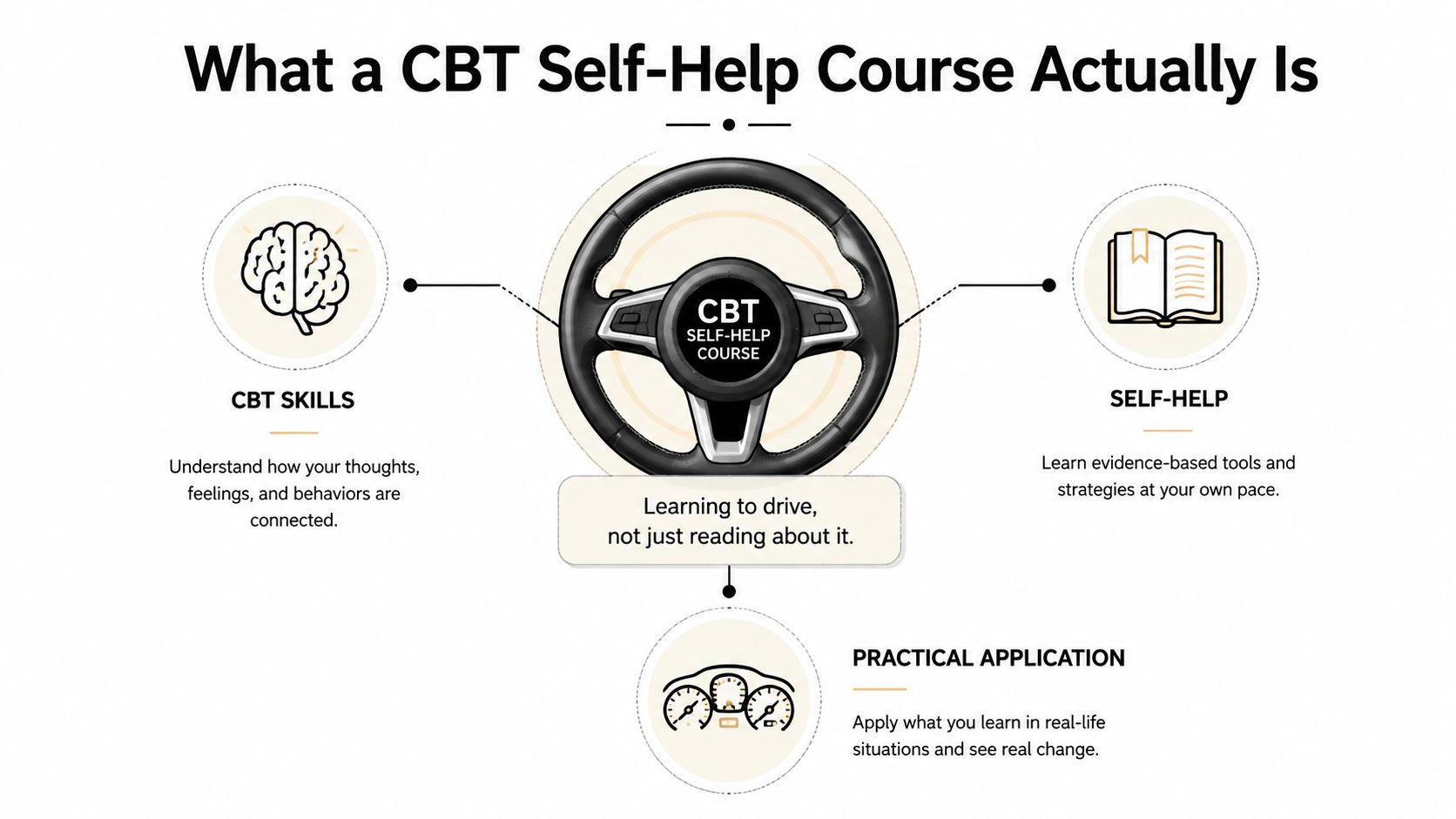
CBT means cognitive behavioral therapy, a practical approach that helps people notice unhelpful thinking patterns and change the behaviors that keep anxiety alive. The “self help” part means you are not only talking about the problem, you are practicing the skills yourself, usually with a workbook, modules, exercises, or a guided program. It works a lot like learning to drive. You need the instructions, but you also need the steering wheel.
The difference between a real course and generic wellness content is structure. A proper course does more than tell you to “think positive” or “challenge your beliefs” and leave you there. It gives you a sequence, practice, and a reason for each exercise, so it is closer to training than to casual advice. For a broader educational path built around that kind of guided learning, the Anxiety Checklist Anxiety University collection follows the same idea of steady understanding instead of random tips.
Mayo Clinic describes CBT as a structured therapy that helps people become aware of thinking patterns, learn coping skills, practice ways to deal with worry, and approach situations they have been avoiding. That structure matters whether the guidance comes from a therapist or a workbook, because the skill comes from repetition, not from who says the words. Mayo Clinic on cognitive behavioral therapy
A self-guided course is not the same as an AI chatbot, which can sound responsive but usually does not give you a stable curriculum, measured homework, or a clear progression. It is also not the same as a loose self-help book that you read once and set aside. A good cbt self help course gives you one path and keeps bringing you back to practice until the new response starts to feel familiar.
That matters most on the hard days. When someone opens the app while foggy, tired, or halfway into a panic spike, the course should still tell them what to do first, what to write down, and what can wait until later.
The format matters less than the repetition. If the course helps you practice the same skill in a clear order, it can do real work.
Inside a Typical CBT Self Help Curriculum
A useful course usually starts with observation before it asks for change. One real self-help program built as a mini 7-step course begins with identifying thoughts, feelings, and behaviors in a recent anxious or distressing situation, then asks you to record what happened, when and where it happened, who you were with, what thoughts or images came up, what emotions you felt, and what body sensations showed up. It also asks you to track at least one situation every day for the next few days, which tells you something important, progress comes from repeated noticing, not a single insight. GetSelfHelp self-help course PDF
The usual building blocks
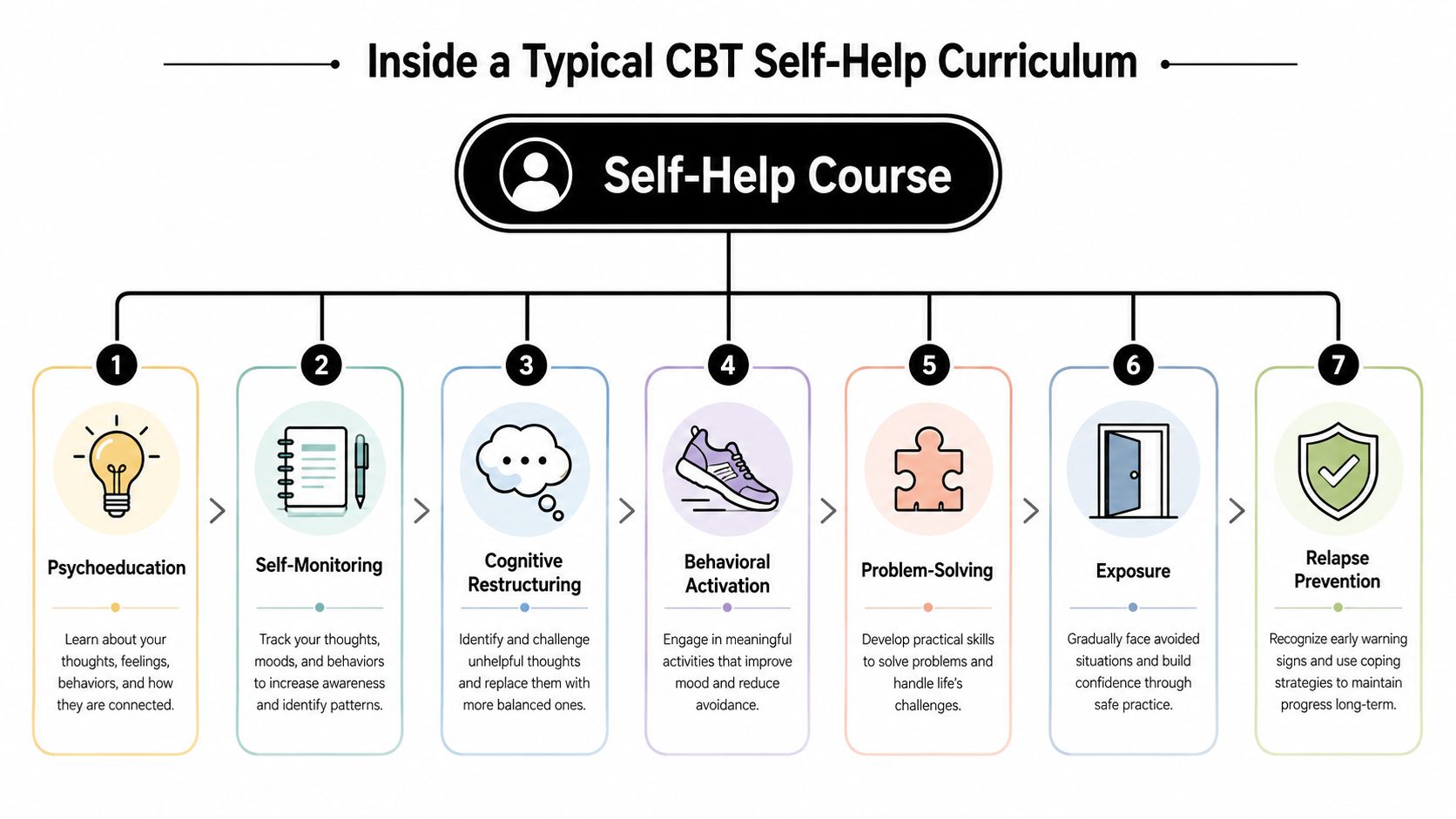
A beginner-friendly course often moves through a pattern like this, even if the labels differ:
- Psychoeducation. You learn how anxiety works, so the problem stops feeling mysterious.
- Self-monitoring. You track situations, thoughts, and body reactions.
- Cognitive restructuring. You test anxious predictions instead of treating them as facts.
- Behavioral activation. You add small, steady actions that reduce shutdown.
- Problem-solving. You break one messy issue into pieces you can act on.
- Exposure. You approach what you've been avoiding in gradual steps.
- Relapse prevention. You plan for future flare-ups before they catch you off guard.
That order matters because it starts with awareness and builds toward action. A person who jumps straight to exposure without learning how to notice thoughts can feel overwhelmed. Someone who only reads about anxiety without trying small experiments often stays stuck in the same loop.
The course structure also explains why The Anxiety Checklist belief experiments style of practice fits CBT so naturally. A belief experiment asks you to test a fear in real life instead of arguing with it in your head. That's classic CBT logic, and it works best when the user already knows what trigger, thought, and behavior they're testing.
The curriculum is less about “learning everything” and more about learning in the right order. First you can see the pattern, then you can challenge it, then you can practice a different response until it starts to stick.
A Realistic 12-Week Learning Pathway
A 12-week course works best when it feels manageable on a rough day, not only on a motivated one. That means short sessions, low-friction entry points, and a plan that still makes sense when you are tired, distracted, or halfway through a panic spike. The historical web-based CBT study on panic disorder is a blunt reminder of why this matters, it logged 484,695 visits, 1,148,097 page views, and 99,695 users, yet only 1,161 users registered and just 12 users completed the full 12-week course, a 1.03% completion rate among registrants, with a first-session view rate of 1.16%. The reach was huge, but adherence was the bottleneck. A later meta-analysis of 21 randomized controlled trials with 2,819 participants found that computer- and internet-based CBT self-help with weekly minimal guidance produced a medium-to-large effect size of 0.65 for depression symptoms compared with controls, which supports the value of structure and support. CBT self-help research and meta-analysis
A practical pacing map
Weeks 1 to 2 usually focus on observe and log. You write down a trigger, the first thought that showed up, what your body did, and what you did next. If you can only do one note a day, that is enough to begin.
Weeks 3 to 4 introduce learn core skills. You work with thought records, simple reframes, and the first belief tests. If your brain feels too tired for full worksheets, keep the task tiny and use a single sentence. A short entry is better than a perfect one that never gets started.
Weeks 5 to 8 are for practice and apply. That may include behavioral experiments, gentle exposure, and trying new responses in real situations. If you need a guided ladder for those steps, the Fear Ladder tool from The Anxiety Checklist can help you sort a fear into smaller pieces instead of treating it like one giant wall.
Weeks 9 to 12 are about solidify and maintain. You review what helped, plan for setbacks, and decide what to keep doing after the course ends.
A course that asks for one small action each day is usually more realistic than a course that demands long homework sessions after work.
What a week looks like
- Early week: read one lesson and do one short exercise.
- Middle of the week: repeat the same skill in a real situation.
- End of the week: write down what changed, even if the change was small.
That rhythm helps anxious people stay engaged without feeling buried. A cbt self help course should feel like a sequence of doable repetitions, not a stack of tasks waiting to become a second job.
Self Help Courses Compared to Therapist-Led CBT
Self-help and therapist-led CBT are not enemies, they solve different problems. The NHS data already shows that guided self-help sits inside a major public mental health system, which tells you it's not a watered-down oddity, it's a mainstream delivery format. The right question is not which one is “better” in the abstract, it's which one fits the person, the risk level, and the available support. NHS Talking Therapies therapy-based outcomes report
The comparison below keeps the trade-offs clear.
| Dimension | Self Help Course | Therapist-Led CBT |
|---|---|---|
| Access | Starts quickly, often from home | Depends on clinician availability |
| Cost | Usually lower | Usually higher |
| Depth | Strong for clear, focused problems | Better for complex patterns |
| Personalization | Limited by the course design | Adjusted in real time |
| Accountability | Depends on the user or app | Built into the relationship |
| Clinical safety | Weaker for high-risk situations | Better when symptoms are complicated |
Mayo Clinic's description of CBT as structured and time-limited fits both formats, but the delivery changes the experience. A therapist can notice when a person's avoidance is tied to trauma, dissociation, or a risk issue and adjust the work immediately. A course can't do that. On the other hand, therapist-led care can be harder to access right away, and people who need support tonight often can't wait for a slot to open.
That's why mobile support for anxiety care matters as a practical concept. A mobile course can keep someone engaged between appointments, or help them start when they're not ready for weekly therapy yet. It doesn't replace individualized care, but it can fill a real gap when access is limited.
The cleanest verdict is simple. If the anxiety is understandable, moderate, and you can practice consistently, a self-help course may be enough to get traction. If the anxiety is tangled with trauma, severe depression, safety concerns, or a pattern that keeps worsening, therapist-led CBT is the safer path.
How to Choose a Quality Course Without Getting Burned
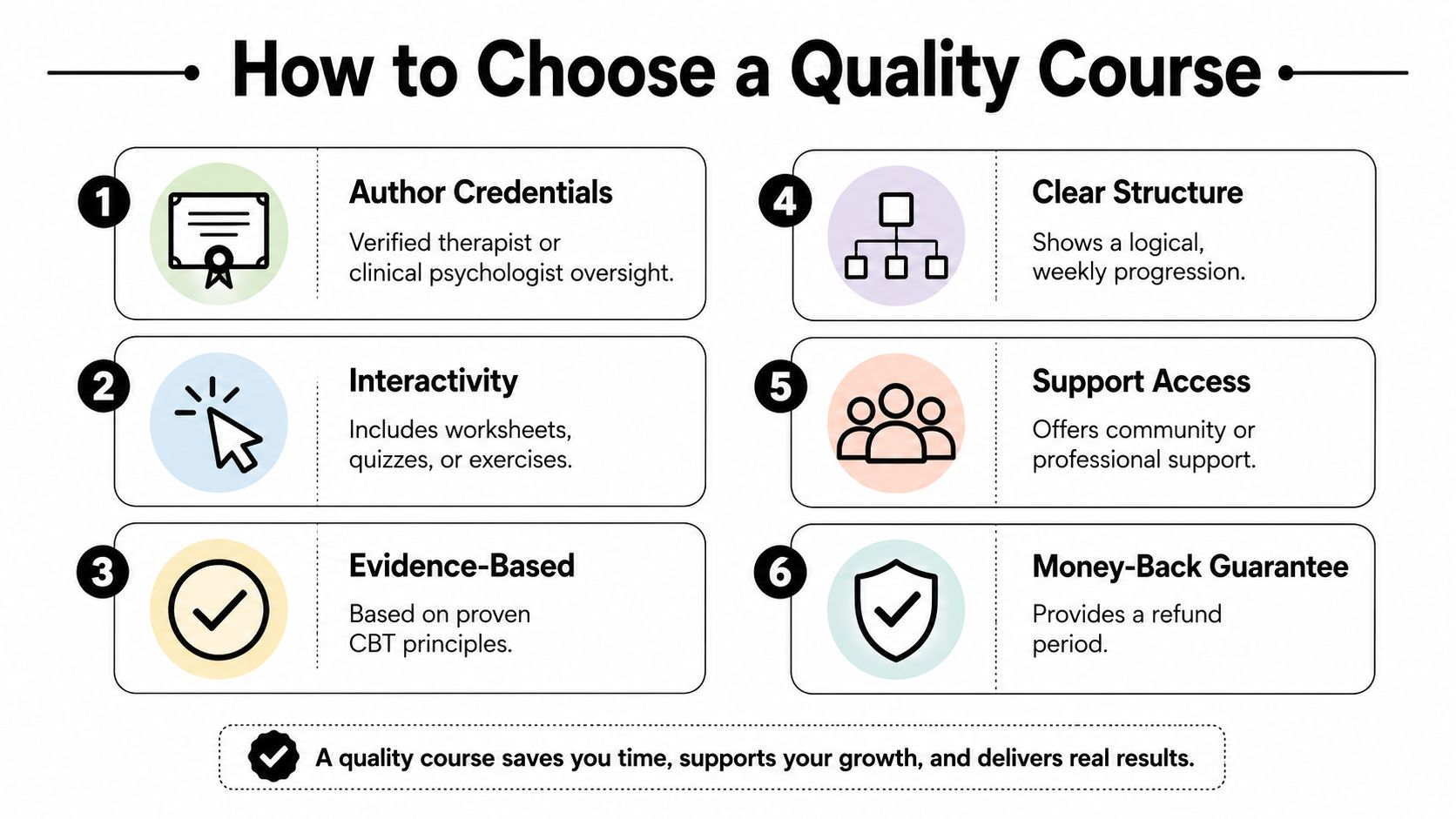
A lot of anxiety courses look helpful for five minutes and fall apart once you try to use them. The fastest way to sort the serious programs from the fluffy ones is to check six things before you pay. You don't need an hour, you need a quick scan and a few direct questions.
A five-minute screening list
- Author credentials. Look for a licensed therapist, clinical psychologist, or clearly described clinical oversight. If the site never names who built the course, be cautious.
- Interactivity. A serious course asks you to do something, not just watch or read. Open a sample lesson and see whether it includes worksheets, quizzes, logs, or exercises.
- Evidence-based structure. Scan for CBT terms like thought records, behavioral experiments, exposure, or relapse prevention. If the language is only “positive vibes” and “confidence,” it's probably not CBT.
- Clear progression. A good program tells you how the weeks fit together. If you can't tell whether it's a one-hour download or a month-long path, the structure is too vague.
- Support access. Some courses include community, check-ins, or professional guidance. That matters when you hit a rough patch and need a nudge, not a lecture.
- Pricing terms. Check the trial, refund, and renewal language before entering card details. If the pricing feels hidden, assume the rest of the offer may be unclear too.
The best quick test is practical. Ask yourself, “Does this tell me exactly what I'll do this week, and how I'll know if I'm doing it right?” If the answer is no, keep looking. A quality cbt self help course should make the next step obvious, especially on a foggy day when concentration is low.
Courses built by credentialed clinicians usually do a better job of balancing education, homework, and safety language than generic blog content pasted into lesson form. That doesn't guarantee a perfect experience, but it gives you a much stronger starting point.
Red Flags and When Self Help Is Not Enough
Some guides talk as if every anxious person can push through with enough worksheets. That's not responsible. A self-help course is one tool, not a substitute for individualized care when symptoms are complex, high-risk, or getting worse.
If panic keeps escalating even after repeated practice, that's a warning sign. If intrusive trauma memories, suicidality, psychosis, severe depression, or substance use are part of the picture, self-help alone is the wrong first move. And if you've used the course consistently for a while and you feel more activated instead of more stable, you need a real assessment, not more self-blame.
If two grounding sessions in a row make symptoms sharper instead of softer, pause the course and book an assessment.
The hardest confusion point is this, discomfort is not always danger. Exposure and thought work can bring up uneasy feelings because you're touching the fear directly. But there's a difference between “this is hard” and “this is making me less safe.” When in doubt, step back and get a professional opinion.
You also want to watch for situations where the problem is bigger than anxiety alone. If you're not sleeping, can't function, or feel pulled toward harmful coping methods, the right move is to ask for help sooner rather than later. Recovery includes knowing when to keep going and when to hand the wheel to someone else for a while.
Practical Tips for Success and Using Tools Like The Anxiety Checklist
The work goes better when it fits your real life. The workbook guidance recommends spending at least a couple of hours on hobbies, one evening or day each week with family or friends, and a minimum of two hours per week reviewing CBT strategies that helped you overcome problems, plus practicing healthy alternative statements several times every day. That mix matters because recovery isn't only about facing fear, it's also about keeping your life wide enough that anxiety doesn't swallow everything else. CBT workbook guidance on practice and maintenance
The easiest way to stay with the course is to make the exercises smaller than your resistance. Do the journaling in a notes app if that's easier than opening a workbook. Do one belief test instead of five. Repeat the same tool until it feels less awkward.
If you want a companion option for real-time support, the anxiety checklist app offers SOS grounding for spikes, plus CBT-style tools like thought journaling, belief experiments, and exposure practice. Used that way, it can sit alongside a course instead of replacing it. And if you're curious about how calming routines affect the body, this stress relief scents guide from Aroma Warehouse is a simple, practical read that may help you think about everyday support habits without turning them into a cure-all.
A few habits make the biggest difference over time:
- Practice when calm. Don't wait for a crisis to learn the exercise.
- Keep the task tiny. A two-minute start beats an abandoned 20-minute plan.
- Write down what worked. Memory gets unreliable when anxiety is high.
- Use support on purpose. Pair the course with a tool, a reminder, or a check-in.
Anxiety is highly treatable, and people do get better with steady practice. A self-paced CBT course, used realistically and supported when needed, can help you build the kind of calm that holds up in ordinary life, not just on your best day.
If you want a place to practice these skills without guessing what to do next, visit The Anxiety Checklist. It gives you real-time SOS support, CBT tools for thought journaling and belief experiments, and a structured way to keep working when anxiety shows up fast.