

You're lying awake, heart beating too hard for a quiet room. Your chest feels tight, your breathing has become shallow, and the same thought keeps returning: What if tomorrow goes badly? Or perhaps anxiety arrives in a supermarket, during a meeting, or while you're trying to fall asleep. The sensations can feel alarming, but they don't mean you're weak or broken.
Guided meditation for anxiety can become more than a temporary coping trick. With the right format, regular practice, and appropriate professional support, it can help you build the capacity to meet anxious sensations without automatically obeying them. Hope matters here because panic-free living isn't a fantasy. It's a realistic direction, built through small, repeatable experiences of safety.
Table of Contents
- When Your Mind Won't Let You Rest
- What Guided Meditation for Anxiety Actually Is
- Why It Works and What the Evidence Shows
- Short SOS Meditations Versus Longer Daily Practice
- Scripts You Can Use Right Now
- Misconceptions That Keep People Stuck
- Building a Calmer Life With Guided Practice
- Your First Week Toward Panic-Free Living
When Your Mind Won't Let You Rest
At night, anxiety often turns an ordinary concern into a full-body event. You may replay a conversation, predict every problem in tomorrow's meeting, or scan your heartbeat for signs that something is wrong. During the day, the same pattern can appear in a crowded supermarket, where a sudden wave of dizziness or breathlessness makes you want to leave immediately.
These reactions are common expressions of the body's threat system. The tight chest, shallow breath, trembling, stomach discomfort, and looping thoughts can feel frightening, especially when you don't understand why they're happening. If overthinking keeps pulling you into imagined futures, this https://anxietychecklist.com/overthinking-and-anxiety offers a useful way to understand that cycle.

Anxiety is a learned alarm, not a character flaw
The mind may interpret physical sensations as evidence of danger. A fast heart becomes “something is wrong.” A missed breath becomes “I'm losing control.” That interpretation adds fear, and the fear adds more physical activation. Guided meditation gives you a different next step. Instead of arguing with every thought, you follow a calm voice toward the breath, the floor beneath your feet, or a neutral sensation in the room.
You don't have to feel peaceful before you begin. You can start while your thoughts are loud. The practice is to notice what's happening, receive the next instruction, and return when attention wanders.
A gentler expectation: You're not trying to win an argument with anxiety. You're teaching your body that an anxious sensation can rise and fall without controlling your choices.
The evidence for meditation as an anxiety intervention is substantial enough to justify trying it, while still leaving room for realistic expectations. A few intentional minutes may begin shifting your attention away from the fight-or-flight loop. Over time, those small returns can become the foundation for a calmer life.
What Guided Meditation for Anxiety Actually Is
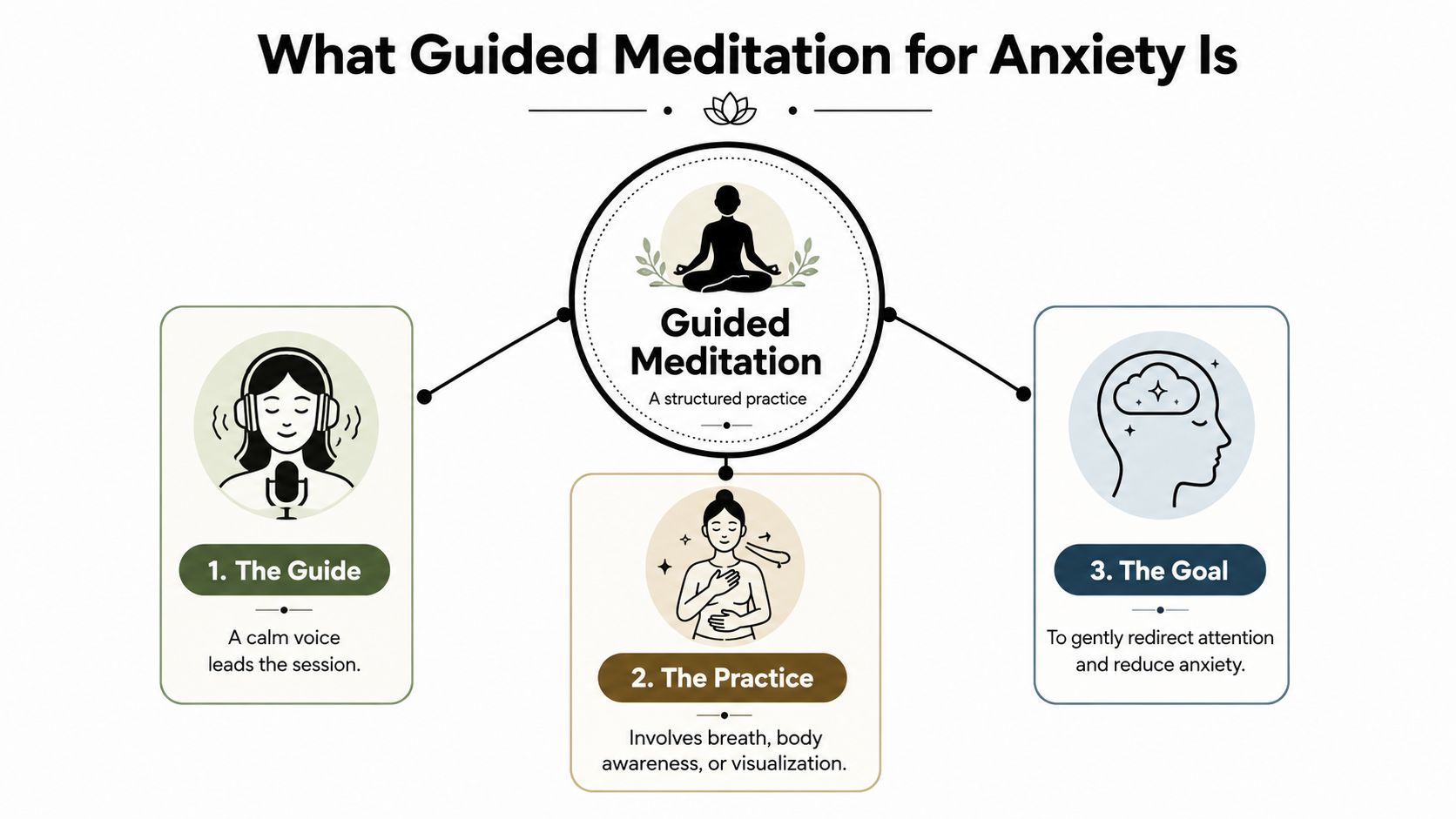
Guided meditation is a structured audio or written practice led by a calm voice. The guide may ask you to notice your breathing, scan your body, focus on sounds, picture a safe place, or repeat a compassionate phrase. You aren't expected to invent the process yourself. The instructions hold your attention while you practice responding differently to thoughts and sensations.
Silent meditation asks you to choose and maintain your own focus. That can be useful later, but anxiety often makes concentration feel unreliable. A guided track supplies continuity. When your mind jumps to a feared outcome, the voice gives you a simple route back.
The practice can be simple
Most guided sessions use one or more of these anchors:
- Breath awareness: Notice the movement of inhaling and exhaling without forcing a deep breath.
- Body awareness: Move attention through areas such as the jaw, shoulders, chest, belly, and feet.
- Grounding: Use sights, sounds, textures, or contact with a chair to reconnect with the present.
- Visualization: Build a detailed, steady mental image of a safe or peaceful place.
- Compassionate attention: Respond to distress with patience instead of criticism.
The right anchor depends on the moment. Breath work may suit general tension, while sounds or foot pressure may feel safer during panic. If focusing on breathing makes you more anxious, switch to an external sensation. You haven't failed. You've learned which doorway is more accessible today.
Where your anxiety fits
Everyday anxiety usually rises in response to a stressor and eases as the situation changes. Clinical conditions, including generalized anxiety disorder, panic disorder, and social anxiety disorder, tend to persist and interfere with sleep, work, relationships, movement, or daily choices.
Guided meditation can support either situation. For occasional worry, it may be a practical self-care habit. For an anxiety disorder, it's better viewed as a complement to a personalized care plan. A meditation anxiety guide can help you explore techniques, but recurring panic, severe avoidance, or major disruption deserves attention from a qualified mental health professional.
Why It Works and What the Evidence Shows
An anxious mind scans for danger and treats each sensation as evidence. Guided meditation offers attention a steadier place to rest, such as the exhale or the floor beneath you. That shift can interrupt the loop in which a racing heart feels threatening, the thought increases fear, and the body becomes more activated.
Meditation may also affect brain networks involved in threat evaluation and emotional regulation. Neuroimaging research connects anxiety relief during meditation with activity in the anterior cingulate cortex, ventromedial prefrontal cortex, and anterior insula, together with less amygdala-driven reactivity, according to this 2024 systematic review and meta-analysis. In everyday terms, practice may help you register an alarm without assuming the alarm proves immediate danger.
What the findings suggest
Research does not promise the same result for everyone. Across different study designs and groups, however, the findings show a recurring pattern.
| Study type | Sample / duration | Reported effect |
|---|---|---|
| Systematic review and meta-analysis of randomized controlled trials | 25 trials, 1,608 unique observations | Anxiety decreased versus waiting-list controls, with SMD -0.52, 95% CI -0.62 to -0.41, p < .001. Effects were also significant versus attention controls and alternative treatments. Systematic review of randomized controlled trials |
| Meta-analysis of mindfulness meditation trials | 55 randomized controlled trials, 68 samples, 4,595 participants | Immediate anxiety effects reached Hedges' g = 0.60. Meta-analysis of mindfulness meditation trials |
| Systematic review and meta-analysis of brief mindfulness inductions | Anxious individuals | State anxiety decreased with g = -0.60, while state mindfulness increased with g = 0.91 versus non-therapeutic controls. Review of brief mindfulness inductions |
| Review of mindfulness meditation over time | Follow-ups at 8 weeks and 3 to 6 months | Anxiety effects were 0.38 at 8 weeks and 0.22 at 3 to 6 months. Review of mindfulness meditation over time |
A separate randomized trial found that an 8-week mindfulness-based stress reduction program was noninferior to escitalopram for adults with anxiety disorders. Within that trial's design, the structured mindfulness treatment performed comparably. The result does not support stopping prescribed care without discussion. It does show why a well-designed program deserves consideration as more than casual relaxation.
Immediate calm and lasting change are different
A short session can reduce state anxiety, the sharp intensity present in the moment. Repeated practice develops a wider skill set: noticing anxious thoughts sooner, staying with uncomfortable sensations longer, and returning attention more reliably. One review also found that 5 to 12 minutes of daily guided mindfulness was associated with lower stress and anxiety, which supports brief practice when repetition is realistic.
Meditation works like training, not a guaranteed cure. Some sessions feel calming; others feel restless or emotionally crowded. The useful repetition is returning with patience, rather than producing a perfect experience. That steady return can become part of a genuine path toward panic-free living, while persistent panic, severe avoidance, or major disruption still calls for professional support.
Short SOS Meditations Versus Longer Daily Practice
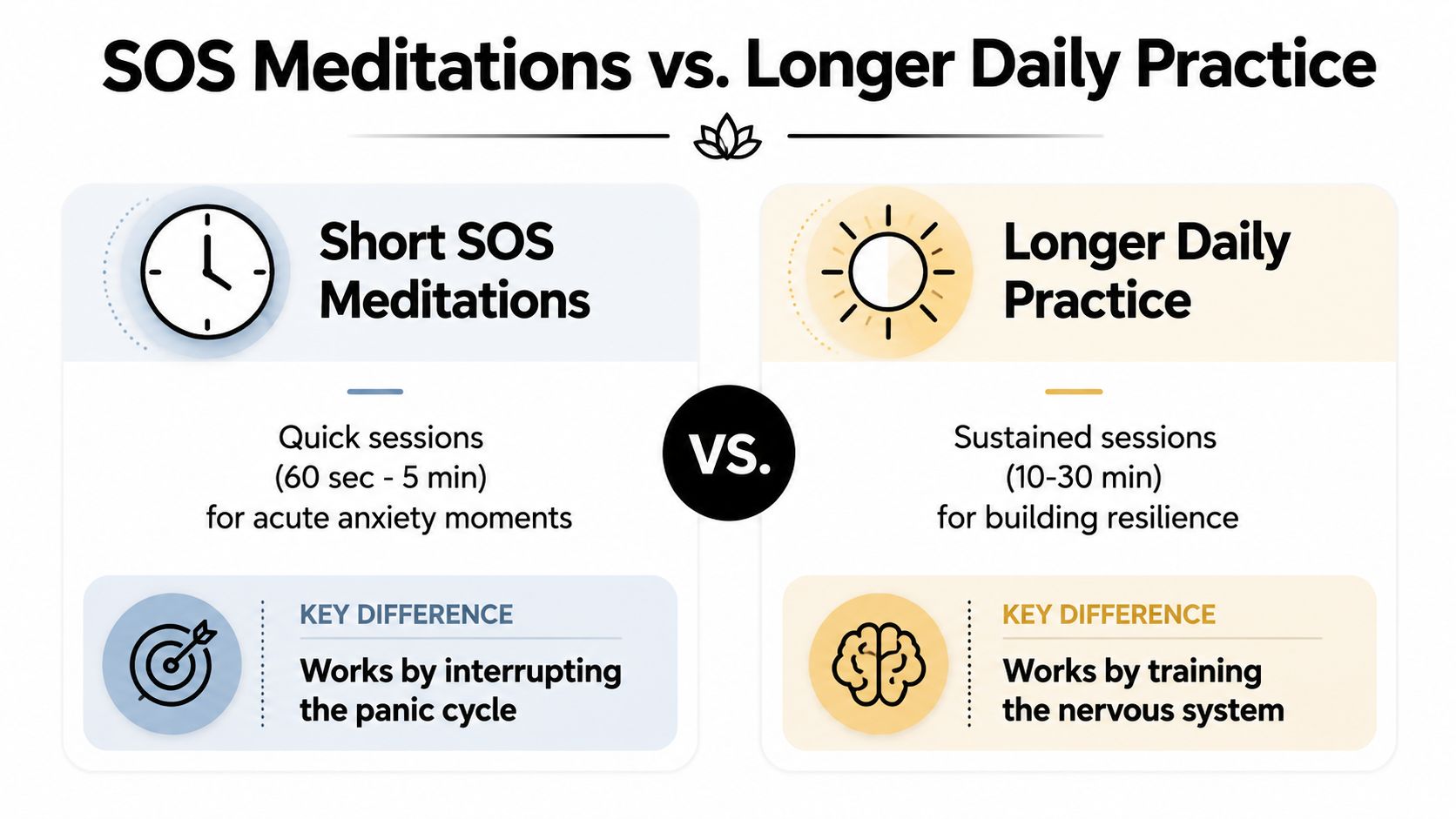
A short SOS meditation and a longer daily session serve different jobs. Reaching for a brief track during a panic spike is like applying a steadying intervention to the moment in front of you. Sitting for a longer practice when you're relatively stable develops familiarity with sensations that might otherwise frighten you.
Match the format to the moment
Short SOS sessions, 60 seconds to 5 minutes, work well when your thoughts are racing before a meeting, your body is escalating in a crowded place, or nighttime worry has begun to spiral. Grounding, paced breathing, and verbal coaching give you an immediate sequence to follow. The aim is to interrupt the panic cycle, not to solve every underlying fear while your nervous system is activated.
Longer daily sessions, 10 to 30 minutes, are better suited to prevention and deeper skill-building. You have enough time to notice tension, watch attention wander, and practice returning without rushing. Over repeated sessions, that experience can support greater attentional control and a less automatic response to anxious sensations.
A practical starting rhythm is two SOS uses per day and one 10 to 20-minute sit on most days, provided that this feels manageable. Those numbers are a suggested routine, not a clinical requirement. The research supports meaningful effects from brief practice, including acute reductions in state anxiety, but it also cautions against expecting every short session to resolve long-standing anxiety. Source
Use a shorter track when you need help staying in the situation. Use a longer practice when you're building capacity between difficult moments. If SOS meditation becomes the only thing you do, and you keep avoiding places, conversations, sleep, or treatment, it may be soothing the alarm without addressing the pattern beneath it. The Anxiety Checklist grounding help can provide another structured option for acute moments.
Here's a guided session you can follow when you want a calm voice and a defined pace:
Scripts You Can Use Right Now
You can record these scripts in your own voice, read them slowly, or ask someone you trust to guide you. Sit with your feet supported, or lie down if you're preparing for sleep. Keep your eyes gently open if closing them feels unsafe, and choose a slower audio speed than ordinary conversation.
A 3-minute grounding reset
Settle into the chair or bed. Let your hands rest somewhere comfortable. You don't need to make the breath deep. Let it be easy enough to follow.
Begin now.
Look around you. Name five things you can see. Let your eyes rest on each object for a moment. Notice its color, shape, or position.
Now notice four things you can hear. Include nearby sounds and distant sounds. You don't need to identify where every sound comes from.
Notice three things you can feel. Feel your feet inside your shoes, the chair beneath you, and the air against your skin. Let those sensations remind you that you're here, in this room, at this time.
Breathe in gently for four counts. One, two, three, four.
Breathe out for six counts. One, two, three, four, five, six.
Again, breathe in for four. Breathe out for six.
As you exhale, say “I'm letting the floor hold me.”
If a frightening thought arrives, label it softly: “thinking.” Then return to the next breath, the next sound, or the pressure beneath your feet.
Take one more comfortable inhale. Let the exhale lengthen without strain. Look at one neutral object and remind yourself, “This is uncomfortable. I'm here. This moment is moving.”
You can pair this reset with affirmations to ease anxiety when self-criticism makes the physical symptoms harder to bear.
A 10-minute body scan
Lie down or sit with your back supported. Allow your gaze to soften. Move attention slowly from the crown of your head toward your feet.
Notice the crown. Feel whatever is present, warmth, pressure, tingling, or very little sensation. You don't need to change it.
Move to your forehead. Let the muscles receive the instruction to soften, without demanding that they relax.
Bring awareness to your jaw. Notice whether your teeth are touching. Breathe softness into this spot.
Move through your neck and shoulders. Sense the weight of your arms. Let the chair, bed, or floor carry some of that weight.
Notice your chest. You may feel movement, tightness, or a racing rhythm. Make room for the sensation. You're observing it, not measuring your safety by it.
Bring attention to your belly. Allow it to move naturally. Say, “This body is working hard to protect me.”
Continue through your hips, thighs, knees, calves, ankles, and feet. Pause at the soles and toes. Feel contact, temperature, or pressure.
If intrusive thoughts appear, don't push them away. Say “planning,” “remembering,” or “fear,” then return to the last body area you noticed. The return is the practice.
Finish by sensing your whole body at once. Take a comfortable breath. Open your eyes or lift your gaze. Move slowly into the next part of your evening.
Misconceptions That Keep People Stuck
A quiet mind is the goal. Anxiety meditation doesn't require an empty mind. The useful moment is noticing that attention has wandered and returning without scolding yourself. Every return strengthens the skill you're practicing.
You need a long session to benefit. You don't need to begin with an ambitious commitment. Evidence includes meaningful effects from brief mindfulness inductions and short daily guided practice, so a few manageable minutes can be a sensible starting point. Source
Silent sitting is automatically stronger. Silence can become valuable, but it isn't morally superior to guidance. A calm voice can reduce decision-making, model patience, and give a beginner a reliable place to return. Try several voices, pacing styles, and anchors until one feels workable.
Meditation replaces therapy or medication. The evidence supports meditation as a useful intervention and complement, not a universal substitute for professional care. In panic disorder, structured CBT has a specific recovery record, with 73% meeting recovery criteria compared with 35% receiving treatment as usual in one randomized trial. Source
Feeling worse means you're doing it wrong. Quiet attention can reveal sensations and thoughts that distractions were covering. Shorten the practice, keep your eyes open, switch to sounds or walking, and seek professional guidance if distress continues or intensifies.
Building a Calmer Life With Guided Practice
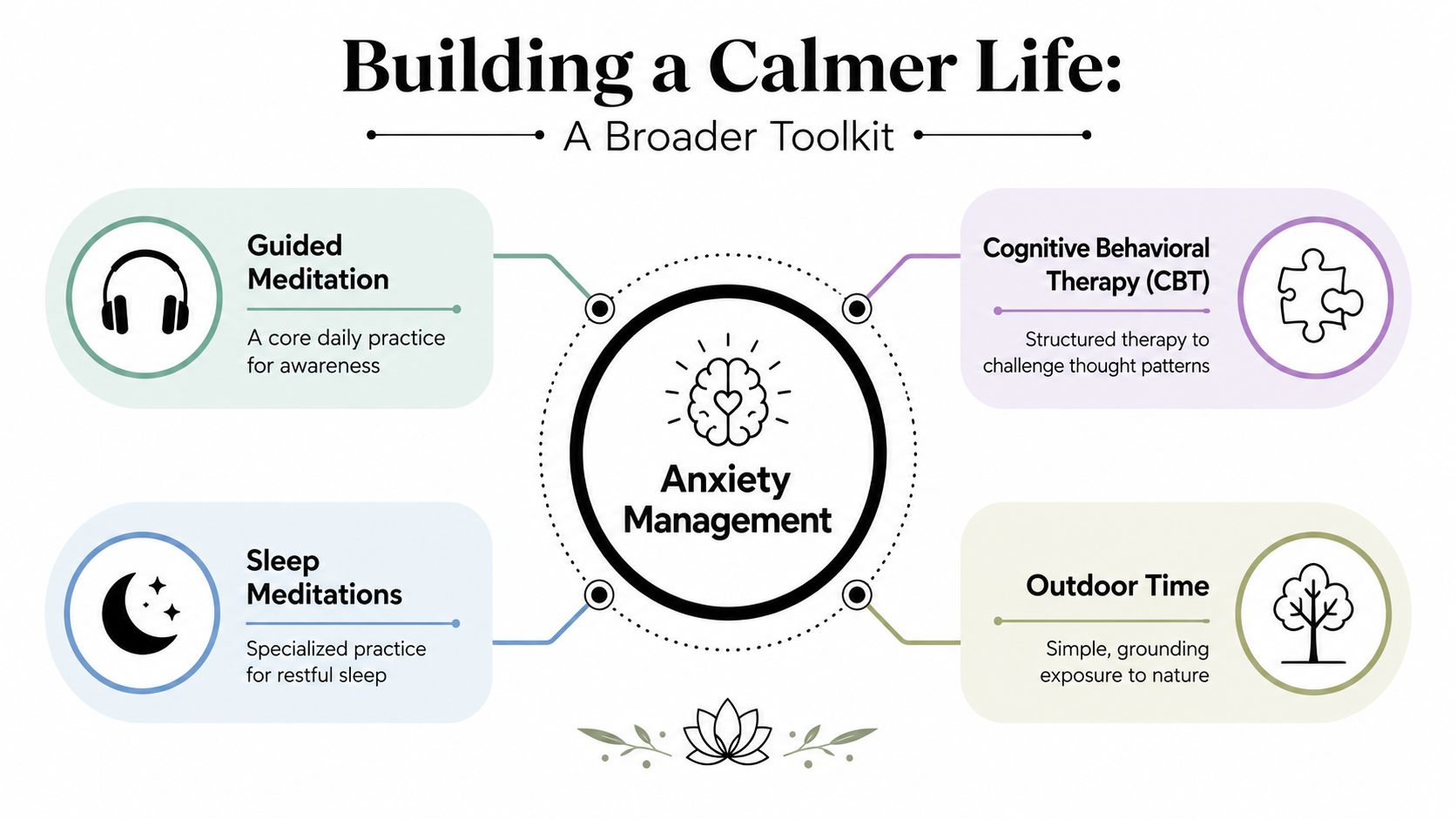
Guided meditation works best as connective tissue between other forms of care. It can help you notice a thought before a CBT exercise, settle your body before sleep, or return to the present during an outdoor walk. It isn't required to perform every job anxiety creates.
Give each tool a clear role
Cognitive behavioral therapy helps you examine predictions, safety behaviors, and beliefs that keep fear alive. A thought record after an anxious spike can ask what you predicted, what happened, and what alternative explanation fits the facts. For panic, CBT and exposure-based work deserve particular respect because they address fear of sensations and avoidance directly.
Sleep meditations serve a different purpose. A slow body scan or quiet visualization can lower mental stimulation at bedtime, while gentle outdoor walking brings attention into movement, light, sounds, and physical contact with the ground. These practices may support one another without becoming a complicated wellness project.
A simple stack might look like this:
- Morning: Use a short guided breath practice while coffee brews.
- Midday: Take a mindful walk and notice three sounds before returning to work.
- After a spike: Complete a CBT thought record once your body has settled.
- Evening: Use a body scan after brushing your teeth, with lights dimmed.
For people who need consistent prompts, The Anxiety Checklist offers an always-free SOS mode with grounding techniques, affirmations, and quick prompts, alongside guided meditations, sleep audios, walking sessions, and CBT self-therapy tools. It can sit beside therapy or other resources rather than replacing them. Readers who want broader, calm-living material may also find the LunaBloom AI blog useful for exploring adjacent approaches to emotional wellbeing.
The aim is a layered defense. Sleep hygiene reduces vulnerability, movement gives anxious energy somewhere to go, CBT challenges fearful interpretations, and meditation helps you practice staying present while all of it unfolds. For additional support with daily relief for panic attacks, choose tools you can return to even on an imperfect day.
Your First Week Toward Panic-Free Living
Panic-free living doesn't mean you'll never notice a strong heartbeat or an uneasy thought. It means those experiences no longer dictate where you go, what you do, or how much of your life you surrender to prevention. A first week can begin that change by making practice small enough to repeat.
A seven-day starting plan
Day 1: Before bed, complete the 3-minute grounding reset. Anchor it to brushing your teeth or turning off the bedside light.
Day 2: Add a short morning breathing session while coffee brews. Keep your eyes open and let your feet touch the floor.
Day 3: Try the 10-minute body scan in the evening. If the chest or belly feels too intense, move attention to your hands or the sounds around you.
Day 4: Pair meditation with a 10-minute walk. Notice the rhythm of your steps, the temperature of the air, and what you can see.
Day 5: Explore a sleep meditation at bedtime. Choose a slow voice and let the practice support rest rather than demanding that sleep arrive.
Day 6: Review your experience. Which practice helped you return to the present? Which one increased discomfort? Adjust the anchor, posture, length, or time of day instead of judging yourself.
Day 7: Design a sustainable weekly rhythm. Keep the shortest practice for busy mornings, reserve longer sessions for days with more space, and keep an SOS option available for sudden surges.
Use the week to measure returning, not silence. A session counts when you notice distraction and come back. A difficult practice still teaches you something about the conditions your nervous system needs.
Professional support can make this plan safer and more effective if panic is frequent, avoidance is expanding, or anxiety is disrupting your life. Recovery can last: a long-term guideline review reported relapse of 5.2% with maintenance CBT versus 18.4% without maintenance over the study's follow-up period, reinforcing that continued support can protect gains. Source
Freedom from panic is built one small session at a time. Start tomorrow with three minutes, repeat what helps, and let consistency become evidence that your life can grow larger than fear.
The Anxiety Checklist offers an always-free SOS mode for grounding, affirmations, and quick prompts, plus guided meditations, sleep audios, walking sessions, and CBT self-therapy tools for longer-term practice. Visit The Anxiety Checklist and choose one short meditation to use today, then build from that first calm, deliberate return.