


You're exhausted, but sleep won't come. At night, a meeting, message, symptom, or unfinished task can replay until your body feels tired and your mind feels responsible for staying awake. You may try harder to relax, only to notice your heartbeat, breathing, and thoughts even more closely.
That pattern can make bedtime feel like a test you're failing. Sleep hypnosis for anxiety offers a different approach. Instead of forcing sleep, it uses focused attention and calming suggestions to work with the racing-mind loop. The evidence doesn't support miracle promises, but it does suggest that hypnosis can be a useful complement, especially when anxiety regulation and sleep are addressed together.
Table of Contents
- The 3 a.m. Loop and Why Sleep Hypnosis Feels Different
- What Sleep Hypnosis Is and How It Works
- What the Research Says About Hypnosis, Sleep, and Anxiety
- What a Sleep Hypnosis Session Looks and Feels Like
- Safety, Who Should Be Cautious, and How It Compares With Other Options
- A Practical First-Week Plan to Try Sleep Hypnosis Tonight
- Your Next Steps Toward Calmer Nights and a Quieter Mind
The 3 a.m. Loop and Why Sleep Hypnosis Feels Different
At 3 a.m., your phone casts a pale glow across the room. You check the time, remember tomorrow's meeting, reread a message, and start calculating how badly you'll function in the morning. Your body is lying still, but your mind is scanning for danger and unfinished business.
Trying harder to sleep often adds another layer of pressure. You tell yourself to relax, monitor whether relaxation is working, and become more alert when it isn't. Generic sleep music may soften the room, but it may not address the anxious thought that keeps returning.
Before focusing on hypnosis, it's useful to understand the broader picture. A practical guide to the causes and solutions for insomnia can help you consider habits, stress, your sleep environment, and physical contributors rather than assuming every restless night has one explanation.
Why anxiety keeps the mind awake
Anxiety and insomnia can reinforce each other. Worry makes it harder to settle, and a difficult night can leave you more apprehensive about the next bedtime. At the population level, a global systematic review covering 83 studies and 144,649 participants estimated anxiety prevalence at 41.42% and insomnia prevalence at 43.76% (systematic review).
That doesn't mean every person with insomnia has an anxiety disorder, or that hypnosis is the right answer for everyone. It does show why a sleep method that speaks directly to mental arousal can feel more relevant than an audio track built only around ambient sound.
If your nights are dominated by rumination, learning practical skills for coping with overthinking and anxiety can sit alongside sleep-focused support. The aim isn't to empty your mind by force. It's to give your attention somewhere gentler to go.
What makes hypnosis distinct
Sleep hypnosis combines narrowed attention, physical relaxation, imagery, and carefully worded suggestions. A voice might guide you to notice the weight of your body, allow thoughts to pass without solving them, and associate bedtime with safety rather than mental work.
You remain an active participant. You can pause the recording, ignore a suggestion, or stop altogether. The useful shift is that the recording gives your anxious brain a simple sequence to follow, reducing the need to negotiate with every thought.
A realistic promise: Sleep hypnosis may help lower the struggle around bedtime. It can't guarantee instant sleep or replace care for severe anxiety.
The rest of this guide separates what sleep hypnosis is from what it isn't, examines the research without inflating it, and offers a cautious plan you can try tonight.
What Sleep Hypnosis Is and How It Works
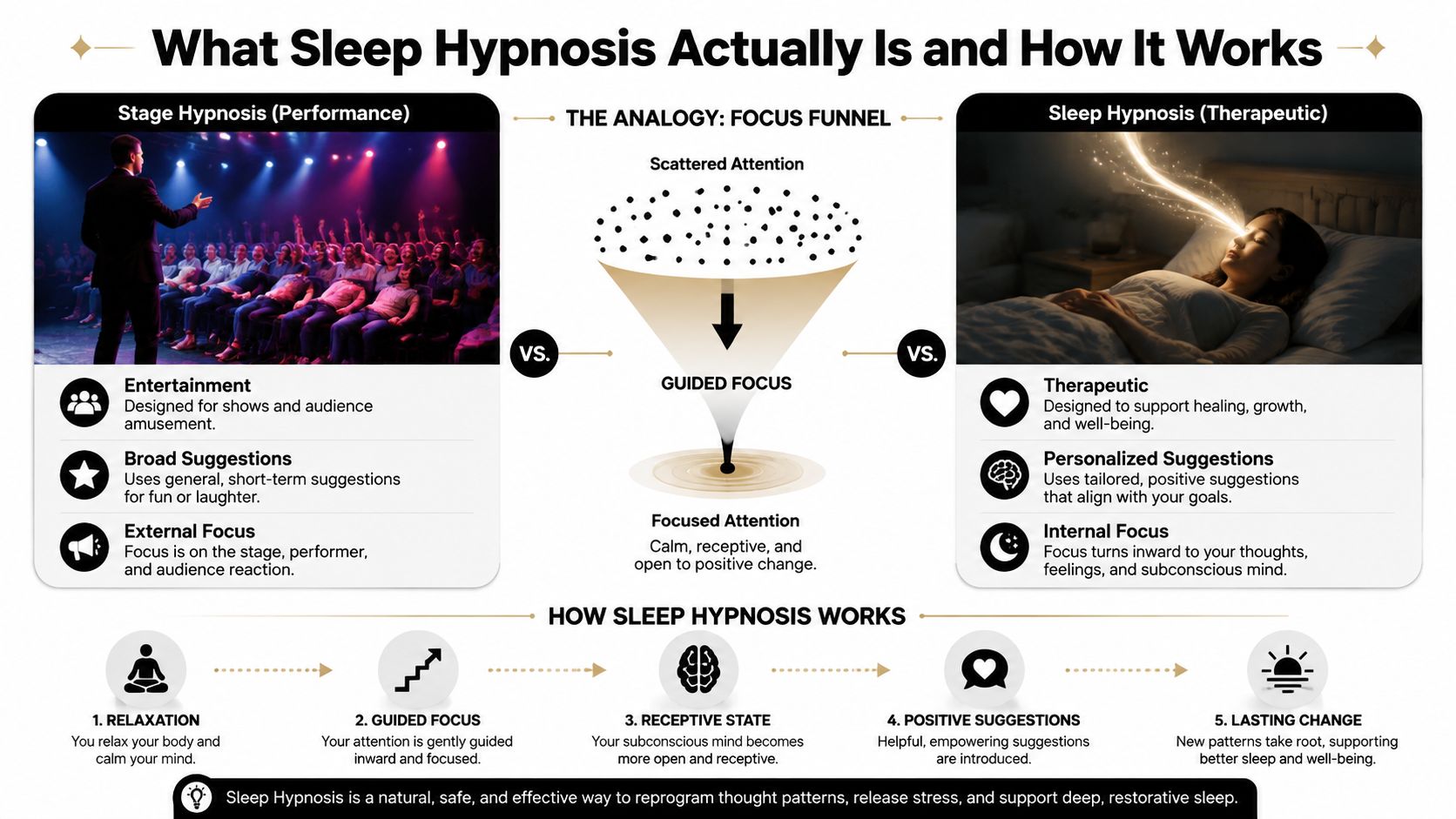
Sleep hypnosis guides absorbed attention toward physical ease and sleep-supportive suggestions. It works like a focus funnel. At bedtime, attention may scatter across tomorrow's tasks, yesterday's conversation, and sensations in the body. A recording gradually directs it toward breathing, heaviness, warmth, and permission to rest.
A focused state with personal control
Therapeutic hypnosis draws on the same absorption you may experience while reading a book or watching a film. Attention follows one channel, distractions recede, and the experience remains focused, voluntary, and reversible. You can hear the voice, form your own judgments, and decide whether a suggestion feels useful.
People differ in how readily they respond to hypnotic suggestions. Skepticism does not automatically prevent benefit, while some people experience deeper absorption than others. Dramatic sensations are unnecessary for a recording to be worthwhile.
The wording matters too. Generic sleep music creates atmosphere, but it rarely guides your response to anxious thoughts. Meditation often supports open awareness, allowing thoughts and sensations to arise without directing attention toward one image. White noise, stories, and ordinary sleep audio may distract or soothe. Sleep hypnosis adds targeted suggestions, such as allowing the body to soften, postponing problem-solving, and letting rest arrive without effort.
Three ways the process may help
It lowers arousal. Slow breathing, progressive relaxation, and attention to physical sensations can reduce the effort spent monitoring each sign of anxiety.
It redirects mental chatter. Rather than debating a worry, you follow a calm sequence. The thought may still appear, but it does not need to become a full planning session.
It rehearses a new bedtime association. Repeating a calm routine can make the recording, bed, and wind-down period familiar cues for settling.
These effects describe possible support, not a command that forces the brain to sleep. If you want to examine the connection between hypnotic techniques and panic, this guide to how hypnosis reduces panic offers a related explanation. For practical sleep troubleshooting, guidance on why you can't sleep may help you look beyond mental techniques.
The clearest expectation is modest: sleep hypnosis may reduce the struggle around bedtime. It cannot guarantee instant sleep, and it does not replace care for severe anxiety. Its role is to create conditions in which anxious attention may become less dominant.
What the Research Says About Hypnosis, Sleep, and Anxiety
The evidence is encouraging in places and incomplete in others. That distinction matters because people searching for sleep hypnosis anxiety support often find claims that treat hypnosis as a universal cure. The research doesn't justify that certainty.
A 2024 meta-analysis of hypnosis for mental health found that 99.2% of measured outcomes were positive, and more than half showed at least a medium effect size (meta-analysis indexed by PubMed). That broad finding suggests a generally favorable pattern across measured mental-health outcomes, but it doesn't prove that every sleep recording works or that every anxiety condition responds equally.
Anxiety evidence is more persuasive as an add-on
A meta-analysis covering 15 studies and 17 trials reported a mean weighted effect size of 0.79 at the end of active treatment and 0.99 at the longest follow-up (controlled-trial meta-analysis). In practical terms, the average participant receiving hypnosis showed more anxiety improvement than a large majority of control participants under the analysis's effect-size interpretation.
The same analysis found hypnosis worked better as an adjunct to other psychological interventions than as a stand-alone treatment. That supports using it alongside structured therapy, skills practice, or clinician guidance rather than treating a recording as a solo cure.
A separate review of anxiety-disorder studies from 1980 to 2015 concluded that evidence was negative or insufficient for chronic anxiety disorders, including phobia and PTSD (clinical review). Another review of randomized trials included 14 RCTs with 693 participants and found the evidence insufficient to support hypnosis as an anxiety treatment (York review). These findings don't erase promising results. They show why diagnosis, treatment design, comparison groups, and practitioner skill matter.
Sleep-specific results are mixed
A systematic review of 44 studies found positive sleep outcomes in 47.7% of studies. In the narrower group of 11 studies requiring sleep disturbance at entry and using sleep-specific suggestions, positive results rose to 54.5%, while 9.1% showed no impact (sleep-focused review and trial).
In an insomnia-specific randomized trial, 4 weekly 1-hour sessions using disease-specific suggestions improved sleep-diary sleep efficiency by 8.5% to 10.4% within groups, although between-group differences weren't significant. That result points to an important practical lesson. A carefully designed sleep protocol may be more relevant than a generic relaxation track, but improvement within a group doesn't automatically establish superiority over another treatment.
| Intervention | Evidence Strength for Sleep | Evidence Strength for Anxiety | Typical Role |
|---|---|---|---|
| CBT-I | Strongest established behavioral option | Indirect, through reduced sleep-related distress | Structured primary treatment for insomnia |
| Sleep hypnosis | Mixed, with a signal in targeted protocols | Promising, particularly as an adjunct | Complementary support for arousal and bedtime anxiety |
| Prescription sleep medication | Can act quickly | May not address underlying worry | Short-term or clinician-directed support |
| Meditation apps | Promising but still developing | Useful for attention and emotional regulation | Self-guided daily practice |
| Generic sleep audio | Variable and often nonspecific | Limited targeting of anxiety | Environmental or relaxation aid |
Recent coverage of app-delivered self-hypnosis and sleep interventions describes promise but also an early evidence base, with many studies focused on feasibility rather than long-term adherence or anxiety outcomes (digital hypnosis review). For readers comparing options, evidence-based anxiety resources can help match self-guided tools with the level of support needed.
The realistic conclusion is hopeful but bounded. Sleep hypnosis is a potentially useful complementary tool, not a miracle treatment.
What a Sleep Hypnosis Session Looks and Feels Like
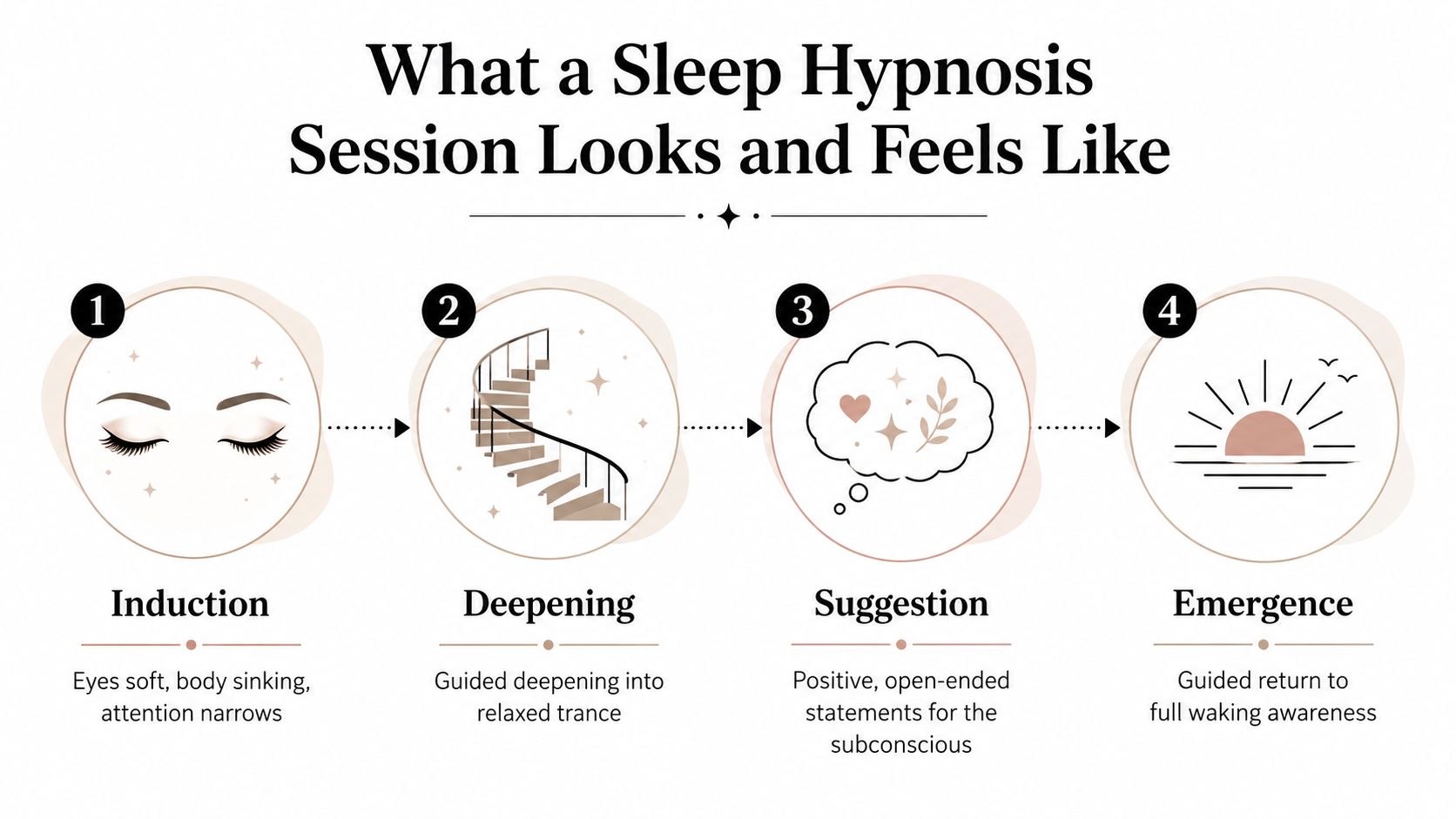
A first session usually feels less mysterious when you know the sequence. Most recordings move from physical settling to focused attention, then to suggestions that make sleep feel less like a task.
The four phases
Induction begins by softening your gaze or closing your eyes, noticing your breathing, and allowing your body to become heavier. The voice may ask you to place attention on one sensation at a time.
Deepening uses progressive relaxation, counting, a staircase image, or a sense of moving inward. You don't need to manufacture a trance. Following the instructions gently is enough.
Sleep-specific suggestions may focus on safety, reduced effort, and permission to let go. A helpful track won't demand that you fall asleep immediately. It may invite you to rest even if sleep takes time.
Emergence is different depending on the recording. A daytime therapeutic session may guide you back to full alertness. A bedtime track may fade into silence so you can continue drifting without a sharp ending.
Here's the kind of slow, open-ended language you might hear:
“Notice the surface beneath you supporting your weight. Nothing needs solving in this moment. Each easy breath gives your body permission to soften, and you can rest without checking whether sleep has arrived.”
Some listeners feel heaviness. Others report floating, warmth, time distortion, spontaneous tears, or no noticeable sensation at all. None of these responses proves that the session worked or failed.
A recording can still be useful if you lie and follow the voice. Falling asleep before the end is fine. In fact, that's often the intended result. Consistency matters more than a dramatic experience, so choose a track that feels safe and tolerable rather than searching for the most intense one.
For a visual explanation of the stages, the following video offers another way to become familiar with the process:
Safety, Who Should Be Cautious, and How It Compares With Other Options
Recorded sleep hypnosis is generally low risk for healthy adults because it uses neither medication nor equipment beyond an audio device. Some people may notice vivid dreams, emotional release, or temporary drowsiness. Don't listen while driving, walking near traffic, or doing anything that requires full attention.
Extra care is appropriate for people with uncontrolled psychiatric symptoms, active trauma or PTSD without clinical oversight, certain neurological conditions, or anxiety severe enough to require crisis support. Pregnant listeners, children, and people taking sedating medication should discuss a new sleep practice with a healthcare provider.
Choose the role, not the hype
Hypnosis may fit as a gentle add-on when you want help settling at night. CBT-I is more structured and skills-based, and it remains the strongest established behavioral option for persistent insomnia. Medication can act faster for some people, but a prescriber needs to weigh issues such as tolerance, dependence, interactions, and next-day grogginess.
Supplements also deserve caution. “Natural” doesn't mean risk-free, consistently effective, or appropriate with every medication. Your mattress, noise level, temperature, and physical comfort matter too, so this discussion of the mattress and mental health connection can prompt a useful bedroom review.
| Option | Best For | Onset of Relief | Key Risks | Role in a Plan |
|---|---|---|---|---|
| Sleep hypnosis | Bedtime arousal and anxious rumination | Often gradual and variable | Drowsiness or emotional discomfort | Complementary self-guided practice |
| CBT-I | Persistent insomnia and learned sleep patterns | Skill-building over time | Requires effort and a structured approach | Primary behavioral treatment |
| Prescription medication | Clinician-identified short-term needs | Often faster | Tolerance, dependence, interactions, grogginess | Medical support when appropriate |
| Supplements | Specific clinician-approved situations | Variable | Interactions and inconsistent effects | Discuss with a provider |
| Sleep-environment changes | Physical discomfort or disruptive surroundings | Can begin quickly when the cause is environmental | May not address anxiety | Foundation for other methods |
If you're unsure when to see a professional about unwelcome thoughts or emotions, use that uncertainty as a reason to seek guidance rather than pushing through alone. Hypnosis should support care, not delay it.
A Practical First-Week Plan to Try Sleep Hypnosis Tonight
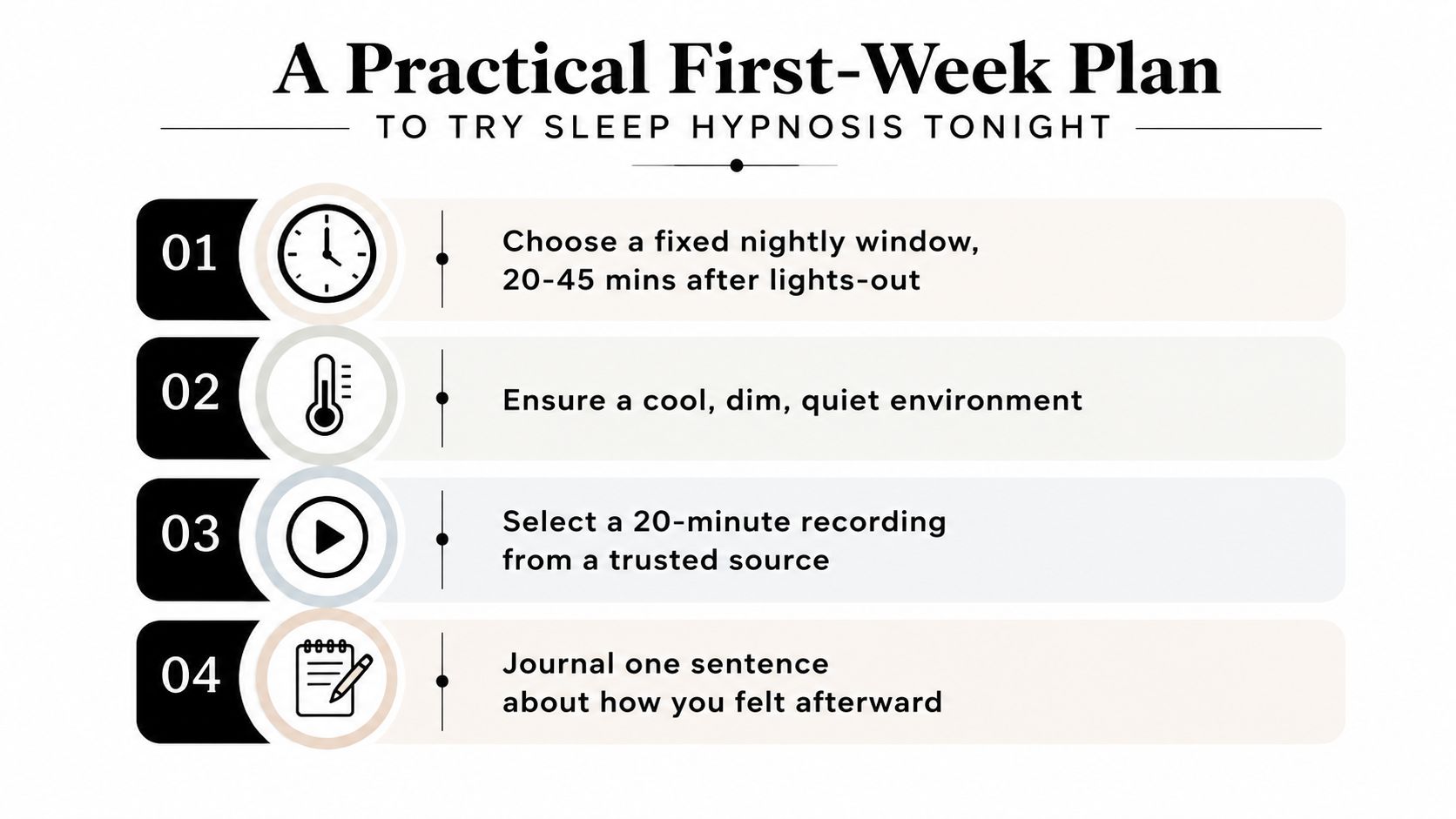
Start small enough that you can repeat the practice. Choose one fixed nightly window, ideally 20 to 45 minutes after lights-out or during your wind-down routine. Keep the room cool, dim, and quiet, put your phone on silent, and use headphones only if they're comfortable and safe for sleeping.
Build one repeatable cue
Select one 15 to 30-minute recording from a source you trust and use it for seven nights before judging it. Changing tracks every night makes it harder to learn whether the voice, wording, or routine is helping.
You might explore a sleep-audio library, a hypnosis app, or YouTube. App-based options can make habit-building simple, while a certified hypnotherapist may offer personalisation for anxiety-specific concerns or trauma-informed work. If your symptoms are complex, personalised clinical support is the more sensible next step.
Use this sequence:
Prepare the room. Finish urgent tasks, dim the lights, silence notifications, and place the phone where you won't keep checking it.
Reset your breathing. Take a calm 60-second pause, allowing the exhale to become comfortable without forcing deep breaths.
Play one track. Lie down, follow the voice, and drop the goal of proving that you're hypnotised.
Park unfinished thoughts. Keep a notebook beside the bed. Write one sentence about the worry or task, then return to the recording instead of solving it in the dark.
You can pair this routine with calming panic with guided affirmations when anxious thoughts remain active. Keep the combination simple. Adding too many techniques can turn bedtime into another performance.
At the end of the week, review sleep onset, night waking, and morning mood. Look for a pattern across several nights rather than evaluating yourself after one difficult evening. If the track increases distress, stop using it and choose a different approach or speak with a clinician.
Your Next Steps Toward Calmer Nights and a Quieter Mind
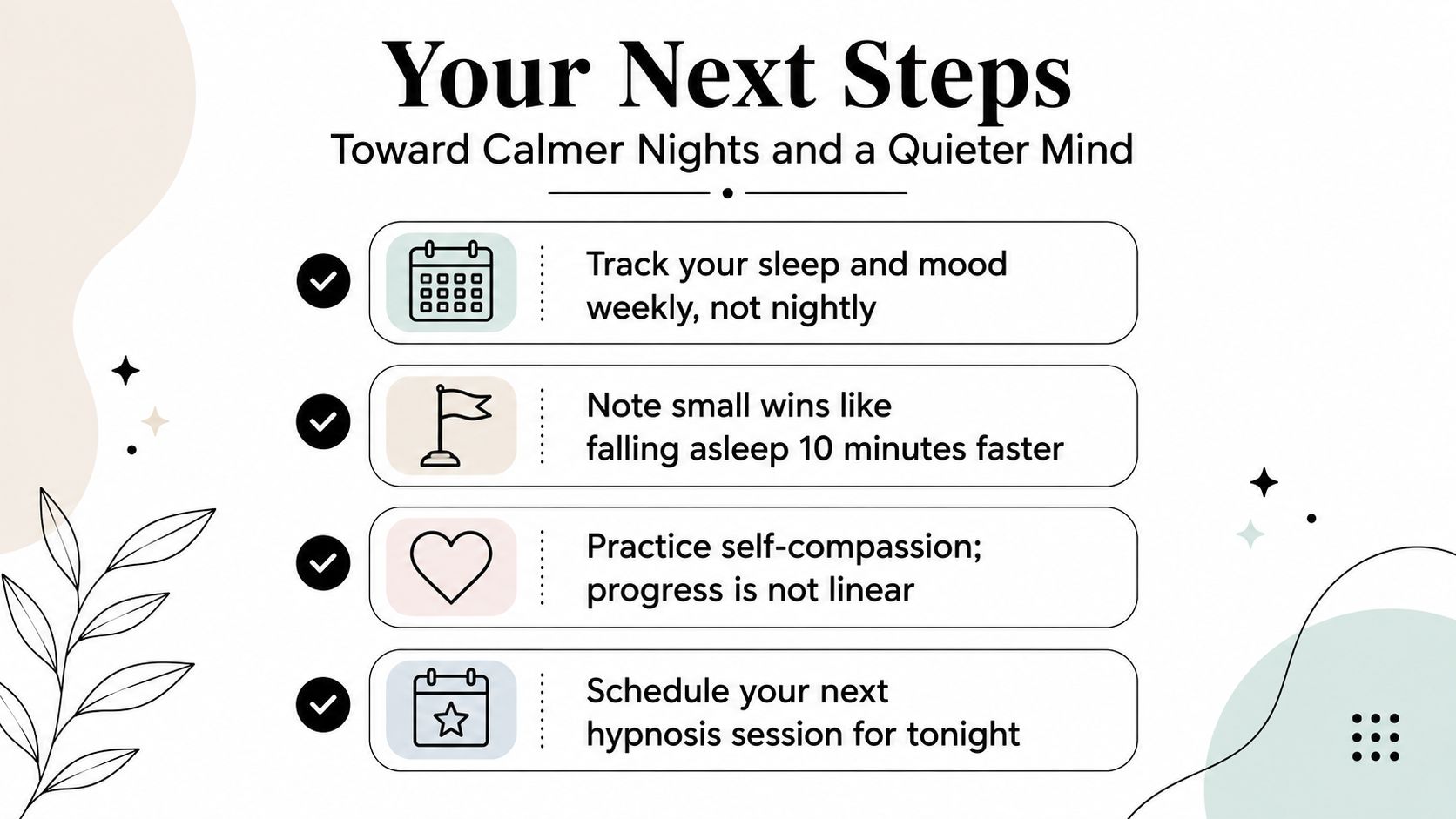
Healing from anxiety rarely looks like one perfect night followed by permanent calm. More often, progress appears as a smaller struggle at bedtime, less fear of being awake, or a quicker return to rest after waking. Those changes matter because they weaken the cycle that teaches your brain to associate night with threat.
The research supports a measured position. Hypnosis may reduce anxiety, particularly as an add-on, while sleep-specific protocols show a more mixed but meaningful signal. A recording can help you practice safety and release, but it can't diagnose insomnia, treat every panic condition, or guarantee that you'll become panic-free.
A simple checklist for this week
- Track patterns weekly. Note sleep, anxiety, and morning mood without turning every night into a verdict.
- Choose one recording. Give the same sleep-hypnosis track a fair trial instead of switching constantly.
- Keep the bedtime window steady. Repetition helps make the routine familiar.
- Pair tools thoughtfully. Use breathing, journaling, or a daily anxiety practice without overwhelming yourself.
- Escalate support when needed. Persistent insomnia, panic, trauma symptoms, or worsening distress deserve professional attention.
Anxiety University can help you choose a deeper level of support when self-guided audio isn't enough. Its materials include hypnotherapy directories, clinician-led programs, sleep-focused CBT modules, and anxiety workbooks, allowing you to match the resource to the severity and persistence of your symptoms.
You don't need to force your mind into silence tonight. Set up one safe, repeatable practice, notice what changes, and ask for help when the problem is bigger than an audio track.
The Anxiety Checklist offers an always-free SOS mode, grounding prompts, affirmations, sleep audios, hypnosis sessions, guided meditations, and CBT self-therapy tools for anxiety and panic support. Visit The Anxiety Checklist tonight to choose a sleep-focused practice and build a calmer routine without pressure.