


Your body may be trying to protect you right now, even if it doesn't feel protective. Your chest is tight. Your thoughts keep jumping to the next worst-case scenario. You might feel restless and frozen at the same time, too activated to sit still but too overwhelmed to know what would help.
That's often the exact moment when guided walking meditation becomes useful.
Not because it demands perfect calm. Not because you need to “clear your mind.” It helps because it gives anxiety something simple, concrete, and kind to do. One foot. Then the other. One sensation at a time. For many people, that's easier than closing their eyes and trying to meditate in stillness while panic is already loud.
I've seen this practice help people who thought meditation wasn't for them at all, especially people who felt trapped in looping fear or disconnected from their body. If you're in that place, start with understanding panic. It can soften the fear of what your symptoms mean. And if part of what you need is a mental picture of what regulated movement can feel like, the complete guide to Pohorje Village offers a calming example of how environment, pace, and gentle routines can support recovery.
You do not need a special personality for this. You do not need to be good at meditation. You need a practice that meets you where you are.
Table of Contents
- A Gentle Path Forward When Anxiety Feels Overwhelming
- How Walking Meditation Calms Your Nervous System
- Your First Guided Walking Meditation Session
- Adapting the Walk for Panic Dizziness or Mobility Limits
- Troubleshooting Common Hurdles on Your Walk
- Weaving This Practice Into Your Daily Life
A Gentle Path Forward When Anxiety Feels Overwhelming
Anxiety often creates a cruel bind. If you sit still, your thoughts get louder. If you try to distract yourself, your body keeps sounding the alarm. If you push through, you may end up more exhausted than before.
Guided walking meditation offers a middle path. It doesn't ask you to suppress sensation. It gives sensation a structure. Instead of getting pulled into “what if I pass out?” or “what if I lose control?”, you return to a direct experience you can verify in real time. The pressure of your heel. The shift of weight. The feeling of air on your skin.
Why this feels more approachable
Traditional seated meditation can be powerful, but for anxious people it can also feel exposing. You're left alone with a fast nervous system and very little to do. Walking changes that equation. The body is moving, attention has a job, and the mind gets repeated chances to come back to something neutral.
That matters when you're overwhelmed.
Guided walking meditation works best when you stop treating calm as a performance and start treating attention as a practice.
There's also a dignity in its simplicity. You don't need incense, silence, or a perfect morning routine. A hallway works. A garden path works. A quiet stretch of sidewalk can work if it feels safe enough.
What healing can look like
Healing from anxiety rarely looks like one dramatic breakthrough. More often, it looks like many small moments where you respond differently. You notice the spiral sooner. You interrupt it earlier. You trust your body a little more. Guided walking meditation can become one of those repeated turning points.
A few shifts people often notice:
- Less fear of bodily sensation: You practice noticing movement and tension without immediately interpreting them as danger.
- More present-moment contact: Attention moves from catastrophic prediction to actual experience.
- A gentler relationship with yourself: The walk becomes a place where you stop fighting your symptoms and start working with them.
If panic has made you doubt whether peace is still possible, hold onto this. Relief doesn't have to arrive all at once. Sometimes it begins with a small loop across a room.
How Walking Meditation Calms Your Nervous System
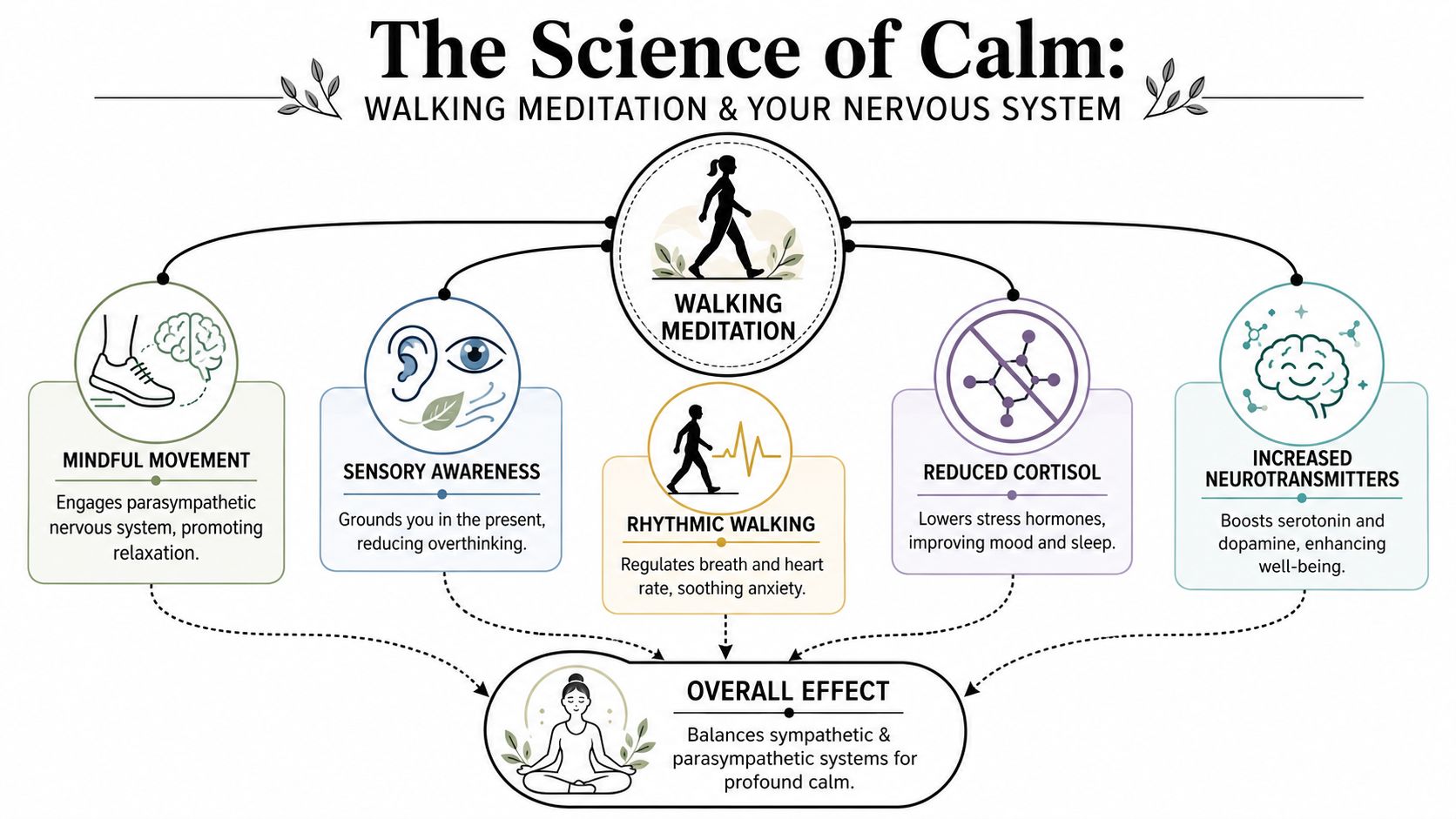
The nervous system responds to what you do, not just to what you think. That's one reason guided walking meditation can be so effective when anxiety feels physical. The practice uses movement, sensory focus, and rhythm to help your body register that this moment may be safer than your mind believes.
Why movement can feel safer than stillness
When someone is anxious, “just relax” usually doesn't work. The body is already mobilized. It wants to brace, scan, pace, or escape. Walking meditation doesn't fight that urge head-on. It channels it.
Instead of restless movement driven by fear, you create intentional movement guided by awareness. That shift matters. The body keeps moving, but the mind starts relating to movement differently. You're no longer fleeing a feeling. You're observing a step.
This is also why people who struggle with seated practice often do better here. If that's familiar, these strategies for anxiety in meditation can help you see why stillness isn't the only doorway into mindfulness.
What the research tells us
A randomized study of university students found that a guided mindful walk produced a significant decrease in state anxiety immediately after the session, with a large effect size of Cohen's d = 1.26 (study details). That's useful because it shows this isn't only a slow-burn habit. It can function as a fast-acting grounding tool.
The design matters too. This was a single guided walk, and the anxiety reduction was measured right after it. For someone who's hesitant to try meditation because they fear it will take months to help, that's encouraging.
Practical rule: If you need something you can feel in your body today, not someday, guided walking meditation is one of the most accessible places to start.
The mechanism is straightforward. Attention narrows to tangible input. The feet contact the ground. Your pace creates rhythm. Your breathing often settles because the body is no longer trapped in static vigilance. Thought loops don't always disappear, but they lose center stage.
That's one reason mindful travel settings can help people reconnect with this kind of practice. If a change of environment supports your healing, this guide to planning your wellness trip to Tulum shows how some people build restorative movement and calm routines into time away.
A regulated nervous system doesn't appear because you ordered it to. It learns through repeated experiences of safety. Guided walking meditation gives it one.
Your First Guided Walking Meditation Session
Start simple. The most effective first session is usually the one you'll do, not the one that sounds impressive.
For a structured practice, guides often recommend a walking path of 10 to 15 paces, or about 20 to 40 feet, walked back and forth. They also suggest 10 minutes daily for at least a week, or 20 to 30 minutes two to three times per week (Greater Good in Action walking meditation guide). That's a useful starting container because it removes the guesswork.
Set up the path and your attention
Choose a route that feels uncomplicated. A hallway, patio, quiet room, driveway, or garden path is enough. You're not trying to cover distance. You're creating a short loop where your brain doesn't have to keep making decisions.
Before you begin:
- Stand still first: Feel both feet on the floor or ground.
- Let your gaze lower: Keep your eyes open and soft.
- Pick one anchor: Your feet often serve as the best anchor.
- Drop the success metric: The goal isn't to feel bliss. The goal is to stay in contact with the walk.
If your body is already revved up, it can help to manage anxiety with breathing for a minute before you start. Then let the walking carry the rest.
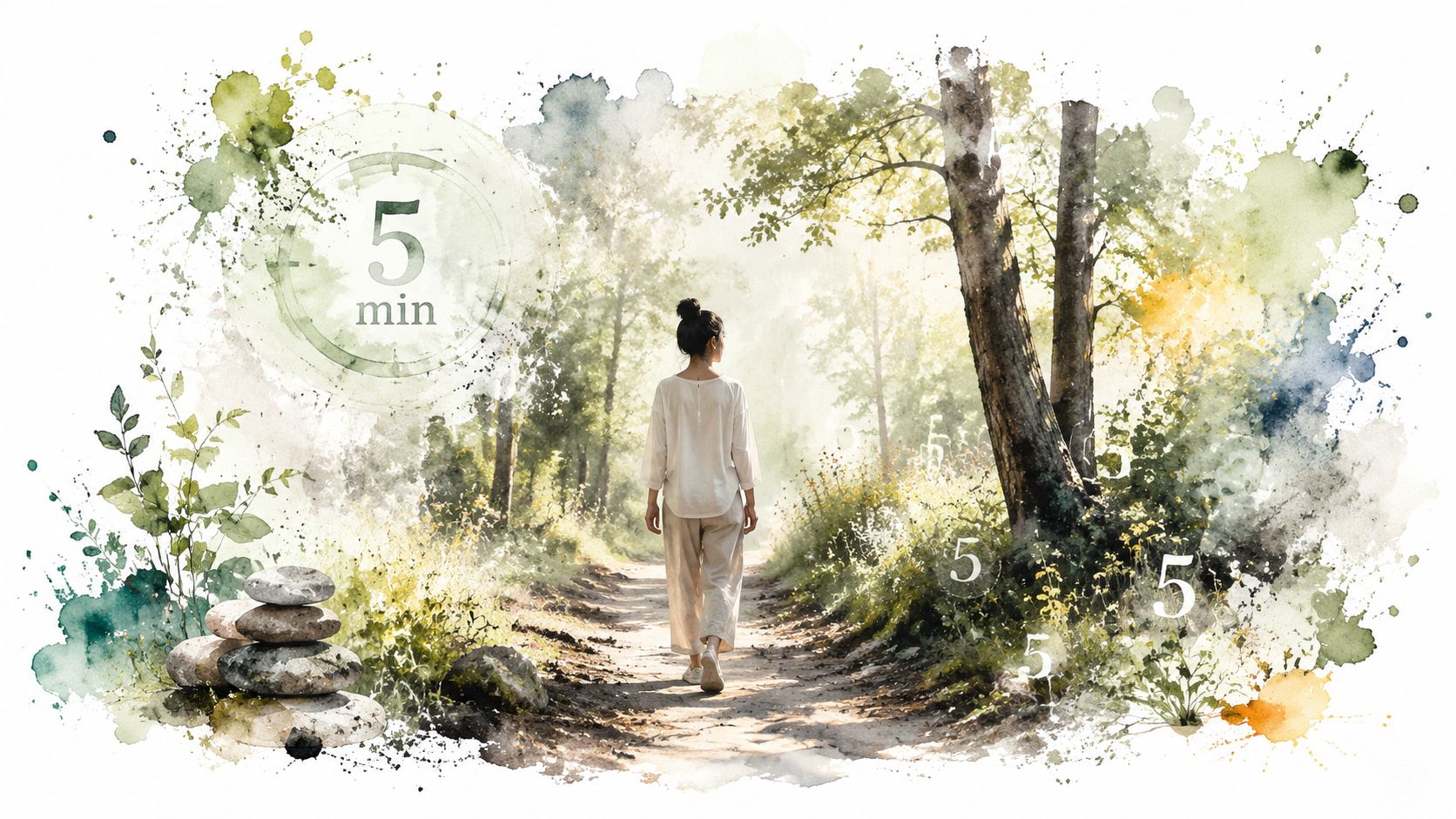
The 5 minute quick reset
Use this when you feel flooded, restless, or unsure whether meditation will help.
First minute
Stand at one end of your path. Notice where your body meets the floor. Don't change your breath. Just notice that you're here.Second minute
Begin walking slowly. Name what you feel. “Left foot lifting.” “Right foot placing.” Keep the labels light.Third minute
Narrow your attention to one sensation only. It might be heel pressure, the ball of the foot, or the shift of weight.Fourth minute
At the end of the path, stop fully before turning. Feel the pause. Then turn and walk back.Fifth minute
When thoughts rush in, don't argue with them. Return to the next step. Then the next.
If all you can do is walk one short path and feel your feet for a few breaths, that still counts.
The 15 minute daily practice
This is the version that builds familiarity and trust.
Break it into three parts. The first few minutes are for arriving. The middle is for steady attention. The final few minutes are for easing out without jolting yourself back into stress.
A simple script:
| Phase | What to do | What helps |
|---|---|---|
| Arrival | Stand, soften shoulders, feel both feet | Let the body know there's no rush |
| Walking | Move at a natural but slower pace | Keep attention on feet, legs, or weight shift |
| Turning | Pause fully at each end | Use the stop as a reset |
| Closing | Stand still again | Notice if your body feels even slightly different |
This version works well when your mind keeps trying to solve your whole life at once. The structure interrupts that habit. You are not fixing everything during these 15 minutes. You are training attention to come home.
To support that, some people use a few repeated phrases:
- “Here.”
- “This step.”
- “Ground under me.”
- “Nothing to solve right now.”
A short guided example can also help you settle into the rhythm:
The 30 minute deep dive
Longer doesn't mean harder. It means more room to notice layers.
In a half-hour session, begin with ordinary awareness of walking. Then gradually become more precise. Notice lifting, moving, placing, and shifting weight. You don't need to force this level of detail. Just let the walk slow enough that each part becomes easier to feel.
Around the middle of the session, many people notice one of two things. Either the mind gets quieter, or it gets louder because it realizes you're no longer obeying the spiral. Both are normal.
Try this progression:
- First stretch: Stay with the general feeling of walking.
- Middle stretch: Notice the parts of each step more distinctly.
- Final stretch: Widen awareness a little. Include posture, jaw tension, hands, and breath.
How to end without snapping back into stress
The ending matters. If you finish and instantly grab your phone, your body may lose the landing.
Instead, stop at the end of the last loop and remain still for a few breaths. Feel the after-effect of movement. Maybe your thoughts are still present, but your footing is clearer. Maybe your chest has a touch more space. Small changes matter.
Ask yourself only three things:
- What do I notice in my body now?
- What feels a little less urgent?
- What kind of pace do I want to carry into the next ten minutes?
That's enough. Guided walking meditation is not a test. It's a way back.
Adapting the Walk for Panic Dizziness or Mobility Limits
Many people avoid guided walking meditation for good reasons. They worry they'll get dizzy. They fear feeling trapped in public. They don't know what to do if walking itself makes them more aware of their body in a way that feels scary.
Those concerns are valid. Mainstream advice often explains where to place attention but leaves out practical adaptation. That gap is real. A common problem in walking meditation guidance is that it assumes movement is always regulating, without giving concrete options like indoor pacing or seated grounding when movement feels unsafe (Mindful.org walking practice discussion).
If walking feels destabilizing
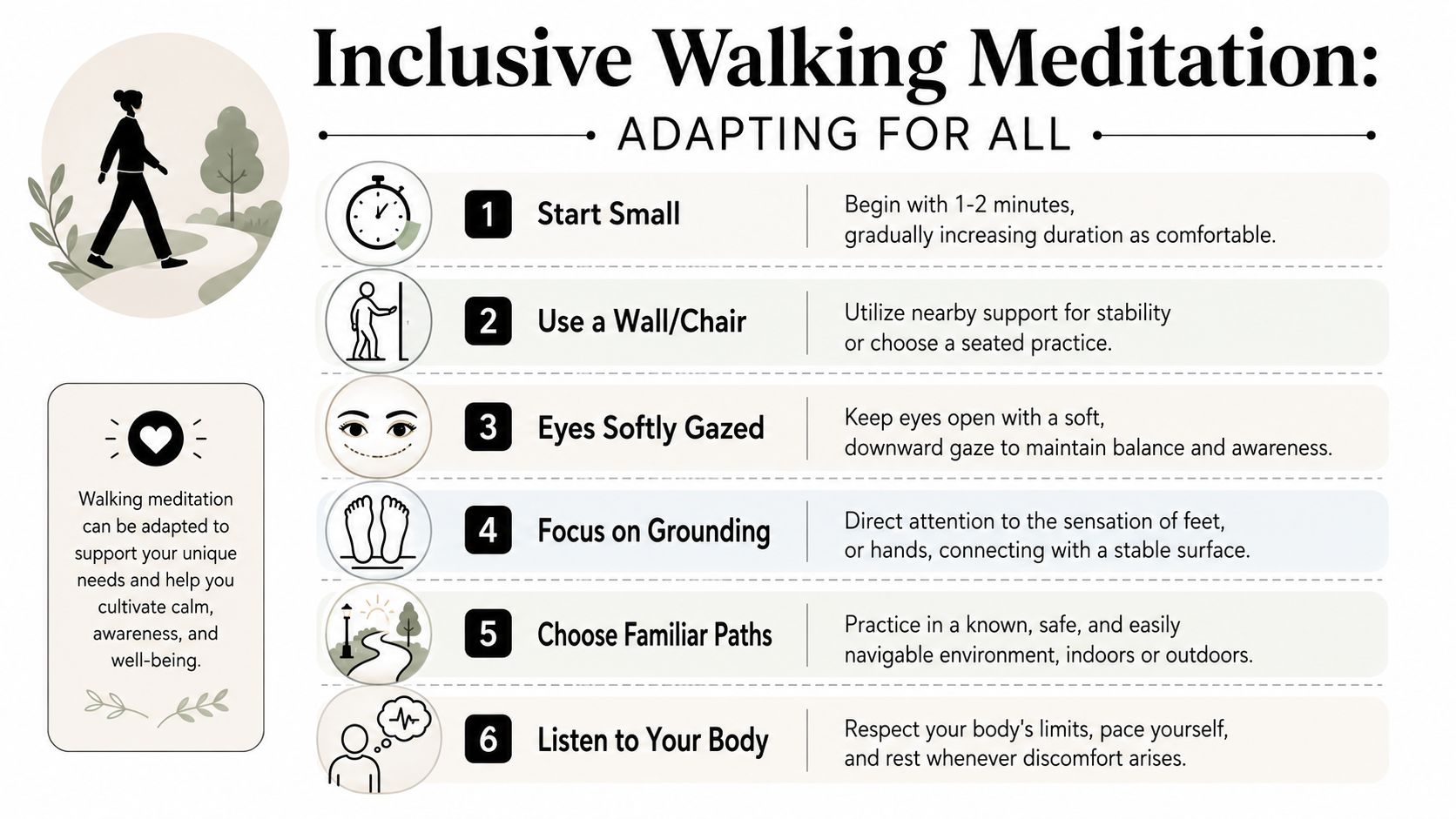
Start by changing the environment before you change yourself. An indoor hallway is often better than a busy sidewalk. A kitchen counter or wall can provide support. A shorter interval may work better than trying to push through discomfort.
Use these adaptations as needed:
- For dizziness: Keep your eyes open with a soft downward gaze. Slow the pace. Make the path shorter. If symptoms rise, stop and feel both feet planted before taking another step.
- For panic spikes: Switch from “notice everything” to one anchor only. Usually the soles of the feet are best.
- For dissociation: Add gentle labeling. “Left.” “Right.” “Standing.” “Turning.”
- For mobility limits: Try seated walking meditation. Feel one foot press into the floor, then the other, or alternate lifting heels and noticing contact.
Safety is not cheating. Adaptation is good practice.
If you need a broader menu of options during a hard moment, The Anxiety Checklist's grounding guide can help you choose a steadier anchor.
Accessibility counts as good practice
There's no prize for doing this the “pure” way. If a cane, walker, chair, handrail, or support person helps, use it. If outdoor walking is overstimulating, practice indoors. If turning around makes you uneasy, shorten the route further and pause longer at each end.
A useful decision lens is this:
| If this happens | Try this adjustment |
|---|---|
| You feel unsteady | Keep one hand near a wall or chair |
| You feel exposed | Practice in a private indoor space |
| You feel flooded by body sensations | Focus on pressure and contact, not breath |
| You tire quickly | Use shorter rounds with rest between them |
The best version of guided walking meditation is the one your nervous system can trust enough to repeat.
Troubleshooting Common Hurdles on Your Walk
A difficult walk doesn't mean you're bad at meditation. It usually means you met the part of the practice that is training your attention.
When your mind races
If your thoughts keep shouting over the walk, shrink the task. Don't try to observe your whole body, your emotions, and your surroundings at once. Feel one foot. Then the other. If needed, label each step with simple words like “left” and “right.”
That reduction in complexity is often what helps.
Some days the practice is not peaceful. It is simply returning, again and again, without adding self-criticism.
When the environment is too much
Sensory overload is a common pitfall. Expert guidance recommends starting in a low-stimulus corridor and using a simple 10 to 15 pace loop to reduce navigational demands that can trigger panic or cognitive dissonance. As noted earlier, this is why many beginners do better with an uncomplicated path than with a scenic but busy outdoor route.
If sounds, movement, or visual clutter pull you off center, try this sequence:
- Reduce input: Move to a quieter path or indoor space.
- Lower the gaze: Looking slightly downward often reduces overstimulation.
- Narrow the anchor: Stay with contact between foot and floor.
- Pause at the turn: Let the stop be part of the practice, not a disruption.
When you feel self-conscious
Public walking meditation doesn't need to look unusual. Walk at a natural pace. Keep your eyes open. Don't worry about appearing “meditative.” From the outside, you're just walking slowly and paying attention.
Self-consciousness usually eases when the practice becomes familiar. Until then, privacy helps. A hallway at home is not a lesser option. It's often the smartest one.
Weaving This Practice Into Your Daily Life
Guided walking meditation becomes powerful when it stops being an event and starts becoming part of how you move through ordinary days.
That might mean a few mindful passes in your hallway before work. It might mean walking the length of a parking lot with full attention on your feet instead of checking your phone. It might mean using the transition after lunch to reset your system before the afternoon starts pulling at you again.
The key is consistency, not intensity. Short, repeatable practice builds trust. When your body learns that you can meet activation with steadiness, panic loses some of its authority. You become less afraid of your own sensations because you've practiced staying with them in manageable doses.
A simple weekly rhythm helps:
- On busy days: Use a brief reset.
- On ordinary days: Keep one regular walking session.
- On hard days: Adapt the practice instead of skipping it entirely.
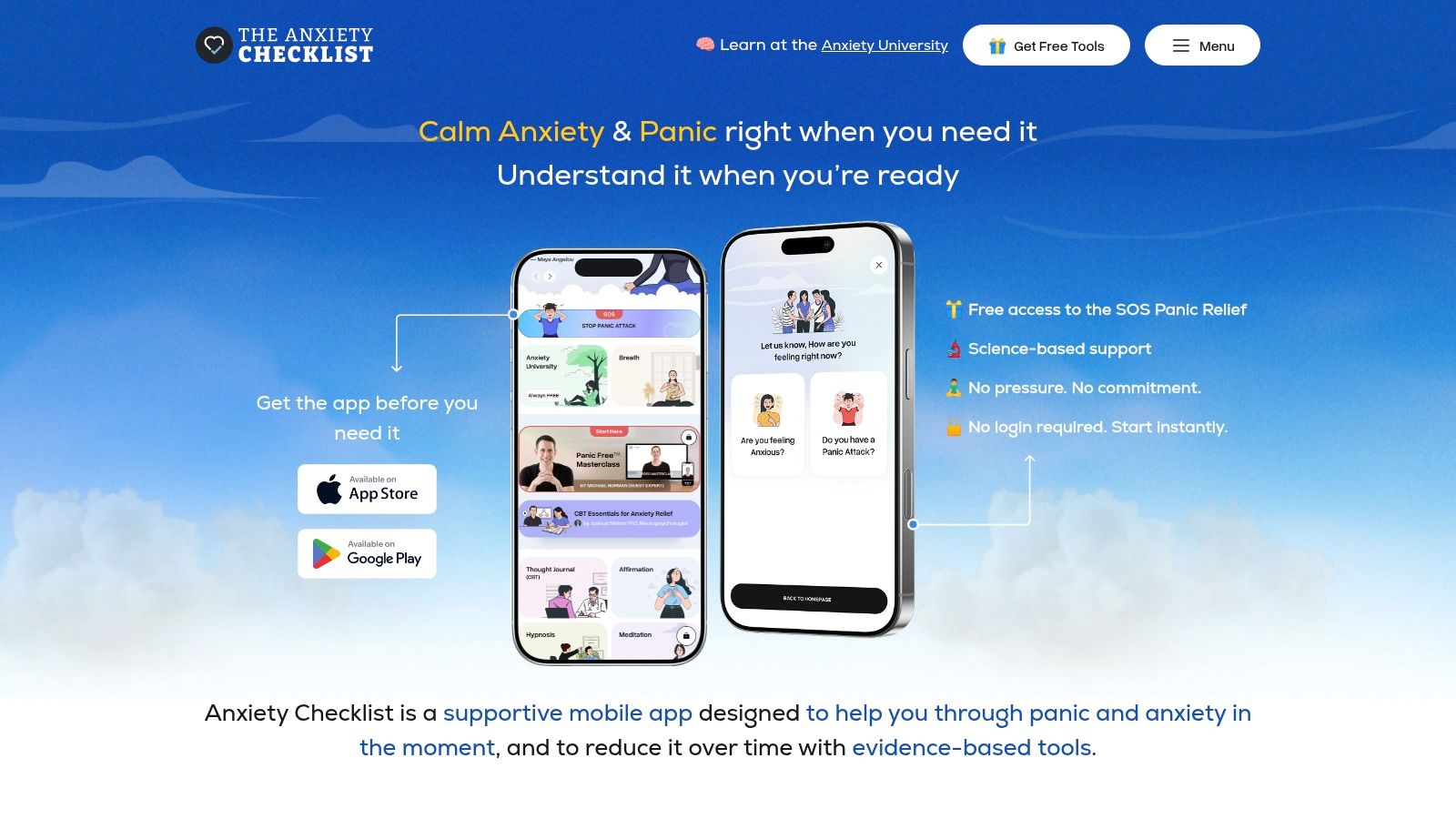
If you want support between sessions, daily anxiety support from The Anxiety Checklist can help you build a fuller calming routine around moments like these.
One mindful walk won't solve everything. But one step taken with awareness can interrupt a spiral. A few more can restore orientation. Over time, those moments add up to something important. A life where anxiety no longer gets the final word.
If you want a steady companion for panic moments and daily recovery, The Anxiety Checklist offers practical support without pressure. You can use it for in-the-moment grounding, guided meditations, walking sessions, sleep support, and deeper CBT-based tools when you're ready.