


Does your mind ever feel like a storm you can't step out of? A loop of what-ifs, body alarms, and worst-case stories that keeps running even when you're tired of listening? Many adults get told to “just journal,” but that advice often misses the core question. What do you write when your mind is racing, your chest is tight, and you can't think clearly enough to be reflective?
That's where targeted journaling questions for adults can become more than a self-help habit. They can become a form of structured self-therapy. The modern expressive writing model is often traced back to psychologist James W. Pennebaker. His early work helped establish writing about emotional experiences as a research-backed tool, and in a later synthesis he described a common format of about 15 to 20 minutes per session over 3 to 4 consecutive days, a structure that shaped many adult journaling practices that followed (background on expressive writing).
That history matters because good prompts aren't random. They're designed to help you notice feelings, identify triggers, challenge anxious thoughts, and reconnect with your body and values. If anxiety has made you feel powerless, this is hopeful news. A blank page can become a place where panic slows down and clarity returns.
If you want a broader practical guide to anxiety journaling, start there too. For now, let's get straight to ten journaling questions that can help you heal your relationship with anxiety, one honest entry at a time.
Table of Contents
- 1. What Am I Feeling Right Now?
- 2. What Thought Triggered This Anxiety?
- 3. Is This Thought Actually True?
- 4. What Would Help Me Feel Safe Right Now?
- 5. What Am I Grateful For, Even Right Now?
- 6. What Do I Need to Accept vs. What Can I Control?
- 7. What Are My Core Values, and How Did I Live Them Today?
- 8. What Did I Learn About My Anxiety This Week?
- 9. What Would My Wisest Self Say About This Situation?
- 10. How Did My Anxiety Protect Me, and What Do I Need Now?
- Comparison of 10 Adult Journaling Prompts
- Your Journal: A Pathway to a Panic-Free Life
1. What Am I Feeling Right Now?

Anxiety likes blurry language. It turns everything into “I feel awful” or “Something is wrong.” That makes sense when your nervous system is overwhelmed, but it also keeps the experience vague and harder to work with.
A stronger opening question is simple: What am I feeling right now? Not what should I feel. Not what would sound reasonable. Just what's here.
Name It Before You Fight It
Try writing a sentence like this: “I feel anxious, frustrated, tired, and a little hopeful.” That's already different from “I'm a mess.” The first sentence describes an experience. The second becomes an identity.
This kind of prompt works well because many of the most useful journaling questions for adults are specific, concrete, and tied to present-moment emotional labeling. Prompt sets that focus on clinically relevant areas often emphasize naming feelings, triggers, values, and next steps because those questions translate better into action than broad diary entries (examples of clinically relevant prompt categories).
A few real-life examples:
- After a panic episode: “I feel scared, embarrassed, shaky, and relieved it passed.”
- Before therapy: “I feel tense, exposed, doubtful, and curious.”
- After work: “I feel drained, restless, proud of finishing, and uneasy about tomorrow.”
Practical rule: If you can name three feelings, you're already creating a little distance from the spiral.
If you tend to freeze, use a feelings wheel or keep a short list in your journal. You can also note where each feeling lives in the body. Tight throat, heavy chest, buzzing arms, upset stomach. If you want to learn about anxiety and panic attacks, that kind of education can make these sensations feel less mysterious and less frightening.
2. What Thought Triggered This Anxiety?

Many adults stop at “I got anxious in the meeting” or “I felt overwhelmed at dinner.” Useful, but incomplete. Anxiety usually rises after a thought, an image, or an interpretation. The body reacts fast, so the thought can flash by unnoticed.
That's why this question matters: What thought triggered this anxiety?
Catch the Thought, Not Just the Feeling
Write the thought exactly as it appeared, even if it sounds dramatic. “They can tell I'm nervous.” “I'm going to mess this up.” “This headache means something serious.” Raw thoughts are more workable than polished summaries.
A helpful phrase is: “I'm having the thought that…” That small shift reminds you that a thought is something your mind produced, not a verdict from reality. This is one of the most practical journaling questions for adults dealing with anxiety because it helps move the experience from chaos into a recognizable pattern.
Common examples include:
- In a work meeting: “I'm having the thought that everyone sees I'm trembling.”
- Before texting someone back: “I'm having the thought that I'll say the wrong thing.”
- During health anxiety: “I'm having the thought that this sensation means danger.”
Published prompt libraries now often contain large sets rather than a handful of prompts. One collection offers 80 daily prompts, another 94 thought-provoking prompts, and another 100 prompts for self-reflection, which shows how broad adult journaling has become as an ongoing practice rather than a one-time exercise (examples of large prompt libraries).
If overthinking is part of your pattern, journaling can help you spot the same mental script repeating in different situations. That's where you can start breaking the overthinking cycle, not by forcing yourself to stop thinking, but by seeing the thought clearly enough to question it.
3. Is This Thought Actually True?

Once you've caught the anxious thought, the next step is not to bully yourself out of it. It's to examine it. Anxiety often speaks in certainty. “This will go badly.” “I can't handle it.” “Everyone will judge me.” A journal gives you a place to slow that certainty down.
Ask: Is this thought true?
Put the Thought on Trial
Make two quick columns. One says “Evidence For.” The other says “Evidence Against.” Keep it plain. You're not trying to win an argument with yourself. You're trying to see more than the fear is showing you.
If your thought is, “I'll panic at dinner and ruin the night,” your evidence against might be: “I've felt anxious at dinners before and still stayed,” “people often don't notice as much as I think,” or “even if I need a break, that's uncomfortable, not catastrophic.”
Anxiety is persuasive, not always accurate.
CBT-style journaling offers a powerful approach. Structured, prompt-driven writing is often more useful than open-ended reflection when anxiety is high because it reduces mental load and gives you a repeatable path through the spiral. Brief, structured journaling formats are commonly used in evidence-based approaches for that reason (brief, structured journaling formats in adult mental health writing).
Another good test is this question: What would I tell a friend who had this exact thought? Many people answer themselves with more compassion and realism when they step outside the anxiety voice. Your journal can hold both truths. “I'm scared” and “this thought may not be fully true” can exist at the same time.
4. What Would Help Me Feel Safe Right Now?
Not every anxiety problem is solved by thinking better. Sometimes your body needs support first. If your heart is racing and your hands are cold, the most helpful journaling question for adults in that moment may be practical, not philosophical.
Ask: What would help me feel safe right now?
Ask Your Body, Not Just Your Mind
This question shifts the focus from “Why am I like this?” to “What does my nervous system need?” That can change the whole tone of an entry. Instead of analyzing yourself, you start caring for yourself.
Your answer might be physical and simple:
- A glass of water
- Slower breathing
- Sitting outside
- A short walk
- A blanket
- Less screen time
- Music with a steady rhythm
A significant underserved need in the journaling world is anxiety-specific prompts for adults who blank out during a spiral. Many prompt lists focus on self-discovery or goals, but fewer are built for the moment when attention narrows and thinking gets hard. This disparity affects a very large audience, especially since the World Health Organization estimates 301 million people are living with anxiety disorders (discussion of the gap in anxiety-specific prompts).
Build a Personal Safety Menu
Write down a short “safety menu” in your journal so you don't have to invent one while panicking. Keep it concrete.
- For fast grounding: cold water on hands, feet on the floor, name five things you see.
- For discharge: walk, stretch, shake out your arms, unclench your jaw.
- For soothing: tea, dim lights, calm audio, gentle self-talk.
If you want a guided reset before writing more, this can help:
A journal doesn't have to be just a place to process the storm. It can become part of the shelter.
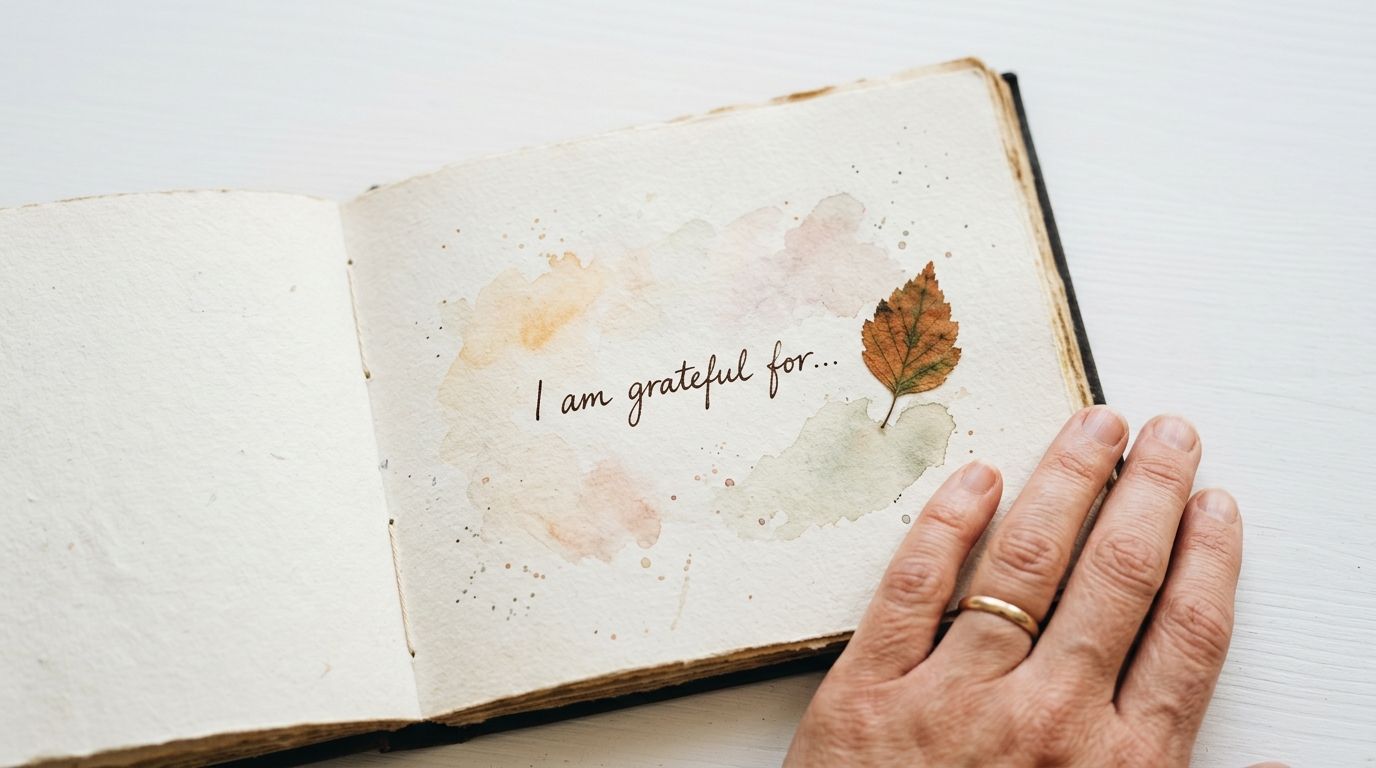
5. What Am I Grateful For, Even Right Now?
Gratitude can sound impossible on an anxious day. If someone tells you to “focus on the positive” while you're trembling inside, it can feel dismissive. That's why this version works better: What am I grateful for, even right now?
It doesn't deny the struggle. It sits beside it.
Small Gratitude Counts
You might write, “I'm scared, and I'm grateful for this cup of tea.” Or, “I'm overwhelmed, and I'm grateful my friend texted back.” Or even, “I hate how I feel today, and I'm grateful I'm still trying.”
That kind of gratitude is honest. It doesn't force you into cheerfulness. It widens the frame. Anxiety narrows attention until the threat feels like the only thing in the room. Gratitude helps you notice that it isn't.
Examples that fit real anxious moments:
- Before a social event: “I'm grateful there's one person there who feels safe.”
- During a hard morning: “I'm grateful I got out of bed.”
- After panic: “I'm grateful my body settled, even if it took time.”
A grateful thought doesn't have to be big to be stabilizing.
If this prompt feels hard, make it smaller. Don't ask for a list of ten. Ask for one true thing. Warm socks. A pet beside you. The courage to stay with the feeling instead of running from it. Over time, that kind of journaling can train you to spot support, not only danger.
6. What Do I Need to Accept vs. What Can I Control?
Anxiety often turns life into a wrestling match with uncertainty. You try to control sensations, people, outcomes, timing, the future, and every possible mistake. That's exhausting. This prompt creates relief through sorting.
Ask: What do I need to accept, and what can I control?
Two Columns That Calm the Mind
Draw a line down the page. On one side, write “In My Control.” On the other, write “Not In My Control.” Keep going until the mental fog starts to clear.
For example, with social anxiety:
- In my control: whether I go, how I prepare, how kindly I speak to myself, whether I stay for ten minutes.
- Not in my control: whether everyone likes me, whether I feel nervous, what other people think afterward.
This question holds strong hope because it doesn't ask you to like uncertainty. It asks you to stop wasting your strength fighting what no one can fully control. Then you can use your energy where it is effective.
For busy adults, this matters even more. A lot of journaling content is built as long prompt libraries for deep reflection, but many people need a repeatable practice that fits into a break, commute, or bedtime routine. Short, use-case-based prompts often fit real life better than sprawling self-discovery exercises (why time-pressed adults need lower-friction journaling options).
If you want ongoing tools to manage anxiety, pairing this prompt with a simple coping tool can help. Write the two columns, then choose one controllable step. That's how acceptance becomes active rather than passive.
7. What Are My Core Values, and How Did I Live Them Today?
Anxiety tells you to organize life around avoidance. Don't go. Don't say it. Don't risk it. Don't feel it. Values ask a different question. Who do you want to be, even while anxiety is present?
That's why this prompt matters so much: What are my core values, and how did I live them today?
Let Meaning Lead
Maybe one of your values is connection. Then texting a friend back while anxious counts. Maybe one of your values is courage. Then attending the appointment you wanted to cancel counts. Maybe one of your values is honesty. Then admitting “I'm struggling today” counts.
This is a powerful shift. You stop measuring the day only by how anxious you felt. You start measuring it by how you lived.
Try filling in sentences like these:
- “I value kindness, and today I was gentle with myself after a hard moment.”
- “I value growth, and today I stayed in the uncomfortable conversation.”
- “I value family, and today I showed up to dinner even though I felt activated.”
Many of the most useful journaling questions for adults center on values, relationships, goals, emotions, and fear because those areas connect insight to behavior. A value is not a mood. It's a direction. You can move toward it on calm days and anxious days alike.
When you journal this way, recovery stops being just “How do I get rid of panic?” It becomes “How do I build a life that matters, even while my nervous system is healing?” That question often creates more freedom than the search for perfect calm.
8. What Did I Learn About My Anxiety This Week?
Daily journaling helps you catch moments. Weekly journaling helps you catch patterns. Without reflection, a rough week can blur into one story: “I was anxious all week.” Often, the specifics are more nuanced than that.
Ask: What did I learn about my anxiety this week?
Turn Entries Into Insight
Set aside a little time to review what you wrote. Pennebaker's commonly cited expressive writing structure used brief sessions over consecutive days, and that kind of repeated writing pattern is part of why journaling can reveal themes you'd miss in a single entry. Patterns need repetition before they become visible.
Look for questions like:
- When did anxiety spike most?
- What was happening before it rose?
- What helped it settle?
- What made it worse?
- What surprised me?
You might notice that your anxiety rises after poor sleep, after conflict, or when you skip meals and then overwork. You might notice that grounding works better than reassurance-seeking. You might realize that one difficult moment no longer ruins your whole day the way it once did.
A weekly review can also show emotional growth that's easy to miss when you're living inside it. If you're interested in deeper reflective work, these shadow work prompts for anxiety can complement weekly pattern tracking without replacing it.
Review doesn't just tell you what hurt. It shows you what helps.
That's the point. Your journal becomes evidence of change, not just a storage place for distress.
9. What Would My Wisest Self Say About This Situation?
Anxiety has a voice. It's urgent, harsh, and certain. It says you're failing, you're unsafe, you're too much, you'll never get better. Many adults know that voice well. Fewer have practiced answering it.
This prompt gives you another voice to work with: What would my wisest self say about this situation?
Borrow Calm From Your Wiser Voice
Your wisest self isn't fake positivity. It isn't denial. It's the part of you that can see the full picture when fear can only see threat.
Write as if that wiser voice is speaking directly to you:
- “You're activated, not broken.”
- “This feeling is intense, but it will shift.”
- “You've handled hard moments before.”
- “You don't need to punish yourself for being anxious.”
Sometimes it helps to imagine a future version of you, a therapist, a loving elder, or a grounded inner voice. The point is perspective. Anxious thinking shrinks your view. Wise thinking widens it.
This prompt can be especially healing after shame spirals. Maybe you had a panic attack in public. Maybe you replayed an awkward comment all night. Maybe you didn't handle something the way you hoped. Your wise voice often sounds different from your anxious one. It might say, “That was hard, and you're still worthy.” Or, “You needed support, not criticism.”
Write the response in second person if that feels easier. “You are safe enough to take the next small step.” Sometimes borrowing that voice on paper is how you learn to recognize it in real time.
10. How Did My Anxiety Protect Me, and What Do I Need Now?
This may be the most compassionate prompt in the whole list. It changes the question from “Why am I like this?” to “What was my anxiety trying to do for me?” That doesn't mean anxiety always helps now. It means it often began as protection.
Ask: How did my anxiety protect me, and what do I need now?
Honor the Protective Pattern
Maybe perfectionism tried to protect you from criticism. Maybe social anxiety tried to protect you from humiliation. Maybe health anxiety tried to protect you from unpredictability after a frightening experience. When you see the protective logic, shame often softens.
You can write it in two parts:
- Then: “My anxiety learned that being hyper-alert might keep me safe.”
- Now: “I need steadiness, perspective, and updated evidence that I can cope.”
This matters because fear of anxiety itself can become part of the cycle. If your body starts to treat the sensations of panic as a threat, you may begin avoiding not just situations, but the feeling of fear. If that sounds familiar, it may help to understand why you fear the feeling of fear.
Try examples like these:
- “My anxiety tried to protect me from rejection. Now I need to learn that awkwardness is survivable.”
- “My anxiety tried to protect me from losing control. Now I need reminders that discomfort isn't the same as danger.”
- “My anxiety tried to protect me from being caught off guard. Now I need trust in my ability to respond.”
When you journal this way, anxiety stops being only an enemy. It becomes a signal from a nervous system that learned something old and is ready to learn something new.
Comparison of 10 Adult Journaling Prompts
| Prompt | 🔄 Implementation Complexity | ⚡ Resource Requirements | ⭐ Expected Outcomes | 📊 Ideal Use Cases | 💡 Key Tips |
|---|---|---|---|---|---|
| What Am I Feeling Right Now? (Emotion Identification) | Low, simple naming and labeling | Minimal, feelings wheel optional; 2–5 min | ⭐ Builds emotional granularity, calms reactivity | Daily check-ins, panic aftermath, therapy prep | 💡 Use a feelings wheel and rate intensity 1–10 |
| What Thought Triggered This Anxiety? (Cognitive Trigger Identification) | Medium, requires honest reflection | Low, short journaling, clear self-questioning | ⭐ Reveals automatic thoughts; enables CBT interventions | Exposure prep, social or health-anxiety moments | 💡 Use "I'm having the thought that…" to create distance |
| Is This Thought Actually True? (Evidence-Based Reality Check) | Medium, structured disputation | Low–Moderate, time to collect examples and memories | ⭐ Reduces thought believability; builds realistic perspective | Recurring anxious thoughts, belief experiments | 💡 Use two columns: evidence for vs evidence against and re-rate belief |
| What Would Help Me Feel Safe Right Now? (Somatic & Sensory Grounding) | Low, action-focused and practical | Moderate, access to sensory tools or app exercises | ⭐ Immediate nervous system regulation and relief | During mild–moderate anxiety, grounding and prevention | 💡 Create a personalized safety toolkit of sensory strategies |
| What Am I Grateful For, Even Right Now? (Anxiety-Compatible Gratitude) | Low, brief reflective practice | Minimal, daily few minutes, consistency required | ⭐ Builds resilience and positive focus over time | Daily practice, mild anxiety, building long-term positivity | 💡 Start with "Even though I'm struggling…" and keep it small |
| What Do I Need to Accept vs. What Can I Control? (Acceptance & Commitment) | Medium, discernment and reframing needed | Low, reflective time; therapist helpful for guidance | ⭐ Increases psychological flexibility and reduces struggle | Chronic anxiety, perfectionism, health anxiety | 💡 List "In my control" vs "Not in my control" and reframe acceptance |
| What Are My Core Values, and How Did I Live Them Today? (Values Clarification) | Medium, requires values exploration | Moderate, time to clarify values and track actions | ⭐ Motivates values-driven behavior and sustainable recovery | Long-term recovery, motivation for exposures and change | 💡 Clarify 3–5 core values and log small value-aligned acts |
| What Did I Learn About My Anxiety This Week? (Pattern Recognition & Insight) | Medium, meta-cognitive analysis | Moderate, regular entries and 15–20 min weekly review | ⭐ Identifies triggers, effective tools, and progress trends | Weekly reviews, personalization of coping strategy | 💡 Note 3–4 patterns and track correlations between triggers and tools |
| What Would My Wisest Self Say About This Situation? (Perspective-Shifting) | Low–Medium, practice accessing wise voice | Minimal, imagination or scripted prompts | ⭐ Reduces self-criticism and increases self-compassion | Shame, rumination, pre/post-anxiety reflection | 💡 Imagine a specific mentor or future self and write their advice |
| How Did My Anxiety Protect Me, and What Do I Need Now? (Anxiety Function Exploration) | High, deeper therapeutic exploration | Moderate–High, time, reflection, possible therapist support | ⭐ Lowers shame, reframes anxiety as protective, opens new strategies | Childhood-rooted anxiety, trauma-informed work | 💡 Ask "Then vs Now," acknowledge protection intent, pair with exposure or therapy |
Your Journal: A Pathway to a Panic-Free Life
Healing from anxiety rarely starts with one grand breakthrough. More often, it starts with a pause. A page. One honest sentence. One calmer response than the one you had before. That's why these journaling questions for adults matter so much. They give shape to an experience that can feel shapeless and overwhelming.
A good journal doesn't ask you to become fearless overnight. It helps you become more aware, more compassionate, and more skilled. One prompt helps you name emotions instead of drowning in them. Another helps you catch thoughts before they run the whole show. Another helps you separate what your body needs from what your mind is predicting. Over time, those are not small changes. They are the building blocks of recovery.
There's also something deeply hopeful about how accessible this practice is. Adult journaling has expanded far beyond a tiny set of canned prompts. Large prompt libraries and modular sets have become common because people use journaling in many different ways, from stress management to self-discovery to emotional processing. That tells us something important. This isn't a niche habit for a few reflective people. It's a flexible tool that many adults can adapt to real life.
If your goal is to live panic free, it helps to think of journaling as training, not performance. You don't need profound entries. You need repeatable ones. A few honest lines after a trigger. A short review at the end of the week. A grounding question when your mind goes blank. That kind of consistency teaches your nervous system that you can stay with yourself, even when anxiety shows up.
It also helps to remember that panic recovery isn't about never feeling fear again. It's about changing your relationship to fear. When you can say, “I know what I'm feeling,” “I see the thought,” “I know what helps,” and “I can still act on my values,” anxiety loses some of its power to define your life. You stop living as if every alarm means emergency. You begin living as someone who can feel activated and still move with wisdom.
For some people, a paper journal is enough. For others, it helps to pair journaling with tools that support grounding and reflection in the moment. The Anxiety Checklist is one relevant option because it includes an SOS mode for moments when your mind goes blank, along with CBT-style journaling tools and anxiety education. If your symptoms also intersect with hormonal changes, this a guide for perimenopausal women may help you put the bigger picture together.
The most important part is this: you are not broken because your nervous system learned fear. You can learn safety too. Page by page, question by question, you can build a calmer inner life. Hope is not passive. Hope is what happens when you keep showing up to your healing with honesty, structure, and care. Your journal can help you do exactly that.
If you want support beyond the page, The Anxiety Checklist can complement this journaling practice with real-time grounding, CBT-based thought tools, and guided support for panic and anxiety. Start simple. Write one answer today, and let that be your next step forward.