

In short
Health anxiety can take over daily life through a repeating cycle of symptom monitoring, catastrophic interpretation, checking, online searching, reassurance, and avoidance. Start by stabilizing without trying to prove you are healthy, then reduce one safety behavior at a time, return to ordinary activities, and seek professional help when functioning is impaired.
Key takeaways
- Checking, searching, asking for reassurance, and avoiding activities can bring brief relief while making the next health fear more demanding.
- During a spike, the first goal is enough stability to postpone the next anxiety-driven action, not proof that nothing is wrong.
- New, severe, sudden, or rapidly worsening symptoms still require appropriate medical assessment; health-anxiety self-help should never replace urgent care or a clinician’s instructions.
- A 2026 network meta-analysis in the British Journal of Psychiatry reviewed 35 randomized trials with 3,263 participants and supported several psychological approaches, including CBT. (pubmed.ncbi.nlm.nih.gov)
- Professional support is warranted when health fear disrupts work, sleep, relationships, necessary medical care, or normal daily activity.
Table of contents
- What do I do in the next 10 minutes?
- Why does health anxiety keep coming back after reassurance?
- How do I know whether to seek medical care or resist checking?
- How can I start breaking the cycle today?
- What if health anxiety is affecting work, sleep, or relationships?
- When should I get professional help?
- What do people ask about severe health anxiety?
- What is the next useful move?
Safety first: This guide cannot diagnose an individual symptom. Use local urgent medical services if a symptom may be an emergency, follow any instructions already given by a clinician, and do not cancel recommended tests or screening. If there is a risk of self-harm or an inability to stay safe, the World Health Organization advises contacting emergency services or a crisis line. In the United States, call or text the 988 Suicide & Crisis Lifeline; other readers can use these urgent help resources to locate country-specific options. (who.int)
What do I do in the next 10 minutes?
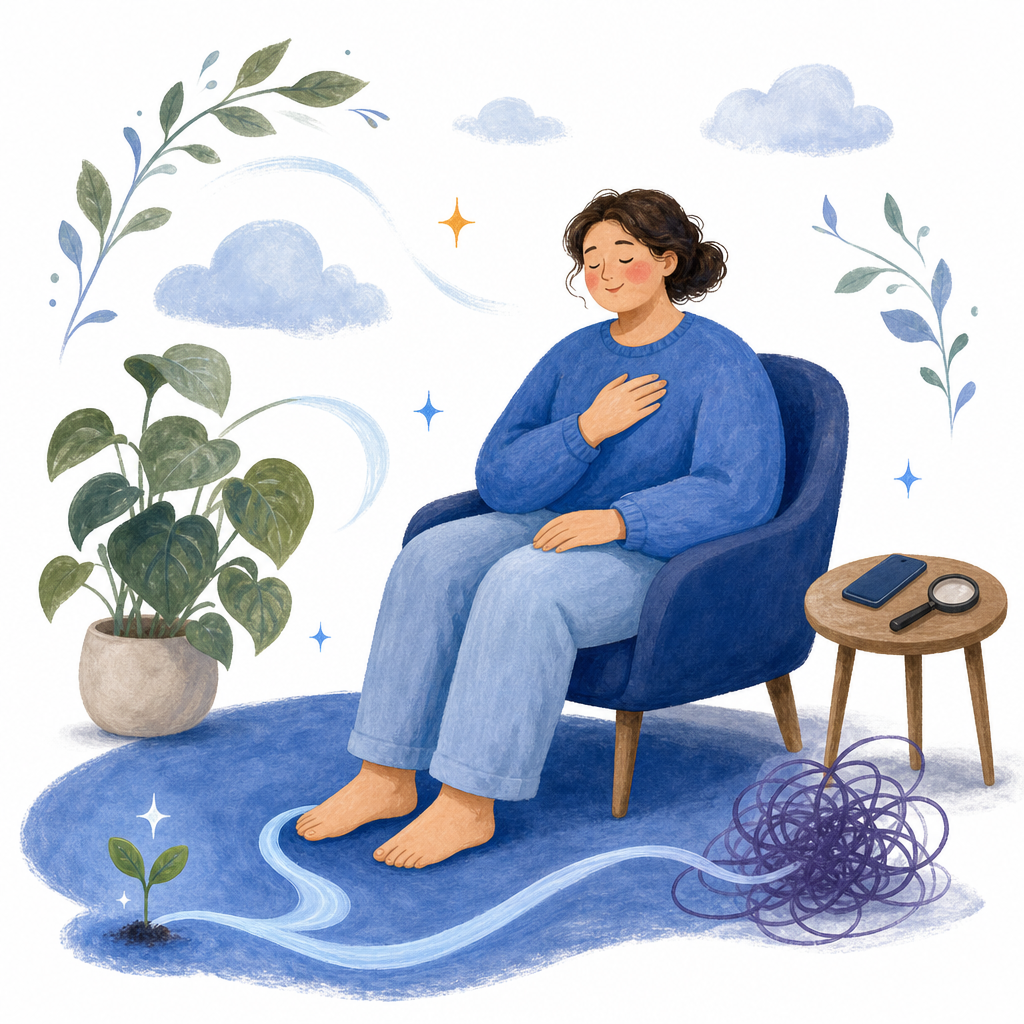
Do not try to settle the medical question while the alarm is peaking. Create enough space to follow a sensible care plan instead of automatically obeying the next urge to check, search, ask, or avoid.
- Stop adding new inputs. Close symptom-search tabs, put down the mirror or monitoring device, and pause requests for reassurance. If a clinician has told you to monitor something at set times, keep following that medical plan.
- Orient to the room. Place both feet on the floor and describe several neutral things you can see, hear, and feel. Use grounding once to reconnect with the present, not repeatedly until fear disappears.
- Name the prediction. Try: My mind is predicting a serious outcome, and I do not have to settle that prediction in this minute. This labels the mental event without claiming that a symptom is harmless.
- Delay the next ritual. Set a 10-minute timer and begin one ordinary activity, such as making food, showering, answering one email, or stepping outside. If 10 minutes feels unmanageable, choose a shorter delay that you can keep.
This pause is not a medical test. It is a way to separate the level of fear from the decision about what care is actually needed.
The first win is not certainty; it is delaying one anxiety-driven action long enough to choose deliberately.
Why does health anxiety keep coming back after reassurance?
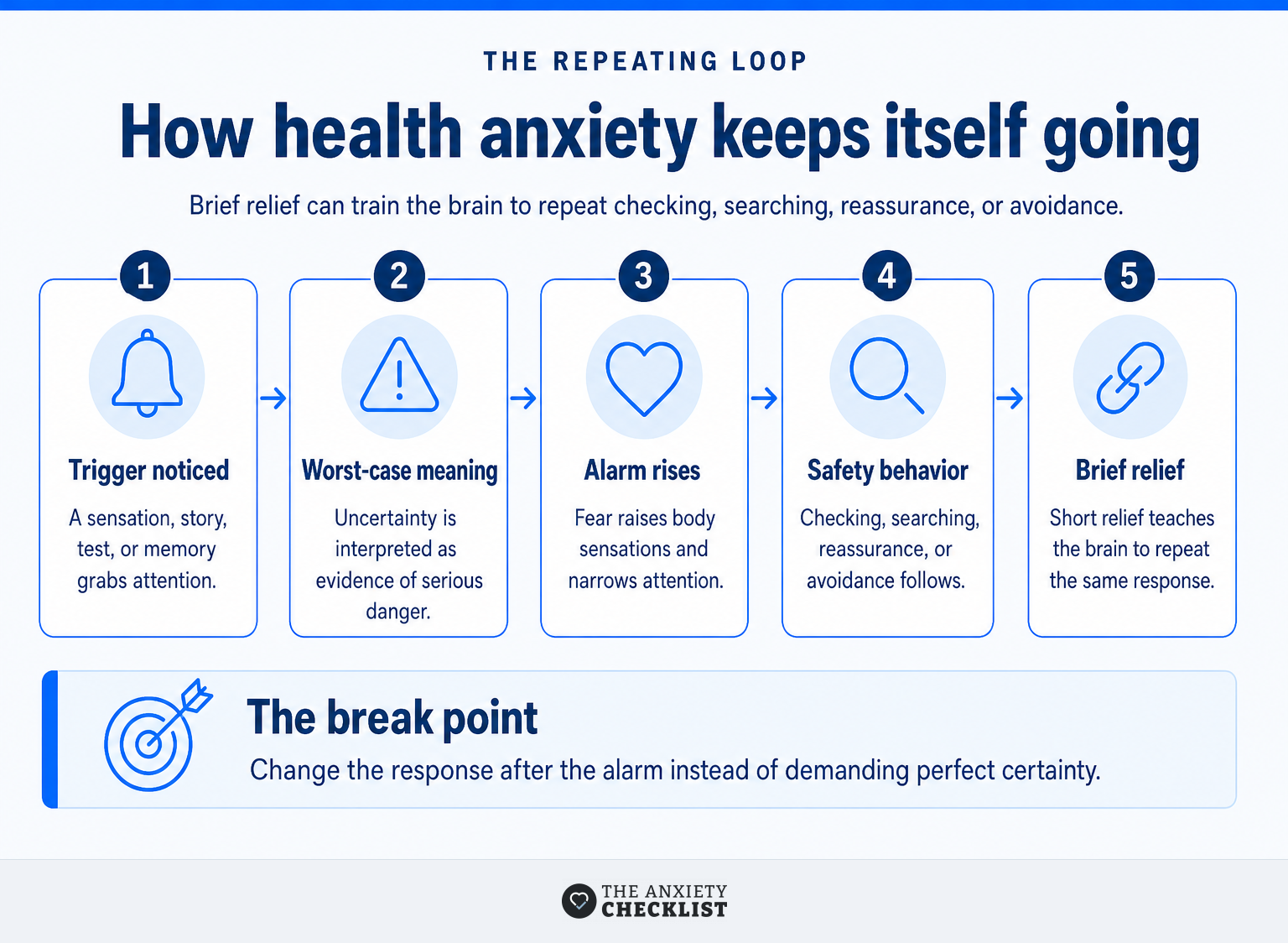
Reassurance often reduces fear for a short time without resolving the underlying intolerance of uncertainty. The brain can then learn that checking, searching, or asking again is necessary whenever another sensation appears.
The NHS health-anxiety guidance identifies repeated body checking, reassurance seeking, online health research, and avoidance as common parts of health anxiety. Oxford Health NHS Foundation Trust describes CBT as examining the beliefs that maintain illness fears and changing reassurance, checking, and restricted daily activity. (nhs.uk)
A typical cycle looks like this:
- A sensation, health story, test, or memory grabs attention.
- The sensation is interpreted as evidence of serious danger.
- Fear increases physical arousal and narrows attention onto the body.
- Checking, searching, reassurance, or avoidance produces brief relief.
- That relief teaches the brain to repeat the same response next time.
What counts as an anxiety-maintaining safety behavior?
- Rechecking a pulse, mark, lump, or sensation after an answer has already been obtained.
- Searching different phrases until one result finally feels calming.
- Asking several people the same health question in slightly different ways.
- Seeking another medical opinion mainly because the last answer did not create certainty.
- Avoiding exercise, travel, work, medical appointments, or ordinary foods because uncertainty feels intolerable.
Checking and reassurance are not automatically unhealthy. The warning sign is repetition beyond a reasonable medical need, especially when the main purpose is immediate emotional relief and the fear soon returns.
Health anxiety loses strength when brief relief no longer trains the same checking, reassurance, searching, or avoidance response.
How do I know whether to seek medical care or resist checking?
Appropriate medical care follows symptoms, clinical history, professional instructions, and an agreed follow-up plan. An anxiety ritual is usually driven by an urgent demand for certainty and continues even after the planned question has been answered.
No article can safely sort an individual symptom. If possible, work with one coordinating clinician and ask for a written plan covering what to monitor, when to arrange a routine appointment, what requires urgent assessment, and what does not need repeated checking. Mayo Clinic similarly recommends coordinated care rather than repeatedly seeking advice from different doctors or emergency departments. (mayoclinic.org)
| Situation | Better next step |
|---|---|
| A symptom is severe, sudden, rapidly worsening, or matches emergency guidance | Use urgent medical care or local emergency services. Do not run a self-help experiment. |
| A symptom has not been assessed and remains concerning | Arrange an appropriate medical appointment rather than relying on internet research. |
| A familiar symptom has been assessed, has not meaningfully changed, and the urge is to check again | Follow the existing care plan and delay the repeated check. |
| Several opinions or tests have already been sought without new clinical information | Tell one clinician about the health-anxiety pattern and agree on coordinated follow-up. |
| Fear is causing avoidance of recommended screening, tests, medication discussions, or appointments | Tell the clinician about the avoidance and ask for support completing the recommended care. |
Some people experience rigid illness-related obsessions and compulsions rather than, or alongside, illness anxiety. The guide to health OCD vs health anxiety explains why checking alone cannot establish the diagnosis and how a clinician considers the full pattern. (anxietychecklist.com)
Follow appropriate medical care, but use a written plan rather than fear intensity to decide when another check is needed.
How can I start breaking the cycle today?
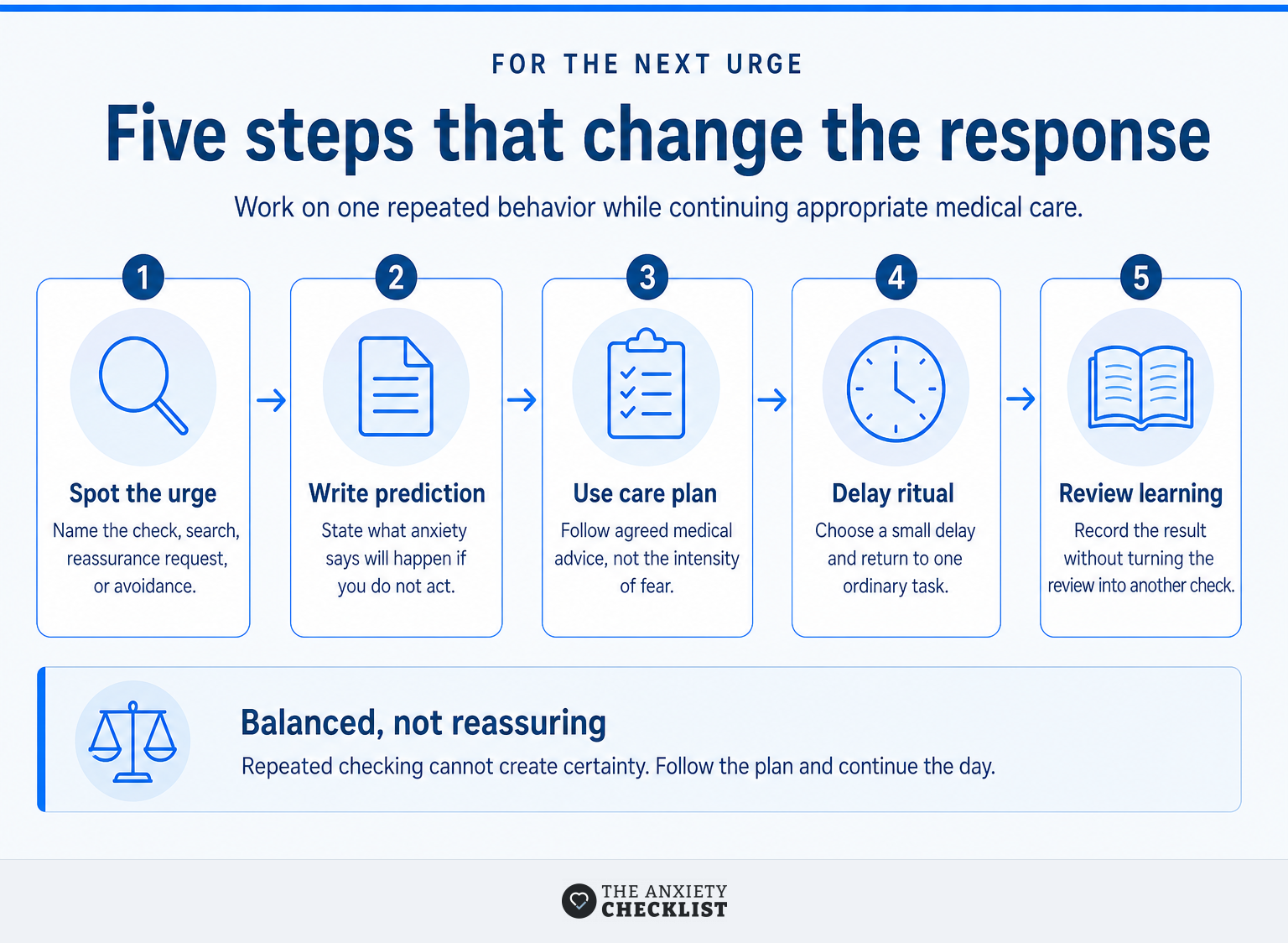
Choose one repeated behavior rather than trying to eliminate every health fear at once. A useful CBT exercise records the prediction, changes the response, and observes what happens without claiming perfect safety.
The 2026 network meta-analysis linked exposure and response prevention, cognitive restructuring, and mindfulness components with improved treatment outcomes. That evidence supports changing both the interpretation and the checking response, although a self-help exercise is not equivalent to individualized therapy. (pubmed.ncbi.nlm.nih.gov)
The goal is a balanced response that follows a care plan without pretending certainty exists.
- Spot one urge. Choose a specific behavior, such as checking a mark, searching a symptom, asking a partner, or avoiding a normal activity.
- Write the feared prediction. State what anxiety says will happen if the behavior is delayed. Keep it concrete.
- Write a balanced response. Avoid statements such as I am definitely fine. A safer response is: Repeated searching cannot diagnose this. I will follow my care plan and return to the task in front of me.
- Change the behavior slightly. Delay the check, shorten the search, ask for reassurance once less, or resume one activity that is medically appropriate.
- Record the learning. Note what happened, how the urge changed, and what ordinary activity became possible. Do not turn the review into another symptom investigation.
For example:
- Trigger: A headache appears during a busy afternoon.
- Prediction: If I do not search immediately, I could miss something serious.
- Usual behavior: Search for 45 minutes and ask two people for reassurance.
- Balanced response: I cannot diagnose this through repeated searching. I will follow the medical plan already in place and complete 15 minutes of work before deciding what comes next.
- Changed response: Put the phone away, complete the work block, and record the urge without analyzing the headache again.
Do not use response prevention to contradict urgent medical guidance, stop prescribed treatment, or avoid a recommended appointment. When the care plan is unclear, clarify it with a qualified clinician before reducing medically relevant monitoring.
A balanced response does not promise safety; it follows the care plan and changes the next behavior.
What if health anxiety is affecting work, sleep, or relationships?
Repair daily functioning in small, observable steps rather than waiting for every health fear to disappear. The measure of progress is a life that becomes less restricted, even if uncomfortable thoughts still appear.
At work or while studying
Choose one short task with a clear endpoint and close health-related tabs before starting. Record the urge to check on paper, then return to the task until the planned break rather than switching between work and symptom investigation.
At night
Keep symptom searching and body checking out of bed when possible. If a concern does not meet the urgent criteria in the medical plan, write one sentence for the next appropriate appointment and return attention to resting rather than trying to reach certainty before sleep.
With family or a partner
Explain that repeated reassurance may calm fear briefly but does not settle the pattern. A support person can use this response:
Please do not tell me that I am definitely fine. Ask what my care plan says, then help me return to the next ordinary task.
This does not mean refusing emotional support. A partner can acknowledge the fear, stay present, and encourage the agreed response without diagnosing the symptom.
The NHS recommends gradually returning to activities that health fear has displaced, including social and physical activities when medically appropriate. Start with a manageable action and repeat it often enough for ordinary life to stop feeling exceptional. (nhs.uk)
Recovery becomes visible when ordinary life expands, even before health fears disappear.
When should I get professional help?
Arrange professional support when health anxiety repeatedly disrupts daily life, drives excessive care use, or causes avoidance of necessary care. Seek help sooner if depression, hopelessness, substance use, self-harm thoughts, or an inability to stay safe is also present.
Signs that an assessment is warranted include:
- Work, study, sleep, relationships, exercise, or travel are being restricted.
- Reassurance lasts only briefly and is required repeatedly.
- Medical visits, tests, or internet research consume substantial time or money.
- Recommended appointments or activities are avoided because the feared result or sensation feels unbearable.
- Careful self-help has not changed the pattern or distress is increasing.
The 2026 British Journal of Psychiatry network meta-analysis reviewed 35 randomized trials involving 3,263 participants. It found benefits compared with waiting-list controls for CBT and several other psychological interventions, while identifying exposure and response prevention, cognitive restructuring, and mindfulness as useful components. Results from groups do not predict an individual outcome, but the evidence supports seeking properly delivered psychological care. (pubmed.ncbi.nlm.nih.gov)
Bring a clinician examples of the triggers, feared outcomes, checks, searches, reassurance requests, avoidance, and effects on daily life. This guide to professional mental-health support can help organize the reasons for arranging an appointment.
If there is immediate danger, possible self-harm, or an inability to stay safe, contact local emergency services or a crisis line now rather than waiting for a routine appointment.
Professional help is warranted when health fear restricts life, drives repeated care, or resists careful self-help.
What do people ask about severe health anxiety?
The most useful answers preserve medical safety while reducing repeated attempts to obtain impossible certainty. Health-anxiety advice should never ask someone to ignore symptoms, but it should also avoid turning reassurance into the main coping strategy.
Can health anxiety cause real physical symptoms?
Anxiety can produce genuine sensations such as a racing heart, sweating, dizziness, muscle tension, or stomach upset. Those sensations are real, but they do not identify their own cause. Because physical symptoms can also have medical causes, use a clinician’s advice rather than assuming every symptom is anxiety or serious disease. (nhs.uk)
Should I stop Googling symptoms completely?
Repeated searching is worth reducing when it briefly lowers fear but leads to more questions, checking, or panic. A total ban is not always necessary. Use trusted sources at a planned time, stop when the agreed question is answered, and take new or concerning symptoms to an appropriate clinician instead of an open-ended search. (nhs.uk)
Is health anxiety the same as illness anxiety disorder?
Health anxiety is a broad description for excessive health-related fear. Illness anxiety disorder is a clinical diagnosis with specific criteria and requires professional assessment; other conditions can involve similar checking, avoidance, or physical concerns. The label matters less at first than the level of distress, repetition, and disruption in daily life. (mayoclinic.org)
Can CBT help with health anxiety?
Yes. A 2026 network meta-analysis of 35 randomized trials involving 3,263 participants found benefits for several psychological approaches, including CBT, compared with waiting-list controls. The review identified exposure and response prevention, cognitive restructuring, and mindfulness as useful components. Self-help can practice pieces of CBT, but it is not a substitute for individualized clinical care. (pubmed.ncbi.nlm.nih.gov)
How long does health anxiety take to improve?
There is no reliable universal timeline. Improvement is usually better measured by behavior than by never feeling afraid: fewer checks, shorter searches, less reassurance, more ordinary activity, and better functioning. If distress remains severe, functioning keeps shrinking, or self-help is not changing the pattern, arrange professional assessment rather than waiting for a deadline.
The safest answers reduce compulsive certainty-seeking without asking anyone to ignore symptoms or professional advice.
What is the next useful move?
Choose one behavior to change during the next 24 hours, not the entire problem. Write down the trigger, the feared prediction, the existing medical plan, and the ordinary activity that will replace one check or search.
For a guided structure, try the free, no-sign-up guided CBT Thought Journal. Its four-step format can help identify an anxious thought, name the thinking pattern, and write a more balanced response without claiming certainty. (anxietychecklist.com)
You do not have to feel certain before taking one deliberate step back toward daily life.