

In short
Health OCD and health anxiety can both involve illness fears, body checking, online searching, reassurance seeking, and avoidance. The distinction is not one behavior but the full pattern: OCD requires obsessions and compulsions, while health anxiety centers on persistent illness preoccupation. Only a qualified clinician can diagnose either condition.
Key takeaways
- Health OCD is an informal name for OCD with illness-related obsessions; it is not a separate formal OCD subtype.
- Checking, online research, reassurance seeking, and medical avoidance can occur in both health anxiety and OCD.
- Diagnostic manuals do not organize the boundary identically, so reputable sources may use different labels.
- A clinician considers the behavior’s purpose, rigidity, repetition, time cost, distress, and impact rather than using one symptom as proof.
- OCD-focused treatment often emphasizes exposure and response prevention, while health-anxiety CBT may place more emphasis on illness interpretations, attention, and safety behaviors.
Table of contents
- Is health anxiety OCD?
- What is the main difference between health OCD and health anxiety?
- How can the same behavior mean different things?
- Why doesn’t reassurance settle the question?
- Can health OCD or health anxiety cause physical symptoms?
- Why do professionals use different labels?
- Does treatment differ?
- When should you get professional help?
- What do people ask about health OCD and health anxiety?
- What should you do next?
Is health anxiety OCD?
Not automatically. Health fears can be the subject of OCD, but health anxiety may also be described or diagnosed outside OCD, and the two can occur together.
Health-related OCD, sometimes called health OCD or illness OCD, is an informal description of an OCD theme. The American Psychological Association’s 2026 clinical overview notes that OCD has no formal subtypes and that diagnosis depends on identifying obsessions, compulsions, and the functional connection between them. (apa.org)
A 2017 symptom-profile study compared 290 participants with severe health anxiety and 95 with a principal OCD diagnosis. The researchers found some co-occurrence, but they concluded that the groups had substantially different symptom profiles and limited overlap. One study cannot diagnose an individual, but it supports treating the terms as related rather than interchangeable. (pubmed.ncbi.nlm.nih.gov)
Health fears can be part of OCD, but health anxiety is not automatically OCD and the two can co-occur.
What is the main difference between health OCD and health anxiety?
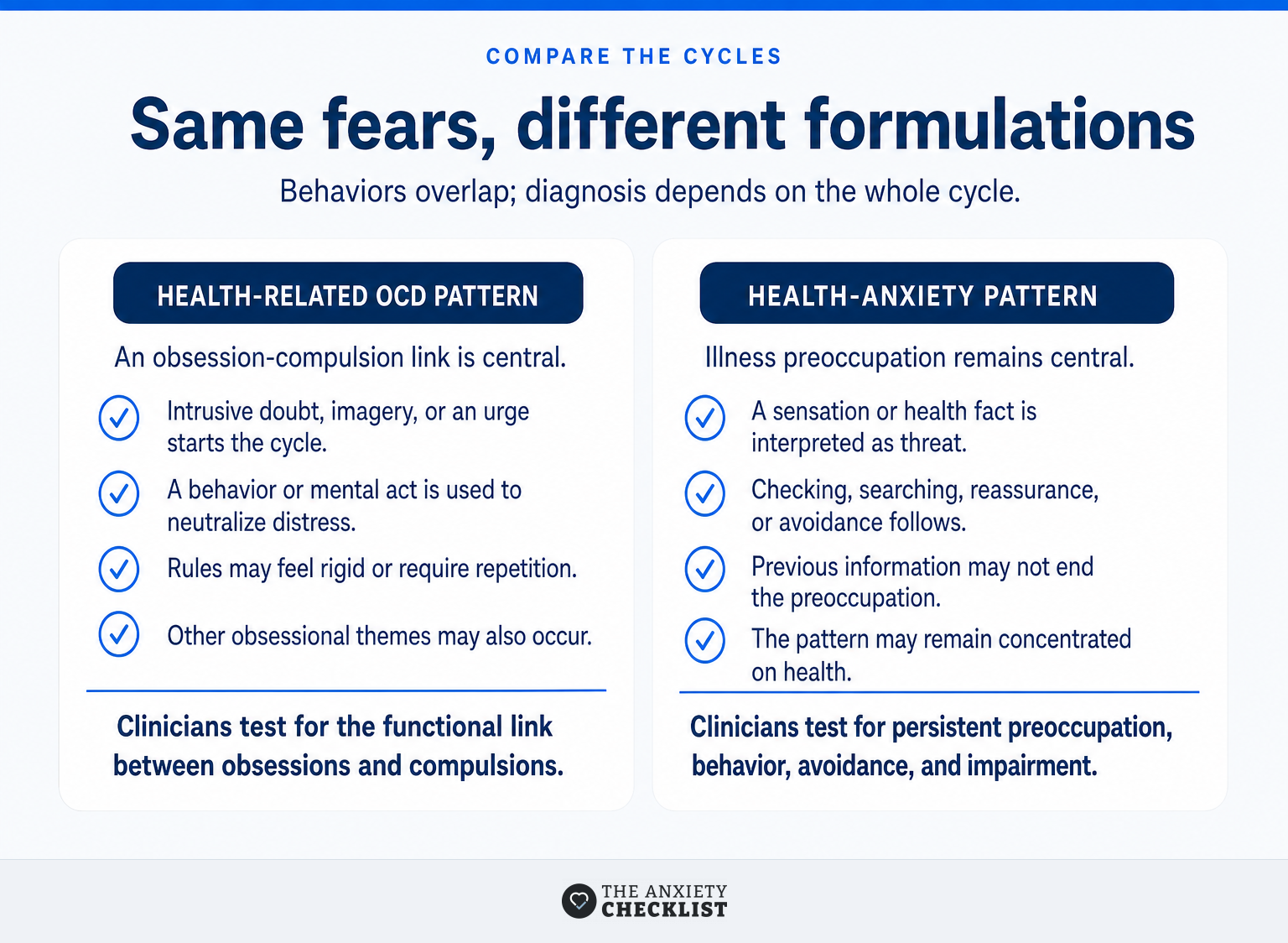
Clinicians look for the structure and purpose of the cycle, not simply whether someone fears illness. An OCD formulation requires obsessions, compulsions, or both, while a health-anxiety formulation centers on persistent illness preoccupation and the behaviors or avoidance surrounding it.
Comparison at a glance
| What is assessed? | Health-related OCD pattern | Health-anxiety pattern |
|---|---|---|
| Core cycle | An intrusive thought, image, urge, or doubt prompts a behavior or mental act intended to neutralize distress or prevent a feared outcome. | A sensation, health fact, or possibility is interpreted as evidence of illness, leading to monitoring, reassurance, care seeking, or avoidance. |
| Need being pursued | Certainty, prevention, neutralization, or a feeling that the issue has been reviewed correctly. | Confirmation that illness is absent or manageable, or protection from health information and medical situations. |
| Repetition | Actions may follow rigid rules, involve mental reviewing, or need to be repeated until they feel complete. | Checking, searching, appointments, reassurance, or avoidance may continue despite previous information or evaluations. |
| Wider pattern | Other obsessional themes or mental rituals may be present, although health can be the only obvious theme. | The preoccupation may remain concentrated on personal health, although other anxiety can also occur. |
| Diagnostic question | Are the actions or mental rituals direct responses to obsessions, and do they cause significant distress or impairment? | Is there persistent illness preoccupation with excessive health-related behavior or avoidance and meaningful impairment? |
The American Psychiatric Association’s illness anxiety overview describes preoccupation with having or acquiring illness, frequent self-checking, and extreme health precautions. Those features overlap with OCD behavior, which is why the whole pattern must be assessed. (psychiatry.org)
These columns describe tendencies, not a home diagnostic checklist. A person may not fit either column neatly, and appropriate concern about a new symptom is not itself a disorder.
The function and structure of the cycle matter more than the topic of illness alone.
How can the same behavior mean different things?
One action can be ordinary healthcare, a health-anxiety safety behavior, or an OCD compulsion. The distinction depends on what triggered it, what it is intended to achieve, how rigidly it is performed, and what happens afterward.
One action, several possible functions
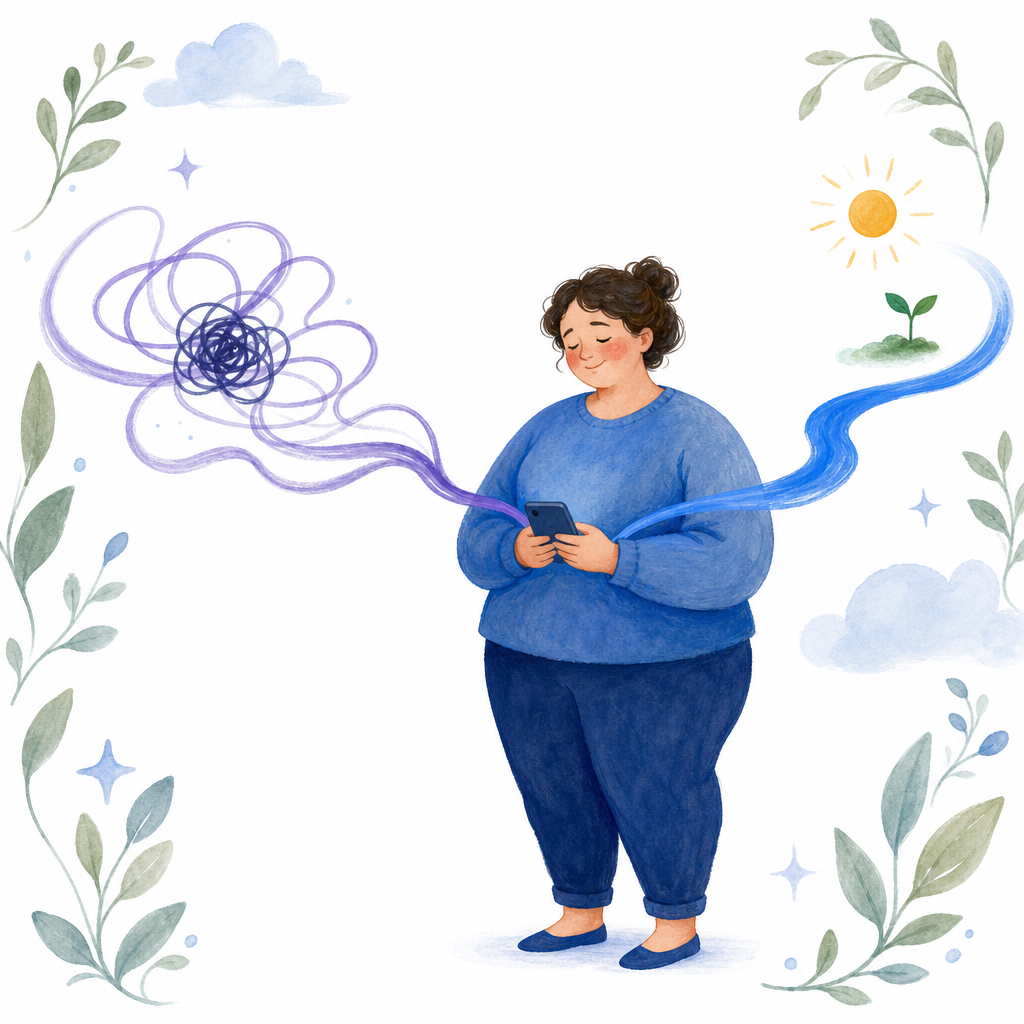
Consider four common examples:
- Body checking: Looking at a change once because a clinician recommended monitoring is different from repeatedly pressing, measuring, comparing, or scanning until certainty feels complete.
- Online research: Reading reliable guidance to decide where to seek care differs from opening dozens of pages, changing search terms, or rereading the same information to remove every possible doubt.
- Reassurance seeking: Clarifying a medical instruction differs from asking the same underlying question repeatedly, testing another person’s reaction, or seeking a new source when the previous answer stops feeling convincing.
- Avoidance: Pausing an activity while following medical advice differs from avoiding routine appointments, exercise, illness-related words, or everyday situations primarily to prevent anxiety.
The 2026 American Psychological Association overview says clinicians must distinguish intrusive obsessions from ordinary worries and establish whether a compulsive action is performed in direct response to an obsession. (apa.org)
A clinician may ask what catastrophe the action is meant to prevent, whether it follows private rules, how much time it consumes, and whether resisting it creates an urgent need to complete it. Catastrophizing, selective attention, and all-or-nothing conclusions may also appear among broader anxious thinking patterns.
The same behavior can be appropriate, anxiety-driven, or compulsive, so context and function must be assessed.
Why doesn’t reassurance settle the question?
Reassurance often lowers anxiety briefly without resolving the underlying intolerance of uncertainty or illness preoccupation. Because this can happen in both health anxiety and OCD, the length of relief is not a reliable way to diagnose yourself.
The reassurance loop
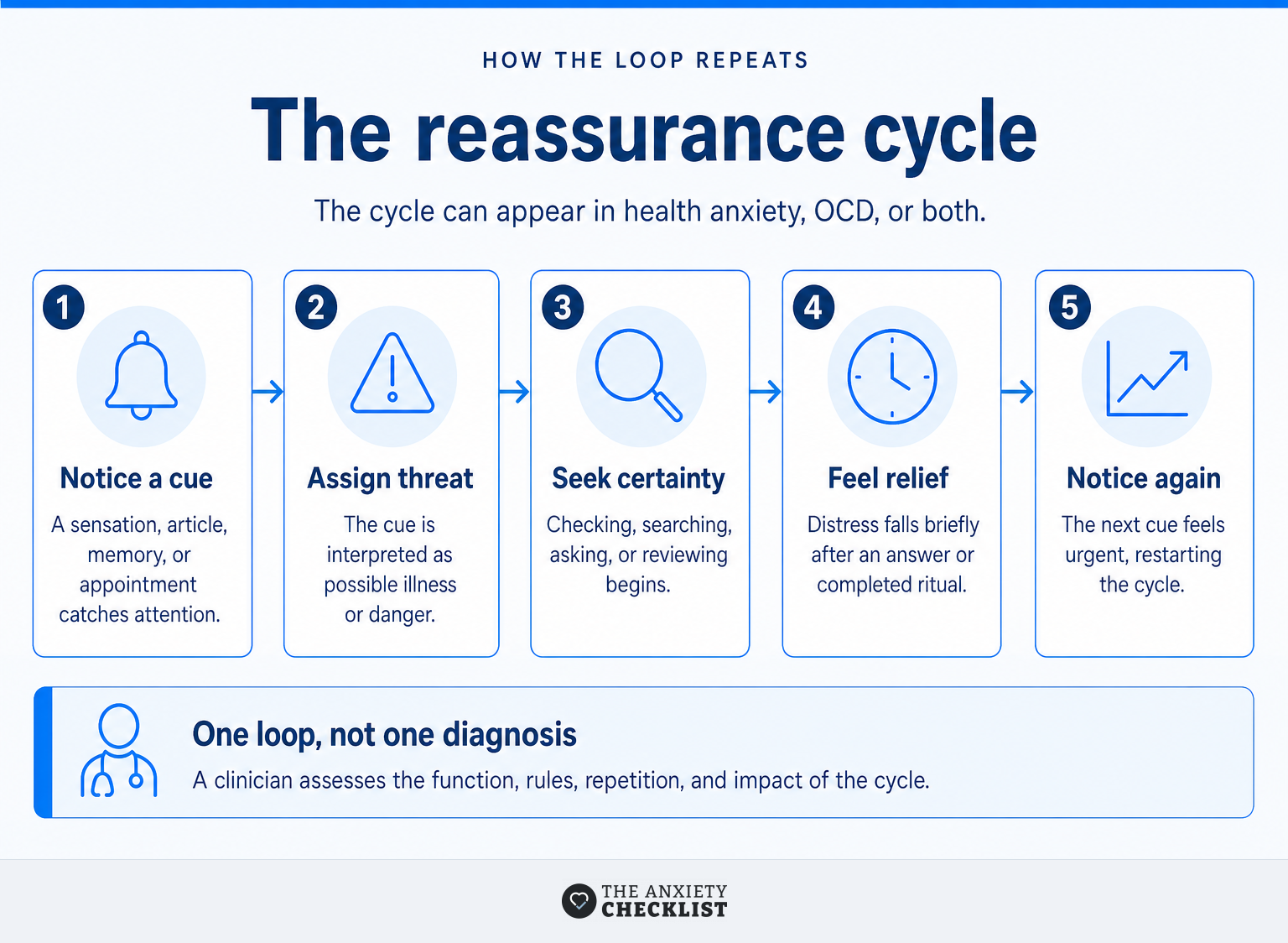
NHS guidance on health anxiety lists body checking, repeated reassurance, health-information searches, and fear that tests missed something. Oxford Health’s specialist health-anxiety guidance similarly explains that reassurance and checking can maintain attention on illness even after medical input. (nhs.uk)
In OCD, reassurance can function as a behavioral or mental ritual: doubt causes distress, reassurance reduces it, and the reduction teaches the person to seek reassurance again. Repetition can then make the next doubt feel more urgent rather than building lasting confidence. (apa.org)
Some online comparisons claim that reassurance works for health anxiety but immediately fails in OCD. The evidence does not support using that distinction as a personal test, because repeated reassurance and renewed doubt are documented in both patterns.
Brief relief after reassurance can occur in both patterns, so it cannot diagnose either one.
Can health OCD or health anxiety cause physical symptoms?
Anxiety can produce real physical sensations, and focused attention can make ordinary changes feel unusually prominent. Physical sensations do not reveal whether someone has OCD, illness anxiety disorder, another anxiety condition, a medical condition, or a combination of factors.
The NHS notes that anxiety can cause symptoms such as headaches or a racing heartbeat, which may then be interpreted as signs of illness. The American Psychiatric Association also distinguishes illness anxiety disorder from deliberate symptom fabrication; the fear and distress are genuine even when serious illness is not found. (nhs.uk)
The guide to illness anxiety disorder explains the broader pattern of persistent illness fears, repeated checking, reassurance seeking, care seeking, and care avoidance.
Neither this article nor an online anxiety assessment can determine the cause of a physical symptom. Seek appropriate medical advice for a new, severe, worsening, or otherwise concerning symptom, and use local emergency services when urgent help may be needed.
Physical sensations are real experiences, but they do not reveal whether the cause is anxiety, a medical condition, or both.
Why do professionals use different labels?
Professionals may be working from different diagnostic manuals, jurisdictions, or clinical formulations. The labels overlap, but they are not exact synonyms.
As of November 2026, the American Psychiatric Association’s DSM-5-TR framework places illness anxiety disorder among somatic symptom and related disorders, separate from OCD. The WHO’s 2024 ICD-11 clinical manual places hypochondriasis, also called health anxiety disorder, within obsessive-compulsive and related disorders and cross-lists it under anxiety and fear-related disorders. (psychiatry.org)
| Term | Usual meaning | Formal status |
|---|---|---|
| Health anxiety | A descriptive term for excessive illness fears and related behavior; it does not always name one diagnosis. | Descriptive umbrella term |
| Illness anxiety disorder | Persistent preoccupation with having or acquiring serious illness within the DSM framework. | Formal DSM diagnosis |
| Hypochondriasis or health anxiety disorder | The terminology used in ICD-11 for category 6B23. | Formal ICD-11 diagnosis |
| Health OCD or illness OCD | OCD in which illness, disease, bodily harm, or health uncertainty is the obsessional theme. | Informal OCD-theme label |
The classification disagreement does not mean that every case of health anxiety is OCD. It means a clinician must state which framework is being used and explain how the person’s symptoms meet that framework.
Different labels partly reflect different diagnostic systems, not a simple disagreement about whether the distress is real.
Does treatment differ?
Often, yes, although the approaches can share important elements. Treatment should target the process maintaining the cycle rather than relying only on whether the fear concerns illness.
For OCD, the National Institute of Mental Health describes exposure and response prevention as a specific form of CBT that involves encountering triggers in a planned setting while resisting the associated compulsion. Medication, commonly an antidepressant prescribed and monitored by a healthcare professional, may also be considered. (nimh.nih.gov)
Health-anxiety CBT may examine catastrophic interpretations, selective attention to sensations, repeated checking, reassurance, avoidance, and withdrawal from ordinary activities. Oxford Health identifies CBT as an evidence-based treatment and describes reducing reassurance and symptom checking as part of a broader, collaborative formulation. (oxfordhealth.nhs.uk)
Exposure methods are not exclusive to OCD. In the 2017 study, participants with severe health anxiety received an exposure and response prevention intervention and showed substantial reductions in health anxiety, although changes in general OCD symptoms were smaller. (pubmed.ncbi.nlm.nih.gov)
This overlap is one reason self-directed treatment based on a label can miss the target. A therapist may need to distinguish appropriate medical follow-up from compulsive testing, identify covert rituals such as mental review, and coordinate care when genuine medical needs are present.
Effective treatment targets the maintaining cycle identified in assessment, not the health-related topic by itself.
When should you get professional help?
Seek professional support when illness fears, rituals, checking, or avoidance repeatedly interfere with daily life or needed healthcare. Assessment is also useful when self-help has become another way to test, monitor, or seek certainty.
Signs that assessment may help
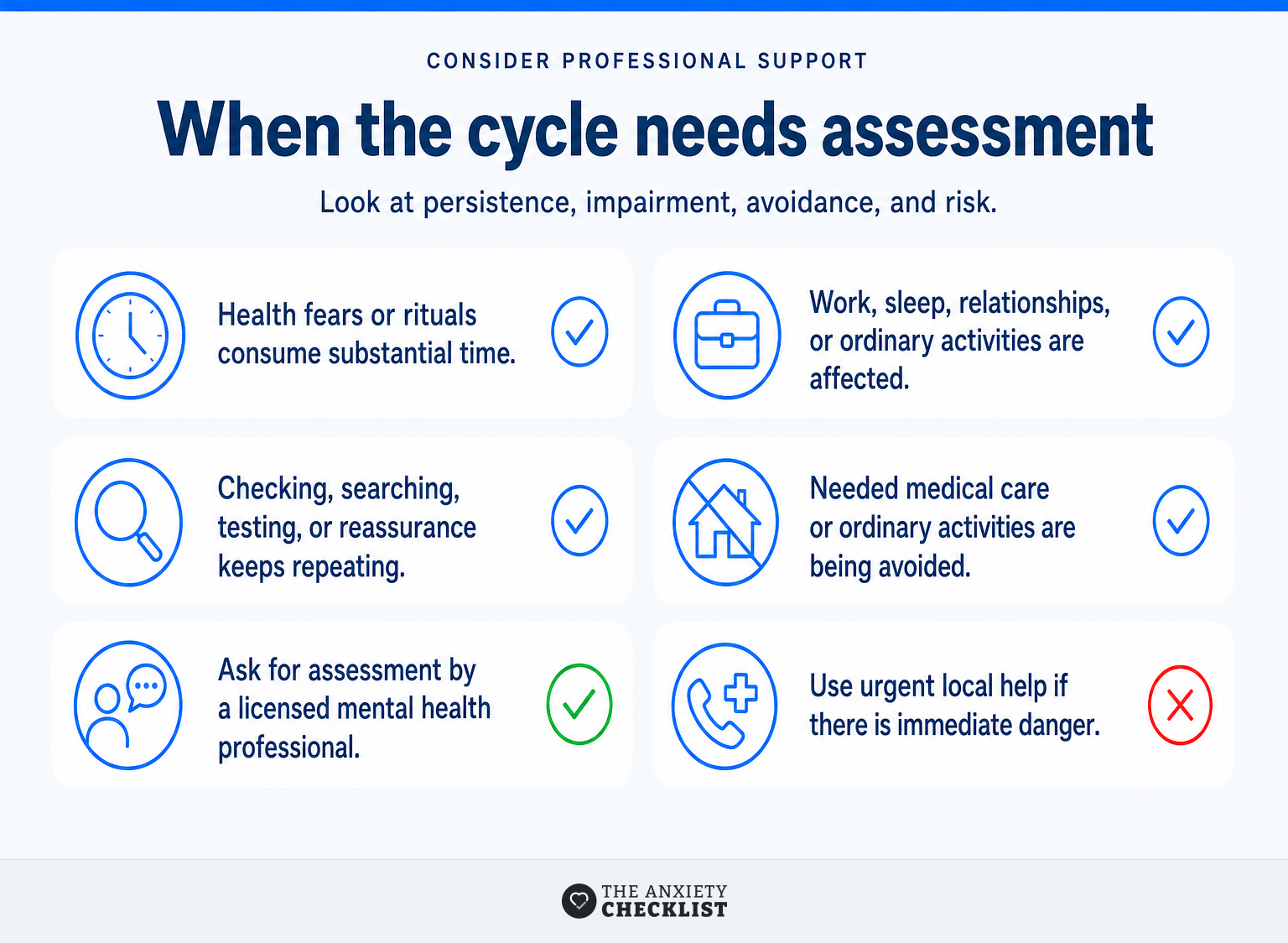
Consider speaking with a licensed mental health professional when:
- Health fears or rituals consume substantial time.
- Work, study, sleep, relationships, or ordinary activities are affected.
- The same checking, search, test, or reassurance request keeps returning.
- You avoid routine medical care, exercise, travel, media, or other activities because of fear.
- Mental reviewing, praying, counting, or repeating phrases is used to neutralize illness fears.
- You cannot tell which actions are appropriate healthcare and which are part of an anxiety cycle.
The guide to when to talk with a mental health professional can help organize that conversation. Look for a clinician who can assess both OCD and health anxiety rather than assuming that every illness fear belongs to one category.
If there is immediate danger, an urge to harm yourself or someone else, or an acute medical emergency, contact local emergency services or an appropriate crisis service. Anxiety Checklist is an educational self-help platform, not an emergency or diagnostic service.
Professional assessment is warranted when the cycle is persistent, distressing, risky, or disruptive.
What do people ask about health OCD and health anxiety?
The most common questions concern whether health anxiety is OCD, whether both can occur, and how treatment differs. The short answers below are educational and cannot identify an individual diagnosis.
Is health anxiety OCD?
Not necessarily. Health anxiety describes persistent fear or preoccupation about illness, while OCD requires obsessions, compulsions, or both. Health fears can become the theme of OCD, and some people meet criteria for both conditions. A clinician must assess the whole pattern rather than one behavior such as checking.
Can you have health anxiety and OCD at the same time?
Yes. A 2017 study comparing 290 people with severe health anxiety and 95 with OCD found some cross-diagnosis overlap, while concluding the groups had substantially different symptom profiles. Co-occurrence is possible, so a clinician should assess both instead of forcing every symptom into one label.
Is reassurance seeking a sign of health OCD?
No. Reassurance seeking occurs in both health anxiety and OCD, and it can also happen during ordinary health concerns. The clinically useful questions are how repetitive and rule-bound it becomes, what feared outcome it is meant to prevent, how much time it consumes, and whether it disrupts functioning.
What treatment is used for health OCD vs health anxiety?
Health-related OCD is commonly treated with OCD-focused CBT, especially exposure and response prevention, and sometimes medication. Health anxiety is commonly treated with CBT that addresses illness interpretations, attention, checking, reassurance, and avoidance; exposure methods may also be included. Treatment should follow an individual assessment, not an online label.
A diagnostic label is useful only when it improves the fit of care.
What should you do next?
Start by documenting the cycle rather than trying to settle the diagnosis yourself. For several days, note the trigger category, what you did next, how long the cycle lasted, and what activity it displaced, without cataloging bodily sensations in detail.
Bring those examples to a clinician and ask directly whether the pattern suggests OCD, illness anxiety disorder, another anxiety problem, or more than one condition. Include mental rituals and avoidance, which are easier to overlook than visible checking.
For a structured educational starting point, use Anxiety University’s educational assessments once to organize general anxiety symptoms and impairment before an appointment. These assessments cannot diagnose health OCD or illness anxiety disorder, and repeatedly retaking them for reassurance is unlikely to answer the comparison.
Use a label to choose appropriate help, not to chase perfect certainty.