

In short
An anxiety attack at work calls for three priorities: get physically safe, slow the escalation, and reduce demands until the symptoms settle. Step away if possible, lengthen your exhale, anchor attention to the room, and contact someone you trust. Seek urgent medical help for new, severe, or unusual symptoms.
Key takeaways
- New chest pain, severe breathing difficulty, fainting, or symptoms unlike previous attacks need medical assessment rather than an assumption that anxiety is responsible. MedlinePlus recommends immediate care for specific chest-pain warning signs.
- Slow, gentle breathing and sensory grounding can give attention a manageable task while the alarm settles. The NHS breathing exercise advises breathing without forcing the breath.
- A neutral sentence such as “I’m having a health issue and need a short break” can protect privacy while making the practical need clear.
- Return to work only when the symptoms have eased enough to perform the actual job safely, especially when the role involves driving, machinery, heights, or responsibility for other people.
- Recurrent attacks, persistent fear of another attack, or growing avoidance are reasons to speak with a qualified health professional. NIMH describes these as possible features of panic disorder.
Table of contents
- Is this an anxiety attack, a panic attack, or a medical emergency?
- What should you do in the first five minutes?
- How do you step away without explaining everything?
- How do you decide whether to return, go home, or get help?
- Should you tell your manager or ask for accommodations?
- How can you prepare for another anxiety attack at work?
- When should you get professional or urgent help?
- What else do people ask about anxiety attacks at work?
- What should you do next?
“Anxiety attack” is common language rather than a precise diagnosis. Healthdirect Australia distinguishes anxiety that builds around stress from a panic attack that comes on suddenly, but a person at work does not need a perfect label before taking sensible safety steps.
This guide provides educational self-help information. It cannot diagnose symptoms or replace medical or emergency care.
Is this an anxiety attack, a panic attack, or a medical emergency?
You do not need to diagnose the episode before acting, but you do need to check for danger. Treat sudden fear with a racing heart, shaking, dizziness, breathlessness, nausea, chest discomfort, or a sense of losing control as possible panic, while treating new, severe, or unusual physical symptoms as a possible medical problem.
The National Institute of Mental Health says panic attacks can include a pounding heart, sweating, trembling, breathing difficulty, dizziness, tingling, nausea, chest pain, and fear of losing control or dying. The symptoms can feel similar to a heart attack.
A panic attack usually begins suddenly and reaches its most intense point within minutes. Anxiety linked to a deadline, conflict, meeting, or feared mistake may rise more gradually, although the experiences can overlap.
Do not assume that chest pain or breathing difficulty is “just anxiety,” especially during a first episode. Seek emergency care if chest pain does not go away, feels like crushing pressure, or occurs with severe shortness of breath, fainting, unusual sweating, nausea, or marked dizziness, as advised by MedlinePlus chest-pain guidance.
When symptoms are new, severe, or medically unusual, choose safety over assuming anxiety is the cause.
What should you do in the first five minutes?
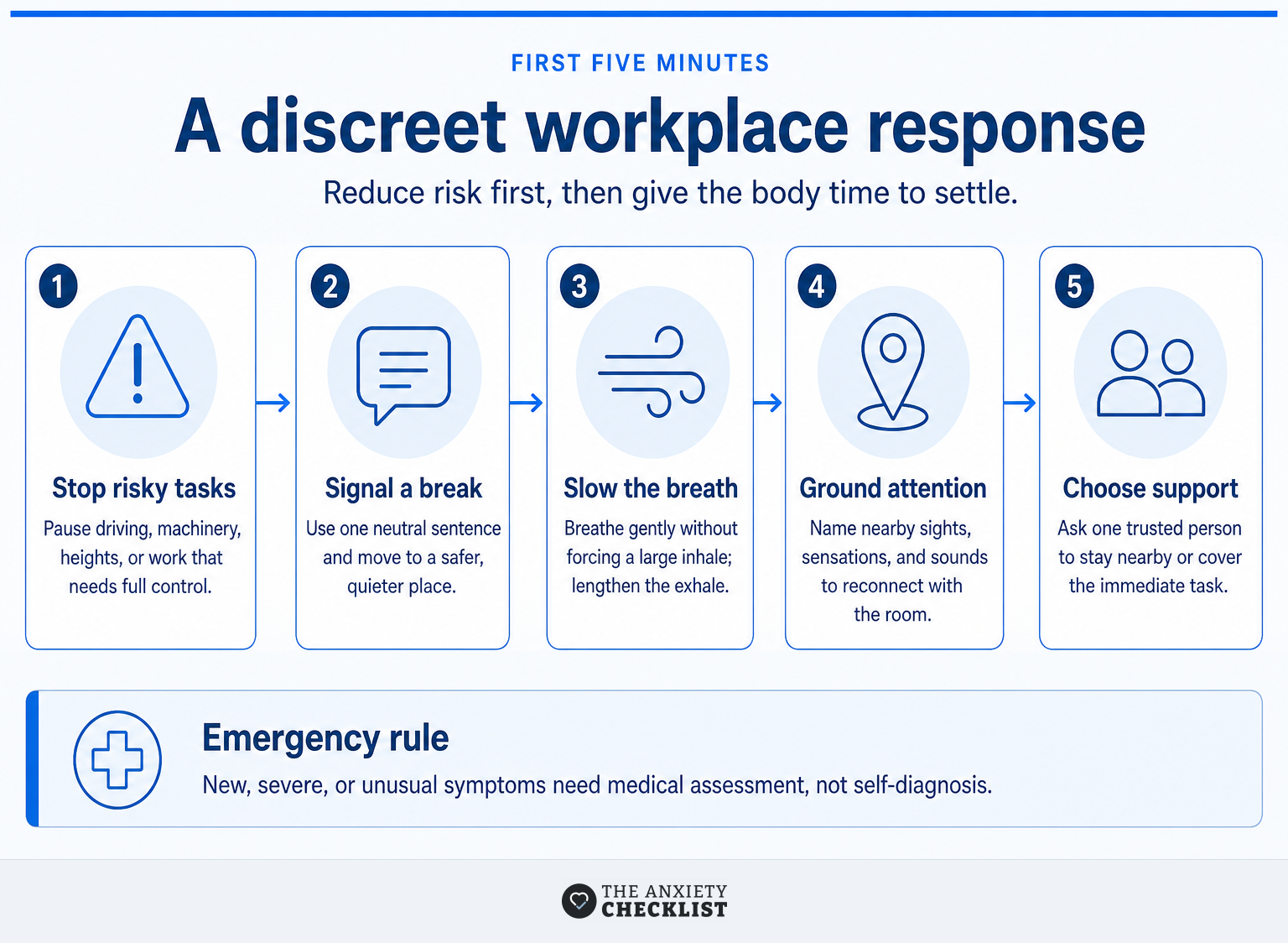
In the first five minutes, lower the risk of injury and reduce what the brain must manage. If you are having an anxiety attack at work, pause the task, move to a safer setting if possible, and use one practiced technique rather than trying to fix every symptom at once.
1. Stop any task that could become unsafe
Put down tools, stop operating machinery, move away from an exposed edge, and do not continue driving. If another person depends on your attention, ask a coworker to take over immediately.
This is not failure or avoidance. It is a temporary safety decision while concentration, balance, breathing, or vision may be affected.
2. Use one sentence to create space
Say what is happening at the level the other person needs to know:
“I’m having a health issue and need ten minutes in a quiet place.”
If the task needs immediate coverage, add the handoff:
“Please take over this station while I step away.”
3. Make the breathing slower, not bigger
Place both feet on the floor or sit somewhere supported. Breathe in gently through the nose and let the breath out slowly through the mouth, counting only as far as feels comfortable.
Do not repeatedly force a huge inhale. The NHS breathing exercise for stress, anxiety, and panic advises allowing the breath to move as deeply as is comfortable without forcing it.
4. Give attention a concrete job
Try a shortened sensory check if the full exercise feels too difficult. Name three things you can see, two sensations you can feel, and one sound you can hear.
If more structure helps, use the full 5-4-3-2-1 sequence described in these grounding techniques at work: five things seen, four felt, three heard, two smelled, and one tasted. Kent Community Health NHS guidance notes that simplifying the sequence is reasonable when panic makes the full version hard to follow.
5. Choose one person or tool for support
Ask one trusted coworker to stay nearby, bring water, cover a call, or help you reach a safer place. Specific requests are easier to follow than “I need help.”
Knowing how to handle anxiety attacks at work means practicing this short sequence while calm, so the steps require less thought when symptoms rise.
The goal of the first five minutes is not perfect calm; it is safety, lower stimulation, and one manageable next action.
How do you step away without explaining everything?

You can leave briefly without giving coworkers a diagnosis or a full personal history. Use a short health-based sentence, name the practical need, and state what should happen to the immediate task.
Useful scripts include:
- At a desk: “I’m feeling unwell and need a short break. I’ll message you in ten minutes.”
- During a meeting: “I need to step out for a health issue. Please continue without me.”
- In a safety-sensitive role: “I’m not safe to continue this task right now. Please arrange cover.”
- During a video call: “I need to leave the call briefly. I’ll update you when I can return.”
- With a trusted coworker: “I’m having a panic episode. Please stay nearby and help keep people from crowding me.”
Choose a place that reduces stimulation without creating another risk. An unused meeting room, staffed reception area, break area, or outdoor space may be suitable. Avoid locking yourself alone somewhere if you feel faint, confused, medically unwell, or at risk of harming yourself.
If leaving is impossible, reduce demands where you are. Sit down, place both feet on the floor, turn off a camera if workplace rules allow, silence nonessential notifications, and ask someone to handle the next immediate interruption.
A short health-based script can protect privacy while still giving other people enough information to keep the work and the person safe.
How do you decide whether to return, go home, or get help?
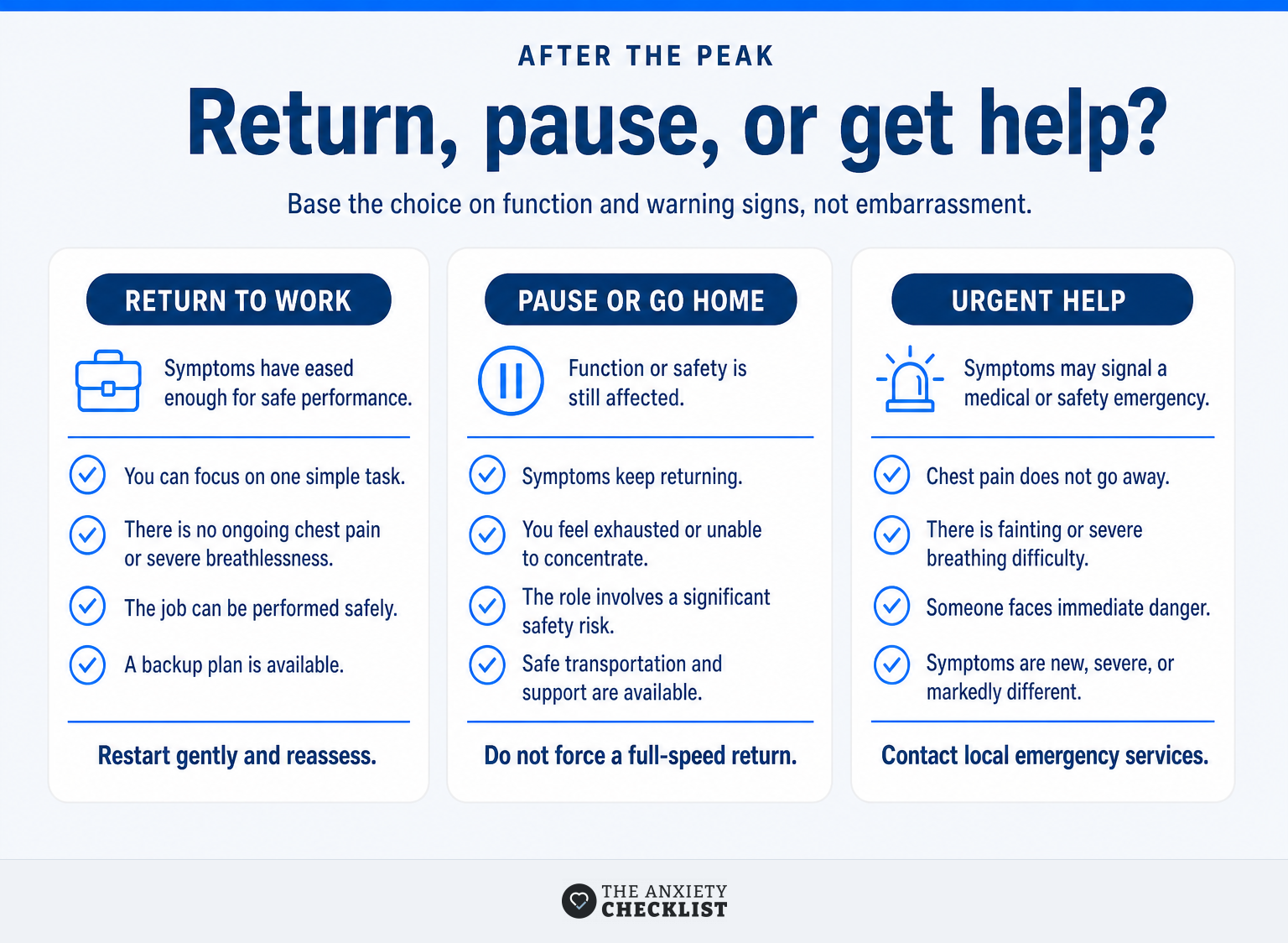
Choose among returning, taking more time or leaving, and seeking urgent care according to function and warning signs. The useful question is not whether the embarrassment has passed; it is whether you can safely perform the actual job.
Return to work gradually
A return may be reasonable when symptoms have clearly eased, you can focus on a simple task, and there is no continuing chest pain, faintness, severe breathlessness, or other warning sign. Start with a low-demand task rather than immediately entering another difficult meeting or operating equipment.
Tell one person if you may need another break. Reassess after a short period instead of committing to the rest of the day while still recovering.
Take more time or go home safely
A longer pause may be appropriate when symptoms keep returning, concentration remains poor, or the episode leaves you exhausted. Mayo Clinic’s March 2026 overview notes that people can feel fatigued after a panic attack subsides.
Do not drive yourself if you remain dizzy, faint, confused, or unable to concentrate. Arrange safe transportation or ask someone to stay with you when needed.
Once steadier, make a brief record of the time, symptoms, possible trigger, caffeine or substance use, sleep, and what helped. The record may help a health professional identify patterns, but it does not need to become a minute-by-minute analysis of every sensation.
Seek urgent medical help
Contact local emergency services for chest pain that does not go away, loss of consciousness, severe breathing difficulty, immediate danger, or symptoms that are markedly different from previous episodes. A first or unfamiliar episode may also need prompt medical assessment because heart, respiratory, thyroid, medication, and other conditions can resemble panic.
Return to work only when the episode has eased enough for safe performance; productivity should not outrank medical or workplace safety.
Should you tell your manager or ask for accommodations?
The immediate explanation can remain brief, but recurring episodes or a recurring workplace barrier may justify a planned conversation. Focus on the work limitation and the specific change that could help, rather than feeling required to describe every symptom or personal detail.
A practical request has three parts:
- The barrier: “Acute symptoms sometimes make it difficult to remain in a crowded meeting.”
- The work effect: “I may need to step out briefly before I can continue safely.”
- The requested change: “Could I sit near the exit and take a short unscheduled break when symptoms begin?”
As of October 2026, U.S. Equal Employment Opportunity Commission guidance says some employees with qualifying mental health conditions may have a right to reasonable accommodation under the Americans with Disabilities Act. Possible examples include modified break or work schedules, a quieter workspace, written instructions, changes in supervisory methods, specific shift assignments, leave, or telework when appropriate.
In the United States, a request can use plain language and does not need to mention the ADA. An employer may request reasonable documentation when the condition or need is not obvious, and an employer is not required to remove essential job duties or accept an accommodation that creates undue hardship.
Employment and disability laws differ by country and sometimes by state, province, or territory. Outside the United States, check local guidance or speak with an appropriate human-resources contact, occupational-health service, union representative, disability adviser, or employment professional.
Ask for the smallest specific change that addresses the work barrier, then review whether it actually helps.
How can you prepare for another anxiety attack at work?
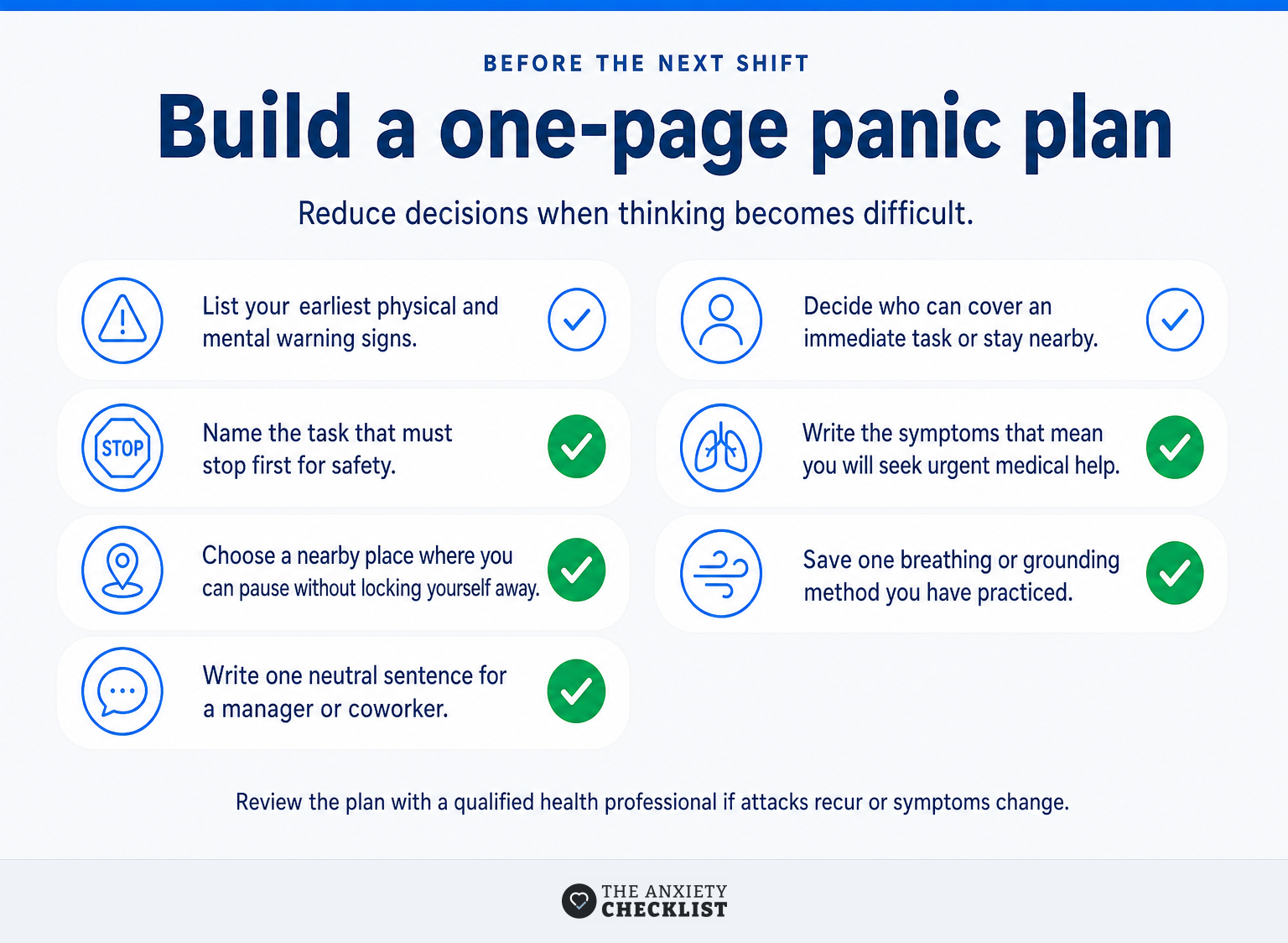
Prepare a one-page response while calm so fewer decisions are required when symptoms rise. The plan should identify early signs, immediate safety steps, a discreet exit sentence, available support, and the warning signs that require medical help.
Include these details:
- Your earliest signs, such as tingling, racing thoughts, feeling overheated, breathlessness, or an urge to escape.
- The first task that must stop for safety.
- A nearby place where you can pause.
- The sentence you will use with a manager or coworker.
- One breathing or grounding method you have already practiced.
- One person who can cover a task or remain nearby.
- A plan for transportation if you cannot safely drive.
- The symptoms that mean you will contact emergency services.
- The clinician, employee assistance program, occupational-health service, or other professional resource you can contact afterward.
Do not make an irreversible employment decision in the minutes after an attack. If it feels like the job is so bad it is giving you panic attacks, separate the immediate episode from the larger question about workload, conflict, role clarity, support, or safety.
A pattern of daily dread needs a broader plan than emergency grounding alone. The guide on how to deal with work anxiety explains how to examine triggers, anxious predictions, workplace conditions, boundaries, and longer-term coping.
Repeated avoidance can make work life progressively smaller. NIMH notes that people with panic disorder may begin avoiding places where attacks occurred or changing their behavior because they fear another attack, which is a reason to seek assessment rather than continually redesigning life around panic.
A written workplace panic plan turns a frightening unknown into a short set of decisions that can be practiced, reviewed, and improved.
When should you get professional or urgent help?
Arrange professional help when attacks recur, symptoms are changing, or fear and avoidance begin affecting attendance, performance, travel, sleep, or ordinary activities. Seek urgent help immediately when symptoms suggest a medical emergency or there is a risk of harm.
Speak with a qualified health professional when:
- This is the first episode and the cause is unclear.
- Attacks are recurring or becoming more intense.
- You spend substantial time worrying about the next attack.
- You avoid meetings, travel, buildings, shifts, or other necessary situations.
- Symptoms interfere with work, relationships, sleep, or basic daily tasks.
- Medication, caffeine, alcohol, drugs, or a physical condition could be contributing.
A clinician can assess possible physical causes and discuss appropriate treatment. NIMH reports that panic disorder can be treated with psychotherapy, medication, or both, with cognitive behavioral therapy commonly used to address panic symptoms and the fear surrounding them.
If you may harm yourself or someone else, contact local emergency services. In the United States, call 911 for immediate danger or a medical emergency, and call or text the 988 Suicide & Crisis Lifeline for crisis support. Readers elsewhere can find crisis and emergency resources by country.
Recurring attacks deserve assessment and a plan; emergency warning signs deserve immediate action.
What else do people ask about anxiety attacks at work?
These are common questions after the immediate episode has passed. Each answer assumes there is no active medical emergency.
What are some home remedies for a panic attack?
Self-help measures for a familiar panic attack include moving to a safe, quieter place, breathing slowly without forcing a large inhale, grounding attention through the senses, and contacting someone trusted. These measures can help you ride out symptoms, but chest pain, fainting, severe breathlessness, or unfamiliar symptoms require medical assessment.
What are the symptoms of panic disorder, according to the Mayo Clinic?
Mayo Clinic’s March 2026 overview lists sudden intense fear plus a pounding heart, sweating, shaking, breathlessness, nausea, chest pain, dizziness, tingling, and unreality. Its diagnosis guidance explains that panic disorder involves recurrent unexpected attacks followed by ongoing worry or behavior changes, not simply one stressful episode.
Should I leave work if I am having an anxiety attack?
Not always. Step away from the immediate task first, especially if it involves driving, machinery, heights, or responsibility for someone else’s safety. Return only when symptoms have eased enough for safe performance. Go home, with safe transportation if needed, when symptoms persist, recur, or leave you unable to function.
Can I ask for workplace accommodations for panic attacks?
In the United States, a qualifying mental health condition may support a reasonable-accommodation request under the ADA. Examples can include adjusted break timing, a quieter workspace, schedule changes, or written instructions. Eligibility and documentation depend on the circumstances, and employment laws differ in other countries, so check local guidance.
When should I call emergency services instead of treating it as anxiety?
Contact local emergency services when chest pain does not go away, breathing difficulty is severe, you faint or lose consciousness, symptoms are new or markedly different, or someone faces immediate danger. Do not assume a first or unusual episode is anxiety. A medical professional can rule out other causes.
Self-help is appropriate only when the symptoms are familiar and no emergency warning signs are present.
What should you do next?
Prepare one small plan before the next shift rather than waiting for symptoms to choose the plan for you. Write a one-sentence exit script, identify the first task you would stop, and save SOS support during a panic attack somewhere it can be reached quickly.
Anxiety Checklist’s free SOS flow requires no sign-up and uses voiced affirmations to guide the next few minutes. It is an educational self-help tool, not medical treatment or an emergency service.
The goal is not to hide the episode perfectly; it is to get safe, reduce the alarm, and make the next response easier.