

In short
Work anxiety is easier to manage when the immediate alarm is separated from the workplace problem causing it. Before work, name the trigger and choose one next task. During work, slow the breathing and ground attention. After work, review the thought, set a boundary, and seek help if anxiety keeps disrupting daily life.
Key takeaways
- Work anxiety may reflect anxious predictions, workplace conditions, or both, so the response should match the source.
- Excessive demands, low control, weak support, conflict, unclear roles, and poorly managed change are recognized work-stress risks. (hse.gov.uk)
- A sensory grounding exercise and gentle breathing can interrupt an anxiety spike long enough to choose one next action. (my.clevelandclinic.org)
- A CBT thought record tests a feared prediction against evidence instead of replacing it with forced positivity. (nhs.uk)
- Persistent or severe symptoms that impair basic tasks, sleep, or attendance warrant professional help. (nimh.nih.gov)
Table of contents
- Why does work make you so anxious?
- What can you do before work to stop the dread building?
- What can you do when anxiety spikes during the workday?
- How can you stop replaying work after you log off?
- How do you use CBT for a work-anxiety thought?
- Should you tell your manager or ask for changes at work?
- If your job gives you anxiety, should you quit?
- When does work anxiety need professional help?
- What else do people ask about work anxiety?
- What should you do next?
Work anxiety is a practical description, not a diagnosis. It can include dread before a shift, racing thoughts after an email, fear of mistakes, panic before meetings, difficulty concentrating, or an inability to switch off after logging out.
This guide focuses on anxiety connected to current duties and workplace conditions. A persistent, overwhelming fear attached to work more broadly may fit the different pattern discussed in fear of work versus work anxiety.
For anyone asking how to deal with anxiety about work, the first task is to identify whether the alarm comes mainly from an uncertain prediction, a genuine workplace problem, or both.
Why does work make you so anxious?
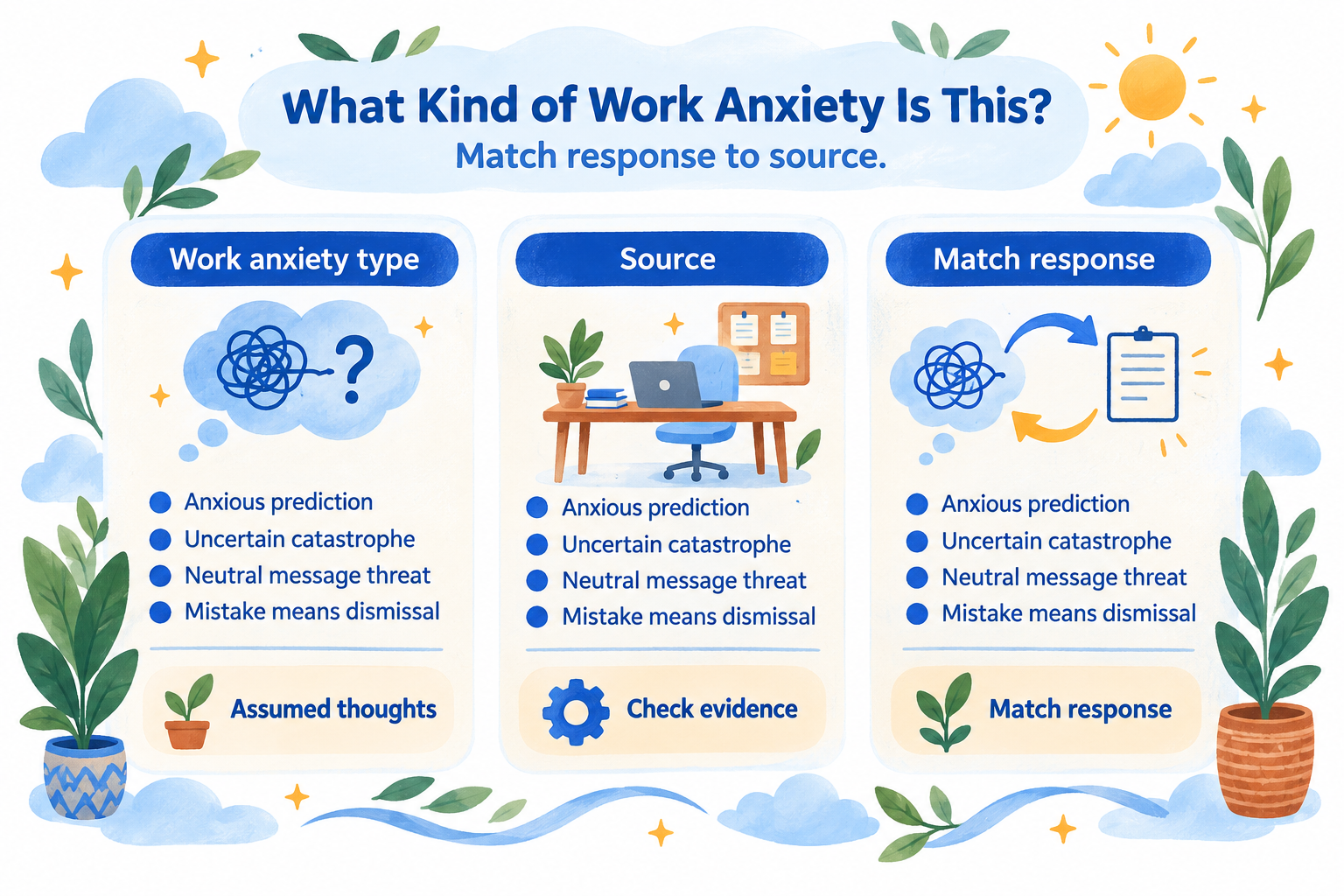
Work can cause anxiety because a job contains real psychosocial risks, because the mind predicts danger around uncertain events, or because both processes are happening together. The most useful first question is not whether the anxiety is justified, but what happened, what outcome was predicted, and what part of the situation can change.
The WHO's 2024 mental health at work fact sheet identifies excessive workloads, long or inflexible hours, little control, limited support, bullying, discrimination, unclear roles, job insecurity, and conflicting work and home demands as workplace risks to mental health. These are conditions to address, not personal failures to breathe through. (who.int)
The United Kingdom's updated 2025 HSE Management Standards group work-design risks into six areas: demands, control, support, relationships, role, and change. The framework is jurisdiction-specific, but the categories provide a useful trigger checklist for workers elsewhere. (hse.gov.uk)
Use three buckets when reviewing a difficult workday:
- Anxious prediction: An uncertain event is treated as a certain catastrophe. A short meeting invitation becomes proof of dismissal, or a correction becomes proof of incompetence.
- Workplace condition: The strain is observable and recurring, such as understaffing, contradictory priorities, harassment, unsafe work, or messages that continue throughout personal time.
- Both: A genuinely demanding environment is intensified by catastrophic predictions, perfectionism, overchecking, or avoidance.
The NHS work-related stress guidance lists patterns such as jumping to the worst-case conclusion, blaming oneself, avoiding tasks, working longer hours, losing confidence, and withdrawing. A pattern matters more than one bad morning. (nhs.uk)
For five workdays, record the time, trigger, feared outcome, physical response, action taken, and what happened next. Compare the notes with these common anxiety triggers to identify repeated people, tasks, times, and uncertainties.
The right plan begins by separating an anxious prediction from a work condition that genuinely needs to change.
What can you do before work to stop the dread building?
Before work, reduce the day to one named trigger, one realistic response, and one defined first action. The goal is not to feel completely calm before starting, but to arrive with fewer unresolved decisions.
Use this short preparation routine:
- Name the trigger: Write one sentence, such as “The client presentation at 10 is triggering anxiety.”
- Separate fact from prediction: The fact is that a presentation is scheduled. The prediction may be that one pause will destroy professional credibility.
- Choose the first visible action: Open the slides and check the first transition, rather than mentally rehearsing the entire meeting.
- Identify the needed support: Decide whether the problem requires clarification, a changed deadline, written priorities, or a private conversation.
The NHS breathing exercise, reviewed in June 2026, recommends breathing as deeply as is comfortable without forcing it, gently inhaling through the nose and exhaling through the mouth. Counting steadily can help, but the breath should remain comfortable. (nhs.uk)
Preparation has become rumination when it keeps generating hypothetical disasters without changing the plan. End the routine once the trigger, first action, and support option are clear.
Before work, shrink the day to one trigger, one realistic response, and one first action.
What can you do when anxiety spikes during the workday?
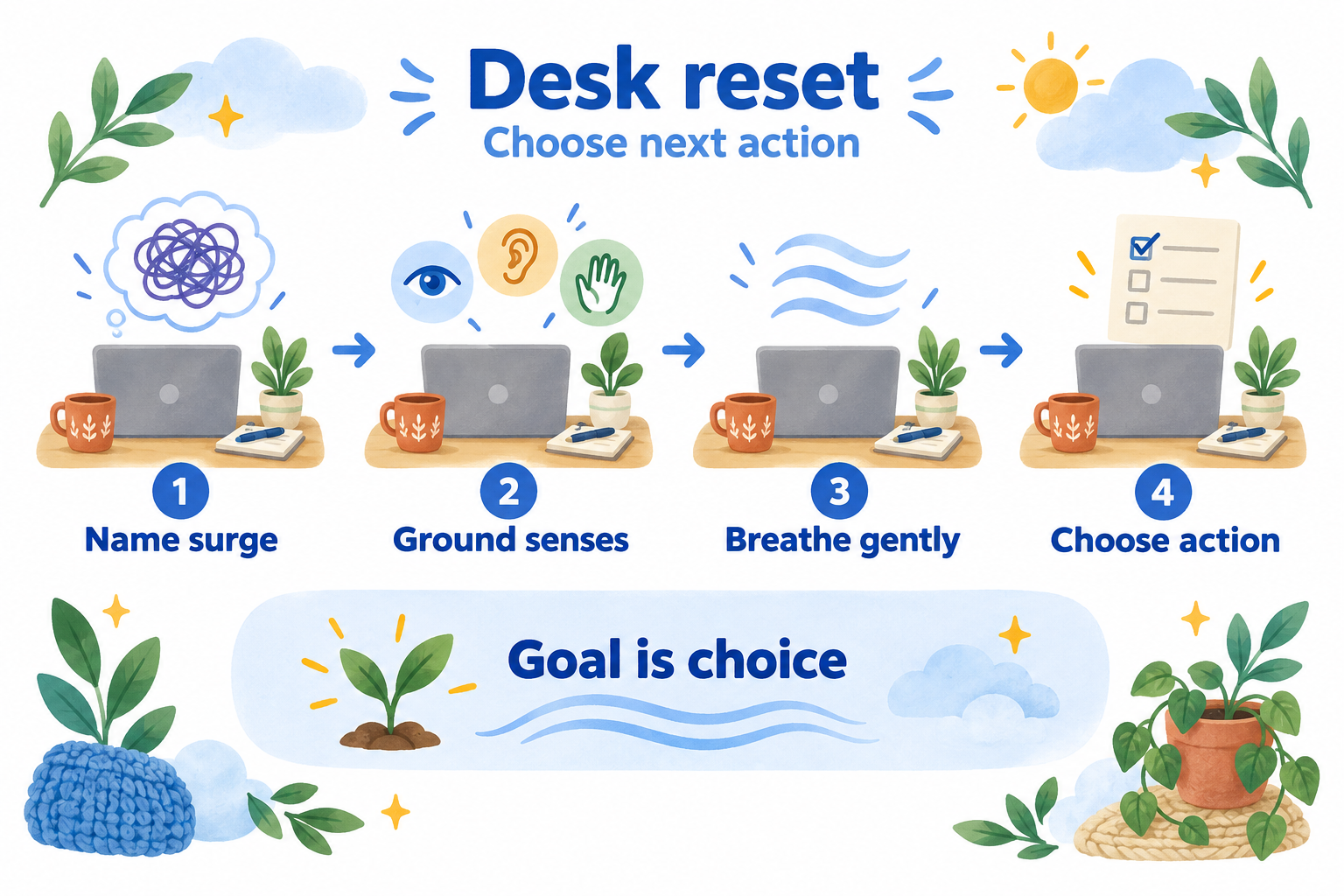
When anxiety rises at work, pause the prediction, orient to the present environment, settle the breathing, and choose the smallest useful action. Complete calm is not required before returning to a task or asking for support.
The 3-3-3 exercise is an informal grounding method. Cleveland Clinic's grounding explanation describes looking for three things that can be seen, three that can be heard, and three that can be touched. The exercise redirects attention from a feared future to the immediate surroundings. (my.clevelandclinic.org)
Follow grounding with a few slow, comfortable breaths. Then ask: “What is the next observable action?” The answer might be opening a document, writing three bullets, requesting clarification, moving to a quieter space, or telling a colleague that a short pause is needed.
Learning how to cope with anxiety at work does not mean hiding every symptom. If the same surge keeps appearing around an impossible workload, a particular person's behavior, or constantly changing instructions, record the pattern and address the condition rather than treating each episode as an isolated failure.
The purpose of an in-the-moment reset is to restore choice, not to prove that anxiety must disappear before work can continue.
How can you stop replaying work after you log off?

Create a deliberate stopping point by recording unfinished work, choosing the first task for the next work period, and closing work channels when the role allows it. A short transition activity can then mark the change from working time to personal time.
Use a four-part shutdown:
- Record what was completed without grading the entire day.
- Write the first next action for anything unfinished.
- Close work tabs and silence notifications when job duties permit.
- Change context through a walk, shower, meal, music, or another ordinary transition cue.
The NHS advises taking breaks, finishing on time, switching off notifications outside working hours, and agreeing realistic deadlines and workloads where possible. Some roles require on-call availability, so the boundary must fit the actual job rather than an ideal schedule. (nhs.uk)
If a review is needed, keep it brief and factual: what happened, what was predicted, what evidence emerged, and what action belongs to the next work period. Repeating the same imagined conversation all evening is not additional preparation.
After work, close practical loops once so the mind does not have to keep rehearsing them all evening.
How do you use CBT for a work-anxiety thought?
Use CBT by recording the event, automatic thought, emotion, evidence for and against the thought, and a more balanced alternative. The aim is not to prove that every situation is safe, but to replace an unsupported certainty with the most accurate interpretation available.
The NHS thought record uses seven prompts covering the situation, feelings, unhelpful thoughts, supporting evidence, contrary evidence, an alternative thought, and the resulting emotional change. The written record makes the prediction available for examination instead of leaving it as a repeated mental alarm. (nhs.uk)
For more background, read how CBT connects thoughts, feelings, and behavior.
| CBT prompt | Work example |
|---|---|
| Situation | A manager sends: “Can we talk at 3?” |
| Initial feeling | Anxiety, rated 85 out of 100 |
| Automatic thought | “A serious mistake has been found and dismissal is coming.” |
| Evidence supporting it | The meeting was unexpected and no subject was provided. |
| Evidence against it | No warning or criticism has been given, current deadlines were met, and short invitations are common. |
| Balanced thought | “The reason for the meeting is unknown. Feedback is possible, but dismissal is not established by this message.” |
| Next action | Check the current project status and prepare two factual questions. |
A balanced thought should be credible, not cheerful. “Everything will be fine” is usually less useful than “The outcome is not known, and the available evidence does not establish the worst case.”
A thought record is also a test of the environment. If the evidence confirms repeated humiliation, retaliation, unsafe demands, or unmanageable priorities, cognitive reframing should not be used to explain away the problem.
WHO's 2022 mental health at work guideline conditionally recommends individual approaches based on CBT, mindfulness, or problem solving for workers experiencing distress. WHO rates much of the workplace-specific evidence as low or very low certainty, so these tools should support, not replace, organizational changes and individualized clinical care when needed. (iris.who.int)
Use one real trigger: The guided CBT Thought Journal follows a practical sequence: define the worry, spot the thinking trap, balance the thought, and rewrite it in more grounded terms. It is an educational self-help tool, not a diagnosis or replacement for professional care.
A useful CBT response is accurate enough to guide the next action, not positive enough to erase every uncomfortable feeling.
Should you tell your manager or ask for changes at work?
Talk to a manager, human-resources contact, union representative, or other appropriate person when a recurring work factor needs a work-level solution. A request is easier to act on when it identifies the barrier, its effect on the task, and one specific change that could help.
A conversation can focus on work without beginning with a diagnosis:
Current priorities are changing faster than the available time. Could the two most important outcomes for this week be agreed, along with what can wait?
Other specific requests might include written priorities, fewer conflicting deadlines, a quieter work area, predictable check-ins, adjusted break timing, clearer role boundaries, or time for health appointments.
As of September 2026, U.S. EEOC guidance on mental health conditions at work states that qualifying employees may have a right to reasonable accommodation under the Americans with Disabilities Act. Possible examples include modified schedules, quiet space, written instructions, altered supervisory methods, or specific shift assignments. Eligibility depends on the facts, and laws differ outside the United States. (eeoc.gov)
WHO also lists flexible hours, modified assignments, time for appointments, extra time for tasks, and regular supportive meetings as examples of workplace accommodations. A suitable change depends on the role, the barrier, local law, and what the employer can reasonably provide. (who.int)
Bullying, discrimination, threats, and unsafe conditions are not breathing problems. Record dates, exact events, witnesses, and prior reports, then seek appropriate workplace, union, regulatory, legal, or clinical advice for the relevant jurisdiction.
Ask for a specific work change tied to a specific barrier, not a vague promise that work will become less stressful.
If your job gives you anxiety, should you quit?
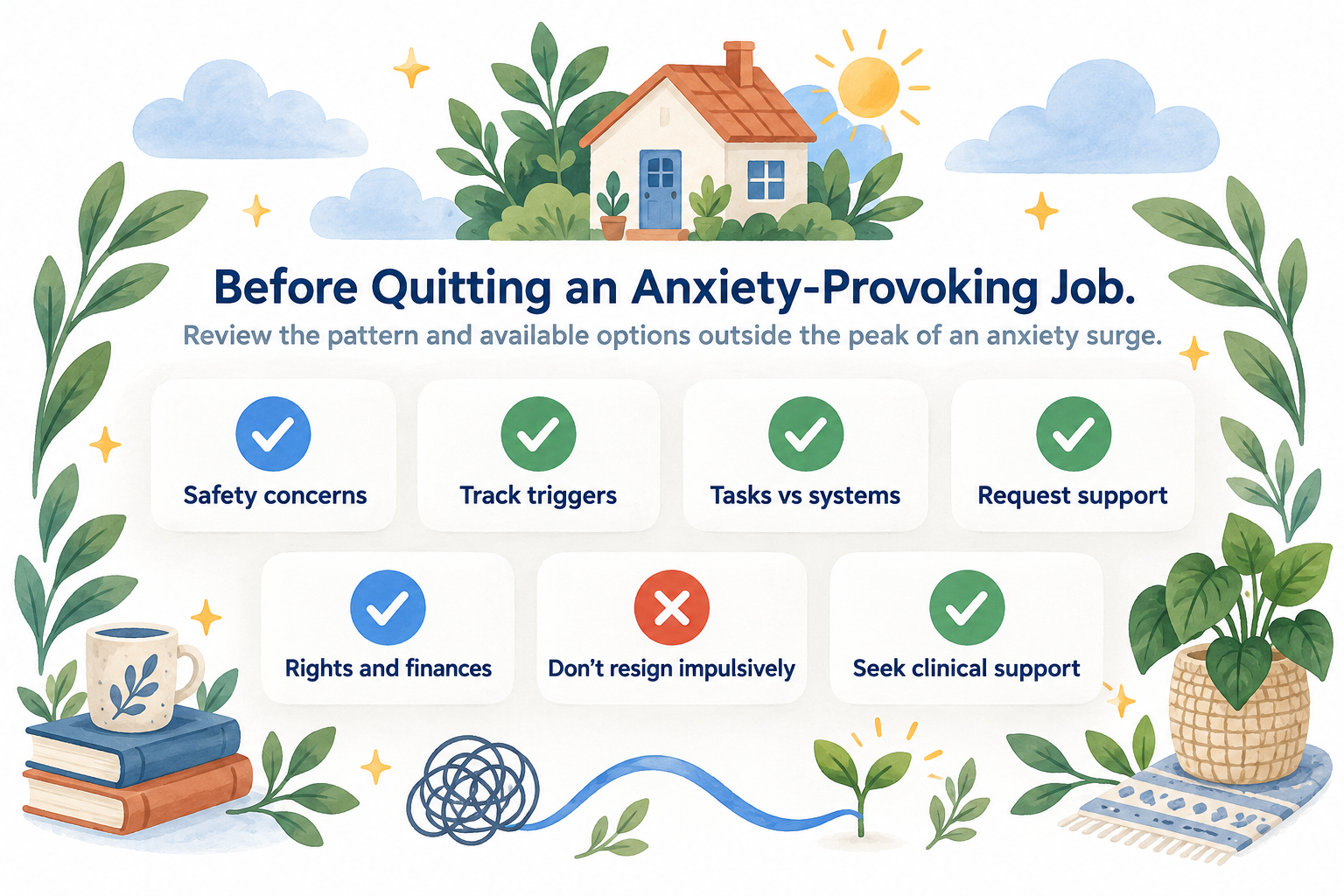
Avoid making a permanent decision at the peak of an anxiety surge unless immediate safety requires leaving the situation. A sound decision considers the pattern, the workplace's response, the effect on health and functioning, and the practical options available before resignation.
Before resigning, consider these questions:
- Does anxiety center on one role, manager, task, or workplace, or does it appear across unrelated jobs and situations?
- Which parts are changeable through priorities, training, boundaries, scheduling, support, or accommodation?
- Has one clear request been made, if making that request feels safe?
- Is the environment unsafe, discriminatory, retaliatory, or persistently harmful?
- What leave, benefits, notice, legal rights, health coverage, and financial runway apply locally?
- Is anxiety impairing sleep, attendance, concentration, relationships, or basic daily tasks?
- Could a clinician help assess whether treatment, leave, a workplace change, or departure is the safer next step?
Leaving may be reasonable when a workplace remains unsafe or harmful, needed changes are unavailable, or health continues to deteriorate. Staying temporarily may also be reasonable while a support request, treatment plan, transfer, or job search is underway.
Neither staying nor leaving proves strength. The decision should reduce avoidable harm without treating resignation as the only available anxiety-relief technique.
Quitting is a work-and-health decision, not an anxiety test that must be passed while distressed.
When does work anxiety need professional help?
Seek professional help when work anxiety is severe, persistent, worsening, or interfering with ordinary functioning. Support can also be appropriate earlier when panic, avoidance, sleep disruption, physical symptoms, or fear of attending work is becoming difficult to manage.
NIMH's 2025 mental-health guide advises seeking professional help for severe symptoms lasting two weeks or more, including difficulty concentrating, making simple decisions, or completing tasks. Symptoms do not need to reach a two-week threshold when safety is at risk or deterioration is rapid. (nimh.nih.gov)
Contact a qualified health professional when:
- anxiety repeatedly prevents attendance or task completion;
- panic or dread is spreading beyond work;
- sleep, appetite, mood, or relationships are being significantly affected;
- coping methods are no longer enough;
- physical symptoms are new, severe, or unexplained;
- hopelessness or thoughts of self-harm appear.
Self-help tools can support reflection and coping, but they do not provide diagnosis, psychotherapy, medication management, or emergency care. If there is immediate danger or a risk of self-harm, contact local emergency or crisis services. In the United States and its territories, call or text 988; call 911 for a life-threatening emergency. (nimh.nih.gov)
Professional help is appropriate when work anxiety is controlling daily life, not only when every self-help option has failed.
What else do people ask about work anxiety?
These answers address common questions without treating one coping method as a complete solution. The appropriate response still depends on whether the main problem is an anxious prediction, a workplace condition, or both.
What is the 3-3-3 rule of anxiety?
The 3-3-3 rule is an informal grounding exercise: identify three things that are visible, three sounds, and three things that can be touched. The task redirects attention to the present environment during an anxiety spike. It may help in the moment, but it is not a diagnosis, cure, or substitute for professional care. (my.clevelandclinic.org)
What are some common triggers for anxiety in the workplace?
Common workplace anxiety triggers include deadlines, high workload, presentations, meetings, feedback, unclear instructions, changing priorities, conflict, noise, customer interactions, job insecurity, and messages outside working hours. The trigger matters, but so does the meaning attached to it, such as treating one ordinary mistake as proof that dismissal is certain. (who.int)
Is work anxiety the same as ergophobia?
Work anxiety is a broad description for worry, dread, overthinking, or panic connected to tasks or workplace conditions. Ergophobia is generally used for a persistent, overwhelming fear of work or working environments. The terms can overlap, but neither should be self-diagnosed from one difficult week or one stressful role.
Can coping skills fix a harmful workplace?
No. Breathing, grounding, and CBT may help a person respond more clearly, but they do not remove excessive workloads, harassment, discrimination, unsafe conditions, or chronic role confusion. The World Health Organization recommends organizational changes that reduce workplace risks, so coping skills and workplace action may both be necessary. (who.int)
Work anxiety is best addressed by matching the response to the actual trigger, not by forcing one technique onto every situation.
What should you do next?
Choose one recurring trigger and apply the matching action during the next work period: ground an immediate spike, test an anxious prediction, or request a specific workplace change. If the trigger log shows worsening symptoms or serious workplace harm, bring that record to a qualified professional or appropriate workplace adviser.
The first useful change is the smallest repeatable action that reveals whether the problem is the thought, the job, or both.