

You finish a stressful day and notice a dull pressure gathering behind your forehead. Your shoulders are raised, your jaw is tight, and the more you worry about the sensation, the more threatening it feels. You may wonder, what do anxiety headaches feel like, and whether the pain means something is seriously wrong.
Anxiety-related headaches are real physical symptoms. They often reflect a nervous system that has stayed on alert, not a body that's broken. Once you learn to recognize the pattern, respond calmly, and address the anxiety underneath it, relief is possible. A life with less headache pain and fewer panic symptoms is achievable with the right support.
Table of Contents
- That Familiar Pressure Is a Message Not a Threat
- Decoding the Sensation of an Anxiety Headache
- Anxiety Headache vs Migraine Understanding the Difference
- The Mind-Body Connection How Stress Creates Real Pain
- Your Toolkit for Relief and Lasting Peace
- When to Talk to a Doctor and Your Path to Healing
That Familiar Pressure Is a Message Not a Threat
Maya notices the headache near the end of a difficult workday. It doesn't arrive like a lightning strike. Instead, pressure slowly builds across her forehead while she answers messages, replays a tense conversation, and tightens her shoulders without realizing it. By evening, her scalp feels tender and she's checking the pain repeatedly, afraid that each wave signals danger.
That experience can feel frightening, especially when physical symptoms appear before you consciously recognize anxiety. You might feel the same pressure after an argument, during a deadline, or once the day finally becomes quiet. The pain can then create a second layer of fear, because your attention locks onto every sensation.
A useful first response is to describe the symptom without judging it. You might say, “My head feels compressed, my neck is tense, and I'm worried.” This separates the physical sensation from the alarming story your mind may attach to it.
A calmer interpretation: Your headache may be a signal that your body needs recovery, not proof that you're in immediate danger.
Keeping a brief record can help you notice patterns involving stress, sleep, meals, screen time, jaw clenching, or panic symptoms. An anxiety checklist can also help you organize what you're experiencing and identify when emotional symptoms appear alongside physical discomfort.
The aim isn't to dismiss the pain. It's to understand it accurately, respond with care, and decide when professional evaluation makes sense. Anxiety headaches aren't a life sentence. They can be one sign that your nervous system has learned to remain guarded, and learned responses can change.
Decoding the Sensation of an Anxiety Headache
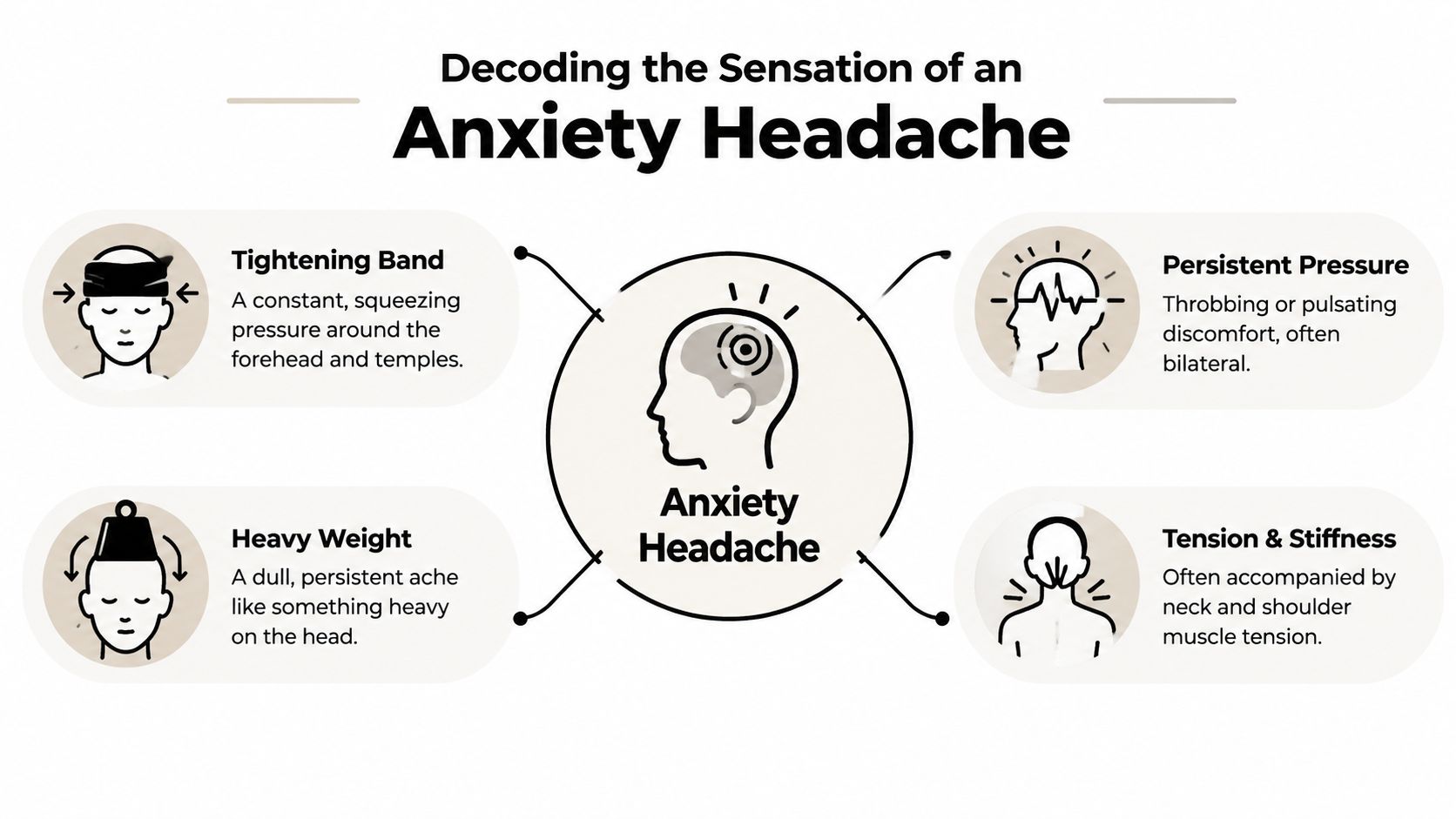
Anxiety headaches most often resemble tension-type headaches. The pain usually develops as a dull or moderate ache, heaviness, or pressure rather than a sudden stabbing sensation. Many people describe it as a band around the head, a vise across the temples, or a weight resting on the forehead. Healthline's description of anxiety headaches outlines this familiar pattern of pressure, muscle tightness, and scalp tenderness.
Where the discomfort appears
The sensation often affects both sides of the head. You may feel it across the forehead, around the temples, at the top of the scalp, or toward the back of the head. The neck and shoulders can feel stiff or sore, and the jaw may become tired if you've been clenching your teeth.
The pain may remain steady rather than pulsing dramatically. It can become more noticeable when stress continues, when you're fatigued, or when noise and glare make an already tense day harder to tolerate. According to MedlinePlus guidance on tension headaches, these headaches can last from 30 minutes to 7 days and may worsen with stress, fatigue, noise, or glare.
What the pattern can tell you
A slow-building, bilateral pressure pattern supports a tension-type explanation, but symptoms can overlap. Some people experience throbbing, nausea, dizziness, or sensitivity to sound, particularly when anxiety and migraine vulnerability occur together. The sensation's quality matters, but so do its timing, frequency, associated symptoms, and changes over time.
If repetitive worry keeps your muscles braced or makes you scan your body for danger, learning more about overthinking anxiety explained may help you understand why the discomfort can feel self-reinforcing. Recognition doesn't eliminate the pain instantly, but it can reduce the fear that keeps your nervous system activated.
Anxiety Headache vs Migraine Understanding the Difference
A headache can be anxiety-related, migraine-related, or influenced by both. Anxiety is common among people with migraine, and recent evidence connects anxious symptoms and behaviors with migraine progression, medication overuse, stigma, and disability. A 2025 review of anxiety and migraine highlights why the question “How can I tell whether my headache is from anxiety, migraine, or both?” deserves a careful answer.
| Symptom | Anxiety Headache (Tension-Type) | Migraine |
|---|---|---|
| Pain quality | Usually dull, squeezing, aching, or pressure-like | Often throbbing or pulsating |
| Location | Commonly affects both sides of the head | Often stronger on one side, though patterns can vary |
| Muscle symptoms | Neck, shoulder, scalp, or jaw tension is common | Neck discomfort can occur, but it isn't the defining feature |
| Sensory symptoms | Noise or glare may worsen discomfort | Light and sound sensitivity are common |
| Stomach symptoms | Nausea can occur, especially when symptoms overlap | Nausea is a familiar migraine-associated symptom |
| Neurological sensations | Not the classic feature of a tension-type pattern | Aura or other neurological symptoms may occur in some people |
This table describes common patterns, not a diagnosis. A severe anxiety-related headache can feel intense, and a migraine can occur during a period of anxiety. One-sided pain doesn't automatically prove migraine, just as bilateral pressure doesn't rule it out.
Why the distinction affects care
The distinction helps a clinician choose an appropriate evaluation and treatment plan. It also prevents an unhelpful cycle in which you assume every headache is “only anxiety” and overlook migraine, or assume every headache is a medical emergency and intensify panic.
If your symptoms include recurrent throbbing pain, nausea, sensory sensitivity, aura-like experiences, or substantial disruption, a clinician can assess the full pattern. For broader education about diagnosis and care choices, this comprehensive guide to migraines offers additional context.
You don't have to solve the anxiety-versus-migraine question alone. Keep notes about location, quality, duration, triggers, and associated symptoms, then share them during an appointment.
The Mind-Body Connection How Stress Creates Real Pain
Anxiety activates the body's protective alarm system. Your attention narrows toward possible danger, your breathing may change, and muscles in the jaw, scalp, neck, and shoulders can tighten. You might not consciously decide to clench or hunch. The body can maintain that posture automatically while your mind focuses on worry.
That sustained contraction helps explain why pressure develops. When upper-body muscles remain activated, the surrounding tissues can become sore and sensitive. At the same time, ongoing stress can make you monitor pain more closely, so ordinary sensations feel urgent and harder to ignore.

Why the cycle can continue
A stressful thought may tighten your body. The resulting headache may frighten you. That fear sends another alarm signal, which encourages more bracing and more symptom monitoring. Understanding the cycle doesn't mean the pain is imaginary. It means the pain has a pathway that can be interrupted.
Population research supports a meaningful association between anxiety and tension-type headache. One report found anxiety in 60% of episodic tension-type headache patients and 44% of chronic tension-type headache patients, as described in the PubMed-indexed study on anxiety and headache.
The pain is physical even when anxiety helps trigger it. Treating the nervous system is part of treating the symptom.
You may find it helpful to notice your earliest warning signs, such as raised shoulders, shallow breathing, jaw pressure, racing thoughts, or an urge to seek reassurance. Learning about the phobophobia and panic attack cycle can also clarify how fear of symptoms may keep the alarm response active.
Your Toolkit for Relief and Lasting Peace
Relief works best when you address both the immediate sensation and the anxiety pattern that keeps returning. Choose one or two practices first. Trying to overhaul everything during a headache can create another source of pressure.
Settle the body first
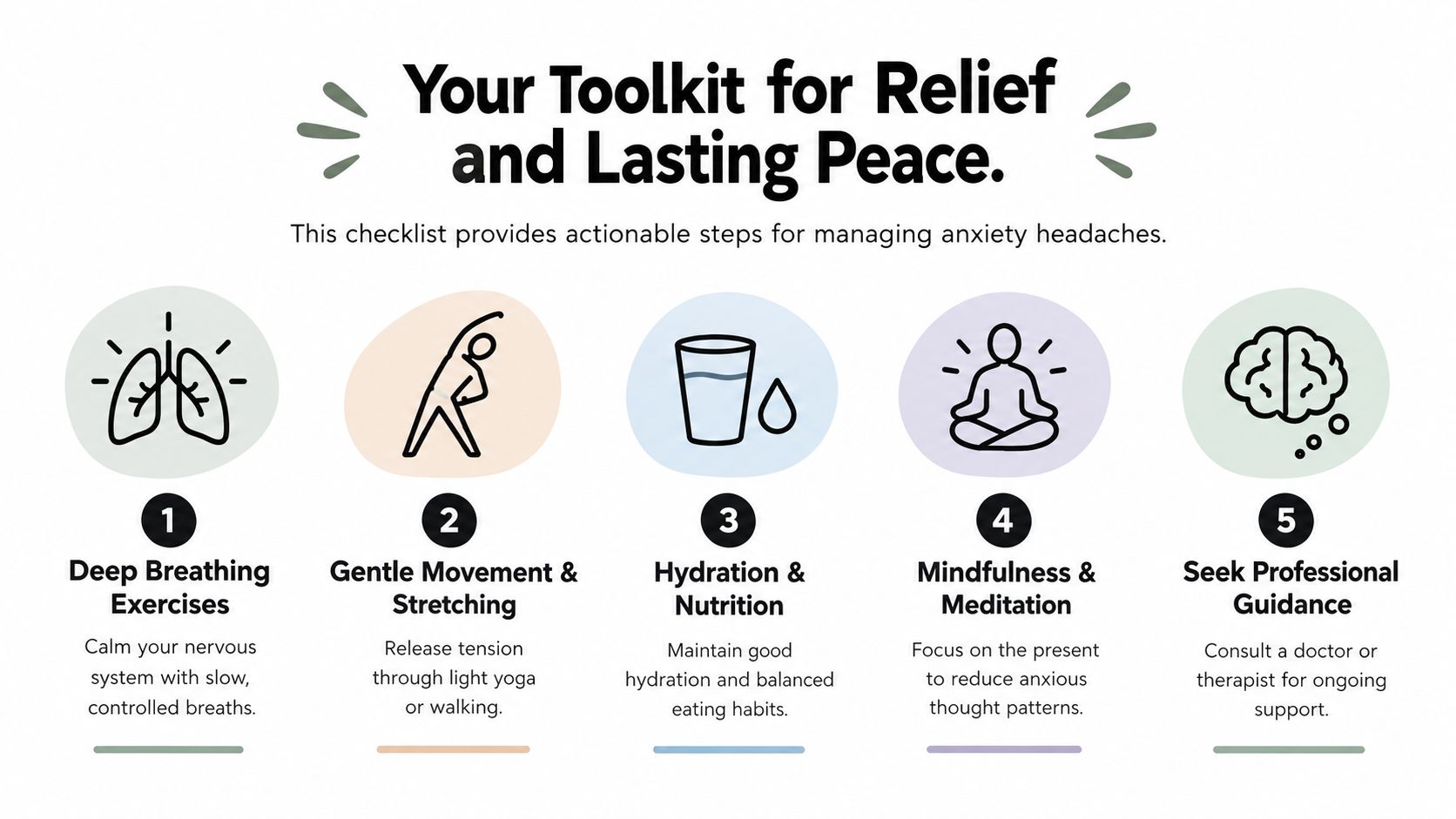
Begin with slow, comfortable breathing. Let the exhale lengthen naturally without forcing a huge inhale. Relax your tongue from the roof of your mouth, lower your shoulders, and unclench your hands. These small signals tell your body that it doesn't need to maintain maximum readiness.
Try calming breathing techniques when you notice the first signs of pressure. Then add gentle movement, such as walking slowly or rolling your shoulders within a comfortable range. Avoid aggressive stretching or anything that increases pain.
Other practical steps include:
- Reduce muscle load: Place warmth over tense neck or shoulder muscles, adjust your posture, and take breaks from prolonged screen use.
- Support basic needs: Drink water and eat regularly, especially if you've gone a long time without food.
- Ground your attention: Name objects you see, sounds you hear, and sensations you feel. Grounding shifts attention away from catastrophic predictions.
- Track patterns: Record the situation, symptoms, sleep, meals, caffeine, and emotional state. Look for recurring combinations rather than judging individual days.
- Create a recovery routine: A quiet wind-down period, mindfulness practice, and consistent relaxation give your nervous system repeated experiences of safety.
For additional education about evaluating different causes of head pain, you can review these migraine and headache treatment options alongside advice from a qualified clinician.
The Anxiety Checklist is another practical option for people who want structured support between appointments. Its always-free SOS mode offers grounding prompts and affirmations, while its broader resources include guided meditations, sleep audios, walking sessions, and CBT self-therapy tools such as thought journaling, belief experiments, and exposure exercises.
Watch the following breathing resource when you're calm, then practice the method before the next difficult moment so it feels familiar rather than experimental.
Retrain the anxious response
Long-term improvement comes from changing how you interpret sensations and how you respond to fear. Cognitive behavioral therapy, or CBT, helps you identify automatic thoughts, test fearful predictions, and practice new behaviors instead of relying on avoidance or repeated reassurance. A placebo-controlled meta-analysis found moderate effects for CBT in anxiety disorders, with a pooled Hedges' g of 0.56 and an odds ratio for response of 2.97 compared with placebo, reported in this CBT meta-analysis.
You're not trying to force yourself never to feel anxious. You're teaching your brain that pressure, dizziness, or a racing heart can be noticed without immediately escalating into panic. With repetition and appropriate professional guidance, that learning can make symptoms less frightening and recovery more sustainable.
When to Talk to a Doctor and Your Path to Healing
Most familiar tension-type patterns can be discussed during a routine medical appointment, particularly when headaches recur, interfere with daily life, become more intense, or change character. A clinician can review your symptoms, medical history, medications, sleep, and possible migraine features rather than asking you to guess the cause.
Seek urgent medical attention for a sudden, explosive headache unlike your usual symptoms, or for headache accompanied by serious warning signs such as weakness, slurred speech, major vision changes, fever with a stiff neck, confusion, fainting, or symptoms following a significant head injury. These signs don't mean a dangerous condition is certain, but they do warrant prompt evaluation.
A therapist or mental health professional can help when worry about symptoms, panic, avoidance, poor sleep, or constant body checking is taking over your day. Seeking support isn't an admission of failure. It's a practical way to address the alarm system that may be contributing to the pain. You can also find advice for managing unwelcome emotions and anxiety.
Hope is supported by the fact that panic recovery can be sustained. A pharmacology review defines full remission as resolution of all five symptom domains maintained for three months, and recommends continuing medication for at least 12 months after remission when possible, as described in this review of panic disorder treatment and remission. Treatment decisions belong with your prescriber, but lasting panic-free recovery is a realistic clinical goal.
The Anxiety Checklist offers practical support for anxiety headaches and panic, including an always-free SOS mode, grounding prompts, guided relaxation, and CBT-based self-therapy tools. Visit The Anxiety Checklist to begin practicing calmer responses to physical sensations and build a steady path toward greater peace.