

You're sitting still, yet your chest feels trapped. Your breath catches, your ribs seem unable to expand, and one frightening thought takes over: What if this is my heart? You press a hand against your sternum, check your pulse, and search your memory for every possible explanation. The sensation is physical, immediate, and convincing.
Chest tightness anxiety can make a normal moment feel like an emergency. That doesn't mean you're imagining it, and it doesn't mean you're weak. Anxiety changes breathing, muscle tension, attention, and threat perception in ways that can create genuine pressure or squeezing in the chest. It's also a symptom clinicians recognize well. A major review found chest pain or tightness in roughly 22% to just over 70% of panic attacks, while emergency-department reviews have reported panic disorder among 18% to 25% of people arriving with chest pain (review of panic symptoms and chest pain).
The safest path has two parts: understand what anxiety is doing inside your body, and know when chest symptoms need urgent medical assessment. Once serious causes have been ruled out, anxiety-related tightness is highly workable, and recovery from panic is a realistic destination.
Table of Contents
- When Your Chest Feels Tight and Your Mind Spirals
- What Anxiety Chest Tightness Actually Does in Your Body
- Telling Anxiety Chest Tightness Apart from Heart Trouble
- Calming Chest Tightness in the Next Five Minutes
- Why Chest Tightness Keeps Coming Back After You Are Cleared
- Becoming Panic-Free Through Therapy That Lasts
- Your Recovery Plan and the Life on the Other Side
When Your Chest Feels Tight and Your Mind Spirals
The episode often begins. You may notice a warm flush, a skipped-feeling breath, or tension beneath your breastbone. Then your attention locks onto the sensation. Your hand moves to your chest, your shoulders rise, and your mind starts scanning: Is the pressure spreading? Is my heart beating normally? Should I call someone?
A few seconds can feel stretched and distorted. You might stand near a doorway, wondering whether you should leave, or sit very still so you don't make the sensation worse. The more closely you monitor your breathing, the less automatic it feels. Each unusual beat or shallow breath becomes new evidence for the frightening story.
Chest tightness anxiety becomes self-reinforcing. The body creates a sensation, the mind interprets it as danger, and that interpretation sends another burst of alarm through the body. People who already spend a lot of time analyzing physical sensations may find overthinking symptoms and solutions useful for recognizing how attention can intensify fear without making the original sensation imaginary.
A reassuring reframe: The sensation is real, but a real sensation isn't automatically proof of tissue damage.
Emergency medicine has long treated chest tightness as a difficult overlap between physical and psychological conditions. A review noted that chest pain accounts for about 20% of annual emergency-department visits nationwide, and anxiety disorders may occur in up to 58% of chest-pain patients while remaining undiagnosed in about 80% of them (emergency-department review). These figures don't diagnose your episode, but they show why anxiety-related chest symptoms are both common and frequently overlooked.
Two questions deserve calm, direct answers. What is happening in my body? And how can I tell anxiety from a potentially cardiac problem? Start with the body, then apply the safety rules later in this article.
What Anxiety Chest Tightness Actually Does in Your Body
Think of your nervous system as a smoke alarm. It doesn't need a real fire to sound; it only needs to interpret something as threatening. A stressful thought, an unfamiliar body sensation, or a memory of a previous panic episode can make the alarm system react as though immediate protection is required.
The sequence usually looks like this:
- Threat detection: The brain's threat circuits interpret a thought or sensation as dangerous.
- Alarm activation: Stress hormones prepare you to fight, flee, or freeze.
- Breathing changes: Breathing becomes faster, shallower, or more upper-chest focused.
- Muscle bracing: The intercostal muscles between the ribs, diaphragm, shoulders, and other accessory muscles contract.
- Threat interpretation: The pressure created by those changes feels so unfamiliar that the brain may misread it as evidence of a heart problem.
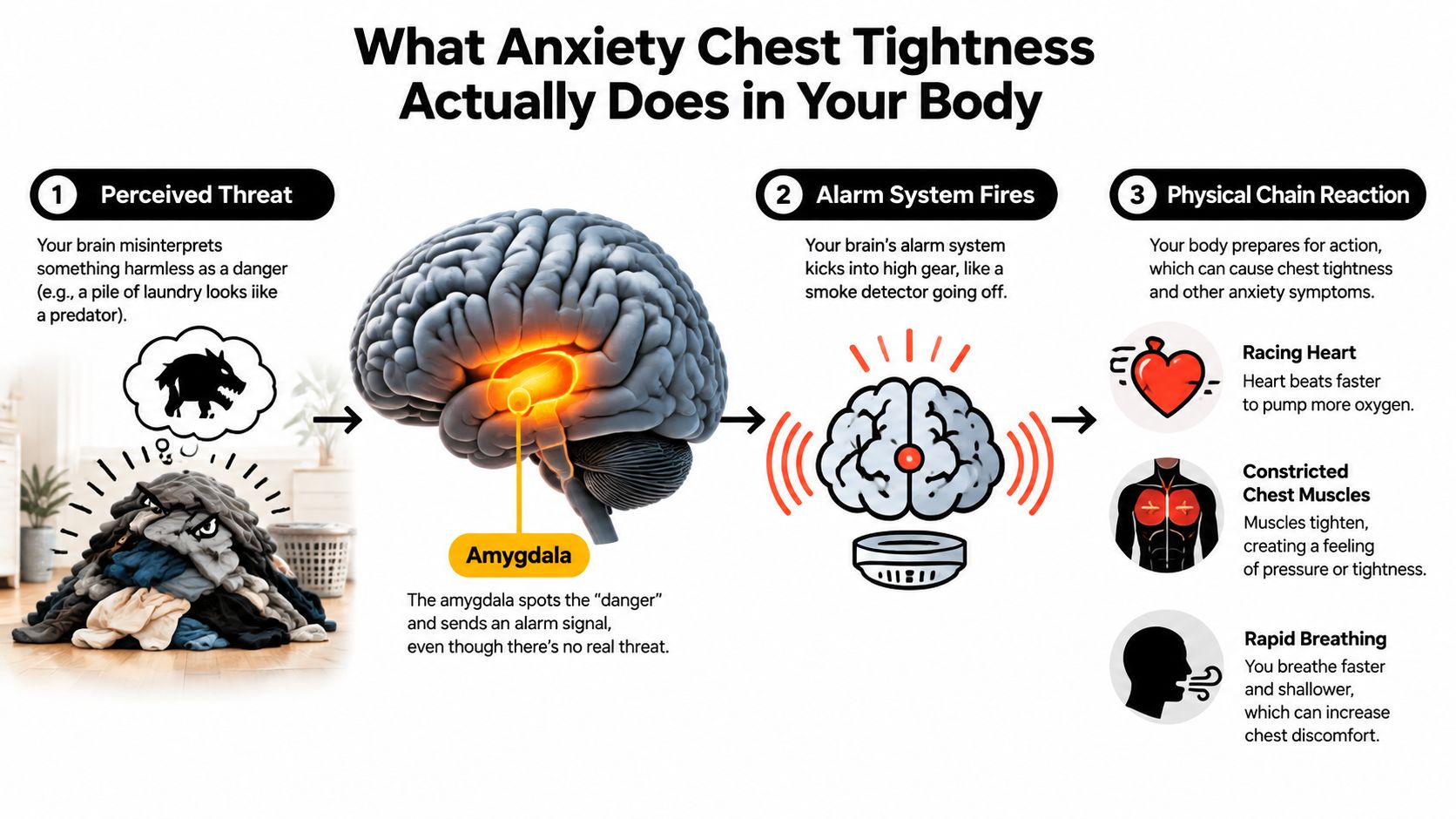
Rapid breathing can also lower carbon dioxide levels. That shift can contribute to tingling, light-headedness, air hunger, and a sense that the chest is constricted. The discomfort then increases fear, fear increases muscle bracing, and the breathing pattern becomes even less comfortable. A clinical explanation of this interaction describes chest pressure as arising from sustained chest-muscle contraction combined with rapid, shallow breathing (anxiety-related chest tightness explanation).
The heart, lungs, and muscles are physically responding, which explains why the sensation feels so credible. It isn't “just in your head” in the dismissive sense. It's a body-wide alarm response that can be turned down, especially when you understand what triggers the fight or flight response.
Panic attacks often create a sharp surge that peaks quickly and brings intense fear or catastrophic thoughts. Generalized anxiety may feel less dramatic but linger as a band of tension through the day, especially during prolonged stress. Breathing-related symptoms can also appear during sleep concerns, so a neutral resource such as OneTwenty on sleep apnea may help you identify questions to raise with a healthcare professional if nighttime breathing is part of your experience.
The central takeaway is simple: anxiety chest tightness is frightening but mechanical. In many episodes, muscle contraction, altered breathing, and threat-focused attention are driving the sensation rather than damaged chest tissue. That explanation should never replace medical assessment for new or concerning symptoms, but it can make the experience less mysterious and more manageable.
Telling Anxiety Chest Tightness Apart from Heart Trouble
No symptom pattern can safely diagnose the cause by itself. Anxiety and cardiac problems can overlap, and people with anxiety can still develop medical conditions. Use the comparison below as a guide for questions to discuss with professionals, not as a reason to dismiss warning signs.
| Feature | Anxiety | Cardiac |
|---|---|---|
| Quality | Often feels tight, sharp, localized, or connected to muscle bracing and breath changes | May feel like pressure, squeezing, or crushing heaviness |
| Spread | Commonly stays centered or in one area, though anxiety sensations can vary | May radiate toward the arm, jaw, neck, or back |
| Associated experience | Rapid breathing, tingling, trembling, catastrophic thoughts, or fear linked to the sensation | Sweating, nausea, shortness of breath at rest, weakness, or discomfort unrelated to anxious thoughts |
| Pattern | May arise during worry, panic, or heightened body attention and may ease as you calm | May occur with exertion or persist despite emotional calming |
| Context | Can occur in otherwise familiar anxiety patterns | More concerning when new, severe, unexplained, or occurring in someone with relevant risk factors |
Risk factors that raise concern for a cardiac cause include age, family history, high cholesterol, and high blood pressure. They don't prove that chest tightness is heart-related, but they lower the threshold for seeking medical advice.
When urgent help matters
Call emergency services when chest pressure is severe, crushing, unfamiliar, or accompanied by pain spreading to the arm, jaw, back, or neck. Seek urgent care for symptoms such as sweating, nausea, fainting, severe shortness of breath, sudden weakness, or persistent discomfort. If you're unsure, treat uncertainty as a reason to get assessed, not as a reason to perform a home diagnosis.
Safety rule: Calming techniques are appropriate after you've considered urgent symptoms. They aren't a substitute for emergency evaluation.
A first episode deserves medical attention, particularly if it appeared without a clear anxiety trigger. A clinician can consider cardiac, pulmonary, gastrointestinal, and musculoskeletal causes, including conditions such as costochondritis. Once professionals have evaluated the danger signs, you can work on anxiety without having to argue with the fear that something important was missed.
Calming Chest Tightness in the Next Five Minutes
If your symptoms match a pattern you've already had medically assessed, use the next few minutes to reduce the alarm rather than fight the sensation. Sit with your feet supported, loosen restrictive clothing, and let your shoulders drop. The aim isn't to force the tightness away. It's to stop feeding the cycle.
Start with paced breathing
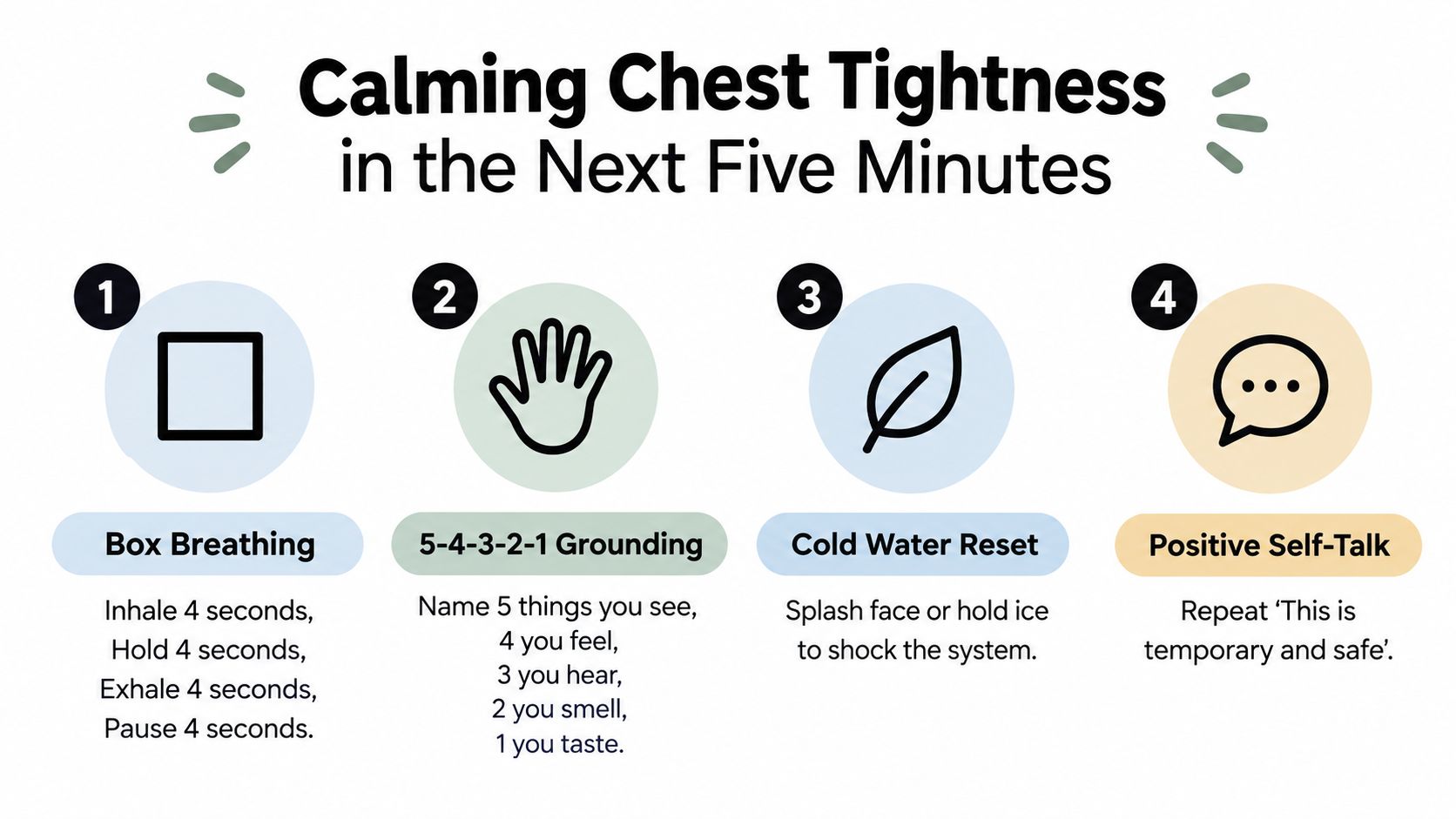
Try box breathing:
- Inhale gently for four seconds.
- Hold for four seconds.
- Exhale slowly for four seconds.
- Pause for four seconds.
- Repeat at a comfortable pace.
Keep the breath gentle. If holding your breath makes you dizzy or uncomfortable, stop and return to ordinary breathing while seeking appropriate medical guidance. The technique works by slowing the rapid breathing pattern that can amplify chest tightness and tingling. You can also find anxiety breathing exercises to practice when you're calm, not only during an episode.
Bring attention outward
Use the 5-4-3-2-1 grounding method:
- 5 things you see: Name colors, shapes, or objects in the room.
- 4 things you feel: Notice your feet on the floor, fabric on your skin, or the chair beneath you.
- 3 things you hear: Identify nearby and distant sounds.
- 2 things you smell: Notice soap, air, food, or another neutral scent.
- 1 thing you taste: Identify the taste in your mouth or take a small sip of water.
This gives your attention a job other than checking the sternum, pulse, and breath.
Change the internal script
Replace “This means something terrible is happening” with exact language that is both honest and steady:
“This is an alarm response. I've felt it before. I can slow my breathing and let the wave pass.”
You don't need to convince yourself that nothing medical could ever happen. You're reminding your brain that a sensation is not the same as a prediction.
For a quick physical reset, sit upright without rigidly holding your chest, unclench your jaw, and lower your shoulders. Cool water on the wrists or face may provide a sharp sensory shift. Use these tools as support, while still following the emergency guidance above if symptoms are new, severe, or unusual.
Why Chest Tightness Keeps Coming Back After You Are Cleared
A normal medical evaluation can remove immediate danger without instantly removing fear. After a frightening episode, your brain may become unusually sensitive to internal signals. A small change in breathing, a normal heartbeat variation, or mild chest tension can suddenly receive the same attention once reserved for a genuine emergency.
This process is called symptom vigilance. You scan your body for signs of trouble, notice sensations you would previously have ignored, and then interpret them through the memory of the earlier episode. The sensation becomes more vivid because attention magnifies its importance.
Reassurance-seeking can keep the loop active. Checking your pulse, pressing the chest repeatedly, searching symptoms online, asking someone to confirm that you look well, or visiting an emergency department may lower fear briefly. But when the brain learns, “I was safe only because I checked,” it becomes more likely to demand another check the next time discomfort appears.
The false-alarm learning loop
The cycle often follows this pattern:
- A harmless sensation appears.
- Your attention detects it immediately.
- Your mind predicts danger.
- Anxiety increases breathing changes and muscle tension.
- The sensation grows stronger.
- Checking brings short-term relief.
- The brain learns to monitor even more closely next time.
This isn't a character flaw. It's learned protection. Interoception, the brain's reading of internal sensations, becomes more threat-focused after a scare. Each false alarm can make the alarm fire faster until you deliberately change your response.
That may mean delaying a pulse check, allowing a mild sensation to exist without seeking immediate confirmation, or practicing understanding the panic attack hangover so post-episode fatigue and sensitivity don't become fresh evidence of danger. The goal isn't to ignore your body. It's to respond proportionately after urgent causes have been ruled out.
Becoming Panic-Free Through Therapy That Lasts
The most useful treatment doesn't merely teach you how to survive the next episode. It helps you stop treating ordinary body sensations as emergencies. Cognitive behavioral therapy, or CBT, does this by working with both the meaning you assign to symptoms and the behaviors that keep fear alive.
Cognitive restructuring helps you examine predictions such as “tightness means my heart is failing” or “if I feel breathless, I'll lose control.” You learn to test those predictions against the full context, including medical findings, previous episodes, triggers, and what happened when the sensation passed. Interoceptive exposure addresses the body side of panic by creating selected sensations in a controlled therapeutic setting, then allowing fear to rise and fall without escape or compulsive reassurance.
What the outcome data shows
Recovery is not a rare exception. Reviews of CBT for panic disorder report short-term panic-free rates around 70% to 80%, with high end-state functioning around 50% to 70% (CBT review). Another review found an average of 73% of treated patients were panic-free after three to four months, compared with 27% of control patients, and 46% remained panic-free at two years (review of CBT trials).
Exposure-based CBT has also produced strong results. In one randomized trial, 71% of treated patients met recovery criteria at the end of treatment compared with 7% in the control group, while fear of physical sensations and agoraphobic thinking dropped into the healthy-control range (randomized exposure-based CBT trial).
These results don't promise that every person will improve on the same schedule. They do challenge the belief that recurring chest tightness means you're permanently damaged or destined to panic. Therapy teaches your nervous system a different prediction: a sensation can be uncomfortable without being dangerous, and fear can fall without escape.
Medication can also be useful for some people, particularly when symptoms are severe or interfere with starting therapy. A prescriber can help weigh options, benefits, and risks. Therapy remains especially valuable because it builds portable skills for interpreting sensations, reducing avoidance, and responding to future stress.
For longer-term protection, maintenance matters. One guideline summary reported relapse of 5.2% with monthly maintenance CBT over nine months, compared with 18.4% without maintenance CBT, with gains lasting up to 21 months (maintenance CBT guideline summary). If you want a structured starting point, you can learn about anxiety and panic attacks before discussing treatment with a qualified professional.
Your Recovery Plan and the Life on the Other Side
A recovery plan should be gradual, specific, and flexible enough to fit real life. The schedule below is a framework, not a test you can fail. If chest symptoms are new, changing, or medically unexplained, complete appropriate medical follow-through before deliberately working with physical sensations.
Weeks 1 and 2, build the foundation
Week 1 focuses on baseline building. Practice breathing for ten minutes each day, keep a symptom journal, and record what happened before, during, and after episodes. Include medical appointments or follow-up rather than using the journal as a substitute for care. The useful question isn't only “How intense was it?” but also “What did I predict, what did I do, and what happened next?”
Week 2 adds skills. Write a short grounding script, practice it when calm, and complete CBT thought records for one recurring fear. Light aerobic activity three times weekly can help you observe the difference between normal exertion sensations and danger, but choose an appropriate level and follow professional advice if exercise symptoms concern you.
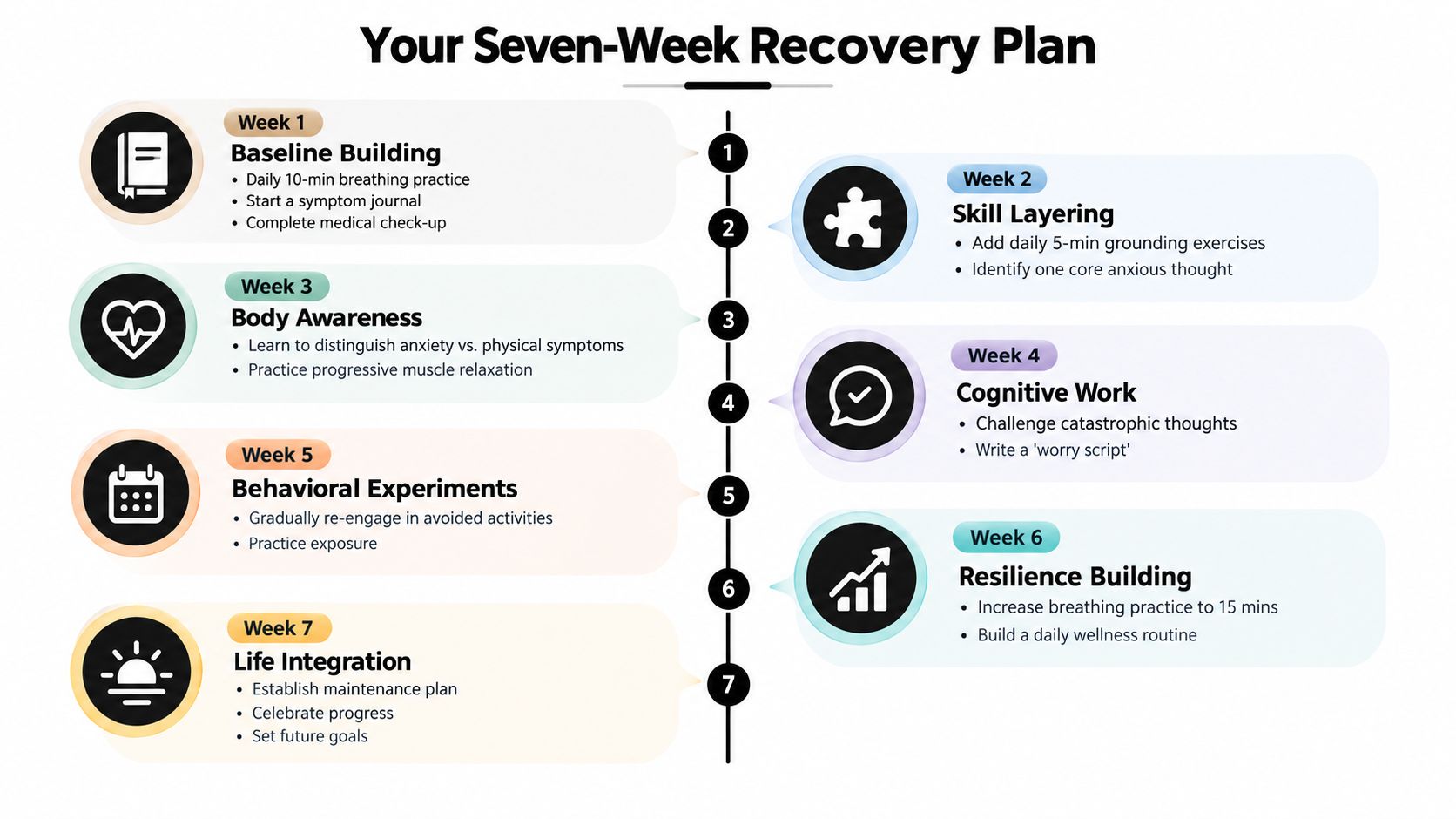
Weeks 3 through 6, change the fear response
During Weeks 3 and 4, work with a therapist on low-level exposure. You might sit with a mild chest sensation, reduce repeated reassurance-seeking, or tolerate the normal increase in breathing that accompanies safe movement. The point isn't to provoke severe distress alone. It's to practice staying present while your nervous system learns that discomfort can resolve without emergency action.
Weeks 5 and 6 are for confidence building. Gradually return to activities you've avoided, such as a gym, a meeting, or driving alone. Refine a relapse plan with your therapist. A difficult day doesn't erase progress; it gives you a chance to use the skills without returning to the old checking cycle.
Week 7 and beyond, maintain freedom
From Week 7 onward, consider regular check-ins, a brief two-minute reset routine, and early-warning notes for sleep disruption, increased body scanning, or avoidance. Maintenance is not proof that you're fragile. It's how you keep a practiced skill available before fear becomes overwhelming.
Life after recovery often looks ordinary in the best possible way. You travel without repeatedly scanning for exits. You exercise without monitoring every pulse change. You sleep through the night, follow a conversation, and concentrate on work instead of listening for the next sensation.
The evidence supports hope grounded in action. Panic-free living isn't an unrealistic promise, and it isn't reserved for people with unusually mild symptoms. Many people become panic-free through structured CBT and exposure, and the documented outcomes show that lasting improvement is common. Start with one safe step today, such as booking an evaluation, writing your first thought record, or practicing paced breathing before the next episode forces the issue.
The Anxiety Checklist offers an always-free SOS mode with grounding prompts, affirmations, and quick support, along with CBT self-therapy tools such as thought journaling, belief experiments, and exposure exercises for longer-term work. Visit The Anxiety Checklist to begin with practical help for chest tightness anxiety, whether you're calming an episode now or building a plan to live panic-free.