

Your chest tightens in the grocery aisle. Your hands start to tingle, the floor feels unstable, and your heart seems to be pounding far too hard. You may wonder whether you're about to faint, lose control, or die. If you're looking for having a panic attack help right now, stay with me. You need a clear sequence, not a lecture: calm your body, check for danger, then build a plan that makes future attacks less powerful.
Panic symptoms are part of a much larger anxiety burden. The World Health Organization reports that anxiety disorders affected 359 million people in 2021, about 4.4% of the world's population, and were the most common mental disorders globally. Panic can feel intensely personal, but you're not facing an unusual or shameful problem. Panic is treatable, and many people recover enough to live without recurring attacks.
Table of Contents
- What It Actually Feels Like in the Middle of One
- Why Panic Attacks Happen and Why These Steps Work
- What to Do in the First Few Minutes of an Attack
- The Safety Check That Decides If You Need Urgent Care
- Building Your Own Panic Plan Before the Next Attack
- Long-Term Tools That Help You Become Panic-Free
- A Realistic Roadmap and the Questions People Ask Most
What It Actually Feels Like in the Middle of One
You're standing in line, driving, sitting in a meeting, or trying to fall asleep. Without warning, your chest tightens. Your heartbeat becomes loud and fast. You take a breath, but it doesn't feel satisfying, so you take another, then another. Your fingers go numb. Your head feels light. The room may look strangely distant, as if you're watching yourself from outside your body.
That combination can produce a terrifying conclusion: something is seriously wrong. You may fear a heart problem, suffocation, fainting, insanity, or public humiliation. The urge to escape becomes physical. You scan for an exit, call someone, check your pulse, search symptoms, or rush toward the nearest place that feels safe.
The sensations are real. Panic isn't imaginary, and telling yourself to “just relax” usually makes things worse because it adds frustration to fear. The body's alarm system has activated, and your mind is treating those alarm signals as proof of danger.
For this moment: You don't have to solve your whole anxiety history. You only have to get through the next step safely.
The guide below gives you three things people often need at the same time: step-by-step help during the attack, a firm safety check for urgent symptoms, and a longer-term route toward becoming panic-free. You can use the immediate steps alone, ask someone nearby to read them aloud, or save the plan on your phone before you need it.
Panic attacks are common even among people who never develop panic disorder. A cross-national epidemiology study found lifetime panic attacks in 13.2% of people across all countries combined, compared with 1.7% for panic disorder, with an estimated lifetime panic-disorder risk of 2.7% by age 75 (cross-national epidemiology findings). Having an attack doesn't automatically mean you have a permanent disorder.
Why Panic Attacks Happen and Why These Steps Work
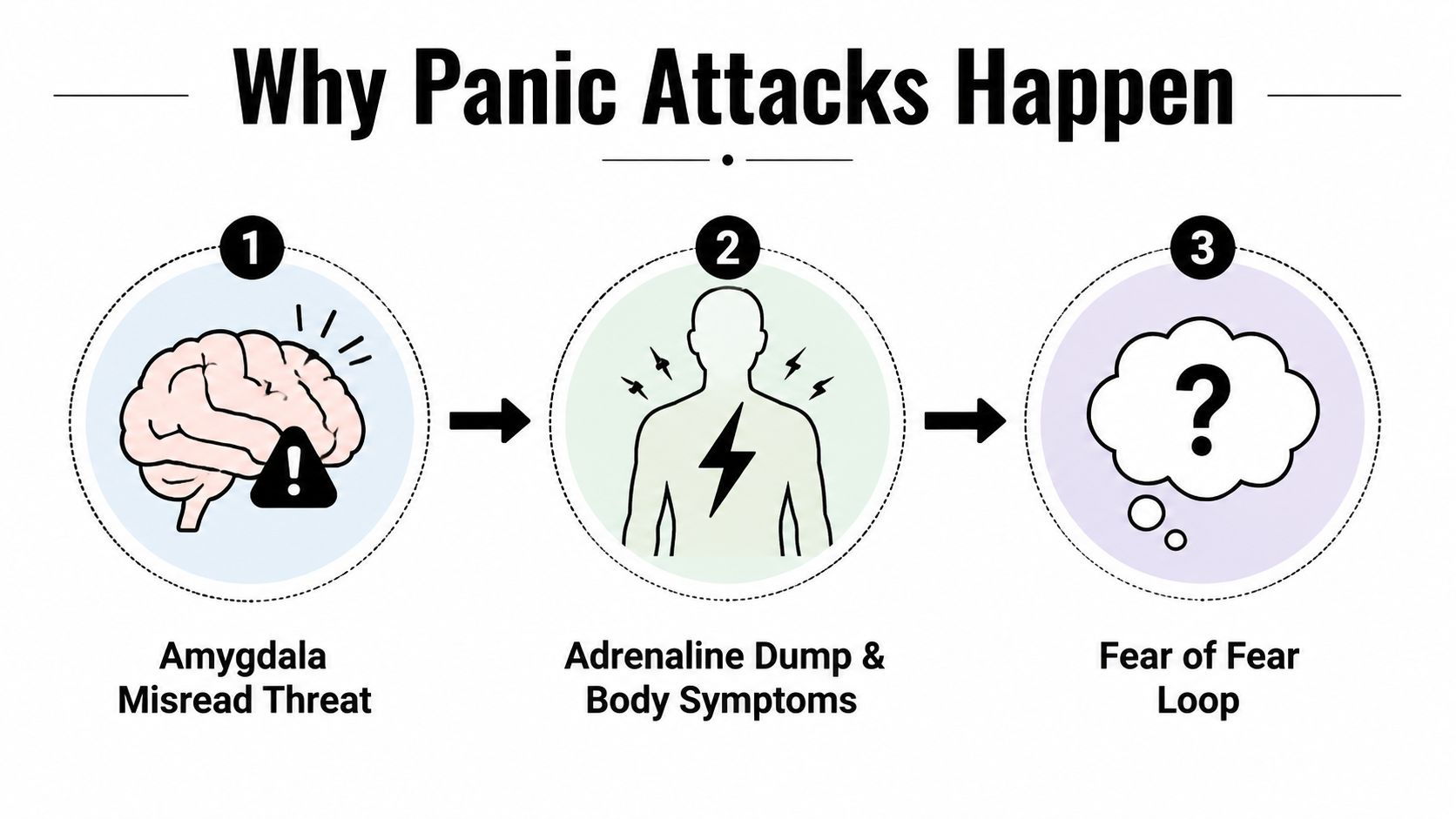
A panic attack starts when the brain's threat alarm misreads a situation or a body sensation. The amygdala sends an emergency signal even though you may be physically safe. Adrenaline then changes your body quickly, increasing heart rate, tightening muscles, altering breathing, and sharpening attention toward possible danger.
The frightening part is the interpretation loop. You notice a racing heart and think, “I'm in danger.” That thought increases adrenaline. You notice stronger symptoms and think, “This proves it.” The fear of the sensations becomes a second threat, creating the fear-of-fear cycle. You can read more about that pattern in this explanation of phobophobia and panic attack cycle.
The body needs a safer signal
Slow, diaphragmatic breathing helps because it reduces the tendency to over-breathe. Neutral medical guidance favors slow breathing with belly movement, a gradual exhale, and roughly 10 breaths per minute, rather than forceful deep breaths (NHS Inform panic self-help guidance). The point isn't to fill your lungs dramatically. It's to stop fighting for a perfect breath and let the exhale lengthen.
Grounding works differently. Naming what you see, hear, touch, smell, and taste pulls attention away from internal threat-monitoring. External focus gives the brain current sensory information instead of allowing it to keep replaying catastrophic predictions.
The sequence that follows uses both mechanisms. First, make your body stable. Then label the experience. Then slow the exhale and redirect attention outward. These actions don't require you to feel calm before you begin. You do them while afraid, and the alarm gradually has less fuel.
What to Do in the First Few Minutes of an Attack
If panic hits while you're standing, walking, or driving, make safety your first move. Stop where you can, sit or pull over safely, and follow the steps in order. Your job is not to force calm. It is to stop adding danger and give your nervous system fewer problems to solve.
The first 90 seconds
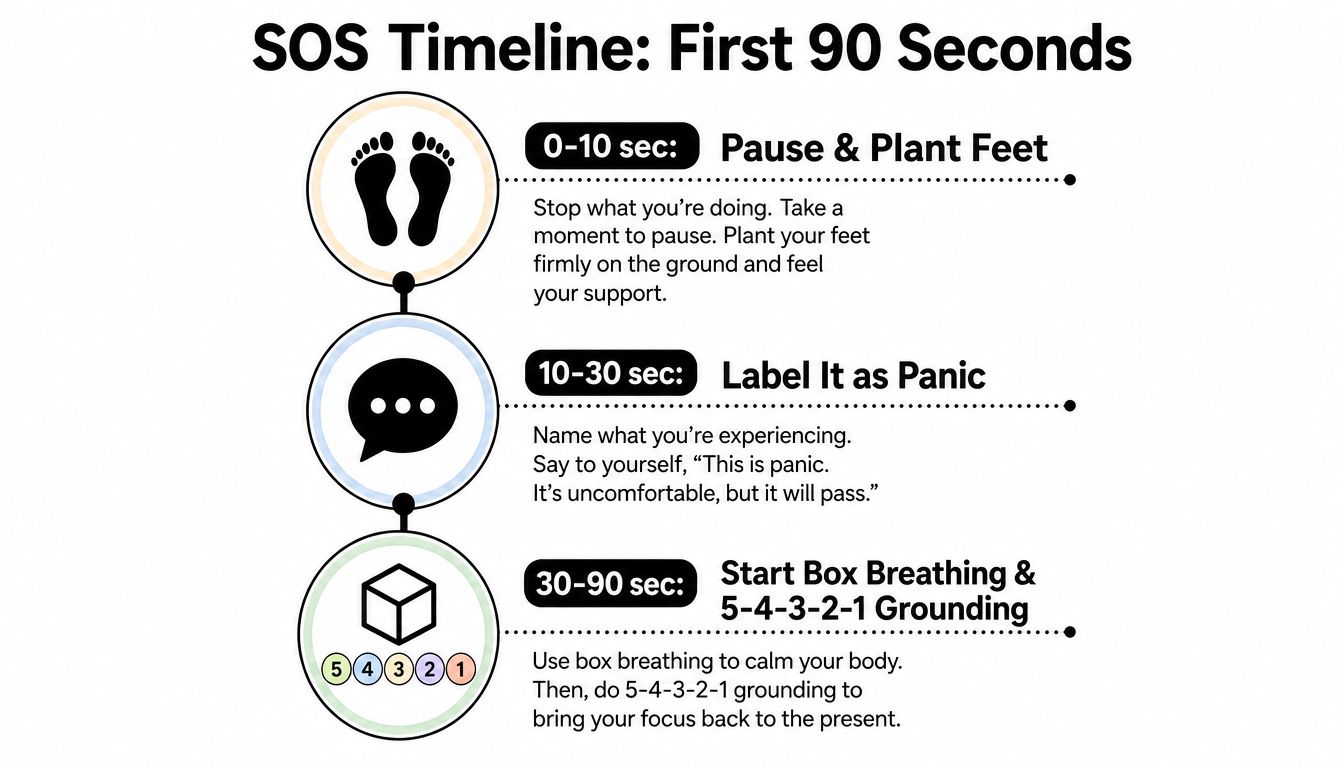
0 to 10 seconds: Plant both feet on the floor and press down gently. Lower your shoulders, loosen your hands, and fix your eyes on one object. If you're driving, pull over before doing anything else.
10 to 30 seconds: Say aloud, “This feels like panic. I'm going to take the next safe step.” Naming the experience gives your mind a clear description instead of leaving every sensation unexplained. Keep the safety check in view, especially if this episode feels new or different.
30 to 90 seconds: Breathe through your nose, then let the breath out slowly through your mouth. Try inhaling for four counts and exhaling for six, holding only if it feels comfortable. Do not gulp air or force a deep inhale. If counting increases tension, use one cue: “Small inhale, longer exhale.”
Add one grounding task
When the breathing becomes less forceful, use the 5-4-3-2-1 method:
- See five things. Name their colors or shapes.
- Hear four sounds. Include distant sounds if nearby ones are hard to notice.
- Touch three things. Notice texture, temperature, or pressure.
- Smell two things. Use the room, your clothing, or a familiar scent.
- Taste one thing. Notice your mouth or take a sip of water.
You can orient to the room instead. Say where you are, what day it is, and what you will do after the wave passes. Cool water on your wrists or a cool pack against your skin may help if it feels soothing. These choices give your attention a specific task.
For other ways to use sights, sounds, and body sensations, read this guide to anxiety grounding. Choose one grounding method, not several at once. A crowded checklist can create more pressure.
Use this resource on anxiety relief through breathing if a guided cue would help. Breathing is a tool, not a test. If big breaths make you feel worse, stop forcing the inhale and return to a quiet inhale with a slower exhale.
Do not breathe into a paper bag. Rebreathing can be unsafe and may delay recognition of another cause of rapid breathing. Stay with the steps, reduce extra stimulation, and let the wave rise and fall without feeding it with more alarm.
The Safety Check That Decides If You Need Urgent Care
A racing heart, chest tightness, tingling, dizziness, shortness of breath, and derealization can all occur during panic. If you have experienced panic before, the pattern may feel familiar. Familiarity still does not prove that every episode is safe.
Get urgent medical help for sudden crushing chest pain, pain spreading to the arm or jaw, shortness of breath that does not resolve, fainting, slurred speech, one-sided weakness, or symptoms that appear only with exertion. Seek help too if the episode is new, markedly different from your usual panic, or you cannot tell what is happening. Losing consciousness, ongoing chest pain, and unresolved breathing difficulty need medical assessment because another cause may be involved.
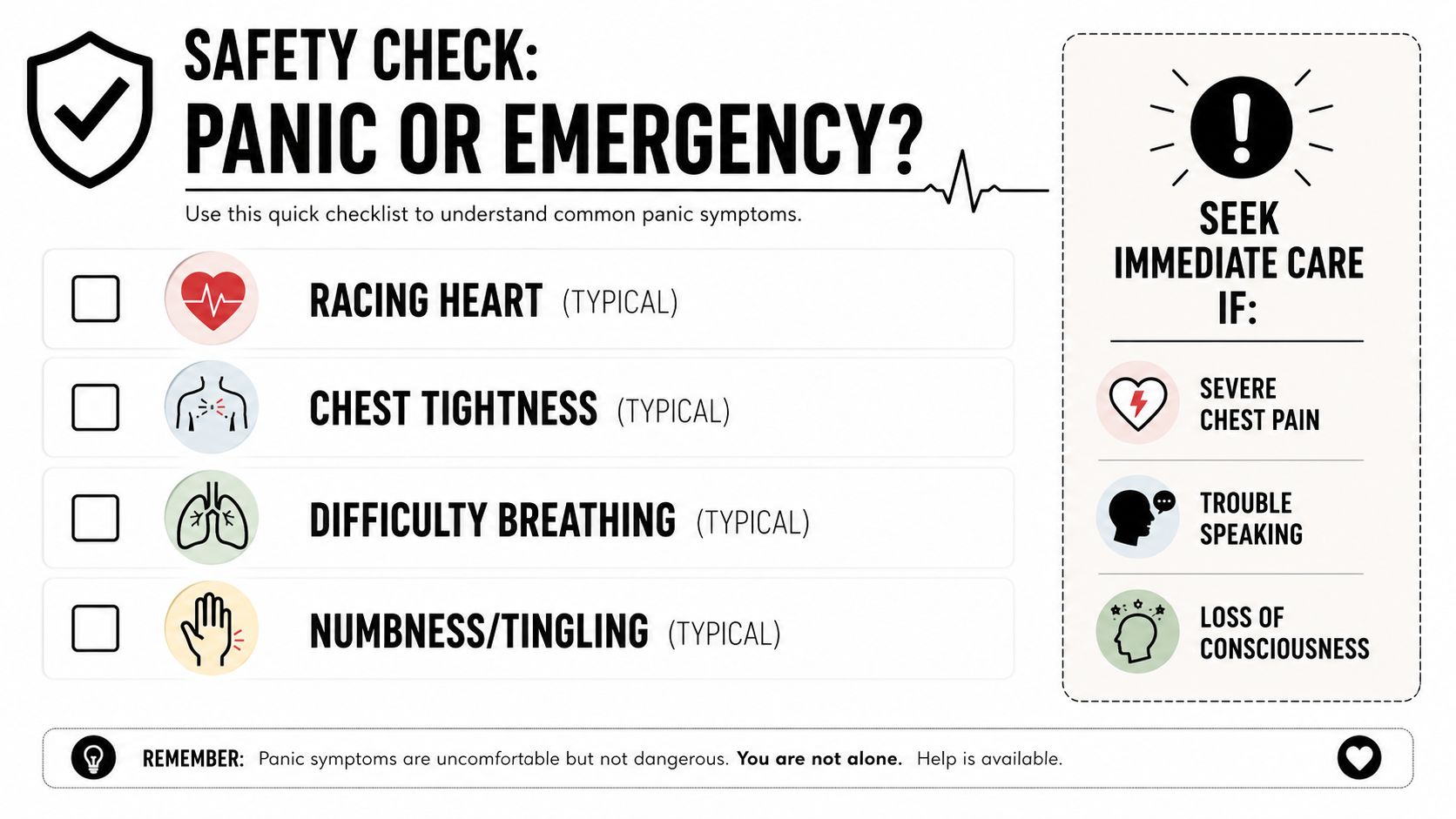
Use a simple decision rule
- Red flag present: Call your local emergency service or get urgent medical care. Do not drive if you may faint or cannot breathe safely.
- No red flag, familiar pattern: Sit somewhere safe, use the SOS sequence, and arrange follow-up with a clinician.
- Uncertain diagnosis: Treat uncertainty as a reason to seek medical advice, not as proof that the symptoms are anxiety.
Skip symptom searches during the peak. Rechecking your pulse, repeatedly asking whether you are dying, or scanning your chest for changes keeps your attention fixed on danger. Those actions can feel protective while extending the fear loop.
If you are suspecting illness next steps, use a clear health-check pathway to decide what support fits the symptom. Once urgent danger has been ruled out, find instant panic relief, then return to one grounding cue. The goal is a calm safety decision first, followed by the right recovery tool, whether that means a free breathing prompt now or clinical support for repeated attacks.
Building Your Own Panic Plan Before the Next Attack
A panic plan should work when your thinking is slow. Keep it to one page, put it on your phone, and share the essential parts with someone you trust.
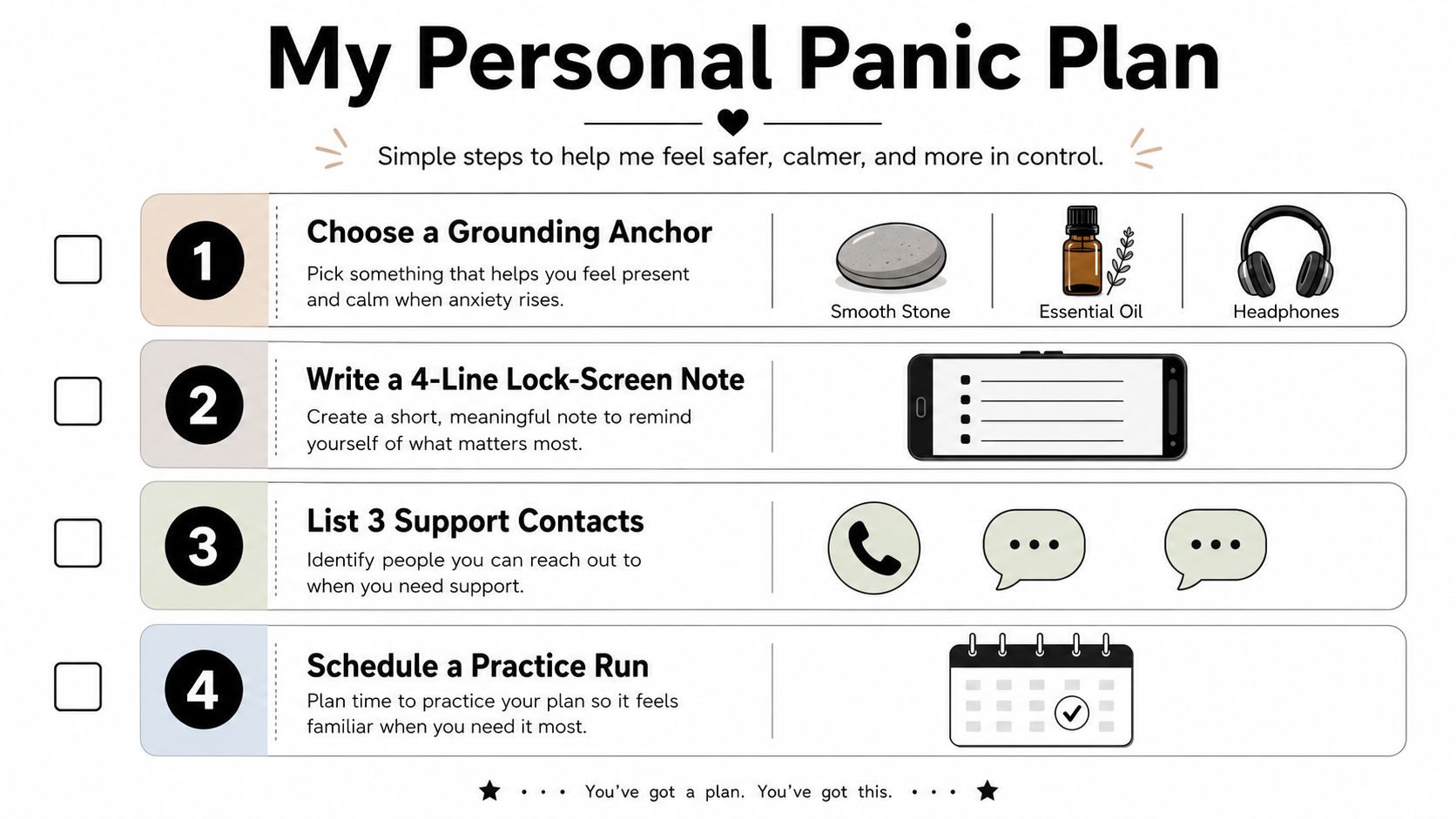
Put the first action where you'll see it
Choose one grounding anchor, such as a smooth stone, a familiar scent, or a short playlist. The anchor won't magically stop panic. It gives you a repeatable starting point, which matters when your mind is searching for escape.
Write a four-line lock-screen note:
- Plant my feet and drop my shoulders.
- Name this as panic, then check red flags.
- Small inhale, longer exhale.
- Name what I see, hear, touch, smell, and taste.
Add three support contacts and label what each person can do. One might stay on the phone, another might collect you from an unsafe location, and another might help arrange a clinician appointment.
Pack a small go-bag with water, a cool pack, headphones, and a paper copy of your breathing cue. Keep it practical rather than elaborate. The aim is to reduce decisions, not create another ritual you'll fear being without.
Brief the people around you
Tell a partner, friend, or coworker:
- Do: Speak slowly, ask whether I'm physically safe, and stay nearby or on the phone.
- Do: Remind me to plant my feet and follow one cue at a time.
- Do: Help me seek urgent care if I report new red-flag symptoms.
- Avoid: Saying “just calm down.”
- Avoid: Forcing conversation, touching me without asking, or arguing about what I feel.
After each episode, record the date, duration, setting, possible trigger, what helped, and what didn't. Review the notes once a week. This five-minute ritual turns a frightening event into information you and a clinician can use to identify patterns, reduce avoidance, and improve the plan.
For structured lessons and practical mental-health information, the free anxiety education hub can sit alongside your personal notes. Education should support your plan, not replace medical care when symptoms are severe or unclear.
Long-Term Tools That Help You Become Panic-Free
Immediate coping gets you through an attack. Recovery requires changing the fear cycle that keeps attacks returning. Match the tool to your level of impairment instead of forcing yourself to start with the cheapest or most convenient option.
Four useful recovery tiers
Tier one, lifestyle foundations: Keep sleep and wake times reasonably consistent, reduce caffeine and alcohol if they worsen symptoms, move your body regularly, and stop treating constant pulse-checking as protection. These habits support a steadier nervous system, but they usually aren't enough by themselves when panic controls driving, work, travel, or exercise.
Tier two, CBT self-therapy: Workbooks, thought records, exposure exercises, and psychoeducation can teach you to question catastrophic interpretations and reduce safety behaviors. This suits someone who can practice consistently and doesn't need live support for every step.
Tier three, guided app support: Structured lessons, SOS audio, reminders, and progress tracking can fill the gap between independent practice and formal therapy. App support is more useful when it includes a clear progression and some form of guidance, rather than a random library of calming exercises.
Tier four, therapist-led CBT: A qualified therapist can tailor cognitive work, breathing practice, and gradual exposure to your specific triggers. This is the strongest starting point when panic is frequent, avoidance is expanding, depression is present, or self-help keeps becoming another thing you abandon.
| Path | Best For | Time Commitment | Typical Cost | Evidence Strength |
|---|---|---|---|---|
| Lifestyle foundations | Mild or early symptoms, alongside other care | Small daily habits | Free or low cost | Supportive, not usually sufficient alone |
| CBT self-therapy | Motivated people with manageable impairment | Regular independent practice | Low cost to moderate | Useful, but less support than therapy |
| Guided app programs | People needing structure between self-help and therapy | Short, repeatable sessions | Free options to subscription-based | Promising, with better results when guided |
| Therapist-led CBT | Significant avoidance, recurring attacks, or functional disruption | Scheduled treatment plus practice | Varies by provider and coverage | Strongest established treatment route |
Recent evidence supports a careful view of digital care. A 2025 randomized trial found that an online self-help program reduced panic and agoraphobia symptoms but didn't improve broader well-being, while a separate 2025 comparison found app-based care helped but remained inferior to face-to-face CBT for panic, depressive symptoms, and avoidance (2025 digital-care evidence). Unguided tools aren't useless, but they shouldn't be sold as a replacement for appropriate clinical support.
If you want a low-barrier place to begin, explore these tools to manage anxiety. The Anxiety Checklist offers an always-free SOS mode with grounding prompts, affirmations, and quick cues, plus optional CBT self-therapy tools and educational content. Use it as one practical layer in your plan, and move up to guided or clinician-led care when symptoms demand more.
A Realistic Roadmap and the Questions People Ask Most
Start small, but don't stay stuck at the emergency stage.
Week one: Practice the SOS sequence when you're calm. Learn the breathing rhythm, test one grounding method, and save the lock-screen note. Practice matters because a technique is easier to access during panic when your body has already experienced it without danger.
Month one: Complete the personal panic plan, identify common triggers and safety behaviors, and tell at least one trusted person how to respond. Arrange a clinical assessment if attacks recur, cause avoidance, or interfere with work, relationships, driving, travel, or exercise.
Months two and three: Begin a structured CBT program or therapist-led work. Focus on the fear-of-fear cycle and gradual return to avoided activities, not on chasing perfect calm before living your life.
Ongoing: Keep the lifestyle anchors, review your attack notes, and adjust the plan after setbacks. Recovery isn't measured by never feeling anxious again. It's measured by anxiety no longer deciding where you go or what you can do.
Long-term outcomes offer real reason for hope. In an 11-year follow-up, 66.7% of participants had experienced no panic attack in the previous year, 87.5% had experienced none in the previous month, and 33% met a composite criterion for complete remission (long-term follow-up study). Another prospective study found a 1-year probability of full remission of 0.39 for uncomplicated panic disorder and 0.17 for panic disorder with agoraphobia (prospective remission study). Recovery can take time, especially when avoidance has grown, but panic disorder isn't necessarily permanent.
Questions that deserve straight answers
Do panic attacks feel like dying? Yes. The sensations can feel life-threatening. If the symptoms are new, severe, or include red flags, seek urgent care. A familiar panic pattern without red flags can be handled with the SOS steps and clinical follow-up.
Do attacks peak within 10 minutes? They often reach their most intense point quickly and then recede, but don't use a timer to dismiss symptoms or delay urgent care. Safety comes first.
Can panic happen without an obvious trigger? Yes. The alarm can activate after accumulated stress, a body sensation, a situation, or no immediately visible trigger.
Do I need medication? No, medication isn't required for everyone. A clinician can discuss medication when appropriate, alongside or instead of therapy depending on your circumstances.
Can I drive, travel, and exercise again? Yes, many people return to these activities through gradual practice and treatment. Don't force a risky situation during an active attack, and don't let avoidance become your permanent safety plan.
A 5-year naturalistic follow-up found a 37.5% probability of full remission and 72.8% consistent symptom amelioration, while 12.12% achieved complete and stable remission (5-year follow-up study). Clinical guidance also notes that full remission may take 6 months or longer for some people with significant agoraphobic avoidance, and summarizes longer follow-up outcomes in which about 30% were well, 40% to 50% were improved but still symptomatic, and 20% to 30% were unchanged or slightly worse (clinical practice guideline).
Screenshot this: Panic is an alarm, not a prophecy. Check safety, slow the exhale, ground in the room, and keep building the life panic told you to avoid.
The Anxiety Checklist gives you an always-free SOS mode for grounding prompts, affirmations, and quick panic cues, with CBT self-therapy and anxiety education available for longer-term work. Visit The Anxiety Checklist today, save the SOS tools to your phone, and start building a practical path from surviving attacks to living panic-free.