

In short
Job interview anxiety can be managed by reducing uncertainty, practicing a few flexible examples, and using a short calming routine before the conversation. During the interview, pause, ground your feet, breathe gently, and answer one question at a time. If anxiety repeatedly causes avoidance or major impairment, seek professional support.
Key takeaways
- Interview anxiety can lower interview ratings without proving poor job performance; a 2019 study of high-stakes interview candidates found no link to later job performance in its specific sample.
- Focus preparation on a small bank of flexible STAR examples rather than memorizing complete answers, as recommended by the U.K. National Careers Service.
- In a 2015 simulated-interview study, reappraisal and acceptance reduced anxiety more than suppression among 82 Chinese college students.
- The NHS describes a five-minute gentle breathing exercise, while Oxford Health NHS provides the 5-4-3-2-1 sensory grounding method.
- Professional support is appropriate when anxiety repeatedly causes avoidance, disrupts daily functioning, or does not improve with self-help.
Table of contents
- Why am I so nervous before an interview?
- What should you do in the 24 hours before the interview?
- How can CBT reframe anxious interview thoughts?
- What is a 10-minute pre-interview routine?
- What can you do when anxiety spikes during the interview?
- How do you stop replaying the interview afterward?
- When is interview anxiety a sign to get more help?
- What else do people ask about job interview anxiety?
- What should you do next?
Why am I so nervous before an interview?
An interview combines social evaluation, uncertainty, and consequences that matter to you. The mind may predict rejection or embarrassment while the body produces a stress response intended to handle a threat.
Feeling nervous before one important event does not by itself mean that you have an anxiety disorder. The National Institute of Mental Health's overview distinguishes ordinary anxiety from patterns that persist, occur across situations, worsen over time, or interfere with everyday functioning.
Interview anxiety can appear as a racing heart, shaking, sweating, a tight voice, rushed speech, difficulty listening, or suddenly losing access to an answer you knew earlier. It can also appear before the interview as repeated checking, sleep disruption, avoidance, or pressure to prepare perfectly.
Anxiety during an interview is not a reliable verdict on job ability. A 2019 study of university residence-assistant candidates found that anxiety was negatively related to interview ratings but not to later job performance; the authors also cautioned that the setting and sample limit how widely the finding can be generalized.
If fear of evaluation also affects meetings, feedback, small talk, and speaking up, read social anxiety at work, explained because the interview may be one part of a wider pattern.
Interview anxiety is a stress response to evaluation, not proof that you are unqualified.
What should you do in the 24 hours before the interview?
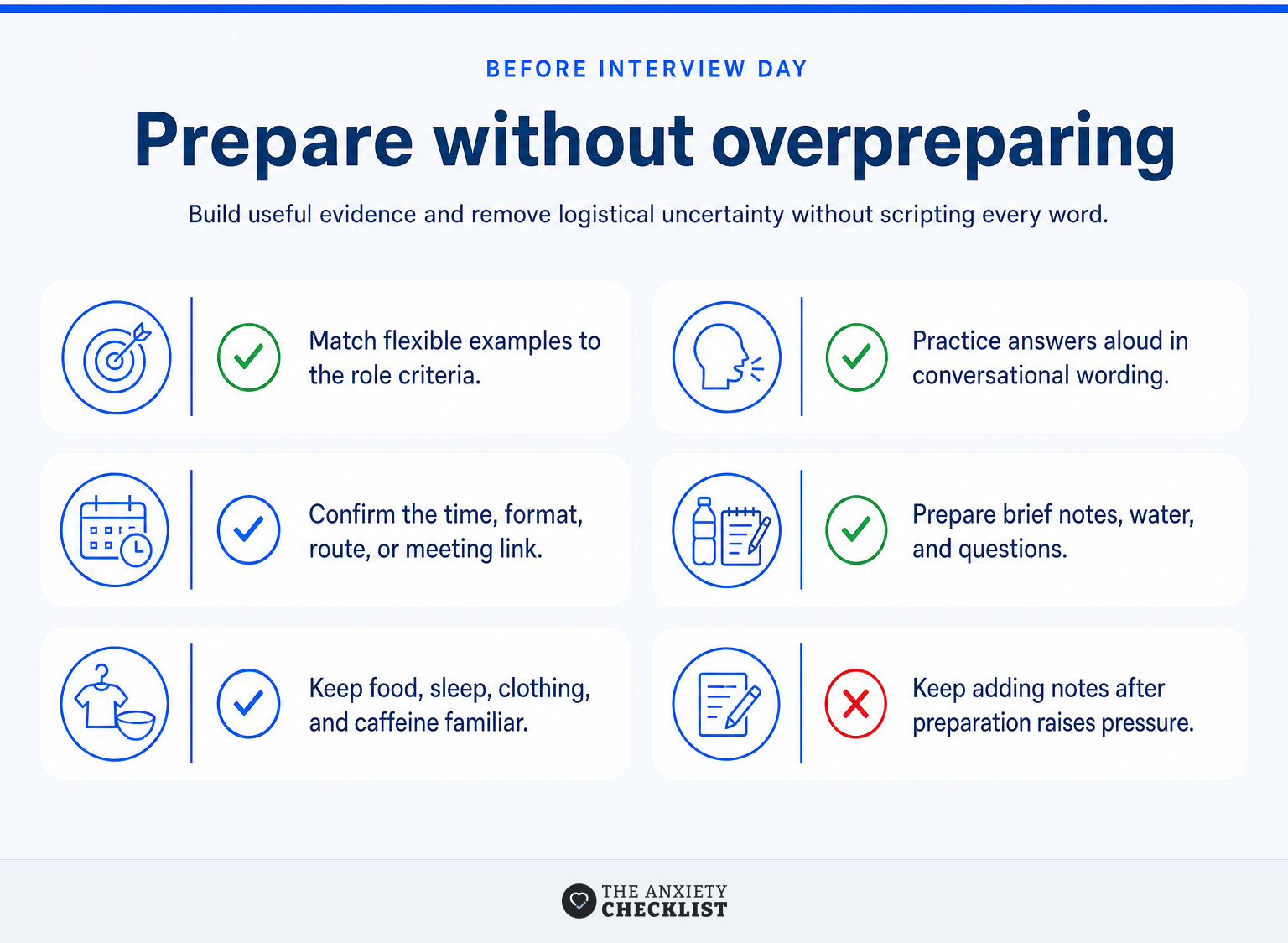
Use the day before the interview to reduce avoidable uncertainty, not to master every possible question. Prepare evidence you can adapt, confirm the practical details, and stop rehearsing before preparation becomes another source of pressure.
The National Careers Service recommends reading the job description, reviewing the application or resume, researching the employer, and preparing examples that show the required skills. Structure those examples with STAR: Situation, Task, Action, and Result.
- Define a realistic goal. Aim to listen, communicate relevant evidence, and ask useful questions. Feeling completely calm is not a requirement.
- Build a small evidence bank. Prepare several flexible examples covering achievements, problem-solving, teamwork, conflict, learning, and mistakes. One example may answer several questions when adjusted honestly.
- Practice aloud. Speaking reveals where an answer is too long or unclear. Practice the main point and structure rather than memorizing every word.
- Remove logistical uncertainty. Confirm the time zone, location or meeting link, expected format, interviewer names, travel plan, device power, camera, microphone, and internet connection.
- Prepare brief prompts. Keep the job description, resume, questions, and example headlines nearby. A page of prompts is easier to use than a complete script.
- Keep the routine familiar. Use familiar food, clothing, caffeine, and sleep habits instead of experimenting with a last-minute fix.
Stop when additional notes are making you more afraid of forgetting them. Preparation has done its job once you can identify the role's needs, retrieve relevant examples, and explain why the position interests you.
Useful preparation lowers uncertainty; endless rehearsal raises the demand to perform perfectly.
How can CBT reframe anxious interview thoughts?
CBT reframing examines an anxious prediction and replaces it with a more complete, usable interpretation. The goal is not forced positivity; it is a thought that acknowledges uncertainty without treating the worst outcome as certain.
| Anxious prediction | Thinking trap | More balanced response |
|---|---|---|
| One blank answer will ruin the interview. | All-or-nothing thinking and fortune-telling | One difficult answer is one part of the conversation. I can pause, clarify, and recover on the next question. |
| They will see that I am nervous and assume I am incompetent. | Mind reading | They may notice some nerves, but nervousness does not establish whether I can do the job. |
| I must sound confident during every second. | Rigid rules | I need to communicate relevant evidence clearly enough, not perform perfect calm. |
| If I do not get this job, the interview was pointless. | Catastrophizing | The outcome matters, but the interview can still provide practice, information, and a clearer next step. |
The CBT reframing for anxious thoughts process begins by naming the prediction rather than arguing with yourself. It also helps to identify common thinking traps, such as mind reading, catastrophizing, or treating a feeling as proof.
The American Psychological Association describes cognitive restructuring as recognizing unhelpful thinking and reevaluating it against reality. Interview-specific evidence is limited, but the 2015 simulated-interview study found that reappraisal and acceptance reduced anxiety more effectively than trying to suppress it in that sample.
Ask three questions when an interview thought feels certain:
- What observable evidence supports this prediction?
- What is another plausible explanation or outcome?
- What useful action remains available even if anxiety is present?
A balanced thought might be: “I may feel nervous and still give relevant answers.” That sentence is more credible under pressure than “I will be completely confident and everything will go perfectly.”
A balanced thought should be believable enough to use under pressure, not unrealistically positive.
What is a 10-minute pre-interview routine?
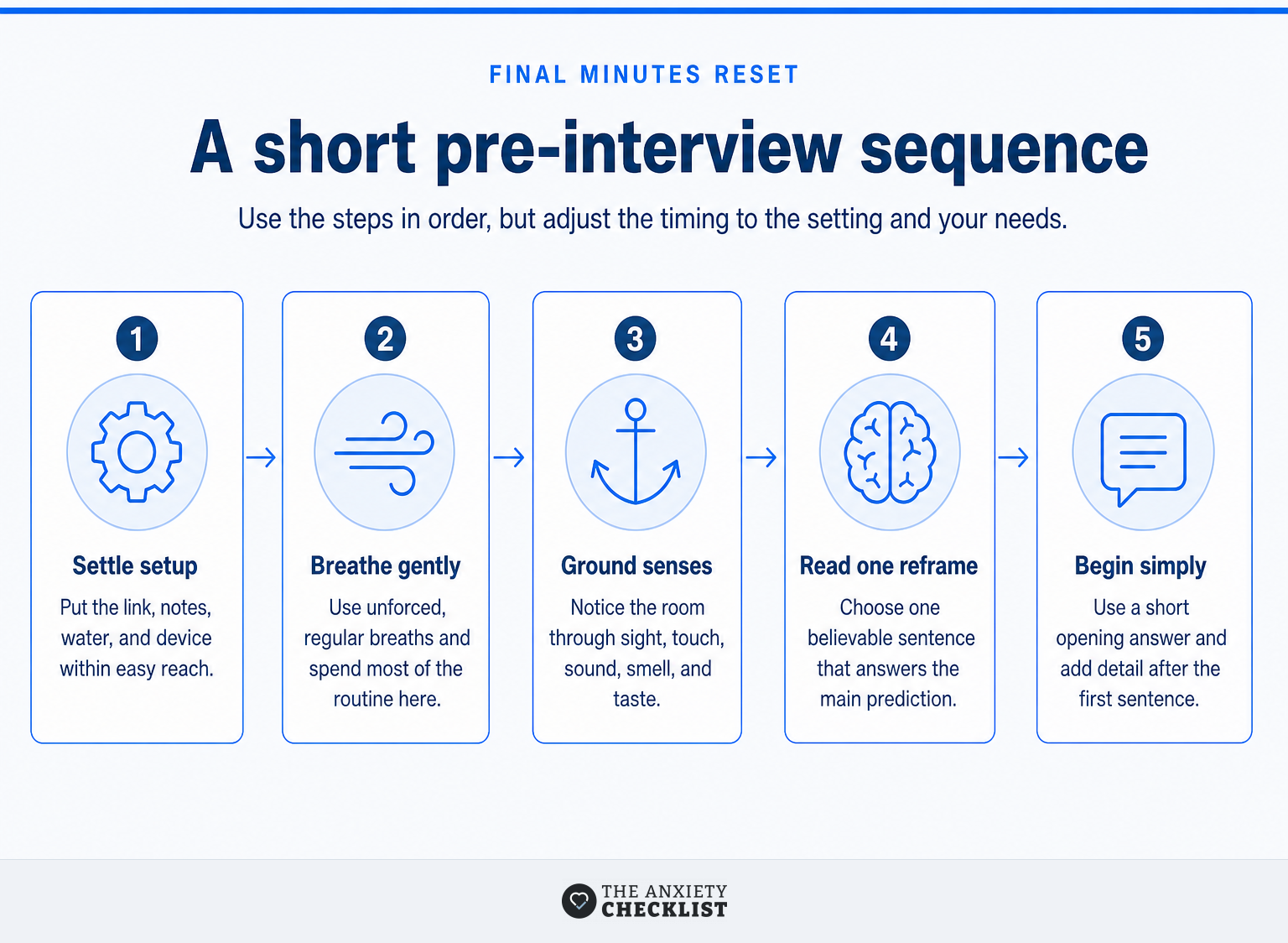
Use the final 10 minutes to settle the environment, regulate breathing, orient attention, and choose one balanced thought. The aim is to begin the interview with a simple sequence already in progress rather than waiting to feel entirely calm.
This is a practical sequence built from established techniques, not a clinically validated 10-minute protocol. Adjust it for travel, accessibility needs, and the interview format.
- 10:00 to 9:00: Settle the setup. Place the meeting link, notes, water, and device within reach, or find a quiet place near the interview room. Silence nonessential notifications.
- 9:00 to 4:00: Breathe gently. The NHS breathing exercise suggests unforced, regular breaths, optionally counting from one to five while breathing in and out, for at least five minutes.
- 4:00 to 2:00: Ground through the senses. Use the Oxford Health NHS guidance to notice five things you see, four you feel, three you hear, two you smell, and one you taste. Shorten the sequence if the interview begins sooner.
- 2:00 to 1:00: Read one balanced sentence. Choose the thought that answers your main prediction, such as “A pause is allowed, and one answer does not decide the whole interview.”
- 1:00 to start: Recall the opening. Prepare a short answer to the likely opening question, then let the rest of the conversation develop naturally.
If focusing on breathing makes anxiety feel stronger, stop forcing the exercise and orient to visible objects, physical contact with the floor, or sounds in the room instead.
The routine is designed to shift attention step by step, not to test whether you can become completely calm.
What can you do when anxiety spikes during the interview?
When anxiety rises, reduce the task to listening to the current question and producing the first relevant sentence. A brief pause, clarification request, or grounded breath can interrupt the rush to answer before you understand what was asked.
Use this recovery sequence:
- Place both feet on the floor and release unnecessary tension in the jaw, shoulders, and hands.
- Listen for the main request in the question. Ask for repetition or clarification if needed.
- Start with a headline sentence: “The most relevant example is…” or “The short answer is…”
- Add the evidence or STAR example after the main point is clear.
- Stop when the question has been answered instead of filling every silence.
The U.K. Home Office interview guidance recommends listening carefully, taking a pause, and writing down the question when useful. It also advises adapting prepared examples rather than forcing an answer that does not match the question.
If the mind goes blank, use a neutral recovery sentence: “Let me take a moment to choose the most relevant example.” There is usually no need to apologize repeatedly or explain every physical symptom.
If a wave of panic appears, briefly direct attention outward. Identify one visible object, feel your feet against the floor, let one breath leave without forcing the next, and return to the interviewer's last sentence.
A pause, clarification, or shorter first sentence is a recovery skill, not an interview failure.
How do you stop replaying the interview afterward?
Give yourself one bounded, factual review instead of repeatedly grading the interview by how anxious it felt. Record what happened, choose one improvement, complete any practical follow-up, and then redirect attention to the next activity.
A useful post-interview debrief has four parts:
- Facts: What questions were asked, and what answers were given?
- Evidence: What did you communicate clearly, even if it felt uncomfortable?
- Adjustment: What is one specific change for the next interview?
- Next action: Send an expected thank-you note, record useful details, or prepare for the next application.
Separate facts from interpretations. “The interviewer looked at the clock” is an observation; “the interviewer was bored and has rejected me” is a prediction.
Do not send an apology simply because you felt nervous. Contact the employer when there is a factual correction, a requested document, or an agreed follow-up, not to seek reassurance about every answer.
A factual debrief creates a next step; repeated mental replay creates more uncertainty.
When is interview anxiety a sign to get more help?
Professional assessment is appropriate when interview anxiety is persistent, causes significant distress, or repeatedly prevents you from pursuing work. Self-help can support ordinary nerves, but it is not a substitute for diagnosis, psychotherapy, or individualized medical care.
The NIMH's 2025 self-check guidance recommends considering how symptoms affect daily life and seeking professional help when severe symptoms persist or interfere with normal responsibilities.
Consider speaking with a qualified health or mental-health professional if anxiety is causing:
- repeated interview cancellations or an inability to submit applications;
- panic attacks, severe physical symptoms, or days of anticipatory distress;
- persistent sleep, appetite, mood, or concentration changes;
- fear across meetings, calls, presentations, or other social situations;
- reliance on alcohol or other substances to tolerate interviews;
- uncertainty about whether another physical or mental-health condition is involved.
NIMH's social anxiety guidance explains that treatment may involve psychotherapy, medication, or both, based on a person's needs and medical situation. A specific medication or dose requires a qualified prescriber; do not start, stop, or change prescribed medication solely for an interview without consulting that professional.
If there is an immediate risk of self-harm or you cannot stay safe, contact local emergency services or crisis support. In the United States, call or text 988 for the Suicide & Crisis Lifeline.
Professional help is appropriate when interview anxiety becomes persistent, disabling, or drives major avoidance.
What else do people ask about job interview anxiety?
These questions focus on immediate calming, the reasons behind interview nerves, pauses, and online advice. The safest answers combine practical preparation with low-risk coping methods and professional support when impairment becomes substantial.
How do I calm my nerves before a big interview?
Calm interview nerves by lowering uncertainty first: confirm logistics, prepare a small set of flexible STAR examples, and practice aloud. In the final minutes, use gentle breathing and a sensory grounding exercise. During the interview, pause before answering and focus on the question rather than monitoring every physical symptom.
Why am I so nervous before an interview?
Interview nervousness usually comes from a mix of uncertainty, social evaluation, and meaningful consequences. The brain may predict rejection, embarrassment, or going blank, while the body produces a stress response. Nervousness before one interview can be ordinary; persistent anxiety that causes avoidance or broader impairment deserves professional assessment.
What is the 10 second rule in an interview?
The 10-second rule is not a universal instruction for candidates. A 2023 LinkedIn Talent article used the phrase as advice for interviewers: wait up to 10 seconds before rescuing a candidate by rephrasing a question. Candidates can take a brief pause, ask for clarification, and then answer deliberately.
How to calm nerves before interview reddit?
If searching Reddit for ways to calm interview nerves, treat personal stories as ideas rather than medical or career evidence. Test low-risk basics first: prepare flexible examples, check logistics, practice aloud, breathe gently, and ground attention in the room. Avoid copying medication advice or assuming one person's result will predict yours.
Reliable preparation and low-risk coping methods are safer than treating an online anecdote as a universal rule.
What should you do next?
Choose one preparation task and one calming task today. Build a small bank of STAR examples, then practice the 10-minute routine once before interview day so the sequence feels familiar rather than new.
For guided sensory practice, Anxiety Checklist's grounding techniques app includes short guided exercises such as 5-4-3-2-1 grounding. The app is educational self-help and does not provide professional diagnosis, psychotherapy, or emergency care.
The goal is not zero anxiety; it is enough steadiness to show your evidence one question at a time.