

You're sitting still, yet your chest feels clamped. You take a deeper breath, check your pulse, and notice the sensation even more. Within moments, the thought arrives: What if this is my heart?
That fear makes chest tightness worse, but it shouldn't be dismissed. The safest way to learn how to relieve chest tightness is to make a quick medical safety check first, then use calming techniques when the pattern fits anxiety or panic. Immediate tools can lower the alarm response. Long-term retraining can help you heal from panic and live panic free.
Table of Contents
- Why Your Chest Feels Tight and What It Really Means
- When to Seek Emergency Care Versus When to Self-Manage
- Immediate Relief Techniques You Can Use Right Now
- Why Breathing Exercises Alone May Not Be Enough
- Building Long-Term Resilience and Living Panic Free
- Your Practical Action Plan for Lasting Relief
Why Your Chest Feels Tight and What It Really Means
You may be resting when pressure suddenly grips your chest. Your breathing changes, your shoulders brace, and your attention scans for danger. Anxiety can create this physical alarm response through rapid or shallow breathing, tightened chest muscles, and heightened sensitivity to normal sensations. Hyperventilation may add lightheadedness, tingling, breathlessness, and pressure.
The sensation is real. Anxiety does not require an imaginary symptom. It can produce intense discomfort without a blocked artery causing it. A clinical review found chest pain in 78% of self-perceived worst panic attacks, while panic attacks appeared in 28.5% of patients with atypical chest pain (clinical review of panic disorder and chest pain).
Remember: A frightening symptom can be real without being dangerous. It still deserves the right safety check.
Chest pain also appears frequently in medical care. The 2021 AHA/ACC guideline reports lifetime chest-pain prevalence in the United States at 20% to 40%, with women reporting chest pain more often than men. It also notes that only 5.1% of emergency-department patients presenting with chest pain have acute coronary syndrome, while more than half ultimately have a noncardiac cause (AHA/ACC clinical guideline). These figures provide context, not permission to diagnose a new or severe episode yourself.
Anxiety-related tightness can feed the phobophobia and panic attack cycle. You notice pressure, label it dangerous, tense your muscles, alter your breathing, and then read those new sensations as proof of danger. Recognizing the sequence gives you a place to interrupt it. For practical discussion of anxiety-related chest symptoms, see Therapsy anxiety chest pain help.
Panic-related chest tightness is treatable. You can learn to stop escalating the alarm and retrain the fear that keeps the symptom returning. Clear information and a deliberate safety check are better guides than automatically obeying the worst-case thought.
When to Seek Emergency Care Versus When to Self-Manage
Don't use breathing exercises to talk yourself out of a potentially serious medical problem. New, severe, persistent, or unusual chest tightness needs urgent evaluation, especially when it appears with symptoms that suggest a cardiac or respiratory emergency.
Use this decision pathway
Step one, stop and check the pattern. Ask whether the tightness is new, unusually intense, persistent, or occurring with exertion. Also consider whether you have a known heart or lung condition, significant cardiac risk factors, or a reason to doubt that this episode matches your usual panic symptoms.
Step two, look for override symptoms. Seek emergency help immediately if the tightness spreads to your arm, jaw, neck, or back, or if it comes with sudden sweating, nausea, faintness, or severe shortness of breath. Don't wait for the sensation to become unbearable. Women can experience heart-related symptoms as pressure, squeezing, tightness, nausea, fatigue, or breathlessness rather than a dramatic stabbing pain, so mild-feeling symptoms still warrant caution (guidance on chest pain symptoms in women).
Step three, call for help when you're unsure. If you can't confidently identify the episode as your familiar, previously evaluated panic pattern, choose medical assessment over self-reassurance. Anxiety and hyperventilation can cause marked dyspnea, chest tightness, tingling, and lightheadedness, but urgent-care guidance treats anxiety as a diagnosis of exclusion in new or atypical presentations. Breathing changes occur in 95.1% of panic attacks, and marked dyspnea has been reported by 68% of respondents, which shows that panic symptoms are common but not specific to panic (urgent-care guidance on dyspnea).
When self-management makes sense
Self-relief is reasonable when a clinician has evaluated the symptom, the episode follows your established panic pattern, and there are no red flags. Panic-related tightness often rises during fear or stress, fluctuates as the alarm response changes, and eases when you slow your breathing, relax your muscles, or redirect attention.
That pattern isn't proof of safety. It's a practical reason to begin calming while staying alert to changes. If symptoms worsen, persist, or develop new features, stop self-management and seek care. The Anxiety Checklist's help center can support you with immediate calming prompts, but it can't replace emergency assessment.
Immediate Relief Techniques You Can Use Right Now
Once serious warning signs have been ruled out, stop trying to force a huge breath. Large, urgent inhalations can keep you overbreathing. Your first goal is quieter, slower breathing that lets the belly move.
Start with diaphragmatic breathing
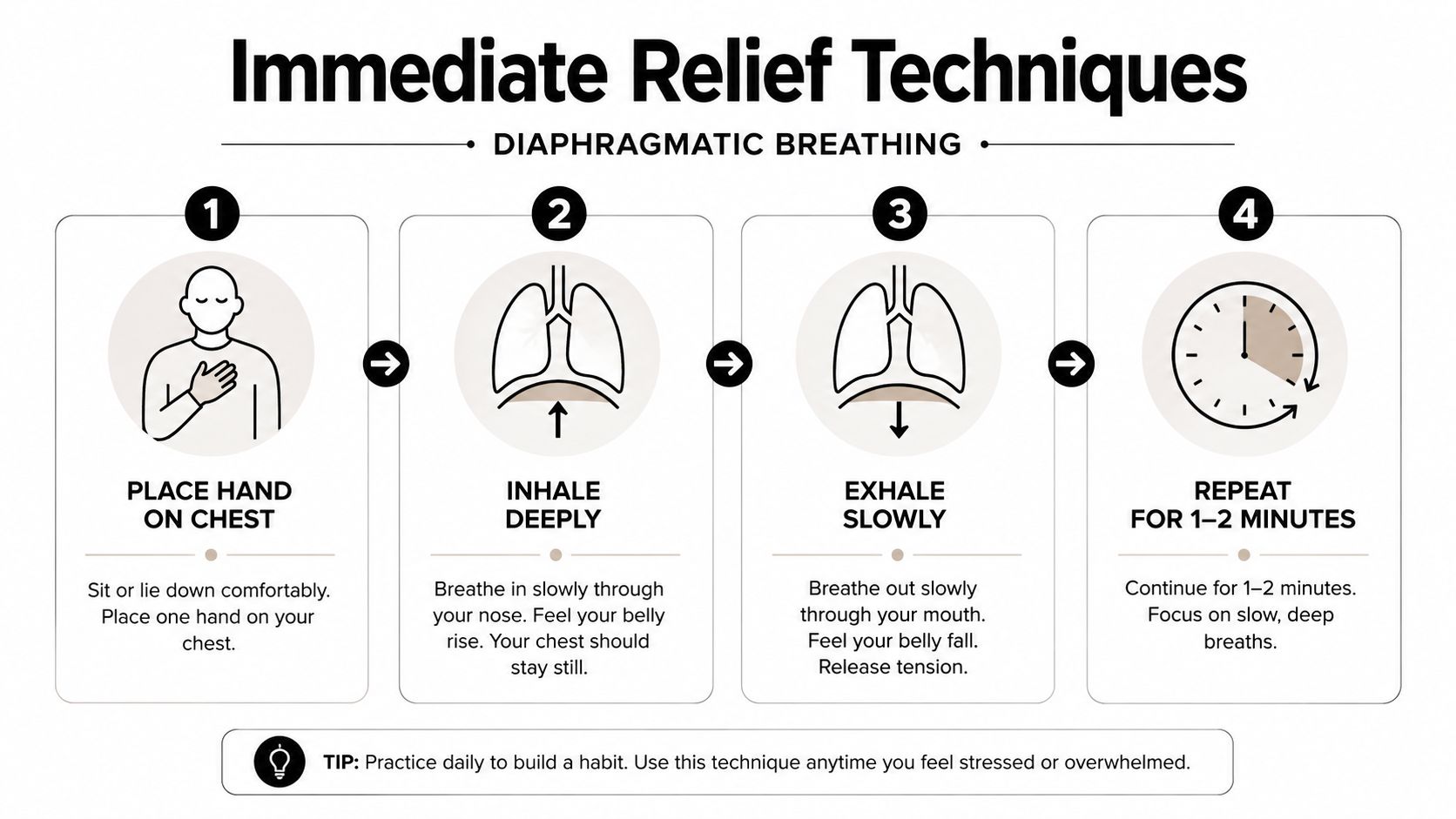
Sit upright with your feet supported, or lie down if that feels safer. Place one hand on your upper chest and the other on your belly. Breathe in gently through your nose so the lower hand rises more than the upper hand, then breathe out through pursed lips with an exhale that's slightly longer than the inhale.
Continue for 5 to 10 minutes, and practice 2 to 3 times per day when you're calm, as well as during episodes. This approach helps reduce hyperventilation-driven tightness by making the breath slower and less chest-dominant (practical guidance on diaphragmatic breathing).
Don't turn this into a performance test. If your chest still feels tight after a few breaths, that doesn't mean you're failing. Keep the exhale easy, reduce the effort, and let your body settle gradually.
Move attention outward
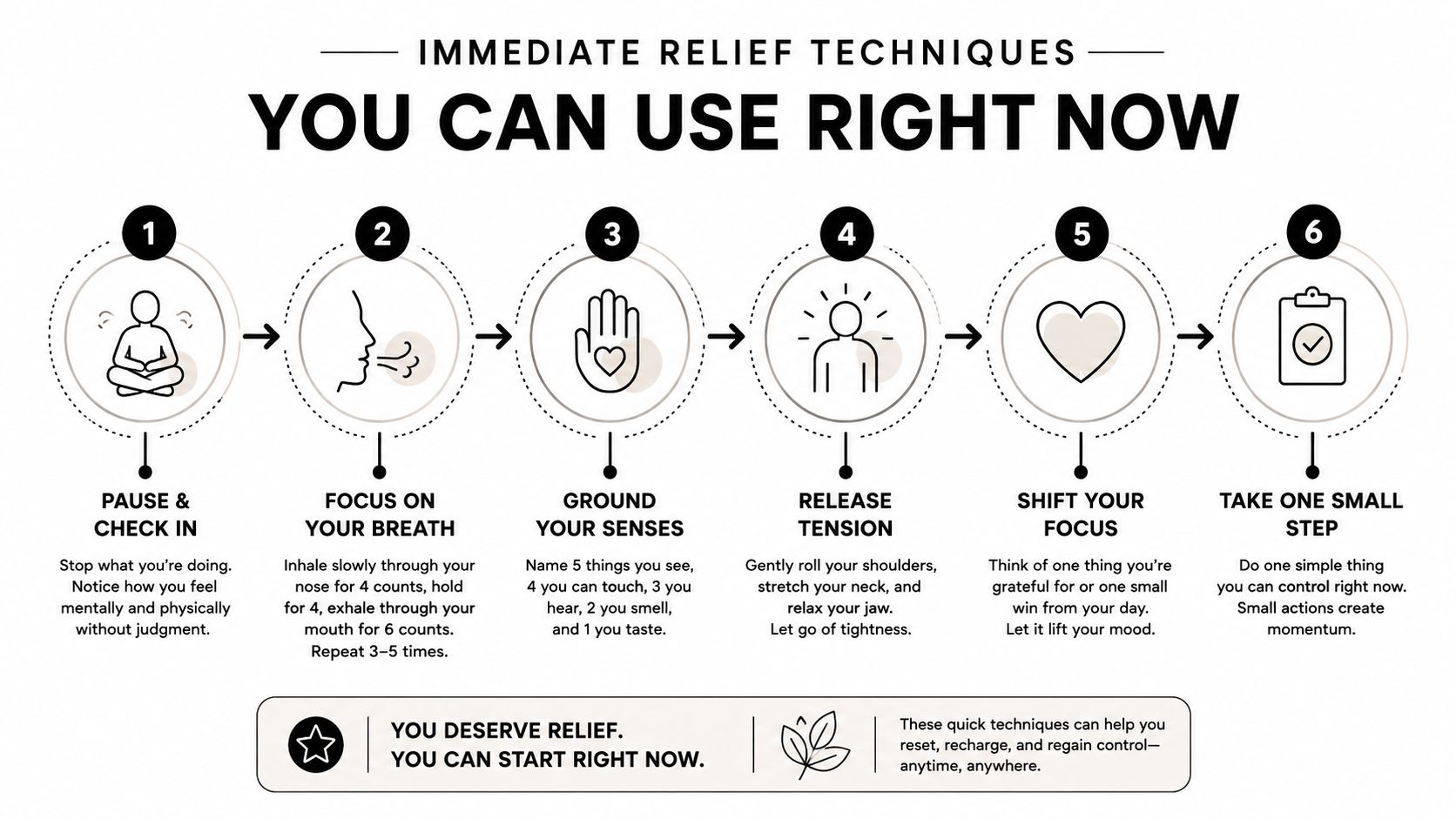
Panic grows when you repeatedly scan your chest, pulse, breathing, and oxygen level. Grounding interrupts that internal surveillance. Name objects you can see, notice the surface beneath your feet, identify sounds in the room, and describe what your hands feel.
Use these SOS grounding methods for anxious moments during a meeting when you can't lie down, while sitting in traffic, or when you're awake at night checking your breathing. The point isn't to prove that nothing is wrong. The point is to stop feeding the alarm with constant monitoring.
Release physical bracing
Lower your shoulders. Unclench your jaw. Rest your hands open instead of gripping your clothing or phone. If you're seated, place both feet on the floor and let your back receive support.
Try a gentle chest-opening movement by drawing your shoulders slightly back without forcing your ribs upward. Stop if movement causes pain, dizziness, or worsening symptoms. Posture can reduce muscular contribution to tightness, but it shouldn't be used to override warning signs.
Use one sequence rather than jumping between ten techniques: soften your posture, breathe gently, ground through your senses, then wait. Relief may arrive in stages. These tools regulate the moment. They don't by themselves retrain the fear that causes future episodes.
Why Breathing Exercises Alone May Not Be Enough
Breathing is useful, but it isn't a complete recovery plan. Some people breathe correctly and still feel chest tightness because the main problem has shifted from breathing mechanics to panic sensitivity, the learned fear of bodily sensations.
The maintenance loop is predictable. You notice tightness, assume it signals catastrophe, check your body for confirmation, avoid activity, seek repeated reassurance, and become more sensitive to the next sensation. Each response teaches your brain that chest sensations require emergency attention. The alarm then activates faster, even when your breathing technique is sound.
The limits of a single calming tool
A 2025 systematic review found that breathing exercises can reduce anxiety and stress in adults, but it also noted that the evidence is limited by a lack of large randomized controlled trials (systematic review of breathing exercises). That's an important distinction. Breathing can help you down-regulate, but no responsible guide should promise that one pattern will stop every episode or resolve persistent chest symptoms.
If you've tried breathing and the tightness keeps returning, don't conclude that you're broken. Ask what happens after the breath slows. Do you immediately check your pulse? Avoid stairs? Search symptoms? Cancel plans? Those behaviors may be maintaining the fear even after the physical arousal drops.
A breathing exercise lowers the volume. Recovery also requires learning that the sensation itself can be tolerated safely after medical causes have been addressed.
The Anxiety Checklist guide to breathing can help you practice different breathing tools without turning each episode into a frantic experiment. Pair breathing with a broader plan: reduce checking, challenge catastrophic predictions, return gradually to avoided activities, and discuss recurrent symptoms with a qualified clinician.
Breathing is the first layer, not the whole foundation. Use it to create enough calm for better decisions and retraining.
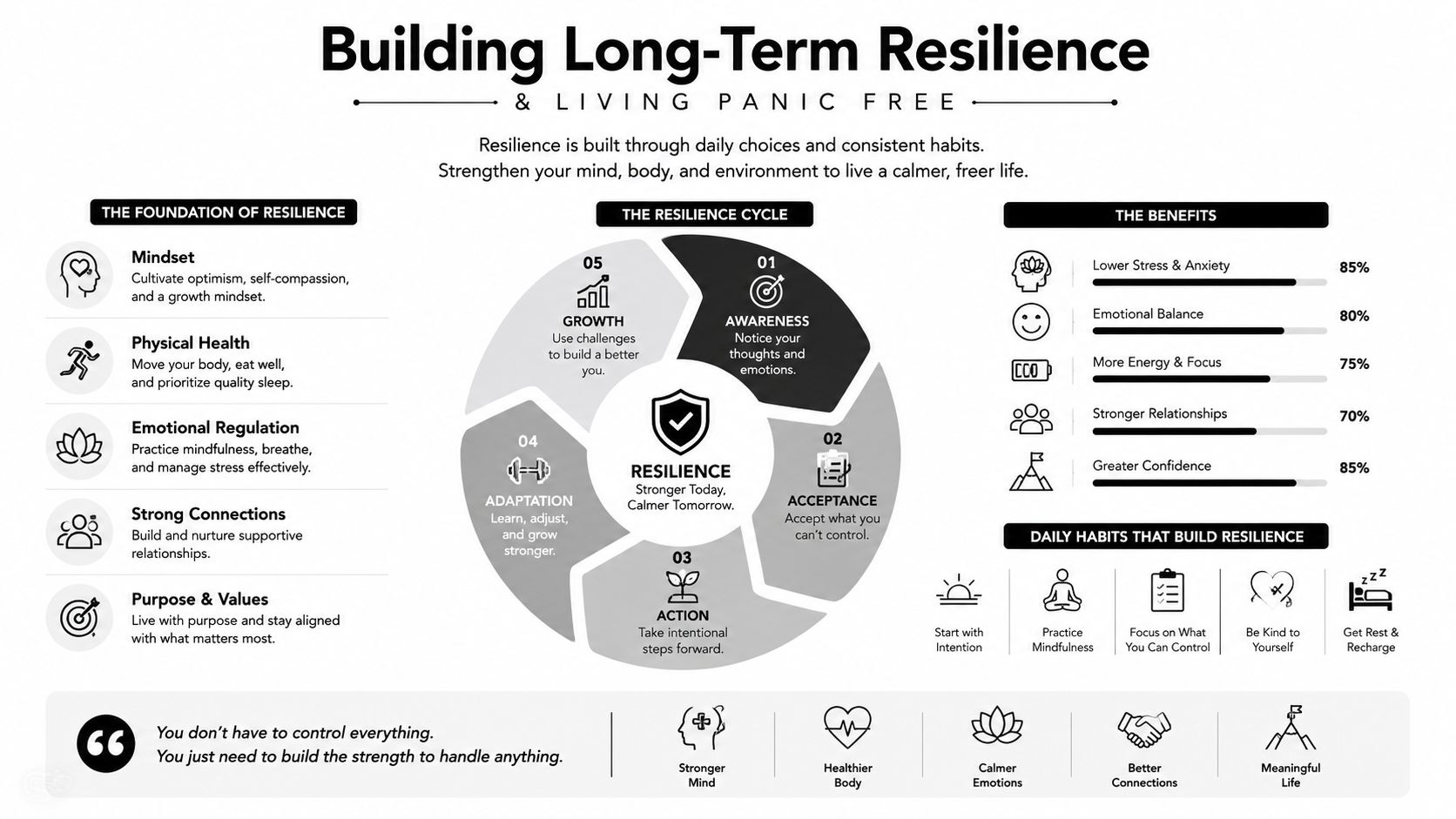
Building Long-Term Resilience and Living Panic Free
You don't have to manage panic forever. The strongest long-term argument for hope is that panic disorder responds to structured treatment, especially cognitive behavioral therapy. A 2023 Cochrane network meta-analysis found that most medications and CBT were more effective than placebo, with CBT plus medication especially efficacious for adults with panic disorder (Cochrane network meta-analysis).
CBT retrains the interpretation of sensations. You record the prediction, such as “this tightness means I'm about to collapse,” compare it with what happened, and test the belief through carefully planned behavioral experiments. Gradual exposure can then teach your nervous system that increased heart rate, breathlessness, or chest sensations are uncomfortable but not automatically catastrophic, provided medical emergencies have been excluded.
A meta-analysis found an overall mean remission rate of 51.0% across adult anxiety-disorder CBT studies (CBT remission meta-analysis). The review also found the highest remission rates when remission meant good end-state functioning or no longer meeting diagnostic criteria. That's more meaningful than feeling better for an afternoon. It points toward returning to ordinary life with less avoidance and less fear.
What durable retraining looks like
- Thought work: Write down the feared meaning of chest tightness and identify the evidence for and against it.
- Behavioral experiments: Test one safety behavior at a time, such as delaying a pulse check, with professional guidance when appropriate.
- Gradual exposure: Re-enter activities you've avoided because of panic, progressing at a manageable pace rather than demanding instant confidence.
- Daily regulation: Use meditation, sleep support, movement, and paced breathing to lower your baseline vulnerability.
A JAMA Psychiatry review reported relapse rates ranging from 0% to 14% in three of seven comparisons after successful CBT (review of long-term anxiety treatment outcomes). In a primary-care panic-disorder effectiveness trial, CBT plus medication produced higher remission than usual care at both 3 months, 20% versus 12%, and 12 months, 29% versus 16% (randomized primary-care panic-disorder trial). These results don't guarantee an identical outcome for every person. They do show that lasting improvement is a realistic treatment goal.
For people comparing broader wellness options, information about a stress relief supplement for focus may be useful, but supplements shouldn't replace medical assessment or evidence-based panic treatment. Structured support matters more than collecting disconnected remedies. The Anxiety Checklist offers app-based SOS relief, guided meditations, hypnosis sessions, walking sessions, affirmations, and CBT self-therapy tools, while evidence-based anxiety resources can help you build a more consistent learning routine.
Your Practical Action Plan for Lasting Relief
Use this plan as a starting point, not a substitute for care when symptoms are new, severe, or atypical.
In the next five minutes
- Run the safety check. Look for radiation, sweating, nausea, faintness, severe breathlessness, or an unfamiliar pattern. If any appear, seek emergency help.
- Settle your breathing. Place one hand on your belly, inhale gently through your nose, and exhale a little longer through pursed lips.
- Stop scanning. Name what you see and hear, relax your shoulders, and let the sensation change without repeatedly testing it.
During the next day
Practice diaphragmatic breathing for 5 to 10 minutes, 2 to 3 times per day, including once when you're calm. Write down one catastrophic prediction and the outcome you observe. Keep the record factual, not reassuring: what you felt, what you feared, what you did, and what happened next.
Over the coming weeks
Arrange a medical conversation for recurrent, persistent, or changing chest tightness. If panic is driving the episodes, pursue CBT or another qualified treatment plan that addresses avoidance, body checking, catastrophic interpretation, and feared sensations. Consistency matters more than intensity. A small practice repeated regularly will teach your nervous system more than a frantic rescue routine used only at the peak of fear.
You're not starting from nowhere. You have a triage method, immediate tools, and a proven route toward deeper recovery. Many people who now live freely once believed every chest sensation meant danger. With appropriate medical care and structured retraining, you can move toward a life that isn't organized around panic.
The Anxiety Checklist gives you an always-free SOS mode for grounding, affirmations, and quick prompts when chest tightness triggers panic, alongside daily practices and CBT self-therapy tools for longer-term change. Visit The Anxiety Checklist and start with the immediate-support tools today, then build the routine that helps you live panic free.