



You're sitting at work when a sudden image flashes through your mind. Maybe it involves harming someone you love, losing control, or making a terrible mistake. Your stomach drops. You replay the thought, search for what it “means,” and ask yourself whether having it makes you dangerous. The more you try to push it away, the louder it seems to become.
That experience can feel isolating, but intrusive thoughts are extremely common. The thought itself doesn't define your character, intentions, or values. What matters clinically is whether the thoughts become persistent, distressing, time-consuming, and connected to avoidance, reassurance-seeking, or rituals.
Effective treatment exists. Healing from anxiety and learning to live panic free are realistic goals, even when your mind has felt unsafe for a long time. The path usually begins with identifying the pattern, finding care that matches it, and learning a different response to mental noise. If you're unsure whether your experience calls for mental health support for unwanted emotions, a qualified professional can help you sort fear from actual risk.
Table of Contents
- When Your Mind Turns Against You
- Understanding What Intrusive Thoughts Really Are
- The Gold Standard in Psychological Treatment
- Medications and Adjunctive Therapies
- Immediate Coping Techniques for Acute Episodes
- Building Your Personalized Treatment Plan
- Finding the Right Care and Overcoming Access Barriers
When Your Mind Turns Against You
Consider a parent washing dishes while their baby sleeps nearby. A frightening image appears without warning. The parent freezes, feels a rush of panic, and starts checking their own emotions: “Why did I imagine that? What kind of person thinks this way?” They may avoid being alone with the baby, ask a partner for reassurance, or mentally review the scene until they feel temporarily calmer.
The thought arrived uninvited. The distress came from what the parent believed the thought might mean. That distinction is central to intrusive thoughts treatment.
People often assume that a disturbing thought reveals a hidden wish. In reality, unwanted thoughts frequently target what matters most. A loving parent may become terrified by harm-related images precisely because caring for their child is important. The thought clashes with their values, so the nervous system marks it as urgent.
A frightening thought is a mental event, not a verdict about who you are.
Individuals experience odd, unwanted mental content and move on without assigning it much importance. Trouble grows when the mind treats the thought as evidence, a warning, or a problem that must be solved immediately. Reassurance, checking, avoidance, and analysis can bring short-term relief, but they may keep attention locked onto the thought.
You don't need to prove that you're a good person every time your mind produces something disturbing. You need support if the cycle is consuming your time, restricting your life, or making ordinary situations feel dangerous. Treatment doesn't promise that your mind will never produce another unwanted image. It helps you stop organizing your life around those images.
Understanding What Intrusive Thoughts Really Are
Think of the mind as having a noisy spam filter. It generates and sorts thoughts, images, urges, memories, and predictions all day. Some messages are useful, many are irrelevant, and a few are shocking. An intrusive thought is an unwanted mental event that appears without deliberate choice and causes distress because it feels threatening, meaningful, or incompatible with your values.
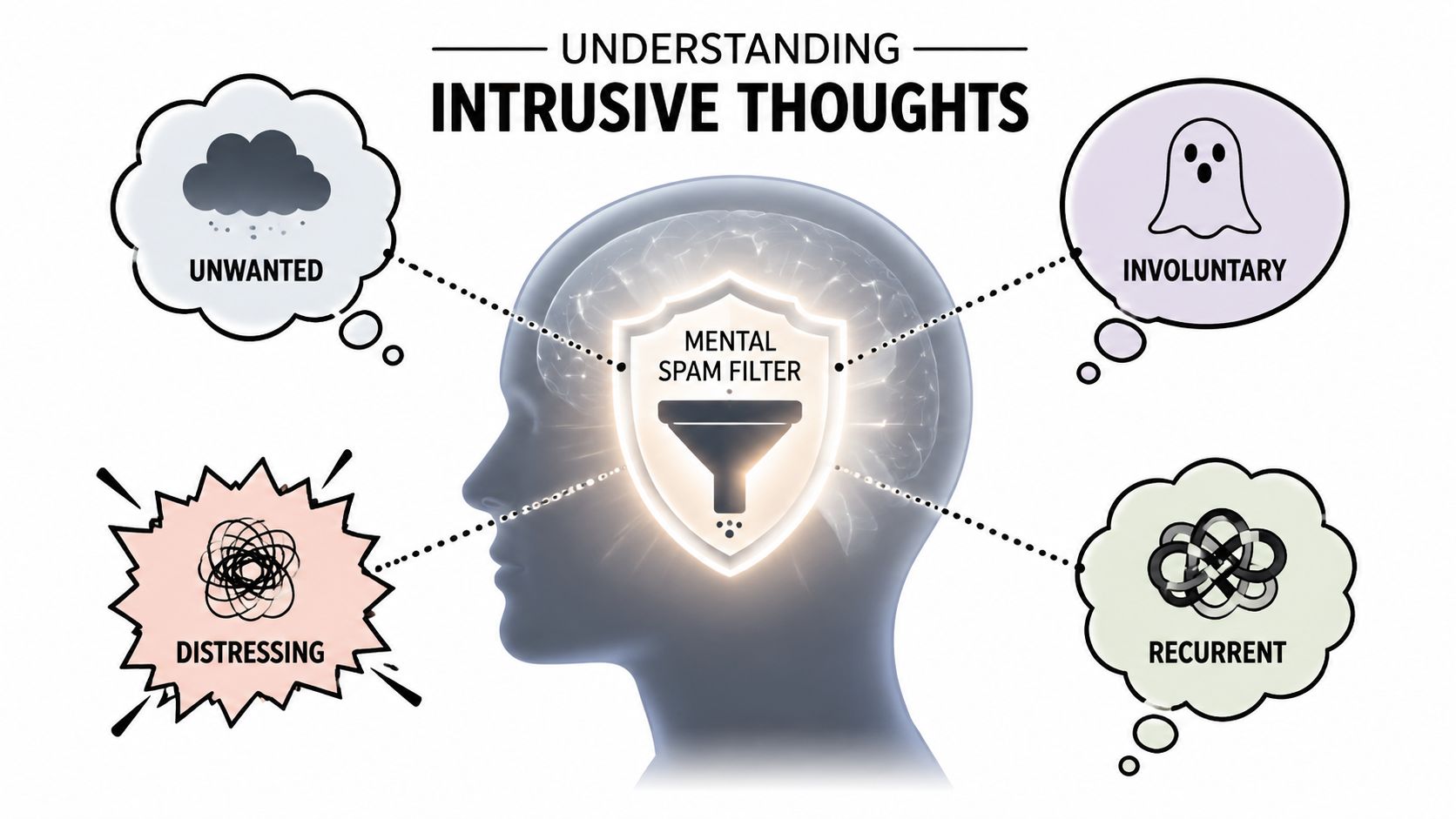
A major medical reference explains that occasional intrusive thoughts are widespread, while OCD affects about 1% to 3% of the global population and involves obsessions, compulsions, or both in its clinical overview of OCD. A Mayo Clinic Press summary cites a global study finding that 94% of people experience intrusive thoughts at least occasionally. The clinical difference isn't whether a person has ever had a strange thought. It's whether the thoughts become frequent, impairing, and tied to behaviors or mental rituals intended to neutralize distress.
The pattern that deserves attention
A thought may warrant professional assessment when you notice several of these features:
- Persistence: The same theme returns repeatedly and feels impossible to set aside.
- Distress: Fear, shame, disgust, or panic remains intense long after the thought appears.
- Compulsions: You check, count, pray, review memories, seek reassurance, or mentally argue with the thought.
- Interference: You avoid people, places, responsibilities, or activities because of the thought.
- Time consumption: Your day becomes organized around preventing, analyzing, or neutralizing imagined danger.
These patterns can occur in OCD and other anxiety-related presentations. Overthinking and anxiety often reinforce each other, but a professional assessment can clarify whether you need OCD-specific treatment, broader anxiety support, or both.
Parents who are trying to understand unusual thoughts in children may also find Children Psych intrusive thoughts advice useful, especially when deciding how to respond without shaming or repeatedly reassuring a child. The aim is compassionate curiosity, not interrogation.
The Gold Standard in Psychological Treatment
For OCD-related intrusive thoughts, the first-line psychological treatment is cognitive behavioral therapy with exposure and response prevention, usually called CBT/ERP. International guidance recommends CBT that includes exposure to obsessive thoughts and response prevention for mental rituals and neutralizing strategies, even when visible compulsions aren't obvious in NICE guidance.
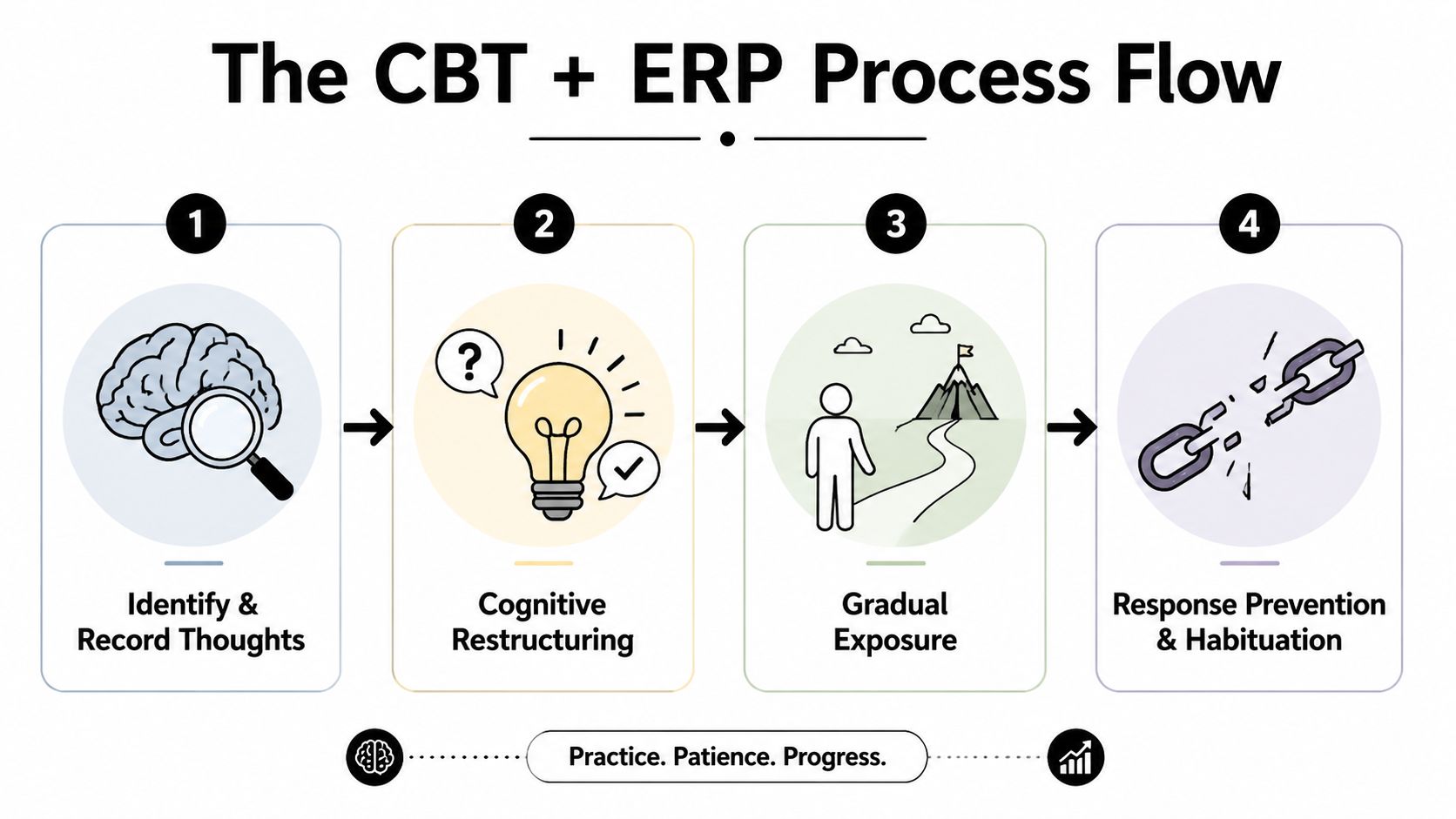
ERP doesn't try to guarantee that an intrusive thought will disappear. That goal can turn into another form of checking. Instead, treatment helps you approach triggers while dropping the rituals that teach your brain the thought is dangerous.
How ERP changes the cycle
A therapist may begin with a functional analysis. Together, you identify the trigger, the feared meaning, the distress response, and the action that follows. A person who fears causing harm might avoid driving, scan constantly for signs of danger, or ask someone else to confirm that nothing happened.
The therapist then helps create a distress-ranked exposure hierarchy. Early exercises are usually selected collaboratively, not forced. During an exposure, you practice allowing the thought, image, uncertainty, or situation to be present while resisting the usual compulsion. That may mean not reviewing the memory, not searching online, or not asking for reassurance.
With repetition, the person learns through experience that anxiety can rise and fall without a ritual. The thought becomes less important because the person stops feeding it urgency. This is the core of exposure therapy for anxiety, though OCD-focused ERP should be guided by someone trained to recognize mental compulsions and reassurance loops.
What treatment can look like
Guidelines describe low-intensity psychological treatment of up to 10 therapist hours per patient for mild impairment when that approach fits the person's preferences in the NICE evidence guideline. Other clinical guidance describes a typical course of 12 to 16 weekly sessions of about 60 minutes, while more intensive formats may involve 12 to 20 sessions lasting 90 to 120 minutes.
A 2022 meta-analysis found an overall ERP effect on OCD symptoms of g = 0.37, with larger effects against placebo controls, g = 0.97, and active drug comparators, g = 0.59 in its published results. These figures don't predict your personal outcome, but they show why ERP is considered a structured, evidence-based intervention rather than vague encouragement to “think positively.”
If you're looking for an explanation of CBT methods or a clinician directory, find CBT at Uptown Psychology as one possible starting point. Ask any provider directly about OCD, ERP, mental rituals, and how they handle reassurance-seeking before committing to treatment.
Medications and Adjunctive Therapies
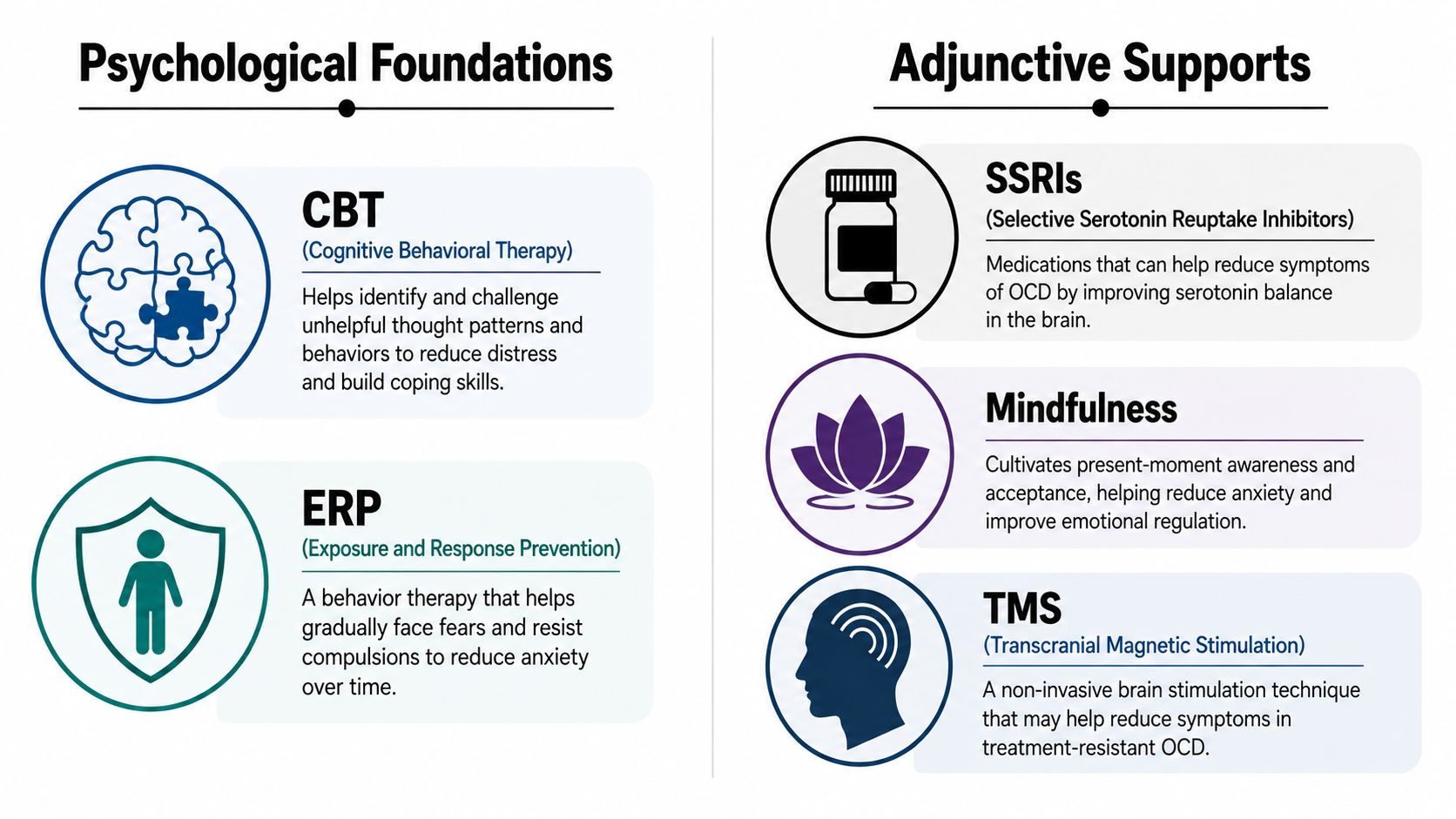
Medication can support intrusive thoughts treatment, particularly when symptoms are severe, persistent, or accompanied by broader anxiety or depression. SSRIs are commonly used as a first-line medication class for OCD, but a prescriber must determine whether they're appropriate, explain possible side effects, and monitor your response. Medication decisions should be individualized rather than based on a frightening symptom alone.
CBT/ERP and medication aren't competing identities. Some people use therapy as the central intervention and medication as support. Others need medication to reduce symptom intensity enough to participate in exposure work. A psychiatrist or other qualified prescriber can discuss options, interactions, and changes safely. Educational material such as psychotropic medications CE training may help professionals deepen their knowledge, while patients should rely on direct clinical guidance.
Options when standard care isn't enough
Some people don't respond fully to an initial course of CBT/ERP, stop treatment because exposure feels overwhelming, or have symptoms that require a more specialized plan. That situation doesn't mean recovery has ended.
A 2025 systematic review examined imagery-based interventions, including imagery rescripting, imaginal exposure, and EMDR. The review found possible reductions in obsessive-compulsive symptoms, distress, and avoidance, with generally high adherence, but it also rated the evidence as low to moderate quality, so these approaches shouldn't be presented as established replacements for ERP in the review's academic record.
A 2026 review reported substantial symptom reductions associated with neuromodulation methods in treatment-resistant OCD. A 2025 review reported a stronger signal for psilocybin than cannabinoids in treatment-resistant OCD, while cannabinoids lacked supportive evidence. These findings describe developing areas, not self-treatment instructions. Discuss eligibility, risks, legal considerations, and evidence quality with a specialist.
For help deciding whether a psychiatric evaluation makes sense, The Anxiety Checklist on anxiety psychiatrists offers general educational guidance. A clinician can then translate that information into a safe plan.
Immediate Coping Techniques for Acute Episodes
Acute distress needs a different response from long-term treatment. When your heart is racing and your mind is demanding certainty, don't try to solve the entire meaning of the thought. Your first task is to lower the intensity enough to choose your next action.
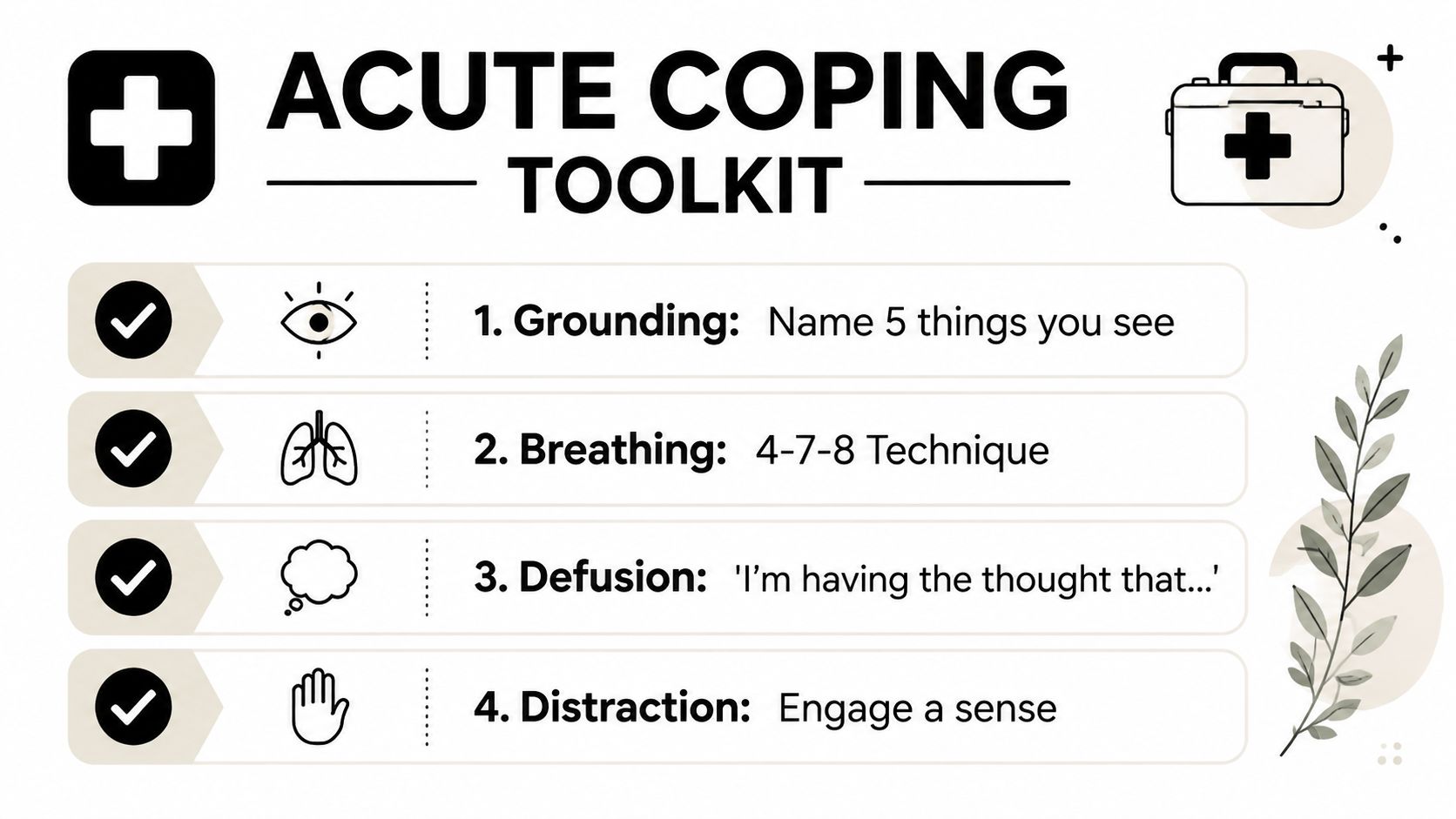
Try this short sequence:
-
Name your surroundings. Use the 5-4-3-2-1 method. Identify five things you see, four things you feel physically, three things you hear, two things you smell, and one thing you taste. Say each item slowly. This shifts attention from internal threat scanning toward present sensory information.
-
Lengthen your exhale. Try the 4-7-8 pattern if it feels comfortable. Breathe in for four counts, hold for seven, and exhale for eight. If holding your breath makes you uncomfortable, use a gentler rhythm with a longer exhale instead.
-
Label the mental event. Replace “This means I might do it” with “I'm having the thought that I might do it.” The wording creates distance without arguing about whether the thought is true.
-
Anchor your body. Press both feet into the floor, notice the chair supporting you, or hold a cool object. Describe its temperature and texture. Physical details give your attention a neutral job.
Practical rule: Relief tools should help you return to life, not become rituals you must perform perfectly.
If you're in a public place, choose one ordinary action and complete it while allowing uncertainty to remain. Take a sip of water, finish washing the cup, answer a simple message, or continue walking. You're practicing movement toward life, not waiting until your mind feels completely certain.
This video can provide a guided visual prompt during a difficult moment:
You can also keep a written cue card or use grounding techniques using a mobile app when anxiety makes it difficult to remember what to do. If a technique becomes something you repeat until you feel certain or “just right,” mention that pattern to your therapist.
Building Your Personalized Treatment Plan
A useful plan starts with the pattern, not the label. Write down what happens before the intrusive thought, what you fear it means, what you do next, and how that response affects the rest of your day. This record can reveal whether you're dealing mainly with occasional mental noise, an OCD cycle, panic, generalized worry, or overlapping concerns.
Match care to impact
If thoughts are occasional and you can return to your activities without rituals or major avoidance, education, grounding, and supportive self-help may be reasonable starting points. If thoughts dominate your attention, interfere with work or relationships, or lead to repeated checking and reassurance, arrange a professional assessment.
Your plan may include:
- Specialist therapy: Seek CBT/ERP when obsessions and compulsions drive the cycle.
- Medical evaluation: Consider a prescriber when symptoms are severe, persistent, or difficult to manage alongside therapy.
- Between-session practice: Track triggers, complete agreed exposures, and notice reassurance-seeking without turning tracking into a compulsion.
- Daily regulation: Protect sleep, eat consistently, move your body, and reduce habits that intensify physiological arousal.
- Maintenance: Keep using the skills that help you respond differently after symptoms improve.
The Anxiety Checklist can serve as one self-help option alongside professional care. Its tools include an always-free SOS mode with grounding prompts, CBT self-therapy features such as thought journaling, belief experiments, and exposure therapy, plus educational content including Anxiety University. No login is required to get started, and premium content has a 7-day free trial.
Measure progress in a useful way
Recovery isn't an all-or-nothing test. Look for functional milestones: you spend less time analyzing, return to avoided activities sooner, ask for less reassurance, or tolerate uncertainty while completing an ordinary task. A thought may still appear, but it no longer dictates your next decision.
For panic symptoms specifically, CBT has strong evidence. One controlled review reported that 85% of patients were panic-free at posttreatment, with gains maintained at follow-up, and a net panic-free rate of 59% after accounting for 26% of waiting-list controls who were also panic-free in the controlled review. Group CBT, individual CBT, and guided self-help CBT all outperformed treatment as usual for panic disorder, with standardized mean differences of -0.47, -0.43, and -0.42, respectively in a 2023 network meta-analysis. These findings support a hopeful conclusion: anxiety recovery can include living panic free, not merely learning to endure symptoms.
Finding the Right Care and Overcoming Access Barriers
Knowing that ERP works does not guarantee that you will find it quickly. A review of real-world OCD care found a mean delay of about 5.15 years before people sought psychotherapy and 5.58 years before OCD was recognized in its review of care gaps. The review also cited a survey in which only 20% received standard CBT plus SSRIs at first contact. A December 2025 IOCDF analysis of more than 10 million U.S. records found documented OCD diagnoses in only about 0.5% to 0.7% of records and documented ERP in only 2%, despite OCD being more prevalent in the population.
This gap can make treatment feel like a locked door, when the core issue may be finding the right key. Make your search specific by asking prospective providers:
- Training: “Do you provide CBT with exposure and response prevention for OCD?”
- Mental rituals: “How do you treat rumination, checking, reassurance-seeking, and covert compulsions?”
- Treatment structure: “How do you build an exposure hierarchy and track progress?”
- Fit: “What happens if exposure feels too difficult or symptoms don't improve?”
- Access: “Do you offer telehealth, referrals, or a sliding-scale pathway?”
Be cautious with providers who promise to eliminate every intrusive thought, spend sessions repeatedly reassuring you that nothing bad will happen, or make avoidance the main solution. A skilled clinician takes your fears seriously while helping you stop treating each thought as a danger signal.
If specialized care is not available nearby, ask a primary-care clinician or therapist for an OCD-focused referral and inquire about telehealth. Bring a short symptom record to appointments. A few notes about triggers, rituals, avoidance, and distress can make the first conversation easier when anxiety clouds your memory.
Seek urgent help if you believe you may act on an intention, cannot keep yourself or someone else safe, or face immediate danger. Otherwise, routine care remains worth pursuing. For generalized anxiety, one recovery study found 40% recovery across 20 treatment conditions, while individual CBT and applied relaxation reached 50% to 60% recovery at six-month follow-up in the recovery study. A long-term meta-analysis of 69 randomized trials with 4,118 patients found CBT produced better anxiety outcomes than control conditions within 12 months, while panic-disorder relapse rates were 0% to 14% over three to 12 months in the meta-analysis.
The search may require persistence, but appropriate care exists. Write down your symptoms, ask directly for ERP-informed treatment, and take one practical step toward an assessment today.
The Anxiety Checklist offers real-time SOS prompts, grounding tools, CBT self-therapy exercises, thought journaling, exposure resources, and educational material while you pursue care that fits your needs. Visit The Anxiety Checklist to begin with practical support.