

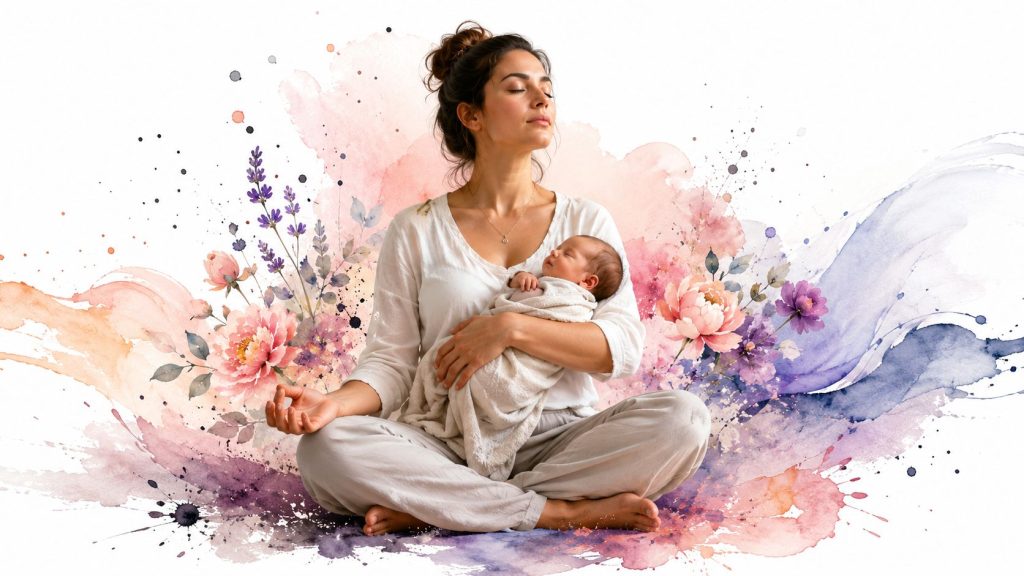
It's 3 a.m. Your baby is finally asleep on your chest, but your body won't settle. You check their breathing again. You replay the day. You jump at every sound in the house. You know you're exhausted, yet your mind keeps scanning for danger.
That kind of postpartum anxiety can feel lonely and frightening, especially when everyone around you assumes you should rest “when the baby rests.” If that advice worked, you wouldn't be reading this. What helps most is not adding another impossible task to your day. It's finding small ways to tell your nervous system, over and over, that in this moment, you are safe.
Meditation for postpartum anxiety works best when it fits your real life. Not a silent retreat. Not a perfect morning routine. Just a few repeatable micro-practices that meet you in the rocking chair, in the bathroom, beside the crib, or while pacing the hallway with a fussy baby.
Table of Contents
- You Can Heal From Postpartum Anxiety
- SOS Practices to Calm Anxiety in the Moment
- How to Build a Gentle Meditation Routine
- Meditating When You Are Exhausted
- When Meditation Is Not Enough
- Your Path Forward to a Panic-Free Life
You Can Heal From Postpartum Anxiety
At 3 a.m., postpartum anxiety doesn't usually sound dramatic. It sounds practical. “What if something happens while I'm asleep?” “What if I miss a sign?” “What if I can't handle tomorrow?” The thoughts can come fast, and because they're tied to your baby, they can feel impossible to question.
You are not weak. You are not failing. And you are not stuck this way.
Meditation for postpartum anxiety can be part of real healing, not just temporary comfort. In one landmark study, at-risk women treated with mindfulness techniques such as yoga experienced depression during pregnancy and after birth in only 18% of cases, whereas the rate was 50% in those treated with conventional psychotherapy or antidepressants, according to University of Colorado Boulder coverage of the study. That finding matters because anxious postpartum minds often live right beside depression, panic, and constant nervous system overload.
Calm is built in small moments
Most new mothers don't need another lecture about self-care. They need something doable while leaking milk, answering texts, reheating coffee, and trying not to cry from lack of sleep. That's why I encourage micro-practices. Two minutes counts. One slow exhale counts. Putting a hand on your chest while feeding your baby counts.
Meditation is not a test of focus. It's a way of interrupting the alarm cycle long enough for your body to remember that danger is not happening right now.
For some mothers, meditation also works best alongside other forms of comfort. If prayer is meaningful to you, these comforting prayers for new mothers can pair beautifully with a short breathing practice, especially in the middle of the night when words are hard to find.
Hope grows faster than guilt
The women I worry about most are often the ones who say, “I should be able to handle this.” That belief keeps people isolated. Healing usually begins when you stop grading yourself and start supporting your nervous system in tiny, steady ways.
If you need a broader starting point beyond meditation, these ways to reduce anxiety and panic can help you create a simple recovery rhythm without overwhelm. The key is not doing everything. The key is doing the next gentle thing, then repeating it tomorrow.
SOS Practices to Calm Anxiety in the Moment
When anxiety spikes, you don't need a long session. You need a fast return to the present. The best meditation for postpartum anxiety in those moments is short, physical, and specific.
Try grounding before insight
Anxious minds often demand answers. Grounding gives your body a different job. Instead of solving every fear, you help your senses reconnect with the room you're in.
Use any of these when your chest feels tight, your thoughts start spiraling, or you notice the urge to check, scan, or pace:
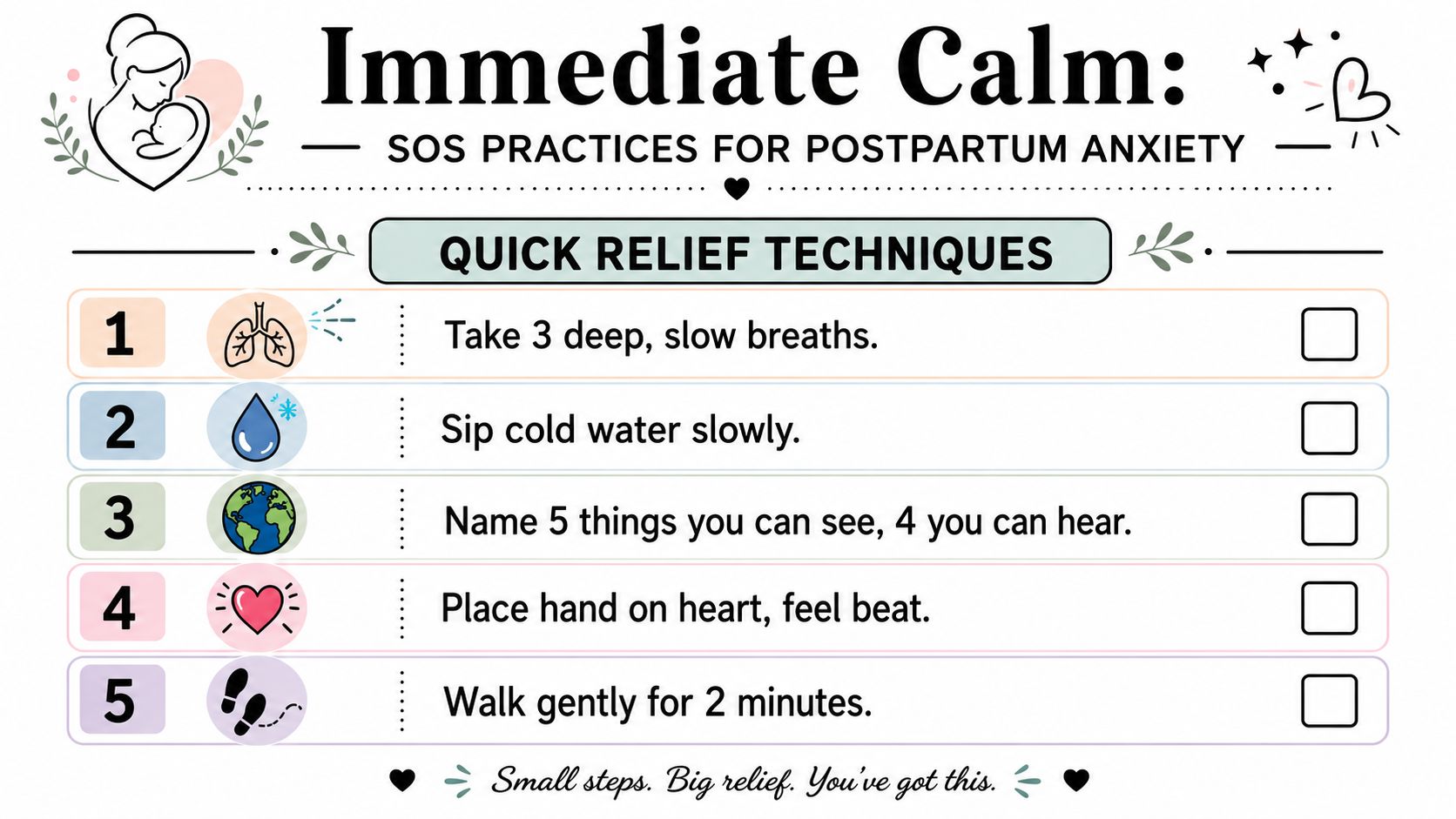
- Three-breath reset: Inhale gently, then exhale longer than you inhaled. Do that three times. Don't force a deep breath if it makes you feel more panicky.
- Cold water pause: Sip cold water slowly and pay attention to the temperature moving through your mouth and throat.
- Sound and sight grounding: Name five things you can see and four things you can hear. If your baby is in your arms, let their weight be part of the exercise.
- Hand-to-heart cue: Place one hand on your chest and one on your belly. Feel movement, not perfection.
- Two-minute walking meditation: Walk slowly through one room or one hallway, matching your steps to your exhale.
If you like structured support during a hard moment, these tools to manage anxiety can make it easier to follow a prompt when your brain goes blank.
A simple breathing script for panic
Some mothers do well with box breathing. Others feel trapped by counting. If counting helps you, keep it loose and gentle.
Breathe in for a comfortable count. Pause briefly. Breathe out a little longer. Pause again. Repeat until your shoulders drop even slightly.
If you want more structure, try this version for one minute:
Inhale. Two. Three. Four.
Hold. Two. Three. Four.
Exhale. Two. Three. Four.
Hold. Two. Three. Four.
What works and what usually doesn't
A few trade-offs matter here.
- What works: very short practices, open eyes, touch, movement, and sensory anchors.
- What often doesn't: trying to “empty your mind,” sitting rigidly when you're activated, or judging the practice because the baby cried through it.
- What helps most: repeating the same few methods often enough that your body starts to recognize them as a cue for safety.
Practical rule: use the shortest practice you'll actually repeat. Two minutes done often is more useful than a perfect technique you never start.
How to Build a Gentle Meditation Routine
Long-term relief comes from repetition, not intensity. A gentle routine helps your nervous system stop living on constant alert, but that routine has to fit postpartum life. It should slide into the day you already have.
Start with the smallest repeatable win
Clinical guidance in the NIH archive recommends daily mindfulness meditation for 30 minutes per day, starting four weeks before childbirth and continuing through the postpartum period, and also notes that a 4-week mindfulness intervention-training program, with sessions lasting no longer than 60 minutes each, has been shown to reduce impulsive behavior, lower postpartum stress, and facilitate maternal adjustment to new life. The same body of evidence also notes that even 5 minutes daily for two weeks can produce measurable neurological changes and reduce cortisol levels, activating the parasympathetic nervous system, as summarized in this Frontiers review.
That doesn't mean you need to aim for the longest session. It means your body responds to consistency. For a new mother, consistency usually starts with attaching meditation to something that already happens every day: feeding, the first nap, a shower, a stroller walk, or getting into bed.
Postpartum Meditation Practice Menu
| Time Available | When to Practice | Recommended Technique |
|---|---|---|
| 5 minutes | During a feeding or right after putting baby down | Breath counting, hand-on-heart breathing, or a very short guided grounding practice |
| 10 minutes | During the first nap or while sitting in the parked car before going inside | Guided meditation focused on body awareness, breath, or calming racing thoughts |
| 20 minutes | Before bed, during partner coverage, or on a weekend reset | Body scan, longer guided meditation, or a slow walking meditation followed by rest |
Use guidance when your brain feels tired
A lot of postpartum women assume they should know how to meditate on their own. That's not necessary. Guided sessions remove decision fatigue. You don't have to choose the words, hold the structure, or remember what comes next.
That's also why education helps. If you want more context around anxiety patterns, triggers, and recovery skills, a free anxiety education hub can make the bigger picture feel less confusing.
One more point matters here. Frequency beats ambition. A five-minute practice you use while the baby dozes on you may do more for your week than a twenty-minute session you keep postponing.
A gentle guided option can help you settle into that rhythm:
Meditating When You Are Exhausted
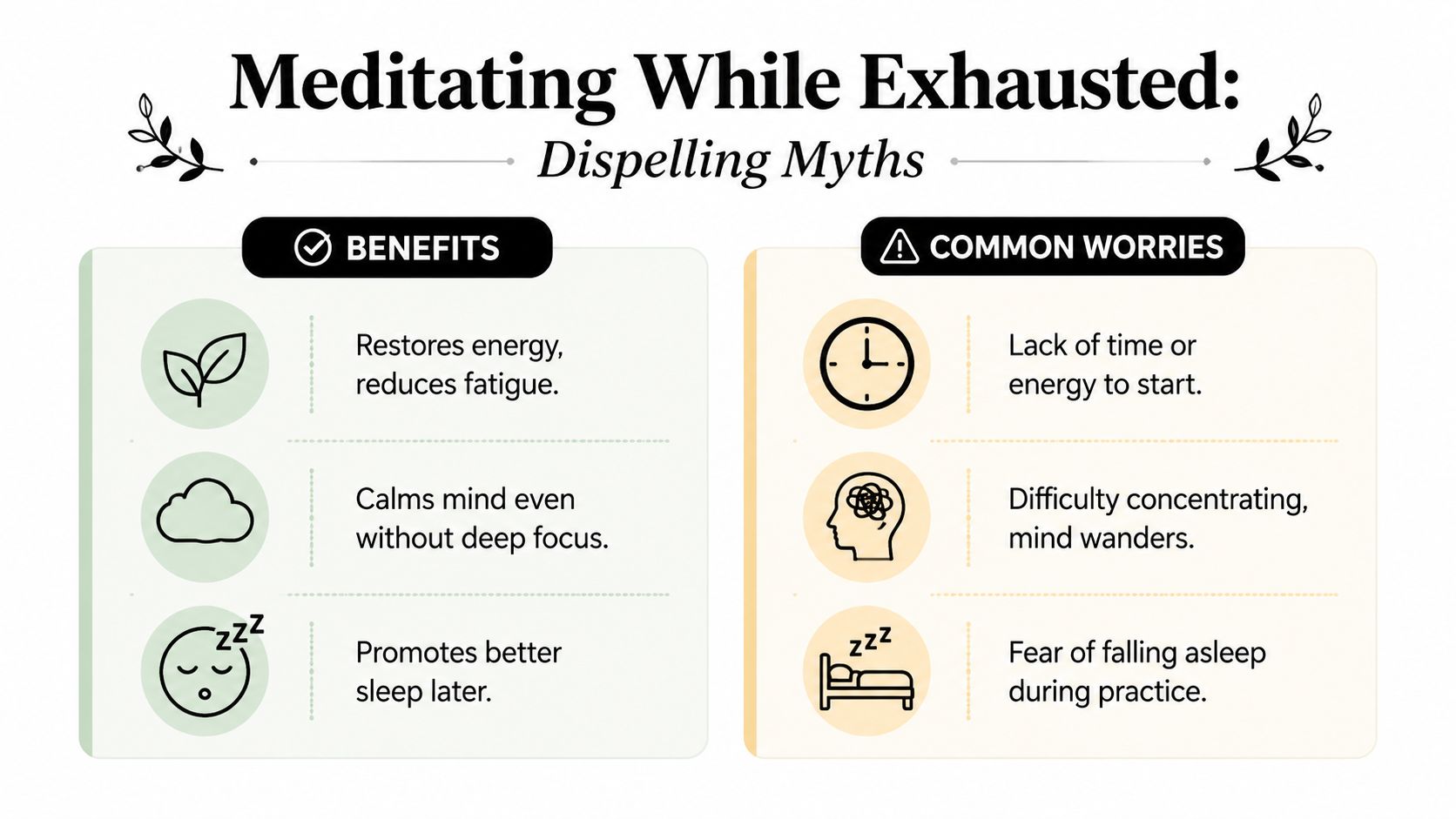
Exhaustion makes many mothers quit before they begin. They think meditation requires alert focus, an upright spine, a quiet room, and a brain that isn't foggy. None of that is true.
Meditation for postpartum anxiety can be more like restorative quiet than formal concentration. If your attention wanders every few seconds, the practice still counts. If you lie down and drift toward sleep, it still counts. If all you manage is listening instead of actively following along, it still counts.
Rest counts even when focus is messy
A mobile mindfulness intervention for postpartum women showed significant improvements in depressive symptoms (PHQ-8: −3.8, P=.004), perceived stress (−6.0, P=.005), and sleep quality (−2.1, P=.02) in this JMIR Mental Health study. I like this finding because it reflects real life. These weren't ideal conditions. They were postpartum conditions.
That matters when you're running on broken sleep and trying to do something supportive for yourself without turning it into another standard you can fail.
Three low-effort ways to practice
- Lying-down meditation: Put one hand on your ribs and listen to a short audio. If you fall asleep, your body likely needed sleep more than technique.
- Walking meditation: Pace the hallway with the baby and notice the pressure of each footstep. This is especially useful if sitting still makes you feel trapped.
- Eyes-open focus: Look at one neutral object, such as the curtain, the wall, or your baby's blanket, and breathe while keeping your gaze soft.
Some days, meditation is not a deep spiritual experience. It's five quieter breaths while the bottle warms.
If your mind won't slow down, don't argue with every thought. Shift from content to sensation. Feel the chair under you. Feel your feet. Listen for the farthest sound in the room. If looping thoughts are your main struggle, these ways to calm an overactive mind can help you work with the mental noise instead of fighting it.
When Meditation Is Not Enough
Meditation is useful. It is not universal care for every postpartum mental health condition.
The most responsible guidance is also the most reassuring. If your anxiety is mild, situational, and feels linked to overwhelm, sleep loss, or constant mental tension, mindfulness can help quite a bit. But when symptoms are moderate to severe, or when you're dealing with clinical OCD, trauma symptoms, or disabling panic, meditation should be a complement, not a replacement.
What meditation can help with
The evidence supports mindfulness approaches for perinatal distress, and clinical reviews have found strong effects for reducing anxiety and depression symptoms in perinatal populations. At the same time, postpartum-specific anxiety can be more complex than a general stress response, especially when intrusive thoughts, compulsions, or trauma are involved.
A careful review of this issue notes that most existing content on meditation for postpartum anxiety avoids the critical question of whether it is safe or effective for mothers with moderate-to-severe anxiety, clinical OCD, or PTSD; data shows mindfulness approaches are beneficial for mild cases but must be a complement, not a replacement, for professional treatment in severe cases, as discussed by Phoenix Health.
Signs you need more than self-guided practice
Please reach out for professional support if you notice any of the following:
- Your fear feels relentless: you can't disengage from scary thoughts even briefly, or the anxiety is dominating most of the day.
- You're changing your behavior to reduce fear: repeated checking, avoiding sleep, avoiding being alone with the baby, or needing rituals to feel safe.
- You feel detached or hopeless: sadness, numbness, or panic are making it hard to function or bond.
- Your history matters: if you've had trauma, OCD, severe anxiety, or depression before, postpartum symptoms can escalate quickly.
Asking for help early is not overreacting. It's skilled care.
If you're unsure where the line is, The Anxiety Checklist's guide on professional help offers a practical starting point for deciding when self-help should become supported care.
Your Path Forward to a Panic-Free Life
Healing usually doesn't arrive as one dramatic breakthrough. It shows up as a nervous system that startles less. A body that unclenches sooner. A mind that begins to trust quiet again.
That's why micro-practices matter. A two-minute grounding pause in the bathroom. Three slower exhales during a feeding. A short guided track before sleep. These are not tiny because they're insignificant. They're tiny because they can fit inside a hard season.
There is real reason for hope here. A review of mindfulness-based interventions found they significantly reduce postpartum depression levels by a mean difference of 5.89 points (95% CI: 4.88–6.91) in this PMC review. That doesn't mean every mother should rely on meditation alone. It means there is a way to heal, and recovery can be supported with practices that are gentle, repeatable, and realistic.
Start smaller than you think you need to. Pick one practice you can do today without waiting for a better schedule, better sleep, or a quieter house. Let it be simple enough that you won't resist it. Then do it again tomorrow.
Panic-free may feel far away right now. But calm is built one safe moment at a time, and you can begin with the next breath.
If you want immediate support and a simple place to start, The Anxiety Checklist offers an always-free SOS mode for real-time grounding, plus guided meditations, sleep audios, walking sessions, and CBT-based tools for longer-term recovery. It's a practical option for postpartum moments when your mind is overloaded and you need calm, fast, without having to figure it all out yourself.