



Your phone is face down on the table, but your mind is still staring at it.
You tell yourself you won't check for a message. Then you check anyway. You replay the last conversation, scan social media for clues, and feel a jolt in your chest every time the screen lights up. At night, your body is exhausted, but your nervous system acts like an alarm that won't switch off.
If that's where you are, you're not weak, dramatic, or failing at moving on. You're likely dealing with a real stress response after loss. Breakups can stir up anxiety, panic, obsessive thinking, and a deep urge to reconnect just to feel steady again.
The no contact rule can help. Not as a trick. Not as a test. And not as a way to force someone back. It can be a compassionate boundary that gives your mind and body room to settle.
Small actions matter here. Even brief calming habits can help interrupt the spiral. A review of 14 scientific studies found that spending as little as 10 minutes in a natural setting can significantly improve psychological and physiological markers of mental well-being, including perceived stress, according to this summary of the research. If your chest is tight and your thoughts are looping, stepping outside, practicing effective breathing techniques for anxiety, or using effective anxiety grounding methods can give your body a first signal of safety.
Table of Contents
- Finding Calm in the Aftermath of a Breakup
- What Is the No Contact Rule Exactly
- The Psychology of Silence Why No Contact Is So Effective
- Navigating No Contact with an Anxious Attachment Style
- Practical Steps for Surviving the No Contact Period
- Variations and Alternatives to the No Contact Rule
- Your Path Forward to a Panic-Free Life
Finding Calm in the Aftermath of a Breakup
A breakup can make ordinary moments feel medically urgent. You wake up and check your phone before your feet hit the floor. You hear a notification from another app and your stomach drops anyway. Part of you knows this isn't sustainable. Another part keeps hoping one text will calm everything down.
That inner conflict is why so many people get confused about what healing should look like. They think they need closure from the other person before they can breathe again. Often, what they really need first is less stimulation, fewer triggers, and a quieter emotional environment.

When anxiety takes over the day
After a breakup, many people don't just miss someone. They feel dysregulated. The body can react as if connection has become a survival issue. That's why simple advice like "just move on" usually lands badly. It doesn't account for the shaking hands, racing mind, or urge to check one more time.
A gentler frame helps. Think of this stage like emotional first aid. You're not trying to win anything. You're trying to help your nervous system stop bracing for impact.
A breakup can feel like an emergency even when you're physically safe. Healing starts when your body begins to believe the emergency is over.
A calmer goal than getting them back
Many guides talk about no contact as if it's mainly a dating tactic. That framing can keep you focused on their reaction instead of your recovery. A healthier starting point is this: the no contact rule creates space so your body and mind can come down from constant activation.
That shift matters. When your goal becomes steadiness instead of reassurance, your daily choices change. You start noticing what lowers distress. A short walk under trees. A text to a trusted friend instead of your ex. A breathing practice before bed. Those moments may seem small, but they help rebuild a sense that peace is possible.
What Is the No Contact Rule Exactly
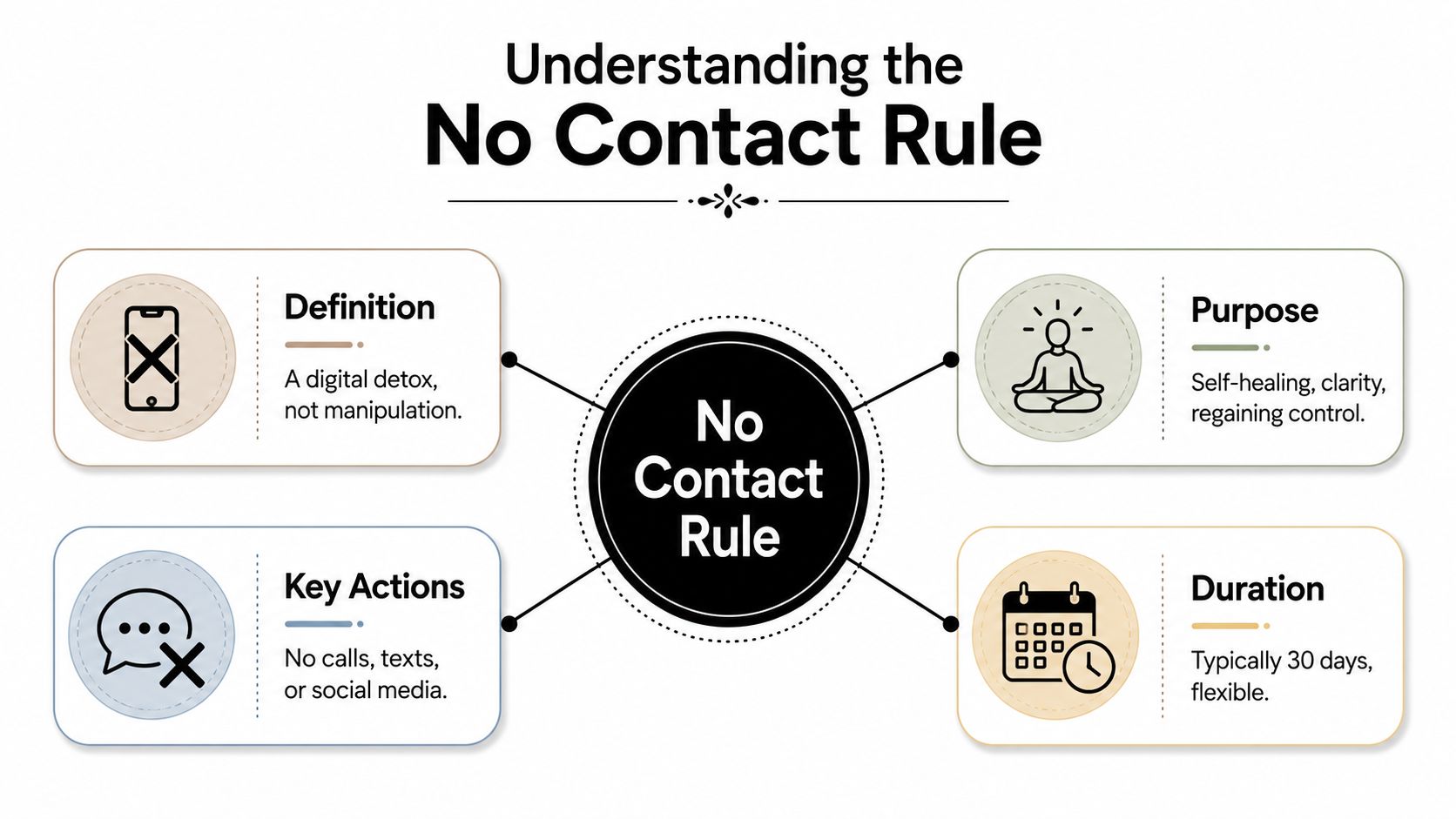
What is the no contact rule? In plain language, it's a self-imposed period where you stop all unnecessary communication with your ex so your mind and body can recover. That usually means no texting, no calling, no checking their social media, no liking posts, and no using mutual friends to keep tabs on them.
The simplest way to understand it is as a digital detox for your heart. If every message, photo, or online update reopens the wound, no contact removes the repeated trigger. It isn't punishment. It's space.
What counts as contact
People often think no contact only means "don't send a text." In practice, it includes more than that.
- Direct communication: texts, calls, emails, and DMs
- Indirect contact: watching stories, liking posts, sending songs, or asking mutual friends what they're doing
- Emotional probing: posting things mainly to get their attention or checking whether they've noticed you
If the behavior keeps the bond electrically active in your mind, it usually works against the purpose of no contact.
How long does it last
The no contact rule is typically a self-imposed period of 30 days or more, with experts often recommending at least 90 days to allow the nervous system to acclimate, a timeframe that aligns with principles from substance abuse cessation strategies, as explained in this discussion of the psychology of no contact.
That doesn't mean every person will need the same timeline. It means healing usually takes longer than the first emotional wave. Many people expect relief in a week, then feel discouraged when they still ache. A longer window helps because the body needs repeated evidence that life can continue without constant reactivation.
Practical rule: If you're using no contact mainly to stop the panic cycle, choose a timeline that protects healing, not one that feeds suspense.
What the rule is really for
The purpose isn't to appear strong, mysterious, or unavailable. The purpose is to regain control over your attention, reduce emotional dependence, and think clearly again. Good effective boundary setting techniques can support this because no contact is really a boundary practice, not a performance.
When people ask what is the no contact rule, they're often asking whether silence is cruel. In a healing context, silence can be kind. It says, "I need enough distance to hear myself think again."
The Psychology of Silence Why No Contact Is So Effective
When a relationship ends, the craving to reach out can feel irrational. It isn't. Your brain learned that this person was tied to comfort, reward, routine, and relief. When that connection disappears, your system can react a lot like withdrawal. That's why the urge can feel so physical.
Silence helps because it interrupts the loop. Every new interaction, even a tiny one, can restart hope, fear, analysis, and bodily activation. It's similar to trying to let a wound close while picking at the scab every day.
Contact can keep distress alive
This isn't just a poetic idea. Research demonstrates that in-person contact with an ex-partner predictably increases separation-related psychological distress. A one standard deviation increase in contact can offset 112% of the natural decline in distress over a two-month period, according to the published research on separation-related psychological distress.
That finding matters because many people assume a little contact will soften the pain. For a lot of people, it does the opposite. It can slow the natural settling that time might otherwise support.
Your nervous system needs fewer triggers
If you've ever felt calm for half a day, then spiraled after seeing their name, you've already experienced the basic mechanism. The body stores associations quickly. One message can pull your system back into vigilance.
Ideas from CBT can help conceptually. Healing often involves less monitoring of every feeling and more willingness to let discomfort rise and fall without obeying it. Silence creates the conditions for that. It gives your brain fewer cues to chase and more opportunities to learn, "I can survive this feeling without acting on it."
A similar principle shows up in neuroplasticity. What you repeatedly activate gets reinforced. What you stop reinforcing can weaken over time. That can sound cold when applied to love, but in practice it's hopeful. It means your current intensity isn't permanent.
Some readers also need more specialized support when the breakup involved manipulation or chronic emotional harm. In those cases, learning about vetting therapists for narcissistic abuse can help you find support that fits the kind of injury you're trying to recover from.
Silence is active healing
No contact isn't passive waiting. You're not sitting in a void hoping time fixes everything. You're helping your system break a cue-response pattern.
That can reduce confusion. Instead of asking, "Why am I still thinking about them?" ask, "What stimuli am I still feeding?" If your body is locked in alarm, resources that explain the Anxiety Checklist resources for fight or flight can help you understand why your reactions feel so intense.
Navigating No Contact with an Anxious Attachment Style
For some people, no contact feels hard. For others, it feels unbearable.
If you have an anxious attachment pattern, distance may not feel calming at first. It can feel like danger. Silence may trigger panic, abandonment fears, obsessive checking, and a crushing urge to restore connection immediately. That reaction doesn't mean you're doing it wrong. It means the strategy needs to be adapted with care.
Why standard advice can backfire
For anxious-attachers, the standard no contact rule often triggers heightened panic, leading to 78% of them making premature contact, according to this overview of no contact and attachment patterns. That's one reason blunt advice like "just stop texting" often fails.
When a person with anxious attachment loses access to reassurance, the mind may fill the silence with catastrophic stories. They hate me. I ruined everything. I'll be alone forever. The goal isn't to shame those thoughts away. The goal is to build a safer bridge through them.
A gentler way to begin
You may do better with structure than willpower. Instead of promising yourself you'll never reach out again, reduce the task into containers you can tolerate.
Try a panic-sensitive approach like this:
- Start with a shorter promise: Commit to the next few hours, then the rest of the day. Smaller agreements can feel less threatening than one giant vow.
- Remove the fastest routes: Archive the chat, mute updates, and move their number out of immediate reach.
- Name the feeling accurately: "I'm having an abandonment alarm" is often more useful than "I need to text."
You're not craving contact because you're broken. You're craving regulation.
Build a panic toolkit before the wave hits
People with anxious attachment often wait until they're flooded, then try to improvise. A better plan is to prepare before the next spike.
Your toolkit might include:
- one friend you can text instead
- a written list of reasons contact hurts your recovery
- a walk route for when your chest tightens
- a note on your phone with calming responses to common fears
- support for understanding anxious attachment styles if this pattern keeps showing up in your relationships
If being alone is part of the trigger, learning about autophobia symptoms and treatment may also help you make sense of why separation feels so destabilizing.
Progress doesn't have to look perfect
An anxious nervous system often interprets one setback as proof of failure. That's not true here. If you break no contact once, that doesn't erase the boundary. It means you need more support, more friction between impulse and action, and more compassion in the process.
People heal better when they stop making shame the coach. Calm grows more easily in a nervous system that feels understood.
Practical Steps for Surviving the No Contact Period
Knowing what is the no contact rule is one thing. Living it on a Tuesday night when you're lonely is another. A concrete routine is especially helpful at such times.
Start with your environment. Don't rely on motivation in the moments when your mind is spinning. Put barriers in place while you're calm.
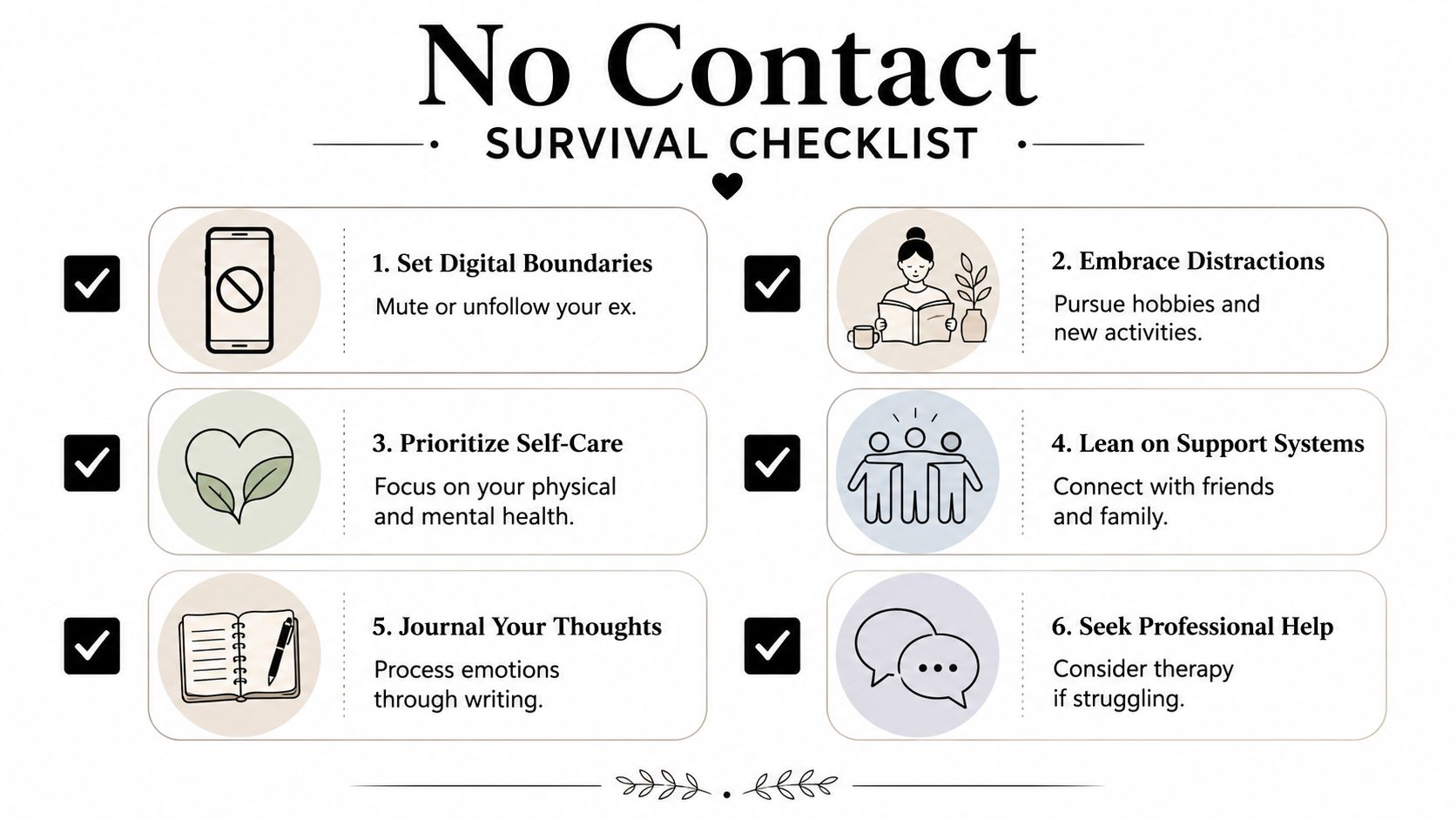
Build your survival checklist
Change your online environment
Mute, unfollow, archive, or block if needed. The right choice is the one that reduces re-triggering. If seeing their profile creates a body-level stress reaction, distance is a health decision.Create a replacement routine
The impulse to contact usually arrives in predictable windows, such as late at night, early morning, or after work. Put something else there on purpose. Tea, a walk, journaling, music, or calling a safe person all work better when chosen ahead of time.Write before you send
Keep a notes app or paper journal for unsent messages. Many people don't need to communicate. They need to discharge emotion.Treat panic as treatable
Clinical trials of a 28-day at-home breathing treatment for panic disorder demonstrated that 86% of patients were completely panic attack-free immediately after completing the treatment, according to this summary of anxiety recovery stories and treatment outcomes. That doesn't mean your path will look identical. It does mean panic can respond to structure, not just hope.
To support that process, many people benefit from science-backed breathing for panic attacks.
After you've set up the basics, a visual reset can help reinforce the plan:
What to do during a contact urge
Use a short script when the wave hits:
- Pause for one song: Don't decide anything until one full song ends.
- Move your body: Stand up, stretch, or step outside. Motion can interrupt tunnel vision.
- Ask one honest question: "Will contact bring relief, or will it restart the cycle?"
- Delay with intention: Tell yourself you'll revisit the urge after food, water, and ten minutes of breathing.
Grounding reminder: The goal isn't to feel amazing before you choose no contact. The goal is to make the next calm choice while feeling activated.
How to measure progress
Don't only track whether you miss them. Track whether you're sleeping a little better, checking less often, eating more regularly, or getting through a wave without acting on it. Those are real signs of recovery.
A lot of healing looks ordinary at first. Fewer compulsions. More quiet. Less urgency. That's how inner peace often returns.
Variations and Alternatives to the No Contact Rule
Real life doesn't always allow total silence. Some people share children, a workplace, a lease, or a practical responsibility that can't be ignored. In those cases, the strict version of no contact may not fit.
That doesn't mean you're excluded from healing. It means you need a version that protects your nervous system while still handling necessary logistics.
When total no contact isn't realistic
With 42% of breakups involving shared children or work, applying a rigid no contact rule can cause 65% more conflict. In those situations, successful co-parents often use structured neutrality, meaning brief, transactional communication with emotional disengagement, as described in this discussion of no contact variations.
Structured neutrality is different from emotional availability. You answer the school question. You don't rehash the relationship. You coordinate the handoff. You don't use logistics as a side door into intimacy.
Choosing the right level of distance
| Strategy | Primary Goal | Core Rule | Best For |
|---|---|---|---|
| No Contact | Nervous system recovery and emotional detachment | No unnecessary communication at all | Breakups with no shared obligations |
| Modified No Contact | Reduce triggers while allowing essential communication | Only necessary messages, often written and brief | Co-parenting, shared housing transitions, legal matters |
| Limited Contact | Maintain minimal interaction without emotional processing | Set narrow topics, specific times, and short replies | Workplace overlap or temporary practical ties |
A simple test for necessary communication
Ask yourself three questions before replying:
- Is this essential? If the message isn't about a real obligation, it may not need an answer.
- Can this be shorter? One practical sentence is often enough.
- Am I trying to solve emotion through logistics? If yes, pause.
This framework helps many people avoid two extremes: total availability and rigid shutdown. The middle path is often more realistic, and sometimes safer.
Your Path Forward to a Panic-Free Life
The no contact rule can sound harsh when it's described as silence, distance, or cutting ties. In practice, its healthiest form is often a return to yourself.
When you use it as a healing tool, the question changes. It stops being "Will this make them notice me?" and becomes "What helps me feel safe, clear, and steady again?" That's a powerful shift. It places your recovery at the center.
If you're still shaky, that doesn't mean the process isn't working. It means your system is learning a new rhythm. Anxiety after heartbreak can be loud, but it doesn't have to run your life forever. There is a way to heal from anxiety and move toward a life that feels lighter, steadier, and freer from panic.
Keep it simple. Reduce triggers. Let your body settle. Ask for support when the grief feels bigger than your tools. And remember that peace often returns, one choice at a time.
If you want support while you heal, The Anxiety Checklist offers practical help for both immediate panic and long-term recovery. You can use its free SOS mode when your mind goes blank, and explore grounding, guided calming tools, journaling, and CBT-based exercises at your own pace. It's a gentle next step if you're ready to build more steadiness into daily life without pressure.