


You open your laptop, see a calendar alert for a meeting, and your body reacts before your mind can catch up. Your chest tightens. You reread a simple email five times. A message from your boss saying “Can we talk?” sends your thoughts straight to the worst-case scenario. By the time the workday starts, you're already exhausted.
If that sounds familiar, you're not broken, weak, or overreacting. Anxiety at work symptoms often feel personal, but they're often signals. Your nervous system is telling you that something needs care, support, or change.
That matters, because symptoms can feel permanent when you're living inside them. They aren't. Healing is possible. People do learn how to calm panic, understand their triggers, and return to work with more steadiness, more choice, and far less fear.
Table of Contents
- You Are Not Alone in Feeling Anxious at Work
- Understanding the Four Types of Anxiety Symptoms
- A Closer Look at Common Symptoms and Scenarios
- How to Know If It Is More Than Just Stress
- Immediate Steps to Calm Anxiety at Work
- The Path to Long-Term Healing and Resilience
- Your Journey to a Panic-Free Work Life Is Possible
You Are Not Alone in Feeling Anxious at Work
A lot of people first notice workplace anxiety in ordinary moments. It might show up before a presentation, during a one-on-one, or late at night when your mind won't stop replaying one comment from the day. You may look calm on the outside while your thoughts race on the inside.
That gap can make anxiety feel lonely. Other people seem fine. You assume you're the only one who can't just “handle it.” But work anxiety is far more common than is commonly believed.
According to the APA Work in America survey, anxiety has emerged as the predominant mental health issue in the workplace, mental health-related absences increased by 33% in 2023 alone, and 77% of employees reported work-related stress in the last month. That doesn't mean every stressed employee has an anxiety disorder. It does mean your reaction exists in a larger reality, not in a personal failure.
What this feels like in real life
You might spend twenty minutes editing a two-line Slack message because you're afraid of sounding rude.
You might avoid speaking in meetings even when you know the answer.
You might finish the workday, sit down to relax, and realize your shoulders are still pulled up toward your ears.
Practical rule: If your body stays braced long after the stressful moment ends, your system may be asking for recovery, not more pushing.
Many people also judge themselves for needing support. They tell themselves they should be tougher, more productive, less sensitive. That self-criticism usually adds another layer of distress.
A kinder starting point is this: anxiety symptoms often make sense in context. Heavy workloads, unclear expectations, conflict, perfectionism, job insecurity, and nonstop digital contact can all keep your system on alert. If you want more grounding and plain-language tools, a free anxiety education hub can help you put words to what you're experiencing.
Understanding the Four Types of Anxiety Symptoms
Anxiety can feel messy because it doesn't stay in one lane. It shows up in your body, your thoughts, your feelings, and your actions. A simple way to understand it is to think of dashboard lights in a car. One light doesn't tell the whole story. Several lights together tell you where attention is needed.
Physical signals
These are the body-based signs. Your heart beats faster. Your stomach tightens. Your jaw clenches. You get headaches, muscle tension, shaky hands, or a rush of heat. The body is preparing for danger, even if the “danger” is an inbox or a meeting invite.
Cognitive signals
These happen in your thinking. You may overanalyze, catastrophize, lose focus, or get stuck in loops like “What if I mess this up?” and “What if they think I'm incompetent?” Your brain starts scanning for threat instead of staying with the task in front of you.
If social interactions trigger a lot of this mental noise, it can help to read social anxiety explained, especially if speaking up, networking, or being observed at work feels unusually intense.
Emotional signals
These are the feeling states that ride alongside anxious thoughts and body sensations. Irritability, dread, embarrassment, guilt, shame, or a constant sense of being on edge all fit here. Some people expect anxiety to feel like obvious fear. Often it feels more like tension, fragility, or emotional overload.
Behavioral signals
These are the things you start doing, or stop doing, because of anxiety. You procrastinate on one task for days. You call in sick to avoid a meeting. You seek repeated reassurance. You check your work over and over. You stay late because leaving unfinished work feels unbearable.
Anxiety symptoms are not random. They're patterns. Once you can sort them into categories, they become easier to notice and easier to respond to.
This framework matters because it turns a swirl of distress into something more manageable. Instead of “Something is wrong with me,” you can ask, “What kind of signal is showing up right now?”
A Closer Look at Common Symptoms and Scenarios
Some symptoms sound abstract until you see them in daily work life. Once you do, they become easier to recognize without panic.
Long working hours can also intensify this cycle. A longitudinal occupational health study found that long working hours are associated with the onset of anxiety because prolonged high work demands can trigger chronic elevation of stress hormones like cortisol. That can lead to a racing heart, muscle tension, and insomnia, which then feed back into more anxious thinking.
Physical symptoms
A tight chest during a performance review is a physical symptom. So is a pounding heart before opening your inbox on Monday morning. Headaches that arrive every afternoon, neck pain during high-pressure projects, or stomach trouble before team calls can all be part of workplace anxiety.
One reason this feels scary is that physical symptoms can mimic illness. Your body reacts first, and your mind then tries to explain the reaction. That can create a loop where the symptom itself becomes the next source of fear.
Cognitive symptoms
A common cognitive symptom is catastrophizing. Your manager says, “Can you hop on a quick call?” and your mind jumps to being fired.
Another is overthinking. You replay what you said in a meeting, then replay the replay. If that pattern feels familiar, this guide on why overthinking causes anxiety can help connect the dots between looping thoughts and rising distress.
For a broader plain-language overview of common anxiety symptoms, Cedar Hill Behavioral Health offers a useful explanation that many readers find validating.
Emotional symptoms
At work, anxiety doesn't always look like visible panic. Sometimes it looks like irritation when a coworker asks a simple question. Sometimes it looks like dread on Sunday night, or shame after making a small mistake.
You may also feel unusually emotional. A short email feels harsh. Neutral feedback feels crushing. A routine request feels like pressure you can't absorb.
Behavioral symptoms
Behavior is often where anxiety hides in plain sight. You put off sending a message because you need it to be perfect. You avoid a colleague because interactions with them leave you rattled. You volunteer for less-visible work because being seen feels risky.
Some people go in the opposite direction and overwork. They answer messages late at night, keep polishing finished tasks, and never feel “done.” That can look productive from the outside while being driven by fear on the inside.
| Symptom Type | Specific Symptom | Workplace Example |
|---|---|---|
| Physical | Racing heart | Your pulse spikes before presenting on Zoom |
| Physical | Muscle tension | Your shoulders stay tight through the entire workday |
| Cognitive | Catastrophizing | A calendar invite makes you assume the worst |
| Cognitive | Difficulty concentrating | You read the same paragraph three times and still can't absorb it |
| Emotional | Irritability | Small interruptions make you snap internally or out loud |
| Emotional | Dread | You feel a wave of fear the night before work |
| Behavioral | Avoidance | You delay replying to an email because it feels overwhelming |
| Behavioral | Reassurance seeking | You ask repeatedly if your work is “okay” even after approval |
Small patterns matter. If the same symptom keeps appearing around the same task, person, or time of day, that's useful information, not a personal flaw.
How to Know If It Is More Than Just Stress
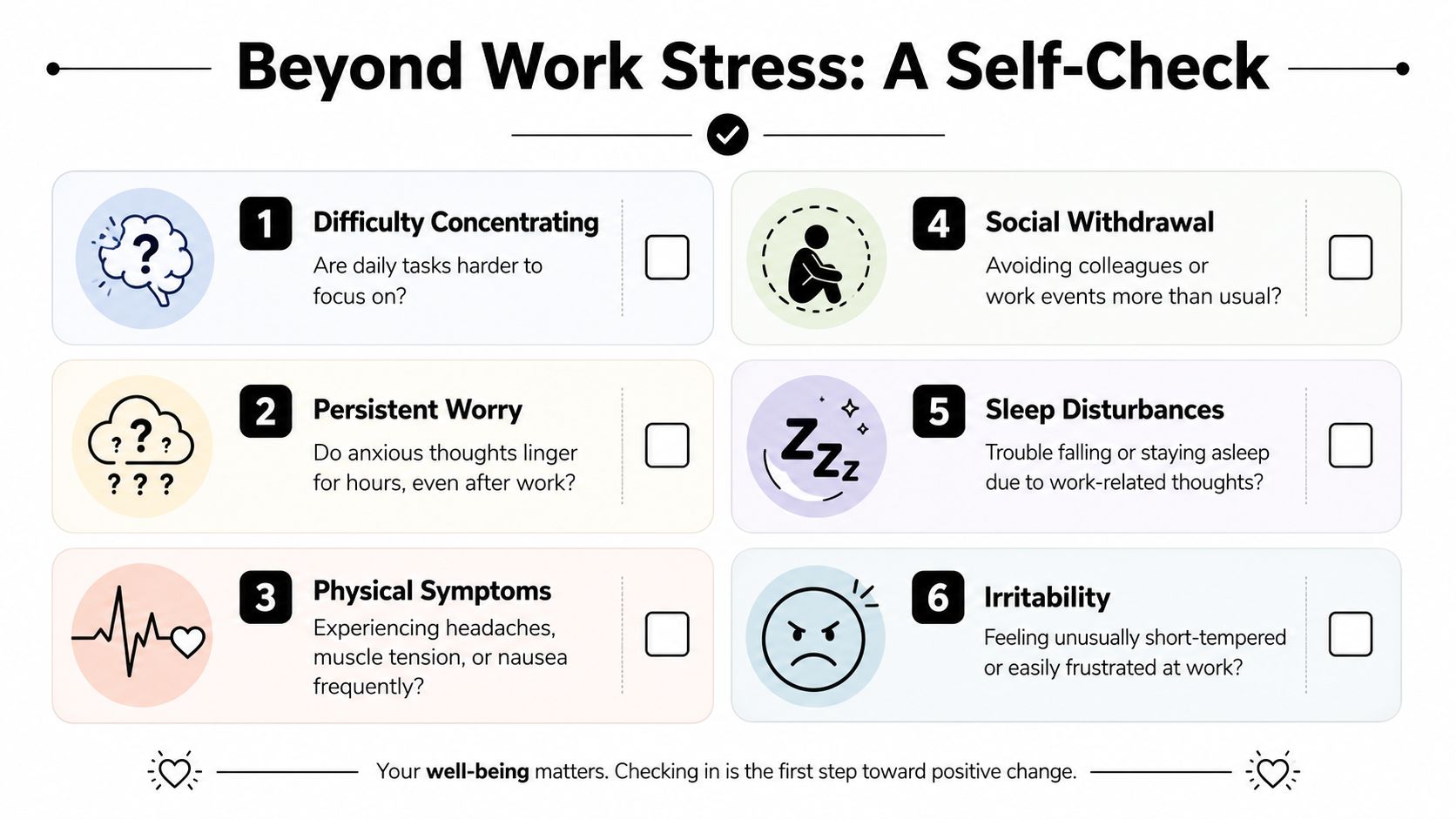
Stress and anxiety overlap, which is why many people dismiss their symptoms for a long time. Normal work stress usually rises around a specific demand and then settles when the demand passes. Anxiety tends to linger, spread, and keep your system activated even when you're technically off the clock.
Questions worth asking yourself
Try asking yourself these gently, without trying to diagnose anything:
- Does work worry keep going after work ends? If your mind stays locked onto tomorrow's tasks all evening, that's different from a busy day that fades after dinner.
- Is sleep getting disrupted? Trouble falling asleep, waking in the night, or dreaming about work can signal that your system isn't powering down.
- Am I avoiding things I used to handle? That might be meetings, emails, presentations, lunch with coworkers, or even checking your phone.
- Do I feel symptoms in my body often? Frequent headaches, nausea, muscle tension, shakiness, or a racing heart deserve attention.
- Is my world getting smaller? Anxiety often narrows life. You stop speaking up, stop volunteering, stop relaxing, and stop feeling like yourself.
When stress turns sticky
A useful distinction is duration plus impact. A hard week is stressful. A recurring pattern that affects sleep, focus, confidence, relationships, or daily functioning needs more care.
If you notice that your reactions feel out of proportion to the situation but still impossible to control, that's important. It doesn't mean you're failing. It means your nervous system may be overloaded.
If your body reacts to work as if it's facing danger, relief starts with listening, not minimizing.
Immediate Steps to Calm Anxiety at Work
When anxiety spikes in the middle of a workday, you don't need a perfect solution. You need a next step that helps your body feel safer.

A strong starting point is to work with the body first. Evidence-based interventions for workplace anxiety include 4-7-8 breathing, time-blocking, and short physical activity breaks. These are grounded in CBT-based approaches that help reset nervous system arousal.
Fast tools you can use discreetly
- Try 4-7-8 breathing. Inhale through your nose for 4, hold for 7, exhale slowly for 8. Do a few rounds. The long exhale tells your body that immediate danger has passed. If you want more options, you can manage anxiety with breathing methods.
- Use a sensory grounding drill. Name 5 things you see, 4 you feel, 3 you hear, 2 you smell, and 1 you taste. This pulls attention away from spiraling thoughts and back into the present room.
- Release one muscle group at a time. Press your feet into the floor. Tighten your hands for a few seconds, then release. Drop your shoulders. Unclench your jaw.
- Shrink the task. Instead of “finish the report,” choose “open the document and write one sentence.” Anxiety hates specificity because specificity lowers uncertainty.
A simple reset for overloaded moments
Time-blocking can help when everything feels urgent. Pick one task, give it a small protected window, silence extra notifications, and tell yourself you only need to stay with this one piece for now. You're not solving the whole week. You're reducing threat by making the next action clear.
A short physical break matters too. Walk to refill water. Stand up and stretch for a minute. If possible, step outside briefly. Movement helps your body discharge some of the tension it has been holding.
This short guided video can also help you reset when your mind is moving too fast:
Don't wait to feel calm before taking one small action. The action often helps create the calm.
The Path to Long-Term Healing and Resilience
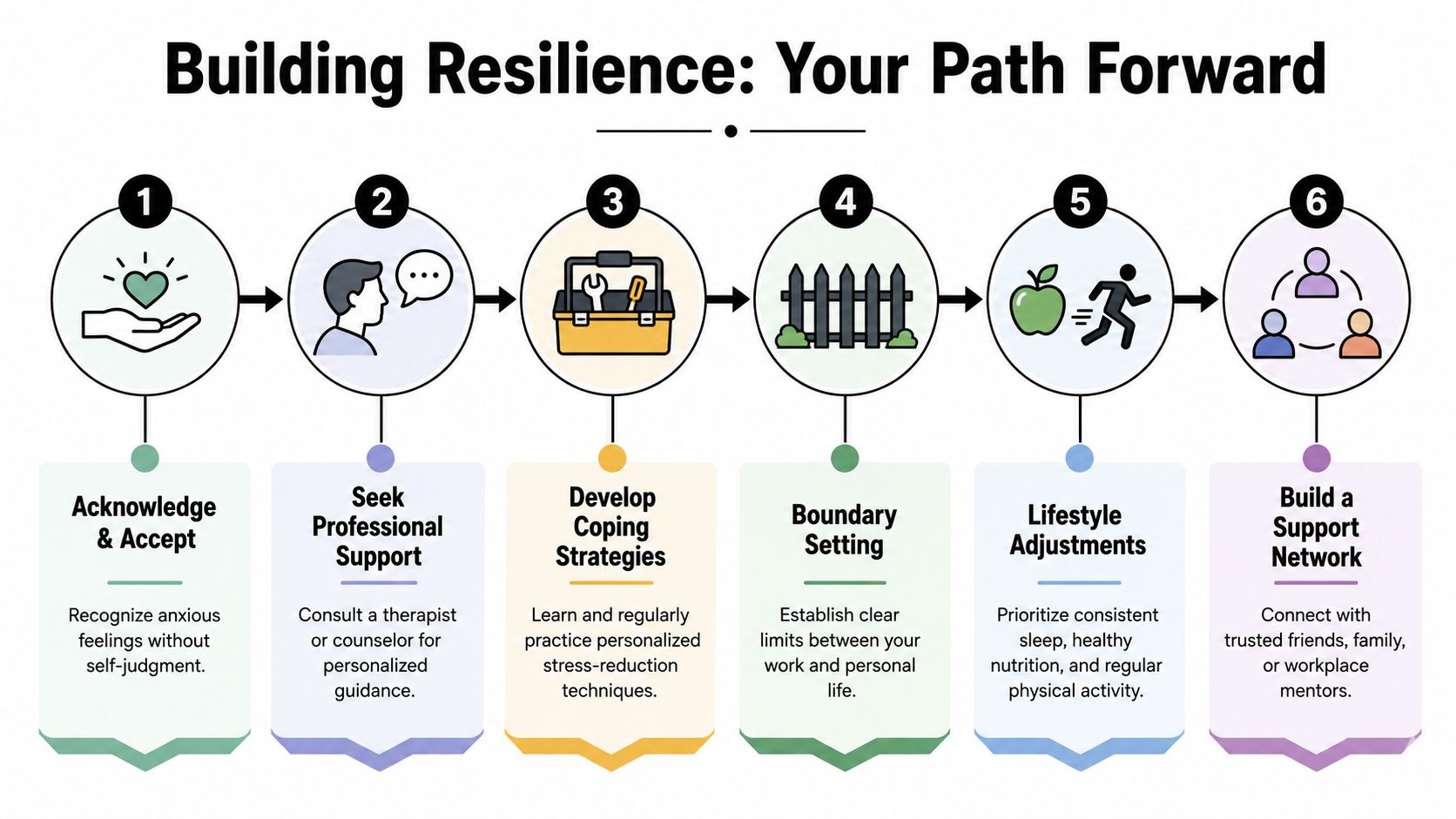
Quick coping tools matter, but lasting relief usually comes from a wider plan. That plan often includes support, boundaries, and a more honest look at what your work environment is asking from you.
When to reach for more support
Consider professional help if work anxiety is affecting your sleep, your physical health, your relationships, or your ability to function. It's also worth reaching out if you're having panic symptoms, intense avoidance, or a constant sense of dread that doesn't lift on weekends or vacations.
Recovery is often gradual, not mysterious. According to this psychiatrist-reviewed overview of anxiety recovery timelines, many people begin to feel improvement within 2 to 4 weeks of proper treatment. More complete recovery often takes 3 to 6 months for moderate anxiety, while severe or long-standing anxiety may take 6 to 12 months or longer. That's a hopeful timeline. It means change is realistic, even if you don't feel better overnight.
Some people also benefit from deeper reflection, especially when workplace anxiety hooks into perfectionism, fear of judgment, or old survival patterns. Journaling prompts like shadow work for anxiety can help uncover those layers.
Workplaces have responsibilities too
Not all work anxiety comes from inside you. The WHO guidance on mental health at work points to systemic drivers such as excessive work pace and lack of participation in decision-making. The same source notes that only 30% of employees feel their organization has effective mental health policies. If your environment keeps overwhelming your nervous system, coping skills alone may not be enough.
That's why it can help to ask practical questions:
- Can your workload be clarified? Unclear priorities often fuel constant vigilance.
- Can after-hours expectations be limited? Boundaries reduce the sense of being permanently on call.
- Can you request accommodations? Flexible scheduling, written instructions, quieter space, meeting agendas, or modified communication expectations may help. This workplace anxiety accommodations guide gives a useful overview of what those conversations can look like.
- Does your workplace offer an EAP? An Employee Assistance Program may provide short-term counseling or referrals.
Seeking support isn't weakness. It's a skill. You're recognizing that healing works better when the burden isn't carried alone.
Your Journey to a Panic-Free Work Life Is Possible
Healing from anxiety at work doesn't mean you'll never feel stress again. It means stress stops running your whole inner world. A meeting can still matter without feeling like danger. Feedback can sting without spiraling into panic. An email can stay an email instead of becoming a catastrophe.
That shift usually happens in visible ways. You notice your triggers sooner. You interrupt negative thought loops more often. Your symptoms show up less frequently. You stop avoiding the tasks, rooms, or conversations that used to flood you.
That lines up with the most verifiable signs of anxiety recovery, which include identifying personal triggers, controlling negative thoughts, a decrease in symptom frequency, and no longer avoiding previously feared work situations. Those are real markers of progress toward living panic-free.
What recovery can feel like
Recovery often feels quieter than people expect. It may look like sending the email without rereading it ten times. Sleeping through the night before a presentation. Taking a break without guilt. Catching the first signs of activation and responding with care instead of fear.
It also includes self-trust. You begin to believe, through experience, that a wave of anxiety can rise and fall without taking over your day.
If you're in the thick of it right now, start smaller than your anxious mind says you should. Notice one symptom. Name one trigger. Use one grounding tool. Ask for one form of support. Healing rarely begins with a dramatic breakthrough. It usually begins with one steady, compassionate next step.
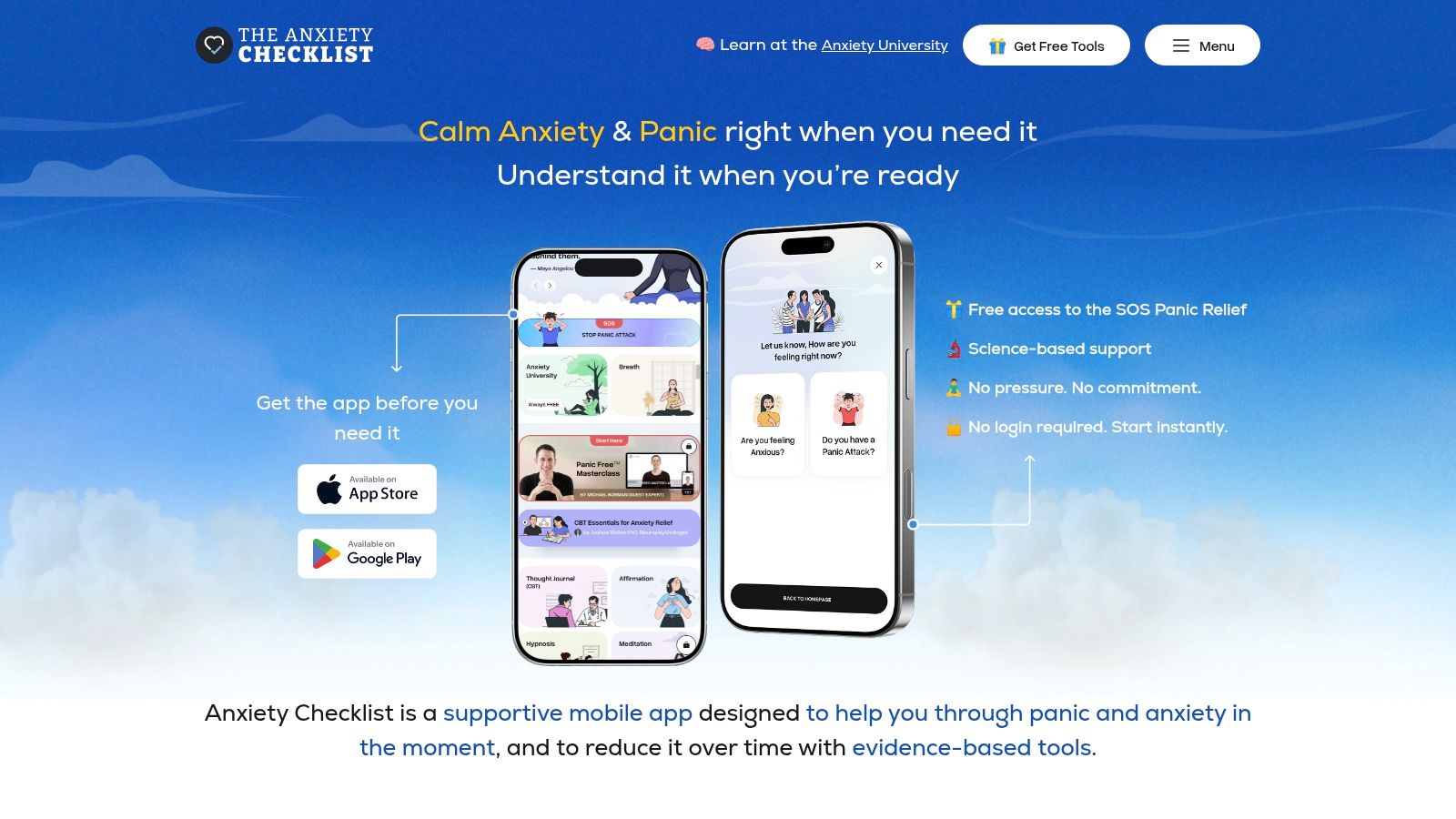
If you want support that meets you in those exact moments, The Anxiety Checklist offers practical help for both immediate relief and long-term healing. Its always-free SOS mode can guide you through grounding when panic hits, and its deeper tools can help you build the kind of steady progress that leads to a calmer, more panic-free work life.