


You may be reading this with your phone in your hand, halfway through a search you've started before and backed out of before. You want help, but another part of you is already asking hard questions. What if I panic in front of strangers? What if the meeting makes me worse? What if it turns into a room full of people describing symptoms and I leave feeling more afraid than when I came in?
Those fears make sense. Panic disorder trains people to scan for danger, and a new group can feel like one more unknown to survive. But a good panic attack support group isn't a performance, and it isn't a place where you have to prove how bad things have been. It's a place where your nervous system gets a new experience. You can be understood without being judged, supported without being pushed too fast, and reminded that healing from panic is possible.
Many people do recover to the point that panic no longer runs their lives. The path usually isn't one single tool. It's support, practice, better information, and repeated experiences of safety. A group can become one part of that process.
Table of Contents
- You Are Not Alone Why Connection Heals Panic
- How to Find Your Panic Attack Support Group
- Choosing a Safe and Effective Group
- What to Expect in Your First Meeting
- How to Start Your Own Support Circle
- Integrating Daily Tools for Lasting Resilience
You Are Not Alone Why Connection Heals Panic
Panic is intensely lonely. Even when other people are nearby, the experience can feel sealed off from the rest of the world. Your body is surging, your thoughts are racing, and you may be convinced that no one else could possibly understand how immediate and physical the fear feels.
That belief is one of panic's most effective lies.
The National Institute of Mental Health estimates that 4.7% of U.S. adults will experience panic disorder at some point in their lives, and women are affected more often than men, according to the NIMH panic disorder statistics. If you've felt singled out by this condition, those numbers matter. They don't reduce your pain, but they do challenge the idea that you're some rare exception.

What connection changes
A strong panic attack support group helps in ways people often underestimate.
One is normalization. You hear someone describe the same chest tightness, dizziness, urge to escape, or fear of losing control that you've been hiding. Shame starts to loosen when another person says out loud what you thought only happened in your body.
Another is borrowed hope. Early in recovery, you may not fully believe you can live differently. It helps to sit with people who are further along and hear that they still travel, shop, drive, sleep, work, or go out even after panic once dominated those parts of life.
You don't have to feel brave before you join. Sometimes you join first, and bravery catches up later.
Groups also interrupt avoidance. Panic gets stronger when life gets smaller. Showing up, even without speaking, can become one of the first ways you teach your nervous system that contact is safer than retreat.
If being alone has become part of the fear pattern, it can help to also learn how to overcome fear of being alone. That fear often overlaps with panic in ways people don't notice at first.
Why hope matters clinically
Hope isn't fluff in panic recovery. It changes behavior. People who believe relief is possible are more likely to stay engaged with skills, treatment, and support long enough to benefit from them.
For many readers, the first useful step isn't a major breakthrough. It's finding steadier footing after a spike. A practical guide to finding calm after anxiety can help with that in-between space, when the panic has passed but your body still feels shaken.
A good group won't erase panic in one meeting. What it can do is replace isolation with recognition, and fear with a more accurate message: this is treatable, this is survivable, and your life does not have to stay organized around the next attack.
How to Find Your Panic Attack Support Group
The search itself can feel like work. You open one listing and it's outdated. Another is too broad. Another says “supportive community” but doesn't explain who the group is for.
Still, this is worth doing. A 2021 synthesis cited in Psychology Today reported that 11 meta-analyses covering 329 studies found group models effective for conditions including anxiety, OCD, and PTSD, as noted in this article on the value of support groups. That means you're not hunting for a vague self-help trend. You're looking for a format with a real track record.
Start with the clearest search
Simple search terms usually work better than broad ones. Try combinations that match what you need.
- Condition-specific terms like “panic attack support group,” “panic disorder support group,” or “panic and agoraphobia support group”
- Format terms such as “virtual panic support group,” “online panic disorder group,” or “in person panic attack group near me”
- Provider terms including “hospital anxiety support group,” “therapy group panic disorder,” or “peer support panic attacks”
If your anxiety spikes while searching, keep the task narrow. Save two listings. Send one email. That's enough for one sitting.
You can also browse a free anxiety education hub before you commit to a group. Some people need clearer language for what they're experiencing before a live conversation feels manageable.
Use directories and community organizations
Not every useful group is easy to find through a general search engine. Better options often come from established directories and community mental health organizations.
Some places to check:
| Where to look | What you may find |
|---|---|
| NAMI chapters | Peer-led mental health support groups, often local or virtual |
| ADAA listings | Anxiety-focused resources and online options |
| Psychology Today therapist profiles | Clinician-led therapy groups and specialty practices |
| Hospitals and clinics | Psychoeducation groups, outpatient support programs |
| University counseling centers | Community workshops or referrals, even for non-students in some areas |
| Specialty anxiety centers | Panic-specific or agoraphobia-specific groups |
A short explainer can help if you want a visual overview before reaching out:
Screen before you attend
You don't need to commit blindly. A brief email or phone call can save you from joining the wrong room.
Ask practical questions such as:
- Is this group specifically for panic attacks or panic disorder?
- Is it peer-led, clinician-led, or mixed?
- What happens if someone becomes overwhelmed during the meeting?
- Can I attend with my camera off at first if it's virtual?
- Do people mostly share experiences, or are coping tools taught too?
Practical rule: If a listing is so vague that you can't tell who the group serves or how the meeting is run, ask before you join.
A good response usually feels organized, calm, and clear. That doesn't guarantee the group will be right for you, but it does tell you someone has thought about safety, fit, and real human needs instead of assuming every anxious person needs the same thing.
Choosing a Safe and Effective Group
Not every support group helps in the same way. Some are grounding, focused, and humane. Others drift into repetitive symptom talk, unsolicited advice, or group dynamics that leave sensitive members more activated than supported.
That difference matters. If you already fear fear itself, the wrong environment can reinforce the cycle. If that pattern sounds familiar, reading about phobophobia and panic attack cycle can put words to what many people experience but struggle to name.
Panic specific versus general support
Many listings are broad. They may be for anxiety, depression, or mental health concerns in general. Those groups can still be helpful. People often find relief in shared coping, being witnessed, and no longer feeling like the only one struggling.
But panic has its own shape. It often includes fear of bodily sensations, anticipatory anxiety, and avoidance patterns that can grow into agoraphobia. That's why it helps to know that panic-specific groups do exist, and some are more targeted. The NAMI-NYC support listings illustrate how many groups are broad, while also pointing to the fact that more focused options such as a Panic Disorder and Agoraphobia Support Group can be found through specialty centers, as reflected on the NAMI-NYC support groups page.
If you need more than general encouragement, don't settle too quickly for a mixed group just because it's easier to find.
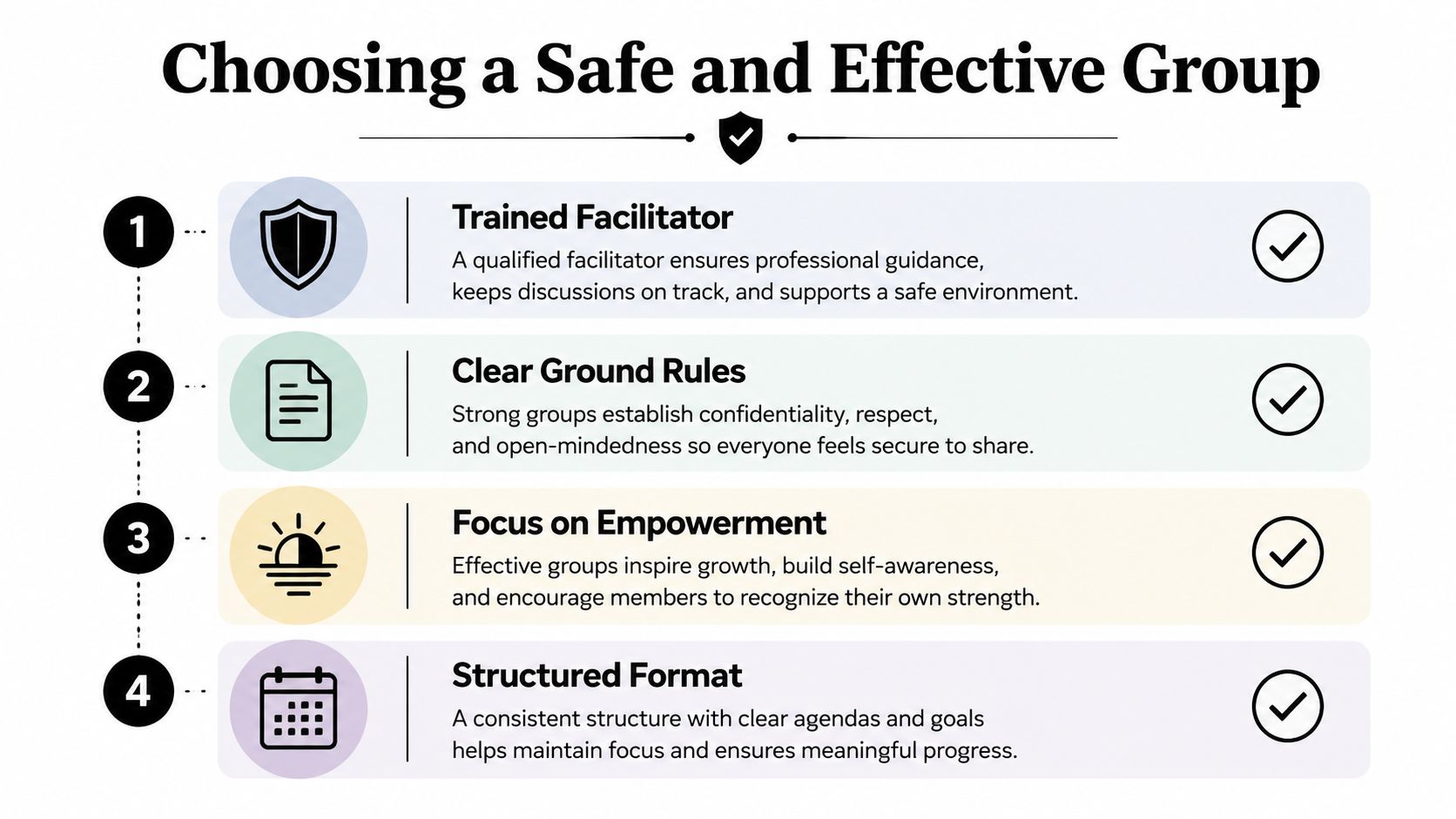
What safe groups usually have in common
A worthwhile group usually has a few consistent features:
- Clear facilitation. Someone guides the meeting, keeps the pace steady, and redirects conversations that become overwhelming or off-topic.
- Ground rules. Confidentiality, respectful listening, and limits on interrupting or diagnosing each other are stated plainly.
- A defined audience. You know whether the group is for panic disorder, general anxiety, mixed mental health concerns, or family members.
- A structure. Open check-in, guided discussion, coping focus, and a clean closing work better than endless free-form sharing.
If you're comparing options, it may help to also find a therapy group for adults through a clinical practice that explains its format and target population clearly.
Safe groups don't demand instant vulnerability. They make room for observation, pacing, and consent.
Red flags worth taking seriously
Here are the patterns that tend to go poorly:
- The group glorifies distress rather than helping people relate to distress differently.
- Members give strong advice as fact about medication, diagnosis, or what others “must” do.
- Detailed symptom descriptions dominate without grounding or reframing.
- No one seems in charge when someone gets visibly overwhelmed.
- You leave more flooded every time and there's no sign the format supports regulation.
A support group should leave you feeling more oriented, even if you also feel emotionally tired. It doesn't need to feel perfect. It does need to feel contained.
What to Expect in Your First Meeting
The first meeting is usually more ordinary than your anxious mind predicts. Whether it's online or in person, most groups begin in a subdued manner. People arrive, settle in, and wait for the facilitator to start. No one expects you to deliver a polished story about your panic.
You may be invited to introduce yourself. In many groups, that can be as simple as your first name and a sentence like, “I'm here because I've been dealing with panic attacks.” If that feels like too much, it's okay to ask whether you can just listen the first time.
The first few minutes
A solid meeting often starts with orientation. The facilitator explains the format, mentions confidentiality, and sets a tone that's steady rather than dramatic. In a virtual group, you may hear practical guidance about muting, chat use, camera options, or stepping away if needed.
The conversation usually moves between sharing and skills. In better-run groups, members aren't encouraged to spiral into long, vivid retellings of every bodily sensation. The focus stays on what happened, how they responded, and what helped.
A lot of first-time attendees expect pressure. What they often find is relief that no one is staring at them the way they feared.
If you panic during the meeting
This is the question people ask before they ask anything else.
A common fear is panicking during a meeting, but good groups are prepared. Peer-led organizations like NAMI emphasize a safe, judgment-free environment, and support settings are built by people who understand distress firsthand, as described in this overview from My Therapy NYC on anxiety and depression support groups. These groups aren't acute crisis services. If you're in immediate danger or a mental health emergency, call 988.
What often helps in the moment:
- Step out without apologizing. You usually don't need permission to turn your camera off, mute, or leave briefly.
- Use one anchor. Feel your feet, hold a cold drink, or name five objects you can see.
- Keep the thought simple. “This is panic. It will crest and settle.”
- Message the facilitator if that's allowed. Some groups make room for quiet support without turning you into the center of the meeting.
If racing thoughts are the loudest part of the episode, these ways to calm an overactive mind can give you a few anchors to practice before you attend.
If panic shows up in the group, that doesn't mean you failed the group. It means you brought panic into a place where you're not alone with it.
What helps after the meeting ends
Expect a little vulnerability hangover. Even a good meeting can leave you tired, shaky, or reflective. That doesn't mean it was harmful. It often means your nervous system did something new.
Afterward, keep the rest of the hour light. Drink water. Avoid intense self-analysis. Write down one useful sentence you heard. Recovery grows when you stop grading every experience and start noticing whether you're becoming less avoidant, less ashamed, and more willing to stay present.
How to Start Your Own Support Circle
Sometimes the right group doesn't exist where you live. Sometimes the available groups are too broad, too inconsistent, or too hard to access. In that case, a small support circle can be a reasonable starting point if you keep it simple and structured.
The main mistake people make is assuming support means unlimited sharing. It doesn't. Unstructured groups can become breeding grounds for emotional transference, where people absorb each other's fear. Guidance from AnxietyCentre notes this risk and recommends time-limited sharing and a coping-focused structure in its discussion of the benefits and detriments of support groups.
Keep the purpose narrow
A useful circle needs a clear identity. Don't try to build a group for every mental health struggle at once.
Choose one sentence that defines it. For example: a weekly support circle for adults dealing with panic attacks and panic-related avoidance, focused on coping tools and encouragement.
That sentence will help you decide who the group is for, what belongs in the meeting, and what doesn't.
Set structure before the first meeting
Before anyone joins, decide on a few essential rules.
- Confidentiality matters. Members need to know personal stories stay in the room.
- Use I statements. People speak from experience instead of analyzing each other.
- Limit detailed symptom storytelling. Brief context is fine. Graphic repetition usually isn't helpful.
- Time sharing. Short turns prevent one person's panic narrative from becoming the entire meeting.
- End with regulation. Close with breathing, grounding, or one practical takeaway.
A simple opening script helps too. It reduces awkwardness and keeps the tone calm from the start.
Start small and stay practical
You don't need a big crowd. Two or three committed people are enough to begin. In fact, smaller can be safer because it's easier to maintain consistency and trust.
If possible, have a co-leader. One person can track the flow while the other notices when someone is becoming flooded or left out. Meet in a quiet setting or use a predictable virtual format. Consistency helps people settle.
You are not attempting to provide therapy unless you are trained and licensed to do so. You are creating a reliable, respectful container where people can speak candidly, learn coping skills, and leave more grounded than they arrived.
Integrating Daily Tools for Lasting Resilience
A panic attack support group can open doors, but recovery usually happens between meetings too. The nervous system changes through repetition. It learns from many small moments of staying, soothing, and responding differently.
That's where daily tools matter. If you only feel supported once a week, the gap between meetings can start to feel long. A steadier approach is to pair human connection with practices you can use on the train, in a parking lot, before bed, or right after a surge of panic.

Use support between meetings
Think in layers instead of silver bullets.
A group helps with belonging, perspective, and accountability. Daily tools help with follow-through. That might include a short grounding routine after each meeting, a thought journal when anticipatory panic spikes, or guided audio support on days when your body feels too activated to think clearly.
One option is tools to manage anxiety, including The Anxiety Checklist app. It offers an always-free SOS mode for immediate grounding and includes CBT self-therapy tools such as thought journaling, belief experiments, exposure therapy, and anxiety education. Used alongside a support group, tools like that can help you process what came up in the meeting instead of carrying it around unstructured.
For readers looking for more formal treatment in a local setting, resources such as Altura Recovery for anxiety in Houston can also help you compare support options when a group alone doesn't feel like enough.
Recovery gets stronger when support is easy to reach in the exact moment you need it, not only when the next meeting starts.
Build a recovery rhythm
A practical rhythm often looks like this:
| Time | What helps |
|---|---|
| Before a meeting | Brief grounding, simple meal or water, low-pressure plan for joining |
| During a hard moment | One coping script, slower breathing, step-away option |
| After a meeting | Short reflection, gentle activity, no harsh self-review |
| On off-days | Education, journaling, exposure practice, calming audio, rest |
Healing from panic rarely feels dramatic while it's happening. More often, it looks like this: you recover faster after a spike, you stop canceling as often, you enter situations with less dread, and one day you notice panic is no longer the main force organizing your life.
That's a real outcome. Not for everyone on the same timeline, and not through one perfect method, but through steady practice and support that teaches your mind and body a different story.
If you want support between meetings, The Anxiety Checklist offers practical tools for panic and anxiety that you can use right away, including an always-free SOS mode and longer-term CBT-based exercises. If joining a panic attack support group feels like a big step, start smaller. Open the app, practice one grounding tool, and let that be your first move toward a life that isn't ruled by panic.