



You wake up at 3 a.m. with your heart already racing, and the thought that sets it off is almost absurd. It's a work email, a family text, a small thing you would've shrugged off last year, yet now your chest tightens and your mind starts scanning for danger. If that sounds familiar, you're not broken, and you're not “losing it.” Your nervous system may be reacting to a real transition, one that can be understood, treated, and eased.
Perimenopause anxiety symptoms can feel frightening because they show up in the same body you've trusted for decades. The good news is that this pattern has a name, a mechanism, and a path toward relief. When you understand what's happening, you can stop blaming yourself and start choosing what helps.
Table of Contents
- When Worry Shows Up Out of Nowhere
- What Perimenopause Anxiety Actually Feels Like
- Why Your Brain and Body Are Reacting This Way
- Perimenopause Anxiety Versus Other Anxiety Patterns
- Who Is Most Likely to Struggle and Why
- Evidence-Based Ways to Feel Better
- A Hopeful Picture of What Recovery Can Look Like
- Your Next Steps and Answers to Common Questions
When Worry Shows Up Out of Nowhere
You're in bed, exhausted, and still not sleeping. The house is quiet, but your mind isn't, and the smallest thing can suddenly feel urgent. A message from your boss, a worry about your mom, a strange thump in your chest, all of it can feel bigger than it should.
That's often how perimenopause anxiety symptoms begin to announce themselves. They don't always arrive as a dramatic panic attack. Sometimes they show up as a steady hum of dread, a sleepless night, or a strange sense that your own thoughts are harder to manage than they used to be.
A lot of women assume this means they're failing at stress management. They're not. The body can become more reactive during this stage, and that change can make ordinary life feel emotionally louder.
Practical rule: when anxiety feels brand new in midlife, pay attention to the pattern, not just the feeling.
If you catch yourself spiraling over the same thought again and again, the piece on how to stop overthinking and worrying can help you recognize the loop before it takes over your night. You don't need to solve your whole life at 3 a.m. You need a steadier way to respond to what your nervous system is doing.
The rest of this guide follows a simple path. First, you'll learn what this anxiety tends to feel like. Then you'll see why it happens, how to tell it apart from other patterns, and what helps. That matters because naming the pattern is often the first real relief.
What Perimenopause Anxiety Actually Feels Like
Think of your internal thermostat losing its set point. It still exists, it still tries to regulate, but the needle keeps swinging and the room never feels quite right. That's a useful way to understand perimenopause anxiety symptoms, because the issue is often less about a single scary thought and more about a regulation system that's become jumpy.
The common signs people notice first
The classic version can look like a racing heart, a knot in the stomach, shaky hands, or a wave of dread that appears before you even know what you're worried about. Many women also notice sleep-onset anxiety, where the moment they lie down, their mind starts listing everything that could go wrong. Others describe waking with morning dread, feeling irritable before breakfast, or becoming unusually sensitive to noise, conflict, or interruption.
Some symptoms are easier to miss because they don't feel like “anxiety” in the usual sense. Sudden fear of driving, pulling back from social plans, watching your body for danger, or feeling oddly detached from yourself can all fit the pattern. Panic-like surges without a clear trigger can happen too.
Why the pattern can come in waves
These symptoms don't have to stay constant. They can rise and fall with cycle changes, sleep quality, and temperature shifts, which is part of why they're so confusing. One week you may feel like yourself, then a few nights of poor sleep or a few hot flashes later, the anxiety seems to roar back.
Helpful frame: if the intensity changes in waves, that doesn't make the feeling less real. It usually means your body is fluctuating, not that you're making it up.
The important vocabulary here is simple. Racing heart, intrusive thoughts, irritability, hypervigilance, sleep disruption, and panic-like surges are all words you can use with a clinician or partner. The more precisely you can describe what's happening, the easier it is to get the right help.
Why Your Brain and Body Are Reacting This Way
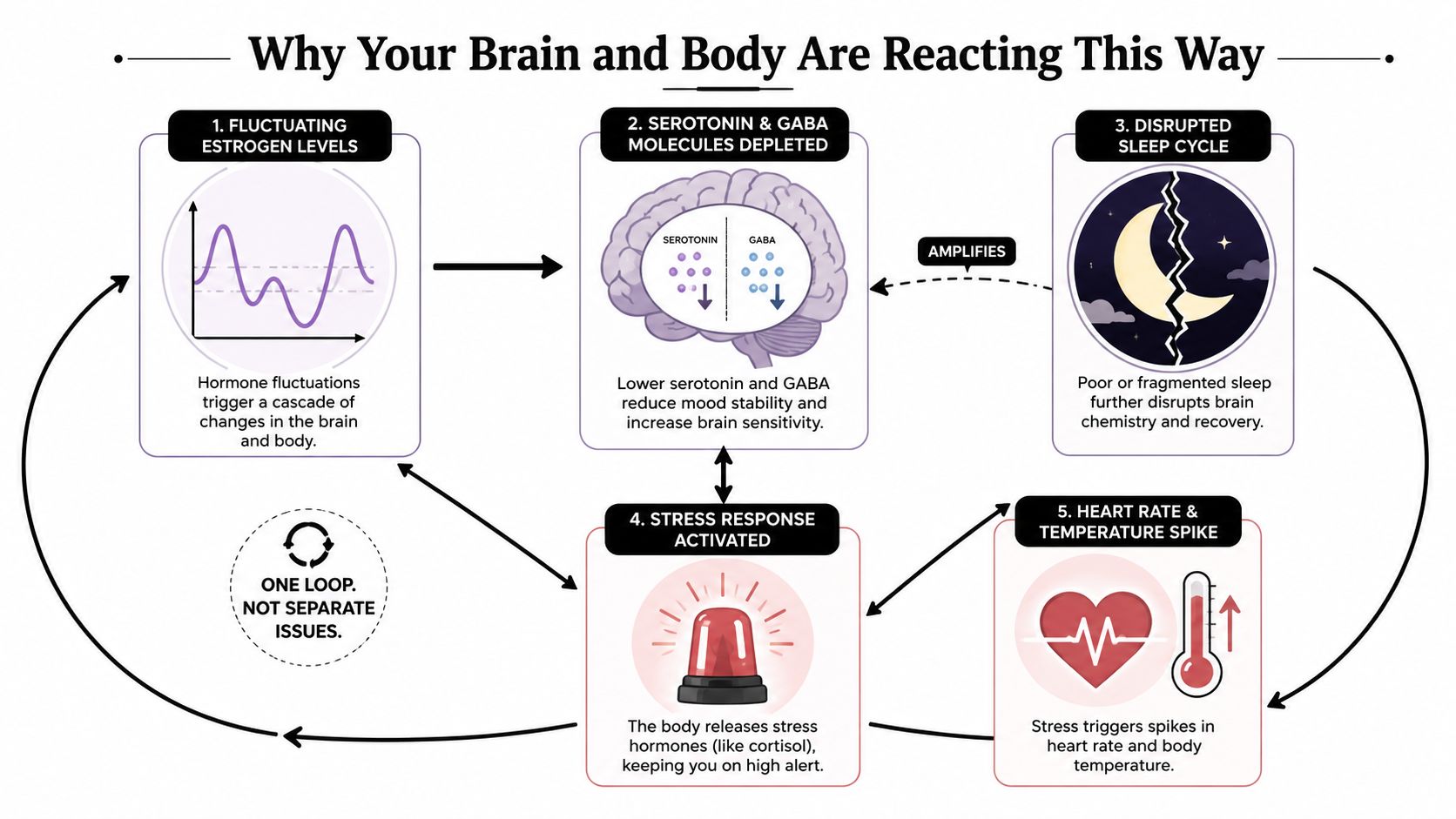
Perimenopause anxiety makes more sense when you stop treating it like one isolated problem. It's usually a loop. Hormone shifts affect brain chemistry, sleep gets lighter or more fragmented, hot flashes or night sweats disrupt rest, and a tired nervous system becomes easier to alarm the next day.
Estrogen interacts with mood-regulating systems such as serotonin and GABA, so when hormones fluctuate, calm doesn't always arrive on schedule. That helps explain why a person can feel emotionally steady one week and unusually raw the next. It isn't a character flaw, it's a regulation problem.
Sleep and hot flashes can keep the cycle going
Sleep disruption matters because a sleep-deprived brain has less room to absorb stress. If you're waking from a hot flash or night sweat, your body doesn't always interpret that as “just warmth.” It may register the sensation as danger, which can bring on a jolt of alertness, a fast heartbeat, and a hard time settling back down.
That's why a mixed picture is so common. A woman may think she has “just anxiety,” when the underlying pattern includes temperature swings, poor sleep, and a stressed-out nervous system feeding one another.
For a practical look at the rhythm of cycle changes, Trim's perimenopause cycle guide is a useful companion read. It can help you connect what your body is doing on paper with what you're feeling at night.
Useful takeaway: if you can ease even one part of the loop, sleep, temperature, or stress response, the whole pattern often becomes more manageable.
Life context matters too
Midlife isn't lived in a vacuum. Many women are carrying aging parents, work pressure, shifting relationships, identity questions, and grief about what's changing. Those stresses don't cause every symptom by themselves, but they can raise the volume on an already sensitive system.
A gentle practice like coping with fight flight response can help when your body seems stuck in alert mode. The point isn't to pretend the stress isn't there. It's to interrupt the alarm long enough for your body to settle.
The emotional side of this stage matters too. A lot of women grieve an earlier version of themselves, or wonder who they're becoming. That's not weakness. It's a normal human response to a body and life that are both changing at once.
Perimenopause Anxiety Versus Other Anxiety Patterns
Not every anxious season means the same thing, and that distinction matters. The more useful question isn't “Do I have an anxiety disorder?” It's “What pattern is this, and what does it need?”
Perimenopause-driven anxiety often has a new, midlife onset and seems closely tied to sleep disruption, hot flashes, night sweats, or cycle irregularity. It can feel worse at night or in the days surrounding hormonal shifts. Generalized anxiety disorder usually looks more chronic, with worry that's been present across many parts of life for a long time.
The quick differences people can actually use
Panic disorder tends to involve discrete panic attacks that arrive hard and fast, often with a fear of having another one, which can lead to avoidance of places or situations. Situational stress usually maps clearly to a life event, like a breakup, job loss, or caregiving crisis, and the trigger is easier to name.
Perimenopause anxiety can overlap with all of those, but it's often mixed with body changes that make the experience feel unusually physical. That's why someone may think, “This is just me becoming more anxious,” when the underlying issue is a transition that's amplifying the whole stress response.
Simple test: if the anxiety seems to track with sleep, temperature swings, and cycle changes, perimenopause belongs on the shortlist.
A useful lens here is phobophobia symptoms and treatment, especially if the fear of your own symptoms is becoming part of the problem. Sometimes the second layer of anxiety, worrying about the worry, is what keeps the cycle going.
None of this means you have to diagnose yourself. It means you can give your clinician a better description. A clear pattern helps them decide whether the answer is hormonal support, therapy, anxiety treatment, or some combination of the three.
Who Is Most Likely to Struggle and Why
Some women sail through with only mild discomfort. Others feel as if the same transition turned their nervous system inside out. That difference is real, and it's one reason one-size-fits-all advice falls short.
Social support appears protective, which makes intuitive sense. When someone has people they can talk to, help from a partner, and room to rest, their body has fewer reasons to stay on guard. Prior coping skills and a stable daily rhythm can help too, because the nervous system likes predictability.
Higher-risk patterns to take seriously
A stronger risk profile often includes a history of anxiety or mood symptoms, a family history of mood disorders, chronic stress, adverse childhood experiences, or a personality style that leans toward worry and self-monitoring. Severe vasomotor symptoms and sleep disruption can also make anxiety harder to settle.
A 2024 narrative review on protective and harmful social and psychological factors in perimenopausal women highlights the same broad picture, with social support on one side and prior mental-health load, trauma, chronic stress, and trait vulnerability on the other (pubmed abstract). That doesn't mean a hard history guarantees a hard transition. It means the odds of needing more support go up.
You may already know you fit that profile if your body has always responded strongly to stress, or if sleep loss tends to make you emotionally fragile fast. That's not self-diagnosis, it's self-knowledge.
A quiet reality check
Two people can have similar hormone changes and very different anxiety trajectories. One may have stable sleep, steady support, and enough margin in daily life to absorb the shifts. Another may be parenting, working, caregiving, and running on fumes.
The second person isn't weaker. She's carrying more while her nervous system is less buffered.
Evidence-Based Ways to Feel Better
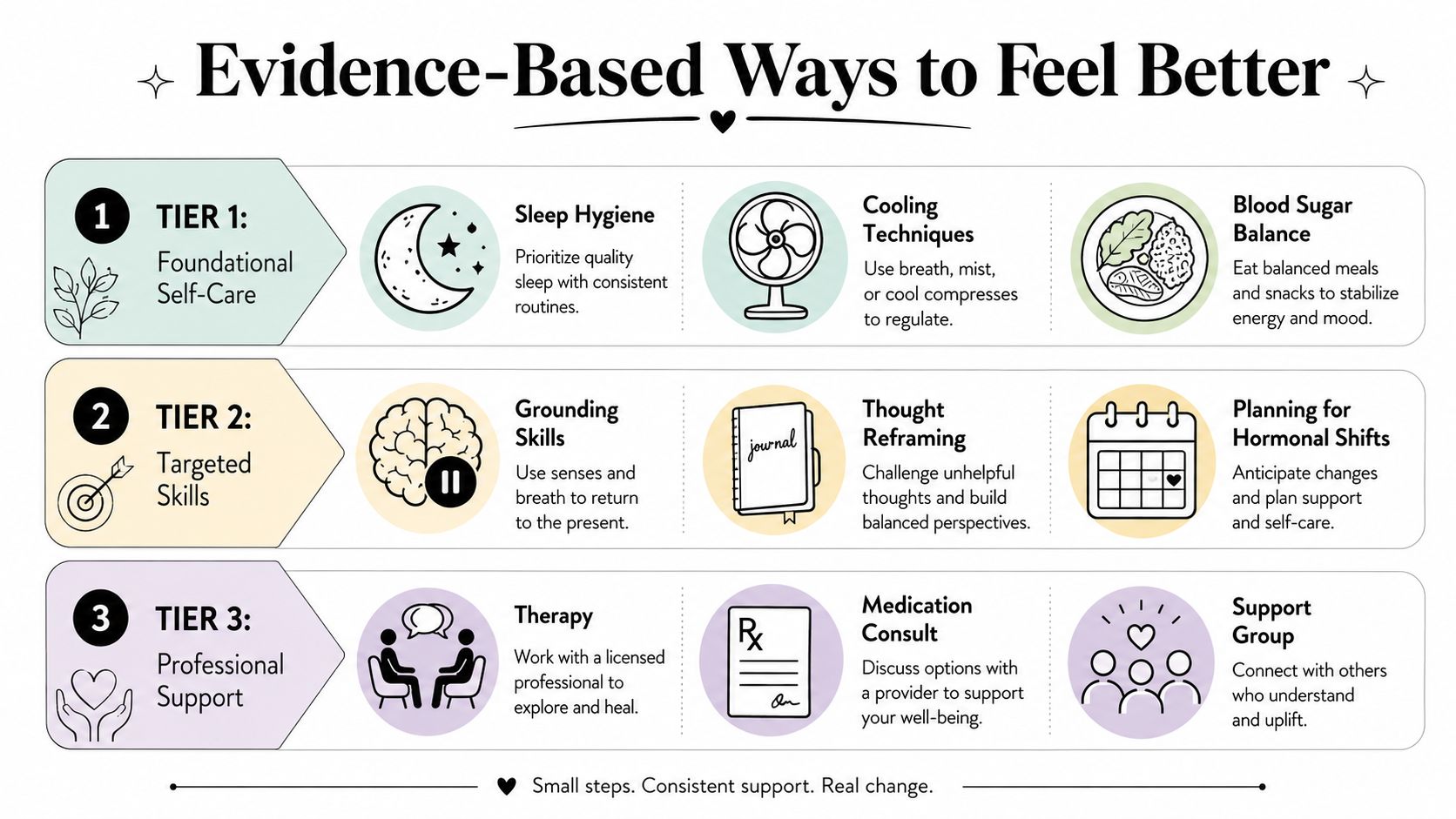
Relief works best when you treat it as a set of tools, not a moral ladder. Some people start with self-care and never need more. Others feel better with therapy, medication, or hormone treatment. Many do best with a combination.
Tier 1, steady the body
Sleep is the first place to look because a shaky sleep schedule can keep anxiety buzzing. A consistent wake time, a cooler bedroom, and fewer late-evening stimulants can help make the night less volatile. If hot flashes or night sweats are part of your picture, cooling pillows, a fan near the bed, lighter bedding, or breathable sleepwear can reduce the body's nighttime alarm.
Food and caffeine matter too. Long gaps between meals can leave some people feeling edgy, and too much caffeine can make a racing heart feel even scarier. A calmer baseline often starts with boring, repeatable routines.
Paced movement helps as well. Walking, gentle yoga, and stretching can settle the stress response without adding more strain. You're not trying to exercise anxiety out of existence, you're telling your nervous system that it can come down a notch.
Tier 2, retrain the response
CBT, or cognitive behavioral therapy, teaches you how to notice catastrophic thoughts and answer them more accurately. MBSR, mindfulness-based stress reduction, helps you change your relationship to body sensations so every flutter or heat surge doesn't become a crisis. The first therapy session usually includes a conversation about symptoms, triggers, goals, and the tools that will fit your life.
A few people like to pair therapy with structured self-help. That can be useful when you want a daily practice between appointments or when you need concrete prompts on the bad days. The aim is not perfection. It's repetition.
Tier 3, involve a clinician
Some symptoms respond well to medication. Healthline notes that SSRIs and SNRIs can reduce anxiety symptoms connected to perimenopause, and that hormone replacement therapy may help when sleep and vasomotor symptoms are part of the pattern, because improving those can ease anxiety too (Healthline). Cleveland Clinic also advises seeking help when anxiety is persistent or intense, interferes with daily life, or comes with physical symptoms such as palpitations, chest pain, dizziness, or shortness of breath (Cleveland Clinic).
If you're wondering whether you need a therapist, a prescriber, or both, the answer can be layered care. That's normal. The right mix depends on your symptom pattern, your medical history, and how much the anxiety is disrupting daily life.
A Hopeful Picture of What Recovery Can Look Like
Relief doesn't always feel dramatic at first. More often, it looks like a small set of wins that slowly add up. You sleep through more of the night, or you wake up but don't immediately spiral. A hot flash still happens, but it passes without taking your whole evening with it.
The best sign is usually not the complete absence of anxiety. It's a shorter recovery time. You notice the surge, use your tools, and come back to yourself faster than before.
If you want a broader set of tools to manage anxiety, that kind of practice is what creates momentum. The brain learns from repetition, so every calmer response teaches your body that a feeling isn't the same thing as danger.
That's why panic-free living is a realistic goal for many people, even if the path is gradual. You may still have stressful days, but they stop owning the whole week. Work feels more doable, home feels less fragile, and your body starts to seem like an ally again instead of a mystery.
A deeper resource on build a calmer, stronger mind can be useful if you like the idea of steady, skill-based resilience. The larger point is simple, with the right supports, the nervous system can learn a new pattern.
Your Next Steps and Answers to Common Questions
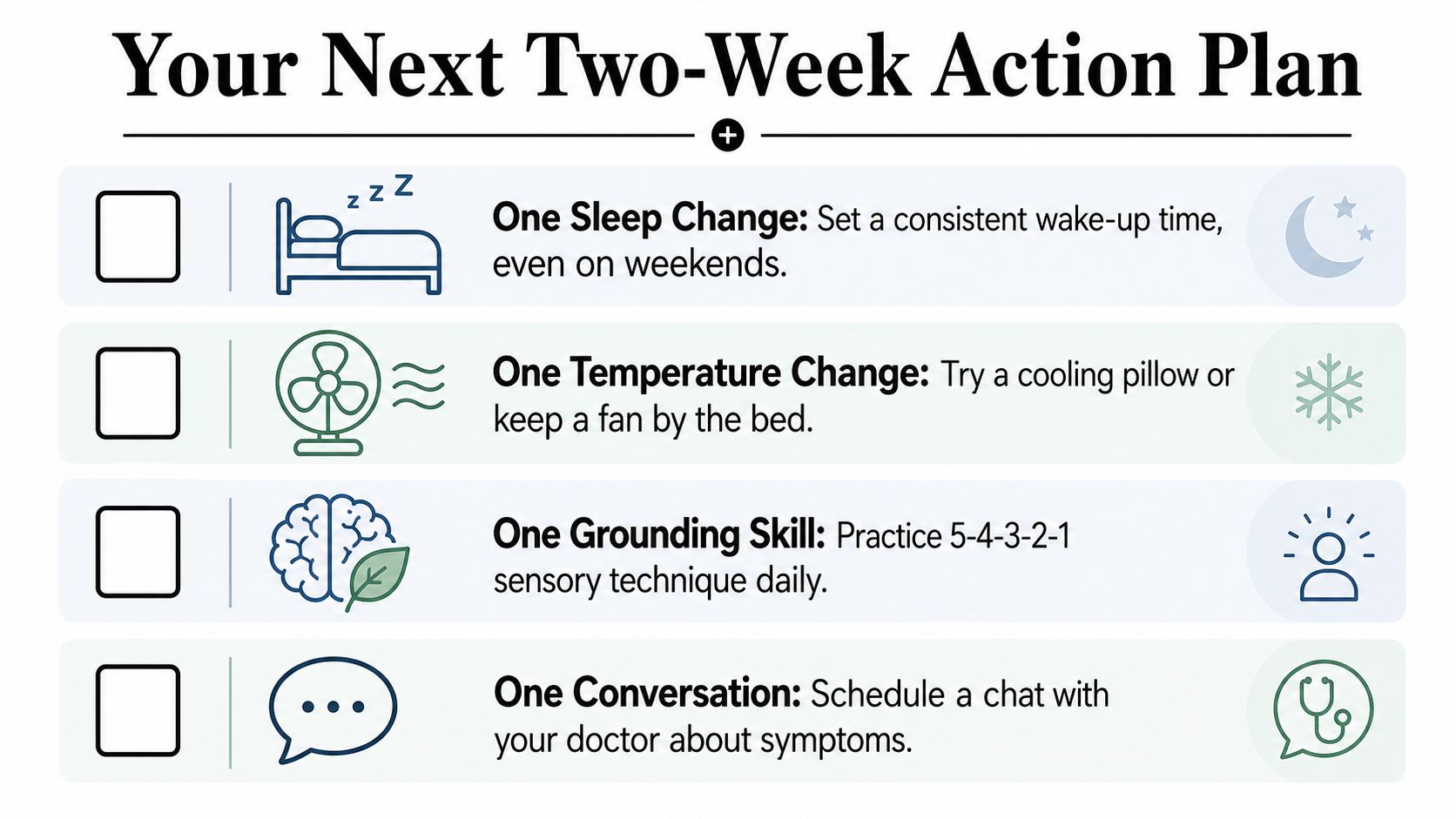
For the next two weeks, keep it small and specific.
- One sleep change. Pick a consistent wake-up time, even on weekends. That gives your body a stronger anchor.
- One temperature change. Try a cooling pillow, lighter bedding, or a fan by the bed if night heat is part of your anxiety spiral.
- One grounding skill. Practice the 5-4-3-2-1 sensory technique once a day, not just during a crisis.
- One conversation. Tell a partner, friend, or clinician what your nights and mornings feel like.
If you're looking for more structure, the free anxiety education hub offers practical learning that can help you keep building after this article.
A few questions come up often. Anxiety can start before periods change, because the body can begin fluctuating before the cycle looks obviously different. It doesn't always go away on its own right away, but it often improves when sleep, vasomotor symptoms, stress, and treatment are addressed together. HRT can be part of care when anxiety is the main symptom, especially if sleep or hot flashes are involved, but that decision belongs with a clinician who knows your history. It may be more serious if you're unable to function, if you have chest pain, dizziness, shortness of breath, or if the anxiety feels relentless and out of proportion to daily life.
You deserve support before things get unbearable. You also deserve to know that this can get better.
If this feels like your story, visit The Anxiety Checklist and explore practical tools for calming panic, easing anxious surges, and building steadier days. The app is made for moments when your mind goes blank and for the slower work of retraining your nervous system.