


You're standing by the door with your keys in hand. It's a normal Tuesday. You're leaving for work, a grocery run, a quick dinner with friends, or a two-day trip you've taken many times before. But the air in the room has changed. Your spouse is asking when you'll text, whether you'll answer right away, whether you really have to go, whether something bad might happen while you're apart.
You may love them intensely and still feel worn thin by this pattern.
Many spouses in this position feel guilty for being frustrated. They wonder if they're being cold, selfish, or impatient. They also know something isn't right, because a simple goodbye shouldn't trigger panic, repeated reassurance, conflict, or a full evening organized around preventing distress. If that's your reality, you're not dealing with a lack of love. You may be dealing with anxiety that has attached itself to the relationship.
That matters because this dynamic is more common than many couples realize. While the strict clinical diagnosis of Adult Separation Anxiety Disorder affects 1% to 2% of the population, the broader experience of separation distress in spousal relationships may affect up to 42% of adults to some degree, according to Rula's overview of relationship separation anxiety. If you're also trying to think clearly about the future of the relationship, legal and practical questions can add pressure, which is why some people also look for grounded information about Foley Family Law Florida separation. And if you've been trying to understand whether what you're seeing is closeness or fear, this guide offers useful support for anxiety's role in love.
There is hope here. Anxiety can heal. Couples can learn a steadier way to connect. And you do not have to keep sacrificing your own peace to keep the relationship afloat.
Table of Contents
- Recognizing the Signs in Your Spouse
- In the Moment Calming Techniques for High Anxiety
- Building Long-Term Solutions Together
- Finding Professional Help and Fostering Hope
- Caring for Yourself The Supporting Partner's Guide
Recognizing the Signs in Your Spouse
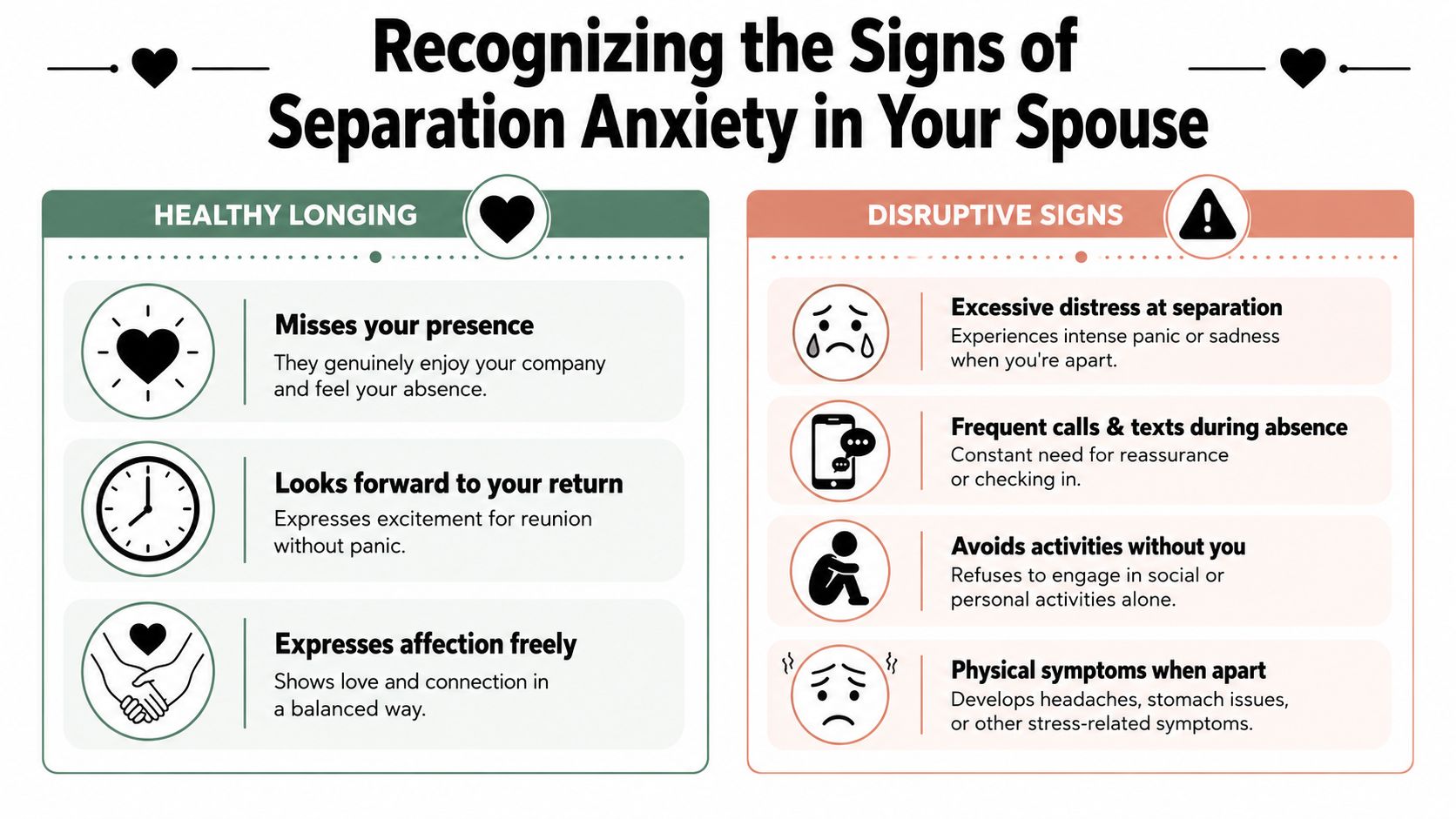
A healthy bond includes missing each other. A strained bond starts to organize daily life around preventing separation. That's the line most spouses are trying to find.
Adult separation anxiety disorder is defined by eight specific symptoms, including excessive distress when anticipating separation and persistent worry about losing an attachment figure, and in adults those symptoms must persist for at least six months to meet diagnostic criteria, according to Thriveworks' summary of adult separation anxiety. You don't need to diagnose your spouse yourself, but that framework can help you stop personalizing the behavior.
When missing you becomes impairment
Plenty of spouses say, “I miss you already,” and mean it affectionately. That's not the problem. The problem starts when distress takes over judgment, work, sleep, social plans, or your freedom to move normally through the day.
Watch for patterns like these:
- Departure distress: Your spouse becomes tearful, panicked, angry, or physically agitated before you leave, even for ordinary errands or workdays.
- Catastrophic fears: They quickly jump to loss, betrayal, accidents, or abandonment when you're unavailable.
- Functioning problems: They struggle to focus, eat, rest, or complete routine tasks while you're gone.
- Reassurance loops: No amount of checking in seems to settle them for long.
- Avoidance: They pressure you to cancel trips, shorten outings, skip plans, or stay physically close to reduce their discomfort.
What the signs often look like at home
In practice, this often shows up less like “clinginess” and more like a whole relationship rhythm built around anxiety. Your spouse may text repeatedly during a meeting, ask for constant location updates, become upset when you don't respond quickly, or say they can't relax until you're back. Some people also avoid being alone entirely, which can overlap with autophobia and separation anxiety.
Practical rule: Don't ask, “Do they love me too much?” Ask, “Does this reaction interfere with daily life and our ability to function as two adults?”
You may also notice a confusing mix of tenderness and control. Your spouse may insist they're only acting this way because they care. That may be true emotionally, but it doesn't make the pattern healthy. Anxiety often borrows the language of love.
A useful test is this: if your leaving the house reliably creates panic, conflict, repeated checking, or pressure for you to manage your spouse's internal state, you are no longer looking at simple closeness. You are looking at a nervous system that treats separation like danger.
In the Moment Calming Techniques for High Anxiety
When your spouse is highly activated, your job isn't to win an argument or prove that everything is fine. Your job is to lower the temperature without becoming the permanent regulator of their emotions.
That's a real trade-off. If you become cold, the panic often spikes. If you over-reassure, the anxiety learns that crisis gets rewarded. The middle path is calm, brief, steady support.
What to do in the first few minutes
Start with your own nervous system. Slow your voice. Unclench your hands. Sit down if possible. People with separation anxiety often read body language faster than words, so your calm matters.
Use this sequence:
Name the distress clearly.
“I can see this is hitting hard right now.”Validate the feeling without agreeing with the fear.
“I understand that being apart feels scary.”State one concrete reality.
“I'm leaving for work, and I'm coming back tonight.”Offer one coping action, not ten.
“Let's do a grounding exercise before I go.”Hold the boundary.
“I'm still going.”
That last line matters. Many spouses accidentally teach anxiety that panic can cancel separation. It brings short-term relief and long-term worsening.
What to say without feeding the panic
Certain phrases soothe. Others backfire.
Helpful scripts:
- “I'm here with you right now.”
- “This feeling is intense, and it will pass.”
- “You can get through this wave.”
- “Let's focus on the next five minutes.”
- “I'll follow the plan we agreed on.”
Less helpful scripts:
- “Nothing bad will happen, I promise.”
- “You have to stop this.”
- “This is ridiculous.”
- “Fine, I just won't go.”
- “Text me whenever you want and I'll answer immediately.”
The first group reduces alarm without making you responsible for eliminating uncertainty. The second group either dismisses the fear or locks you into a reassurance contract you can't sustain.
If your spouse spirals into repetitive thoughts, it can help to redirect them toward concrete ways to calm an overactive mind instead of continuing the same conversation in circles.
“I believe you're overwhelmed. I don't believe we need to obey the anxiety.”
A grounding routine you can use together
Use a short shared exercise instead of a long emotional debate. One of the most practical is the 5-4-3-2-1 method.
Try it like this:
- 5 things you see: Have your spouse say them out loud.
- 4 things you feel: Feet on the floor, shirt on skin, chair against back.
- 3 things you hear: Fan, traffic, birds, a clock.
- 2 things you smell: Coffee, soap, fresh air.
- 1 thing you taste: Water, mint, toothpaste.
Keep your voice slow. Don't rush to the end. If they can't complete it, scale down and just ask for three visible objects in the room.
Later, when the wave has eased, this short video can be a useful reset point for both of you:
If panic episodes are frequent, create a simple departure card together. Put three statements on it: what's happening, what the plan is, and which coping step comes next. That gives your spouse something concrete to return to when their mind goes blank.
Building Long-Term Solutions Together
Emergency calming helps, but it won't change the pattern by itself. Lasting improvement comes from building predictability, practicing separation in manageable doses, and refusing to let anxiety run the household.
Make departures predictable
One of the most useful changes couples can make is agreeing on communication expectations before a separation. Medical News Today notes that a key step is establishing communication expectations and boundaries before time apart, so both partners know the timing, frequency, and method of contact in advance in its discussion of adult separation anxiety.
That means no vague “I'll text sometime.” Be specific. Decide things like:
- When contact will happen: “I'll text when I arrive.”
- How much contact is realistic: “One lunch check-in, then I'm offline until after the meeting.”
- What happens if there's a delay: “If I don't respond quickly, it means I'm occupied, not that something is wrong.”
Specificity reduces the anticipatory scramble that often starts before you've even left.
Use exposure as practice, not punishment
One effective long-term approach is gradual exposure. According to Healthline's explanation of separation anxiety exposure practice, people can start with separations of 10 to 15 minutes and increase duration by about 25% each session. The principle is simple: small, repeated separations teach the nervous system that distance is survivable.
This only works if it's done with consistency. It doesn't work when the anxious spouse agrees in theory but demands rescue halfway through every attempt. It also doesn't work when the supporting spouse gets so exhausted that they abandon the plan completely.
A practical version might look like this:
- First practice: One partner takes a short walk alone.
- Next step: A solo errand with one planned check-in.
- Then: A meal out with a friend.
- Later: A half day apart with the same agreed structure.
The goal isn't to prove toughness. The goal is to create repeated experiences of separation without catastrophe.
If you want structured psychoeducation alongside this work, some couples benefit from curated anxiety self-help guides that explain patterns and coping skills in plain language.
Supportive Actions vs. Enabling Behaviors
| Scenario | Supportive Action (Promotes Growth) | Enabling Behavior (Reinforces Anxiety) |
|---|---|---|
| Your spouse panics before you leave for dinner with friends | Validate the fear, review the plan, and leave on time | Cancel the dinner to stop the distress |
| They send multiple reassurance texts during your work meeting | Reply at the agreed check-in time | Break your boundary and answer every message immediately |
| They insist something terrible will happen on your trip | Acknowledge the fear and encourage a coping tool | Spend an hour proving every feared outcome won't happen |
| They say they can't be alone tonight | Help them choose one grounding activity or support contact | Rearrange your life so they never have to be alone |
| They ask for your location repeatedly | Remind them of the communication agreement | Start live-updating your whereabouts to reduce their anxiety |
That table captures the hard truth. Support comforts without surrendering the structure. Enabling gives relief now and deepens dependence later.
Finding Professional Help and Fostering Hope
Many couples wait too long to seek help because they assume this is just a rough patch, a personality issue, or a relationship flaw. It isn't always. Sometimes it is an anxiety pattern with a well-established treatment path.
Why treatment changes the outlook
Cognitive Behavioral Therapy, or CBT, is the first-line treatment for separation anxiety disorder in adults. Clinical protocols show that approximately 60% to 70% of patients achieve significant symptom reduction and long-term panic-free functioning after 12 to 16 weeks of structured therapy, according to Cleveland Clinic's overview of separation anxiety disorder.
That matters for one reason above all. It means anxiety is not a life sentence. People can learn to think differently, respond differently, and live with far less panic. Couples can stop arranging their relationship around fear.

Some adults also benefit from a treatment plan that includes medication, especially when symptoms are severe or persistent. That decision belongs with a licensed clinician, but it helps spouses to know that effective care isn't limited to “talking about feelings.”
How to bring up therapy without a fight
Timing matters. Don't raise therapy in the middle of a panic spiral or during a goodbye argument. Bring it up during a calm, connected moment.
Try language like this:
- “I can see how painful this is for you, and I don't want us living around panic.”
- “I think we deserve support that actually helps.”
- “This isn't about blaming you. It's about making life easier for both of us.”
- “I'd be open to couples counseling too, so we work on the pattern together.”
If your spouse resists because therapy feels intimidating, start with education. Sometimes reading about symptoms and treatment lowers shame enough for the first appointment to feel possible. If you need a gentle entry point, this resource on Understanding mental health support for anxiety can help frame the conversation.
A good therapist offers more than telling your spouse to “calm down.” They will help identify triggers, challenge catastrophic beliefs, reduce avoidance, and build tolerance for separation. If the relationship itself has become organized around anxiety, couples work can help both of you interrupt the pattern.
Caring for Yourself The Supporting Partner's Guide
This is the part most spouses need and rarely get. You can be compassionate and exhausted at the same time. You can understand your partner's pain and still admit that living beside constant reassurance demands has worn you down.
A 2025 study from the American Psychological Association, cited by ADAA, found that spouses of people with anxiety disorders experience higher burnout rates, with 45% reporting that they feel emotionally drained daily, as summarized in ADAA's guidance for spouses and partners. If you feel depleted, that reaction makes sense.

Your exhaustion is real
Burnout in a separation anxiety spouse dynamic often looks quiet. It's not always dramatic resentment. Sometimes it's smaller and sadder than that.
You may notice:
- You monitor your own behavior constantly so you don't trigger panic.
- You stop making plans because every outing comes with a negotiation.
- You feel responsible for your spouse's stability in a way that leaves no room for your own needs.
- You lose parts of your identity because the relationship keeps narrowing around management of anxiety.
Caring for yourself is not abandoning your partner. It is refusing to disappear.
Boundaries that protect both of you
Boundaries are not punishments. They are the structure that keeps support from turning into self-erasure.
Useful boundary scripts include:
- “I'm happy to text when I arrive. I'm not able to text continuously.”
- “I can sit with you for ten minutes before I go. I'm still leaving afterward.”
- “I want to support you, and I also need you to use your coping tools.”
- “I won't argue with the fear for an hour. We can talk briefly, then return to the plan.”
- “I'm not going to cancel important commitments to make the anxiety feel better.”
These boundaries can feel harsh at first, especially if you've spent months or years acting as a full-time regulator. But a loving boundary is often the most respectful thing you can offer. It treats your spouse as someone capable of growth, not as someone who must remain dependent.
How to stop disappearing inside the relationship
You need a life that doesn't collapse every time your spouse struggles. That means protecting routines that belong to you.
Rebuild in concrete ways:
- Keep one independent commitment. A class, walk, coffee date, workout, volunteer role. Pick one and make it a priority.
- Stay in contact with your people. Anxiety isolates couples. Push back against that.
- Get your own support. Individual therapy, a support group, or one trusted person who understands the pattern can make a major difference.
- Track your resentment accurately. Resentment is often a signal that a boundary is overdue.
- Stop calling self-neglect loyalty. It isn't.
If you've been functioning like the emotional scaffolding of the marriage, this shift can feel uncomfortable. Do it anyway. Security grows when both adults are allowed to be adults. Your steadiness, your independence, and your refusal to be consumed by the anxiety all model the kind of safety your spouse is trying to build.
Healing in this kind of relationship rarely comes from loving harder. It comes from loving more clearly. You offer warmth. You stop feeding the cycle. You support treatment. You protect your own mind. That is how many couples move from panic to something steadier, and for many people, that path leads to living far more freely and panic free than they thought possible.
If you need a practical next step, The Anxiety Checklist offers real-time panic support, guided grounding, and longer-term CBT tools in one place. It's a simple way to get help when your mind goes blank, and it can support both the person with anxiety and the spouse trying to respond with calm, clarity, and healthier boundaries.