


You're sitting still, but your chest feels anything but calm. Maybe it's a dull pressure under your breastbone. Maybe it's a tight band that seems to pull tighter every time you notice it. Your thoughts jump fast: Is this anxiety? Is something wrong with my heart? Do I need help right now?
That fear is real. Chest pressure can feel intense, alarming, and physical. It can also happen during anxiety, panic, ongoing stress, or even when your body is bracing for danger before your mind has caught up.
The good news is that there is a way through this. If anxiety is driving the sensation, relief is possible in the moment, and healing is possible over time. Many people who once felt trapped by panic learn how to calm their body, understand their symptoms, and eventually live with far less fear.
Table of Contents
- That Frightening Squeeze Understanding Chest Pressure
- Is It Anxiety or Something More Serious?
- Immediate Relief Techniques You Can Do Right Now
- Short-Term Actions to Calm Your Nervous System
- A Hopeful Path to a Panic-Free Life
- Frequently Asked Questions About Chest Pressure
That Frightening Squeeze Understanding Chest Pressure
One common pattern goes like this. You notice a strange sensation in your chest. Then you take a quicker breath. Then your shoulders tense. Then your brain starts scanning for danger, and suddenly the pressure feels stronger.
That doesn't mean you're imagining it. It means your fight-or-flight response may be switching on.
When your body thinks you're under threat, it prepares you to act. Muscles tighten. Breathing can become shallow. Your chest wall may feel rigid. Your stomach may clench. Your heartbeat may become more noticeable. All of that can create a feeling of squeezing, heaviness, tightness, or pressure.
Why anxiety can feel so physical
Anxiety often tricks people because it doesn't stay in the mind. It shows up in the body first. A person may think, “If this were just anxiety, it wouldn't feel this real.” But anxiety often does feel that real.
Practical rule: If chest pressure comes with fear, racing thoughts, body tension, and a sense of alarm, anxiety may be part of the picture even when the symptom feels intensely physical.
Many people also get frightened by the way symptoms feed each other. Chest pressure creates fear. Fear creates more muscle tension and faster breathing. That creates more chest pressure. The cycle can build quickly.
If you want a clearer picture of what your body is doing during that surge, Anxiety Checklist's fight or flight resources explain the pattern in plain language.
What helps most at the start
The first shift is simple but powerful. Instead of asking, “How do I make this disappear instantly?” ask, “What is my body trying to do right now?”
That question lowers panic. It turns a mysterious symptom into a known stress response. Once you understand that, you can start using skills that work with your nervous system instead of fighting it.
Is It Anxiety or Something More Serious?
This is the question that matters most. If chest pressure is new, severe, unusual for you, or paired with alarming symptoms, it needs medical attention. Anxiety is common, but so are other causes of chest discomfort.
Why this question matters
Historical data from the Mayo Clinic's 2020 chest pain guidance indicates that 4 out of 10 emergency room visits for chest pressure are not caused by heart attacks, and anxiety and panic disorders account for approximately 35% of these non-cardiac cases (Mayo Clinic chest pain diagnosis and treatment). That's reassuring in one sense. It means many people with chest pressure are not having a heart attack.
It is not permission to self-diagnose blindly.
If breathing feels harder when lying flat, that can point people toward other medical issues that deserve evaluation. In that situation, a plain-language resource like PSCharlotte's guide to orthopnea can help you understand why position-related breathing symptoms should be taken seriously.
A simple comparison you can use
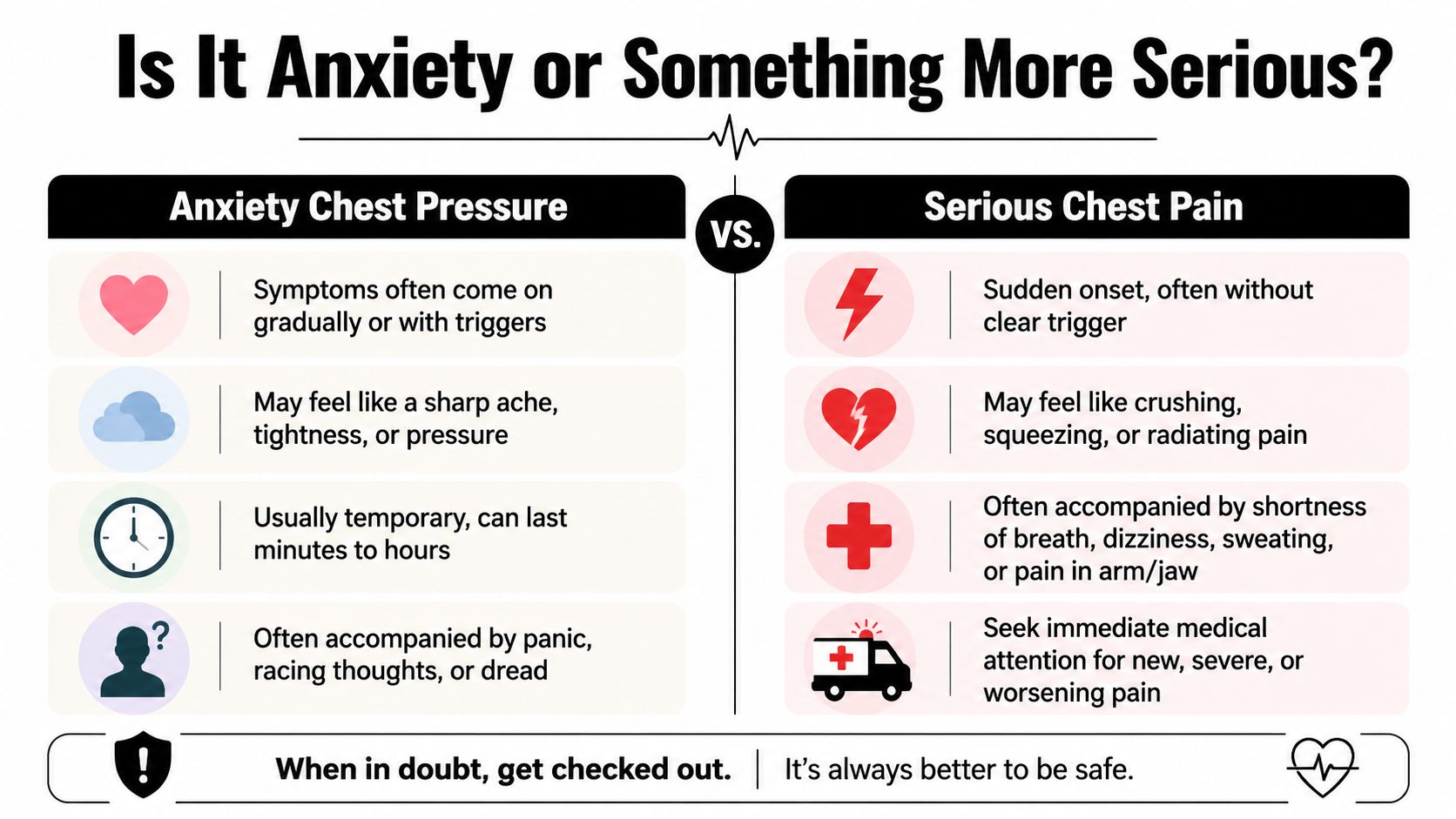
Anxiety-related chest pressure and cardiac pain can overlap, so no table replaces medical care. Still, a calm comparison can help you think more clearly.
| Symptom | Often Anxiety-Related | Potentially Cardiac (Seek Emergency Care) |
|---|---|---|
| Onset | May build during stress, panic, or body scanning | Can be sudden, intense, or unlike anything you've felt before |
| Sensation | Tightness, ache, pressure, chest wall tension, difficulty getting a satisfying breath | Crushing, squeezing, heavy pressure, or pain that feels dangerous and unfamiliar |
| Location | Can stay in one area or shift as attention changes | May feel central and severe, sometimes with spreading discomfort |
| Thought pattern | Often comes with dread, racing thoughts, “what if” spirals | May happen with or without anxiety |
| Body clues | Hyperventilation, tingling, shakiness, urge to escape | Sweating, dizziness, faint feeling, severe shortness of breath, pain in arm or jaw |
Red flags that need urgent care
Stop reading and seek emergency help now if chest pressure is:
- New and severe: especially if it feels crushing, heavy, or rapidly worsening
- Paired with dangerous symptoms: shortness of breath, fainting, severe dizziness, sweating, or pain spreading to the arm, jaw, back, or shoulder
- Not typical for you: even if you've had panic before, a different pattern deserves medical attention
- Happening during exertion: or continuing despite rest
- Connected to a known medical risk: if your doctor has told you that you have heart or lung concerns
Chest pressure should never be dismissed just because you have anxiety.
There's another complication. Fear of the symptoms themselves can keep the cycle going. Some people become terrified of panic sensations, which makes each chest sensation feel even more dangerous. That pattern is common in phobophobia and panic attack cycle.
If you've been medically evaluated and told your chest pressure is anxiety-related, the next step isn't more fear. It's learning exactly what to do when the sensation starts.
Immediate Relief Techniques You Can Do Right Now
When your chest feels tight, you need something concrete. Not theory. Not vague advice. You need a small action your body can follow.
A 2019 study in the American Journal of Preventive Medicine found that 72% of individuals who engaged in diaphragmatic breathing reported immediate relief from stress-associated chest pressure (NSW chest pain factsheet reference).
Box breathing when your chest feels tight
Start with the simplest structure. The 4-4-4-4 box breathing technique means inhale for four seconds, hold for four, exhale for four, hold for four, then repeat.
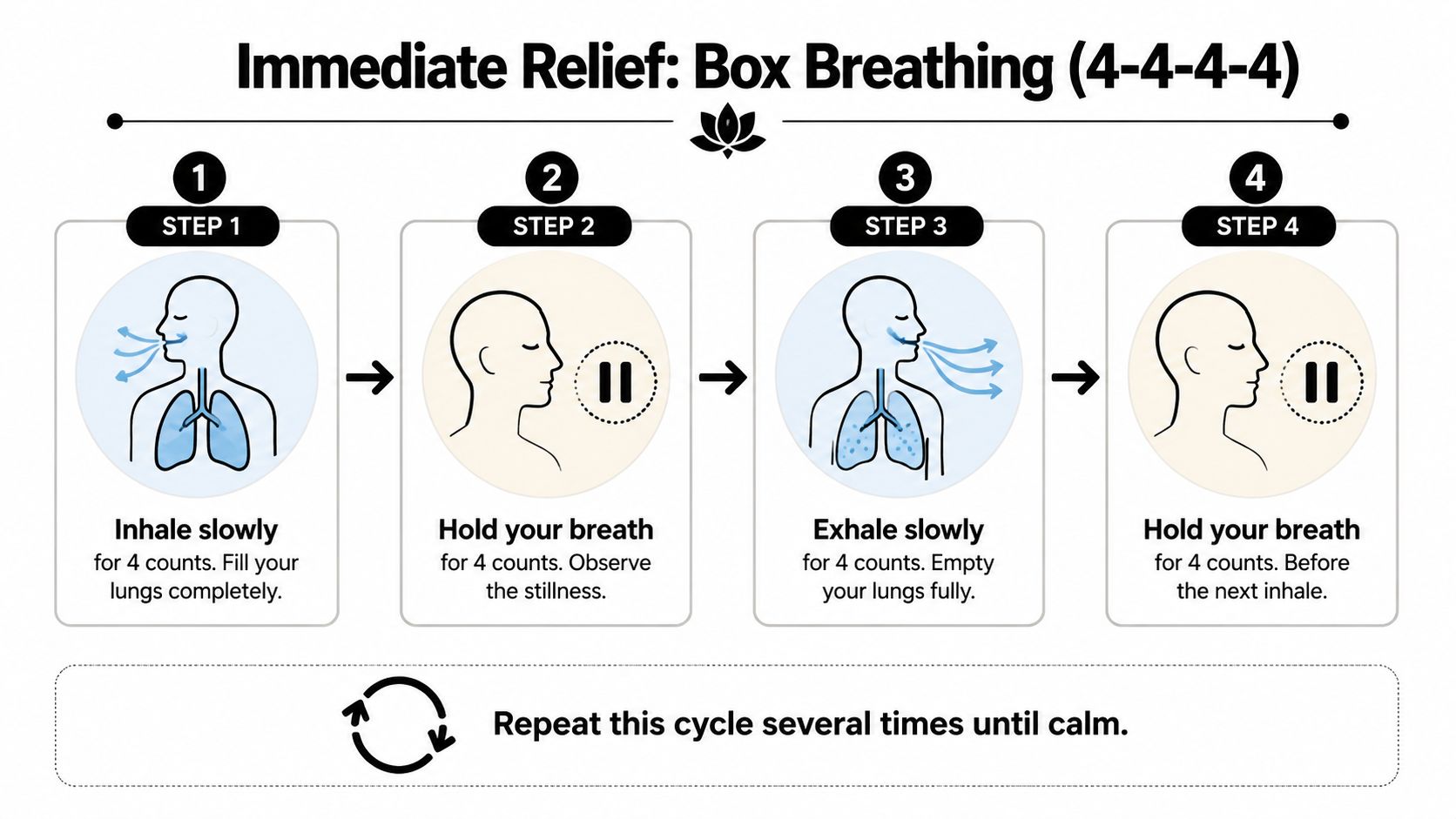
Here's how to do it:
- Place one hand on your belly. This helps you notice diaphragmatic movement instead of lifting only your chest.
- Inhale through your nose for four. Let your belly rise.
- Hold for four. Keep the count steady, not forced.
- Exhale through pursed lips for four. Think of breathing out as if through a straw.
- Hold for four again. Then begin the next round.
A common mistake is trying to take a huge breath. Don't do that. Gentle, even breathing is better than deep, strained breathing.
For extra support, these breathing exercises for anxiety can help you practice before the next spike hits.
Here's a guided version if you want something to follow instead of counting on your own.
Grounding when your mind starts spiraling
Sometimes the chest pressure stays strong because your attention is trapped inside your body. Grounding interrupts that loop.
Try the 5-4-3-2-1 method:
- Five things you can see: name them slowly
- Four things you can feel: chair under you, feet in shoes, air on skin
- Three things you can hear: even very quiet sounds count
- Two things you can smell: or two scents you remember clearly
- One thing you can taste: a sip of water, gum, or just the taste in your mouth
If your mind says, “This isn't enough,” keep going anyway. Grounding works by shifting attention, not by being dramatic.
If scent helps you settle, a gentle sensory cue can support grounding. Some people like to pair breathing with familiar smells, and Jackpot Candles' calming scent guide offers ideas for building that kind of routine at home.
A posture reset that helps your breathing
Posture won't fix panic by itself, but it can reduce the feeling of being compressed.
Try this for one minute:
- Sit upright: don't stiffen, just lengthen your spine
- Unclench your jaw: many people hold tension there without noticing
- Drop your shoulders: let them fall away from your ears
- Loosen your abdomen: tight stomach muscles can make breathing feel restricted
If you can, rest one hand on your upper chest and one on your belly. Aim for the lower hand to move more.
When people ask how to relieve chest pressure fast, these are the first tools I'd want them to have: slower breathing, external focus, and a more open breathing position.
Short-Term Actions to Calm Your Nervous System
Once the worst moment passes, your body may still feel shaky, sore, keyed up, or “off.” That doesn't mean the danger is rising again. It often means your nervous system hasn't fully settled yet.
Try progressive muscle relaxation

Progressive Muscle Relaxation, often shortened to PMR, is especially useful after chest pressure because anxiety tends to leave tension all over the body, not just in the chest. PMR achieves a 78% reduction in chest pressure intensity within 15 minutes when performed with full diaphragmatic awareness, and combining it with cognitive labeling such as “this is anxiety” increases its efficacy by 30%.
Try a short version:
- Feet and legs: tense for five seconds, then release
- Abdomen and hands: tighten gently, then let go fully
- Shoulders and face: squeeze, then soften
As you release each area, say, “This is anxiety, not danger.”
“This is anxiety, not danger” is not denial. It's a way of telling your body that it can stop bracing.
What to do for the rest of the day
After an anxiety surge, treat your body like it's recovering from a false alarm.
A few things help:
- Drink water: slow sips can be grounding and physically soothing
- Skip stimulants for now: caffeine can mimic the same sensations that make chest pressure scary
- Take a gentle walk: not as a test, just as a way to discharge tension
- Reduce mental replay: if you keep rehashing the episode, your body may stay activated
If your mind won't stop reviewing what happened, learning how to stop overthinking can make the post-panic hours much easier.
The key idea is simple. Don't punish yourself for having symptoms. Respond with steady, ordinary care.
A Hopeful Path to a Panic-Free Life
Relief matters. Recovery matters more.
If chest pressure is being driven by anxiety, your future doesn't have to revolve around managing the next episode. People do get better. They learn what their symptoms mean, stop fearing every body sensation, and rebuild trust in themselves.
Why recovery is realistic

Cognitive Behavioral Therapy, or CBT, is one of the clearest paths forward. Verified data shows CBT has a 50 to 60% response rate in patients with panic disorder, with many achieving complete remission after 12 to 16 weeks of structured treatment (Talkiatry overview of anxiety-related chest tightness).
There is even more reason for hope. The National Institute for Mental Health reports that panic disorder is one of the most treatable anxiety conditions, with clinical data showing that 7 out of 10 patients respond positively to treatment (Ubie Health summary citing NIMH).
What healing usually looks like
Healing usually doesn't mean never feeling stress again. It means the symptoms stop running your life.
That often includes:
- Learning your triggers: not to avoid life, but to understand your pattern
- Changing the meaning of body sensations: chest pressure becomes a signal, not proof of catastrophe
- Reducing safety behaviors: less checking, less googling, less testing your body
- Practicing response skills repeatedly: calm is built through repetition
Some people also benefit from age-specific support. If anxiety is affecting a teenager's daily life, school, or safety, this guide to help for struggling adolescents may help families understand higher-support options.
Recovery often begins when you stop asking, “How do I make sure this never happens today?” and start asking, “How do I teach my brain and body that I'm safe?”
If you want to keep learning in a structured way, a free anxiety education hub can help you understand panic, symptoms, and evidence-based recovery tools in plain language.
Frequently Asked Questions About Chest Pressure
Can anxiety chest pressure happen without a full panic attack
Yes. Some people feel chest tightness during chronic stress, anticipatory anxiety, or periods of constant body tension without having a classic panic attack. The body can stay partially activated for hours or days, especially when you're bracing, overbreathing, or scanning for symptoms.
How long can anxiety chest pressure last
It varies. For some people, it fades quickly once breathing and muscle tension settle. For others, mild tightness can linger after the main wave of fear has passed because the chest wall, shoulders, and abdomen are still tense.
If chest pressure is persistent, changing, or concerning, it deserves medical evaluation.
Can reflux or digestion make anxiety chest pressure worse
Yes. A 2024 meta-analysis in Gastroenterology showed that 60% of chronic chest pressure in anxiety patients stems from stress-induced gut dysmotility, which means the gut and nervous system may be feeding into each other at the same time.
That's why relief may require a two-part approach:
- Calm the stress response: breathing, grounding, relaxation
- Reduce digestive strain: smaller meals, staying upright after eating, and noticing foods or eating patterns that seem to worsen symptoms
What if I keep checking my body over and over
That's understandable, but repeated checking often keeps the alarm switched on. Every scan asks your brain, “Is there danger now?” and your brain keeps answering with more vigilance.
A gentler approach is to notice the urge, name it, and return to one chosen action such as slow breathing, walking, or a grounding exercise. That shift is small, but it's how the cycle starts to loosen.
If chest pressure and panic keep interrupting your life, The Anxiety Checklist can give you steady support in the moment and over time. It includes an always-free SOS mode for real-time calming, plus tools for grounding, CBT-based self-therapy, guided audios, and anxiety education so you can move from surviving symptoms to building a calmer, more confident, panic-free life.