


It's Sunday evening, and your stomach already knows what Monday holds. A team meeting where your name might get called. A Slack message from your manager that says, “Got a minute?” A presentation you've rehearsed so many times that the words feel worn out, but your body still reacts like danger is coming.
If that sounds familiar, you're not weak, dramatic, or “just bad at work.” You may be dealing with social anxiety in a work setting, and that experience is far more common, disruptive, and treatable than many people realize. The hardest part is that it often hides in plain sight. Other people see quietness, overpreparation, or avoidance. You feel the racing heart, the mental fog, the replaying of every sentence, and the urge to escape.
There is hope here. Social anxiety and work can be a painful combination, but it doesn't have to define your future. People do get better. They learn how to calm their nervous system, handle high-pressure moments, ask for support when needed, and build careers that don't feel ruled by panic.
Table of Contents
- The Hidden Toll of Social Anxiety at Work
- What Social Anxiety at Work Really Feels Like
- In-the-Moment Strategies to Manage Anxiety
- How to Handle Meetings Presentations and Interviews
- Talking to Your Manager About Social Anxiety
- The Hopeful Path to a Panic-Free Career
- Your Next Steps and Where to Find Support
The Hidden Toll of Social Anxiety at Work
You might look capable on paper and still feel terrified in ordinary work situations. You meet deadlines, think carefully, and do solid work. Then a meeting starts, your manager asks for your thoughts, and your mind goes blank. By lunchtime, you're exhausted from acting normal.
That gap between outer performance and inner distress is one reason social anxiety and work can become such a lonely struggle. Many professionals don't talk about it. They assume they should just push harder, be more confident, or “get over it.” Instead, they start shrinking their world. They speak less, volunteer less, and subtly turn down opportunities they want.
The scale of the problem matters. About 90% of American adults with Social Anxiety Disorder report significant workplace impairment, and people with the condition are more than twice as likely to be unemployed. One in five have turned down a job or promotion because of social fears, according to social anxiety disorder statistics compiled here.
Social anxiety at work isn't a character flaw. It affects choices, visibility, income, and career direction.
When anxiety changes your career without permission
Social anxiety doesn't only show up during dramatic moments like presentations. It also shapes the smaller choices that build a career over time.
- Holding back in meetings: You have an idea, but you wait too long to say it.
- Overediting communication: A simple email takes far longer than it should because you're trying to avoid judgment.
- Avoiding visibility: You skip networking, optional events, and stretch assignments.
- Turning down advancement: A promotion sounds good until you imagine more scrutiny, more meetings, and more exposure.
Those choices make sense when your nervous system believes social risk equals real danger. But they can leave you feeling stuck, underused, or ashamed.
Why this article is hopeful
The pain is real, but so is recovery. You can learn to handle work situations that currently overwhelm you. You can become more steady in meetings, less rattled by feedback, and more willing to be seen. Many people don't need a new personality. They need skills, repetition, and treatment that helps their brain stop mislabeling workplace interaction as threat.
What Social Anxiety at Work Really Feels Like
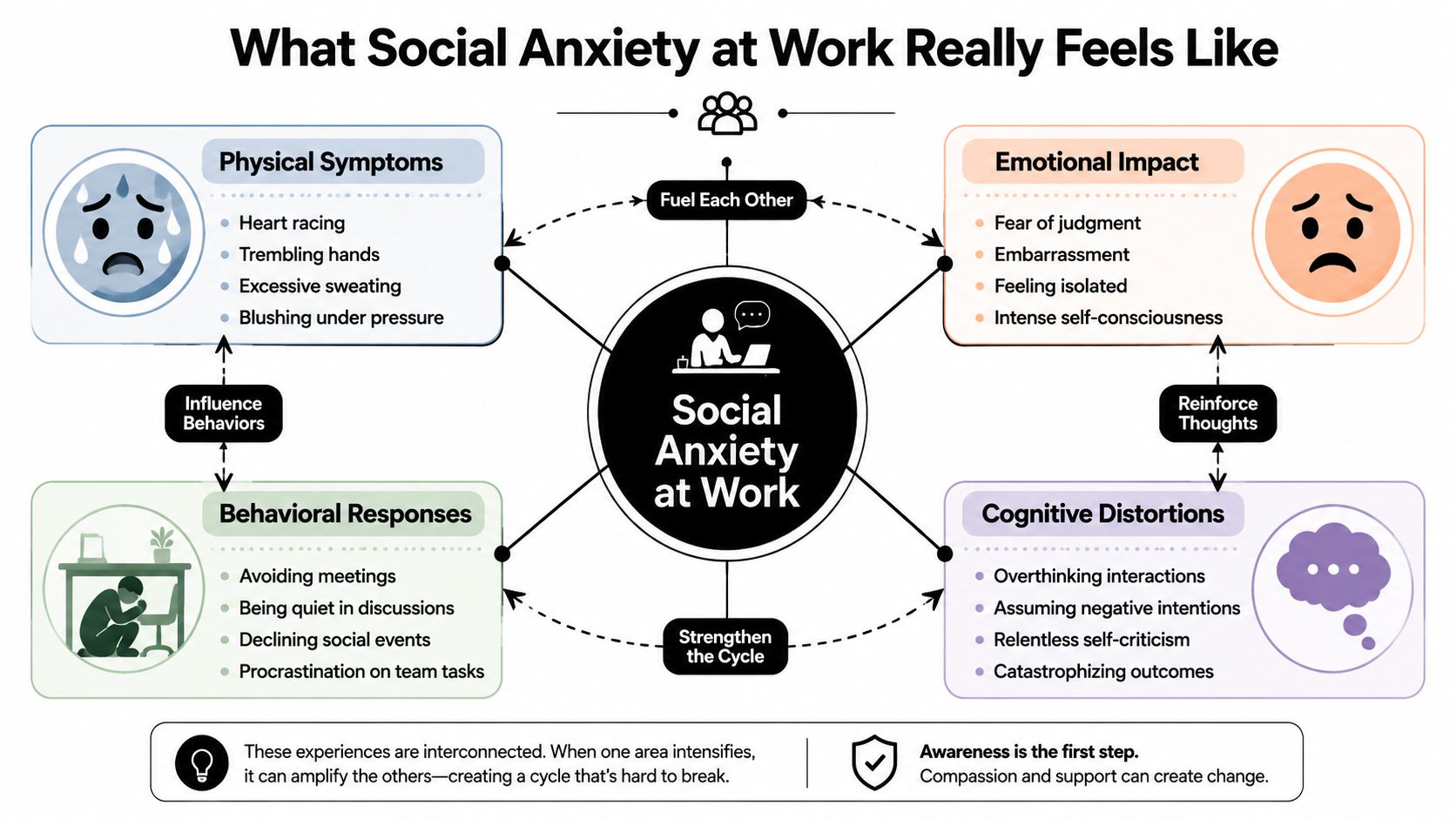
You open your laptop for a routine meeting. Before anyone says your name, your chest tightens, your mind starts scanning for mistakes, and a simple comment feels as risky as stepping onto a stage. That is often what social anxiety at work feels like. The task may be ordinary. Your nervous system treats it like exposure.
Why your brain treats work like a threat
A useful term here is scrutiny fear. Your brain starts predicting negative evaluation from other people. It does not only brace for disagreement. It braces for embarrassment, rejection, or the sense that you will be seen as incompetent. Once that alarm turns on, the body joins in fast.
That is why capable employees can feel flooded during tasks that look small from the outside. A check-in with a manager, speaking up on a call, asking a question, or introducing yourself to a new coworker can trigger blushing, shaking, sweating, nausea, muscle tension, or a racing heart.
Then a second process kicks in. Attention swings inward. You start tracking your face, voice, posture, wording, and every pause. It is a lot like trying to drive while staring at the dashboard instead of the road. The more closely you monitor yourself, the harder it becomes to think clearly and respond naturally.
For many readers, learning more about social anxiety symptoms and treatment brings relief because it shows that these reactions follow a known pattern. The problem is not weakness. The alarm system is overfiring.
Why a normal workday can feel exhausting
Social anxiety also burns energy in a way other people often cannot see. A helpful comparison is a phone battery running too many apps in the background. Even if you are sitting still at your desk, part of your mind may be scanning for threat, rehearsing what to say, replaying what you already said, and trying to hide visible anxiety.
That mental load adds up. Researchers writing in BMC Psychology describe how social anxiety at work is linked with avoidance, self-focused attention, and strain in occupational functioning. In plain language, the work task is only part of the job. Managing the alarm becomes a second job.
This helps explain why some people seem fine for one presentation or one client call, then crash afterward. The hard part is not only the event itself. It is the invisible effort of bracing, masking, and recovering.
Practical rule: If you keep wondering why ordinary work interactions leave you depleted, ask how many moments your nervous system is labeling as danger.
Common signs include:
- After-meeting rumination: replaying your comments and spotting flaws other people likely missed
- Self-monitoring while speaking: paying more attention to how you sound than to the conversation itself
- Delay around contact: postponing emails, calls, Slack messages, or follow-ups because interaction feels risky
- Safety behaviors: overpreparing, scripting, apologizing too much, or staying quiet to reduce the chance of judgment
- Shutdown or irritability: looking detached, brief, or unfriendly when you are overloaded
These patterns matter because they are treatable. Once you can see the cycle clearly, you can stop treating it as a personality verdict and start working with it like a nervous system problem that can be retrained.
In-the-Moment Strategies to Manage Anxiety
When anxiety spikes at work, you don't need a perfect mindset. You need something usable in the next five minutes. Think of this as a first-aid approach, not a full cure. The goal is to reduce the alarm enough that you can function.
A first-aid approach for anxious moments
Start with your body. Anxiety pulls attention into catastrophic thinking, but your nervous system responds well to concrete sensory input. If you're about to join a meeting or answer a difficult question, place both feet on the floor and press them down. Feel the chair supporting you. Relax your jaw. Exhale longer than you inhale.
Then narrow the task. Don't ask, “How do I calm down completely?” Ask, “What is the next useful action?” That might be reading your first sentence, asking one clarifying question, or taking one sip of water before you speak.
A quick grounding method that helps many people is the 5-4-3-2-1 exercise. Name five things you see, four things you feel, three things you hear, two things you smell, and one thing you taste. This interrupts spiraling and returns attention to the present.
You can also keep a short list of tools to manage anxiety handy on your phone, especially for moments when your mind goes blank and you need structure.
“I don't need to feel confident right now. I need to stay present long enough to do the next small step.”
Your workplace anxiety first-aid kit
| Technique | Best For | Quick Steps |
|---|---|---|
| Grounding with 5-4-3-2-1 | Pre-meeting panic, bathroom break resets, post-feedback spirals | Silently name 5 things you see, 4 you feel, 3 you hear, 2 you smell, 1 you taste |
| Longer exhale breathing | Racing heart, shaky voice, visible tension | Inhale gently, then make your exhale slower and longer for several rounds |
| Script the first line | Meetings, calls, interviews | Write the first sentence you want to say so you don't have to improvise under pressure |
| Cognitive reframe | Catastrophic thoughts | Replace “They'll think I'm incompetent” with “People usually notice less than I assume” |
| External focus shift | Over-self-monitoring | Listen for one key point, look at the agenda, or focus on helping the conversation move forward |
| Micro-break reset | After a stressful interaction | Step away briefly, unclench your hands, drop your shoulders, and orient to the room |
What helps most in the moment
Different tools work for different kinds of anxiety. If your body is activated, start with breathing or grounding. If your mind is spiraling, use a written reframe. If you're frozen, make the task smaller.
Try these prompts:
- Before speaking: “My job is to communicate one point, not to impress everyone.”
- During a panic spike: “This is anxiety. It feels urgent, but I am safe.”
- After a mistake: “Awkward isn't dangerous. I can recover.”
Use these tools repeatedly, even on lower-stress days. Skills become more reliable when your brain has practiced them before the big moment.
How to Handle Meetings Presentations and Interviews
A lot of advice on social anxiety and work tells people to find low-interaction jobs. That can help some people, but it doesn't solve the underlying problem for professionals who are already in visible roles or want to grow into them. Many jobs require meetings, collaboration, client contact, interviews, or leadership. Avoidance can shrink your career faster than anxiety itself.
Stop waiting for a perfect low-social job
That “just find a quieter role” advice misses a major reality. Existing advice often fails to address the reality for the 68% of anxious workers in major markets who are locked into performance-based roles. Data also shows 0% of top search results provide in-situ CBT strategies for unavoidable high-stakes public speaking, according to McKinsey Health Institute insights. Many people can't remake their career around anxiety. They need to function where they are.
That's why skill-building matters. The goal isn't to become fearless. It's to become prepared enough, practiced enough, and self-regulated enough that anxiety stops running the show.
If you want more structured practice material, these anxiety coping guides and tools can support the kind of repetition that helps in real workplace scenarios.
A playbook for high-stakes moments
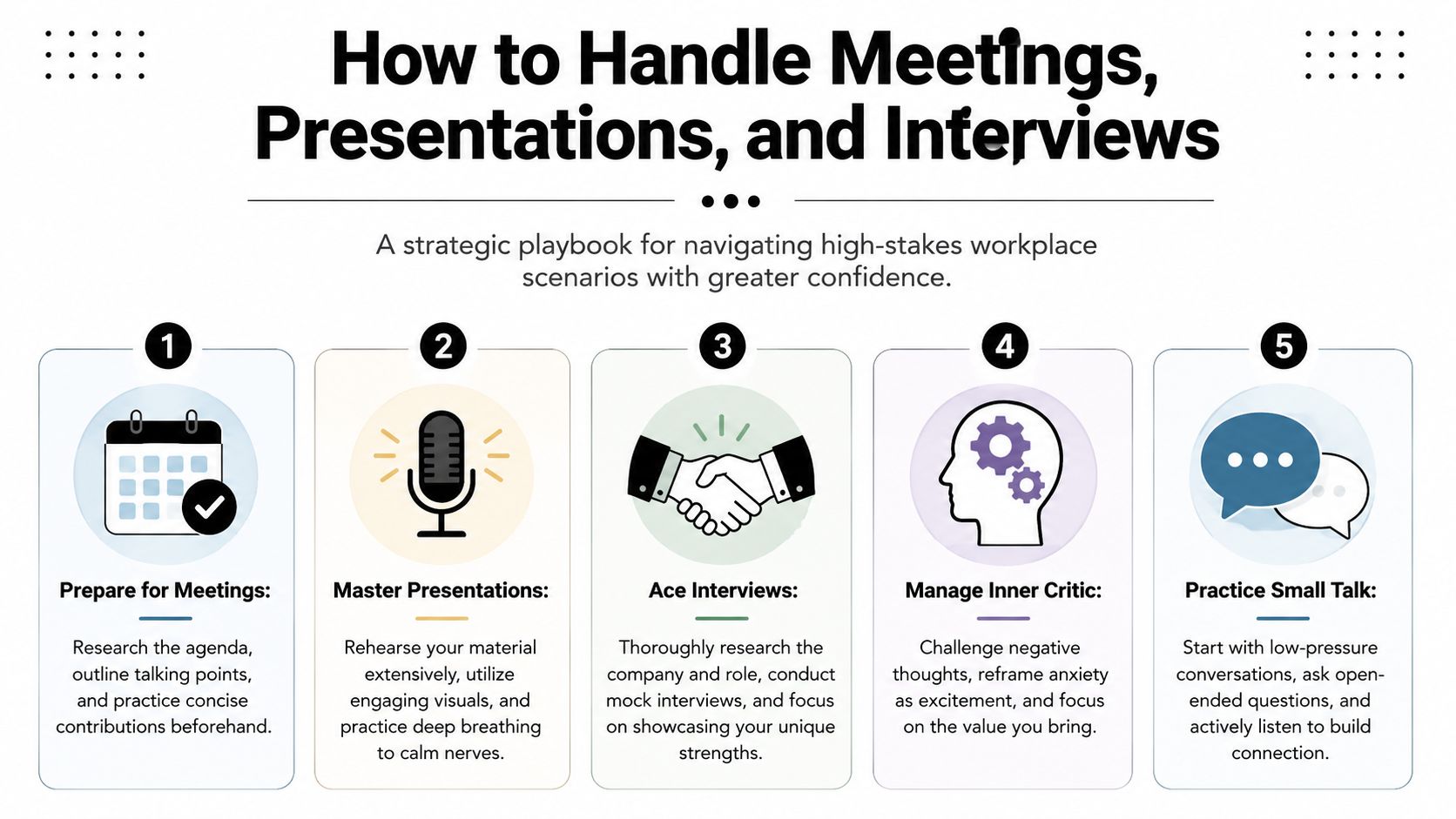
For meetings, don't aim to “speak naturally” if that phrase makes you freeze. Prepare one sentence, one question, and one supporting example in advance. That gives your brain a map. If you say only one prepared point, that still counts as progress.
For presentations, rehearse out loud. Silent practice isn't enough for an anxious nervous system. Practice with the slides visible, standing up if possible, and begin by slowing your first two sentences on purpose. Speech tends to accelerate under anxiety.
A short video can help you reset how you approach visible performance at work.
For interviews, reduce pressure by building stories ahead of time. Think of one challenge you handled, one conflict you resolved, one success you're proud of, and one example of learning from a mistake. You don't need perfect answers. You need a few reliable stories you can adapt.
Use this quick comparison:
When anxiety says: “I have to perform flawlessly.”
Try instead: “I need to be understandable, relevant, and steady enough.”
When anxiety says: “If I blush or shake, they'll write me off.”
Try instead: “Visible nerves are common. Clear communication matters more.”
When anxiety says: “If I stumble once, the whole thing is ruined.”
Try instead: “Most strong communicators recover in real time. Recovery is part of competence.”
Recovery is a workplace skill. You don't need zero anxiety to handle a high-stakes moment well.
Talking to Your Manager About Social Anxiety
Deciding whether to talk to a manager or HR about social anxiety can feel loaded. You may worry that disclosure will change how people see you. You may also know you'd function better with a few practical adjustments. Both concerns are valid.
Disclosure is a strategy, not a confession
Many people encounter a common sticking point regarding disclosure. They treat disclosure as an all-or-nothing emotional reveal. In reality, it can be a focused workplace conversation about what helps you do your job well.
The fear is common. A 2024 JAMA Psychiatry study found that 73% of employees with social anxiety feared disclosure would harm their career, while only 12% of companies had formal accommodation protocols for non-physical anxiety disorders, based on JAMA Psychiatry reporting on workplace mental health disclosure. That gap explains why the decision can feel so risky.
Before you disclose, ask yourself:
- What problem am I trying to solve? Maybe surprise presentations derail you, or verbal-only feedback leaves you flooded.
- Who is safest to approach? A direct manager, HR partner, or another supervisor may differ in discretion and empathy.
- What specific support would help? Concrete requests usually land better than broad statements.
What useful accommodations can look like
You don't have to share your entire history. Often, brief and practical works best. You can say that anxiety affects certain work situations and that specific adjustments would improve performance.
Examples of reasonable requests might include:
- Agendas in advance: Helpful when unpredictability triggers panic.
- Written follow-up: Useful if verbal feedback is hard to process in the moment.
- Gradual exposure to visibility: Starting with shorter presentations before larger ones.
- Flexible timing: Scheduling a difficult meeting at a time when you're more regulated.
- Remote or hybrid options for certain interactions: Sometimes a camera-off or remote format helps you contribute more effectively.
A simple script can help: “I do my best work when I can prepare for high-visibility interactions. It would help me to receive meeting agendas in advance and written follow-up on major feedback so I can respond thoughtfully.”
You may also need stronger day-to-day limits. These strategies for reducing anxiety through boundaries can help you think clearly about where preparation, availability, and emotional labor are becoming too costly.
Ask for support in terms of performance. That keeps the conversation grounded in work, not self-judgment.
Not every workplace will respond skillfully. That's painful, but it's useful information. If a manager dismisses reasonable, concrete requests, the issue isn't that your needs are illegitimate. It may be that the environment lacks maturity around mental health.
The Hopeful Path to a Panic-Free Career
You leave a meeting and feel the familiar surge. Your chest is tight, your mind starts replaying one sentence you wish you had said differently, and part of you wants to redesign your whole career around never feeling that exposed again. Many people call that a personality problem. It is usually a nervous system problem that can be treated.
Long-term relief starts when work stops revolving around avoidance. The goal is not to force yourself into constant confidence. The goal is to retrain your brain and body so visibility, evaluation, and small mistakes no longer register as emergencies.
Why treatment changes the pattern
Social anxiety responds well to treatment, especially approaches such as cognitive behavioral therapy and exposure-based work. Reviews from the National Institute for Health and Care Excellence guidance on social anxiety disorder support CBT as a first-line treatment because it helps change both the thinking habits and the alarm response that keep anxiety going.
CBT works like physical therapy for a threatened social brain. One part helps you catch distorted predictions, such as “If I stumble, everyone will notice and my credibility is gone.” Another part helps you test those predictions in real life, in planned steps, so your nervous system can learn from experience rather than fear.
That second part matters in high-stakes careers.
If you only wait to feel calm before speaking, presenting, leading, or interviewing, anxiety keeps setting the rules. Gradual exposure changes the rulebook. You practice tolerating eye contact, asking a question without over-rehearsing, giving a concise update, or presenting before you feel perfectly ready. With repetition, your body starts to file those moments under challenge instead of danger.
What healing often looks like at work
Healing at work often looks quiet before it looks dramatic. You spend less energy bracing. You recover faster after a visible moment. You make one mistake and keep going instead of treating it as proof that you should stay small forever.
A major turning point is learning how to overcome fear of fear. In many careers, the hardest part is not only the meeting, interview, or presentation. It is the terror of the physical sensations themselves. Once your brain learns that a racing heart, shaky voice, or hot face is uncomfortable rather than dangerous, your options widen.
Progress often shows up as:
- Faster recovery: an awkward comment no longer ruins the rest of the day
- Less avoidance: you stop building your schedule around escape routes
- Clearer thinking: discomfort stops masquerading as evidence of incompetence
- More career range: you can pursue leadership, visibility, or stretch roles with support and practice
- Better self-trust: you know anxiety can rise and fall without controlling your decisions
This is also why workplace systems matter. Personal coping skills help, but they work best inside an environment that supports sustainable performance. If you are rebuilding confidence in a demanding role, habits that support sleep, pacing, recovery, and realistic expectations create real workplace wellness for lasting impact.
A panic-free career means something simple and powerful. Panic stops being the architect of your choices. You can still feel activated sometimes, especially in meaningful roles, but you are no longer organizing your future around hiding. Healing is achievable, and at work it often looks like freedom in small, repeatable moments.
Your Next Steps and Where to Find Support
If you've recognized yourself in these patterns, take that seriously and kindly. Social anxiety and work can distort how you see your competence, but it doesn't erase your strengths. You may be thoughtful, perceptive, diligent, creative, and highly capable. Anxiety has been interrupting your access to those qualities under pressure.
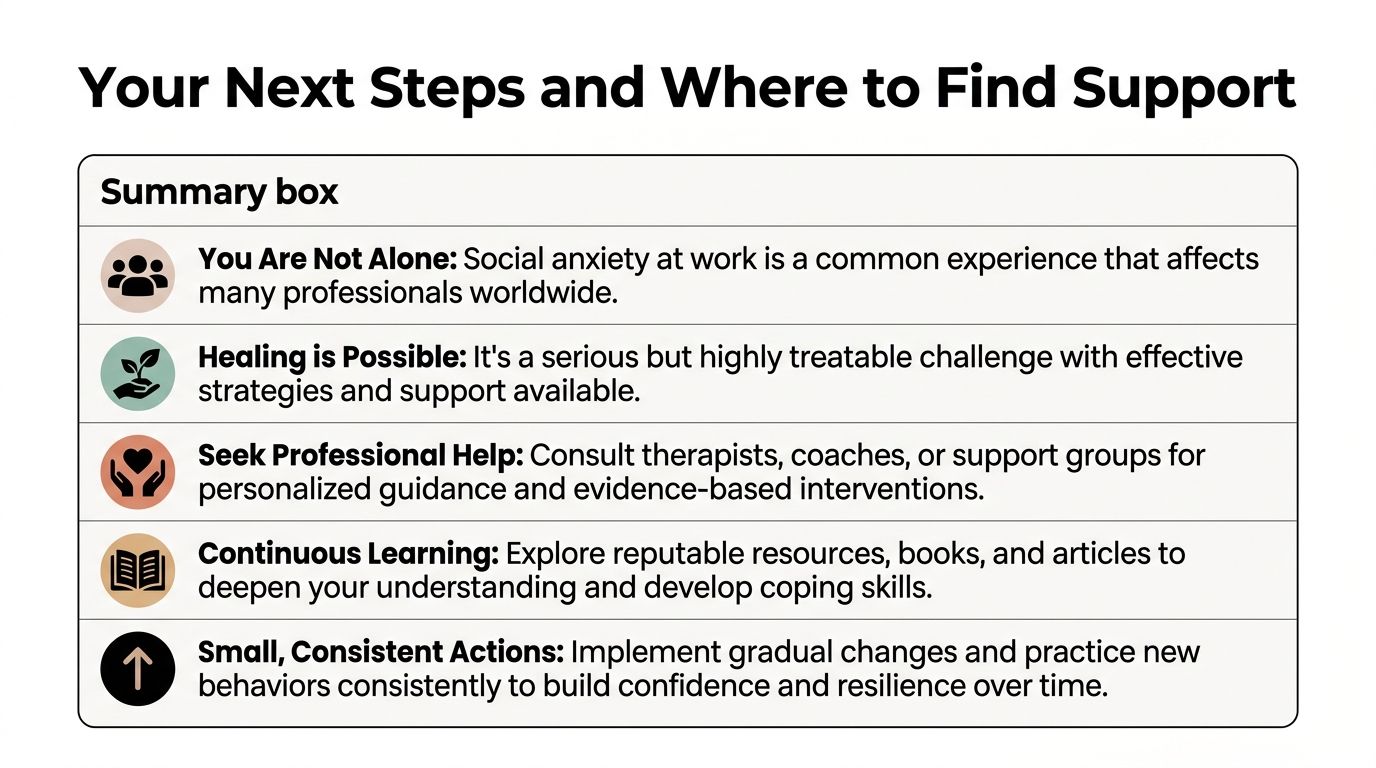
A simple plan for this week
Pick one small work situation to practice differently. Not your hardest one. Choose something that stretches you without overwhelming you, such as speaking once in a meeting, sending an email without endless editing, or asking one question instead of staying silent.
Then add support around that step:
- Write a coping card: one sentence you can read before a stressful interaction
- Prepare one exposure goal: a small action that moves toward visibility
- Track one win: not perfection, just evidence that you showed up differently
Helpful resources and supportive allies
Professional support can make a major difference, especially with a therapist trained in CBT and exposure-based work. National organizations such as ADAA and NAMI can help you learn more and locate support options. If you're a manager, partner, or friend, your role isn't to force confidence. It's to reduce shame, respect pacing, and support consistent practice.
It also helps to improve the environment around the person, not just the person themselves. If you're looking for broader ideas on creating real workplace wellness for lasting impact, that guide offers practical ways to make work feel more supportive and sustainable.
Healing is possible. Not in a vague, motivational-poster sense. In a practical sense that people learn new patterns, retrain stressed nervous systems, and build work lives that feel livable again.
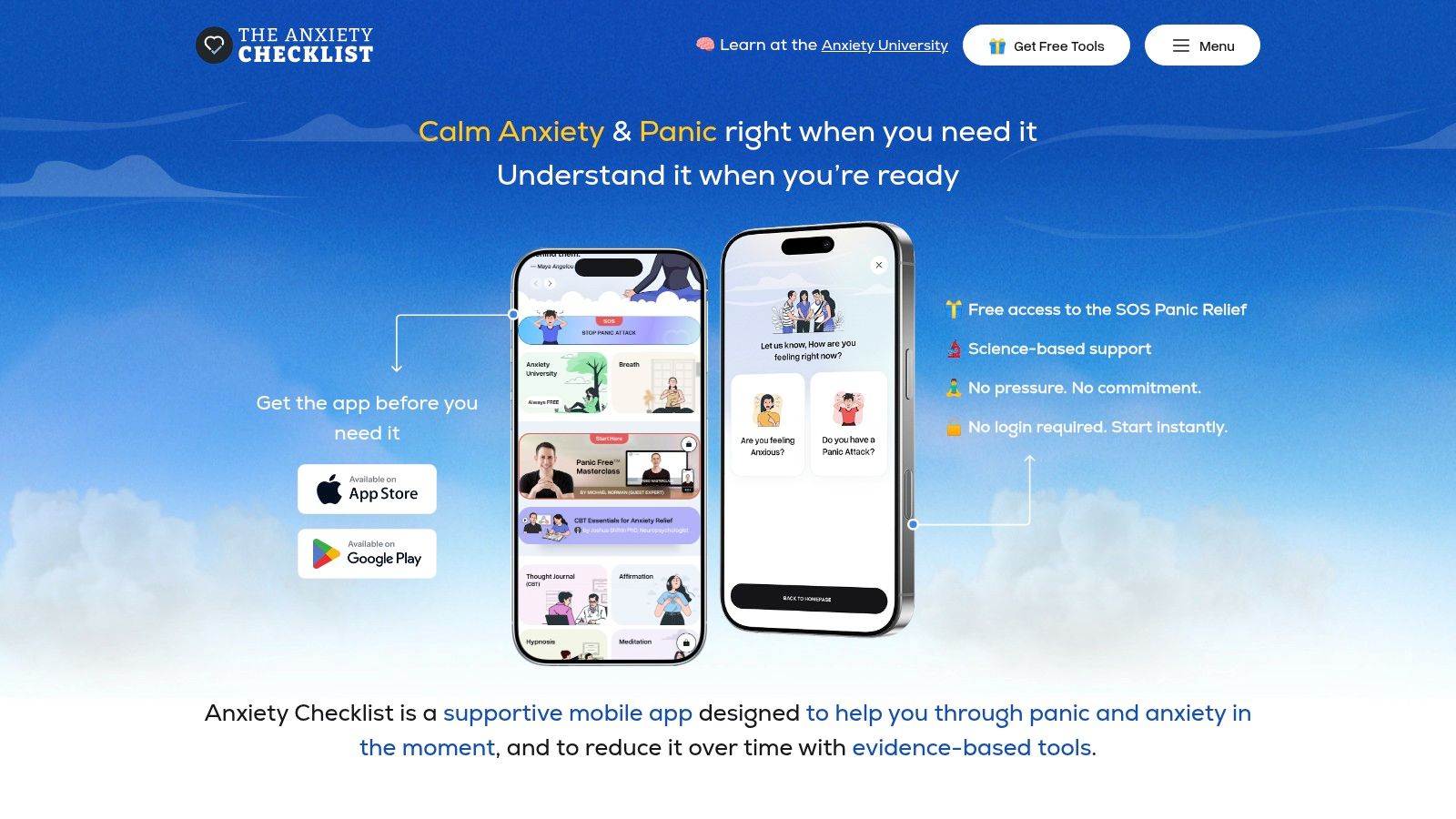
If you want practical help between therapy sessions or while you're starting on your own, The Anxiety Checklist offers immediate support for panic and longer-term tools for change. Its free SOS mode can guide you through grounding and calming prompts when anxiety spikes at work, and its deeper features include CBT self-therapy tools, guided meditations, sleep audios, hypnosis, exposure exercises, and expert-led education. It's a gentle place to begin if you're ready to move from surviving work to feeling safe in it again.