

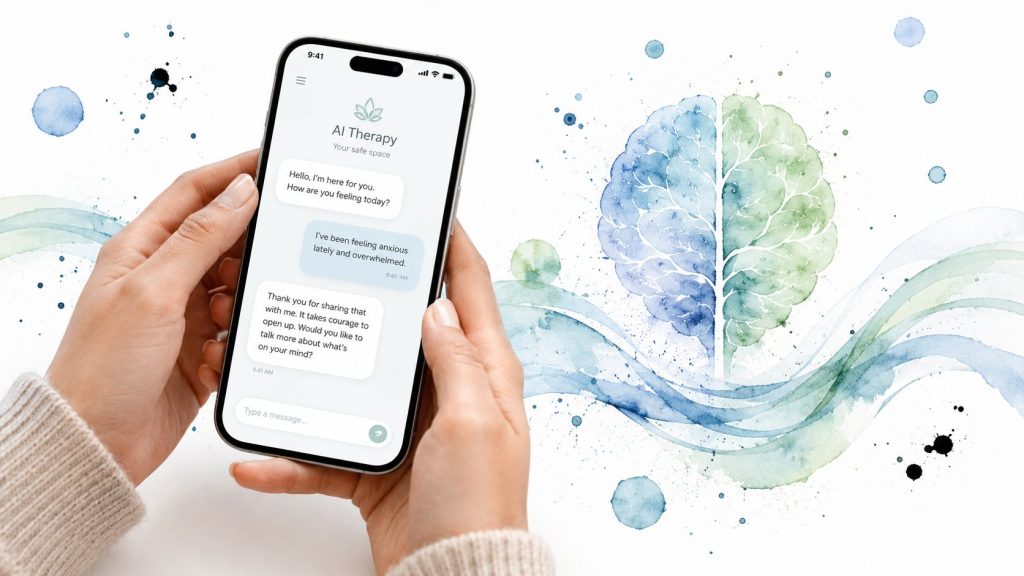
Can an AI app help you heal from anxiety enough to live with fewer panic spirals, or can it only help you get through the next hard hour?
That is the question that matters, and it is the standard used here. Plenty of roundups compare chat quality, journaling prompts, and subscription tiers. Far fewer ask whether a tool helps someone interrupt avoidance, practice steadier coping, and build a life that is not organized around fear.
AI support for mental health is now common enough that it deserves a more careful review than hype or dismissal. People are already using these tools for anxiety, emotional reflection, and day-to-day regulation, especially younger users. Use is growing. Safety, fit, and limits matter just as much.
From a clinical and practical standpoint, the best AI therapy apps are rarely complete treatment on their own. They tend to help most when they reinforce evidence-based skills such as grounding, cognitive reframing, mood tracking, exposure practice, and consistent reflection between therapy sessions. They help less when they offer soothing conversation without any path toward behavior change, panic recovery, or human follow-up when symptoms are escalating.
That trade-off matters for anyone trying to heal from anxiety rather than feel reassured in the moment.
Some tools are strong for daily check-ins and symptom awareness. Others fit better inside a therapist-guided plan, a clinic, or an employer benefit. A few are useful for identifying panic triggers and patterns over time. Some are warm and engaging but too generic to support meaningful recovery if panic attacks, agoraphobia, health anxiety, or trauma-related symptoms are driving the problem.
For readers comparing options, it helps to pair app reviews with other mental health tools for anxiety and, when needed, licensed care. The goal is not to replace therapists, psychiatrists, or trusted support. The goal is to use AI well, with clear expectations, so it can reduce friction, support practice, and help more people move toward a calmer, more panic-free life.
Table of Contents
- 1. Wysa
- 2. Limbic
- 3. Tess by X2AI
- 4. Elomia
- 5. Earkick
- 6. Pi
- 7. Twill
- 8. Koko
- 9. Stoic
- 10. Tharros
- Top 10 AI Therapy Apps, Feature & Use Case Comparison
- Final Thoughts
1. Wysa
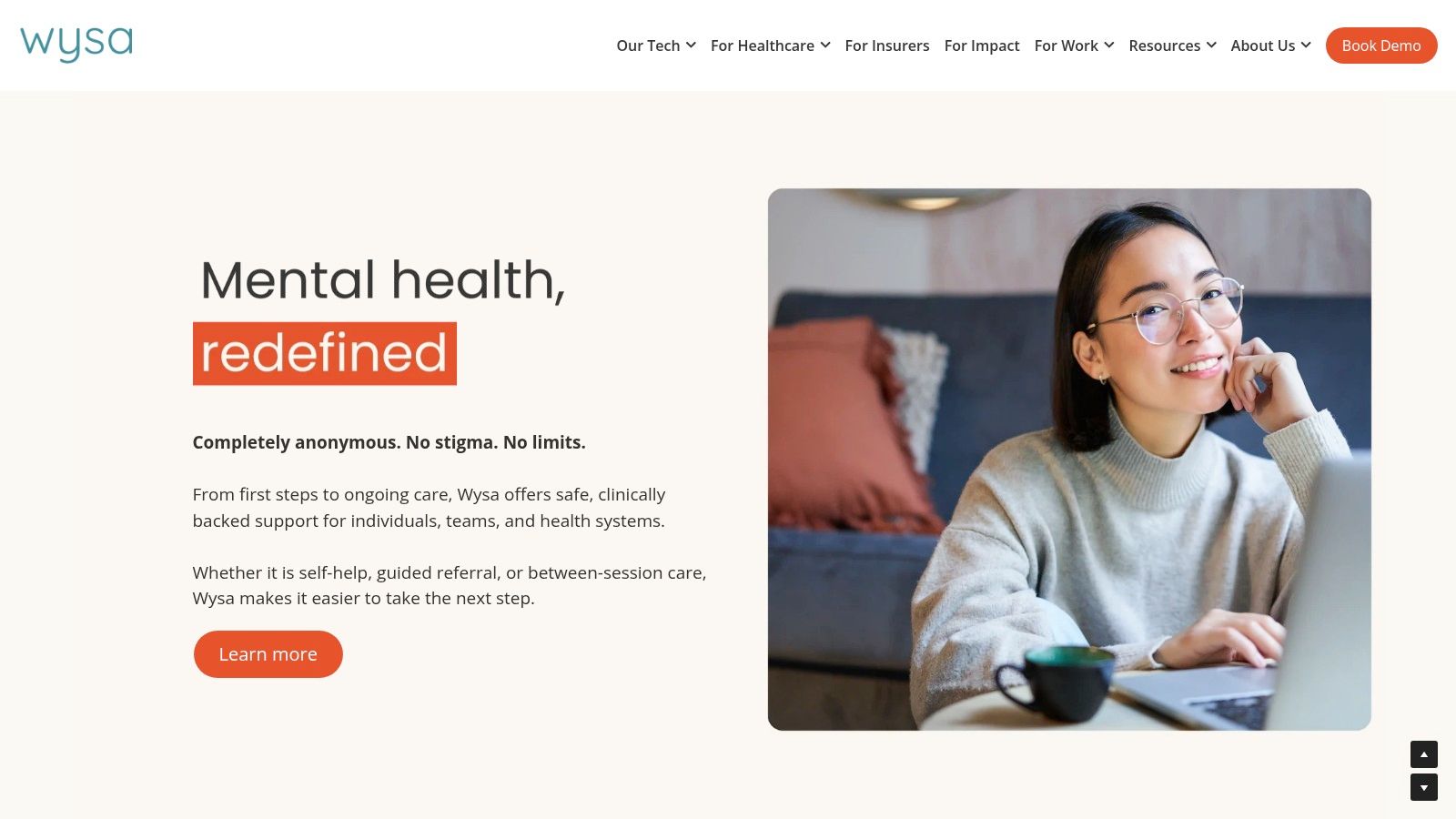
Wysa is one of the strongest picks if you want a mature, therapy-inspired app that doesn't feel flimsy. It offers an AI coach with CBT-style exercises, DBT techniques, mindfulness tools, journaling, and optional human support through some programs. You can explore it directly at the Wysa website.
What I like most about Wysa is that it gives anxious users something to do, not just somewhere to vent. That matters. Healing from anxiety usually requires repetition, structure, and learning how to respond differently when your body sounds the alarm.
Where Wysa helps most
Wysa is especially useful for everyday check-ins, racing thoughts, sleep-related stress, and post-panic decompression. It tends to work best for people who want guided self-help between therapy sessions, or as a starting point when they're not ready to talk to a person yet.
A few practical strengths stand out:
- Strong coping library: It combines chat with structured exercises, which is better than endless unstructured reassurance.
- Good daily usability: It's available around the clock, so you can use it when anxiety spikes at night or during a workday.
- Clear self-help role: It fits well alongside other mental health tools for anxiety.
Practical rule: Use Wysa to practice skills repeatedly. Don't use it to decide whether severe symptoms are “serious enough” to ignore.
The trade-off is simple. Wysa can support recovery habits, but it isn't licensed therapy, and it can't replace a clinician for diagnostic clarity, trauma work, or crisis assessment. If your anxiety is tied to panic disorder, agoraphobia, trauma, or worsening depression, Wysa makes more sense as part of a broader plan than as the whole plan.
2. Limbic
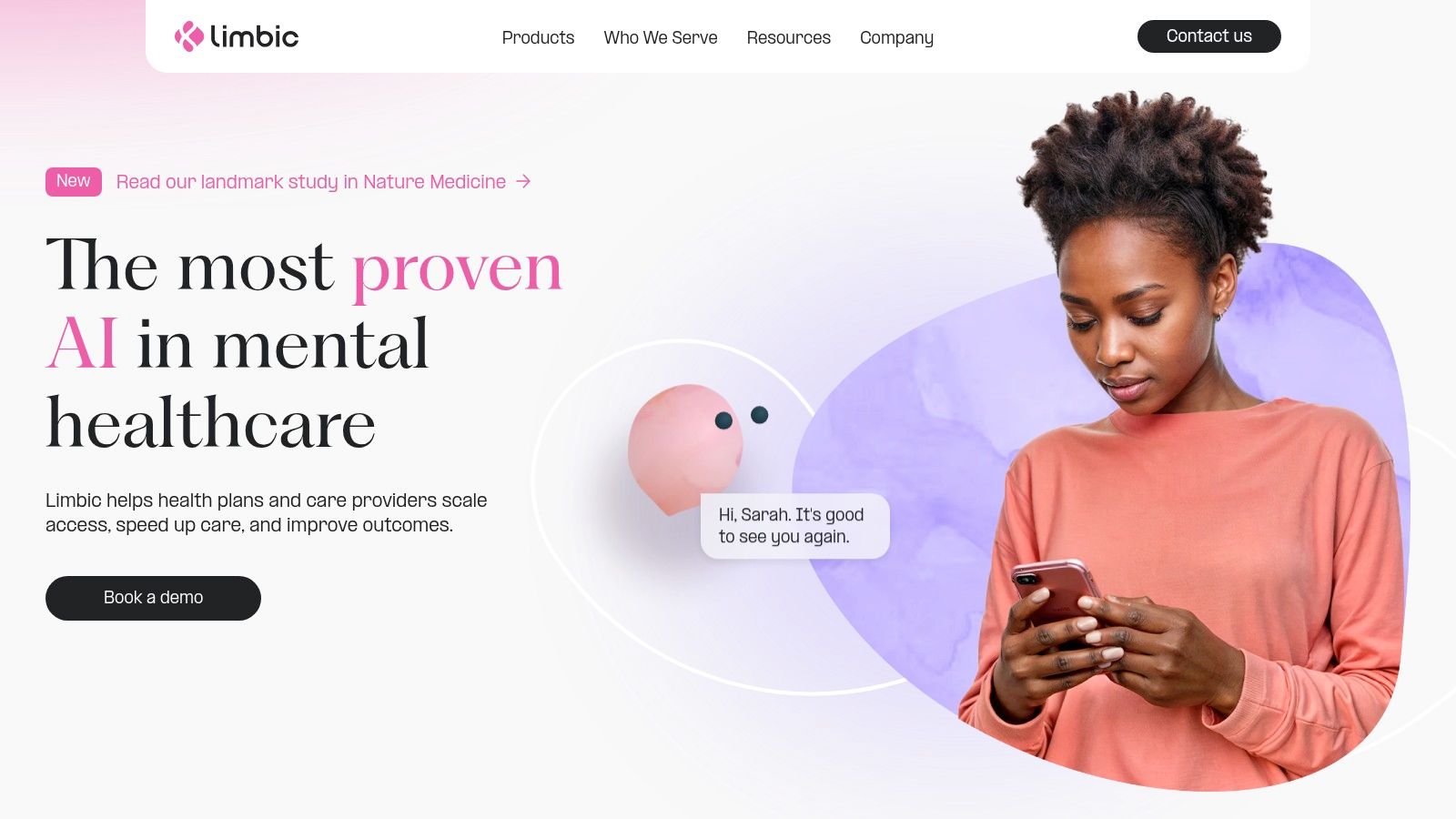
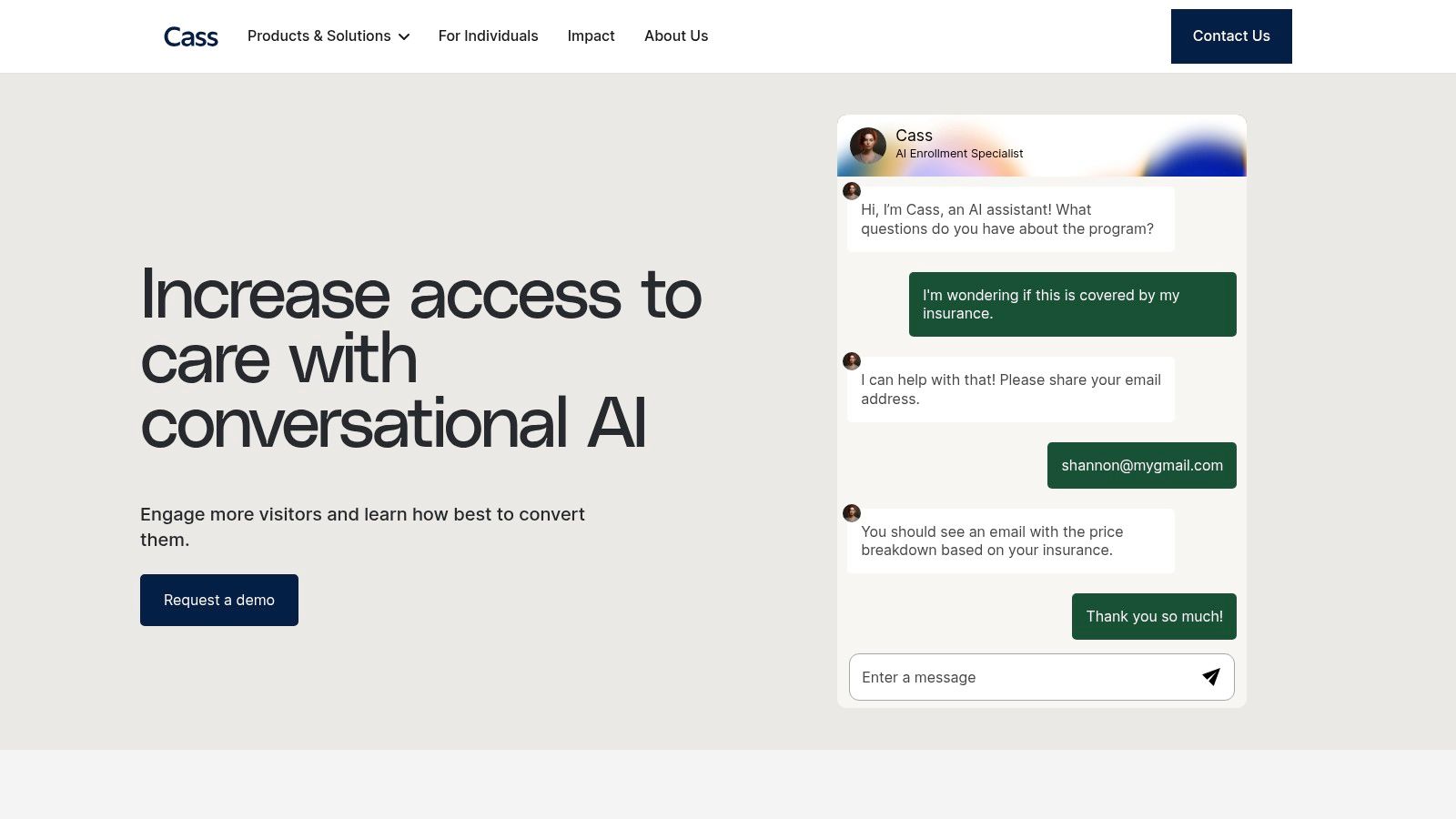
Limbic isn't really for someone browsing the app store at 2 a.m. looking for help. It's built for healthcare systems. Its products, including Limbic Access and Limbic Care, focus on intake, assessment support, and on-demand patient support inside regulated care settings. You can learn more through the Limbic platform.
That makes it one of the more serious entries in this space. If your goal is safe integration with human treatment, Limbic deserves attention because it was designed around provider workflows instead of direct-to-consumer convenience.
Best fit
Limbic makes the most sense when a clinic, health service, or provider group wants patients to have support between appointments without pretending AI is the therapist. That distinction matters for anxiety care. Many people need help with triage, reflection, and continuity, but they also need a human team involved.
Its strengths are practical:
- Provider-centered design: It helps clinicians gather information and extend support beyond the session.
- Healthcare alignment: It's built for regulated environments rather than casual wellness use.
- Better hybrid potential: It can reinforce treatment instead of competing with it.
A limitation is also obvious. If you're an individual reader hoping to download something directly, Limbic probably won't be accessible unless your provider already uses it.
When AI sits inside a clinical relationship, it usually becomes more useful and less confusing.
That's why I'd place Limbic high for systems of care and much lower for independent self-help seekers. It's not the best AI therapy option for casual personal use. It is one of the better models for how AI can support anxiety treatment without overselling what a chatbot can do alone.
3. Tess by X2AI
Tess has been around long enough to feel different from the newer wave of AI companions. It was designed with clinical input and often reaches people through schools, employers, and organizations rather than traditional consumer app channels. You can review the platform at X2AI's Tess page.
Its core appeal is access. Tess can work through SMS and web, which lowers the barrier for users who don't want another app, don't have much phone storage, or prefer lightweight text support.
Why Tess stands out
Tess is a strong option for brief, therapy-inspired interactions during the day. For anxious users, that can be helpful when the need is a fast check-in, a grounding prompt, or a simple cognitive reframe before worry grows legs.
What works well:
- Low friction delivery: SMS support can feel easier to use than opening a full mental health app.
- Multilingual potential: That broadens reach in organizational settings.
- Short interaction design: Good for people who freeze when faced with long exercises.
Where it falls short is depth. Tess is not the tool I'd choose for someone trying to systematically reduce panic disorder through exposure work or to untangle long-standing avoidance patterns. It helps at the micro level. It doesn't usually serve as a full recovery framework.
A broader challenge across the category is that coverage and adaptation in diverse populations remain uneven. Reviews of AI therapy tools have noted limited independent evidence about language coverage, cultural adaptation, and effectiveness across different real-world settings. That matters when a platform is presented as widely accessible.
Tess is at its best when you need support to feel possible, immediate, and light enough to use.
4. Elomia
Can a gentler AI conversation help you heal anxiety, or does it only make hard feelings easier to avoid for a while?
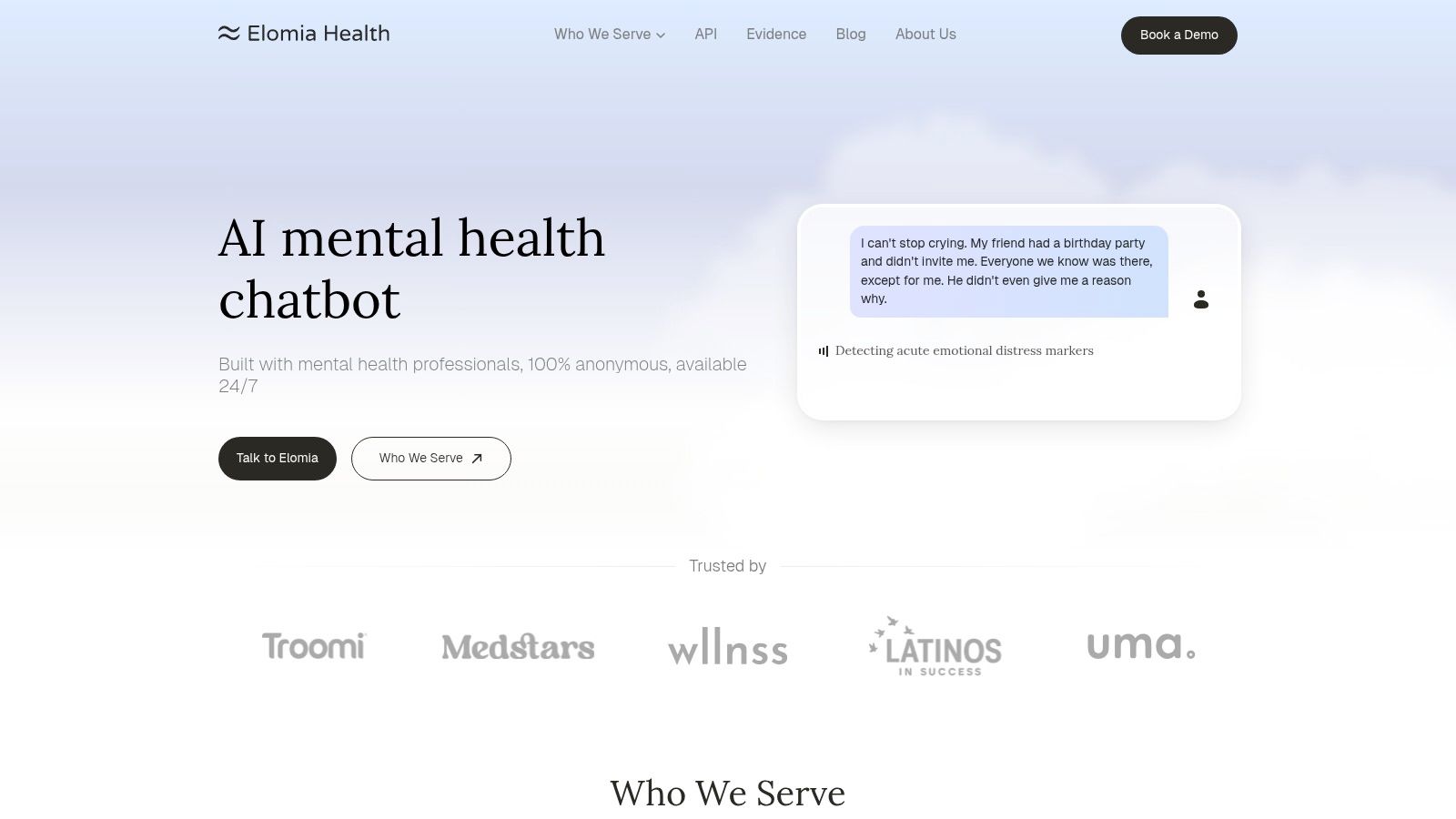
Elomia sits in that tension. It is a consumer-facing AI mental health app with a warm, reflective style built around emotional check-ins, stress support, low mood, and therapy-like prompts. If you want to explore it directly, visit Elomia.
For anxiety recovery, Elomia's main value is not crisis handling or a structured panic treatment plan. Its value is helping people slow down, name what they are feeling, and interrupt spirals before they become a full day of rumination. That can matter a lot for someone who lives in anticipatory anxiety, self-criticism, or constant mental rehearsal of worst-case scenarios.
Where it helps, and where it does not
Elomia is often most useful between therapy sessions, during lonely hours, or in periods when emotions feel loud but not dangerous. I would place it in the support layer of care, not the treatment core, for anyone whose goal is lasting relief from panic.
What it does well:
- Encourages reflection: The conversational format can make it easier to put vague distress into words.
- Offers support on demand: That matters when anxiety spikes at night or outside office hours.
- Feels less clinical: Some users open up more when the tone feels calm and human-centered.
The trade-off is depth and safety boundaries. A reflective chatbot can soothe, but soothing is not the same as recovery. People who want to live panic-free usually need more than emotional validation. They often need skills practice, behavior change, and at times licensed care that can assess severity, avoidance, trauma history, medication questions, and risk.
That is the key lens I would use with Elomia. It may help you feel more regulated in the moment and more aware of your patterns over time. It is a reasonable companion tool for anxious users who freeze up with harsher or more clinical apps. It should not be the place where you decide, by yourself, whether escalating panic, depression, trauma symptoms, or safety concerns can wait. For those situations, human assessment is still the safer choice.
5. Earkick
If your anxiety tends to feel physical, sudden, and pattern-based, Earkick is one of the more practical tools on this list. It focuses on tracking, fast interventions, grounding tools, and wearable support rather than trying to simulate deep therapy. You can find it at Earkick.
That makes it especially relevant for panic-prone users. Panic recovery improves when you can catch patterns early, notice triggers, and build confidence in your ability to move through activation without immediately escaping it.
Best for panic pattern awareness
Earkick's best feature set is its immediate utility. Mood tracking, quick check-ins, grounding audio, and a panic button flow give anxious users something concrete when their thinking gets noisy.
Here's where it earns its spot:
- Fast support: It's useful when you need a tool in the moment, not an essay.
- Wearable access: Apple Watch support can reduce the steps between panic and intervention.
- Tracking helps behavior change: Seeing trends can help you identify sleep issues, social triggers, or recurring avoidance loops.
Its weakness is that it may support symptom management more than full recovery work unless you use it deliberately. Tracking alone doesn't heal anxiety. It helps when the data leads to different choices.
Large randomized trials do suggest structured AI mental health interventions can reduce anxiety and depressive symptoms meaningfully over time. One trial involving a generative-AI-powered mental health app with over 1,100 participants found statistically significant and clinically meaningful decreases in anxiety and depressive symptoms. That's encouraging, but the true benefit still depends on consistent use.
Earkick is strongest when you want to interrupt panic quickly and learn from the pattern afterward.
6. Pi
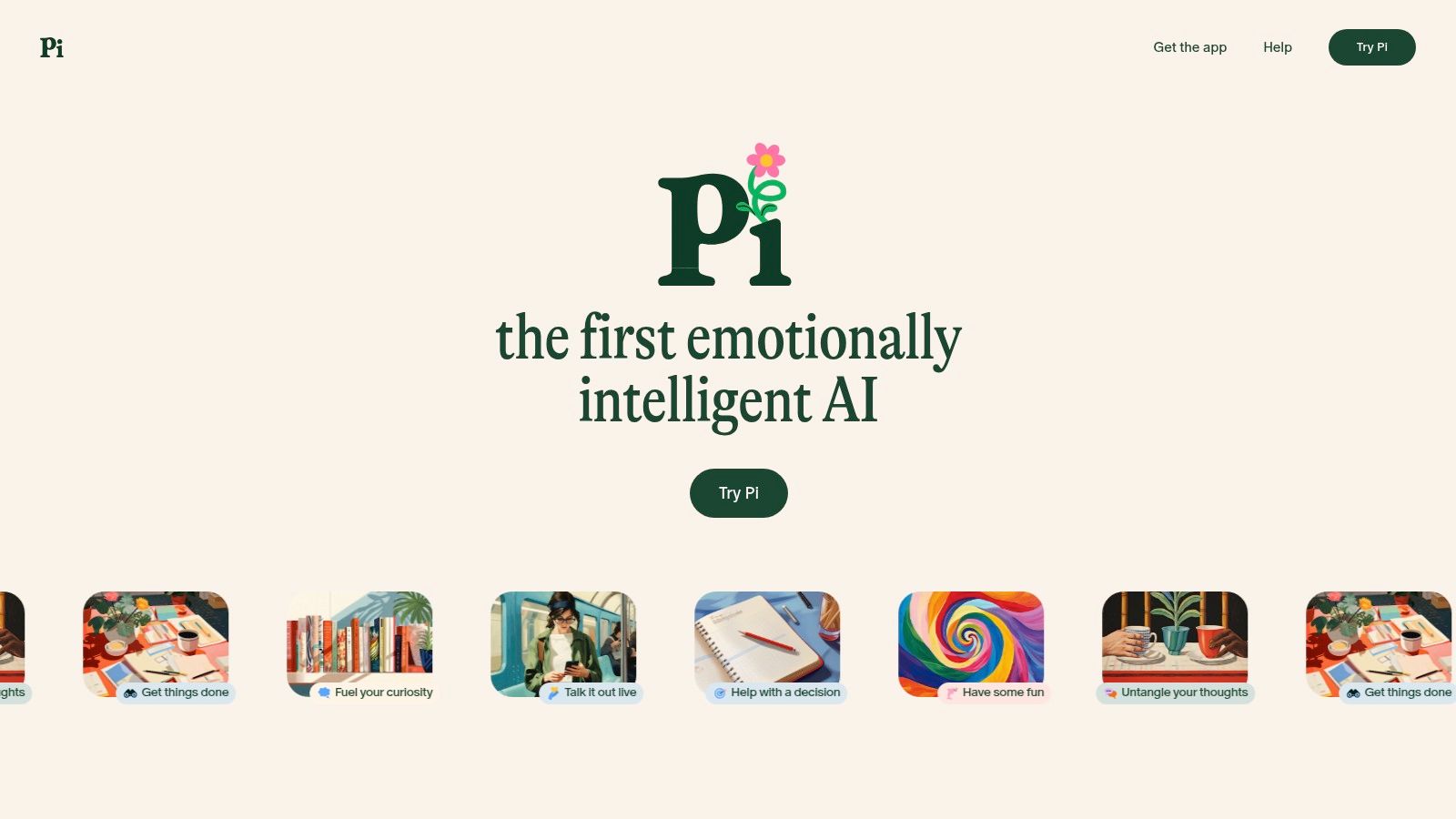
Pi is not a therapy app, and that's important to say plainly. It's a conversational AI companion with an emotionally supportive tone, available through text and voice, and many people use it for reflection, decompression, and everyday emotional support. The official product is Pi by Inflection AI.
Pi is often better than people expect for organizing anxious thoughts. It can help you slow down, hear yourself think, and turn a blurry sense of dread into something more specific and workable.
Where Pi helps and where it doesn't
Pi is a good companion for overthinking, social replay, decision spirals, and the need to talk something through without feeling judged. If anxiety makes your mind loop, it can pair well with structured resources on how to stop overthinking and worrying.
That said, Pi has clear limits:
- Good emotional tone: It often feels warm and easy to talk to.
- Low-friction use: Free to start and available across devices.
- Not treatment-specific: It doesn't give you a panic recovery program, an exposure ladder, or a clinical care pathway.
If you also struggle with motivation and executive function, some people pair reflective tools like Pi with behavior-focused apps outside the anxiety category, such as these best ADHD motivation apps, to create more structure around daily follow-through.
Use Pi for perspective. Don't expect it to run your recovery plan for you.
Pi belongs on a best AI therapy list because people do use it that way. But I'd classify it as a supportive companion, not a therapy substitute. It helps most when it sits beside real coping skills, not in place of them.
7. Twill
Twill, including Happify by Twill, takes a broader programmatic approach than a pure chatbot. It combines evidence-based activities with AI-personalized sequencing, and it's often delivered through employers or health plans. You can review it at Happify by Twill.
This style won't appeal to everyone. Some users want a conversational tool. Others do better with structured activities, guided modules, and a clearer path through CBT-informed exercises. Twill is stronger for the second group.
Best for structured support at scale
Twill is useful when anxiety is part of a larger daily health burden and you need a system that supports repeated skill practice. It's less intimate than a companion chatbot, but that can help some people stay focused.
Its main advantages include:
- Evidence-based activity design: Stronger for users who want to do exercises, not just chat.
- Benefits integration: Helpful when access comes through a plan or employer.
- Broader learning path: It can complement anxiety learning resources for people who want education alongside tools.
A market-level signal supports why platforms like this keep expanding. Future Market Insights projects the AI-powered behavioral therapy market to grow from USD 992.1 million in 2025 to USD 2.74 billion by 2035 at a 10.7% CAGR. That doesn't prove any single app is best, but it does show sustained demand for scalable, self-guided support.
Twill's biggest drawback is access. If your employer or plan doesn't offer it, you may not be able to use the version that makes it most valuable.
8. Koko
Need support from a real person, but not ready for therapy or able to pay for it? Koko offers a different path. It is a non-profit, free platform built around anonymous peer support, with AI used in the background for safety and triage rather than as the main source of care. You can access it through Koko Cares.
For anxiety, that distinction matters. People working toward fewer panic spirals often need more than advice. They need to feel less alone in the moment. Koko can help with that early step, especially for users who would never open a traditional therapy app, book a session, or put their name on a mental health platform.
Best for immediate human connection without cost
Koko is most useful when anxiety is rising and the first need is simple human contact. A brief, thoughtful reply from another person can interrupt isolation, lower shame, and make it easier to choose the next safe step, whether that is breathing through a surge, reaching out to a clinician, or using a structured tool later.
Its strengths are practical:
- Peer response instead of pure chatbot output: Helpful for users who calm down when another person acknowledges what they are feeling.
- Anonymous access: A strong fit for shame-heavy anxiety, social fear, or people testing support for the first time.
- Safety-focused design: Better contained than posting into random forums or unmoderated social feeds.
There are trade-offs. Peer support can be comforting, but it is inconsistent by nature. Replies vary in depth, timing, and usefulness. Koko also does not replace panic-focused treatment, medication management, or a therapist who can assess avoidance patterns, trauma history, or worsening symptoms over time.
I see Koko as a bridge tool. It can reduce the loneliness that keeps anxiety stuck, but it works best when paired with a broader plan for healing. If panic is tied to attachment distress or being by yourself, it may sit alongside resources on coping with fear of being alone while you build more stable support.
For the right user, that is meaningful progress. Free, anonymous, human-centered help can be the first step toward feeling safer, seeking proper care, and eventually living with much less fear.
9. Stoic
Stoic approaches the problem from a mental fitness angle rather than a clinical treatment angle. It offers guided journaling, daily prompts, habit-building routines, and an AI coach that helps unpack thoughts in a CBT-inspired way. The product is available at Stoic.
That positioning is both its strength and its limitation. If your anxiety responds well to routine, reflection, and small daily resets, Stoic can be excellent. If you need targeted panic treatment, it may feel too general.
Best for consistency over intensity
Stoic is one of the better tools for people who know what helps them but struggle to do it regularly. Instead of waiting for a crisis, it nudges you into a daily rhythm of noticing thoughts, reframing them, and building steadier habits.
A few reasons it works:
- Polished journaling flow: Easier to sustain than blank-page reflection.
- Good for skill repetition: Helpful for users practicing CBT basics.
- Routine-friendly: Strong fit for prevention and maintenance.
The downside is that “mental fitness” can be too soft a frame for people with severe anxiety. There's a risk in using a smooth daily wellness tool to avoid admitting that symptoms have become disruptive and need more formal treatment.
Still, not every anxious person needs an intense intervention every day. Sometimes the best AI therapy option is the one you'll return to consistently, especially when the goal is to keep your nervous system from escalating in the first place.
10. Tharros
What if the best AI therapy tool for panic is not the one that calms you fastest, but the one that helps you stop shrinking your life?
Tharros earns its place on this list because it targets a specific anxiety pattern: panic reinforced by avoidance. The app centers on CBT and exposure-based practice, with fear ladders, in-the-moment coaching, and post-exposure reflection. You can explore it at Tharros.
That focus matters. Someone trying to live panic-free often needs more than reassurance. They need help re-entering places, sensations, and situations their nervous system has labeled unsafe. Tharros is built around that job.
Best for panic tied to avoidance and agoraphobia
I see the strongest fit for Tharros in people who already recognize the pattern. They avoid driving, standing in line, entering crowded stores, taking public transit, or being far from home because panic might happen there. For that user, an exposure-oriented app can be more useful than a general AI companion that mainly offers comfort.
Its strengths are practical:
- Exposure-based structure: Fear ladders give users a graded plan instead of vague advice to “face fears.”
- Panic-specific use case: Better match for agoraphobia and panic loops than broad mood or journaling apps.
- Action after anxiety: Debriefs can help users notice what happened, which is often less catastrophic than the mind predicted.
There is a real trade-off. Exposure work can be highly effective, but it is also easy to do poorly if someone goes too fast, uses the app as a safety behavior, or has symptoms severe enough to need clinician guidance. As noted earlier in the article, one concern with AI mental health tools is that symptom management can sometimes delay appropriate human care. Tharros partly addresses that risk by focusing on approach rather than retreat, but it is still a newer tool with limited third-party validation.
For readers whose panic has turned into fear of the sensations themselves, it helps to pair exposure practice with education on how to overcome fear of fear. That combination often makes the process feel less punishing and more understandable.
Tharros is not the best choice for every anxious user. It is one of the more hopeful options for people who want to break the avoidance cycle, regain range, and work toward a life that is not organized around the next panic attack.
Top 10 AI Therapy Apps, Feature & Use Case Comparison
| Product | Core features ✨ | UX / Quality ★ | Target 👥 | Price / Value 💰 | USP 🏆 |
|---|---|---|---|---|---|
| Wysa | 24/7 AI coach, CBT/DBT exercises, journaling, optional human coaching | ★★★★ evidence-based, polished | 👥 Consumers, health systems | 💰 Freemium; paid coaching/subscription | 🏆 Long-standing, clinically validated AI tools |
| Limbic (Access/Care) | AI intake & assessments, on-demand patient companion, provider integrations | ★★★★★ clinical-grade safety & outcomes | 👥 Clinicians, healthcare orgs | 💰 B2B / enterprise contracts only | 🏆 Built for regulated healthcare with validated safety |
| Tess (X2AI) | SMS/web therapy-inspired micro-chats, multilingual, org deployments | ★★★ lightweight, clinically informed | 👥 Schools, employers, organizations | 💰 Org-sponsored / enterprise pricing | 🏆 Extremely accessible SMS delivery (no app needed) |
| Elomia | 24/7 therapy-style chat, personalized content & affirmations | ★★★ approachable, privacy-focused | 👥 Consumers seeking on-demand reflection | 💰 Subscription (pricing after signup) | 🏆 Personalized therapy-style prompts and resources |
| Earkick | Anxiety tracking, panic button, grounding audio, Apple Watch support | ★★★★ practical, fast interventions | 👥 Users needing panic relief & tracking | 💰 App-store subscription (varies by region) | 🏆 Wearable integration + panic-button for in-the-moment aid |
| Pi (Inflection AI) | Natural supportive chat (text & voice), reminders, mobile apps | ★★★ empathetic, very conversational | 👥 Casual users for reflection & debriefs | 💰 Free to start | 🏆 Highly natural, voice & text companion experience |
| Twill (Happify by Twill) | CBT/mindfulness activities, AI-personalized care paths, enterprise integration | ★★★★ evidence-backed, scalable | 👥 Employers, health plans, population health | 💰 Employer/health-plan provision | 🏆 Large evidence-based content library + personalization |
| Koko (non-profit) | Anonymous peer replies, mini CBT courses, AI safety & crisis links | ★★★ free, safety-minded design | 👥 Youth & young adults, low-barrier seekers | 💰 Always free (non-profit) | 🏆 Free anonymous peer support across messaging platforms |
| Stoic, AI Mental Fitness | Guided journaling, CBT reframes, daily routines & habits | ★★★★ polished UX, habit-oriented | 👥 Mental-fitness & habit-builders | 💰 Freemium; premium features paid | 🏆 Structured daily routines for resilience practice |
| Tharros, Panic/Agoraphobia Coach | Personalized exposure ladders, in-the-moment coaching, progress tracking | ★★★★ niche, goal-oriented | 👥 Users working on panic & agoraphobia | 💰 Paid app (niche offering) | 🏆 Focused CBT/ERP exposure workflows for avoidance change |
Final Thoughts
What helps someone heal from anxiety and live more panic-free. The most human-sounding chatbot, or the tool that reliably supports better habits, calmer body responses, and less avoidance?
For that goal, usefulness matters more than novelty. The right AI therapy tool should help in one of three ways: lower distress in the moment, support skill practice between episodes, or make it easier to stay engaged with human care. The strongest options in this list do at least one of those jobs well. A few do two.
That distinction matters. Anxiety recovery usually comes from repetition, not insight alone. People improve by catching spirals earlier, practicing grounding and cognitive skills often, and reducing avoidance in small, tolerable steps. An app can support that process. It cannot assess risk, build a full case formulation, or replace a good therapist when panic is severe, trauma is active, or daily functioning is dropping.
Each tool here fits a different stage of recovery. Wysa works well for structured self-help. Earkick is practical during panic spikes and useful for tracking patterns over time. Stoic helps people who benefit from routine. Pi can be a decent outlet for reflection, though warmth is not the same as treatment. Twill and Limbic make more sense inside a care system, where clinicians or health plans can add context and follow-through. Koko offers low-barrier human connection. Tharros stands out for people trying to reverse panic-driven avoidance, which is often the turning point in getting life back.
I'm optimistic, with guardrails.
AI can help people start sooner, especially when shame, cost, isolation, or exhaustion make traditional therapy feel out of reach. It can also keep treatment alive between sessions by prompting practice on ordinary days, which is where a lot of anxiety recovery is won. But the trade-off is real: fast comfort can become another form of avoidance if a tool only soothes and never helps you face feared situations safely.
A good rule is simple. Use AI for coaching, structure, journaling, grounding, and between-session support. Use human care for diagnosis, risk assessment, exposure planning when symptoms are intense, trauma work, medication decisions, and any situation involving suicidality or major impairment.
Healing from anxiety rarely comes from one perfect app. It comes from a good fit, steady practice, and the judgment to add human support when the problem is bigger than self-help. That combination gives many people their best chance of feeling safer in their body, less trapped by fear, and more able to live without constant panic.
If you want an option built specifically for calming panic in real time and supporting long-term anxiety recovery, try The Anxiety Checklist. It offers an always-free SOS mode, grounding tools, affirmations, CBT self-therapy exercises, exposure support, guided audios, and expert-led education, all in a format designed to help you feel safer in your body and steadier in daily life.