



You may have arrived here after another exhausting loop. A disturbing thought shows up out of nowhere, your body reacts as if there is danger, and then you feel pulled to do something that will make the fear settle down. You might check, wash, avoid, confess, count, pray, replay a memory, search online, or ask someone to reassure you. The relief is real, but it rarely lasts.
That experience can make people question themselves in painful ways. Some worry, "What if this thought says something terrible about me?" Others wonder whether they are overreacting or failing to cope well enough. OCD often creates that kind of confusion. It mixes fear, doubt, and urgency so tightly that the problem can feel personal, when it is a treatable pattern.
A helpful way to understand OCD is to picture a smoke alarm that is too sensitive. It goes off loudly, even when there is no fire. The alarm feels convincing. Your nervous system responds as if the threat is urgent. Then the things you do to feel safe teach the alarm to keep sounding. The good news is that this pattern can change.
Recovery starts with understanding what is happening and recognizing that you are not powerless in it. Learning about OCD gives many people their first sense of solid ground. If you want broader anxiety learning resources, that wider context can help you see how OCD fits into the bigger picture of fear, uncertainty, and healing.
You are not broken. You are dealing with a condition that can be understood, treated, and managed with skill and support.
Table of Contents
- Your Path to Understanding OCD Begins Here
- The OCD Cycle Not Just a Quirk
- The Many Faces of OCD Symptoms and Themes
- Uncovering the Roots of OCD and How It Is Diagnosed
- Proven Treatments That Bring Hope and Lasting Relief
- Your Toolkit for Managing OCD Day to Day
- How to Support Yourself and Others on the Path to Healing
Your Path to Understanding OCD Begins Here
You wake up, have a disturbing thought, and feel a jolt of fear before your feet even hit the floor. Then the day starts to organize itself around one goal: get rid of the doubt, get certainty, make sure nothing bad happens. By evening, you may look fine to other people and still feel worn out from an invisible fight that never seemed to end.
That experience can feel confusing. It can also feel lonely.
OCD often pulls people into the same trap. It says the answer is to think harder, check one more time, review the memory again, ask for reassurance, or wait until you feel completely sure. The problem is that certainty keeps moving. The more you chase it, the farther away it seems.
Why OCD feels so convincing
OCD works like a smoke alarm that reacts to burnt toast as if the whole house is on fire. The alarm is loud, urgent, and hard to ignore. What it reacts to often connects to what you care about most.
If safety matters to you, OCD may focus on harm. If being a good person matters, it may target morality, guilt, or responsibility. If health matters, it may latch onto contamination, illness, or body sensations. The theme feels personal because it is built from your values. That does not mean the thought reflects your character or your intentions.
Many people find relief in learning this point. The content of the fear matters less than the pattern keeping it alive.
A steadier way to understand OCD: the intrusive thought may start the alarm, but the suffering usually grows through the repeated attempts to feel completely certain, safe, or internally "just right."
What often gets missed
A person can live with OCD for years and never call it OCD. They may describe themselves as perfectionistic, overly careful, irresponsible for needing reassurance, or weak for not being able to let a thought go. From the outside, they may seem high-functioning. Inside, a large part of the day may be spent checking, reviewing, neutralizing, avoiding, or trying to prove something to themselves.
Some compulsions are easy to spot. Washing, checking locks, or arranging items are the examples people know. Others happen unseen in the mind. Mental replay, silent counting, repeating phrases, scanning feelings, testing attraction, checking intentions, and confessing can all serve the same purpose. They are attempts to get relief.
Relief is the bait. Freedom comes from a different approach.
The hopeful part
OCD is a real and recognizable mental health condition, not a character flaw or a failure of self-control. That matters because problems with clear patterns can be treated with clear methods. People get better by learning how OCD operates and then practicing new responses to fear and uncertainty.
Recovery does not require you to solve every thought. It asks for something more realistic and more powerful. You learn to let the alarm ring without obeying it every time.
If you want a broader foundation as you make sense of anxiety and related conditions, these anxiety learning resources can help you build that understanding. Hope grows faster when the problem has a name, a pattern, and a treatment path.
And OCD does have a treatment path. Many people learn to reclaim time, energy, and trust in themselves. That path often begins with one simple shift: stopping the search for perfect certainty and starting to understand the loop.
The OCD Cycle Not Just a Quirk
You check the stove before leaving home. Halfway down the street, a jolt of fear hits. What if you only thought you checked it? You go back, look again, feel calmer for a minute, and leave. Then the doubt returns.
That repeating loop is the heart of OCD.
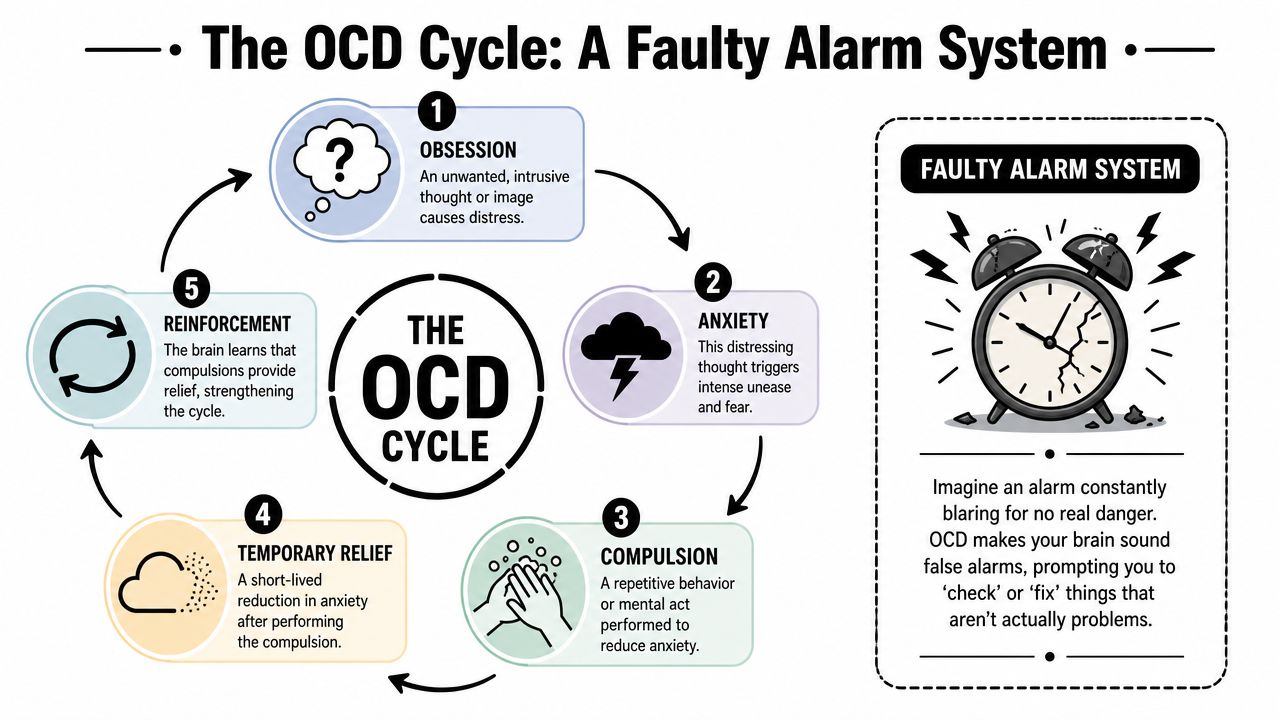
OCD works like an overprotective alarm system. It fires loudly, quickly, and often at the wrong time. The problem is not that you are careless, dangerous, or irrational. The problem is that your brain starts treating uncertainty as an emergency, then pushes you to do something that brings brief relief.
How the cycle keeps itself alive
Here is the pattern many people get stuck in:
An intrusive thought, image, feeling, or urge shows up.
It might sound like, "What if I contaminated someone?" "What if I made a terrible mistake?" or "What if this thought means something about who I am?"Your body reacts with alarm.
Anxiety, disgust, guilt, or dread rises fast. Even if part of you knows the fear seems exaggerated, your nervous system acts as if the threat is real.You do something to feel safer.
You might check, wash, avoid, confess, ask for reassurance, review memories, pray in a certain way, or repeat a phrase to oneself.Relief arrives.
Usually it is brief, but it feels convincing.Your brain links the relief to the ritual.
It learns, "That action protected me." So the next intrusive thought feels more important, not less.
That is why OCD can take up so much time and energy. The compulsion brings short-term comfort, but it teaches the brain to keep sounding the alarm.
A smoke detector that goes off every time you make toast can train a whole household to panic at burnt bread. OCD creates a similar problem in the mind. The alarm is real. The danger signal is loud. But the signal is misfiring.
Why intrusive thoughts feel so personal
Many people get scared by the content of their thoughts. They wonder whether having a violent, sexual, blasphemous, or relationship-related thought means they secretly want it, agree with it, or might act on it.
Usually, it means the opposite.
OCD tends to latch onto what matters most to you. If you prioritize being kind, your mind may throw up cruel thoughts. If faith matters to you, the mind may produce blasphemous images. If loyalty matters to you, doubt may target your relationship. That is one reason themes such as contamination fears, relationship doubt, and retroactive jealousy can feel so convincing. If that last theme fits, this guide to retroactive jealousy OCD can help you understand how the cycle shows up in romantic relationships.
The thought is not the problem by itself. The trap is what happens next. OCD pushes you to treat the thought like evidence, then solve it with a ritual.
Ordinary mental noise versus an OCD loop
Unwanted thoughts are part of being human. The difference with OCD is less about having a strange thought once and more about getting pulled into a repeated pattern of fear and response.
| Experience | Typical unwanted thought | More consistent with OCD |
|---|---|---|
| Thought itself | Odd, unwanted, and brief | Recurring, sticky, hard to dismiss |
| Emotional impact | Mild discomfort | Sharp anxiety, guilt, disgust, or dread |
| Response | Let it pass or shrug it off | Rituals, avoidance, reassurance, mental review |
| Effect on daily life | Little disruption | Steals time, attention, and peace |
This distinction matters because people with OCD often misread the intensity of the fear as proof that the thought must mean something. It does not. Intensity is a feature of the alarm system, not proof of danger.
The hopeful part of the cycle
Once you can spot the pattern, you are no longer trapped inside a mystery. You can begin to say, "This is the loop again," instead of, "I must solve this right now."
That shift matters. Recovery does not depend on making every intrusive thought disappear. It depends on changing your response to the alarm. Over time, with the right treatment and practice, the brain can learn that uncertainty is survivable and rituals are not required.
For some people, the content of the obsession centers on contamination and illness. If that is part of your experience, this practical guide for mysophobia may help you see how fear and rituals reinforce each other.
Hope grows when the cycle makes sense. And OCD does make sense once you see how obsession, alarm, relief, and repetition fit together.
The Many Faces of OCD Symptoms and Themes
Two people can both have OCD and look completely different on the surface. One may wash their hands for long stretches. Another may never wash excessively but spend hours replaying whether they said something offensive. A third may feel tormented by unwanted sexual, violent, or religious thoughts and tell no one because the shame feels unbearable.
That's why understanding obsessive compulsive disorder requires looking past stereotypes.

Common themes people recognize
Here are some of the ways OCD often shows up:
Contamination fears
A person touches a door handle, shopping cart, sink, or package and feels a wave of danger. The ritual may be washing, sanitizing, changing clothes, or avoiding certain places. If this is your struggle, this practical guide for mysophobia may help you understand the overlap between germ fears and anxiety patterns.Checking
Someone locks the door, then checks again. Then again. Or they reread messages to make sure they didn't say something harmful, dishonest, or inappropriate.Symmetry and just-right feelings
This isn't simply liking order. It's a strong sense that something feels off, incomplete, or unbearable until it looks, sounds, or feels exactly right.Harm thoughts
A loving parent gets a sudden image of hurting their child and feels horrified. A driver worries they may have hit someone without noticing and circles back repeatedly.
The themes people often hide
Some forms of OCD are especially hard to disclose because the thoughts feel taboo.
- Sexual or violent intrusive thoughts can lead a person to avoid loved ones, sharp objects, certain settings, or even being alone with children, despite having no wish to act on the thoughts.
- Scrupulosity centers on morality or religion. A person may fear sinning, blaspheming, lying, or not praying "correctly."
- Pure O is a common phrase people use when compulsions are mostly mental. On the outside, it can look like nothing is happening. Inside, the person may be ruminating all day.
- Relationship OCD can focus on whether a relationship is right, whether attraction is real, or whether doubt itself means something is wrong. Some readers find this guide to retroactive jealousy OCD useful when the obsession gets tied to a partner's past.
The theme may change. The engine underneath it is the same. doubt, urgency, ritual, brief relief, repeat.
A gentle reality check
People with OCD are often frightened by their own minds because the thoughts target what they care about most. That's one reason OCD can feel so convincing. It sounds urgent, personal, and morally loaded.
But strange content doesn't make you strange. It means your fear system has learned to stick to certain topics. Once you understand that, your symptoms can start to feel less like a secret and more like a pattern that can be treated.
Uncovering the Roots of OCD and How It Is Diagnosed
Many people still carry the idea that OCD is about being high-strung, rigid, or overly picky. That misunderstanding adds shame. Modern clinical thinking points in a different direction. OCD is understood as a biologically based disorder involving brain circuits, not a simple failure of discipline.
One summary from Stanford's OCD program, discussed in this OCD statistics article from NOCD, describes abnormal activity in a cortico-striato-thalamo-cortical loop. The same source notes that imaging and pharmacology work in the 1990s helped shift understanding toward a brain-and-behavior model. It also highlights a painful reality. One estimate places the average gap between symptom onset and diagnosis at about 13 years.
What can contribute to OCD
OCD usually doesn't come from one single cause. It makes more sense to think in layers.
- Brain-based vulnerability matters. Some people seem more prone to getting stuck in threat detection and doubt loops.
- Stress can intensify symptoms. A major life event, transition, illness, or period of pressure can make an existing pattern louder.
- Temperament and learning also play a role. Some people are especially sensitive to uncertainty, responsibility, or internal discomfort.
If you're curious about the broader picture of what causes anxiety, it can help to see how biology, stress, and learned responses often interact.
What diagnosis usually looks like
A good assessment doesn't just ask, "Do you wash your hands a lot?" It looks at the whole pattern:
| What a clinician listens for | Why it matters |
|---|---|
| Obsessions | Unwanted thoughts, images, or urges that create distress |
| Compulsions | Behaviors or mental acts done to reduce distress or prevent feared outcomes |
| Time and impact | Whether symptoms consume major time or disrupt life |
| Avoidance and reassurance | Hidden rituals can keep OCD going even when visible compulsions are limited |
What diagnosis should feel like: not an interrogation, but a careful sorting process that helps separate OCD from other kinds of anxiety, habits, or personality traits.
Getting assessed can feel scary, especially if your obsessions involve taboo content. Many people fear being misunderstood. Naming symptoms accurately often brings relief. Once OCD is recognized, treatment can become much more targeted and much more hopeful.
Proven Treatments That Bring Hope and Lasting Relief
The most encouraging thing I can tell you is this. OCD treatment is not based on endlessly analyzing every thought. The strongest evidence supports approaches that change the cycle directly.

According to the APA's overview of OCD diagnosis and treatment, Exposure and Response Prevention (ERP) is the first-line psychological treatment for OCD. The other first-line option is SSRI medication, which is often prescribed at a higher dose for at least 12 weeks for OCD than is common in depression.
How ERP helps your brain relearn safety
ERP sounds intimidating until it's explained clearly. You face a trigger on purpose, in a planned and supported way, and then you don't do the compulsion that usually follows.
That might mean touching something that feels contaminated and delaying washing. It might mean sending an email without rereading it repeatedly. It might mean allowing a scary thought to exist without checking your feelings, asking for reassurance, or mentally proving you're a good person.
Over time, your brain learns several new lessons:
- The alarm can rise and fall on its own
- A thought isn't an emergency
- Uncertainty is uncomfortable, but survivable
- Compulsions aren't what keep you safe
If you want a broader explanation of science-backed exposure therapy, it can help to see why gradually facing fear changes the nervous system.
What medication can and can't do
Medication doesn't erase every thought, and it isn't a moral test of strength. For some people, SSRIs reduce the volume of obsessions and anxiety enough that practicing ERP becomes more doable. For others, therapy is the main path. Many people use both.
The choice depends on symptom severity, access to specialized therapy, past treatment experience, and personal preference.
A brief primer can help make the process more concrete:
What progress often feels like
Progress doesn't usually feel like instant certainty. More often, it feels like needing less reassurance, spending less time trapped in rituals, and getting more of your life back.
Recovery often begins with a small shift. "I can feel anxious and still choose not to obey OCD."
That is where hope becomes practical. Each time you resist a ritual, even imperfectly, you teach your brain something new.
Your Toolkit for Managing OCD Day to Day
Professional treatment does the heavy lifting, but daily skills matter. They help you get through hard moments without automatically feeding the cycle. Think of these tools as support beams, not a substitute for ERP.
Skills that help between therapy sessions
Some tools are simple, but not easy. Their power comes from repetition.
Name the pattern
Instead of debating the content, try labeling it. "This is an OCD spike." That small shift can reduce the urge to solve the obsession.Delay the ritual
If you can't drop a compulsion completely yet, practice postponing it. Even a short delay interrupts the automatic chain between anxiety and ritual.Use grounding when your body surges
Grounding won't solve OCD, but it can steady you enough to make a better choice. These strategies for anxiety grounding can be useful when panic or overwhelm floods your system.Limit reassurance loops
Reassurance feels kind and calming in the moment, but it often acts like a compulsion. Notice when you're asking others to settle doubt for you.
Helpful routines that lower the background noise
Daily stress doesn't cause every OCD spike, but it can make the alarm system louder. Many people benefit from:
- Regular sleep habits
- Gentle movement or walks
- Mindfulness practice that teaches observing thoughts without arguing with them
- Structured journaling that separates triggers, fears, rituals, and outcomes
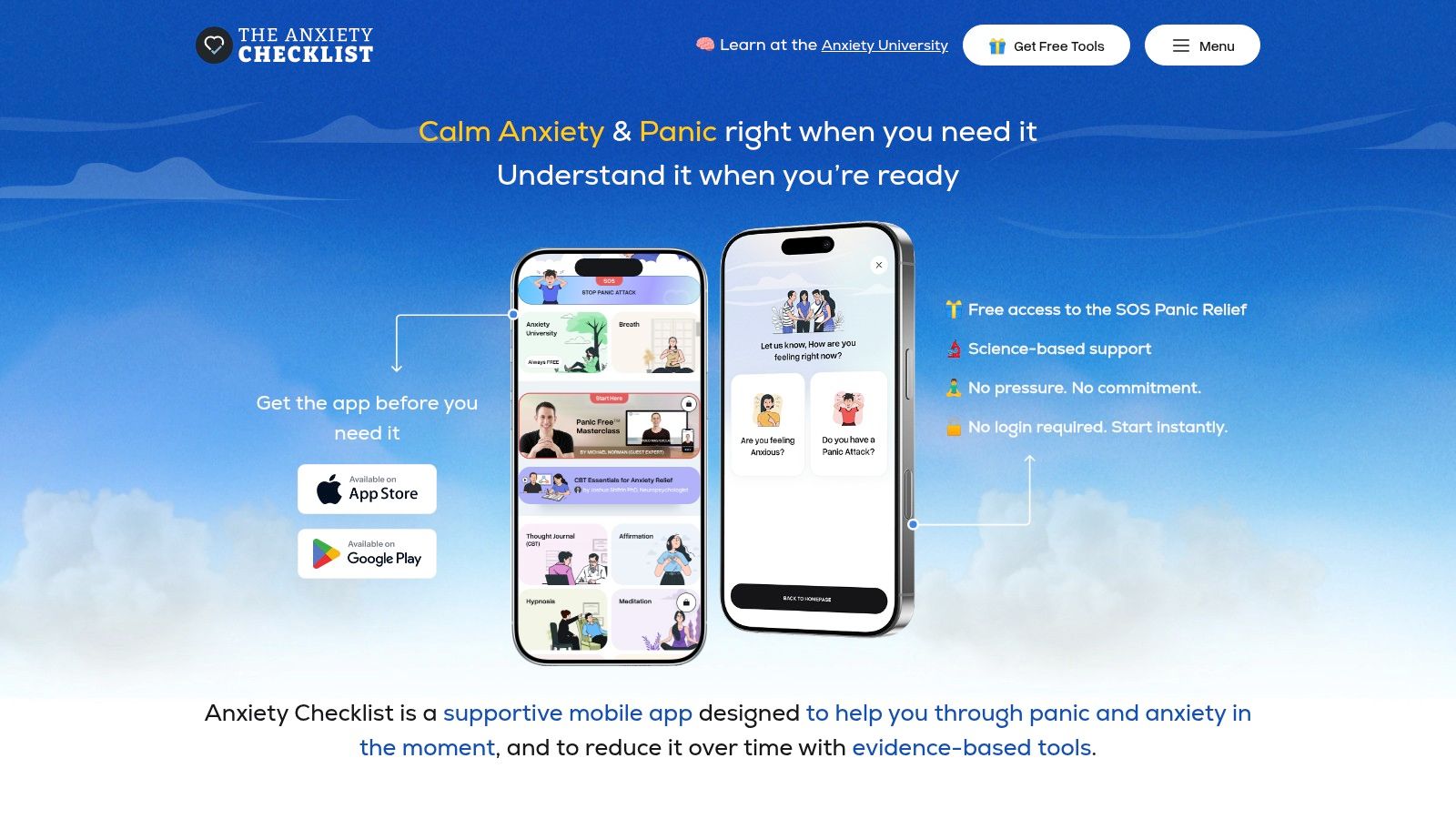
For people who want guided support between sessions, The Anxiety Checklist is one option. It includes an SOS mode, grounding prompts, CBT journaling, exposure tools, and educational lessons in one place.
When self-help is useful and when to reach out
Self-help works best as practice, not secrecy. If you're using tools to avoid treatment, hide symptoms, or build more rituals around "doing recovery perfectly," OCD may have grabbed the steering wheel again.
Some readers also appreciate this broader guide to managing anxiety for lifestyle-based support. Keep in mind that OCD usually needs targeted strategies, especially when compulsions and avoidance are well established.
A good daily question is not "Do I feel certain?" It's "Did I respond in a way that strengthens freedom rather than fear?"
How to Support Yourself and Others on the Path to Healing
A lot of healing begins in a quiet moment. You notice the urge to check one more time, ask one more question, avoid one more situation, and you choose a different response, even for a few seconds. That small choice can feel ordinary from the outside. Inside, it is practice for a new relationship with fear.
Recovery from OCD rarely looks dramatic. It often looks like telling one honest person what has been happening. It looks like showing up for treatment even when your mind demands certainty first. It looks like letting doubt sit in the passenger seat without handing it the wheel. That is how confidence grows. Not from feeling sure, but from learning that you can handle uncertainty and still move forward with your life.
If you are supporting someone with OCD, aim to be warm, calm, and consistent. Their fear may sound strange to you, but the distress is real. Respect the pain without treating the obsession like an emergency that must be solved right now. That balance matters. Reassurance can feel helpful in the moment, yet repeated reassurance often acts like pouring water into a leaking bucket. It brings relief for a minute, then the urge comes back stronger.
Simple ways to help
Name the distress without agreeing with OCD
"I can see this is really hard right now."Set kind limits on reassurance
"I care about you, and I do not want to help OCD grow by answering that again."Support treatment, not rituals
Offer rides, help with scheduling, or sit nearby after an exposure. Skip checking, confessing, or avoiding on the person's behalf.Praise courage, not comfort-seeking
Notice the brave moment. "You stayed with that uncertainty longer today. That matters."
If you are the one struggling, try to speak to yourself the same way. OCD is loud, convincing, and repetitive. None of that means it tells the truth. A smoke alarm that goes off while you make toast is still loud. It is also still a false alarm. Treatment helps you retrain that alarm system, and support helps you keep practicing when the noise rises.
You are more than the thoughts that scare you. You are also more than the rituals that follow. With the right help and steady practice, people do get better. Understanding obsessive compulsive disorder is a strong start. The next step is action, taken gently and repeatedly, until fear stops running the show.
If you want structured support for panic, anxiety spikes, grounding, CBT journaling, and exposure practice in one place, The Anxiety Checklist offers tools you can use right away without pressure.