


Your notes are open. The exam is close. You've studied more than people realize, but your body is acting like danger is coming. Your heart speeds up. Your hands feel cold or shaky. You read one question and suddenly can't remember something you knew yesterday.
If that's where you are right now, your reaction makes sense. Test anxiety can feel very personal, but it isn't a character flaw, and it doesn't mean you're incapable. In practice, it often acts like a stress response that hijacks access to what you already know.
I've seen students mistake this for failure before the test even begins. What usually helps isn't “trying harder to be calm.” It's learning how to manage test anxiety in a way that retrains both mind and body. Relief is possible. So is healing. Many people move from panic, blanking out, and avoidance to a steadier, more confident way of taking tests.
Table of Contents
- You Can Overcome Test Anxiety and Reclaim Your Focus
- Build a Calm Foundation Before the Test
- Your Toolkit for Instant Calm During the Test
- Change Your Mindset Change Your Experience
- Everyday Habits That Build Long-Term Resilience
- Knowing When to Seek Help and Where to Find It
You Can Overcome Test Anxiety and Reclaim Your Focus
A student once described test anxiety to me this way: “I know the material at home. Then I sit down in the room and it's like someone turned the lights off.” That's how many people experience it. Not as simple nerves, but as a sudden split between what they know and what they can access under pressure.
That gap is painful. It can make you question your intelligence, your future, even your worth. It can also create a cycle. You dread the next test, avoid practice because it feels upsetting, then walk in less certain and more reactive.
You are not broken. Your nervous system has learned to connect tests with threat, and learned patterns can be changed.
That's the hopeful part. Anxiety is trainable. The same brain and body that learned panic can learn familiarity, rhythm, and recovery. You don't need to become fearless to perform better. You need a repeatable way to prepare, regulate, and respond when stress rises.
A different way to think about the problem
Many students treat test anxiety like a motivation problem. They tell themselves to be tougher, stop overreacting, or “just relax.” That usually backfires. A better frame is that this is a skills problem. Skills can be practiced.
If you've ever looked into strategies for public speaking, the pattern will feel familiar. Fear gets smaller when your body recognizes the situation, your mind has a script, and you've practiced recovering from mistakes instead of fearing them.
What healing can look like
Healing doesn't always mean you never feel nervous again. Often it means:
- You notice anxiety sooner and respond before it takes over.
- You prepare with structure instead of panic.
- You recover faster if your mind goes blank for a moment.
- You stop treating one test like a verdict on your future.
That shift is real. It's gradual, but it's real.
Build a Calm Foundation Before the Test
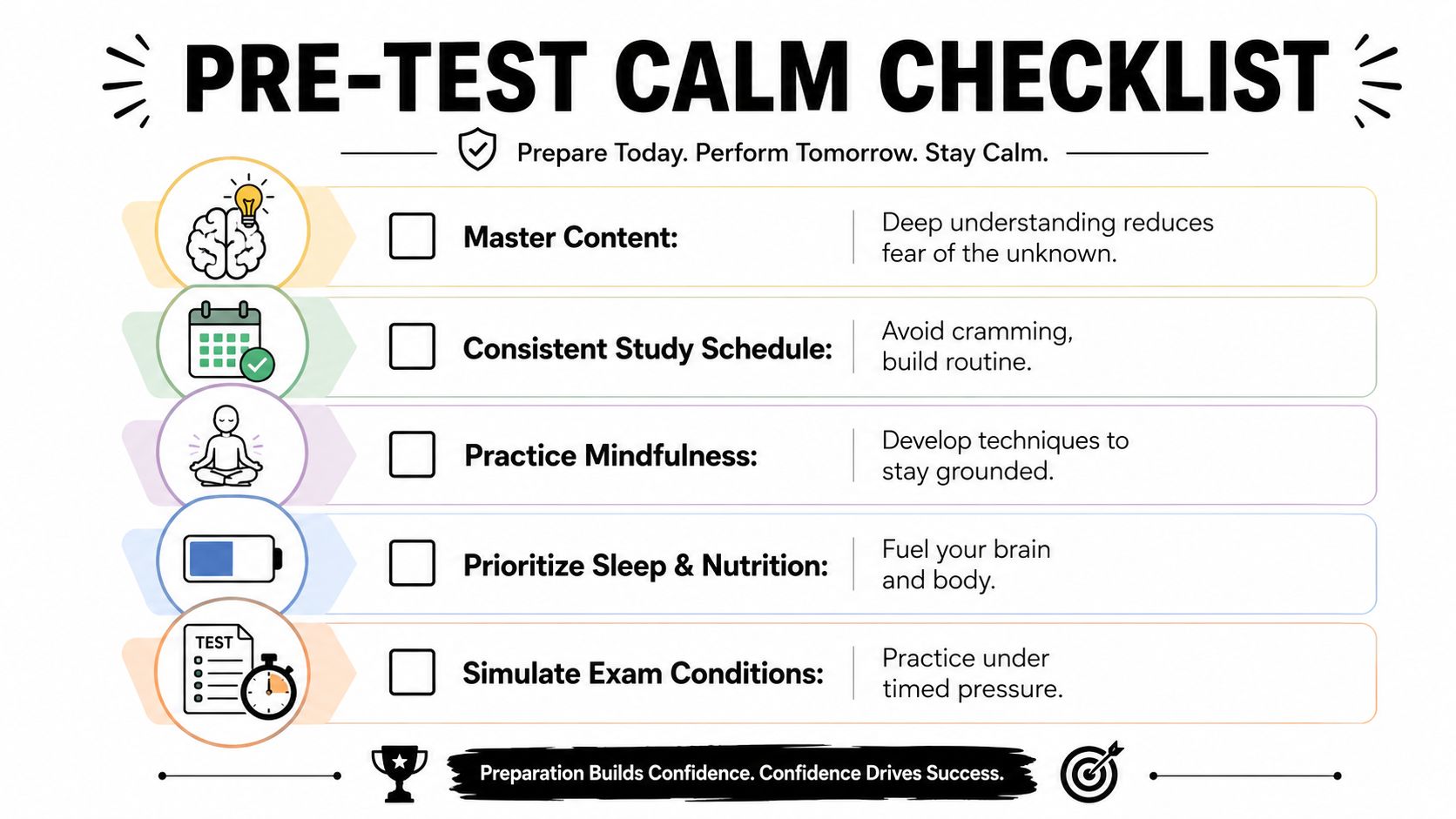
The strongest way to reduce test anxiety is to make the test feel less unknown. Preparation helps because uncertainty feeds fear. Guidance summarized in an ACT review of test anxiety points toward early studying, consistent routines, and avoiding cramming. That approach treats test anxiety as a skills-training issue, not a willpower contest.
Why preparation changes anxiety
When students say, “I'm anxious about the test,” they often mean several things at once. They may be unsure what will appear, unsure how to pace themselves, and unsure how they'll react if they get stuck. Good preparation reduces all three.
A calm foundation isn't about studying nonstop. It's about making the exam feel familiar enough that your nervous system doesn't treat it like chaos.
Practical rule: Study to reduce uncertainty, not to punish yourself.
A simple pre test system
Use a structure like this in the days before an exam:
- Break the material into small chunks. Divide by topic, chapter, or question type.
- Study early enough to repeat key material. Repetition is more calming than last-minute intensity.
- Use active recall. Close the book and pull information from memory.
- Practice the format. If the test is timed, do at least some timed practice.
- Review mistakes without drama. Errors show you what still needs attention.
Students preparing for school exams often benefit from practice tools that mimic real conditions. If you need something structured, Exam Practice for GCSE is one example of a format-based practice resource that can help make test conditions feel more familiar.
You can also keep a short list of personal tools to manage anxiety alongside your study plan, so you're preparing both academically and emotionally.
Build a routine your body can trust
A pre-test routine is a set sequence you repeat before exams. It teaches your body, “I know this situation. I know what to do.”
Keep it simple:
- The night before: stop reviewing at a reasonable point, pack what you need, and choose your morning essentials.
- The morning of: eat something familiar, leave with extra time, and avoid frantic last-minute discussions with other students.
- Right before the test: sit down, relax your shoulders, place both feet on the floor, and take a few slow breaths.
Here's a useful comparison:
| Unsteady approach | Calmer approach |
|---|---|
| Studying everything at once | Studying in planned blocks |
| Re-reading passively | Testing yourself from memory |
| Cramming late | Stopping in time to rest |
| Walking in rushed | Arriving early enough to settle |
| Hoping to feel confident | Building confidence through repetition |
Preparation won't erase every anxious feeling. It does something better. It lowers the power of surprise.
Your Toolkit for Instant Calm During the Test
Even when you've prepared well, anxiety can still spike when the paper lands in front of you. That's normal. In-the-moment regulation matters because portable skills like deep breathing, breaking work into smaller chunks, and moving on when stuck are recommended in student support guidance from LSUHSC. Those techniques work because they're simple enough to use discreetly under pressure.

What to do in the first wave of panic
The first mistake many students make is arguing with the feeling. “I can't be anxious right now.” “This is ridiculous.” “Why is this happening?” That internal fight adds another layer of stress.
Try this instead:
- Name it. “I'm having a wave of anxiety.”
- Lower the urgency. “This feels intense, but I can still take one step.”
- Return to the page. Find the next doable action only.
If your body is revving hard, use breathing exercises for anxiety that you've practiced before test day. Familiar breathing works better than trying to invent a calming method in the moment.
How to steady yourself without leaving your seat
You don't need a dramatic reset. You need a discreet one.
Box breathing is useful because it gives your mind a job and slows the physical spiral. Breathe in slowly, hold, breathe out slowly, hold again. Keep the pace comfortable. The point isn't perfection. The point is rhythm.
Grounding helps when your thoughts jump ahead to failure. Try a quick sensory check. Feel your feet in your shoes. Notice the chair under you. Touch the edge of the paper. This pulls attention back to the present task.
Mini muscle release works when your body is tight but your face looks calm. Unclench your jaw. Drop your shoulders. Relax your hands for one breath, then begin again.
When anxiety rises, shrink the task. Don't solve the whole test. Solve the next question.
Another practical move is pacing. If you're stuck, mark the question and move on. Many students lose time not because the test is impossible, but because anxiety glues them to one item too long.
A later reset can help if your mind starts drifting. This short video offers a guided calming pause you can practice before exam day, so it feels familiar when you need it:
Use a simple desk-level sequence:
- Read the question once slowly
- Underline or note key words mentally
- Cross out wrong options when possible
- Choose the next step, not the whole solution
- Move on if you freeze
These are small actions, but that's why they work. Anxiety makes the future feel loud. A toolkit brings you back to what your hands, eyes, and breath can do right now.
Change Your Mindset Change Your Experience
Test anxiety isn't only a body problem. It's also a story problem. Your mind starts producing harsh, absolute conclusions and then treats them like facts. That's where many students get trapped.
A more durable approach treats test anxiety as a skills-and-exposure problem. The Mayo Clinic advises practicing relaxation techniques daily so they become familiar before exam day, and it also notes that issues such as ADHD, dyslexia, or other learning difficulties can intensify anxiety if they aren't addressed in the background. You can read that guidance in Mayo Clinic's overview of test anxiety and related factors.
Notice the mental glitches
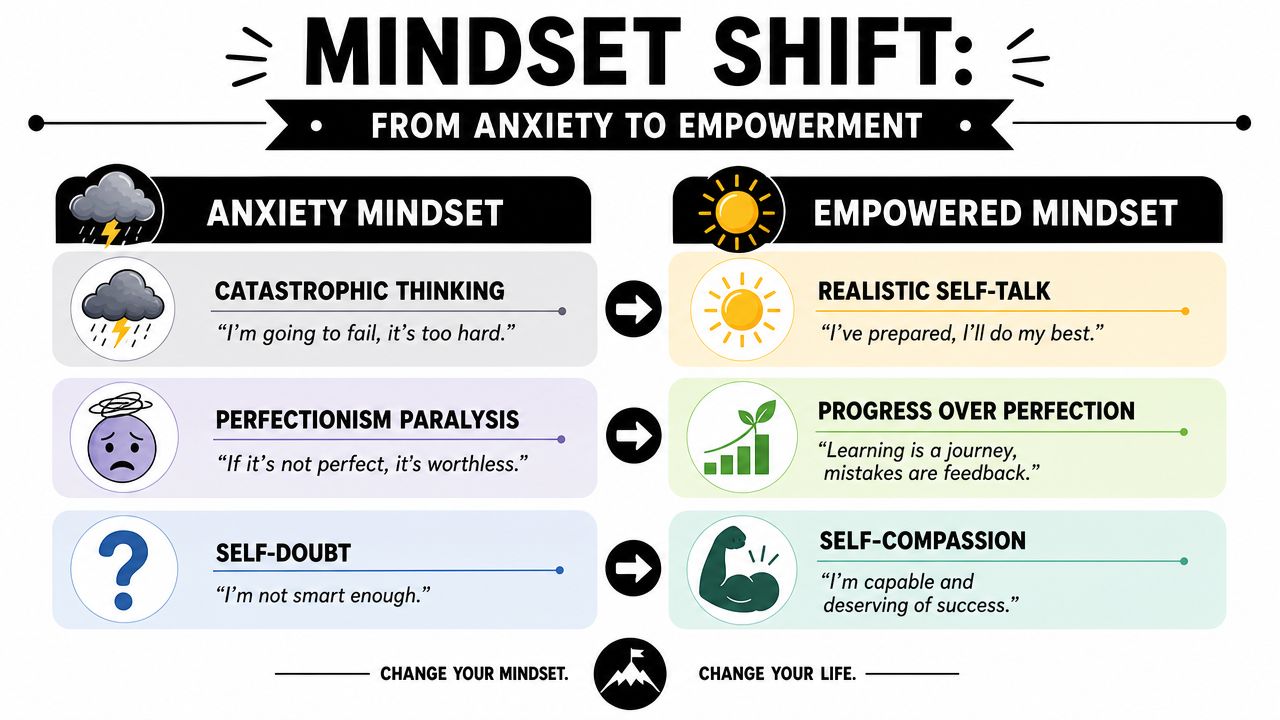
I call these mental glitches because that's what they are. Not truth. Not prophecy. Just biased thinking under stress.
Common ones include:
Catastrophizing
“If I do badly on this test, everything falls apart.”Black-and-white thinking
“If I don't do perfectly, I've failed.”Mind reading
“Everyone else is calmer than I am, so I must be less capable.”Fortune telling
“I'm going to blank out, so there's no point trying.”
If you struggle with spiraling thoughts between study sessions, learning how to stop overthinking can make these patterns easier to catch early.
Replace fear with accurate self talk
The goal isn't fake positivity. It's accuracy.
Use this three-part reset:
| Anxious thought | Reality check | Balanced replacement |
|---|---|---|
| “I'm going to fail.” | I don't know the outcome yet. | “I can take this one step at a time.” |
| “I forgot one thing, so I know nothing.” | Stress can block recall temporarily. | “Memory often returns when I settle.” |
| “I should be calmer by now.” | Anxiety doesn't follow commands. | “I can feel anxious and still function.” |
Speak to yourself the way a skilled teacher would. Clear, firm, and kind.
Shame makes anxiety stickier. Compassion makes it easier to recover. Students often improve not when they become stricter with themselves, but when they stop turning every hard moment into evidence against themselves.
If your anxiety links to an untreated learning or attention issue, mindset work alone may not be enough. In that case, self-talk should include realism: “I may need support, accommodations, or a better strategy for how I learn.”
That thought isn't weakness. It's problem solving.
Everyday Habits That Build Long-Term Resilience
Students often separate “real test prep” from daily health habits. That split causes trouble. Your nervous system doesn't care whether stress comes from algebra, poor sleep, skipped meals, or days of sitting tense at a desk. It responds to the full load.
If you want to know how to manage test anxiety for the long term, build a life that gives your body fewer reasons to stay on high alert. These habits aren't optional extras. They shape your baseline.
Sleep is part of test prep
Sleep affects mood, focus, patience, and mental flexibility. When students cut sleep to study longer, they often feel productive in the moment but more fragile the next day. A tired brain is quicker to panic and slower to recover.
A steadier pattern helps more than one heroic night of revision. Aim for consistency in the week leading up to the exam. If your sleep has been erratic, don't panic about fixing everything instantly. Start by protecting your wind-down time and stopping intense studying late at night.
Your body needs steady fuel and movement
Food matters because sharp swings in energy can feel a lot like anxiety. A familiar, balanced meal before studying or before an exam usually works better than skipping food or relying on sugar and caffeine to carry you.
Movement matters because stress builds physically. You don't need an extreme workout. A walk, a stretch break, a short bike ride, or a few minutes outside can reduce tension and help your mind reset.
Here are the habits I'd put at the center:
- Protect your sleep window. Keep bedtime and wake time as regular as possible near exam periods.
- Eat predictably. Don't let hunger sneak up on you and amplify irritability or shakiness.
- Move on purpose. Use physical activity to discharge tension, not to “earn” rest.
- Limit panic studying. Long, frantic sessions can train your body to associate learning with distress.
- Schedule recovery. Quiet breaks help your brain absorb what you've studied.
Calm on test day often starts with ordinary choices made days earlier.
If you want to strengthen this foundation beyond exams, these ideas connect closely with developing resilience to manage anxiety. The same daily habits that help with tests also make you less vulnerable to spiraling under pressure in general.
Knowing When to Seek Help and Where to Find It
Sometimes test anxiety is mostly performance stress. Sometimes it starts to look more like panic, avoidance, or a broader anxiety issue. That distinction matters. Columbia Teachers College notes that while many students benefit from preparation and relaxation, some may need exposure-based treatment, and it discusses cases where approaches such as interoceptive exposure can be useful over six to twelve weeks for panic-related symptoms in its article on when test anxiety may need deeper treatment.
Signs you may need more than self help
Pay attention if any of these sound familiar:
- You avoid tests, classes, or school-related tasks because the fear feels overwhelming.
- You have panic-like symptoms such as feeling out of control, unable to breathe comfortably, or convinced something terrible is happening.
- Your anxiety persists despite preparation. You study, practice, and still repeatedly shut down.
- Your daily life is shrinking. Sleep, concentration, mood, or attendance are suffering.
- You suspect another challenge is involved, such as an attention, learning, or processing difficulty.
Self-help can still be part of the answer, but it may not be the whole answer.
Support options that can make a real difference
Start with the most available support. That might be a school counselor, campus counseling center, teacher, academic advisor, or a licensed therapist. If the problem is severe, ask specifically about therapies that address panic and avoidance, not just general reassurance.
Some people also benefit from structured digital support between appointments or while building skills on their own. The Anxiety Checklist is one option. It includes an SOS mode, CBT journaling, breathing support, and educational tools that can complement professional care or self-guided practice.
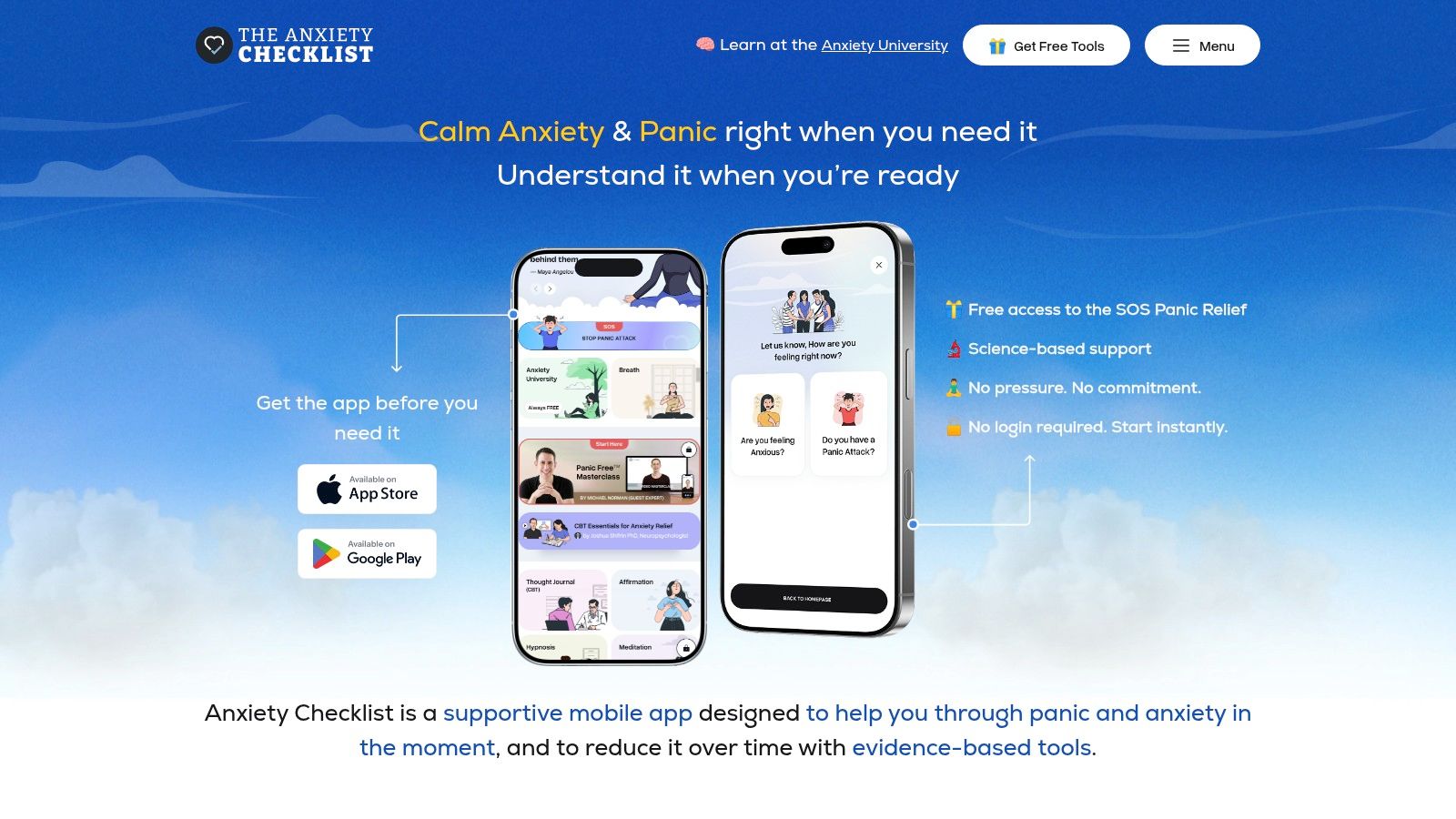
If you're unsure whether your distress has crossed that line, The Anxiety Checklist's mental health advice offers guidance on when it may be time to talk with a mental health professional.
Seeking help doesn't mean you've failed at managing anxiety. It means you're responding wisely to what your nervous system is telling you. Many students become panic-free not because they forced themselves through suffering alone, but because they got the right kind of support and practiced new responses until those responses became familiar.
If you want extra support while working on test anxiety, The Anxiety Checklist offers practical tools you can use both in the moment and over time, including grounding help, breathing guidance, CBT-style thought work, and education designed to help you feel safer in your own mind and body.