

In short
A panic attack in public is handled best with a short, discreet sequence: stop moving if safe, soften and slow the breath, orient to one neutral detail outside the body, and move only to the nearest safer or quieter spot. Seek emergency help for new, severe, or different chest pain, fainting, or serious breathing difficulty. (nimh.nih.gov)
Key takeaways
- The immediate goal is not instant calm. It is physical safety, gentler breathing, outward attention, and one manageable next action.
- Slow breathing and sensory grounding can be done without closing the eyes, lying down, or drawing attention.
- If the situation is physically safe, staying briefly or moving only a short distance may be more helpful than automatically fleeing.
- New, severe, or different symptoms should not be assumed to be panic, especially when chest discomfort, collapse, or serious breathing difficulty is present. (heart.org)
- Repeated attacks, persistent worry, or growing avoidance deserve professional assessment; CBT is a well-supported treatment for panic disorder. (nimh.nih.gov)
Table of contents
- What should you do first when panic starts in public?
- How can you slow the panic without anyone noticing?
- Should you leave, stay, or move somewhere quieter?
- What can you say if you need help?
- What should you do after the wave passes?
- How can you prepare for the next public panic attack?
- When could the symptoms be a medical emergency?
- What else do people ask about panic attacks in public?
- What should you do before your next outing?
The phrase how to stop a panic attack in public suggests an instant off switch, but no technique can promise one. A safer target is to reduce overload, keep the body physically safe, and make the next decision while the alarm response settles.
What should you do first when panic starts in public?
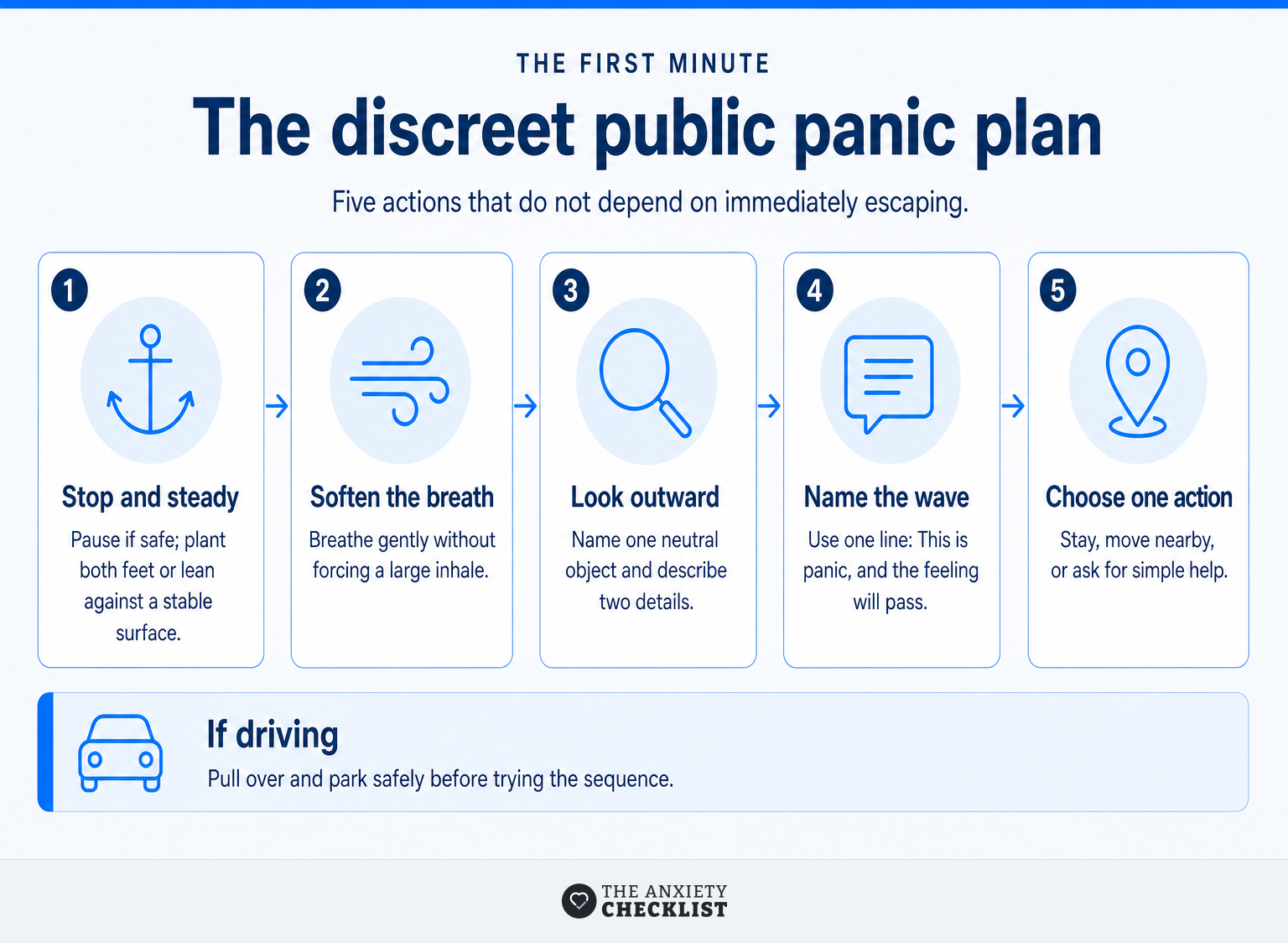
When panic starts, stop adding tasks and decisions. If safe, pause, support the body, soften the breath, direct attention outward, and choose one small action.
- Stop and steady the body. Plant both feet, sit, or lean against a stable surface. If driving, pull over and park safely before trying any exercise.
- Release one long, comfortable breath. Do not force a maximum inhale. Let the next breath enter gently.
- Find one neutral detail. Notice the edge of a shelf, the feel of a chair, a sound in the distance, or the temperature of the air.
- Name the pattern. Use a short line such as This is a panic wave, not a command to run.
- Choose one action. Stay where the body is supported, move to a quieter nearby spot, or ask someone for simple help.
The National Institute of Mental Health describes panic attacks as sudden waves of fear or discomfort that can include a racing heart, dizziness, chest pain, nausea, trembling, tingling, and breathing difficulty. Familiar panic symptoms normally resolve with time, but the similarity to medical symptoms is why new or different episodes require caution. (nimh.nih.gov)
In the first minute, physical safety and one simple sequence matter more than finding the perfect calming technique.
How can you slow the panic without anyone noticing?
Use a small breathing rhythm and one-sense grounding exercise instead of attempting a complicated routine. Both can be done while standing in line, sitting on transportation, or remaining near other people.
How can breathing stay subtle?
Let the breath travel as deeply into the abdomen as feels comfortable, without forcing it. Breathe gently through the nose and release the breath slowly; counting from one to three or one to five can provide structure.
The NHS breathing guidance advises allowing the breath to flow comfortably rather than forcing it. If counting creates more pressure, drop the numbers and focus only on making the breathing softer and slower. The longer guide to breathing exercises for anxiety can be practiced before a public situation, when concentration is easier. (nhs.uk)
How can grounding stay discreet?
Choose one sense first. Press a thumb against a fingertip and notice the contact, feel both shoes against the floor, or silently describe the shape and color of one object.
If more structure helps, use grounding techniques such as 5-4-3-2-1. NHS Inform's 5-4-3-2-1 method moves attention through five things seen, four felt, three heard, two smelled, and one tasted. Completing every step is optional; one clearly noticed sensation is a valid start. (nhsinform.scot)
In public, a quiet breath and one neutral external detail are often enough to begin interrupting the spiral.
Should you leave, stay, or move somewhere quieter?

Stay if the situation is physically safe and the symptoms match a familiar panic pattern, but do not turn staying into a test of endurance. Move to the nearest lower-stimulation place if support, space, cooler air, or a stable seat would make the situation safer.
A useful middle option is a nearby reset rather than an automatic retreat home. In a store, that might mean the end of an aisle or a seat near staff. At an event, it might mean a lobby or the edge of the room. On transportation, it could mean changing seats or telling an employee that support is needed.
Do not remain in traffic, near a platform edge, in extreme heat, or anywhere there is a genuine threat. The advice to stay applies only when the environment is safe.
The 2026 NHS guidance on anxiety, fear, and panic cautions that repeatedly avoiding anxiety-provoking situations can maintain fear. NIMH similarly identifies exposure as a CBT method for changing reactions to feared sensations and situations. That does not mean forcing an unplanned exposure during a crisis; it means avoiding the rule that every sensation requires immediate escape. (nhs.uk)
Staying briefly or moving only as far as safety requires can prevent panic from making every decision.
What can you say if you need help?
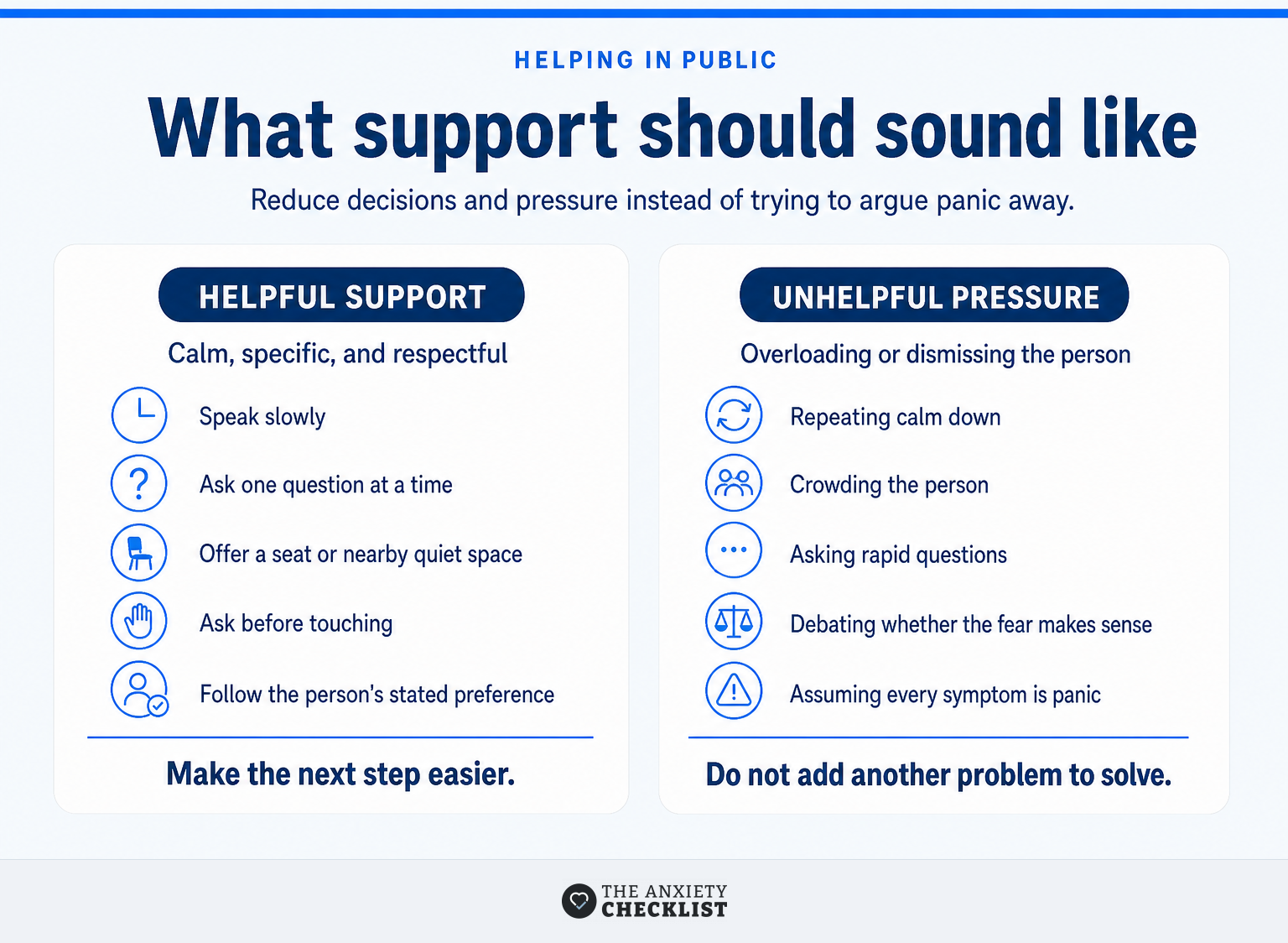
Use one direct sentence that describes the immediate need rather than explaining an entire medical history. The request can be as simple as asking for a seat, company, a quieter location, or emergency help.
Useful scripts include:
- Panic symptoms are starting. Could you stay nearby for a few minutes?
- A quieter seat would help.
- Please speak slowly and ask one question at a time.
- These symptoms are different from usual. Please call emergency services.
If disclosing panic feels uncomfortable, saying feeling unwell is enough. A companion can help by staying calm, limiting questions, offering one choice at a time, and following the person's preference about touch or space. NIMH recommends patient, supportive communication rather than judgment or pressure. (nimh.nih.gov)
A useful help request tells another person what to do next, not everything about why the panic started.
What should you do after the wave passes?
After the intensity drops, allow concentration and balance to return before driving or making another demanding decision. Record a few facts about the episode, then choose the next manageable activity rather than reviewing every sensation for the rest of the day.
A short debrief can include:
- Where the episode began
- The first symptom noticed
- What action helped most
- Whether anything felt new or different
- What would make the next situation easier
Do not use a stopwatch as a diagnosis. Official sources give different duration ranges: the NHS says many panic attacks last 5 to 20 minutes, while NIMH notes that an attack can last from a few minutes to an hour or sometimes longer. The safer distinction is whether the symptoms are familiar and easing or new, severe, and different. (nhs.uk)
If the episode happened at work and fear of judgment becomes the main problem afterward, the guide to social anxiety at work offers situation-specific steps for meetings, conversations, and returning after an anxious moment.
After a public panic attack, a factual two-minute review is more useful than hours of replaying what might have looked wrong.
How can you prepare for the next public panic attack?
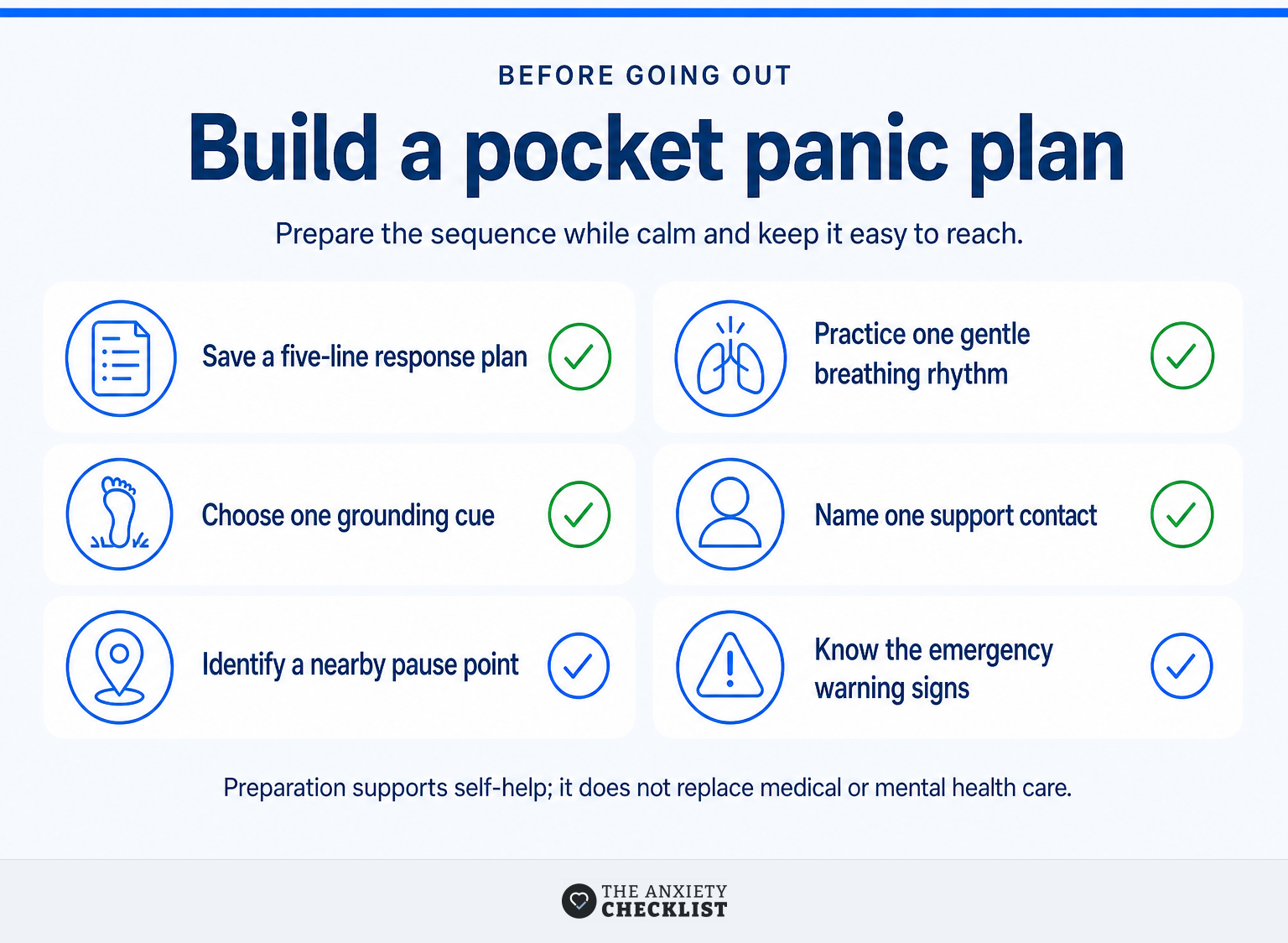
Prepare a five-line plan while calm, because panic can make choosing among several coping methods harder. Save the plan in a phone note or on a small card that can be read without searching through multiple screens.
A practical plan contains:
- Label: This is a familiar panic pattern.
- Body: Feet down, shoulders loose, breath unforced.
- Grounding: Name one sight, one sound, and one physical sensation.
- Place: Identify a nearby seat or quieter area.
- Support: Name one person who can stay nearby or receive a short message.
- Emergency rule: Get urgent help when symptoms are new, severe, or different.
Practice the sequence when calm so it is familiar before it is needed. If panic attacks recur, lead to persistent worry, or cause growing avoidance, a health professional can assess possible medical causes and discuss treatment. NIMH identifies CBT as a well-studied treatment, while NICE panic disorder guidance, amended in 2020, recommends CBT for moderate to severe panic disorder and structured self-help for some milder cases. (nimh.nih.gov)
Preparation cannot guarantee that panic will stay away, but it can remove several decisions from the hardest moment.
When could the symptoms be a medical emergency?
Call the local emergency number when symptoms are new, severe, substantially different from previous panic episodes, or include warning signs of a heart or breathing emergency. Do not delay care solely because anxiety has caused similar sensations before.
The American Heart Association, whose warning-sign guidance was reviewed in 2024, advises emergency action for symptoms including:
- Chest pressure, squeezing, fullness, or pain that lasts more than a few minutes or returns
- Pain or discomfort spreading to the arms, back, neck, jaw, or stomach
- Shortness of breath with or without chest discomfort
- Cold sweat, nausea, severe lightheadedness, or collapse
- Unresponsiveness or an absence of normal breathing
Also seek urgent help after a serious injury, an overdose, or when someone cannot stay safe. In the United States and its territories, the 988 Suicide & Crisis Lifeline provides call, text, and chat support; elsewhere, use the local crisis line or emergency service. (heart.org)
A history of panic should never be used to dismiss symptoms that are new, worsening, persistent, or medically concerning.
What else do people ask about panic attacks in public?
These questions often arise when someone wants an immediate answer or is supporting another person. The safest answers combine simple coping steps with a clear limit on when self-help is appropriate.
How to stop panic attacks fast?
To stop a panic attack fast, reduce stimulation, breathe gently rather than taking repeated huge breaths, and anchor attention to a neutral sight, sound, or touch. No method guarantees an instant stop. If symptoms are new, severe, or unlike previous panic episodes, seek urgent medical assessment rather than assuming anxiety is the cause. (nhs.uk)
Why do I keep having panic attacks in public?
Repeated panic attacks in public can become linked to places where escape or help feels difficult. Worry about another attack may increase body monitoring and avoidance, which can keep the fear active. A health professional can check for medical causes and assess panic disorder, agoraphobia, or another anxiety condition. (nimh.nih.gov)
How to calm someone down from an anxiety attack?
To calm someone during an anxiety attack, speak slowly, reduce questions, and offer one simple choice, such as sitting nearby or moving to a quieter spot. Encourage gentle breathing without forcing it. Stay with the person if company is welcome, and seek emergency help if symptoms suggest a medical crisis. (nimh.nih.gov)
What can I say to help someone who is having a panic attack?
Say, You are not alone. Help is here. This can be handled one minute at a time. Ask what usually helps instead of assuming. Avoid arguing with the fear, crowding the person, or repeatedly saying calm down. If the person reports unfamiliar chest pain or collapses, call emergency services. (nimh.nih.gov)
Good support reduces decisions, protects physical safety, and respects the person's need for either company or space.
What should you do before your next outing?
Save the five-line plan and rehearse it once in an ordinary setting. The aim is familiarity, not perfect relaxation.
Before the next outing, open SOS Panic Relief and keep it within easy reach. Anxiety Checklist documents the SOS feature as free, available without sign-up, and designed to guide users through voiced affirmations and follow-up options. It is an educational self-help tool, not emergency care or a substitute for professional diagnosis or treatment. (anxietychecklist.com)
A prepared plan does not need to stop every sensation; it only needs to make the next safe step easier.