


In short
Health anxiety can cause or intensify genuine physical sensations; “fake” is the wrong word. Nervous-system arousal, altered breathing, muscle tension, digestive changes, and close monitoring of the body can all affect what a person feels. Anxiety is one possible contributor, however, and it cannot rule out a medical condition.
Key takeaways
- Physical sensations remain real experiences when anxiety triggers, intensifies, or prolongs them.
- The threat response can change heart rate, breathing, muscle tension, sweating, and digestion.
- Close body monitoring can make ordinary or mild signals feel unusually prominent.
- Repeated checking, searching, and certainty-seeking reassurance may provide brief relief while strengthening the health-anxiety loop.
- No symptom pattern proves anxiety is the cause, so new or concerning symptoms require appropriate medical judgment.
Table of contents
- Are health-anxiety symptoms fake, imaginary, or real?
- How can anxiety create physical sensations?
- Why do health-anxiety symptoms seem so real?
- How does the symptom-anxiety loop keep going?
- What can you do without turning this into reassurance?
- When should you get professional or medical help?
- What else do people ask about health-anxiety symptoms?
- What is the next useful step?
Are health-anxiety symptoms fake, imaginary, or real?
No. A physical sensation can be genuine even when anxiety is helping to produce, intensify, or prolong it.
The word “fake” mixes up two separate questions: What is the person feeling? and What is causing the feeling? A headache, racing heartbeat, tense muscle, stomach sensation, or feeling of breathlessness is still an experience occurring in the body. Anxiety being one possible cause does not make the experience deliberate or invented.
The NHS health-anxiety guidance, last reviewed in 2023 states that anxiety can itself cause symptoms such as headaches or a racing heartbeat. The same guidance identifies repeated body checking, reassurance seeking, and online health research as common features of health anxiety.
A real sensation and a serious disease are not the same claim. Anxiety can contribute to a symptom, a medical condition can contribute to it, or several factors can overlap. That is why “this might involve anxiety” should be treated as a possibility, not as proof that medical assessment is unnecessary.
Health anxiety describes a pattern of fear and preoccupation. The related diagnosis of illness anxiety requires assessment by a qualified professional rather than conclusions based on one symptom or an online article.
The sensation can be real even when anxiety is helping to produce or intensify it.
How can anxiety create physical sensations?
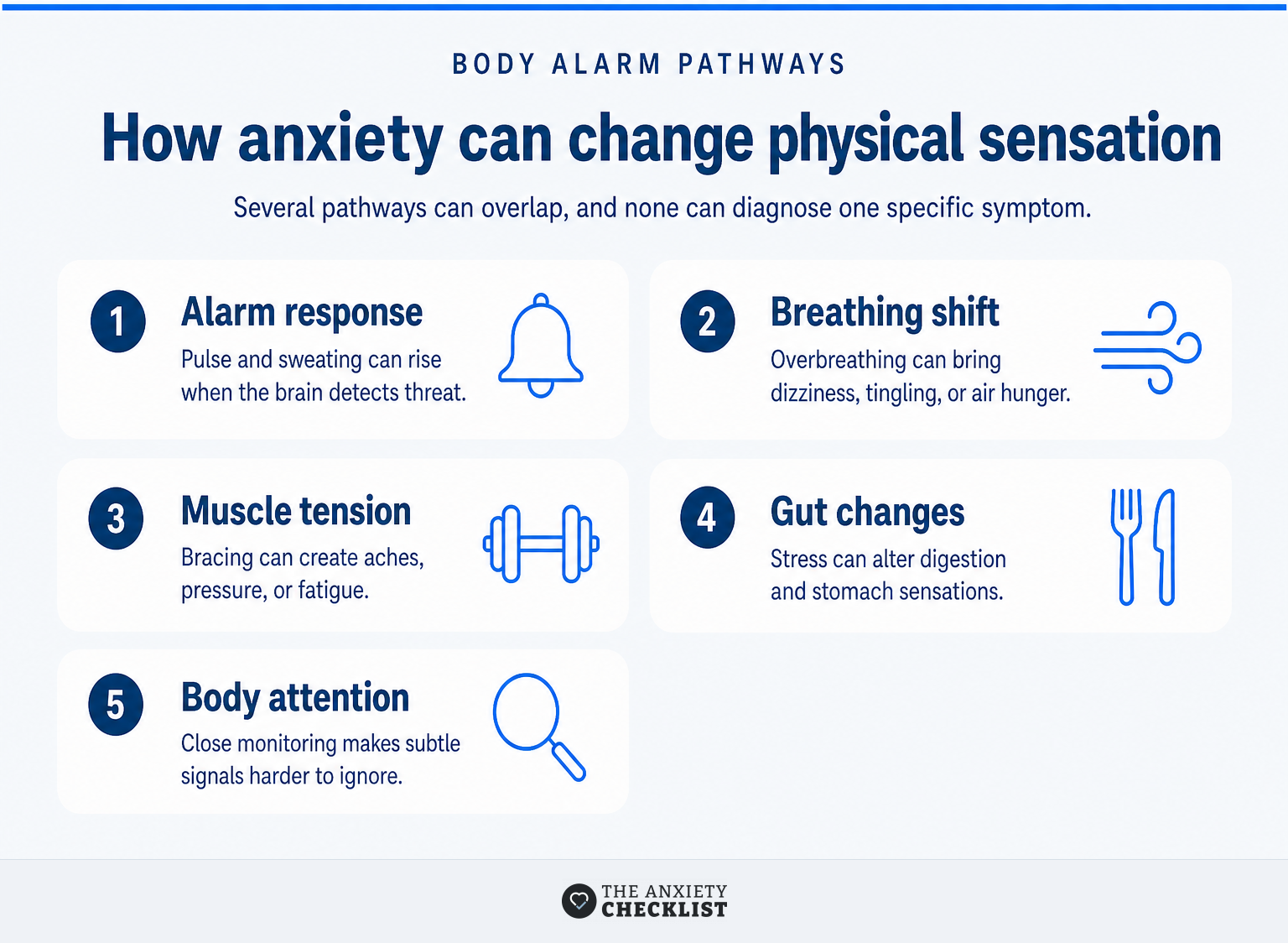
Anxiety can create physical sensations because the threat system changes heart rate, breathing, muscle tone, sweating, and digestion. These changes can feel uncomfortable even though they are not consciously produced.
An August 2023 NIH MedlinePlus overview explains that the fight-or-flight response can make the heart beat faster, increase breathing, direct more blood toward muscles, and tense those muscles. These protective changes can become distressing when the alarm activates repeatedly or in situations that do not require physical action. A fuller guide to the fight-or-flight response explains why the same system can produce several sensations at once.
Breathing changes can add another layer. The MedlinePlus hyperventilation page, reviewed in July 2024 explains that rapid or deep overbreathing lowers carbon dioxide in the blood. Possible effects include dizziness, breathlessness, a pounding heartbeat, muscle spasms, and tingling. A person may notice those effects without realizing that breathing has changed.
Muscles can also remain partly braced. Tight shoulders, a clenched jaw, or sustained abdominal tension may produce aching, pressure, fatigue, or twitching. Meanwhile, NHS anxiety guidance reviewed in July 2026 lists digestive symptoms such as nausea, cramps, bloating, constipation, and diarrhea among the possible physical effects of anxiety.
These pathways often overlap. A person may first tense a muscle, notice the resulting sensation, become alarmed, breathe faster, and then experience additional sensations. The mechanism explains how anxiety can affect the body; it does not determine what caused a specific symptom.
Anxiety can alter several body systems at once, but those mechanisms cannot diagnose the cause of one person’s symptom.
Why do health-anxiety symptoms seem so real?
Health anxiety can narrow attention onto the body, making faint, familiar, or fluctuating signals harder to ignore. Attention does not invent the experience, but it can change how prominent and threatening the experience feels.
Think of attention as a spotlight. A background sound can suddenly seem loud when someone listens for it, even though the sound was present before. Body scanning can have a similar effect: subtle pressure, movement, temperature, digestion, or muscle activity becomes the main object of attention.
A 2024 systematic review of 57 mechanistic studies found evidence involving health-related attention and memory biases, threat-confirming thought patterns, safety-seeking behavior, and possible overestimation of internal signals. The authors also reported that study quality varied substantially and that research on internal-signal processing and neurobiology remains at an early stage.
That limitation matters. Research supports a relationship among attention, interpretation, and health anxiety, but it does not justify claiming that focused attention explains every unexplained symptom.
Distraction should not be used as a diagnostic test either. A sensation becoming less noticeable during an activity does not prove it was caused by anxiety, just as noticing it while resting does not prove disease. The useful target is the habit of constant monitoring, not a new test designed to deliver certainty.
Attention can amplify the prominence of a sensation without making the sensation imaginary.
How does the symptom-anxiety loop keep going?
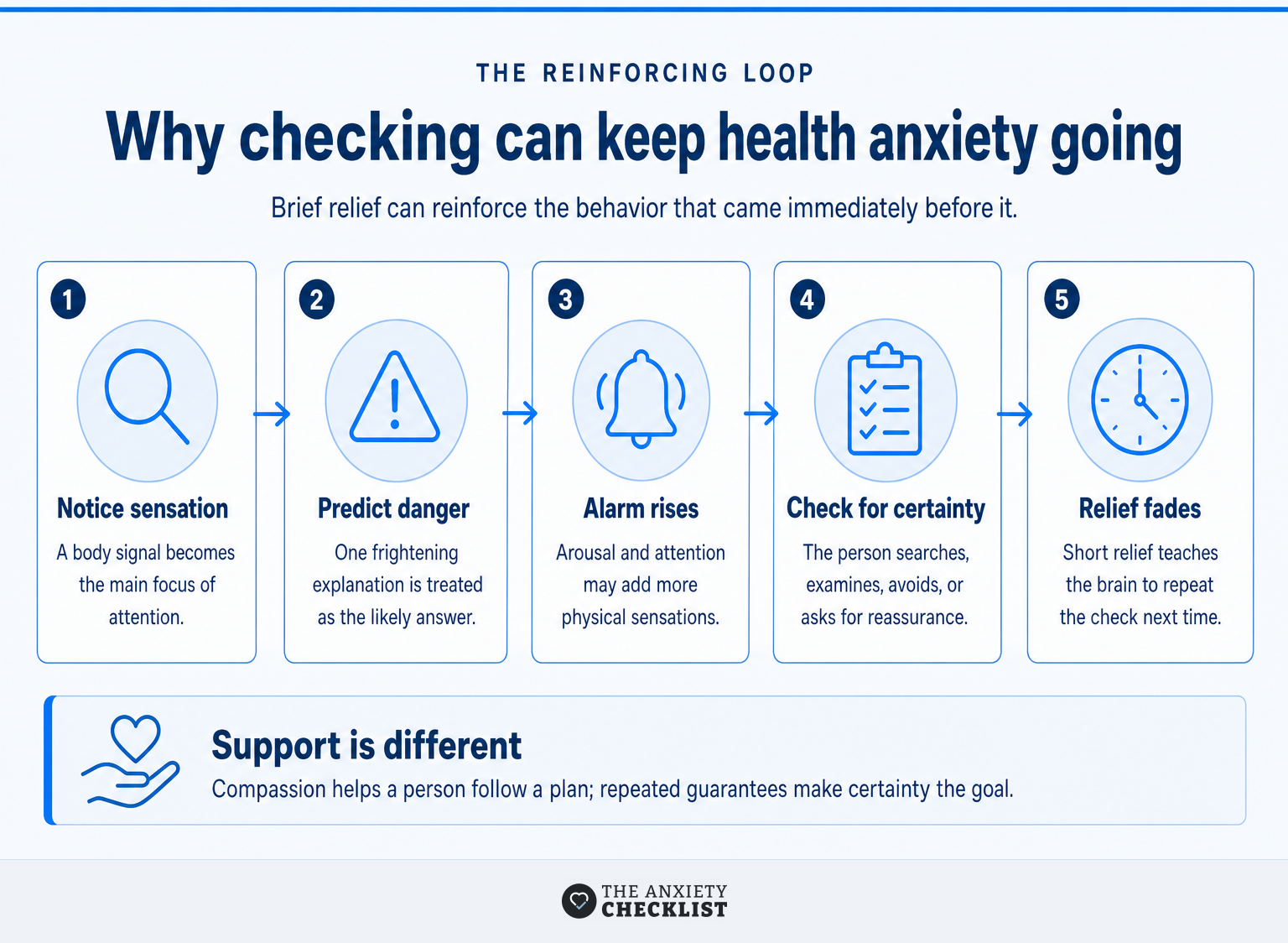
Health anxiety often continues because a sensation, a frightening interpretation, physical arousal, and a safety behavior repeatedly reinforce one another. Checking or reassurance may lower fear briefly, but the short relief can teach the brain to repeat the same response next time.
The loop commonly follows this shape:
- A sensation is noticed. It may be new, familiar, mild, or difficult to describe.
- The mind predicts danger. One possible explanation becomes treated as the likely or only explanation.
- Anxiety rises. Heart rate, breathing, muscle tension, and attention change, potentially adding more sensations.
- A safety behavior follows. The person checks the body, searches symptoms, asks for reassurance, avoids activity, or repeats a test.
- Relief arrives briefly. Because checking came before relief, checking feels necessary the next time uncertainty appears.
The Western Australian government’s Centre for Clinical Interventions health-anxiety workbook addresses focused attention, unhelpful interpretations, checking, reassurance seeking, avoidance, and other safety behaviors as maintaining factors. Its material also notes that repeated physical checking can sometimes produce additional soreness or irritation.
Compassionate support is not the same as repeated certainty seeking. Asking someone to stay present while anxiety settles or help follow an existing care plan is support. Repeatedly asking another person to guarantee that a feared illness is impossible places certainty at the center of the interaction, and certainty rarely lasts.
CBT works on the whole pattern rather than arguing that a symptom is fake. The guide to CBT for health anxiety explains how thought evaluation, reduced checking, response prevention, and a gradual return to avoided activities can address the reinforcing cycle.
Short-term certainty can reinforce long-term monitoring, which is why the response to a sensation matters.
What can you do without turning this into reassurance?
The practical goal is to change the response to uncertainty, not to prove through self-analysis that anxiety caused a symptom. A brief response log can help if it records the interpretation and behavior without becoming a continuous symptom diary.
Use one entry for one episode:
- Describe the situation and sensation neutrally. Use one sentence and avoid repeatedly examining the body to make the description more precise.
- Write the first meaning your mind assigned. Record the feared conclusion without treating it as an established fact.
- Name the urge. Examples include searching, touching the area, comparing sides, asking someone for certainty, or avoiding an ordinary activity.
- Choose a planned response. Follow any medical care plan already provided, reduce an unnecessary check, and return attention to the next ordinary task when it is appropriate to do so.
- Review the pattern later. Ask whether the response increased or decreased repeated monitoring, rather than grading whether the sensation disappeared.
Do not record the symptom every few minutes, build a growing disease checklist, or repeatedly rewrite the “balanced” answer until it feels completely certain. Those actions can turn journaling into another safety behavior.
A May 2026 network meta-analysis examined 35 randomized trials involving 3,263 adults with substantial health anxiety. CBT and several related psychological approaches showed significant effects compared with a waiting-list control, while component analysis linked exposure and response prevention, cognitive restructuring, and mindfulness with improved outcomes. A self-help journal can practice parts of this process, but it is not equivalent to individualized treatment.
To practice a structured thought record, use the CBT Thought Journal as a self-help tool for separating sensations, interpretations, urges, and alternative responses. It does not diagnose a symptom or replace medical or mental health care.
A useful self-help record tracks the interpretation and response, not every fluctuation in the body.
When should you get professional or medical help?

Use medical care for medical uncertainty and mental health care for a recurring health-anxiety cycle; sometimes both are appropriate. An article cannot determine whether anxiety, a health condition, or several factors caused a particular symptom.
Seek urgent local medical help if the situation appears to be an emergency. For nonurgent symptoms that are new, persistent, changing, or concerning, follow local health guidance or contact an appropriate medical professional rather than relying on an anxiety explanation from the internet.
When a clinician has already assessed a recurring concern, ask for a clear follow-up plan. Useful questions include what changes should prompt another appointment, what monitoring is medically necessary, and which repeated checks can be reduced. A plan creates boundaries without assuming that every future sensation is harmless or dangerous.
Seek mental health support when health fears interfere with sleep, work, relationships, activity, or medical decision-making, or when checking and reassurance take up substantial time. The NHS recommends contacting a health professional when health worries prevent normal life or self-help is not working, and identifies CBT as a possible treatment.
This article provides general education, not diagnosis, treatment, or emergency care.
What else do people ask about health-anxiety symptoms?
These questions often use words such as “real,” “false,” and “fake” to ask about the same uncertainty. The safest answers validate the physical experience without claiming to know the cause of an individual symptom.
Can health anxiety cause real symptoms?
Yes. Health anxiety can trigger or intensify genuine physical sensations through nervous-system arousal, muscle tension, breathing changes, digestive changes, and heightened attention to the body. The experience is real, but the sensation alone cannot identify its cause, so anxiety should not be used to dismiss a symptom without appropriate medical judgment. NHS guidance
How can I stop health anxiety from ruining my life?
Start by targeting the cycle rather than trying to obtain perfect certainty. Reduce repeated body checking, symptom searches, and reassurance requests gradually; record the feared interpretation; return to planned activities; and seek CBT or another evidence-based treatment if worry is taking over daily life. Medical questions still belong with a qualified clinician. CCI workbook
Can hypochondria cause false symptoms?
What people used to call hypochondria can involve real bodily sensations, normal sensations noticed more intensely, or sensations amplified by anxiety. Calling them false is misleading because the experience is genuine. The more useful question is how the sensation, interpretation, attention, and checking behavior are interacting, while leaving medical diagnosis to a clinician. 2024 review
Can anxiety make you have fake symptoms?
Anxiety can produce or amplify physical sensations, so “fake” is not an accurate description. Stress hormones, faster breathing, tense muscles, gut changes, and close body monitoring can all affect sensation. However, no online explanation can establish that anxiety caused a particular symptom or rule out a medical condition. MedlinePlus
The safest answer keeps two truths together: anxiety can create real sensations, and a specific symptom still cannot be diagnosed online.
What is the next useful step?
Pick one link in the health-anxiety loop that can be changed without trying to settle the diagnosis alone. Record the sensation once, identify the frightening interpretation and checking urge, then choose the response already supported by an appropriate care plan.
The aim is not to feel completely certain before continuing the day. It is to make one deliberate response that does not hand every new sensation control of attention, behavior, and time.
The next useful move is to change one response in the loop, not to force certainty about every sensation.