


In short
Anxiety can cause sleep loss by keeping the brain and body alert, while lost sleep can make anxiety feel sharper the next day. The cycle is usually interrupted by reducing sleep effort: stop checking the clock, leave bed when wakefulness becomes a struggle, keep a steady wake time, and seek assessment if the pattern persists.
Key takeaways
- Anxiety and sleep loss can reinforce each other, but one poor night does not establish an anxiety disorder or chronic insomnia.
- A 2024 meta-analysis combined 1,338 effect sizes from 154 studies involving 5,717 participants and found that experimental sleep loss increased anxiety symptoms.
- Clock checking can increase presleep worry, perceived time awake, and pressure to fall asleep.
- When wakefulness becomes frustrating, use sleepiness and your state of mind rather than a timed clock check to decide when to leave and return to bed.
- Chronic insomnia generally involves sleep difficulty at least three nights a week for three months or longer, with daytime effects despite adequate opportunity for sleep.
Table of contents
- Why is my anxiety making me lose sleep?
- Does sleep deprivation cause anxiety?
- Why does trying harder to sleep make the problem worse?
- What should you do when you are awake and anxious at night?
- Which next-day habits keep the anxiety-sleep cycle going?
- How can you challenge catastrophic predictions after a bad night?
- Is this temporary sleep disruption or chronic insomnia?
- What treatment helps when the cycle keeps returning?
- What else do people ask about anxiety and sleep loss?
- What is the next step tonight?
One poor night can create two problems: the actual fatigue and the prediction that the next night must go perfectly. Separating those problems makes the cycle easier to interrupt, because the response to tiredness is different from the response to fear about sleep.
Why is my anxiety making me lose sleep?
Anxiety can cause loss of sleep because the mind starts treating bedtime, bodily sensations, or tomorrow's demands as threats that require monitoring. That alert state competes with the passive conditions in which sleep normally appears.
What does the anxiety-sleep loop look like?
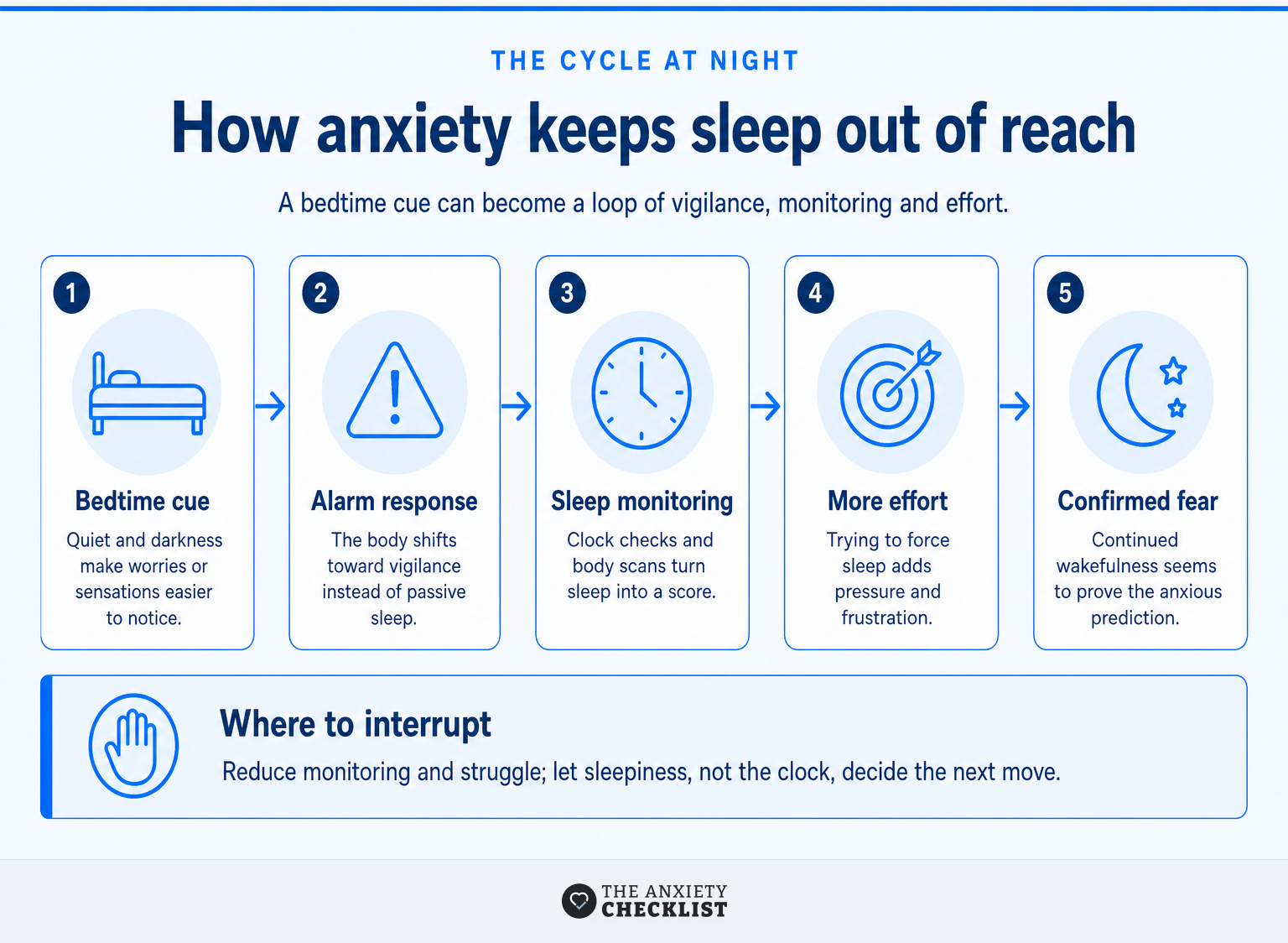
At night, fewer external tasks compete for attention. An unfinished conversation, a physical sensation, or a concern about tomorrow may therefore feel louder than it did during the day.
A cognitive model of insomnia published in 2002 describes how worry about sleep and its daytime consequences can increase arousal, threat monitoring, and distorted estimates of time awake. Continued wakefulness then appears to confirm the original fear.
Common signs of this loop include:
- Feeling sleepy elsewhere but suddenly alert after getting into bed.
- Checking the time and calculating how many hours remain.
- Monitoring the heart, breathing, muscles, or thoughts for signs of anxiety.
- Rehearsing everything that could go wrong the next day.
- Treating each minute awake as evidence that sleep has been lost for the night.
It also helps to distinguish tired from sleepy. Tired can mean depleted, tense, or desperate to rest. Sleepy means that staying awake is becoming difficult. Going to bed because anxiety says it is late enough can produce more time awake if genuine sleepiness has not arrived.
The central problem is often not a lack of tiredness but an alarm-and-monitoring pattern that keeps tiredness from becoming sleepiness.
Does sleep deprivation cause anxiety?
Yes, sleep deprivation can increase anxiety symptoms, especially after extended wakefulness, shortened sleep, or repeated nighttime disruption. It can make threats feel louder and coping feel harder, but it does not automatically create an anxiety disorder.
What does the experimental evidence show?
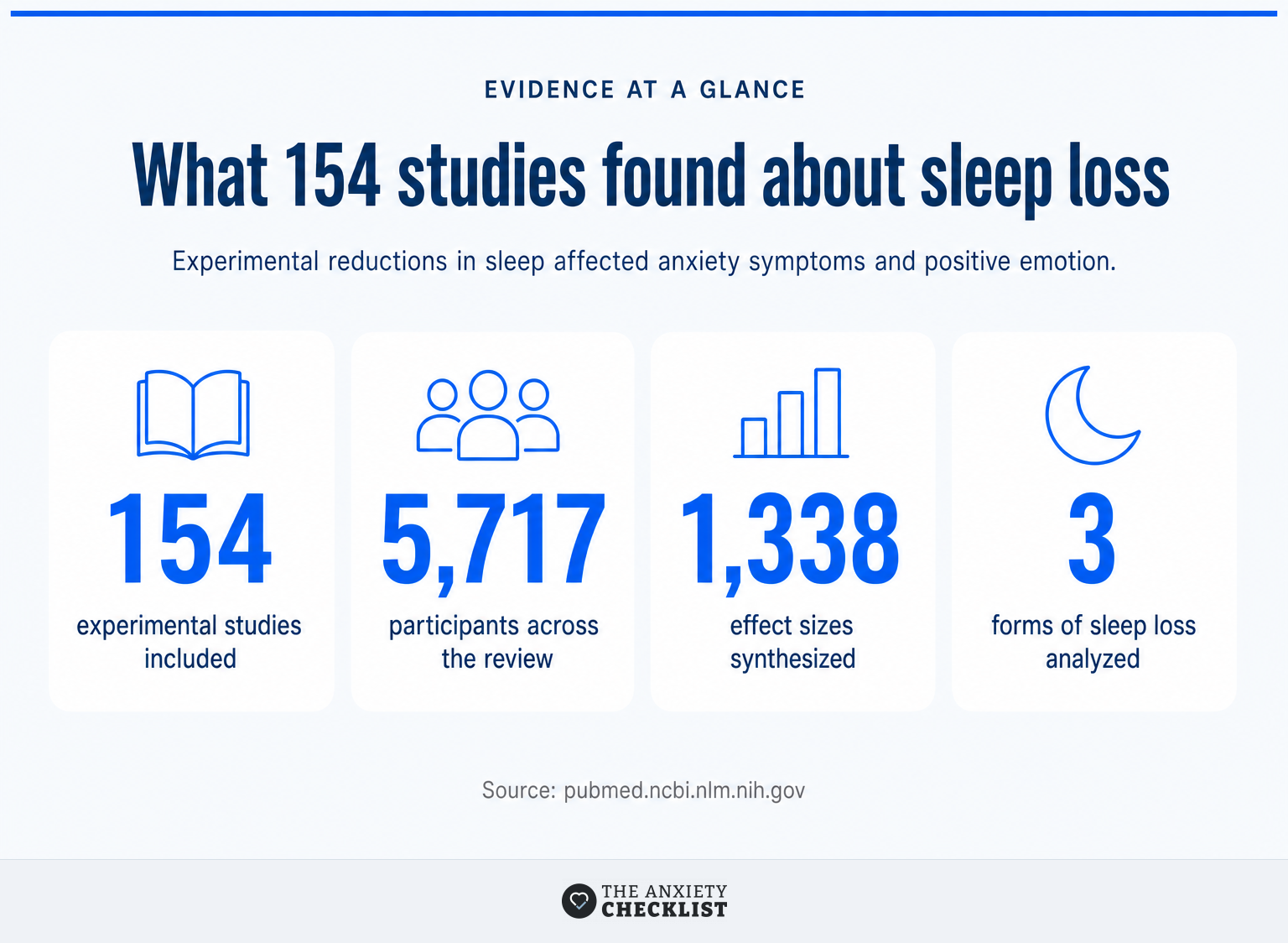
A 2024 systematic review and meta-analysis combined 1,338 effect sizes from 154 studies involving 5,717 participants. Across total sleep deprivation, partial sleep restriction, and sleep fragmentation, sleep loss reduced positive emotion and increased anxiety symptoms.
An earlier 2016 systematic review and meta-analysis included 18 articles and 34 experiments. It found increased state anxiety after total or partial sleep deprivation, but its analysis did not find a significant effect for sleep restriction. The later review used a much larger evidence base and broader emotional outcomes, so the difference should not be reduced to a claim that every form of sleep loss affects everyone identically.
After a poor night, anxiety may show up as irritability, restlessness, stronger reactions to uncertainty, difficulty concentrating, or greater attention to physical sensations. Those changes can feel alarming, but an increase in symptoms is not proof of permanent harm or a diagnosis that appeared overnight.
Poor sleep can amplify anxiety the next day, but amplification is not the same as a new disorder or permanent damage.
Why does trying harder to sleep make the problem worse?
Trying harder to sleep can backfire because sleep is not a voluntary performance. Monitoring progress, demanding a result, and predicting disaster increase mental effort at the exact time the brain needs less engagement.
When does sleep become a performance?
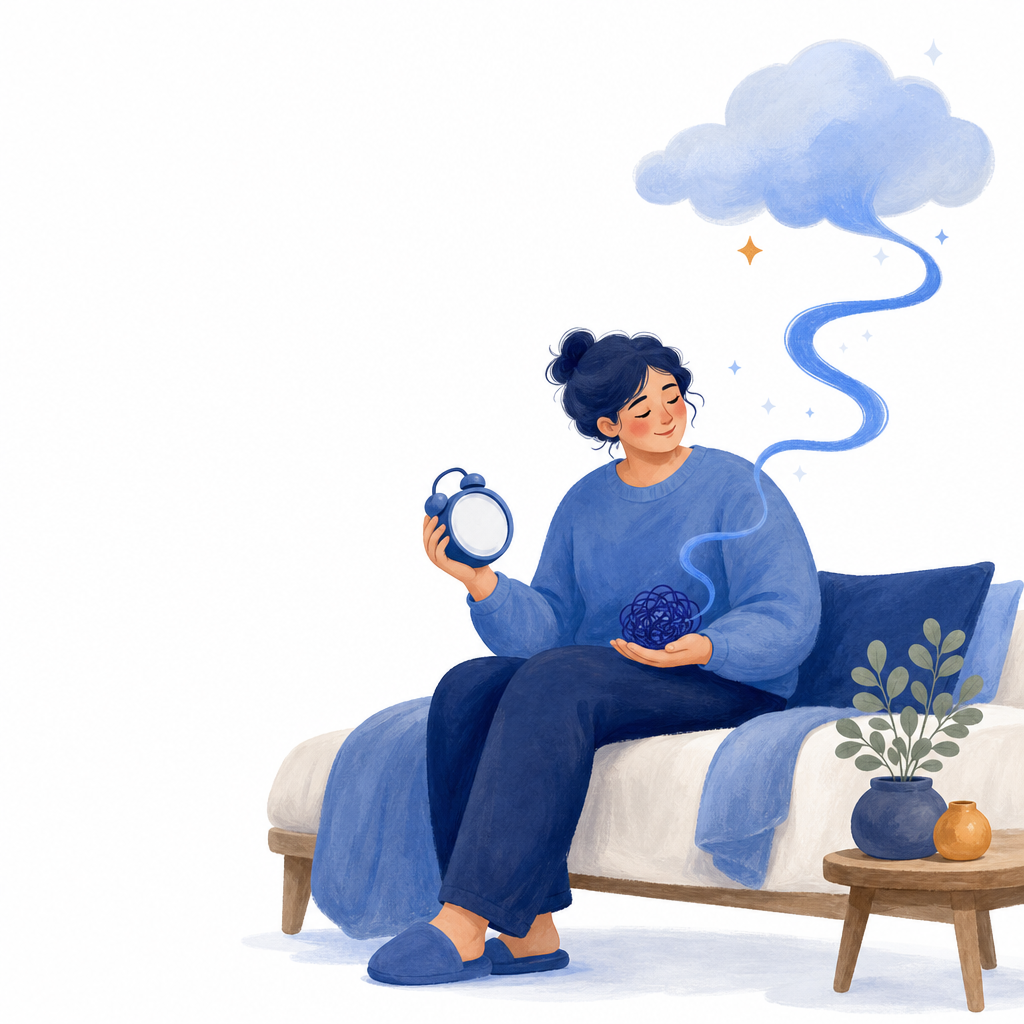
A 2024 scoping review of sleep effort defines sleep effort as conscious cognitive and behavioral attempts to initiate sleep. Sleep effort may look like:
- Repeatedly asking whether a relaxation exercise is working.
- Trying to suppress every thought.
- Staying in bed because getting up feels like admitting defeat.
- Calculating the consequences of each passing hour.
- Searching for reassurance that the body can survive the next day.
Clock checking is particularly unhelpful. A 2007 experimental study of clock monitoring found that people instructed to monitor a clock reported more presleep worry and longer sleep-onset estimates than people who did not monitor it.
Relaxation itself is not the problem. The problem begins when relaxation becomes an examination that must produce sleep. A more useful goal is to create reasonable conditions for rest without demanding evidence that sleep is arriving.
Reducing sleep effort means replacing the demand to sleep with conditions that allow sleepiness to return on its own timetable.
What should you do when you are awake and anxious at night?
When wakefulness turns into struggle, stop treating the bed as a place to solve sleep. Turn the clock away, notice whether you are calm or frustrated, and move to a dim, quiet place if the struggle keeps growing.
What is a no-clock response plan?
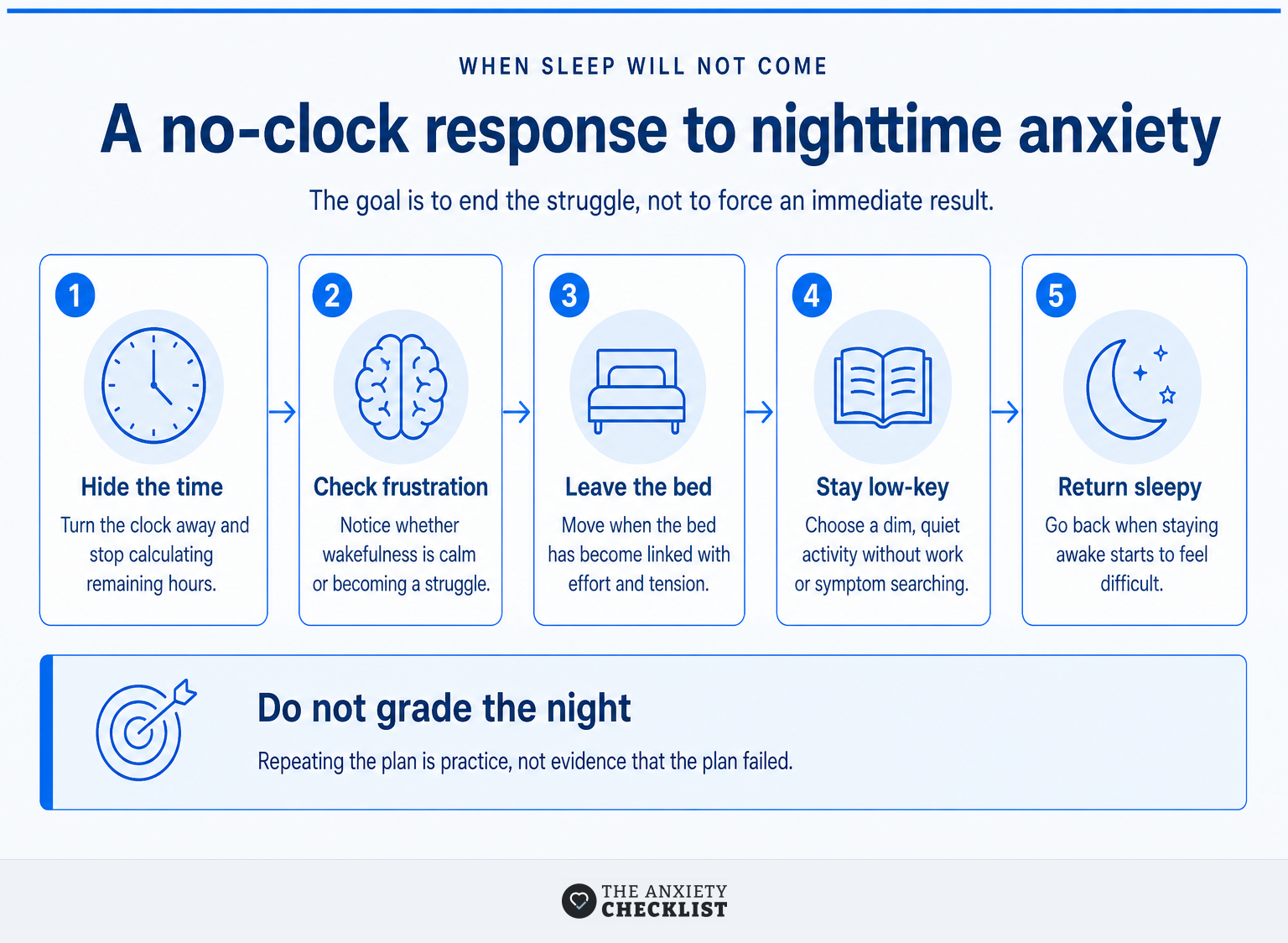
This approach is adapted from stimulus control, one component of CBT-I. VA stimulus-control guidance advises leaving bed when wakefulness becomes a struggle, avoiding clock watching, doing something calming, and returning when sleepy.
- Remove the score. Turn the clock away and stop calculating remaining sleep time. Keep an alarm if needed, but place the display out of sight.
- Check your state, not the minutes. Ask whether you feel quietly awake or increasingly frustrated, tense, and alert.
- Leave when the bed becomes a struggle. Move to another safe, comfortable place if practical. If getting up is unsafe or impossible, sit up or change position to mark the end of the effort to force sleep.
- Choose a low-stimulation activity. Read something calm, listen to quiet audio, fold laundry, or write down the task your mind is trying to remember. Avoid work, news, and repeated symptom searches.
- Return when sleepiness appears. Heavy eyelids and difficulty staying awake are more useful cues than a specific time on the clock.
- Repeat without a postmortem. Another period of wakefulness does not mean the plan failed. The aim is to weaken the bed-frustration association over time.
If physical tension is the main problem, a brief round of progressive muscle relaxation can help identify and release clenched muscles. More options for bedtime and nighttime waking are available in the guide to how to calm anxiety at night.
For guided support during the wind-down period, explore the Anxiety Checklist sleep anxiety app. It includes five guided sleep sessions, lock-screen playback, and optional evening reminders. These are self-help tools, not treatment for persistent insomnia, and they cannot promise sleep on demand.
New or severe chest pain, fainting, major breathing difficulty, or other symptoms that could have a medical cause should not be assumed to be anxiety. Seek appropriate medical care.
The aim of the nighttime plan is not to make sleep happen on command; it is to stop rehearsing wakefulness and fear in bed.
Which next-day habits keep the anxiety-sleep cycle going?
The day after poor sleep matters because emergency recovery habits can reduce sleep pressure and make the next night feel like another test. Keep the day recognizable, get up near the planned time, use morning light, scale tasks rather than canceling everything, and protect safety if you are drowsy.
Which next-day pattern is steadier?
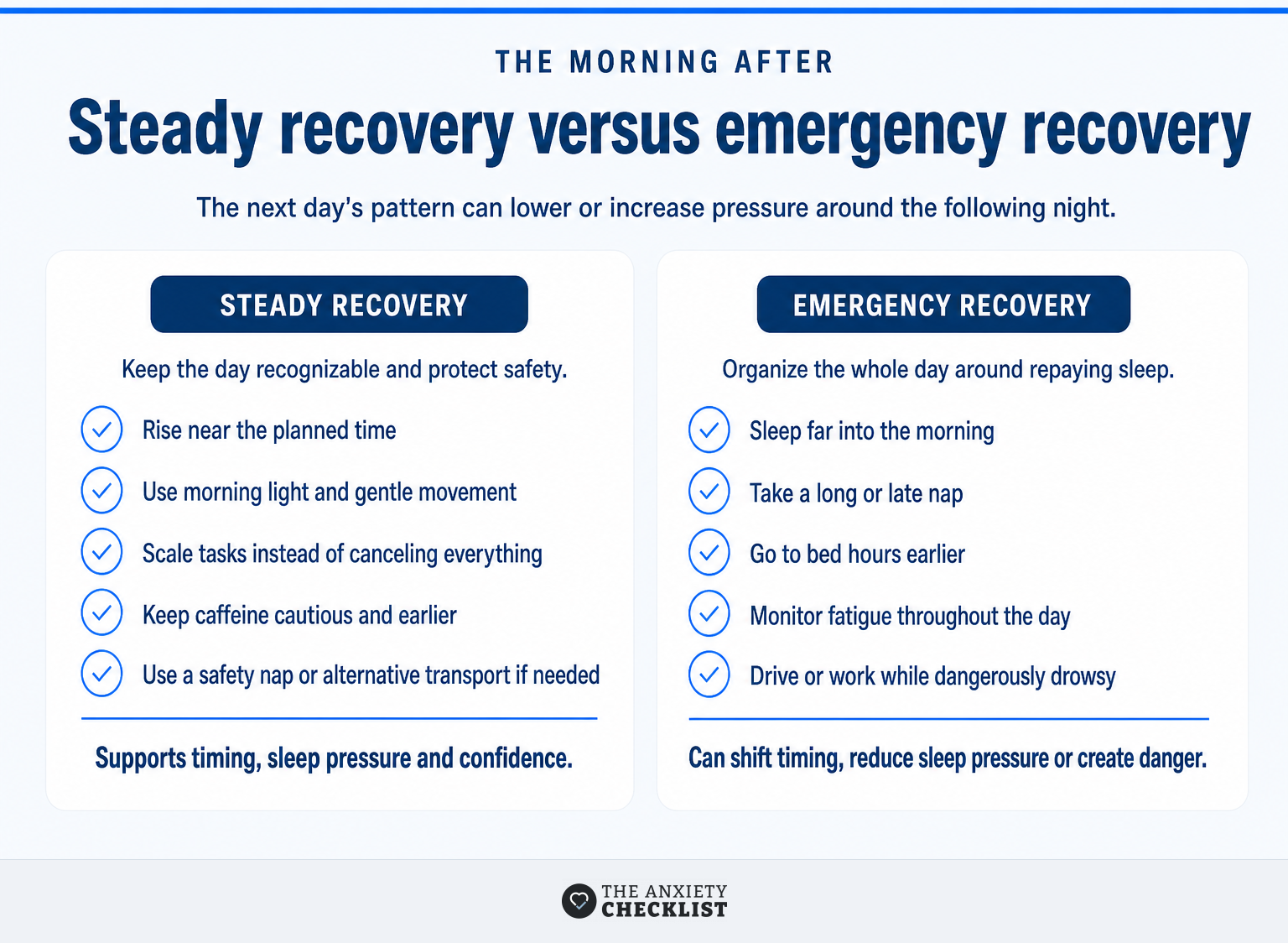
Helpful next-day choices usually include:
- Getting out of bed close to the usual wake time rather than repeatedly resetting the alarm.
- Opening curtains, going outside, or otherwise getting morning light.
- Keeping essential plans while reducing unnecessary demands.
- Using caffeine cautiously and avoiding a cycle of adding more late in the day.
- Avoiding long or late naps when possible.
The habits that often feed the cycle are the understandable attempts to guarantee recovery: sleeping far into the morning, going to bed hours early, staying in bed while awake, taking a long late nap, canceling every activity, and monitoring fatigue all day. These actions can turn one poor night into a full day organized around sleep fear.
Safety overrides any behavioral sleep rule. NHLBI guidance on the health effects of sleep deficiency warns that inadequate sleep can impair focus, reaction time, judgment, and driving. Do not drive or perform hazardous work when struggling to stay awake. A short safety nap or alternative transportation is more appropriate than rigidly following a no-nap plan.
A steady, safe day usually prepares the next night better than an emergency recovery day built around chasing lost sleep.
How can you challenge catastrophic predictions after a bad night?
Catastrophic predictions turn expected tiredness into a forecast of collapse: Tomorrow will be impossible, the body is being permanently damaged, or normal sleep will never return. The useful response is not forced positivity; it is a narrower prediction that can be examined and acted on.
The 2002 cognitive model of insomnia describes worry about daytime consequences as part of the cycle. Anxiety treats uncertainty as certainty, then uses normal fatigue as evidence that the prediction was correct.
Use four questions:
- What is known? Perhaps sleep was shorter than desired and tomorrow may feel harder.
- What is being predicted? Examples include total failure, humiliation, illness, or another guaranteed sleepless night.
- What is a more precise sentence? The day may be slower, but the exact effect is unknown and the most important tasks can be simplified.
- What is the safe plan? Use notes, postpone an optional task, ask for practical help, and avoid driving if drowsy.
A balanced prediction does not claim that fatigue feels good or has no effect. It removes invented certainty. Repeated reassurance searches, constant body checks, and hourly performance reviews can become additional safety behaviors that keep attention fixed on the feared outcome.
A balanced prediction makes room for a difficult day without declaring that the day, the next night, or the future is already ruined.
Is this temporary sleep disruption or chronic insomnia?
A few poor nights during stress are common and are not the same as chronic insomnia. NHLBI diagnostic guidance describes chronic insomnia as difficulty sleeping at least three nights a week for three months or longer, with daytime effects despite adequate opportunity for sleep.
How do the sleep patterns differ?
| Pattern | Typical clues | What it may mean | Reasonable next step |
|---|---|---|---|
| Occasional rough nights | A night or two linked to stress, travel, illness, or schedule change | Normal short-term disruption may be present | Reduce sleep pressure and return to a steady routine |
| Short-term sleep trouble | Difficulty continues for days or weeks and affects daytime functioning | Stress-related or situational insomnia may be developing | Discuss persistent or worsening symptoms with a healthcare professional |
| Possible chronic insomnia | Trouble occurs at least three nights a week for three months or longer | Formal assessment for insomnia and contributing conditions is appropriate | Ask about CBT-I and keep a sleep diary for the clinician |
| Possible other sleep or medical condition | Loud snoring, gasping, strong urges to move the legs, unusual behaviors during sleep, or severe daytime sleepiness | Anxiety may not be the only cause | Seek assessment rather than relying only on calming strategies |
Do not wait for the three-month threshold when symptoms are severe, dangerous, or suggest another condition. Prompt assessment is appropriate for loud snoring or gasping, marked daytime sleepiness, recurrent chest pain, abrupt medication or substance changes, or sleep behaviors that risk injury.
Seek urgent help if sleep loss occurs with thoughts of self-harm, hallucinations, sudden confusion, or a marked period of unusually high or irritable mood with very little need for sleep and risky behavior. NIMH information on bipolar disorder lists decreased need for sleep, racing thoughts, and increased activity among manic-episode symptoms. Contact local emergency services or a crisis line when immediate safety is in question.
Persistent sleep trouble deserves assessment because anxiety, insomnia, medical conditions, medications, substances, and other sleep disorders can overlap.
What treatment helps when the cycle keeps returning?
The best-supported treatment for chronic insomnia is cognitive behavioral therapy for insomnia, or CBT-I, which targets thoughts, bed-wake associations, timing, arousal, and sleep drive. Anxiety-focused treatment may also be needed when daytime worry, panic, trauma symptoms, or fear of sleep are major drivers.
As of October 2026, the 2021 AASM clinical practice guideline strongly recommends multicomponent CBT-I for adults with chronic insomnia. The 2026 AASM combination-treatment guideline conditionally favors CBT-I plus medication over medication alone, but conditionally advises against adding medication to CBT-I rather than using CBT-I alone; both 2026 recommendations are based on low-certainty evidence.
The practical components of CBT-I are explained in more depth in the guide to CBT for sleep anxiety. A trained clinician can adapt those components around shift work, medical conditions, safety-sensitive jobs, pregnancy, mood disorders, or significant daytime sleepiness.
A professional assessment may examine:
- How often the problem occurs and how long it has lasted.
- Anxiety, mood, panic, trauma, and fear-of-sleep symptoms.
- Snoring, breathing interruptions, leg sensations, or unusual sleep behaviors.
- Medications, caffeine, nicotine, alcohol, and other substances.
- The sleep schedule, time awake in bed, naps, and daytime impairment.
Sleep hygiene may support treatment, but the AASM guideline does not recommend sleep hygiene as the only treatment for chronic insomnia. A perfect bedroom routine cannot, by itself, resolve conditioned arousal, catastrophic beliefs, or a strong bed-wake association.
Recurring anxiety and sleep loss are most effectively addressed by treating the maintaining sleep pattern and the anxiety that feeds it, rather than asking either problem to disappear first.
What else do people ask about anxiety and sleep loss?
These questions capture common fears that arise when anxiety and sleep begin reinforcing each other. The answers provide general education, not an individual diagnosis.
Why is my anxiety making me lose sleep?
Anxiety can keep you awake by increasing mental and physical alertness. Worry, body scanning, clock checking, and predictions about tomorrow all tell the brain that bedtime requires vigilance. The resulting effort to force sleep adds more arousal. Reducing monitoring and struggle helps remove fuel from the cycle.
What causes panic attacks before bed?
Panic attacks before bed may be associated with anticipatory fear, attention to bodily sensations, stress, stimulants, or fear of another attack, although some attacks have no obvious trigger. Panic can also occur during sleep. New or severe chest pain, fainting, or breathing difficulty needs medical assessment rather than self-diagnosis.
Why do I feel like if I go to sleep I won't wake up?
The fear that sleep will be unsafe is an anxiety prediction, not evidence that danger is present. It can grow after panic, nightmares, illness anxiety, or a frightening sleep experience. If the fear causes persistent bedtime avoidance or accompanies snoring, gasping, fainting, or other symptoms, seek professional assessment.
How to calm restlessness at night?
Calm nighttime restlessness by turning the clock away, loosening tense muscles, and dropping the demand to sleep immediately. If frustration grows, leave the bed for a dim, quiet activity and return when sleepy. Avoid work, news, and repeated symptom checks. Seek care when restlessness is persistent, severe, or medically unexplained.
The common thread across these questions is that fear deserves a calm response, while persistent, severe, or medically concerning symptoms deserve assessment.
What is the next step tonight?
The next step tonight is to remove one source of pressure, not to fix sleep permanently. Turn the clock away, choose the place and quiet activity to use if struggle grows, and decide on a reasonable wake time before getting into bed.
If sleep comes, let it come without checking whether the plan worked. If sleep does not come quickly, follow the plan without turning wakefulness into an emergency.
The goal tonight is one less turn of the anxiety-sleep loop.