


You're at your desk, behind the wheel, or standing in your kitchen when your chest suddenly feels tight. Your breathing changes, your shoulders tense, and one frightening thought takes over: “Is this anxiety, or is something seriously wrong?” That fear is real, but it doesn't have to control your next decision.
Chest tightness can happen during panic, yet it can also signal a heart problem. The safest approach is neither instant reassurance nor automatic catastrophizing. Use a clear triage process, calm your body only when the symptoms fit a low-risk pattern, and get medical help when warning signs appear. With the right support and consistent practice, healing from anxiety and living panic-free is possible.
Table of Contents
- When Chest Tightness Strikes and You Need Answers Now
- Spotting Emergency Red Flags and Making Smart Decisions
- Immediate Calming Techniques That Work in Real Time
- Understanding the Difference Between Panic and Cardiac Chest Tightness
- Short-Term Recovery Strategies for the Hours After an Episode
- Building Long-Term Resilience and Living Panic-Free
- Your Personalized Action Plan for Chest Tightness Episodes
When Chest Tightness Strikes and You Need Answers Now
Maya noticed the pressure during a meeting. She'd slept poorly, rushed through breakfast, and drank more caffeine than usual. As her chest tightened, she stopped hearing the conversation and started scanning her body for danger. She wanted to leave, call someone, and search every symptom at once.
That reaction is common during panic. Chest discomfort appears in a substantial share of panic attacks, and one clinical review reported chest discomfort in 22% to 70% of panic attacks, while one study found chest pain reported by 28.5% of patients during panic attacks, as summarized in NICE's surveillance evidence. But those figures don't make a new or alarming symptom safe to dismiss.
Start with one grounded question: Do I have an emergency warning sign right now? If you do, call emergency services. If you don't, sit down, stop driving, loosen restrictive clothing, and follow a brief calming routine while arranging appropriate medical advice when needed.
Your fear deserves compassion, and your symptoms deserve sensible triage.
You can prepare before the next episode by saving an anxiety checklist and writing down your personal warning signs, known triggers, medications, and emergency contacts. Preparation reduces frantic decision-making when your mind feels overloaded. If you're considering medication for panic, review anxiety attack medication risks with a qualified clinician rather than taking someone else's prescription or changing a prescribed dose on your own.
The goal isn't to prove that every sensation is harmless. It's to respond intelligently, protect your health, and remember that one frightening episode doesn't define your future.
Spotting Emergency Red Flags and Making Smart Decisions
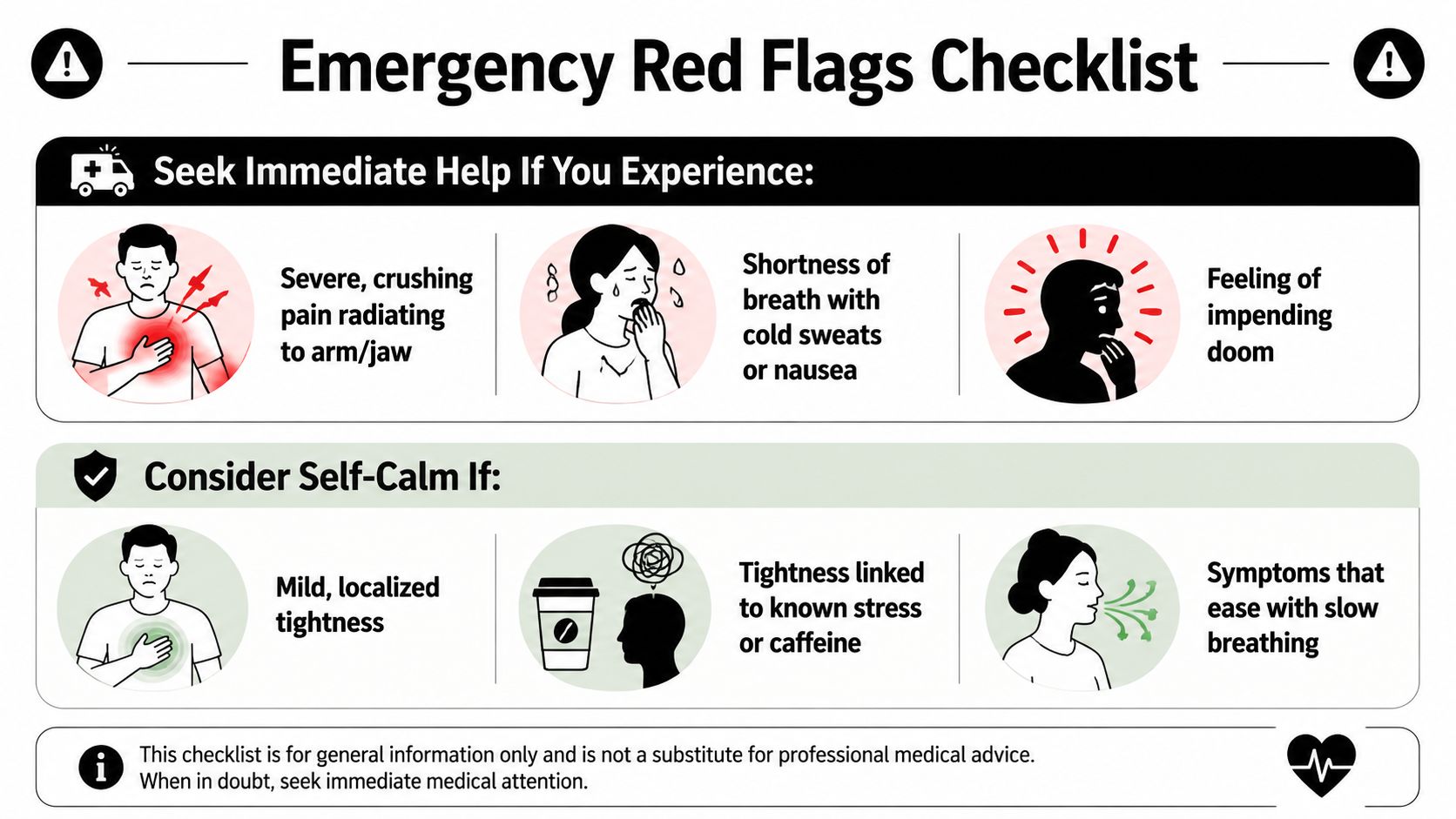
Chest tightness becomes an emergency when it's sudden, pressure-like, persistent, or paired with symptoms that suggest reduced blood flow or serious breathing trouble. NICE identifies chest pain lasting longer than 15 minutes, or pain accompanied by nausea, vomiting, marked sweating, or breathlessness, as potentially indicating acute coronary syndrome. Stable angina is typically relieved by rest or glyceryl trinitrate within about 5 minutes, but you shouldn't use that pattern to dismiss unfamiliar symptoms.
Call for immediate help
Call emergency services immediately if the tightness spreads to your arm, jaw, neck, back, shoulders, or upper abdomen, or if it comes with shortness of breath, sweating, nausea, light-headedness, fainting, or severe difficulty breathing. NHS guidance describes angina as tightness, squeezing, or pressure that can spread through these areas, and advises urgent help when sudden chest discomfort doesn't go away or occurs with those associated symptoms. You can review the full NHS chest pain guidance for the warning signs, but don't delay emergency care to read more.
New, unexplained chest pain also warrants urgent medical attention. MedlinePlus advises emergency help if nitroglycerin-treated pain isn't better after 5 minutes, or isn't gone after 3 doses, but only follow a nitroglycerin plan prescribed for you.
Use self-calming only when the pattern supports it
If the tightness is mild, localized, connected to a familiar stress response, and already easing, stop exertion and begin slow breathing. Don't drive yourself if symptoms are intense or uncertain. If chest pain, an irregular heartbeat, or ongoing sickness remains after about 20 minutes of slow breathing, seek medical advice rather than repeating self-treatment, based on the panic literature summarized in the clinical evidence.
For a simple decision aid, open The Anxiety Checklist guide. First-time symptoms, symptoms that worsen, symptoms triggered by exertion, or symptoms in someone with heart-risk factors deserve prompt medical assessment even when anxiety seems likely.
Immediate Calming Techniques That Work in Real Time
Once emergency warning signs have been ruled out, stop trying to force the sensation away. Your job is to lower the alarm response gradually. Sit with your back supported, place both feet on the floor, and let your shoulders drop.
Start with slower breathing
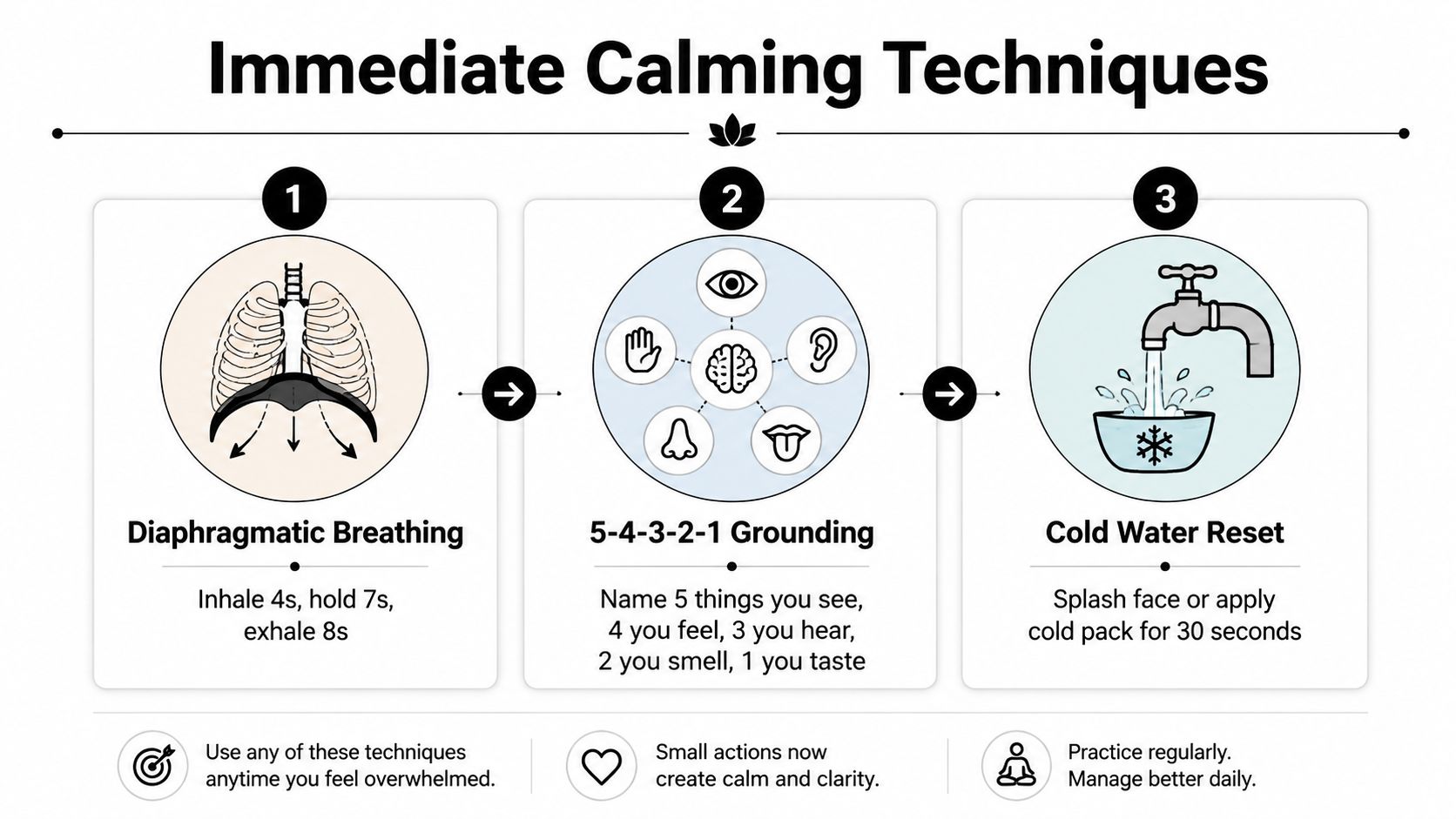
Place one hand on your upper chest and one on your abdomen. Breathe in gently through your nose for 4 seconds, hold for 7 seconds, then breathe out slowly for 8 seconds. If holding your breath feels uncomfortable, shorten the hold and keep the exhale smooth. The priority is a controlled, unforced rhythm, not perfect counting.
Diaphragmatic breathing can help reduce overbreathing and give your nervous system a less threatening signal. The research isn't definitive, however, so persistent or unusual symptoms still need medical evaluation. For more guidance on breathing techniques for emotional regulation, choose an approach you can repeat without straining.
Give your attention a safer target
Use the 5-4-3-2-1 grounding exercise. Name five things you see, four things you feel physically, three things you hear, two things you smell, and one thing you taste. Say each item aloud if possible. This interrupts the habit of repeatedly checking your pulse, chest, or breathing.
A cold-water reset can add another sensory anchor. Splash cool water on your face or apply a cold pack briefly, then return to ordinary breathing. Don't use cold exposure as a substitute for emergency care.
Calm is a skill you practice, not a test you pass during one perfect episode.
If your thoughts are racing, use one sentence: “This sensation is uncomfortable, and I'm taking the next safe step.” You can also follow a guided routine that helps you breathe away anxiety naturally. Practice these methods when you're already calm, because familiar actions are easier to access during panic.
Understanding the Difference Between Panic and Cardiac Chest Tightness
Panic and cardiac chest tightness overlap enough that symptoms alone can't always identify the cause. NICE surveillance evidence notes that chest tightness is a classic feature of both panic attacks and angina. In one emergency-transport study, 18,971 of 77,604 urgent ambulance dispatches, or 24.4%, involved chest pain, and 1,969 of those cases, or 10.4%, were later diagnosed as acute myocardial infarction in hospital, as reported in the same evidence summary.
Use patterns to inform your decision, not to diagnose yourself. A first episode, a change from your usual panic pattern, exertion-related tightness, or symptoms with cardiac risk factors should be assessed by a clinician.
| Feature | Panic/Anxiety Pattern | Cardiac Pattern |
|---|---|---|
| Typical trigger | Stress, fear, overstimulation, or no obvious trigger | Often exertion or physical strain, though symptoms can vary |
| Sensation | Tightness may occur with racing thoughts, tingling, trembling, derealization, or fear of losing control | Pressure, squeezing, or heaviness may spread to the arm, jaw, neck, back, or shoulders |
| Course | Often rises quickly and begins easing as the alarm response settles | May persist, recur, worsen with activity, or occur with sweating, nausea, faintness, or breathlessness |
| Best response | Slow breathing and grounding may reduce the intensity | Rest and prescribed treatment may help, but persistent or unfamiliar symptoms require urgent assessment |
NHS guidance describes angina as pressure, squeezing, or tightness that can radiate beyond the chest, while NICE's evidence summary emphasizes that similar sensations occur in panic. That's why duration, associated symptoms, and context matter more than the word “tightness” alone.
A symptom diary can reveal patterns your clinician needs: what you were doing, how suddenly it began, what accompanied it, and whether rest changed it. To compare anxiety and panic attacks, focus on recurring patterns without using the comparison as a reason to ignore danger. When panic is the established explanation and medical causes have been addressed, you can browse panic attack support for structured coping ideas.
Short-Term Recovery Strategies for the Hours After an Episode
The hours after chest tightness often bring a second wave of fear. You may feel tired, watchful, and reluctant to move in case the sensation returns. Treat that period as recovery time, not proof that another episode is inevitable.
Begin with basic physical care. Drink water, eat something simple if you haven't eaten, and avoid adding stimulants while your body is already activated. Skip strenuous exercise until you understand the episode and feel physically settled, but don't spend the entire day motionless and monitoring yourself.
Let your body return to ordinary activity
Take a gentle walk if you have no concerning symptoms and movement feels safe. Stretch your neck, jaw, shoulders, and upper back without forcing any area. Return to normal tasks gradually, rather than treating every heartbeat or breath as an emergency signal.
Write a short factual account of what happened. Record the situation, sensations, thoughts, actions, and outcome. This turns a frightening blur into useful information and helps separate “I felt danger” from “danger was confirmed.”
If you need to tell a colleague or family member, keep the explanation straightforward: “I had a chest-tightness episode, I checked for warning signs, and I'm taking sensible steps now.” Ask for practical support, such as sitting nearby or helping with a task, rather than repeated reassurance checks.
Don't cancel every future meeting, journey, or errand because panic appeared once. Avoidance teaches the brain that the situation was dangerous. Resume ordinary activities in manageable steps, and seek professional help if fear keeps shrinking your work, driving, caregiving, sleep, or social life.
Building Long-Term Resilience and Living Panic-Free
Immediate coping matters, but it shouldn't become your entire strategy. If you constantly battle every sensation, your brain may keep treating normal body changes as threats. Long-term recovery comes from changing the beliefs and avoidance patterns that keep the alarm system active.
Cognitive behavioral therapy tools are especially practical. Thought journaling helps you identify predictions such as “tightness means I'll collapse.” A belief experiment tests that prediction carefully. Gradual exposure lets you approach avoided sensations or situations in planned steps, without using escape as the only way to feel safe.
The aim isn't to guarantee that you'll never feel anxious again. It's to teach your brain that anxiety can rise and fall without dictating your choices. Consistent repetition matters more than dramatic breakthroughs.
The Anxiety Checklist can sit alongside therapy or medical care as a self-guided option. Its tools include thought journaling, belief experiments, exposure therapy, guided meditations, sleep audios, hypnosis sessions, walking sessions, affirmations, and expert-led education such as the PanicFree Masterclass and CBT material from Dr. Joshua Shifrin, PhD. You can also learn about anxiety and panic attacks through its educational library.
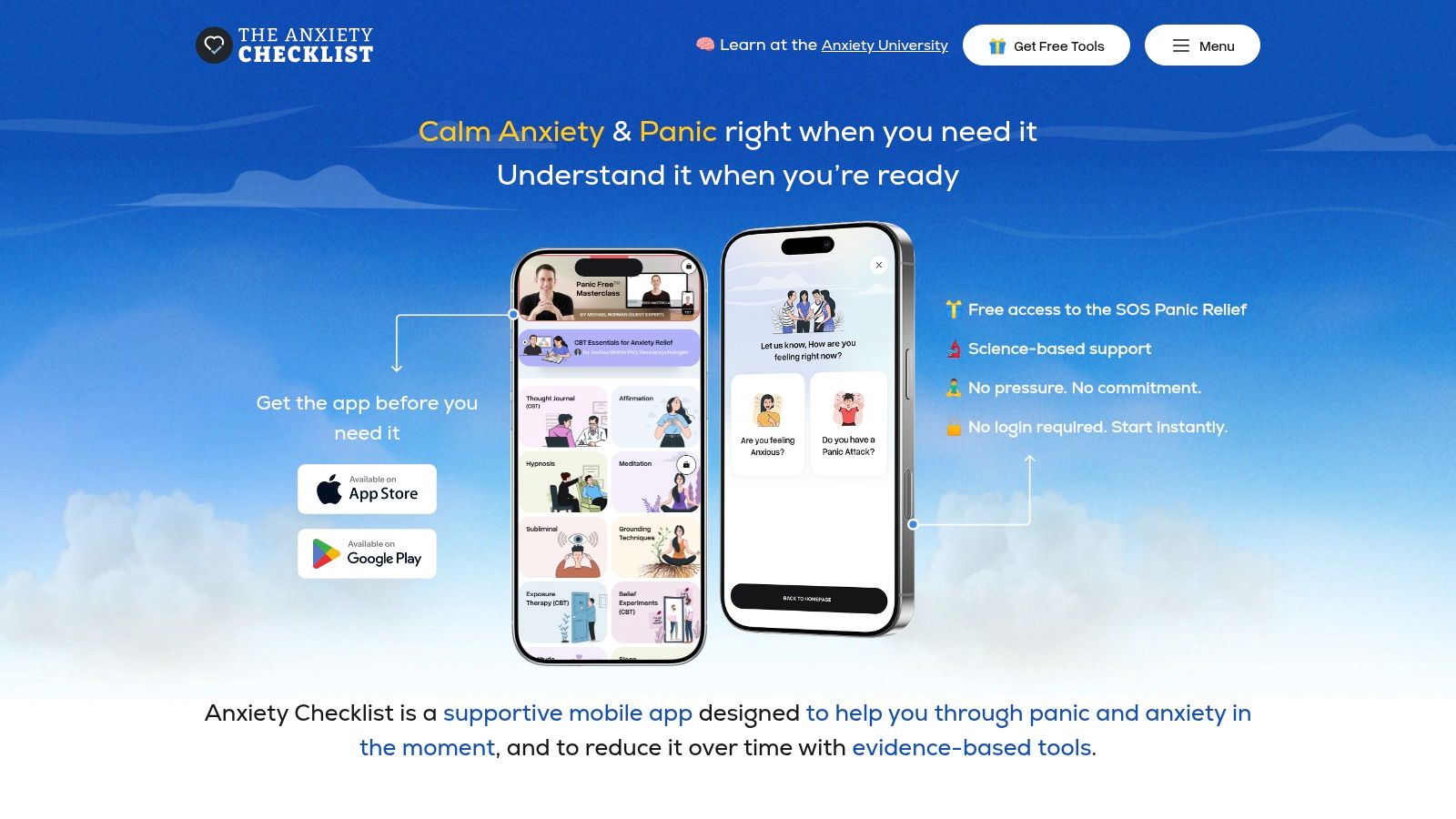
Use app-based support as a bridge, not as a replacement for urgent medical care or individualized treatment. If panic remains frequent, causes major avoidance, or comes with depression, substance use, or thoughts of self-harm, contact a qualified mental health professional. You don't have to wait until anxiety becomes unbearable to ask for help.
Your Personalized Action Plan for Chest Tightness Episodes
Remember Assess, Calm, Recover.
Assess
Stop what you're doing and check the emergency pattern. Is the discomfort sudden, pressure-like, persistent, spreading, or paired with breathlessness, sweating, nausea, faintness, or severe difficulty breathing? If yes, call emergency services. If the episode is new, worsening, exertional, or medically uncertain, arrange prompt evaluation rather than relying on an anxiety explanation.
Calm
Only after the emergency check, sit down and slow your breathing. Use the diaphragmatic rhythm, 5-4-3-2-1 grounding, a steady phrase, or a guided exercise. Don't repeatedly measure, search, or ask for reassurance while the technique is working. Give your body a quiet opportunity to settle.
Recover
Drink water, reduce stimulation, record what happened, and return gradually to ordinary activity. Contact your clinician if symptoms persist, recur, or don't match your established panic pattern. A medical evaluation can provide clarity, while therapy can address the fear cycle that keeps episodes returning.
Common questions deserve direct answers. Tell trusted people what support looks like, such as sitting with you or helping you reach care. At work, step somewhere safe, stop driving or operating equipment, and use your written plan. Consider therapy when panic affects your choices, and discuss medication only with a qualified prescriber who knows your history.
Chest tightness can be frightening without being permanent. You can learn to recognize danger, calm a sensitized nervous system, and rebuild trust in your body. Panic-free living is a realistic direction, not a fantasy.
The Anxiety Checklist offers an always-free SOS mode with grounding prompts, affirmations, and quick guidance for moments when your mind goes blank, plus longer-term tools for anxiety recovery. Visit The Anxiety Checklist and save it before your next episode so practical support is ready when chest tightness strikes.