

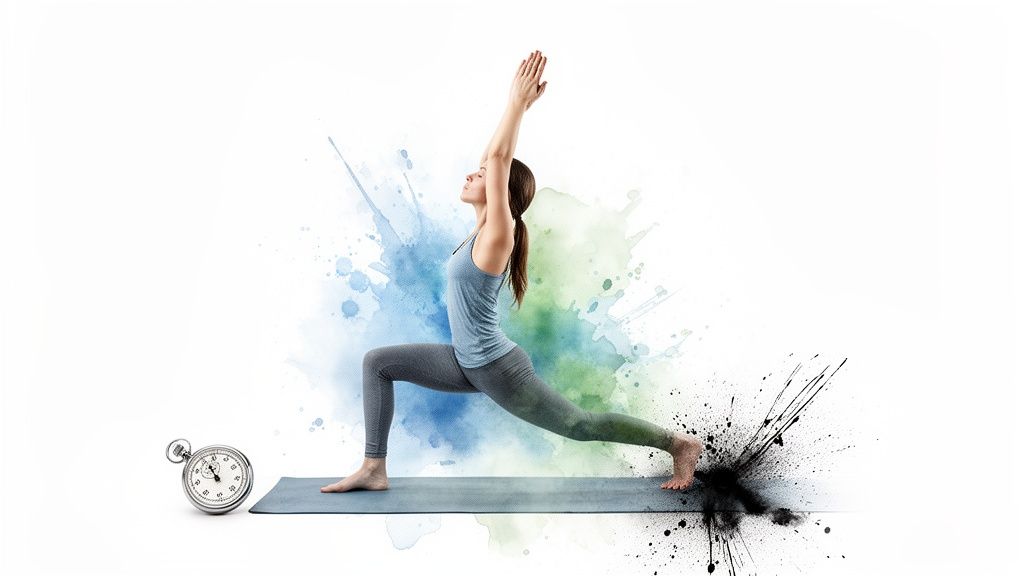
A practical, effective 30 minute workout routine could be the very thing you need to start healing from anxiety. It’s a simple plan that combines physical movement with mental grounding to help you build resilience and discover that a life free from panic is possible. And it only takes up 2% of your day—a small commitment with the power to create profound, lasting change.
Your Path to a Calmer Mind Starts Here
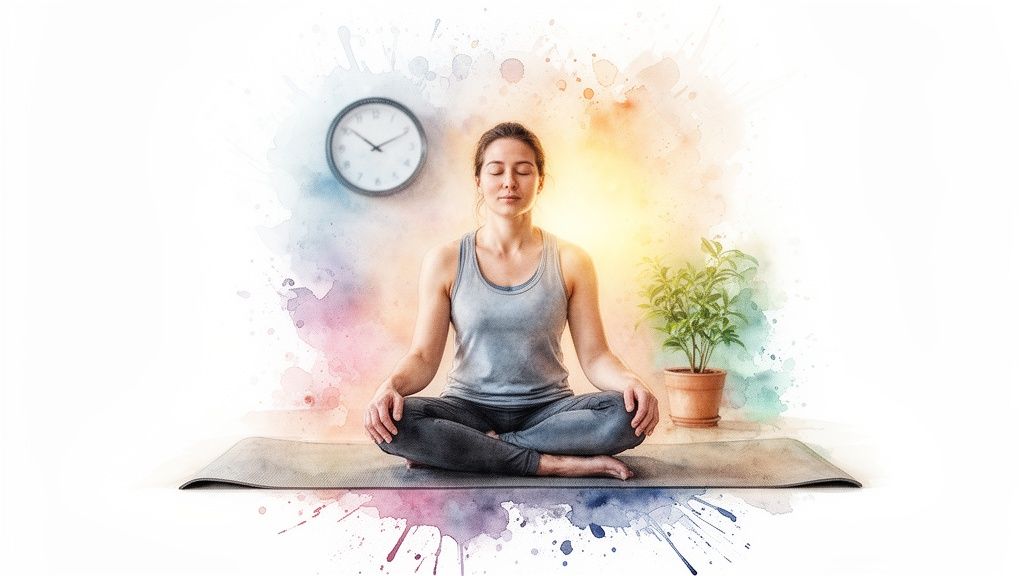
When anxiety has its grip on you, it can feel like you're trapped. The crushing weight of anxious thoughts has a way of convincing you that you’re stuck forever and that feeling better is out of reach. But what if you could find a sense of control and hope again in just 30 minutes?
This guide is designed to give you exactly that: hope, wrapped in a plan you can actually follow.
We’ve put together a manageable 30 minute workout routine that does double duty. It's not just about getting fit; it's a powerful tool on your journey to healing, designed to help you live a life with less panic and more peace. This is your first step toward forgetting the myth that you need hours in the gym to make a real difference.
Think of this routine as partnering with your body to find relief, build confidence, and heal. It’s not about pushing through pain or adding another stressful task to your plate. It's a genuine investment in your own healing journey.
Overcoming the First Hurdle
The biggest challenge with anxiety isn't always the physical symptoms. It's the mental roadblocks—fear, low motivation, and a sense of hopelessness—that can stop you from ever getting started. This is where a small, consistent routine becomes your pathway to hope.
Committing to just 30 minutes gives you a realistic starting point. It’s an achievable promise you can make to yourself, a single, concrete step toward believing you can heal. When you frame this workout as a form of self-care, you begin to rewire the belief that anxiety is in control.
Here’s how this approach creates a pathway to healing:
- It Builds Agency: Taking deliberate action proves that you have power over your day and your state of mind. You are not powerless.
- It Creates Tangible Results: You'll feel the immediate mood-lifting effects of movement, providing the positive reinforcement you need to believe that change is possible.
- It Fosters Self-Trust: Each completed session is a deposit in your self-trust bank, building the belief that you can rely on yourself to navigate difficult times and heal.
This isn’t just another workout plan. It’s a foundational practice for anyone looking to heal from anxiety. For those seeking structured tools and cognitive strategies to go along with this physical routine, our comprehensive Anxiety University program offers a deeper dive into living panic-free. Let this guide be the first step on your path to believing that a calmer, more fearless life is truly within your reach.
How Movement Rewires Your Brain for Calmness
When you’re caught in the grip of anxiety, moving your body might feel like the last thing you want to do. But what if I told you that a short workout is one of the most direct ways to communicate with your anxious brain and show it the way back to peace? A 30 minute workout routine isn’t just about getting fit—it's about actively rewriting your body's response to stress and opening the door to healing.
Think of anxiety as your internal alarm system going haywire. It floods your body with stress hormones like cortisol and adrenaline, leaving you in that familiar state of high alert. Exercise is your manual reset button, a tangible way to restore calm.
Shifting your perspective is key. Stop seeing exercise as a chore and start seeing it as a direct way to care for your brain. It's not about punishment; it's about giving your nervous system exactly what it needs to find its way back to calm and begin to heal.
Burning Off Anxious Energy
When you start moving, your body gets to work metabolizing those excess stress hormones. You're literally burning off the nervous energy that fuels anxious thoughts and physical tension. Our Fight Or Flight Response Guide goes deeper into how exercise helps you complete this stress cycle in a healthy, productive way, a crucial step toward healing.
At the same time, your brain releases endorphins—those incredible "feel-good" chemicals. They act as natural mood lifters, creating a sense of calm and clarity that can last for hours. The mental quiet that follows a focused workout is undeniable proof that you have the power to change how you feel and find relief.
The science is compelling. Studies show that just 30 minutes of moderate exercise on most days can make a huge difference in mental health. It’s a manageable commitment with a massive payoff for your well-being.
The Hope in Taking Action
Understanding the "why" behind it all is what turns exercise from something you have to do into something you get to do. It becomes an act of hope—a conscious choice to give your mind and body the tools they need to heal and find balance again.
Every time you finish a short workout, you’re sending your brain a few powerful messages:
- You are safe. The physical feelings of exercise—a faster heart rate, deeper breathing—happen in a controlled context. This teaches your brain that these sensations are not a threat, but a sign of healthy effort.
- You are in control. You made the choice to move your body and do something that makes you feel better. This reinforces your own power and agency in your healing journey.
- You can feel good again. That immediate endorphin rush is tangible proof that relief is accessible. You created it. You can create it again.
This simple act of moving your body is a foundational step toward a life with less panic and more freedom. To see just how profound the connection is, you can explore the surprising link between exercise and anxiety and its power to calm the mind.
Your Complete 30-Minute Anxiety-Relief Workout Plan
Here’s a simple, actionable plan for finding calm in just 30 minutes. This routine is built on a powerful idea: you can partner with your body to quiet your mind. Forget about complicated, grueling workouts. This is all about accessibility, effectiveness, and most importantly, providing a clear path to mental relief and healing.
This 30-minute workout routine is your structured path from anxious energy to intentional calm. The whole process is designed to turn physical movement into a tool for mental peace.
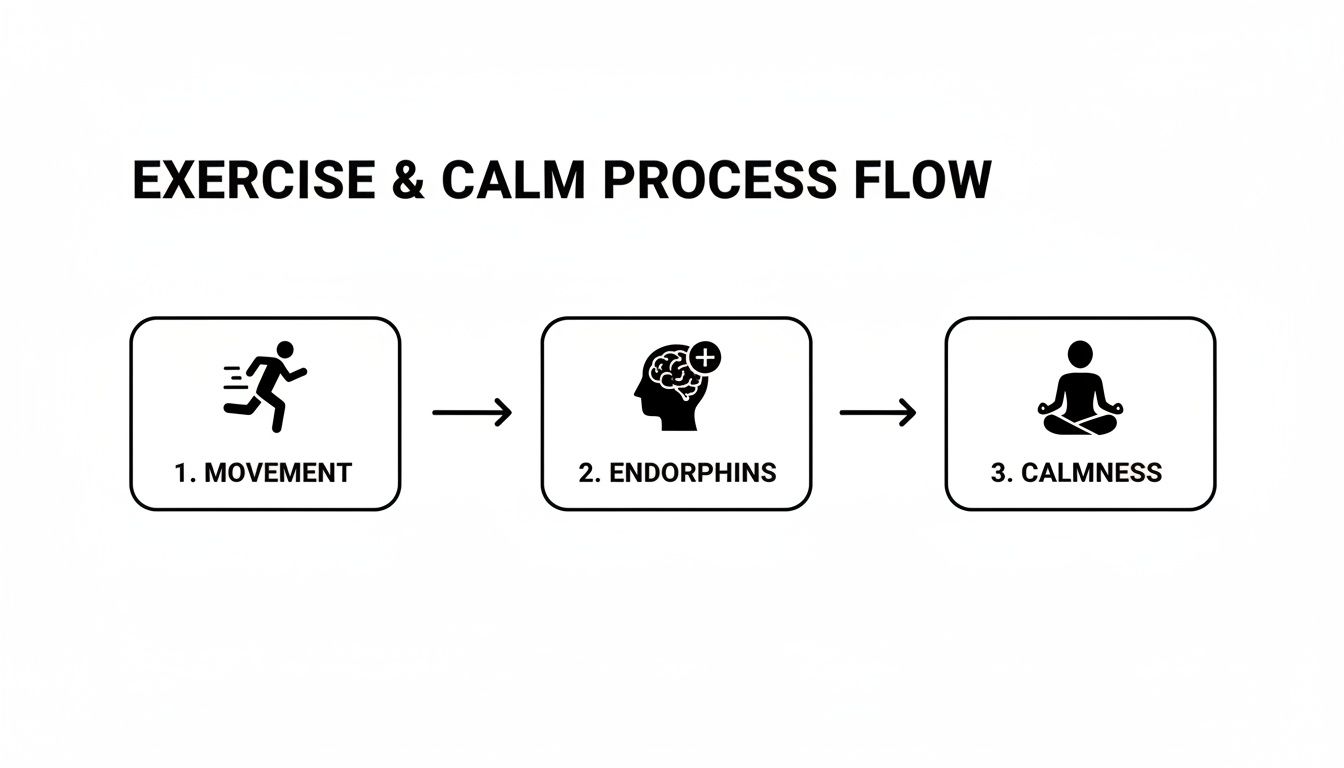
Think of it like this: intentional movement triggers the release of mood-boosting endorphins, which directly leads to a state of greater calmness. This simple flow is your key to rewiring your body’s response to stress.
We've broken down the session into three distinct phases, each with a specific purpose for managing anxiety and fostering hope:
- Phase 1: The Mindful Warm-Up (5 Minutes) – Gently prepares your body while grounding your mind, showing you that calm is accessible.
- Phase 2: The Main Circuit (15 Minutes) – Builds strength and burns off stress hormones, proving your capability and resilience.
- Phase 3: The Recovery Cool-Down (10 Minutes) – Activates your body’s relaxation response to lock in the calm and reinforce a sense of safety.
This structured approach is what makes the routine so powerful. It’s designed to meet you where you are and give you a clear path forward on your journey to living panic-free.
The Mindful Warm-Up (5 Minutes)
The goal here isn't just to warm up your muscles; it's to send a signal to your nervous system that you are safe, in control, and beginning the process of healing. This is your chance to shift from a state of mental chaos to one of focused presence.
Move through each of the following for 60 seconds, flowing gently from one to the next.
Neck Rolls: Stand with your feet shoulder-width apart, arms relaxed. Gently drop your chin to your chest and slowly roll your right ear toward your right shoulder. Pause, then return to center and repeat on the left.
- Mindfulness Cue: Close your eyes if that feels comfortable. Notice the sensation of release in your neck and shoulders, an area where we all tend to hold stress.
Shoulder Rolls: Inhale and lift your shoulders up toward your ears. As you exhale, roll them back and down, feeling your shoulder blades slide together.
- Mindfulness Cue: With each exhale, imagine you are letting go of the physical weight of worry from your shoulders.
Torso Twists: Stand with a soft bend in your knees and your arms crossed over your chest. Gently twist your upper body from side to side.
- Mindfulness Cue: Feel your feet firmly planted on the ground, creating a stable base. This connection to the earth can be incredibly grounding when your mind feels like it's spinning.
Cat-Cow Stretch: Get on all fours. Inhale as you drop your belly and look up toward the ceiling (Cow). Exhale as you round your spine, tucking your chin to your chest (Cat).
- Mindfulness Cue: Sync your breath with the movement. This rhythmic action is one of the most effective Breathing Exercises for Anxiety you can do, and it’s a direct line to calming your nervous system.
Walking in Place: Lift your knees gently as you swing your arms naturally. The goal is to elevate your heart rate just slightly.
- Mindfulness Cue: Focus on the sensation of your feet making contact with the floor. This simple act keeps you rooted in the present moment, pulling you out of anxious thought loops.
The 15-Minute Main Workout Circuit
Now it's time to transition into the main circuit. The structure is simple: perform each exercise for 45 seconds, then take 15 seconds of rest before starting the next one. After you've done all four exercises, give yourself a full 60-second rest. You'll complete this entire circuit 3 times.
The key here is choosing the variation that feels challenging but still manageable for you.
Remember, the goal is not exhaustion; it is empowerment. Each repetition is proof that you can handle physical stress, which builds your confidence to handle mental stress on your path to healing.
Here’s your circuit, with options for every fitness level.
The 15-Minute Main Workout Circuit
Complete the circuit 3 times with a 60-second rest between each round.
| Exercise | Beginner | Intermediate | Advanced |
|---|---|---|---|
| Squats | Bodyweight squats to a chair. Mindfulness Cue: Feel your whole foot press into the floor as you stand up. | Bodyweight squats to full depth. Mindfulness Cue: Exhale with effort as you rise, pushing anxious energy out. | Jump squats. Mindfulness Cue: Notice the moment of weightlessness and land softly, feeling grounded. |
| Push-Ups | Knee or wall push-ups. Mindfulness Cue: Focus on the strength in your chest and arms. | Standard push-ups. Mindfulness Cue: Keep your core engaged, creating a feeling of stability and control. | Decline push-ups (feet elevated). Mindfulness Cue: Acknowledge the challenge and your power to meet it. |
| Lunges | Alternating reverse lunges (bodyweight). Mindfulness Cue: Find a focal point to stare at for balance. | Alternating forward lunges. Mindfulness Cue: Feel the stretch in your hip flexor as you step. | Jumping lunges. Mindfulness Cue: Embrace the rhythm and flow of the movement. |
| Plank | Forearm plank on knees. Mindfulness Cue: Breathe steadily into your belly. | Forearm plank on toes. Mindfulness Cue: Imagine a line of energy from your head to your heels. | High plank with shoulder taps. Mindfulness Cue: Stay centered as your weight shifts, a metaphor for life. |
Once you've finished your three rounds, it's time to bring your body and mind back to a state of calm.
The Recovery Cool-Down (10 Minutes)
This final phase is non-negotiable. It's where you actively guide your body out of exertion and into deep relaxation, lowering cortisol and reinforcing the feeling of calm you've just created. Hold each stretch for 30-45 seconds, breathing deeply and slowly throughout.
This trend toward shorter, psychologically beneficial workouts is gaining serious momentum. We're seeing a collective shift toward sustainable fitness, with things like Japanese walking seeing a nearly 3,000% jump in search interest. Research even confirms that 30-minute workouts can produce identical body mass loss as hour-long sessions, making them a much more appealing and less intimidating option for anyone managing anxiety. You can learn more about these emerging fitness trends on Athletechnews.com.
Making Your New Routine a Sustainable Habit
The real victory over anxiety isn’t found in a single, perfect 30-minute workout routine. It’s found in the quiet consistency of showing up for yourself.
True power comes from this gentle persistence, especially on the days when it feels impossible. This is how you build a habit that becomes a reliable anchor, a tool that proves you can find calm whenever you need it.
Thinking about making exercise a permanent part of your life can feel overwhelming, but it doesn't have to be. The secret isn't a sudden burst of motivation. It’s about using smart, simple strategies to make the choice to move easier.
This is a journey of self-compassion. The goal is to build a tool you can depend on—one that proves, day by day, that you are healing and reclaiming your life from anxiety.
Weave Your Workout into Your Day
One of the most effective ways to build a habit that sticks is a technique called habit stacking. Instead of trying to carve out brand-new time in your day, you link your workout to something you already do automatically.
For example, instead of vaguely planning to "work out later," make it specific:
- "Right after my morning coffee finishes brewing, I will change into my workout clothes."
- "Immediately after I close my work laptop for the day, I will start my 5-minute warm-up."
This simple shift takes the decision-making out of the equation. The action becomes as automatic as brushing your teeth. Truly understanding how to stay consistent with working out is a game-changer for long-term success and healing.
Another powerful strategy is to schedule your workouts like any other important appointment. Block out the 30 minutes in your calendar. Treat it as a non-negotiable meeting with your well-being—because that's exactly what it is.
Overcome Your Inner Critic
It’s completely normal to face resistance, especially when anxiety is whispering doubts. Your mind can come up with a dozen reasons to skip your workout. The key is to meet that negative self-talk with logic and grace.
When you hear that voice saying, "I'm just too tired," try reframing it with hope: "I know movement can create energy. Even just 10 minutes will help me feel better than doing nothing. This is a step toward healing."
Setting clear, realistic expectations is everything. Using a framework like Smart Goals For Anxiety helps you define achievable steps that will quiet that inner critic over time.
Despite the overwhelming evidence that exercise helps, sticking with it is a global challenge. Current data shows that only 46.9% of American adults meet the recommended Physical Activity Guidelines. People with anxiety often face extra hurdles, like low motivation, which is why building these mental skills is just as important as the physical routine. You can find more details about these findings on the CDC’s exercise statistics page.
Building this habit is an act of hope. Every single time you complete your 30-minute workout routine, you’re proving to yourself that you are capable, resilient, and actively building a life where anxiety no longer calls the shots.
How to Listen to Your Body and Exercise Safely
Starting a new 30 minute workout routine is a courageous step on your healing journey. But turning that first step into a lasting habit comes down to safety and self-awareness. It’s about learning to trust your body again, not fear it.
When you live with anxiety, you’re often hyper-aware of every racing heartbeat or muscle twinge. That can make it tough to know what’s safe and what’s not. This is where we learn to work with our bodies, not against them.
It's all about building a new relationship with those physical sensations—one founded on trust and understanding, not fear. The most important skill you can develop is learning to tell the difference between the discomfort of a good challenge and the sharp pain that signals a problem.
Good Pain vs. Bad Pain
"Good pain" is that satisfying muscle fatigue you feel during the last few reps. It’s the burn that says, “I’m working hard, and I’m getting stronger.” It typically feels like a dull, widespread ache in the exact muscle you’re targeting. This is the feeling of progress and empowerment.
Bad pain, on the other hand, is your body’s bright red stop sign. It’s often sharp, sudden, or shooting, and you might feel it in a joint rather than deep in a muscle. If you feel anything like this, stop the exercise immediately. Pushing through this kind of pain is never worth it and can set back your healing.
This isn't about being tough; it's about being smart and compassionate with yourself. Listening to your body’s warning signals is a powerful act of self-care that keeps you healthy enough to stay consistent on your path.
What to Do When Panic Rises
So, what happens if your heart is pounding mid-workout and you suddenly feel that familiar wave of panic? It’s a common fear, but having a plan gives you power and shows you that you can handle it.
Here’s your action plan for when you feel panic setting in:
- Pause Immediately: Don’t try to push through it. Just stop what you’re doing with kindness.
- Shift to Cool-Down Mode: Move directly into the gentle stretches from the cool-down section. Child's Pose is especially effective for feeling grounded and safe.
- Focus on Your Exhale: Take a breath in for a count of four, but make your exhale longer—for a count of six or even eight. This simple trick activates your body’s built-in relaxation response and sends a signal of safety to your brain.
When you have a plan, you take back your power. You prove to yourself that you can manage these feelings, which slowly dismantles their hold over you. Each time you do this, you build more self-trust and show yourself that you are in control of your own healing.
It’s one thing to have a workout plan ready to go. It’s another thing entirely to actually start it, especially when anxiety is whispering doubts in your ear. Getting tangled in questions and "what-ifs" is completely normal.
Let's untangle those common worries with straightforward, compassionate answers. You have it in you to take back control, heal, and find calm—sometimes you just need a little clarity to take that first step.
What if I Feel Too Anxious to Even Start?
This is, without a doubt, the most common hurdle. That feeling is real, so let’s honor it by not fighting it. Instead, we radically lower the bar for what "starting" even means.
Forget the full 30-minute workout routine. Your only goal for today is to do the five-minute warm-up. That's it. If even that feels like too much, just commit to changing into your workout clothes. Seriously. That one tiny action is often all it takes to break through the paralysis. You might be surprised to find that once you’re dressed, a little movement feels possible.
Remember this: progress, not perfection. A five-minute session on a day when anxiety is high is a massive win. It’s proof that you can show up for yourself, and that’s the foundation for real, lasting healing.
Can This Routine Stop a Panic Attack?
This is a great question. While consistent exercise is a powerhouse for reducing the frequency and severity of panic attacks over time, jumping into a high-intensity workout during a panic attack can sometimes backfire. The symptoms—a racing heart, shortness of breath—can feel too similar to panic, making it feel worse.
If you feel an attack coming on, your best bet is to immediately pivot to the cool-down section of this routine. Your focus should shift entirely to slow, gentle stretches and deep breathing. This move helps activate your body’s parasympathetic nervous system—its built-in "rest and digest" mode—and gently walks you back from the edge, reminding your body it is safe.
How Soon Will I Actually Feel a Difference?
Many people feel a noticeable shift—a sense of relief or lower stress—right after a single workout. That post-exercise "glow" from endorphins is very real, and it’s a fantastic dose of hope that gives you immediate, positive feedback.
For the deeper, more lasting changes to your baseline anxiety, consistency is your most important tool. Most people start to see a significant and stable improvement in their overall mood, sleep, and day-to-day anxiety after sticking with a routine for just 3-4 weeks. This is where the real healing begins to take root.
To really see your progress, try keeping a simple mood journal or using a dedicated anxiety checklist. Tracking the small shifts on paper can be incredibly motivating. It provides tangible proof that your efforts are working and that you are, in fact, healing and moving toward a life free from panic.
At The Anxiety Checklist, we believe that managing anxiety is about having the right tools, not just willpower. Our Fearless Living system is designed to turn proven strategies into your own personalized toolkit, giving you a practical, action-oriented path toward a calmer, more confident life. Learn more about our approach to living panic-free.